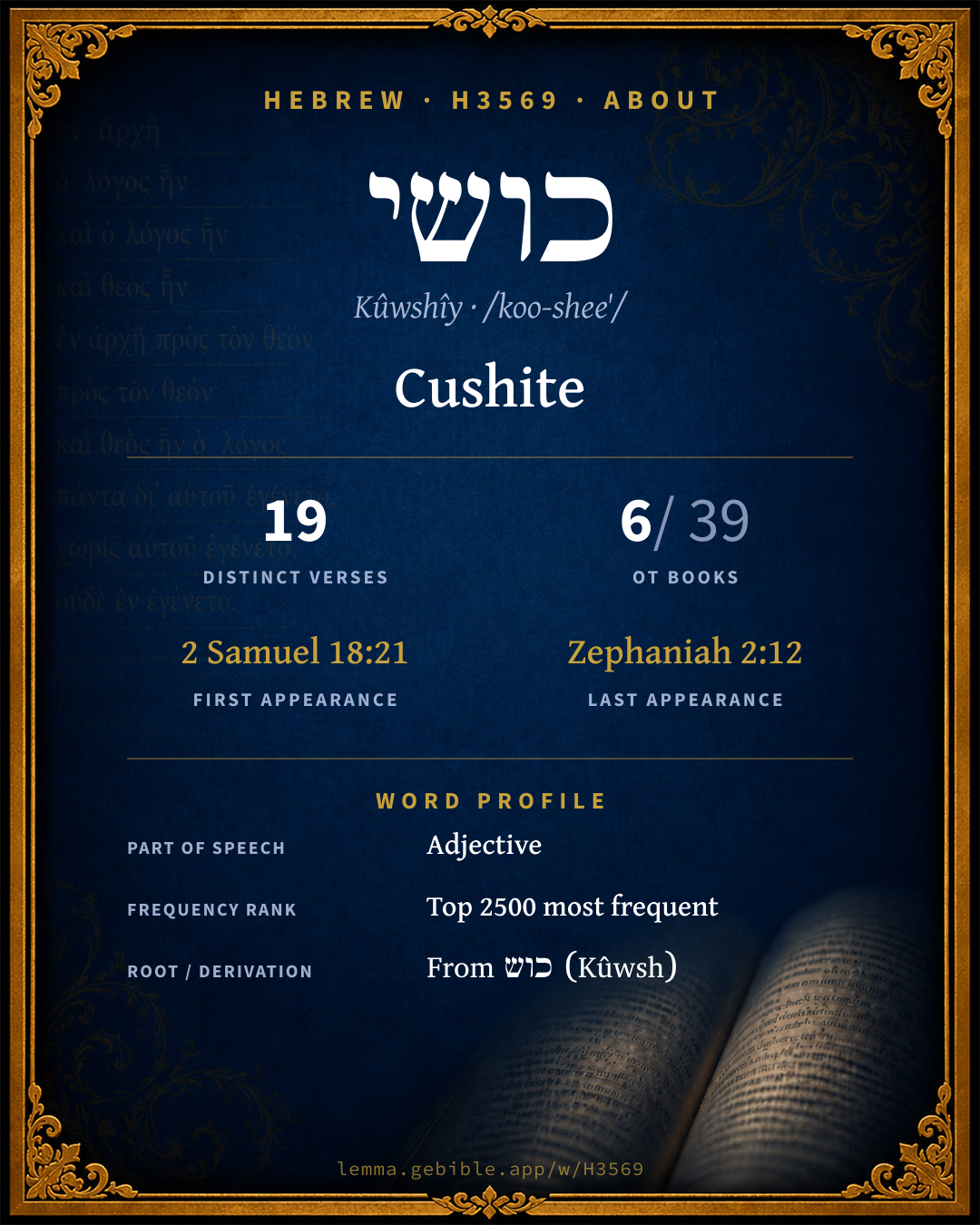
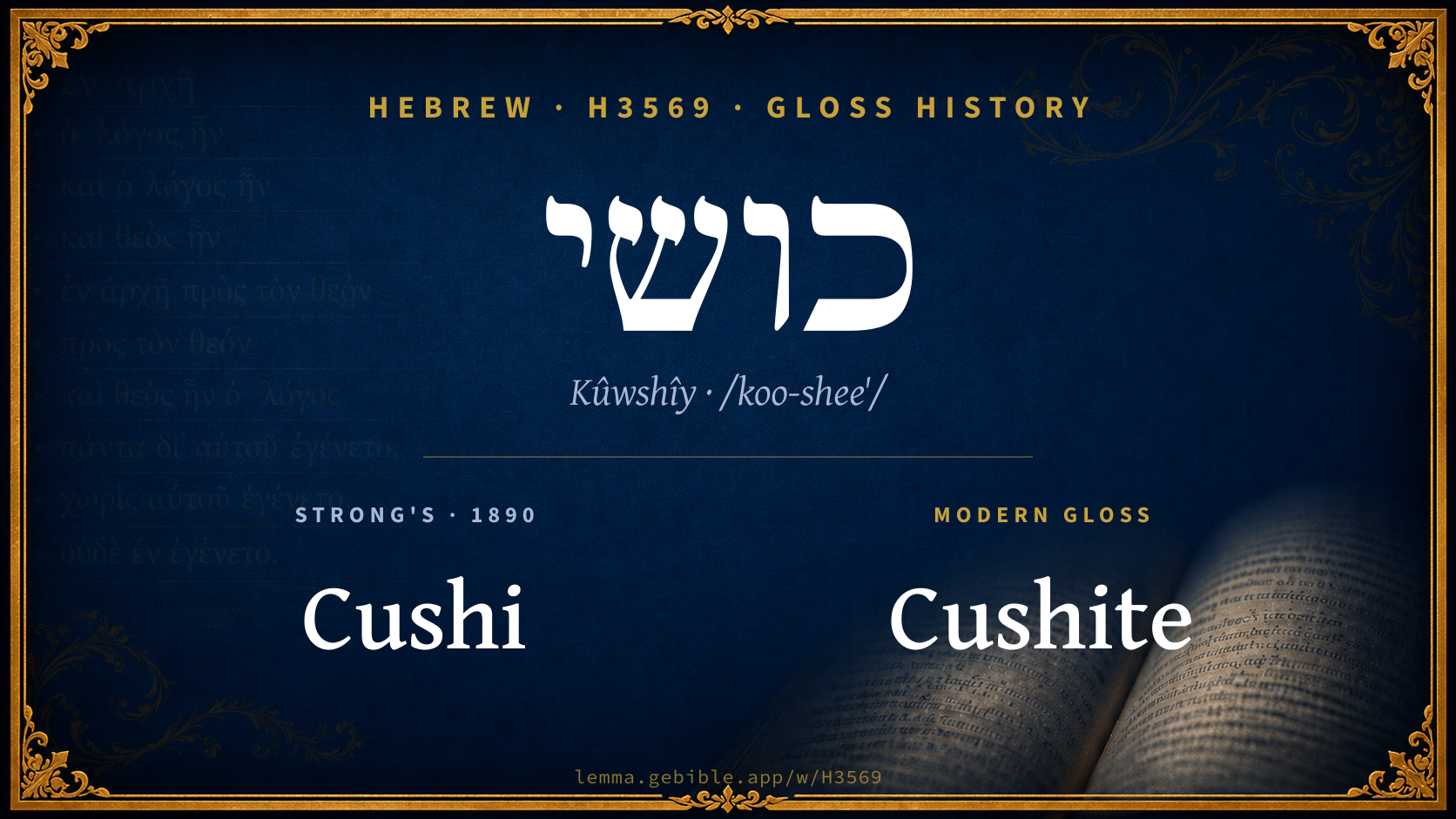
כּוּשִׁי
Cushite
BDB lists 4 entries for ‘Cushite’ fuller range ↓
Full lexicon entry — Brown-Driver-Briggs (BDB)
From Brown-Driver-Briggs (BDB)
Where this word appears
Grammar key — what these labels mean
Part of speech
- Noun
- A naming word — a person, place, thing, or idea.
Noun type
- Gentilic
- A noun naming a member of a people, tribe, or region of origin (e.g. an Israelite, a Moabite).
State
- Absolute
- The independent form of a noun, not bound to a following word.
Gender
- Masculine
- Grammatically masculine.
Number
- Singular
- One.
- Plural
- More than one (in Hebrew, generally three or more).
Grammatical forms
- Noun, Gentilic, Masculine, Singular, Absolute 14 times (61%)
- Noun, Gentilic, Masculine, Plural, Absolute 9 times (39%)
Parsed forms decoded from the imported morphology (morphhb / Westminster Leningrad Codex — WLC text public domain, morphhb tagging CC BY 4.0), counted across 23 parsed occurrences — not distinct verses.
Every verse where H3569 appears — 19 distinct verses across 6 books. Click any verse to open its interlinear word-by-word view. Verse text shown in the World English Bible for context — . Each verse’s Hebrew form is shown with its reference; the English is not keyword-highlighted, since the data carries no word-level English alignment. Use “Compare translations” on any verse to read it across multiple English versions. This concordance covers the Hebrew Bible; Septuagint (Greek Old Testament) occurrences are not indexed here.
2 Samuel 5 verses
- 2 Samuel 18:21 לַ/כּוּשִׁ֔י כוּשִׁ֛י prep det + n Gentilic ms n Gentilic ms Then said Joab to the Cushite, Go, tell the king what you have seen. The Cushite bowed himself to Joab, and ran.
- 2 Samuel 18:22 הַ/כּוּשִׁ֑י ptcl def.art + n Gentilic ms Then said Ahimaaz the son of Zadok yet again to Joab, But come what may, Please let me also run after the Cushite. Joab said, Why will you run, my son, seeing that you will have no reward for the news?
- 2 Samuel 18:23 הַ/כּוּשִֽׁי ptcl def.art + n Gentilic ms But come what may, [said he], I will run. He said to him, Run. Then Ahimaaz ran by the way of the Plain, and outran the Cushite.
- 2 Samuel 18:31 הַ/כּוּשִׁ֖י הַ/כּוּשִׁ֗י ptcl def.art + n Gentilic ms ptcl def.art + n Gentilic ms Behold, the Cushite came; and the Cushite said, News for my lord the king; for Yahweh has avenged you this day of all those who rose up against you.
- 2 Samuel 18:32 הַ/כּוּשִׁ֔י הַ/כּוּשִׁ֗י ptcl def.art + n Gentilic ms ptcl def.art + n Gentilic ms The king said to the Cushite, Is it well with the young man Absalom? The Cushite answered, The enemies of my lord the king, and all who rise up against you to do you hurt, be as that young man is.
2 Chronicles 6 verses
- 2 Chronicles 12:3 וְ/כוּשִֽׁים conj + n Gentilic mp with twelve hundred chariots, and sixty thousand horsemen. The people were without number who came with him out of Egypt: the Lubim, the Sukkiim, and the Ethiopians.
- 2 Chronicles 14:9 הַ/כּוּשִׁ֗י ptcl def.art + n Gentilic ms There came out against them Zerah the Ethiopian with an army of a million troops, and three hundred chariots; and he came to Mareshah.
- 2 Chronicles 14:12 הַ/כּוּשִׁ֔ים הַ/כּוּשִֽׁים ptcl def.art + n Gentilic mp ptcl def.art + n Gentilic mp So Yahweh struck the Ethiopians before Asa, and before Judah; and the Ethiopians fled.
- 2 Chronicles 14:13 מִ/כּוּשִׁים֙ prep + n Gentilic mp Asa and the people who were with him pursued them to Gerar: and there fell of the Ethiopians so many that they could not recover themselves; for they were destroyed before Yahweh, and before his host; and they carried away very much booty.
- 2 Chronicles 16:8 הַ/כּוּשִׁ֣ים ptcl def.art + n Gentilic mp Weren't the Ethiopians and the Lubim a huge host, with chariots and horsemen exceeding many? yet, because you did rely on Yahweh, he delivered them into your hand.
- 2 Chronicles 21:16 כּוּשִֽׁים n Gentilic mp Yahweh stirred up against Jehoram the spirit of the Philistines, and of the Arabians who are beside the Ethiopians:
Jeremiah 5 verses
- Jeremiah 13:23 כּוּשִׁי֙ n Gentilic ms Can the Ethiopian change his skin, or the leopard his spots? then may you also do good, who are accustomed to do evil.
- Jeremiah 38:7 הַ/כּוּשִׁ֜י ptcl def.art + n Gentilic ms Now when Ebedmelech the Ethiopian, a eunuch, who was in the king's house, heard that they had put Jeremiah in the dungeon (the king then sitting in the gate of Benjamin),
- Jeremiah 38:10 הַ/כּוּשִׁ֖י ptcl def.art + n Gentilic ms Then the king commanded Ebedmelech the Ethiopian, saying, Take from hence thirty men with you, and take up Jeremiah the prophet out of the dungeon, before he die.
- Jeremiah 38:12 הַ/כּוּשִׁ֜י ptcl def.art + n Gentilic ms Ebedmelech the Ethiopian said to Jeremiah, Put now these rags and worn-out garments under your armholes under the cords. Jeremiah did so.
- Jeremiah 39:16 הַ/כּוּשִׁ֜י ptcl def.art + n Gentilic ms Go, and speak to Ebedmelech the Ethiopian, saying, Thus says Yahweh of Hosts, the God of Israel: Behold, I will bring my words on this city for evil, and not for good; and they shall be accomplished before you in that day.
Daniel 1 verse
Amos 1 verse
Zephaniah 1 verse
About this entry
At a glance — auto-summarized from this page’s data, not written by a person. Every figure links to its source below. This summary describes the numbers; it doesn’t interpret them.
כושי (Kûwshîy) is a Hebrew name most often rendered “Cushite.” Scripture first uses it in 2 Samuel 18:21. Spanning 19 verses in 6 books, it ranks among the uncommon words of the Hebrew Bible. 2 Chronicles dominates its distribution — 6 of 19 verses. The sections below give every occurrence and version rendering.
Gloss history
Strong's 1890 vs modern scholarship
About this word
Strong's H3569 catalogs a Hebrew word from the Hebrew Old Testament.
These counts are not copied from any lexicon or concordance. They are computed here, from the morphology-tagged Hebrew Old Testament. What Lemma adds →
- 19
- distinct verses
- The word appears in 19 distinct verses.
- 6 / 39
- OT books
- The word appears in 6 of 39 Old Testament books.
- #1,368
- by frequency
- Top 2500 most frequent Hebrew words (rank 1,368 of 8,640 Hebrew words by occurrence).
View all 19 occurrences in the concordance →
Most concentrated in
- 2 Chronicles 6 verses 32%
- 2 Samuel 5 verses 26%
- Jeremiah 5 verses 26%
By section of the Old Testament
By traditional corpus
Conventional, traditional groupings — biblical authorship is debated, so this is a traditional corpus grouping, not an authorship claim. Each share is this word’s portion of its verses in that division of the Hebrew canon. Each figure is a share of the word’s 19 distinct verses.
- Prophets (Nevi'im) 12 verses · 63%
- Writings (Ketuvim) 7 verses · 37%
How translations render this word
Counts come from each version’s own published word-to-Strong’s tagging or interlinear alignment — an approximate guide to how each version renders this word, not a word-level alignment the data otherwise carries. Because each total is that version’s own tagged count, the per-version totals vary from one another and need not match the appearance or distinct-verse counts above. These counts may also differ from a printed concordance because Lemma counts each distinctly tagged rendering and does not collapse phrase taggings into a single head-word total. This is a fixed set of word-tagged versions (KJV, ASV, BSB, ULT) and does not change with the reading translation you choose elsewhere. Each version’s license is shown beside its name below (and on Sources).
- King James Version: Cushi 7×, Ethiopians 7×, Ethiopian 5×
- American Standard Version: Ethiopians 7×, Cushite 6×, Ethiopian 5×
- Berean Standard Bible: Cushite 13×, Cushites 8×
- unfoldingWord Literal Text: Cushite 10×, Cushites 8×
King James Version Public Domain
Renders H3569 across 23 tagged occurrences — most commonly:
Plus 4 renderings that appear only once — usually multi-word phrases or single function words the recovered tagging swept in, not distinct renderings.
American Standard Version Public Domain
Renders H3569 across 23 tagged occurrences — most commonly:
Plus 5 renderings that appear only once — usually multi-word phrases or single function words the recovered tagging swept in, not distinct renderings.
Berean Standard Bible Public Domain
Renders H3569 across 25 tagged occurrences — most commonly:
Plus 4 renderings that appear only once — usually multi-word phrases or single function words the recovered tagging swept in, not distinct renderings. Not rendered by a distinct English word in 1 further occurrence.
unfoldingWord Literal Text CC BY-SA 4.0
Renders H3569 across 19 tagged occurrences — most commonly:
Plus 1 rendering that appears only once — usually multi-word phrases or single function words the recovered tagging swept in, not distinct renderings.
Senses in the full BDB
What do BDB’s symbols mean?
BDB uses these scholarly abbreviations:
| Symbol | Meaning |
|---|---|
| 𝔊 | the Septuagint (the ancient Greek translation, LXX) |
| 𝔙 | the Vulgate (the Latin translation) |
| 𝔖 | the Syriac version (the Peshitta) |
| 𝔗 | the Targum (the Aramaic translation) |
| ψ | the Psalms |
| √ | root (the underlying root or stem) |
| ‖ | parallel passage (a synonymous or contrasted parallel) |
| † | the dagger: every passage where the word occurs is cited |
The 2 senses and sub-senses the full Brown-Driver-Briggs lexicon distinguishes for this word, in lexicon order (not ranked by frequency), with BDB’s own verbatim wording and sub-sense lettering. Shown in Hebrew script with BDB’s own scholarly abbreviations. The condensed entry is in the Lexicon Entry tab. See also the Forms in the corpus table below.
- 1. Je 36:14 great-grandfather of יְהוּדִי, q.v. (perhaps orig. appellat. Cushite). e.g. Jeremiah 36:14
- 2. father of prophet Zephaniah Zp 1:1. e.g. Zephaniah 1:1
Senses from the full Brown-Driver-Briggs lexicon (Brown, Driver, Briggs; Oxford 1906 — public domain), digitized via Sefaria, supplemented by the OpenScriptures HebrewLexicon (CC BY 4.0). Full attribution on Sources.
Word origin
Derived from כוש (Kûwsh) (H3568) — Cush.
Jastrow Dictionary
A second Hebrew/Aramaic lexicon for comparison, covering Aramaic and post-biblical (Talmudic, Targumic, Midrashic) usage that the biblical-Hebrew BDB does not. Matched by lemma rather than by Strong’s number, so a lemma may carry more than one Jastrow headword (shown separately below), and the entries cover usage well beyond the Bible.
כּוּשִׁי
- Cushite, negro; Aethiopian. Gen. R. s. 60, beg.; Cant. R. to II, 8 (not כותי), v. בַּרְבָּרִי. Gen. R. s. 73, end; a. fr. [B. Kam. 113ᵇ, a. e. in later ed. כושי for גּוֹי or נָכְרִי.]—Succ. III, 6 אתרוג הכ׳, expl. ib. 36ᵃ דומה לכ׳ a Palestinean Ethrog resembling an Aethiopian one; (oth. opin.) a real importation from Aethiopia. Y. ib. 53ᵈ אתרוג הכ׳ פסול the Aeth. Ethrog is ritually unfit; הבא מן הכ׳ כשר one of Palestinean growth descended from an Aethiopian Ethrog is available for ritualistic use.—Trnsf. abnormally dark-complexioned. Bekh. VII, 6. Ber. 58ᵇ; Tosef. ib. VII (VI), 3; a. e.—עֵין כּוּשִׁי pr. n. pl. En Kushi. Ab. Zar. 31ᵃ; Y. ib. V, 44ᵈ ע׳ כושי׳; Y. Shebi. V, 36ᵃ top ע׳ כּוּשִׁין.
A Dictionary of the Targumim, the Talmud Babli and Yerushalmi, and the Midrashic Literature (Marcus Jastrow; London, Luzac, 1903) — Public Domain. Digitized via Sefaria. Digitized via Sefaria. Full attribution on Sources.
Forms in the corpus
The 18 distinct written forms H3569 takes in the Hebrew Bible, most frequent first — each parse links to that state’s occurrences in the concordance. Hebrew forms include their vowel points and cantillation, so a single lemma takes many written forms.
| Form | Parsing | Example | Uses |
|---|---|---|---|
| הַ/כּוּשִׁ֗י | Noun, Gentilic, Masculine, Singular, Absolute | 2 Chronicles 14:9 | 3 |
| הַ/כּוּשִׁ֜י | Noun, Gentilic, Masculine, Singular, Absolute | Jeremiah 38:7 | 3 |
| הַ/כּוּשִׁ֖י | Noun, Gentilic, Masculine, Singular, Absolute | 2 Samuel 18:31 | 2 |
| הַ/כּוּשִׁ֑י | Noun, Gentilic, Masculine, Singular, Absolute | 2 Samuel 18:22 | 1 |
| הַ/כּוּשִׁ֔י | Noun, Gentilic, Masculine, Singular, Absolute | 2 Samuel 18:32 | 1 |
| הַ/כּוּשִׁ֔ים | Noun, Gentilic, Masculine, Plural, Absolute | 2 Chronicles 14:12 | 1 |
| הַ/כּוּשִׁ֣ים | Noun, Gentilic, Masculine, Plural, Absolute | 2 Chronicles 16:8 | 1 |
| הַ/כּוּשִֽׁי | Noun, Gentilic, Masculine, Singular, Absolute | 2 Samuel 18:23 | 1 |
| הַ/כּוּשִֽׁים | Noun, Gentilic, Masculine, Plural, Absolute | 2 Chronicles 14:12 | 1 |
| וְ/כֻשִׁ֖ים | Noun, Gentilic, Masculine, Plural, Absolute | Daniel 11:43 | 1 |
| וְ/כוּשִֽׁים | Noun, Gentilic, Masculine, Plural, Absolute | 2 Chronicles 12:3 | 1 |
| כֻשִׁיִּ֨ים | Noun, Gentilic, Masculine, Plural, Absolute | Amos 9:7 | 1 |
| כּוּשִׁ֔ים | Noun, Gentilic, Masculine, Plural, Absolute | Zephaniah 2:12 | 1 |
| כּוּשִֽׁים | Noun, Gentilic, Masculine, Plural, Absolute | 2 Chronicles 21:16 | 1 |
| כּוּשִׁי֙ | Noun, Gentilic, Masculine, Singular, Absolute | Jeremiah 13:23 | 1 |
| כוּשִׁ֛י | Noun, Gentilic, Masculine, Singular, Absolute | 2 Samuel 18:21 | 1 |
| לַ/כּוּשִׁ֔י | Noun, Gentilic, Masculine, Singular, Absolute | 2 Samuel 18:21 | 1 |
| מִ/כּוּשִׁים֙ | Noun, Gentilic, Masculine, Plural, Absolute | 2 Chronicles 14:13 | 1 |
Same root — word family
Other BDB entries built from the same root as H3569, grouped by Strong’s listed origin. These share a root / origin per the lexicon — not necessarily a shared meaning. Each links to that word’s own entry.
Derives from
Proper names from this root
People and places named from this root — a name, not an additional meaning of the word.
Compare all same-root words → Showing 4 of 5 — not the complete family. 4 of the same-root words are proper names (people or places). They share a root, not necessarily a meaning.
Bible dictionary
Public-domain dictionary articles matched to this entry by name (Cushite). A biblical name can be shared by more than one person or place, so an article may treat several.
Easton's Bible Dictionary · M. G. Easton, 1897
(1.) The messenger sent by Joab to David to announce his victory over Absalom (2 Sam. 18:32).
(2.) The father of Shelemiah (Jer. 36:14).
(3.) Son of Gedaliah, and father of the prophet Zephaniah (1:1).
(4.) Moses married a Cushite woman (Num. 12:1). From this circumstance some have supposed that Zipporah was meant, and hence that Midian was Cush.
Classic public-domain reference works; full attribution on Sources.
Septuagint verse parallels
This word appears in 19 verses that also exist in the Greek Old Testament (Septuagint), out of the 19 Hebrew verses it occurs in. You can read those verses in Greek by switching the Old Testament edition to the Septuagint.
Read these verses in the Septuagint
This is a verse-level parallel only — the same verses exist in both the Hebrew and Greek Old Testaments. No word-level Hebrew↔Greek correspondence is claimed: the data carries no such alignment, so no Greek word is shown as this Hebrew word’s translation. Coverage is not total — the Septuagint omits the deuterocanon and renumbers the Psalms, so some Hebrew verses have no direct Greek parallel.