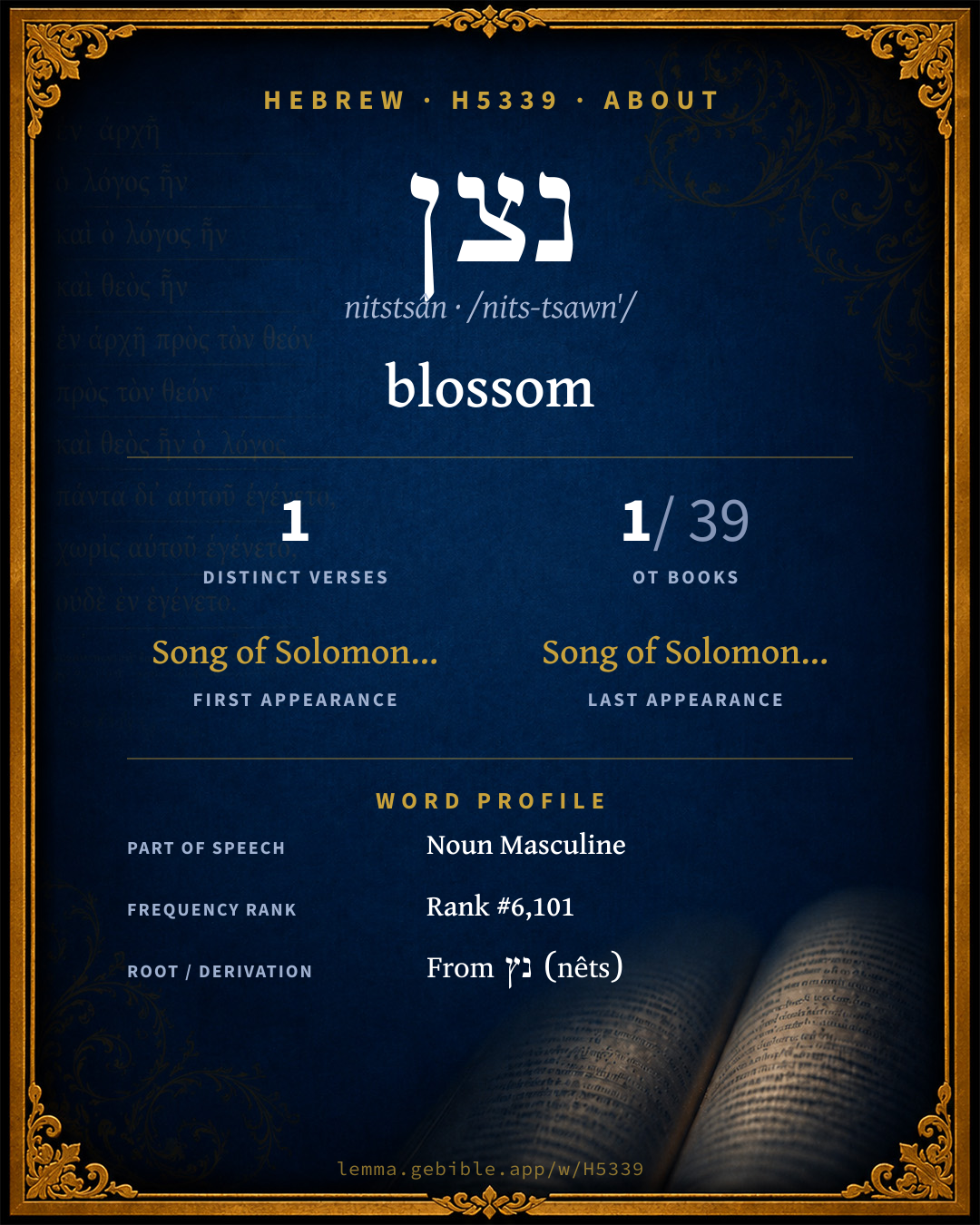
נִצָּן
blossom
Full lexicon entry — Brown-Driver-Briggs (BDB)
From Brown-Driver-Briggs (BDB)
Where this word appears
Grammar key — what these labels mean
Noun type
- Common
- A common noun — a general class of person, place, or thing (“king,” “city,” “water”), not a specific name.
State
- Absolute
- The independent form of a noun, not bound to a following word.
Gender
- Masculine
- Grammatically masculine.
Number
- Plural
- More than one (in Hebrew, generally three or more).
Every verse where H5339 appears — 1 distinct verse across 1 book. Click any verse to open its interlinear word-by-word view. Verse text shown in the World English Bible for context — . Each verse’s Hebrew form is shown with its reference; the English is not keyword-highlighted, since the data carries no word-level English alignment. Use “Compare translations” on any verse to read it across multiple English versions. This concordance covers the Hebrew Bible; Septuagint (Greek Old Testament) occurrences are not indexed here.
Song of Solomon 1 verse
About this entry
At a glance — auto-summarized from this page’s data, not written by a person. Every figure links to its source below. This summary describes the numbers; it doesn’t interpret them.
“blossom” is the headline sense of the Hebrew noun נצן (nitstsân). The Hebrew Bible uses it only 1 verse. More than three-quarters of its appearances fall in Song of Solomon. Its lone occurrence is Song of Solomon 2:12. It shares a root with נץ and נצה. See the sense tree, 1-verse concordance, and the renderings breakdown below.
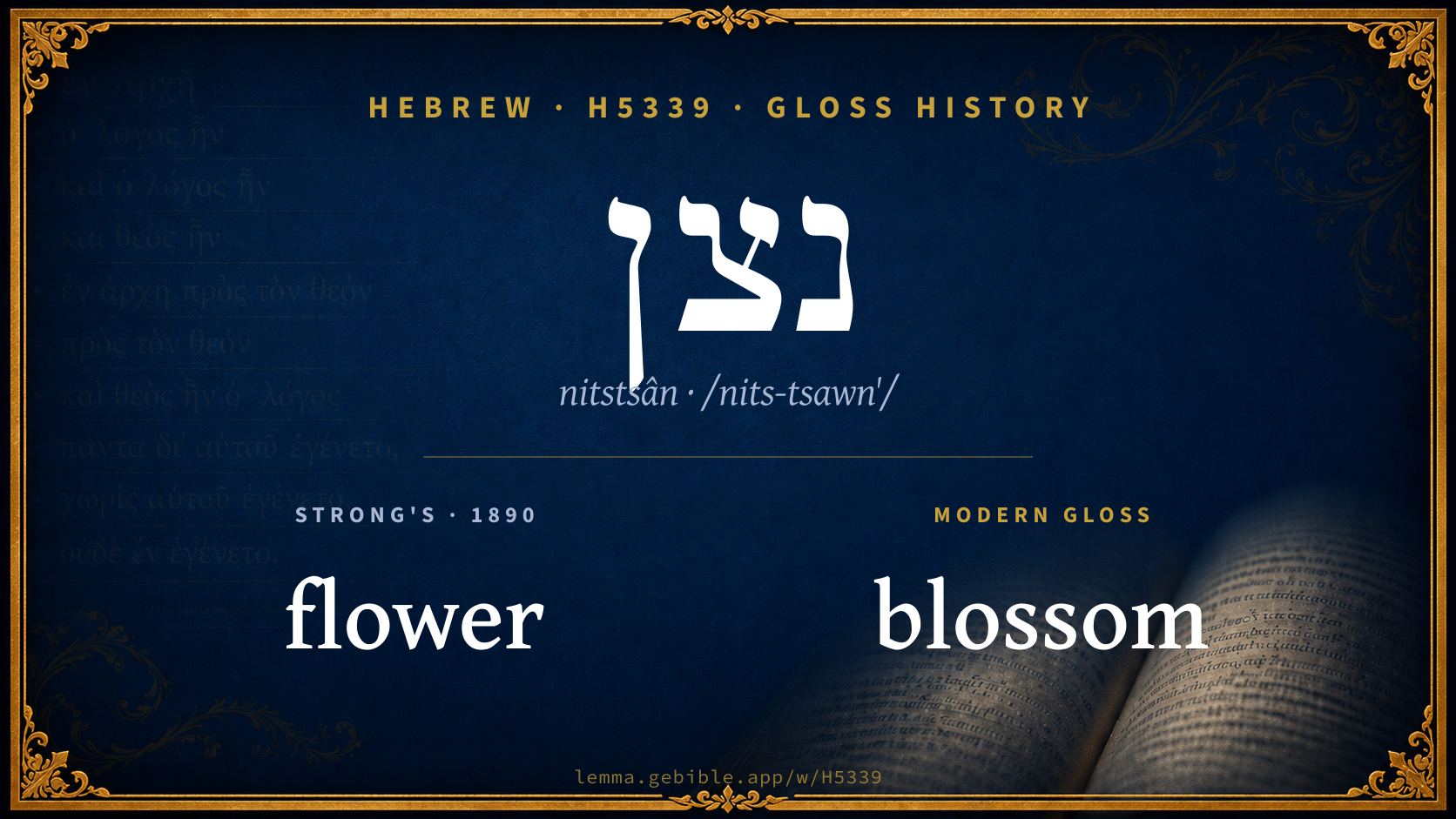
Gloss history
Strong's 1890 vs modern scholarship
About this word
Strong's H5339 catalogs a Hebrew word from the Hebrew Old Testament.
These counts are not copied from any lexicon or concordance. They are computed here, from the morphology-tagged Hebrew Old Testament. What Lemma adds →
- 1
- distinct verses
- The word appears in 1 distinct verse.
- 1 / 39
- OT books
- The word appears in 1 of 39 Old Testament books.
- #6,101
- by frequency
- Rank #6,101 (rank 6,101 of 8,640 Hebrew words by occurrence).
View all 1 occurrence in the concordance →
Most concentrated in
- Song of Solomon 1 verse 100%
By section of the Old Testament
By traditional corpus
Conventional, traditional groupings — biblical authorship is debated, so this is a traditional corpus grouping, not an authorship claim. Each share is this word’s portion of its verses in that division of the Hebrew canon. Each figure is a share of the word’s 1 distinct verse.
- Writings (Ketuvim) 1 verse · 100%
How translations render this word
Counts come from each version’s own published word-to-Strong’s tagging or interlinear alignment — an approximate guide to how each version renders this word, not a word-level alignment the data otherwise carries. Because each total is that version’s own tagged count, the per-version totals vary from one another and need not match the appearance or distinct-verse counts above. These counts may also differ from a printed concordance because Lemma counts each distinctly tagged rendering and does not collapse phrase taggings into a single head-word total. This is a fixed set of word-tagged versions (KJV, ASV, BSB, ULT) and does not change with the reading translation you choose elsewhere. Each version’s license is shown beside its name below (and on Sources).
- King James Version: Flowers 1×
- American Standard Version: Flowers 1×
- Berean Standard Bible: Flowers 1×
- unfoldingWord Literal Text: Blossoms 1×
King James Version Public Domain
Renders H5339 across 1 tagged occurrence — most commonly:
American Standard Version Public Domain
Renders H5339 across 1 tagged occurrence — most commonly:
Berean Standard Bible Public Domain
Renders H5339 across 1 tagged occurrence — most commonly:
unfoldingWord Literal Text CC BY-SA 4.0
Renders H5339 across 1 tagged occurrence — most commonly:
Senses in BDB
The 1 sense BDB distinguishes for this word, in lexicon order (not ranked by frequency or importance). The full entry — with sub-senses — is in the Lexicon Entry tab.
- blossom
Word origin
[ נִצָּן ] n.[m.] id. [ n.ew.ad ], only pl. נִצָּנִים Ct 2:12.
— Brown-Driver-Briggs (Oxford 1906, public domain), digitized via Sefaria, supplemented by the OpenScriptures HebrewLexicon (CC BY 4.0). See Sources.
Derived from נץ (nêts) (H5322) — hawk.
Jastrow Dictionary
A second Hebrew/Aramaic lexicon for comparison, covering Aramaic and post-biblical (Talmudic, Targumic, Midrashic) usage that the biblical-Hebrew BDB does not. Matched by lemma rather than by Strong’s number, so a lemma may carry more than one Jastrow headword (shown separately below), and the entries cover usage well beyond the Bible.
נַצָּא
- (mostly בר נ׳) same. Targ. O. Lev. XI, 16; Deut. XIV, 15. Targ. Job XXXIX, 26 (Ms. נֵיצָא).—Pl. נֵצָן. Targ. II Esth. I, 2. e.g. Deuteronomy 14:15
נָצָא II
- c. (נְצֵי)
- 1. (adj.) shrunk, withered.—Pl. f. נָצַן. Targ. Gen. XLI, 23 (h. text צנמות).
- 2. lean (low) ground. M. Kat. 10ᵇ נצא (Ms. M. צנא, v. Rabb. D. S. a. l. note); B. Bath. 54ᵃ, v. מוּלְיָא.
נְצֵי
- 1. to be pressed; to shrink, be lean, v. נָצָא II.
- 2. to wrangle. Targ. Gen. XXVI, 20, sq.; a. fr.—Part. נָצֵי, נָאצֵי; f. נַצְיָא; pl. נָצָן. Targ. Prov. XXVI, 17 נא׳ ed. Lag. (ed. Wil. נְצֵי, corr. acc.). Ib. XXVII, 15. Targ. Ex. II, 13; a. e.—M. Kat. 16ᵃ דנְצִינָן וכ׳ that we (the court) must contend (with persons disregarding legal summonses) and curse &c.
- same. Targ. O. Lev. XXIV, 10. Targ. Gen. XLV, 24; a. fr.—B. Mets. 84ᵇ הוה קא מִינַּצְיָא וכ׳ his wife was quarrelling with &c. Kidd. 76ᵃ נשי דכי מִינְּצוּ בהדי הדדי בעריות הוא דמִינְּצוּ when women quarrel with one another, they will eventually reproach one another with unchaste conduct; גברי … ביוחסין הוא דמינצו when men quarrel, they will reproach each other with spurious descent (if there is any rumor about it). Ib.ᵇ. כיון דמִנְּצוּ בהדי אינשי (or דמְנַצּוּ Pa.) because they (charity collectors) expose themselves to reproaches. Ib. והוה קא מִנְּצֵי איהו וכ׳ (or מְנַצֵּי) he and Rab Bibi strove with each other, one saying, I want the town office &c. Meg. 24ᵃ משום דאתי לאִינַּצּוּיֵי because it may come to quarrels between them. Ib. 24ᵇ אינצי אביו ומינצי רבו Ms. M. (ed. נִיצּוּיֵי) his father may take up the quarrel for him, or his teacher. B. Kam. 117ᵃ מנצו, v. שׁוּתָא III; a. e.
- same. Targ. Koh. III, 7; a. e.—Meg. 24ᵃ קטן בר נַצּוּיֵי הוא will a minor quarrel (about precedence)? Ber. 56ᵃ מְנַצּוּ (Beth N. מִינְּצֵי); a. e. (v. supra).
צָנַן
- (cmp. סָנַן) [to sting; (of taste) to be pungent; (of color) to be bright, polished]; (of temperature) to be cold. Mekh. Yithro s. 4 רחק ממנה צ׳ if he is removed from it, he is cold. Y. Pes. IV, 31ᵇ top שלא תִיצַן that she (the ass in heat) may not cool off (before copulation). Gen. R., s. 87 איקונין … וצָ׳ דמו he saw his father’s image before him, and his blood grew cold; ib. s. 98 וצינן (corr. acc., or וצוּנָּן); a. e.—V. צוֹנָן.
- to become cold. Y. Hor. III, 46ᵈ יָצֵן he must become cold (suppress his passion); לא ה׳ if he does not cool off (what shall he do)? Ib. ויהא מֵיצַן and he will cool off. Ib. ראה … מיד ה׳ he saw his father’s image and at once was cooled off (v. supra).—Gen. R. s. 20 שמא תִיצּוֹן (Nif.), v. next w.
- to be cooled off. Ab. Zar. III, 9 ישן יוּצַן if it is an old oven, it must be allowed to cool off (before being used again); Pes. 26ᵇ; 27ᵃ
- to cool off. Sabb. 53ᵃ לצַנְּנָהּ to cause the perspiring animal to cool off, opp. לחממה to keep her warm. B. Bath. 74ᵇ סירס … וצי׳ הנקבה he emasculated the male (Leviathan), and cooled the female. Ex. R. s. 10 ומְצַנְּנִין אותו (not ומצנן) they caused the stove to cool off. Pes. 118ᵃ the angel Gabriel said, ארד וַאֲצַנֵּן וכ׳ let me go down and cool the furnace &c.; a. e.—[Gen. R. s. 98, v. supra.]
- to be cooled off. Gen. R. s. 98, v. supra.—Part. מְצוּנָּן; f. מְצוּנֶּנֶת. Ḥull. III, 5 המצ׳ an animal suffering from frost; Tosef. ib. III (IV), 19.
- to become cold; to get chills. Sabb. 129ᵃ הקיז דם ונ׳ if one has chills after blood-letting. Yoma 77ᵃ אלמלא לא נִצְטַנְּנוּ וכ׳ if the coals had not been cooled off on their transmission from the hand of the Cherub &c. Sot. 11ᵇ; Ex. R. s. 1 מִצְטַנְּנוֹת, v. יָרֵךְ; a e.
A Dictionary of the Targumim, the Talmud Babli and Yerushalmi, and the Midrashic Literature (Marcus Jastrow; London, Luzac, 1903) — Public Domain. Digitized via Sefaria. Digitized via Sefaria. Full attribution on Sources.
Same root — word family
Other BDB entries built from the same root as H5339, grouped by Strong’s listed origin. These share a root / origin per the lexicon — not necessarily a shared meaning. Each links to that word’s own entry.
Derives from
Shares the same root
Compare all same-root words → They share a root, not necessarily a meaning.
Septuagint verse parallels
This word appears in 1 verse that also exists in the Greek Old Testament (Septuagint), out of the 1 Hebrew verse it occurs in. You can read those verses in Greek by switching the Old Testament edition to the Septuagint.
Read these verses in the Septuagint
This is a verse-level parallel only — the same verses exist in both the Hebrew and Greek Old Testaments. No word-level Hebrew↔Greek correspondence is claimed: the data carries no such alignment, so no Greek word is shown as this Hebrew word’s translation. Coverage is not total — the Septuagint omits the deuterocanon and renumbers the Psalms, so some Hebrew verses have no direct Greek parallel.