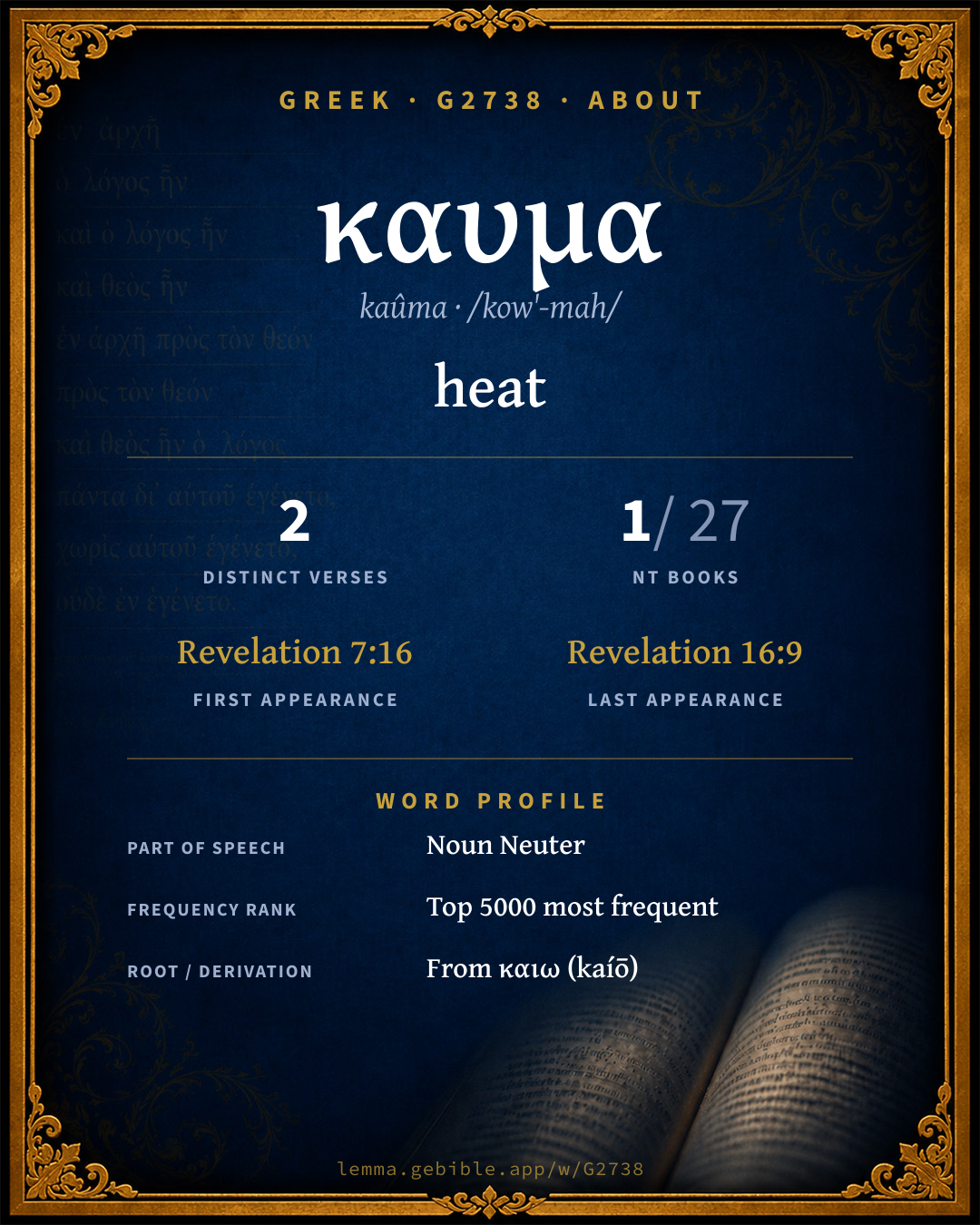
καῦμα
heat
Full lexicon entry — Thayer's Greek Lexicon
From Thayer's Greek Lexicon
Where this word appears
See every Accusative-case word in the Greek New Testament →
Grammar key — what these labels mean
Part of speech
- Noun
- A naming word — a person, place, thing, or idea.
Case
- Accusative
- The case of the direct object and of extent.
- Nominative
- The case of the subject (and the predicate nominative).
Gender
- Neuter
- Grammatically neuter.
Number
- Singular
- One.
Grammatical forms
- Noun, Accusative, Singular, Neuter 1 time (50%)
- Noun, Nominative, Singular, Neuter 1 time (50%)
Parsed forms decoded from the imported morphology (Robinson–Tischendorf, public domain), counted across 2 parsed occurrences — not distinct verses.
Every verse where G2738 appears — 2 distinct verses across 1 book. Click any verse to open its interlinear word-by-word view. Verse text shown in the World English Bible for context — . Each verse’s Greek form is shown with its reference; the English is not keyword-highlighted, since the data carries no word-level English alignment. Use “Compare translations” on any verse to read it across multiple English versions. This concordance covers the Greek New Testament; Septuagint (Greek Old Testament) occurrences of this word are not indexed here.
Revelation 2 verses
- Revelation 7:16 καῦμα n nom sg neut They will never be hungry, neither thirsty any more; neither will the sun beat on them, nor any heat;
- Revelation 16:9 καῦμα n acc sg neut People were scorched with great heat, and people blasphemed the name of God who has the power over these plagues. They didn't repent and give him glory.
About this entry
At a glance — auto-summarized from this page’s data, not written by a person. Every figure links to its source below. This summary describes the numbers; it doesn’t interpret them.
καυμα — transliterated kaûma — is a Greek noun carrying the sense “heat.” The Greek New Testament uses it only 2 verses. More than three-quarters of its appearances fall in Revelation. It first appears in Revelation 7:16. Related forms include καιω, καμινος and καυσις. Each statement above links to its evidence; the full detail follows below.
Gloss history
Strong's 1890 vs modern scholarship
About this word
Strong's G2738 catalogs a Greek word from the Greek New Testament.
These counts are not copied from any lexicon or concordance. They are computed here, from the morphology-tagged Greek New Testament. What Lemma adds →
- 2
- distinct verses
- The word appears in 2 distinct verses.
- 1 / 27
- NT books
- The word appears in 1 of 27 New Testament books.
- #2,678
- by frequency
- Top 5000 most frequent Greek words (rank 2,678 of 5,347 Greek words by occurrence).
View all 2 occurrences in the concordance →
Most concentrated in
- Revelation 2 verses 100%
By section of the New Testament
By traditional corpus
Conventional, traditional groupings — biblical authorship is debated, so this is a traditional corpus grouping, not an authorship claim. Some books belong to more than one corpus (Luke is in both the Gospels and the Lukan corpus, and so on), so these shares overlap and need not total 100%. Each figure is a share of the word’s 2 distinct verses.
- Johannine 2 verses · 100%
- Revelation 2 verses · 100%
How translations render this word
Counts come from each version’s own published word-to-Strong’s tagging or interlinear alignment — an approximate guide to how each version renders this word, not a word-level alignment the data otherwise carries. Because each total is that version’s own tagged count, the per-version totals vary from one another and need not match the appearance or distinct-verse counts above. These counts may also differ from a printed concordance because Lemma counts each distinctly tagged rendering and does not collapse phrase taggings into a single head-word total. This is a fixed set of word-tagged versions (KJV, ASV, BSB, ULT) and does not change with the reading translation you choose elsewhere. Each version’s license is shown beside its name below (and on Sources).
- King James Version: Heat 2×
- American Standard Version: Heat 2×
- Berean Standard Bible: Heat 1×, Scorching heat 1×
- unfoldingWord Literal Text: A 1×, Heat 1×, Scorch 1×
King James Version Public Domain
Renders G2738 across 2 tagged occurrences — most commonly:
American Standard Version Public Domain
Renders G2738 across 2 tagged occurrences — most commonly:
Berean Standard Bible Public Domain
Renders G2738 across 2 tagged occurrences — most commonly:
unfoldingWord Literal Text CC BY-SA 4.0
Renders G2738 across 3 tagged occurrences — most commonly:
Senses in Thayer's
The 1 sense Thayer's distinguishes for this word, in lexicon order (not ranked by frequency or importance). The full entry — with sub-senses — is in the Lexicon Entry tab.
- heat
Word origin
Derived from καιω (kaíō) (G2545) — to burn.
From G2545 ; properly a burn (concretely) but used (abstractly) of a glow : - heat.
— Strong’s Exhaustive Concordance (1890), public domain.
Same root — word family
Other Thayer's entries built from the same root as G2738, grouped by Strong’s listed origin. These share a root / origin per the lexicon — not necessarily a shared meaning. Each links to that word’s own entry.
Derives from
Shares the same root
Derived from this word
Compare all same-root words → Showing 4 of 6 — not the complete family. They share a root, not necessarily a meaning.
Septuagint usage
The same Greek word καυμα appears 13 times in the Greek Old Testament (Septuagint), across 13 verses in 8 books.
- 13
- LXX occurrences
- Tagged occurrences of this Greek word in the Septuagint.
- 13
- verses
- Distinct Septuagint verses containing this word.
- 8 / 39
- OT books
- The word appears in 8 of the 39 Old Testament books.
Sample Septuagint occurrences
- Genesis 8:22 καῦμα
- Deuteronomy 32:10 καῦμα
- 2 Samuel 4:5 καῦμα
- Job 24:24 καῦμα
- Proverbs 10:5 καῦμα
- Isaiah 4:6 καῦμα
- Jeremiah 17:8 καῦμα
- Daniel 3:66 καῦμα
Septuagint occurrences (same lexeme)
Every verse where the same Strong’s number (G2738) appears in the Greek Septuagint. Verse text shown in the World English Bible for context; the Greek form is the matched word — the English is not keyword-highlighted.
- Genesis 8:22 καῦμα While the earth remains, seed time and harvest, and cold and heat, and summer and winter, and day and night shall not cease."
- Genesis 31:40 καῦμα Thus I was; in the day the drought consumed me, and the frost by night; and my sleep fled from my eyes.
- Deuteronomy 32:10 καῦμα He found him in a desert land, In the waste howling wilderness; He compassed him about, he cared for him, He kept him as the apple of his eye.
- 2 Samuel 4:5 καῦμα The sons of Rimmon the Beerothite, Rechab and Baanah, went, and came about the heat of the day to the house of Ish-bosheth, as he took his rest at noon.
- Job 24:24 καῦμα They are exalted; yet a little while, and they are gone. Yes, they are brought low, they are taken out of the way as all others, And are cut off as the tops of the ears of grain.
- Job 30:30 καῦμα My skin grows black and peels from me. My bones are burned with heat.
- Proverbs 10:5 καῦμα He who gathers in summer is a wise son, But he who sleeps during the harvest is a son who causes shame.
- Proverbs 25:13 καῦμα As the cold of snow in the time of harvest, So is a faithful messenger to those who send him; For he refreshes the soul of his masters.
- Isaiah 4:6 καῦμα There will be a pavilion for a shade in the daytime from the heat, and for a refuge and for a shelter from storm and from rain.
- Isaiah 18:4 καῦμα For thus has Yahweh said to me, I will be still, and I will see in my dwelling-place, like clear heat in sunshine, like a cloud of dew in the heat of harvest.
- Jeremiah 17:8 καῦμα For he shall be as a tree planted by the waters, who spreads out its roots by the river, and shall not fear when heat comes, but its leaf shall be green; and shall not be careful in the year of drought, neither shall cease from yielding fruit.
- Jeremiah 43:30 καῦμα
- Daniel 3:66 καῦμα
These are occurrences of the same Greek lexeme (G2738) in the Septuagint — not a translation of any one Hebrew word. The store carries no word-level Hebrew↔Greek alignment, so no Hebrew original is asserted here. Counts come from the recovered LXX Strong's tagging — high-frequency vocabulary is well covered, while rare or late forms may be untagged — so they reflect tagged occurrences and may slightly undercount.