
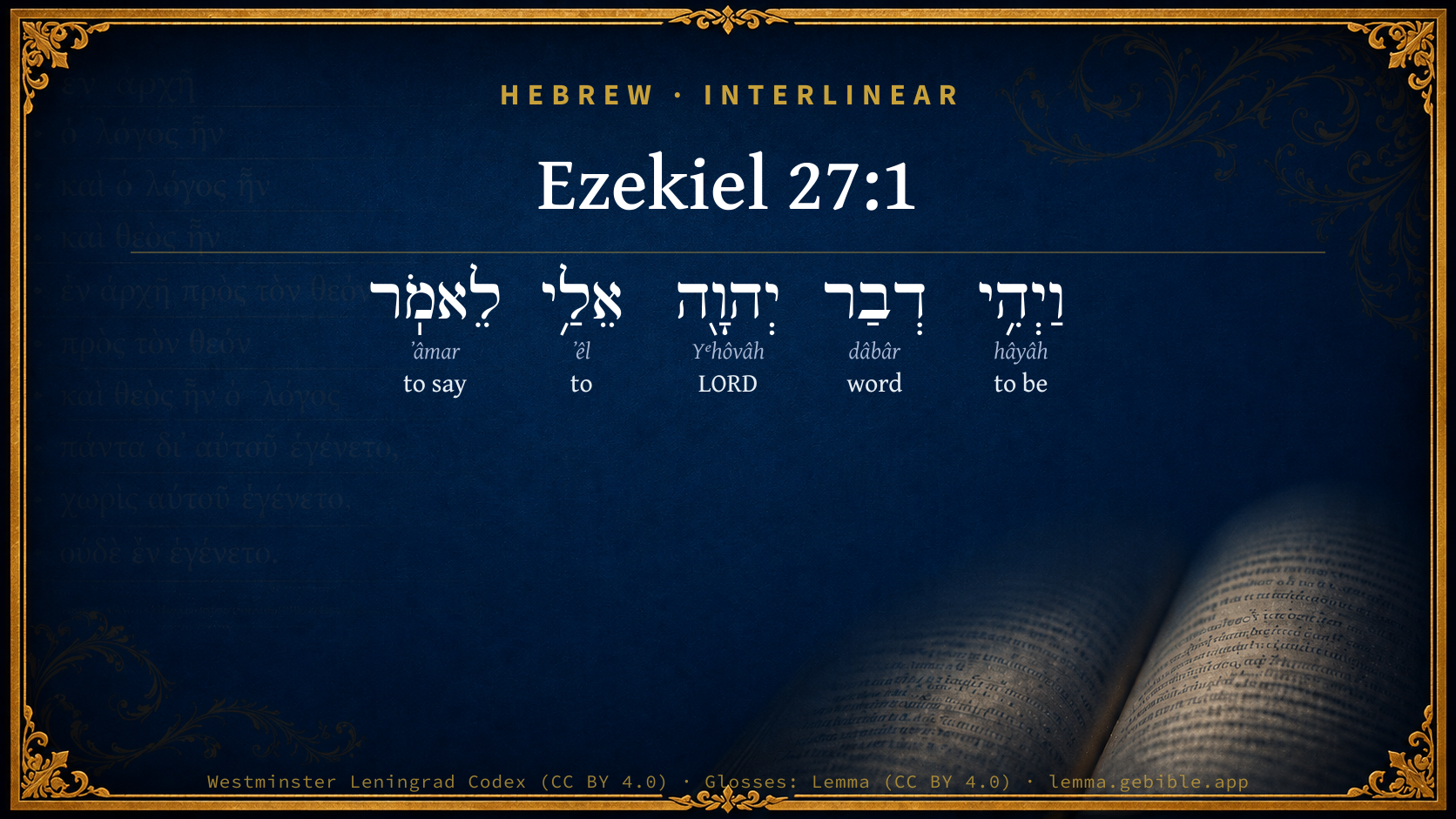
Ezekiel 27:1

Hebrew (Westminster Leningrad Codex) Ezekiel 27:1 appears in the Hebrew Old Testament. The text above is from the Westminster Leningrad Codex. Each word links to its Strong’s number, a concise gloss, and parsing drawn from the Open Scriptures Hebrew Bible morphology. Click any word for its full Brown-Driver-Briggs (BDB) entry.
Download image
Cite this verse

Ezekiel 27:1 (World English Bible). Public Domain. Lemma interlinear Bible study tool, https://lemma.gebible.app/v/ezekiel/27/1.

Show BibTeX & RIS
BibTeX
RIS
English Translation
The word of Yahweh came again to me, saying,
World English Bible · Public Domain
Download a study sheet

One document with this verse’s original text, its word-by-word gloss line, the meaning frame, cross-references with their text, attributed commentary, and full source and license credits — printable, and it pastes into notes with its structure intact.

This verse Autodidact and up

Study sheet (.html) Plain text (.txt)

A passage Seminary Student

Up to 50 verses in one chapter. A passage sheet keeps up to 6 commentary sources and 12 cross-references per verse, in the order this page ranks them, and says so on the sheet whenever that leaves anything out. Ask for a single verse and you get the Autodidact verse sheet above.

Everything on this page stays free to read, with no account — the sheet is a download of what is already on screen, not access to it.

Want to remove ads? Support Godless Engineer
Compare translations 3

The same verse in 3 English versions, stacked beneath the original-language interlinear above. Click any original word for its lexicon entry.

Each is an independent rendering of the whole verse — the interlinear is not word-aligned to these translations.

Highlighted words mark where these versions differ — a whole-verse word diff, not a word-by-word alignment.

  • World English Bible Public Domain
    The word of Yahweh came again to me, saying,
  • King James Version Public Domain
    The word of the LORD came again unto me, saying,
  • unfoldingWord Literal Text CC BY-SA 4.0
    Again the word of Yahweh came to me, saying,

unfoldingWord Literal Text — © unfoldingWord, licensed CC BY-SA 4.0. Word-aligned USFM3 via Door43 (git.door43.org/unfoldingWord/en_ult).

Versions to compare (up to 4)

3 of 4 selected

Show all 18 translations

Every available English version of this verse, each an independent rendering of the whole verse.

  • World English Bible Public Domain
    The word of Yahweh came again to me, saying,
  • Berean Standard Bible Public Domain
    Then the word of the LORD came to me, saying,
  • Majority Standard Bible Public Domain
    Then the word of the LORD came to me, saying,
  • King James Version Public Domain
    The word of the LORD came again unto me, saying,
  • American Standard Version (1901) Public Domain
    The word of Jehovah came again unto me, saying,
  • Revised Version (1885) Public Domain
    The word of the LORD came again unto me, saying,
  • Geneva Bible (1599) Public Domain
    The worde of the Lord came againe vnto me, saying,
  • Douay-Rheims (1899) Public Domain
    And the word of the Lord came to me, saying:
  • Young's Literal Translation Public Domain
    And there is a word of Jehovah unto me, saying:
  • Literal Standard Version CC BY-SA 4.0
    And there is a word of YHWH to me, saying,
  • Unlocked Literal Bible CC BY-SA 4.0
    Again the word of Yahweh came to me, saying,
  • unfoldingWord Literal Text CC BY-SA 4.0
    Again the word of Yahweh came to me, saying,
  • Darby Bible Public Domain
    And the word of Jehovah came unto me, saying:
  • World Messianic Bible Public Domain
    The LORD’s word came again to me, saying,
  • Webster's Bible Public Domain
    The word of the LORD came again to me, saying,
  • Free Bible Version CC BY-SA 4.0
    A message from the Lord came to me, saying,
  • Bible in Basic English Public Domain
    The word of the Lord came to me again, saying,
  • JPS Tanakh (1917) Public Domain
    Moreover the word of the LORD came unto me, saying:

Literal Standard Version (2020), Covenant Press — licensed CC BY-SA 4.0. Text via the HelloAO Bible API (eBible.org). Unlocked Literal Bible (unfoldingWord) — licensed CC BY-SA 4.0. Text via the HelloAO Bible API (eBible.org). unfoldingWord Literal Text — © unfoldingWord, licensed CC BY-SA 4.0. Word-aligned USFM3 via Door43 (git.door43.org/unfoldingWord/en_ult). Free Bible Version, Dr. Jonathan Gallagher — licensed CC BY-SA 4.0. Text via the HelloAO Bible API (eBible.org).

Word by word

More ways to search: Search by grammar → Find every occurrence → Compare this word →

Practice this passage: Drill this verse → Learn its vocabulary →

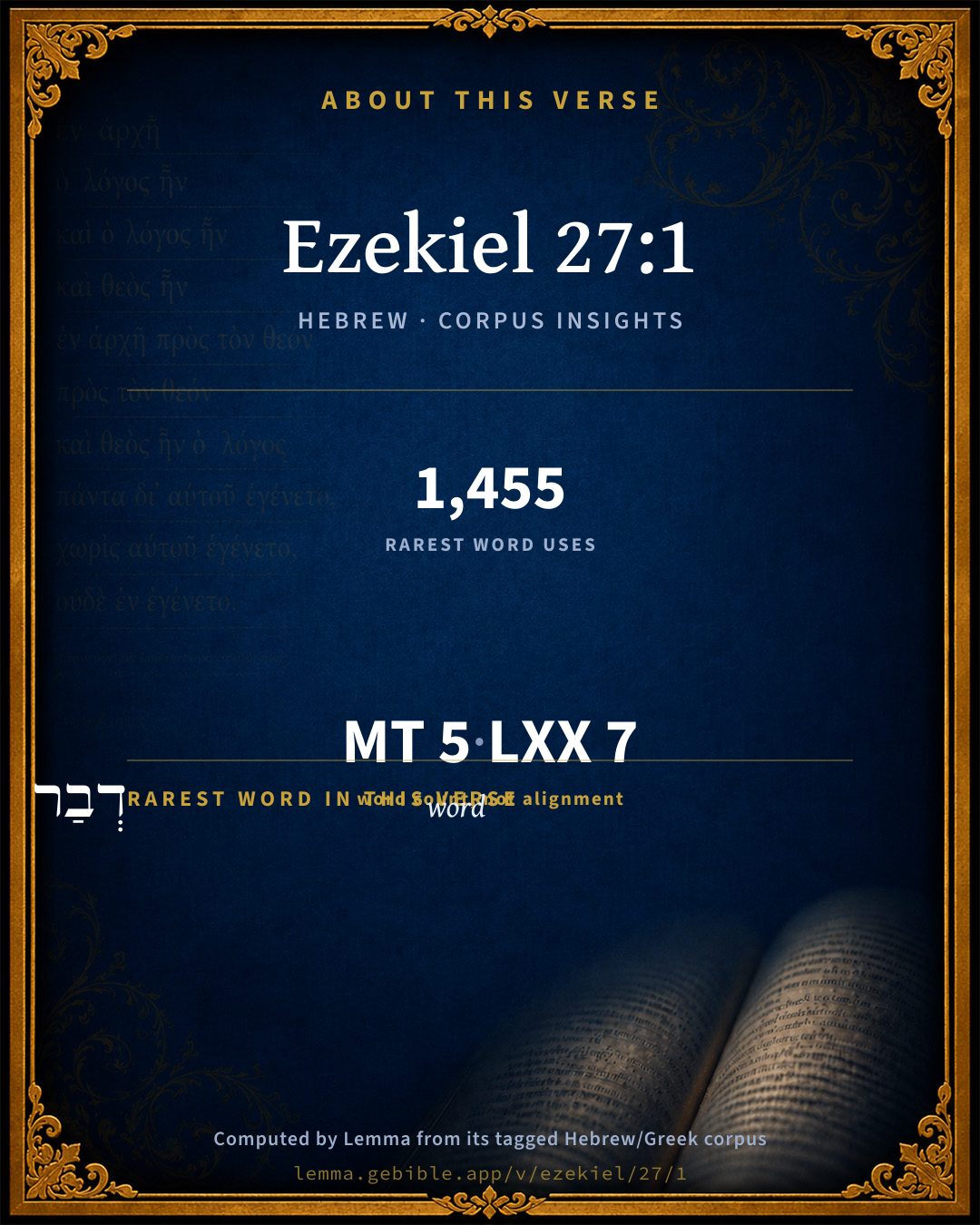
About this verse

These counts appear in no published source. They are computed here, from the morphology-tagged text and Lemma’s own curated glosses. What Lemma adds →

5
words
5
distinct lemmas
Prophets
section

Grammatical profile

  • 2 verbs
  • 2 nouns
  • 1 preposition

Verb forms

  • וַיְהִ֥י Qal · Sequential Imperfect
  • לֵאמֹֽר Qal · Infinitive Construct

Hebrew & Septuagint length

In English translation the verse runs 9 words from the Hebrew and 10 from the Septuagint (LXX English) — closely comparable.

A rough comparison of the two English renderings, which tokenize alike — not a word-level alignment.

Word counts can differ between the Hebrew and the Greek without any difference in meaning — e.g. the Hebrew direct-object marker אֵת has no separate Greek word, and Greek often adds the article ὁ.

In the original languages it is 5 Hebrew tokens and 7 Greek tokens — but the two are counted differently (Hebrew bundles its prefixes and suffixes into one token; the Greek is in lemma form), so that isn’t a like-for-like length.

Hebrew and Greek witnesses Masoretic Hebrew ↔ Greek Septuagint

The same verse in the two great witnesses to the Old Testament, shown verse-for-verse.

These are two independent witnesses, not word-aligned to each other, and the Septuagint is shown in lemma (dictionary) form.

Hebrew Ezekiel 27:1 Masoretic · Westminster Leningrad Codex

וַיְהִ֥י דְבַר יְהוָ֖ה אֵלַ֥י לֵאמֹֽר

The word of Yahweh came again to me, saying,

World English Bible · Public Domain

Greek LXX Ezekiel 27:1 Septuagint · lemma form

καί γίγνομαι λόγος κύριος πρός ἐγώ λέγω

And the word of the Lord came to me saying,

LXX2012 (modern English Septuagint) · Public Domain

On this verse, Fairbairn on Ezekiel, Jonah & the Pastoral Epistles discusses the Septuagint’s reading. Read the note in Commentary ↓

Hebrew: Westminster Leningrad Codex (CC BY 4.0). Greek: Septuagint (public domain); English from LXX2012 (modern English Septuagint) (Public Domain). How the Septuagint differs from the Hebrew →

Targum (Aramaic paraphrase)

1

The Targum is the ancient Jewish Aramaic paraphrase of the Hebrew Scriptures — an interpretive translation, not the Hebrew text itself. Onkelos (literal) and Pseudo-Jonathan (expansive) render the Torah, and Jonathan the Prophets. Coverage is partial: where no permissively-licensed English translation exists for a verse, only the Aramaic is shown. This is verse-level text, not a word-by-word alignment to the Hebrew.

  1. Targum Jonathan Prophets (Joshua–Malachi)
    וַהֲוָה פִּתְגַם נְבוּאָה מִן קֳדָם יְיָ עִמִי לְמֵימָר:

    (no public-domain English translation for this verse)

    Targum Jonathan — Aramaic: “Mikraot Gedolot” (public domain). English: “Sefaria Community Translation” (CC0 1.0 (public-domain dedication)); “London "Chaldee Paraphrase," 1871” (public domain). Text via Sefaria.

Commentary

Notes on Ezekiel 27:1 from classic Christian and Jewish commentators (each source and its license shown beneath its notes). The classic Christian expositions comment on the surrounding passage and are grouped to its opening verse, so a note may address several verses; the Jewish commentaries on the Tanakh (Rashi and others) are per-verse, so they appear only where the commentator wrote on this verse.

Lemma curates 59 commentaries, every one of them public domain or Creative Commons licensed, each selected and text-cleaned for this edition rather than reprinted as found. About our sources →

Trapp's Complete Commentary

John Trapp

Eze 27:1 The word of the LORD came again unto me, saying,

Ver. 1. The word of the Lord.] See on Eze 18:1.

John Trapp, A Commentary or Exposition upon All the Books of the Old and New Testament (1647–1656) — public domain. Text from a community e-Sword module.

The Biblical Illustrator

Joseph S. Exell

Eze_27:1-36

Take up a lamentation for Tyrus.

A proud city

The men of the world are wise, choosing the fittest places for their own advantage and interest. Let us learn so much of the men of the world, to be wise for our spiritual interest, and seat ourselves near the waters of the sanctuary, that so, trading with God and Christ, we may abound with spiritual treasure.

2. Outward excellences lift up mens hearts, beget vain confidences, and cause them to boast. This is the great wickedness of cities enriched by God, that they forget Him, and glory in external excellences.

3. No situation, strength, or outward advantage can secure proud cities.

4. Artists will put forth themselves to the utmost to show their skill. Thy builders have perfected thy beauty; they concealed not their art; what skill soever they had in architecture, they strove to manifest the same. (W. Greenhill, M. A.)

The sin of Tyre

To Ezekiel, as to the prophets generally, Tyre is the representative of commercial greatness, and the truth which he here seeks to illustrate is that the abnormal development of the mercantile spirit had in her case destroyed the capacity of faith in that which is truly Divine. The real god of Tyre was not Baal nor Melkarth, but the king, or any other object that might serve as a symbol of her civic greatness. Her religion was one that embodied itself in no outward ritual; it was the enthusiasm which was kindled in the heart of every citizen of Tyre by the magnificence of the imperial city to which he belonged. The state of mind which Ezekiel regards as characteristic of Tyre was perhaps the inevitable outcome of a high civilisation informed by no loftier religious conceptions than those common to heathenism. It is the idea which afterwards found expression in the deification of the Roman emperors--the idea that the state is the only power higher than the individual to which he can look for the furtherance of his material and spiritual interests, the only: power, therefore, which rightly claims his homage and his reverence. None the less, it is a state of mind which is destructive of all that is essential to living religion; and Tyre in her proud self-sufficiency was perhaps further from a true knowledge of God than the barbarous tribes who in all sincerity worshipped the rude idols which represented the invisible power that ruled their destinies. And in exposing the irreligious spirit which lay at the heart of the Tyrian civilisation the prophet lays his finger on the spiritual danger which attends the successful pursuit of the finite interests of human life. The thought of God, the sense of an immediate relation of the spirit of man to the Eternal and the Infinite, are easily displaced from mens minds by undue admiration for the achievements of a culture based on material progress, and supplying every need of human nature except the very deepest, the need of God. The commercial spirit is indeed but one of the forms in which men devote themselves to the service of this present world; but in any community where it reigns supreme we may confidently look for the same signs of religious decay which Ezekiel detected in Tyre in his own day. At all events, his message is not superfluous in an age and country where energies are well-nigh exhausted in the accumulation of the means of living, and whose social problems all run up into the great question of the distribution of wealth. (John Skinner, M. A.)

The fate of Tyre

Why was Tyrus rebuked and stripped and humbled? Because it came to pass in the case of Tyrus, as it comes to pass in our case, that too much prosperity begets a spirit of sneering. And God will not have any sneering in His school. How did Tyrus sneer? She sneered religiously, which is the worst kind of sneering. Because that Tyrus hath said against Jerusalem, Aha. That Aha cost Tyrus her life. He who sneers at Jerusalem challenges God; he who mocks the humble poor defies high Heaven. Tyrus versus Jerusalem,--the case so limited, Jerusalem might go down; but so long as Jerusalem stands for godliness, the true worship, the right conception of things, he who offends Jerusalem has to fight Omnipotence. Can Tyrus fail? When Tyrus fails all the islands of the sea know of it: Then all the princes of the sea shall come down, etc. Behold them all!--princes of Polynesia coming down from their thrones, stripping themselves, themselves folding up the garments and putting them away, and then replacing the garments embroidered and golden with garments of trembling. Why? Because famed Tyrus has fallen. Howl, fir tree; for the cedar is fallen. We should learn from ruins. O vain man, poor boaster, you shall beg tomorrow! You that steep your arms to the elbows in gold shall write a begging letter ere the year closes. Riches make to themselves wings and fly away, and the great Babylon which you have builded is but a bubble in the air. Lay not up for yourselves riches where moth and rust doth corrupt, and where thieves break through and steal: have riches in heaven; have riches in the word of God. See the uselessness of what is called environment. Tyrus had environment enough; her shipboards, trees of cedar; her masts made of the cedars of Lebanon; her oars of the oaks of Bashan; fine linen with broidered work from Egypt, blue and purple from the isles of Elishah; treasure upon treasure. So much for environment! We think if we had more pictures on the walls we should pray more; if we had a larger garden behind the house we should be more spiritually minded. It is not so. A mans heaven is in his heart; a mans hell is within. Moreover, what is environment? Who are we that we should define environment and say, Under such and such circumstances such and such moral issues would take place? Never! unless there be something more. Only the Spirit can make man right, and only Christ, according to the faith, to the Christianity which I solemnly accept, can get at the spirit with renewing and sanctifying energy. All other teachers are reformers. Christ is a Saviour. When Christ gets into a mans heart, all the rest follows--all the cleanliness comes the same day, and on the morrow comes music, and on the third day comes the dawn of heaven. (J. Parker, D. D.)

The position of Tyre on land and sea

Part of the city was on an island, and part on the mainland. Alexander, the conqueror, was much embarrassed when he found so much of the city was on an island, for he had no ships. But his military genius was not to be balked. Having marched his army to the beach, he ordered them to tear up the city on the mainland and throw it into the water, and build a causeway two hundred feet wide to the island. So they took that part of the city which was on the mainland, and with it built a causeway of timber and brick and stone, on which his army marched to the capture of that part of the city which was on the island, as though a hostile army should put Brooklyn into the East River, and over it march to the capture of New York. That Tyrian causeway of ruins which Alexanders army built is still there, and by alluvial deposits has permanently united the island to the mainland, so that it is no longer an island but a promontory. The sand, the greatest of all undertakers for burying cities, having covered up for the most part Baalbec and Palmyra and Thebes and Memphis and Carthage and Babylon and Luxor and Jericho, the sand, so small and yet so mighty, is now gradually giving rites of sepulture to what was left of Tyre. But, oh, what a magnificent city it once was! Mistress of the sea! Queen of international commerce! All nations casting their crowns at her feet! Where we have in our sailing vessels benches of wood, she had benches of ivory. Where we have for our masts of ships sails of coarse canvas, she had sails of richest embroidery. (T. De Witt Talmage.)

Responsibility of city rulers

Cities are not necessarily evils, as has sometimes been argued. They have been the birthplace of civilisation. In them popular liberty has lifted up its voice. Witness Genoa, Pisa, Venice. The entrance of the representatives of the cities in the legislatures of Europe was the deathblow to feudal kingdoms. Cities are the patronisers of art and literature. Cities hold the worlds sceptre. Africa was Carthage, Greece was Athens, England is London, France is Paris, Italy is Rome.

I. Commercial ethics are always affected by the moral or immoral character of those who have principal supremacy. Officials that wink at fraud, and that have neither censure nor arraignment for glittering dishonesties, always weaken the pulse of commercial honour.

II. So also of the educational interests of a city. There are cities where educational affairs are settled in the low caucus in the abandoned parts of the cities, by men full of ignorance and rum. It ought not to be so; but in many cities it is so. I hear the tramp of the coming generations. What that great multitude of youth shall be for this world and the next will be affected very much by the character of our public schools. Instead of driving the Bible out, you had better drive the Bible further in.

III. The character of officials in a city affects the domestic circle. In a city where grog shops have their own way, and gambling hells are not interfered with, and for fear of losing political influence officials close their eyes to festering abominations--in all those cities the home interests need to make imploration. The family circles of the city must inevitably be affected by the moral character or the immoral character of those who rule over them.

IV. The religious interests of a city are thus affected. The Church today has to contend with evils that the civil law ought to smite; and while I would not have the civil government in anywise relax its energy in the arrest and punishment of crime, I would have a thousand-fold more energy put forth in the drying up of the fountains of iniquity. The Church of God asks no pecuniary aid from political power; but it does ask that, in addition to all the evils we must necessarily contend against, we shall not have to fight also municipal negligence. (T. De Witt Talmage.)

Gods observation of our business hours

Thus said the Lord. This account of the trade of Tyre intimates to us that Gods eye is upon men, and that He takes cognisance of what they do when they are employed in their worldly business, not only when they are at church, praying and hearing, but when they are in their markets and fairs, and upon the exchange, buying and selling, which is a good reason why we should in all our dealings keep a conscience void of offence, and have our eye always upon Him whose eye is always upon us. (M. Henry.)

The Biblical Illustrator, edited by Joseph S. Exell (c. 1880s–1900s) — public domain. Text from a community e-Sword module.

The Preacher's Complete Homiletical Commentary

Joseph S. Exell (gen. ed.)

TYRE’S FORMER GREATNESS, SUGGESTING A LAMENTATION OVER HER SAD DOWNFALL (Chap. 27)

EXEGETICAL NOTES.—“The lamentation commences with a picture of the glory of the city of Tyre, its situation, its architectural beauty, its military strength and defences (Eze_27:3-11), and its wide commercial relations (Eze_27:12-25); and then passes into mournful lamentation over the ruin of all this glory (Eze_27:26-36).”—Keil.

Eze_27:1-11. Introduction and description of the glory and might of Tyre.

Eze_27:3. “At the entry of the sea.” This should be rendered, “by the entrances of the sea.” The description is that of insular Tyre with her two harbours, one on the north and the other on the south. The former was called the Sidonian harbour, because it was on the Sidonian side; and the latter the Egyptian, because of the direction in which it pointed. “A merchant of the people for many isles.” Rather, “the peoples unto.” Tyre is thus described as the mercantile emporium of the peoples of many sea coasts, both from the East and from the West. Thus Isaiah describes her as, “a mart of nations” (Isa_23:3).

Eze_27:5. “They have made all thy ship boards of fir trees.” In Eze_27:4-8, Tyre is described as a stately ship built of the best material, manned with the best marines and most skilful pilots. The allegory is broken off in the middle of Eze_27:9, but it is resumed in Eze_27:26, where this noble ship so well furnished and managed by able hands is at last wrecked in tempestuous seas.

Eze_27:7. “Broidered work.” Devices were worked in the sails, so that they served also for the purpose of ensigns.

Eze_27:10. “They set forth thy comeliness.” The meaning is, that Tyre must feel herself honoured in having so many nations to supply her with hired soldiers. The commercial greatness of the city rested upon a military basis.

Eze_27:12-25 A description of the commerce of Tyre with all nations who delivered their productions in the market of this metropolis of the commerce of the world, and received the wares and manufactures of this city in return.

Eze_27:12. “Tarshish.” This was “Tartessus,” in Spain, famed for its various metals, which were mostly exported to Tyre. It is probable that most of the “tin” was conveyed by the Phœnicians from Cornwall to Tarshish. “The enumeration of the different peoples, lands, and cities which carried on trade with Tyre commences with Tarshish in the extreme west, then turns to the north, passes through the different lands of Anterior Asia and the Mediterranean to the remotest north-east, and ends by mentioning Tarshish again, to round off the list.”—Keil.

Eze_27:13. “Traded in the persons of men.” They were addicted to the slave-trade. To this day the Turkish harems are supplied with female slaves from Circassia and Georgia, such being remarkable for their beauty. Compare Joe_3:6.

Eze_27:14. “House of Togarmah.” “The northern Armenians, who call themselves the house of Torgom, and claim Torgom, or Togarmah, the son of Gomer, as their founder. (Gen_10:3; 1Ch_1:6.) They inhabit the rough mountainous regions on the south side of the Caucasus. The country was celebrated for its breed of horses, which were in great request by the Persian kings.”—(Henderson).

Eze_27:15. “Denda.” “An island, or commercial town in the Persian Gulf, established by the Tyrians to secure the trade of India, which abounded in ivory. The tusks resembling horns will account for the term being here employed.” “Ebony.” “Gesenius thinks the reason why this word is plural in the Hebrew, is that it was obtained only in planks split into pieces for transportation. Its great hardness made it an article of value.”—(Henderson.)

Eze_27:25. “The ships of Tarshish.” “The prophet now returns from his enumeration of the various articles of commerce with which Tyre enriched herself, and the various countries with which she traded, to commemorate her fall. But just before entering upon that part of his subject, he stops for a moment to advert to her navy, by which her wares were conveyed to Spain and other coasts of the Mediterranean. The ships of Tarshish were, comparatively speaking, like our old Indiamen. They are called the walls of Tyre, for the same reason that we speak of our ships of war as the wooden walls of Old England. They were the glory and defence of the merchant city.”—(Henderson).

Eze_27:26. “The east wind hath broken thee in the midst of the seas.” This wind, blowing from the direction of Lebanon, is the most violent of all in the Mediterranean (Psa_48:8) Nebuchadnezzar is represented under this figure.

Eze_27:31. “They shall make themselves utterly bald for thee.” Alluding to the Phœnician custom in mourning, which, on account of its connection with heathenish superstitions, was forbidden to Israel (Deu_14:1).

Eze_27:32. “In the midst of the sea.” Thus showing that the prophecy is to be understood of insular Tyre.

Eze_27:33. “Thou didst enrich the kings of the earth.” The custom dues levied on her wares were a source of wealth to the surrounding nations.

Eze_27:36. “The people shall hiss at thee.” With the hiss of astonishment, as in 1Ki_9:8.

HOMILETICS

(Eze_27:1-10)

When Tyre rejoices over Jerusalem, then the prophet rejoices over Tyre: this is the recompense of the pious. If we must not repay evil with evil, there still is with God a recompensing of evil with evil. All human and earthly things go out at last in lamentation. This is the lamentation of the spirit, that the world sows to the flesh, and of the flesh reaps corruption. With kettledrums and flutes the world begins, but it ends with wailing and misery. “We must profoundly know the gloria mundi, if we are to take to heart the sic transit gloria mundi.”—(Hengstenberg). Let no one boast of his strength or worldly elevation; how soon can the Lord, if His judgment should break forth, bring all to the dust of desolation! (Eze_27:3-4; Jer_9:23; Jer_9:25). There is a perfection of beauty which is nothing else than ripeness for judgment. Beauty is a transient splendour, but the knowledge of the eternal, leads from glory to glory. In boasting one sees what things the heart is full of. Mark the contrast between Tyre and the daughter of the king, who is all beautiful within (Psalms 45). The security is very different: one is of faith, since we know that we are reconciled through Christ, and, even if the world should fall in ruin, can remain in peace; the other proceeds from unbelief, which has respect to men, walls, etc., and relies upon these. The buildings of men, and the building of God, namely, His church, against which not even the gates of hell can prevail. When people once surrender themselves to pride, pomp, and dissipation, they can hardly lay them aside again; nay, they often know not, from inconsideration and wantonness, what they should do (Deu_32:15, etc.). Every land has its peculiar gift from God, and the gifts of God must thus shamefully minister to the vanity of men. It is quite right to take into one’s service and pay qualified persons, but woe to him who makes flesh his arm, and whose heart departs from the Lord!

(Eze_27:12-25).

Men run through the wide world for the sake of merchandise, while the word of God, which makes rich without trouble, and imparts treasure which neither moth nor rust corrupts, nor can thieves steal, is so near us! The one pearl of great price Tyre did not make an article of traffic. What advantages it to gain the whole world if the soul suffers damage. Oh, how many gifts of God are in the service of sin? Great merchant-cities, great cities of sin. How often, and how many ways are men’s souls the objects of buying and selling (Eze_27:13). With things perfectly beautiful man was certainly to occupy himself. But where are they to be found in the earthly sphere? (Col_3:2). That Tyre was so full and honoured, while Zion became always poorer and poorer, and sunk miserable—this formed a stumbling-block to the people of God, But what has become of all the fulness and glory of Tyre? Zion, on the other hand, has gloriously blossomed anew.

(Eze_27:26-36).

The glory of the earth shall become dust and ashes. The higher we reach, so much the more precipitous, and so much the deeper will be the fall. The element of our security can so easily become the element of our misery: here the sea, elsewhere gold, one’s position, &c. A person of high estate when cast down is lower than one who has always been in a humble position. The wind does not always fill our sails; it often also, and suddenly, tears them short and small. In prosperity men so rarely consider how vain it is, that in adversity they cry out the more loudly; but, alas! only upon the vanity of earthly things, and not upon the vanity of their earthly hearts. Remember that thou art dust, and bethink thyself that thou hast a soul. Fear is salutary, but there is also a fear which we again shake off, and which we do not suffer to warn us. The loss of earthly things gives such trouble and for the loss of heavenly things men will laugh! A Christian should not so mourn, but should smite his breast alike in prosperity and in adversity. Michael and Tyre (Eze_27:32). Who is as thou? This it is proper to say only of God in reference to glory. In respect to nothingness, on the other hand, one of us is as another. Mournful times should be times of repentance.—The holy sense of the nil mirari. From Eze_27:34 we learn, the end of earthly things, their scale value, and true estimation. All this world is nothing; how surely must there be what is something! But faith cries out of the depths to God. Contrast the glory of the children of God with the world’s glory.—(Lange).

The Preacher's Complete Homiletical Commentary (gen. ed. Joseph S. Exell; Funk & Wagnalls, c. 1892) — public domain (pre-1929). A full-Bible homiletical/sermon-outline anthology covering 65 of 66 books (2 John is absent from the source module). Text from a community e-Sword module.

Keil & Delitzsch

C. F. Keil & F. Delitzsch

The lamentation commences with a picture of the glory of the city of Tyre, its situation, its architectural beauty, its military strength and defences (Eze 27:3-11), and its wide-spread commercial relations (Eze 27:12-25); and then passes into mournful lamentation over the ruin of all this glory (Eze 27:26-36).

Introduction and description of the glory and might of Tyre. - Eze 27:1. And the word of Jehovah came to me, saying, Eze 27:2. And do thou, O son of man, raise a lamentation over Tyre, Eze 27:3. And say to Tyre, Thou who dwellest at the approaches of the sea, merchant of the nations to many islands, thus saith the Lord Jehovah, Tyre, thou sayest, I am perfect in beauty. Eze 27:4. In the heart of the seas is thy territory; thy builders have made thy beauty perfect. Eze 27:5. Out of cypresses of Senir they built all double-plank-work for thee; they took cedars of Lebanon to make a mast upon thee. Eze 27:6. They made thine oars of oaks of Bashan, thy benches they made of ivory set in box from the islands of the Chittaeans. Eze 27:7. Byssus in embroidery from Egypt was thy sail, to serve thee for a banner; blue and red purple from the islands of Elishah was thine awning. Eze 27:8. The inhabitants of Sidon and Arvad were thy rowers; thy skilful men, O Tyre, were in thee, they were thy sailors. Eze 27:9. The elders of Gebal and its skilful men were with thee to repair thy leaks; all the ships of the sea and their mariners were in thee to barter thy goods. Eze 27:10. Persian and Lydian and Libyan were in thine army, thy men of war; shield and helmet they hung up in thee; they gave brilliancy to thee. Eze 27:11. The sons of Arvad and thine army were upon thy walls round about, and brave men were upon they towers; they hung up their shields upon thy walls round about; they have made thy beauty perfect. - The lamentation commences with an address to Tyre, in which its favourable situation for purposes of trade, and the perfect beauty of which she was conscious, are placed in the foreground (Eze 27:3). Tyre is sitting, or dwelling, at the approaches of the sea. מבואת ים, approaches or entrances of the sea, are harbours into which ships sail and from which they depart, just as מבוא העיר sa t, the gate of the city, it both entrance and exit. This description does not point to the city on the mainland, or Old Tyre, but answers exactly to Insular Tyre with its two harbours.

(Note: Insular Tyre possessed two harbours, a northern one called the Sidonian, because it was on the Sidonian side, and one on the opposite or south-eastern side, which was called the Egyptian harbour from the direction in which it pointed. The Sidonian was the more celebrated of the two, and consisted of an inner harbour, situated within the wall of the city, and an outer one, formed by a row of rocks, which lay at a distance of about three hundred paces to the north-west of the island, and ran parallel to the opposite coast of the mainland, so as to form a roadstead in which ships could anchor (vid., Arrian, ii. 20; Strabo, xvi. 2. 23). This northern harbour is still held by the city of Sur, whereas the Egyptian harbour with the south-eastern portion of the island has been buried by the sand driven against the coasts by the south winds, so that even the writers of the Middle Ages make no allusion to it. (See Movers, Phnizier, II. 1, pp. 214ff.).)

ישׁבתי, with the connecting i, which is apparently confounded here after the Aramaean fashion with the i of the feminine pronoun, and has therefore been marked by the Masora as superfluous (vid., Ewald, 211b). The combination of רכלת with 'אל איּים ר may be accounted for from the primary meaning of רכל, to travel about as a merchant: thou who didst go to the nations on many shores to carry on thy trade. Tyre itself considers that she is perfect in her beauty, partly on account of her strong position in the sea, and partly because of her splendid edifices.

(Note: Curtius, iv. 2: Tyrus et claritate et magnitudine ante omnes urbes Syriae Phoenicesque memorabilis. (Cf. Strabo, xvi. 2. 22.))

In the description which follows of this beauty and glory, from Eze 27:4 onwards, Tyre is depicted allegorically as a beautiful ship, splendidly built and equipped throughout, and its destruction is afterwards represented as a shipwreck occasioned by the east wind (Eze 27:26.).

(Note: Jerome recognised this allegory, and has explained it correctly as follows: "He (the prophet) speaks τροπικῶς, as though addressing a ship, and points out its beauty and the abundance of everything. Then, after having depicted all its supplies, he announces that a storm will rise, and the south wind (auster) will blow, by which great waves will be gathered up, and the vessel will be wrecked. In all this he is referring to the overthrow of the city by King Nabuchodonosor," etc. Rashi and others give the same explanation.)

The words, "in the heart of the seas is thy territory" (Eze 27:4), are equally applicable to the city of Tyre and to a ship, the building of which is described in what follows. The comparison of Tyre to a ship was very naturally suggested by the situation of the city in the midst of the sea, completely surrounded by water. As a ship, it must of necessity be built of wood. The shipbuilders selected the finest kinds of wood for the purpose; cypresses of Antilibanus for double planks, which formed the sides of the vessel, and cedar of Lebanon for the mast. Senir, according to Deu 3:9, was the Amoritish name of Hermon or Antilibanus, whereas the Sidonians called it Sirion. On the other hand, Senir occurs in Ch1 5:23, and Shenir in Sol 4:8, in connection with Hermon, where they are used to denote separate portions of Antilibanus. Ezekiel evidently uses Senir as a foreign name, which had been retained to his own time, whereas Sirion had possibly become obsolete, as the names had both the same meaning (see the comm. on Deu 3:9). The naming of the places from which the several materials were obtained for the fitting out of the ship, serve to heighten the glory of its construction and give an ideal character to the picture. All lands have contributed their productions to complete the glory and might of Tyre. Cypress-wood was frequently used by the ancients for buildings and (according to Virgil, Georg. ii. 443) also for ships, because it was exempt from the attacks of worms, and was almost imperishable, and yet very light (Theophr. Hist. plant. v. 8; Plinii Hist. nat. xvi. 79). לחתים, a dual form, like חמתים in Kg2 25:4; Isa 22:11, double-planks, used for the two side-walls of the ship. For oars they chose oaks of Bashan (משּׁוט as well as משׁוט in Eze 27:29 from שׁוּט, to row), and the rowing benches (or deck) were of ivory inlaid in box. קרשׁ is used in Exo 26:15. for the boards or planks of the wooden walls of the tabernacle; here it is employed in a collective sense, either for the rowing benches, of which there were at least two, and sometimes three rows in a vessel, one above another, or more properly, for the deck of the vessel (Hitzig). This was made of she4n, or ivory, inlaid in wood. The ivory is mentioned first as the most valuable material of the קרשׁ, the object being to picture the ship as possessing all possible splendour. The expression בּתּ־אשּׁרים, occasions some difficulty, partly on account of the use of the word בּת, and partly in connection with the meaning of אשּׁרים , although so much may be inferred from the context, that the allusion is to some kind of wood inlaid with ivory, and the custom of inlaying wood with ivory for the purpose of decoration is attested by Virgil, Aen. x. 137:

"Vel quale per artem

Inclusum buxo, aut Oricia terebintho

Lucet ebur."

But the use of בּת does not harmonize with the relation of the wood to the ivory inserted in wood; nor can it be defended by the fact that in Lam 3:3 an arrow is designated "the son of the quiver." According to this analogy, the ivory ought to have been called the son of the Ashurim, because the ivory is inserted in the wood, and not the wood in the ivory.

(Note: The Targum has paraphrased it in this way: דפּין דאשׁכרעין מכבשׁין בשׁן דפיל, i.e., planks of box or pine inlaid with ivory.)

We must therefore adopt the solution proposed by R. Salomo and others - namely, that the Masoretic division of בת־אשּׁרים into two words is founded upon a mistake, and that it should be read as one word בּתאשּׁרים, ivory in תּאשּׁרים, i.e., either sherbin-cedar (according to more recent expositors), or box-wood, for which Bochart (Phal. III 5) has decided. The fact that in Isa 60:13 the תּאשּׁוּר is mentioned among the trees growing upon Lebanon, whereas here the תּאשּׁרים are described as coming from the islands of the כּתּיּם, does not furnish a decisive argument to the contrary. We cannot determine with certainty what species of tree is referred to, and therefore it cannot be affirmed that the tree grew upon Lebanon alone, and not upon the islands of the Mediterranean. כּתּיּם are the Κιτιεῖς, the inhabitants of the port of Κίτιον in Cyprus; then the Cyprians generally; and here, as in Jer 2:10, where איּים of the כּתּיּם are mentioned, in a still broader sense, inhabitants of Cyprus and other islands and coast-lands of the Mediterranean. In 1 Macc. 1:1 and 8:5, even Macedonia is reckoned as belonging to the γὴ Χεττειεῖμ or Κιτίεων. Consequently the place from which the תּאשּׁרים were brought does not furnish any conclusive proof that the Cyprian pine is referred to, although this was frequently used for ship-building. There is just as much ground for thinking of the box, as Bochart does, and we may appeal in support of this to the fact that, according to Theophrastus, there is no place in which it grows more vigorously than on the island of Corsica. In any case, Ezekiel mentions it as a very valuable kind of wood; though we cannot determine with certainty to what wood he refers, either from the place where it grew or from the accounts of the ancients concerning the kinds of wood that ship-builders used. The reason for this, however, is a very simple one - namely, that the whole description has an ideal character, and, as Hitzig has correctly observed, "the application of the several kinds of wood to the different parts of the ship is evidently only poetical."

The same may be said of the materials of which, according to Eze 27:7, the sails and awning of the ship were made. Byssus in party-coloured work (רקמה, see comm. on Exo 26:36), i.e., woven in mixed colours, probably not merely in stripes, but woven with figures and flowers."

(Note: See Wilkinson, Manners and Customs, III Pl. xvi., where engravings are given of Egyptian state-ships with embroidered sails. On one ship a large square sail is displayed in purple-red and purple-blue checks, surrounded by a gold border. The vessel of Antony and Cleopatra in the battle of Actium had also purple sails; and in this case the purple sails were the sign of the admiral's ship, just as in Ezekiel they serve as a mark of distinction (נס). See Movers, II 3, p. 165, where the accounts of ancient writers concerning such state-ships are collected together.)

"From Egypt;" the byssus-weaving of Egypt was celebrated in antiquity, so that byssus-linen formed one of the principal articles of export (vid., Movers, ut supra, pp. 317ff.). מפרשׁ, literally, spreading out, evidently signifies the sail, which we expect to find mentioned here, and with which the following clause, "to serve thee for a banner," can be reconciled, inasmuch as it may be assumed either that the sails also served for a banner, because the ships had no actual flag, like those in Wilkinson's engraving, or that the flag (נס) being also extended is included under the term מפרשׁ (Hitzig). The covering of the ship, i.e., the awning which was put up above the deck for protection from the heat of the sun, consisted of purple (תכלת and ארגּמן, see the comm. on Exo 25:4) from the islands of Elishah, i.e., of the Grecian Peloponesus, which naturally suggests the Laconian purple so highly valued in antiquity on account of its splendid colour (Plin. Hist. nat. ix. 36, xxi. 8). The account of the building of the ship is followed by the manning, and the attention paid to its condition. The words of Eze 27:8 may be taken as referring quite as much to the ship as to the city, which was in possession of ships, and is mentioned by name in Eze 27:8. The reference to the Sidonians and Arvad, i.e., to the inhabitants of Aradus, a rocky island to the north of Tripolis, as rowers, is not at variance with the latter; since there is no need to understand by the rowers either slaves or servants employed to row, and the Tyrians certainly drew their rowers from the whole of the Phoenician population, whereas the chief men in command of the ships, the captain and pilot (חבלים), were no doubt as a rule citizens of Tyre. The introduction of the inhabitants of Gebal, i.e., the Byblos of the Greeks, the present Jebail, between Tripolis and Berytus (see the comm. on Jos 13:5), who were noted even in Solomon's time as skilful architects (1 Kings 5:32), as repairers of the leak, decidedly favours the supposition that the idea of the ship is still kept in the foreground; and by the naming of those who took charge of the piloting and condition of the vessel, the thought is expressed that all the cities of Phoenicia assisted to maintain the might and glory of Tyre, since Tyre was supreme in Phoenicia. It is not till Eze 27:9 that the allegory falls into the background. Tyre now appears no longer as a ship, but as a maritime city, into which all the ships of the sea sail, to carry on and improve her commerce.

Eze 27:10, Eze 27:11. Tyre had also made the best provision for its defence. It maintained an army of mercenary troops from foreign countries to protect its colonies and extend its settlements, and entrusted the guarding of the walls of the city to fighting men of Phoenicia. The hired troops specially named in Eze 27:10 are Pharas, Lud, and Phut. פּוּט is no doubt an African tribe, in Coptic Phaiat, the Libyans of the ancients, who had spread themselves over the whole of North Africa as far as Mauretania (see the comm. on Gen 10:6). לוּד is not the Semitic people of that name, the Lydians (Gen 10:22), but here, as in Eze 30:5; Isa 66:19, and Jer 46:9, the Hamitic people of לוּדים (Gen 10:13), probably a general name for the whole of the Moorish tribes, since לוּד (Eze 30:5) and לוּדים (Jer 44:9) are mentioned in connection with פּוּט as auxiliaries in the Egyptian army. There is something striking in the reference to פּרס, the Persians. Hvernick points to the early intercourse carried on by the Phoenicians with Persia through the Persian Gulf, through which the former would not doubt be able to obtain mercenary soldiers, for which it was a general rule to select tribes as remote as possible. Hitzig objects to this, on the ground that there is no proof that this intercourse with Persian through the Persian Gulf was carried on in Ezekiel's time, and that even if it were, it does not follow that there were any Persian mercenaries. He therefore proposes to understand by פרס, Persians who had settled in Africa in the olden time. But this settlement cannot be inferred with sufficient certainty either from Sallust, Jug. c. 18, or from the occurrence of the African Μάκαι of Herodotus, iv. 175, along with the Asiatic (Ptol. vi. 7. 14), to take it as an explanation of פּרס. If we compare Eze 38:5, where Pâras is mentioned in connection with Cush and Phut, Gomer and Togarmah, as auxiliaries in the army of Gog, there can be no doubt that Asiatic Persians are intended there. And we have to take the word in the same sense here; for Hitzig's objections consist of pure conjectures which have no conclusive force. Ezekiel evidently intends to give the names of tribes from the far-off east, west, and south, who were enlisted as mercenaries in the military service of Tyre. Hanging the shields and helmets in the city, to ornament its walls, appears to have been a Phoenician custom, which Solomon also introduced into Judah (Kg1 10:16-17, Sol 4:4), and which is mentioned again in the times of the Maccabees (1 Macc. 4:57). - A distinction is drawn in Eze 27:11 between the mercenary troops on the one hand, and the Aradians, and הילך, thine army, the military corps consisting of Tyrians, on the other. The latter appears upon the walls of Tyre, because native troops were employed to watch and defend the city, whilst the mercenaries had to march into the field. The ἁπ. λεγ. גּמּדים (Gammâdim) signifies brave men, as Roediger has conclusively shown from the Syrian usage, in his Addenda to Gesenius' Thes. p. 70f. It is therefore an epitheton of the native troops of Tyre. - With the words, "they (the troops) completed thy beauty," the picture of the glory of Tyre is rounded off, returning to its starting-point in Eze 27:4 and Eze 27:5.

Keil & Delitzsch — Biblical Commentary on the Old Testament (1861–1891) — public domain (CC PDM 1.0). Text via the HelloAO Bible API. (Old Testament only.)

Lange's Commentary on the Holy Scriptures

CHAPTER 27

1, 2And the word of Jehovah came to me, saying: And thou, son of man, raise 3over Tyre a lamentation. And say to Tyre that dwells at the entrances of the sea, trafficker of the peoples in many islands [coasts]: Thus saith the Lord 4Jehovah, Tyre, thou sayest, I am perfect in beauty. In the heart of the sea 5is thy territory, thy builders have perfected thy beauty. Of the cypresses of Shenir they have built for thee all thy boards; cedars of Lebanon they havetaken to make a mast for thee. 6Of the oaks of Bashan have they made thy oars; thy rudder they made of ivory, inlaid in larch, from the isles of Chittim. 7Byssus in embroidered work from Egypt was thine outspread [flag], to be for a sign to thee; purple-blue and purple-red from the islands of Elishah was thy covering. 8The inhabitants of Zidon and of Arvad were thy rowers; thy 9skilled men, Tyre, were in thee, they were thy pilots. Gebal’s masters and its wise men were in thee; they fastened [repaired] thy leaks. All the ships of 10the sea and their mariners were in thee to carry on thy traffic. Paras, and Lud, and Phut, were in thy [marine] force, thy men of war: the shield and 11helmet they hung in thee; they gave thy ornament. The sons of Arvad and thy force were on thy walls round about, and Gammadim (?) were in thy towers: their shields they hung upon ’thy walls round about; they completed 12thy beauty. Tarshish traded with thee because of the fulness of all kinds of wealth [goods]; in silver, in iron, in tin and lead they paid for thy wares. 13Javan, Tubal, and Meshech, they were thy merchants; in souls of men and 14articles of brass they made thy traffic. From the house of Togarmah they paid with steeds [horses], and riders [steeds], and mules were thy wares. 15The sons of Dedan were thy merchants; many islands [coasts] were the traffic of thy hand; horns of ivory and ebony they brought as thy barter-payment 16[to thee as exchange in value]. Aram was thy trader because of the abundance of thy works; in carbuncle, red purple, and embroidery, and byssus, and corals (?), and rubies they paid for thy wares. 17Judah, and the land of Israel, they were thy merchants; in wheat of Minnith, and pastry, and honey, and oil, 18and balm they made thy traffic. Damascus was a trader with thee on account of the abundance of thy works; on account of the abundance of all riches, in 19wine of Helbon and white wool. Bedan and Javan from Uzal, for thy wares they paid wrought iron; cassia and calamus were among thy goods. 20, 21Dedan was thy merchant in broad coverings for riding. Arabia and all the princes of Kedar, they were dealers of thy hand in lambs, and rams, and he goats: in these they were thy dealers. 22The merchants of Sheba and Raamah, they were thy merchants: in the best [the chiefest] of all spices, and all sorts of 23precious stones and gold, they bought thy wares. Charan, and Khanneh, and Eden, the merchants of Sheba, Asshur, Chilmad, were thy dealers. 24These were thy merchants in ornaments, in mantles of purple and embroidery, and in treasures of many-threaded [many-coloured] yarns [rich damask], bound with cords, and firm, in thy market. 25The ships of Tarshish were thy caravans, thy traffic; and thou wast very glorious [mighty] in the heart of the sea. 26They that rowed thee have brought thee into great waters; the east wind 27broke thee in the heart of the sea. Thy riches and thy wares, thy merchandise, thy mariners and thy pilots, the repairers of thy chinks, and the traders in thy merchandise, and all thy men of war that are in thee, also with thy whole company which is in thy midst, they shall fall into the heart 28of the sea on the day of thy fall. At the sound of the cry of thy pilots the 29suburban grounds shall shake. And from their ships shall come down all that handle the oar, the mariners and all the pilots of the sea, that are in thy 30midst, they shall stand upon the land. And they shall make their voice heard over thee, and shall cry bitterly, and cast dust upon their heads: 31they shall strew themselves with ashes. And they shave themselves bald for thee, and gird themselves with sackcloth, and weep upon thee in bitterness of 32soul with bitter lamentation. And they raise over thee in their wailings a lamentation, and lament over thee: Who is like Tyre? as the destroyed one in the midst of the sea! 33When thy wares went forth out of the seas, thou didst satisfy many people with the abundance of thy riches and thy merchandise; 34thou didst enrich the kings of the earth. At the time thou wert broken by the seas in the depths of the waters, thy merchandise and thy whole company fell in the midst of thee. 35All the inhabitants of the isles are astonished at thee, and their kings shudder greatly, their countenances tremble. 36The merchants among the peoples hiss over thee; terrors shalt thou be, and shalt be no more for ever.

Eze_27:3. Sept.: ... τῳ ἐμποριῳ τ. λαων, ἀπο νησων πολλων … ἐγω περιεθηκα ἐμαυτη καλλος μου,—

Eze_27:4. ... θαλασσης τῳ Βεελειμ, κ. υἱοι σου (other read.: בָנַיִךְ ,גבולֹך ,כלב, thy sons,) Arabs, Syr., Hex.).

Eze_27:5. ... ὠκοδομηθη σοι, ταινιαι σανιδων κυπαρισσινων—other read.: באו לך; Syr.: adduxerunt. Hexapl.: ædificata est tibi, as Sept.

Eze_27:6. … (ἱστους) ἐλατινους, ἐκ … ἐποιησαν τ. κωπας σου. Τα ἱερα σου … οἰκους ἀλσωδεις ἀπο νησων—(other read.: קדשך, Arabs as Sept. in plur.—Sept. read בתי אשרים).

Eze_27:7. ... του περιθειναι σοι δοξαν κ. περιβαλειν σε ὑακινθον … και περιβολαια ἐγενετο σοι.

Eze_27:8. Κ. οἱ ἀρχοντες σου οἱ κατοικουντες Σιδωνα—

Eze_27:9. ... Οἱ πρεσβυτεροι Βιβλιων … οὑτοι ἐνισχυον τ. βουλης σου … ἐγενοντο σοι ἐπι δυσμας δυσμων. Vulg.: … habuerunt nautas ad ministerium variæ supellectilis tuæ.

Eze_27:10. ... ἐκρεμασαν ἐν σοι.—

Eze_27:11. Sept.: ... φυλακες ἐν τ. πυργοις … ἐπι των ὁρμων σου—(other read.: וגמרים, et Cimmerii. Sept. read ושמרים); Vulg.: … sed et Pygmæi—

Eze_27:12. ... Καρχκδονιοι ἐμποροι σοι … και χρυσιον κ. χαλκον … ἐδωκαν τ. ἀγοραν σου. Vulg.: Carthaginenses.

Eze_27:13. Ἡ Ἑ λλας και ἡ συμπασα κ. τα παρατεινοντα.. Vulg.: advexerunt populo tuo.

Eze_27:14. Other read.: תורגמה.

Eze_27:15. Sept.: Τἱοι ̔Ροδιων … ἀπο νησων ἐπληθυναν τ. ἐμποριαν σου ὁδοντας ἐλεφαντινους, κ. τοις εἰσαγομενοις ἀντεδιδους τ. μισθους σου,

Eze_27:16. ἀνθρωπους ἐμποριαν σου … του συμμκτου σου, στακτην κ. ποικιλματα ἐκ Θαρσεις κ. ̔Ραμμοθ κ. Κορχορ ἐδωπαν (other read.: אדם, Edom, Sept. in the sense of man, followed by Arabs, Syr., Hexapl.).

Eze_27:17. ... ἐν σιτου πρασει κ. μυρων, κ. κασιας, κ. πρωτον μελι … εἰς τ. συμμικτον σου (ופנג, nonnulli per: “et balsamum” alii ופגג, “et ficus, grossulos,” vel ex Arab. “angurias, pepones Indicos”). Vulg.: … in frumento primo: balsamum … et resinam (Sept. ῥητινην) proposuerunt in nundinis tuis.

Eze_27:18. Sept.: ... κ. ἐρια ἐκ Μιλητου (19), κ. οἰνον εἰς τ. ἀγοραν σου ἐδεκαν. Ἐξ Ἀσηλ σιδηρον … σπαρτιον κ. τροχιας ἐδωκαν ἐν τ. συμμικτῳ σου ἐστιν. Vulg.: … in vino pingui, in lanis coloris optimi. Dan et Græcia et Mosel—(other read.: דדן).

Eze_27:20. ... μετα κτηνων ἐκλεκτων—Vulg.: … in tapetibus ad sedendum.

Eze_27:21. ... δια χειρος σου, καμηλους—(other read.: בפרים, in tauris vel juvencis.—Chald.).

Eze_27:23. ... και Δαιδαν … κ. Χαρμαν. (For חרן it is read הרה, and for וכנה a reading exists וכלנה.)

Eze_27:24. ... ἐν μαχαλιμ κ. ἐν γαλιμα ὑακινθον κ. πορφυραν κ. θησαυρους ἐκλεκτους δεδεμενους σχοινιοις ἐν κυπαρισσινοις (25) πλοιοις ἐν αὐτοις. Καρχηδονιοι ἐμποροι σου, Θαρσεις ἐμποροι σου ἐν τ. πληθει ἐν τ. συμμικτω σου, κ … κ. ἐβαρυνθνς.—Vulg.: … multifariam involucris hyacinthi et polymitorum gazarumque pretiosarum … cedros quoque habebant in negotiationibus tuis. Naves maris principes tui in negotiatione tua—

Eze_27:26. Div. read.: כמים.

Eze_27:27. Other read.: וכל. Sept.: ἠσαν δυναμεις σου, κ. ὀ μισθος σου ἐν τ. συμμικτῳ σου … και οἱ συμβουλοι σου και οἱ συμμικτοι σου ἐκ τ. συμμικτως σου, κ. … πασα ἡ συναγωγη.—

Eze_27:28. ... της κραυγης σου οἱ κυβερςηται σου φοβῳ—Vulg.: … conturbabuntur classes.

Eze_27:29. ... και οἱ ἐπιβαται κ. οἱ πρωρεις της θαλασσης.

Eze_27:32. Sept., Arabs, Syr. read בניהם, “their sons.” Και ληψονται οἱ υἰοι αὐτων … κατασιγηθεισα ἐν μεσῳ θαλασσης;—

Eze_27:33. Ποσον και τινα εὑρες μισθον ἀπο τ. θαλασσης; Ἐνεποιησας ἐθνη ἀπο τ. πληθους σου κ. ἀπο τ. συμμικτου σου … παντας τας βασιλεις—

Eze_27:34. Νυν συνετριβησ ἐν θαλασση, ἐν βαθει ὑδατος ὁ συμμικτος σου. Vulg.: … contrita es a mari; in profundis … ceciderunt.

Eze_27:35. (Ἐπεσον) ταντες … και οἱ κωπηλαται σου ἐστυγνασαν ἐπι σε … κ. ἐδακρυσαν τῳ προσωπῳ αὐτων ἐπι σοι. Vulg.: … tempestate perculsi mutaverunt vultus.

Eze_27:36. Sept. add λεγει κυριος ὁ Θεος.

EXEGETICAL REMARKS

Eze_27:1-25. The Glory of Tyre

The lamentation over Tyre is closely connected with the prophecy in Ezekiel 26, and is prepared for by the 17th verse of that chapter.

Eze_27:2. For that the overthrow of Jerusalem was the prophetic prolepsis, for this the overthrow of Tyre. With the lamentation, expression is at the same time given to the righteous pain occasioned by the misuse of the fulness of divine gifts, which Tyre had enjoyed.—ואתה, J. H. Michaelis makes: tu etiam, ut alii.

Eze_27:3. מבוא is the entrance into a city, the entrance of the gate; and so here מבואת, the openings or entrances of the sea, into which people entered from the sea, and again went out into the sea—therefore the harbours or ports (porta and portus). Hävernick refers to Strabo 16:2, Arrian 2:20, 21, who make mention of a northern and southern harbour of Tyre, and at the same time of the deficiency elsewhere of proper harbours on the Syrian coast. Hengst.: “from whence the sea is readily accessible on all sides, in the centre of the then civilised world: thus Tyre went forth for purposes of trade to visit the nations.”—For הַיִשַׁבְתִּי (to be thus pointed) the Qeri has הַיּוֹשֶׁבֶת.—On רכלת, comp. at Eze_26:12—אל־איים׳, which for the sake of merchandise frequents many coasts.—The address to Tyre holds up to her, as previously in Eze_26:2 her scornful malicious joy, so here her complete self-satisfaction. Perfect in beauty is as much as: perfectly beautiful, that is: of perfect beauty, but not as well: the completion of beauty. Observe the parallel with Jerusalem in Lam_2:15. What is indicated thereby appears from Eze_27:4 : for the “I am perfect in beauty,” in the mouth of Tyre is the theme of the detailed descriptions that follow.—In the heart of the sea = in the midst of the sea, surrounded on every hand by the same. J. H. Michaelis cites the words of Alexander the Great to the Tyrian ambassador (Curtius, iv. 2): Vos quidem fiducia loci, quod insulam incolitis, pedestrem hunc exercitam spernitis.—A strait of four stadia separated the city from the continent.—The boundaries, the strict meaning of גבולי, are the territory enclosed by these.—Hence the perfectness of its local position; hence, also, this perfectness under the notion of the beautiful, which certainly comprehends not merely the architectural (though this primarily), but also generally the civic beauty of Tyre.

Eze_27:5. In this further look Tyre is allegorized by our prophet—after his own peculiar manner—under the image of a state-ship. The builders (in Eze_27:4) mediate the transition; not less (as Hitzig acutely remarks) was the image suggested by the local position of Tyre,—in the midst of the sea, surrounded by a wilderness of masts, the city had the appearance of a sea-ship.—Because a state-ship, hence the finest kinds of wood for material (accusative).—(Häv. remarks, that in reality the palaces of Tyre were made of cedar from Lebanon, Joseph. Antiq. viii. 5.)—שְׂנִיר (=שריון, Deu_3:9), the Amorite name for Hermon, though from this in the stricter sense distinguished, was renowned for its cypresses (Sir_24:17), which were recommended by the firm, durable nature of the wood (Virgil, Georg. 2:444).—The framework of the vessel, with which the delineation commences, presents itself as dualistic (לחותים),—the boards or timbers both right and left, especially where the whole is meant, as here. The mast (main-mast), in accordance with its representative character (comp. Eze_27:7), is of wood of the nobler kind, cedar, Psa_29:5.

Eze_27:6. Bashan, on the farther side of Jordan, from Jabbok to Hermon, and eastward to the outermost limits, on the south-west mountainous—so called from its oaks. It belongs to the world-embracing character of Tyre that all lands contributed to her glory.—מִשּׁוֹט = מָשׁוֹט, ver 29, from שׁוט, to row. The oars must be of heavy, in particular of firm, wood.—קֶרָשׁ is “board” or plank, from קָרַשׁ, to split; here collectively, either of the benches for rowers (Eze_27:2-3) over each other, or of the deck (Hitzig). Häv.: the thick plank-work as stays, the scaffold of the mast. Meier: table-work, wainscoting, for the laying out of the ship. Rashi: the helm; which recommends itself more than the others, on account of its importance for the vessel, and its suitableness in respect to the adorning that follows. The strange שׁן, ivory (elephant’s tooth), is anyhow modified by בת־אשרים, daughter of—what? אשׁור is “step,” from אָשַׁר. A kind of wood, however, must be meant. As it is more nearly indicated by the isles of Chittim, and by these are to be understood in the larger sense the islands and coasts of the Mediterranean, Rosenmüller thinks of Sardinia and Corsica, and, with many, supposes the box-tree to be meant, which is quite common in the latter island (Virgil, Æn. 10:137). The expression, however, more particularly denotes the islands and coasts of Greece. Recent expositors understand it of Cyprus, on account of the old Phœnician city in it, Κίτιον, Κίττον (Chethi), and of the islands and coasts in the neighbourhood. Häv. is in favour of the Cyprian pines (Theophrast. Hist. pl. Eze_5:8)

Very suitable; Cyprus was particularly famous for its excellent ship-building materials. The regularly successive compact growth of the pine would agree well with אשר, also its firm, sure position, and its thick wood. Gesen. takes the word as & תְּאַשּׁוּר, Sherbin-cedar. Hitzig throws the two words together, and reads בּתְאשרים; which is unnecessary, since בת denotes simply the subordinate dependent relationship—more exactly expressing that which is enclosed by another (בת עין, the pupil: also in Lam_3:13, בת אשפה, the arrow), and indicating that the ivory formed only the costly article inlaid in the wood mentioned. This wood itself was the material; of it was the helm made, and the handle and other parts were ornamented with ivory.

Eze_27:7. Comp. on Eze_16:10. Out of Egypt, with its famous looms, went forth “embroidered linen” (Hitz.), “embroidered byssus” (Hengst.), with flowers and figures.—The more immediate destination: to be to thee for a sign (נֵם, visible from afar), leads one, with מפרשך, to think either of sails provided with emblems and devices, after the Egyptian fashion, or rather of the flag placed by the ancients on the fore-part of the ship.—ארגמן is the red purple, purple-red cloth, from a shell-fish (πορφύρα) found on the Syrian and Peloponnesian coasts. The islands of Elishah, according to Jerome, were the islands of the Ionian Sea; according to Bochart, the Peloponnesus, in which was Elis (Hellas). As derived from so great a distance, this purple figures here as a foreign commodity, and does so, indeed, by means of its finely coloured fabric; its splendid colour was much prized.—תכלת; comp. at Eze_23:6—מכִסה (part. Piel of כסה) is the covering of the ship above deck, against the heat of the sun.

Eze_27:8 forms a transition to the manning, not of the ship, but of the Tyrian state-constitution. Zidon, the oldest city of Phœnicia, on this account designated “the mother,” and Arvad, the island Aradus, entirely covered by the city of the same name,—hence a second Tyre, which, as did also Zidon, always possessed its own kingdom,—serve to illustrate the commonwealth represented by Tyre, each contributing its share of help; but illustrate also the relation of the several parties, the oarsmen being from those places, but the helmsmen (captains), those skilled in navigation, were Tyrians, so that Tyre stands forth as the guiding intelligence. And so also in Eze_27:9 figure the ancients; they were the experienced, approved masters and skilled architects from Gebal (where was the burial-place of Adonis, whence the name), in Tyre, employed in its marine force. Comp. 1 Kings 5:32 [1Ki_5:18]. For the allegory of the ship, their expertness in healing breaches, renovating, instantly repairing what was decayed, is drawn into consideration. (May there not, however, withal be meant to be conveyed an impression of the supremacy which Tyre in this position exercised upon the other Phœnician states?) But the sentence that follows introduces the principal point, for which all that precedes was merely preparatory, namely, that Tyre was a mercantile power.—מלח is, in the general, seamen, so designated from the “salt,” for sea (ἁλιεις, from ἁλς). Tyre included, as it were, all navigation in itself; the sea-world was its fleet. (Hitzig: foreign merchant - vessels lie here at anchor. Hengst.: all the Tyrians with their colonies are, as it were, in this one giant ship, as the jolly-boats in an ordinary large ship, and are sent out from it.)—ערב, “to exchange,” hence: “to trade.”

Eze_27:10. Before the main tendency indicated was given way to, the representation turns back from the image of the ship, through an emphasizing of the military weapons of defence and offence, in which Tyre prided herself, to the beginning, and so to the city.—פרם (Pares, Fares, Fars, in the cuneiform inscriptions Pâraça) must be Persia. Hitzig contends for those who, in primeval times, settled in Africa. Hengstenberg, as also Häv., holds firmly by their Asiatic character, and as having even then probably entered into connection with the anti - Chaldaic coalition in a relation to Tyre,—the first germ of their later victorious lifting of the shield against the Chaldean ascendency; comp. at Eze_8:16. Lud and Phut are African populations: the former, not the Semitic Lydians, may well enough be the Hamitic Ludim (Gen_10:13); the latter, the Libyans of antiquity—both well known as soldiers in the Egyptian army (Jer_46:9). Either to picture the far-extending relations of the Tyrian mercantile power are they named, or because the most foreign among the foreign; as in Rome, in Byzantium, they were purposely taken into pay, whether for display or as a security against internal tumults. We learn the existing relations best from Carthage. Rich enough to pay the costs, the mercenary army secured for the Tyrian merchant ability to ply his traffic; he found in it military protection for his settlements, and advantage also for prosecuting new undertakings. If the hanging up of shield and helmet is not a poetical expression,—their arms were thy arms, their conquests thine, or such like,—we must think of a military custom, as to-day still the armour is hung up when there is no service. The garrison of the city they did not likely form (Hitzig), as Eze_27:11 shows that the protection of the city was committed to domestic and allied troops. But what were the Gammadim? Hävernick explains the word from the dialects by “valiant,” “audacious,” and thinks that it was the favourite expression for the national militia, as there was among the Carthaginians a “sacred host.” The latter, however, would not be designated the proper troops, in contrast to the mercenaries! Hence Hengst.: “bold champions”—a Tyrian designation for a select band. Hitz.: “deserters from the neighbouring countries, to whom the rich republic offered more favourable conditions than the kings,”—if there may not have been the marring of the original גִּבֹּרִים, with reference to Son_4:4! [Jewish expositors made out of the word pigmies—from גֹמֶד, an ell, therefore ell-high—because they appeared such in the towers. Others conjectured a particular Phœnician allied people to be meant by it (Gamale); the Targum: Cappadocians. Meier, with an eye to עמד, explains it: “as posts.” We must then render: “The sons of Arvad and thy force were on thy walls round about, and posts in thy towers.”]—It is to be remarked that שׁלט is a noble shield, while in Eze_27:10 only common armour is mentioned. So, too, the language rises; while it is there תלו־בך, here it is תלו על־חום׳; the home element is heightened. Hence, also, instead of נתנו הדרך, which is as much as: it ornamented thee (Eze_16:14) thus to have distant ones, foreigners, in thy pay, to do thee service, now it is: כללו יפיך, they completed thy beauty, forming at the same time a close of the detailed theme.

Eze_27:12. The mercantile glory of Tyre begins here; comp. Eze_5:9.—Tarshish, the most renowned mart of commerce in the West, a city and district of Spain, Tartessus, between the two mouths of the Bætis (Guadalquivir). It traded with Tyre not so much by means of things brought thither, as because the fulness and variety of the Tyrian wares, the costly, rich articles which the Tyrian vessels brought, were given (נתן) in payment for the abundance in precious metals for which Tartessus was renowned in antiquity (Diodor. 5:35 sq.; Strabo, 3.; Plin. Hist. Nat.). But trader agrees better with that than merchant. It was a barter-dealing, as was very commonly the case in antiquity.—עֹזבון (only in plural), from עזב, to let go; and hence better, with Hitzig, taken as equal to wares, than, with Ewald, as “sale.”

Eze_27:13. Javan is the land of Greece (Ionia); Tubal, often joined with Meshech, are together the Tibareni and Moschi of the ancients, in Lesser Asia,—the former to the west of the latter, who were the inhabitants of a mountainous region between Iberia, Armenia, and Colchis. The enumeration of the traders in Tyre’s merchandise turns now, therefore, northwards.—In souls of men, slave-traffic; if we have not a special case in Joel 4:6 (Eng. V. Eze_3:6), then it was reciprocal. Häv. is of opinion that female slaves from Greece were of old highly estimated in the East, and, on the other side, male slaves (?).—For the copper (or brass) articles, Hitzig makes account of the name Tibareni, as well as the neighbours of the Moschi, the Chalybes, and remarks that to this day the Colchian mountains in Trabosan contain unexhausted mines of copper. Häv. notices that in the hilly Caucasian region inhabited by Tubal and Meshech, the people have been ever distinguished for their beauty, and that through all time they have been noted for commerce in slaves (see Bochart, Phaleg.). Comp. besides, at Eze_27:9.

Eze_27:14. Togarmah is Armenia.—From the house, either out of the region, or the race of people from it(?). Armenia was distinguished for its breeding of horses. Herodotus speaks of its asses (1. 194).—סוסים ופרשׁים, usually draught horses and riding horses.

Eze_27:15. The sons of Dedan, occasioned by מבית going before, are the Cushite Dedanites (Gen_10:7), as middle-men in the trade. As such, and as representatives of the land-trade with their caravans, yet as identical with those in Eze_27:20, since Scripture knows only of one Dedan, the Arabian one, they are regarded by Hengst.; but he admits of no connection on the part of Dedan directly with the many islands. On the other hand, Häv., following Heeren’s guidance, thinks of a south Arabian tribe, and the three Bahrein islands (Gesen.: “perhaps the island Daden”?), on the west side of the Persian Gulf, where were the “many coasts” of the East Indies, with which the articles mentioned of ivory and ebony very well suit. With Hitzig, also, the Dedanites are the traders with Tyre in the south-east, from the Persian Gulf (Isa_21:13). If we should understand by איים islands, we must suppose it to be said, that what the caravans transported had also by Tyre been conveyed by sea. According to Philippsen, it is meant that those caravans of the Indian wares contained others also from distant sea-coasts unknown to us.—סחרת, according to Hitzig to be pointed as a participle (?), is merchandise or traffic, in the sense of the abstract for the concrete. The addition: of thy hand, marks the dependence, the intermediate sort of traffic; they were agents for Tyre.—The horns, used of ivory, since it was the teeth of the elephant, must be understood by way of comparison. Pliny recognises it as dentes, and yet names it cornua elephanti. It is commonly connected with ebony (Diospyros Ebenum, which has white bark, dark green leaves, and medlar-like fruit). For both, Ethiopia was famous in the old world.—אֶשְׁכָר (שָׂכָר ,שָׁכַר)—comp. Hupfeld on Psa_72:10—might, with השׁיבו (to bring back, restore), be understood in the sense of a sort of tribute, since Tyre would represent herself as having, through her merchandise, made the products of all lands, as it were, tributary to her. It suits with אשׁכר (payment), however, as with השׁיב, to think of barter, in which the value of the goods purchased is brought back, restored.

Eze_27:16. Those who read Edom [that is, instead of Aram, which was done by the Sept., exists also in several codices, and is preferred by Ewald, Hitzig, etc.] conceive that Aram lay too far out of the way from Dedan, in the direction of Israel (!); also, that first in Eze_27:18 it comes in regular order. Edom, however, and in particular Petra, was important as a goods emporium. And not less so was Aram, i.e. Syris, in the wider sense Mesopotamia, for an agency-traffic. The Syrians, according to Jerome, were born merchants, madly intent on its gains. [Usque hodie permanet in Syris ingenitus negotiations ardor, qui per totum mundum lucri cupiditate discurrunt, et tamtam mercandi habent vesaniam, etc.]—מרב מעשׂיך, for which, at Eze_27:12, there is מרב כל־הון, designated as (artistic) work, manufactured goods. Carbuncle (נפך), a precious stone; see at Exo_28:18. On the rest, comp. at Eze_27:7.—בוץ appears to designate the Syrian, in contradistinction from the Egyptian byssus (שֵׁשׁ)—the finest white cotton?—Babylon was renowned for its weaving, as it was also a market for precious stones.—רָאמוֹת, part. act. plur. for רמות; Hengst.: precious things, what stands high, is valuable. In particular, red (dark) corals or pearls, have been thought of.—כדכד, a gem of glittering splendour (Gesen.); jasper has been suggested, also garnet, crystal, ruby.

Eze_27:17. Palestine gave wheat in merchandise to Tyre (חטים, in grains).—Minnith (מנית), a place in the territory of the Ammonites (Jdg_11:33); comp. 2Ch_27:5; 1 Kings 5:25 [1Ki_5:11]; Act_12:20.—פנג, according to Meier, might be: “the rubbed off,” “the shaved off” = κασια, קְצִיעָה; or more generally: “something soft” = sweet, which dissolves itself. R. Parchon in his Lexicon makes it = חלות דבשׁ, placenta mellis. Some have referred to פנק, deliciari, and combined therewith several operations. Comp. Rosenmüller. Balsam, however, has also been given as an interpretation, but צרי is the term for that, namely, the resin from the balsam-powder (opobalsamum), Jer_8:22. Hitzig recurs to pannaga (serpent), a Sanscrit word for a healing aromatic wood.—דבשׁ, the honey of bees, as well as grape-syrup (dibs) and fruit-syrup generally—a great article of merchandise in Palestine, Eze_16:13; Deu_32:13.—On oil, comp. Deu_8:8; Deu_28:40; 1 Kings 5:25 [ 1Ki_5:11]; 2Ch_2:10; Hos_12:2 [1].

Eze_27:18. Damascus is here specialized, because it was a particularly important mart of commerce for Tyre; comp. Eze_27:16; Eze_27:12. Hengst. remarks on the riches, that they must therefore have paid for wares also with gold.—Helbon, now Aleppo, famous for its wine, the wine of the Persian kings, still a notable city (Strabo, 15.). Instead of white wool, Ewald has “wool of Sachar,” a Syriac town, where was then the best wool. But צחר expresses the shining white wool, as wool of that sort was especially derived from the pasture-lands of Syria and Arabia (Häv. ). “The finest and most silky, because the sheep pasturing in the deserts were always under the open heaven” (J. D. Mich.). The Sept.: Milesian wool.

Eze_27:19. ודן can neither be a third Dedan (Ewald), nor “and Dan”, but it must be taken for an unknown Arabic district; according to Movers, it would be the trade-renowned Aden. Javan, too, is perhaps to be taken for a Greek settlement in Arabia, and to be distinguished, as Arabic, from that in Eze_27:13; and מאוזל may serve as a nearer determination of it—only not as part. Pual from אָזָל, to turn, wind (a thread); in the Talmud: to spin, מְאוּוָּל, that is, “the spun” yarn (Gesen., Meier)—such a mention of a particular sort of ware being scarcely suitable here, but as מֵאוּזָל, agreeably to Gen_10:27 = out of Sanaa, the capital of Yemen. It accords with this that a Javan in Yemen is mentioned, and the articles which are referred to likewise agree. Tuch very properly calls to remembrance, in connection with ברזל עשות, wrought iron, the sword-blades of Yemen, along with the Indian so famous through all the East.—קרה, the Arabic cassia (a kind of cinnamon), and קנה, a reed, acorus calamus, likewise native to Arabia; according to others an Indian product, which Yemen traded in from there.

Eze_27:20. Dedan—ch. Eze_25:13; Gen_5:3—Semitic—comp. Eze_27:15—in Northern Arabia. בגדי־חפשׁ לרכבה, Gesen.: tapetes stratœ aa equitandum; from the verb חפשׁ, to stretch. Others: “robes,” “garments of the nobles,” which would be expressed through the meaning “setting free.” Häv. questions the signification of spreading out (comp. Hupfeld on Psa_88:6 [5]); holds “to cover,” “to bind,” “to wind round,” as the radical meaning; and as to the matter, compares Jdg_5:10. The allusion probably is to the splendid riding or horse apparel, which in the East (like the stirrups, for example) are marks of distinction and luxury.

Eze_27:21. Arabia (ערב; comp. ערבה, a steppe), here together with “all the princes of Kedar” (Gen_25:13)—in Pliny, Codrei—a particularizing of the small trafficking nomadic tribes in the interior of Arabia; comp. Eze_27:15. Their large property in flocks is well known; comp. also Jer_49:28 sq.—Even the roving, unsettled Bedouins of the desert were Tyre’s ready instruments for his merchandise.

Eze_27:22. The merchants of Sheba and Raamah (רעמה), that is, Sabæa, in Arabia Felix, and the Cushite Ῥέγμα, on the Persian Gulf.—ראשׁ, the head, for the highest of their kind; here of the foremost, most excellent perfumes (בֶּשֶׂם, or בּשֶֹׁם, of the balsam-shrub), if the genuine balm is not meant by it. The mountains of Hadramaut and Yemen yield all sorts of precious stones, and the latter was esteemed among the ancients as a very rich gold region.

Eze_27:23. Haran (Gen_11:31, Κάῤῥαι, the Carræ, noted in later times for the defeat of Crassus) comes into view as on the cross-way of the caravans when they were passing through Mesopotamia. Khanneh (כנה, contracted for כַּלְנֵה), the later Ctesiphon, as a commercial city on the Tigris. Eden (עדן) is the Mesopotamian, as distinguished from the Syrian, town, which has been sought in the delta of the Euphrates—Maadan?—By the Sheba here Rosenmüller understands another Sabæa than that mentioned in Eze_27:22. Häv. translates: “Haran and Canneh and Eden are the merchants of Saba; (on the other hand) Asshur, Chilmad are thy customers” (?). Keil and Movers, understand the meaning to be, that the Sabæans, who held a yearly market in Carræ, were named as negotiators between the districts of Mesopotamia and Tyre.—Asshur must, according to Keil, not be Assyria, but (Movers) the emporium of Sura (Essurieh), on the Euphrates, above Thapsacus, in a caravan road which branches off toward כלמד, Charmande. Häv. sees in Chilmad a Tyrian emporium for the trade with Assyria.

Eze_27:24. מכללים, from כלל, ornaments, perfectly fine articles, finished productions; by which may be understood, with Häv., works of art of tasteful, perfectly beautiful workmanship, or, with others, of splendid garments. (Ewald: full equipments.)—גלום (from גלם, to roll, wind up) is a mantle, a wide garment, well-nigh corresponding to the Chlamys; comp. Eze_27:7.—גנזים, treasures, which signification Hengst. firmly retains; but what were “treasures of damask”? The word must specify the preceding more general objects of beautiful workmanship. Häv. takes it for a Persian word, intended to designate a foreign object, and naturalized in Syriac; either girdles, or pouches, or trousers. (Gesen.: chests for packing and preserving in: Hitzig: “and in cords.” גנז, what is twined, wound up. Ewald: pouches of Damascus.)—ברומים; Gesen.: a kind of cloth with a many-coloured wool, the πολύμιτα of the Greeks, damask. Häv.: garments of peculiar sorts of weaving (διπλοΐδες?). The Tyrians then dyed silk-yarn, silk, and cotton wool.—בחבלים׳ Häv. translates: “with threads wound round and firm,” as a nearer description, partly in respect to the costly threads with which the cloth in question was inwrought, and partly in respect to its durability.—ארוז the ancients mostly connect with אֶרֶז, cedar, and understand by it chests of cedar. Philippson: packed in cedar. חבלים must be taken for cords or strings. חבש, to bind. Hengst.: “bound with cords and fastened.” “Ezekiel describes the bales of such stuffs probably according to his own view.” Hitzig: “with many-threaded, tight-drawn cords.”

Eze_27:25. The sum from which the tendency of the whole representation clearly appears. Häv. unsuitably connects this verse with Eze_27:26. Tarshish alone points back to the commencement of the representation, in Eze_27:12. Ships of Tarshish, however, were those prepared for distant voyages generally, as we speak now of “India-men,” “Greenlanders.”—שׁרות, according to Häv., must mean “walls,” as if the Tarshish fleet had formed, in a manner, the breastwork of Tyre—had been the security of the Tyrian commerce. According to other explanations, “singers,” who celebrate thee on account of thy merchandise; Hitzig: שָׂדוֹתַיִךְ = thy fields, thy lands. It probably comes from שׁוּר, Chald. שְׁיָרָא, caravan; and the sense will be: they moved off caravan-like to drive your traffic (Ges.). Hengst.: “The ships of Tarshish visit thee, thy wares; these were the special object of the visit.” But this made nothing for the aim of the representation; and the sentence that follows stands better, if the ships are conceived of as trading towards Tartessus, and then always bringing back their gains from the distant world, which filled Tyre, and lent to it its singular importance in the midst of the sea. Comp. on Eze_26:2.—מערבך can be the accusative: in respect to thy merchandise; as to the sense, much the same as: navigation, on a grand scale, was thy business; it was his lever.

Eze_27:4.

Eze_27:26-36. The Overthrow of Tyre.

In Eze_27:26, already introduced by Eze_27:25, the lamentation upon Tyre resumes the image of a ship, which was dropped at Eze_27:10. Häv. justly draws attention to the contrast, since Tyre received his deathblow in the midst of his glory, and to the impressive repetition of בלב ימים, in the heart of the sea. “The overthrow of the city was its shipwreck” (Hitzig). במים׳; comp. Psa_77:20 [19]. Therefore like a vessel that was brought upon the high sea by its rowers, who moved it;—which, indeed, did not bespeak a policy that adventured into danger, but might well enough indicate the proud self-sufficiency which inspirited the whole. Hengst.: “The many waters an image of great dangers and sufferings.”—The east wind (Eze_17:10; Eze_19:12), exactly as at Psa_48:7. Peculiar to it are strong, continued blasts; if the vessel strengthens itself to the storm, then the danger becomes very great. “In the midst of the sea” is no deliverance, it now becomes the grave for all and of all.

Eze_27:27. A recapitulation; comp. Eze_27:12; Eze_27:18-19; Eze_27:22; Eze_27:9; Eze_27:17; Eze_27:8; Eze_27:10—ch. Eze_26:15.

Eze_27:28. Cry of the pilots, which depicts the perfect hopelessness of deliverance.—מגרשׁ, from גרשׁ, a separate piece of ground: a common, pasture-ground, but this as the environs of the city, so that the continent with its adjoining territory will be meant. The death-cry on the high sea finds its echo on the continent,—Palætyre?—The sensation upon the land is connected in Eze_27:29 sq. with a prolonged representation of the same on the sea. Very fitly those who stood in a marine relationship to Tyre took up the lamentation over her. Whether it might be to give a strong impression of the general insecurity since Tyre had fallen, or to add solemnity to the lamentation, in the one way or the other is the coming down of the persons concerned to be understood; either all will as quickly as possible find deliverance on the land, or sympathy makes them come nearer to the scene of the disaster.

Eze_27:30. Comp. Eze_26:16 sq. A collection of all sorts of expressions of mourning, with the view of representing the grief as at once great and general.

Eze_27:31. Comp. Eze_7:18.

Eze_27:32. ני, contracted from נהי, suited for the yelling, sharp wail-cry (Hav.); against which, Hitzig gives as an emendation: בְּפִיהֶם, raised up in their mouth = took upon their lips.—מי כצור, Hitzig quite correctly grounds in Eze_27:33-34 : from so great a height so deeply sunk down !—כדמה (Gesen.: דֻּמָּה, destruction, that which is destroyed; Keil, part. Pi. with מ dropt off: “as the annihilated in the midst of the sea”; Hitzig, part. Pual) is the destination suitable to a place like Tyre. Hengst.: דמה is not the participle, but the perf. Pual, which, as often with the perf., stands in place of the participle: “like one that is destroyed.” Ewald: “like her in the midst of the sea.” Häv.: “who is, like Tyre, become so still!”—compared with the earlier noisy bustle of the city. In the בתוך הים there sounds again בלב ימים.

Eze_27:33. When thy wares went forth. Hengst.: “from the seas they were brought into all the harbours of the world.” Rosenmüller: out of all seas to Tyre. Hitzig: like the productions, the fruits of the field from all soils.—Satisfy is: to meet the desire, the demand, the necessity. Tyre, on the one side, satisfied the world’s need; on the other, it enriched those of whom it bought or trafficked in respect to gold or costly goods. The “Suri” or Tyrian gold pieces were well known in antiquity.

Eze_27:34. The contrast, נשׁברת עת, indication of the time, which so far is specified as to be identified with that of Tyre’s overthrow. Others: now. (Ewald improves thus: עַתָּ נִשְׁבַּרְתְּ, “now art thou shattered.”) The going down of a vessel, where all goes down. Eze_27:35. The closing chorus in a manner: those who were friendly to the commerce; and in Eze_27:36, the co-operators and rivals in it. Amazement, terror, but also malicious joy. The close agrees with Eze_26:21.

HOMILETICAL HINTS

On Ch. 27

Eze_27:1-10. “When Tyre rejoices over Jerusalem, then the prophet raises a lamentation over Tyre: this is the recompense of the pious” (Stck.).—If we must not repay evil with evil, there still is with God a recompensing of evil with evil.—“All human and earthly things go out at last in lamentation” (Stck.).—This is the lamentation of the Spirit, that the world sows to the flesh, and of the flesh reaps corruption.—With kettledrums and flutes the world begins, but it ends with wailing and misery.—“We must profoundly know the gloria mundi, if we are to take to heart the sic transit gloria mundi” (Hengst.).

Eze_27:3-4. “Let no one boast of his strength or worldly elevation; how soon can the Lord, if His judgments should break forth, bring all to the dust of desolation! Jer_9:23; Jer_9:25” (Tüb. B.).—There is a perfection of beauty which is nothing else than ripeness for judgment.—Beauty is a transient splendour, but the knowledge of the Eternal leads from glory to glory.—“In boasting one sees what things the heart is full of” (Stck.).—The contrast between Tyre and the daughter of the king, Psalms 45, who is all beautiful within.—“The security is very different: one is of faith, since we know that we are reconciled through Christ, and, even if the world should fall in ruin, can remain in peace; the other proceeds from unbelief, which has respect to men, walls, etc., and relies upon these” (L.).—“There are many kinds of beauty, but none perfect without godliliness” (Stck.).—“We shall also have to think of that woman who, Revelation 18., says, I am it” (B. B.).—The buildings of men and the building of God, namely, His church, against which not even the gates of hell can prevail.

Eze_27:5-9. Comp. with the splendid ship Tyre the heavenly Jerusalem, Revelation 21—“When people once surrender themselves to pride, pomp, and dissipation, they can hardly lay them aside again; nay, they often know not, from inconsideration and wantonness, what they should do, Deu_32:15 sq.” (O.)—Trim the lamps !—Every land has its peculiar gift from God, and the gifts of God must thus shamefully minister to the vanity of men!—God forbids the misuse of His gifts as an unprofitable waste.—It is quite right to take into one’s service and pay qualified persons, but woe to him who makes flesh his arm, and whose heart departs from the Lord!

Eze_27:10. The best defence is after all another thing than soldiers, Psa_33:16-17.—The angel of the Lord encamps round about those who fear Him, Psa_34:8 [7].—God’s camping host for believers, Genesis 32; 2Ki_6:17.—We must, according to Eph_6:10 sqq., put on the divine armour, which protects land and people.

Eze_27:12-25. Men run through the wide world for the sake of merchandise, while the word of God, which makes rich without trouble, and imparts treasure which neither moth nor rust corrupts, nor can thieves steal, is so near us!—The one pearl of great price Tyre did not make an article of traffic.—What advantages it to gain the whole world if the soul suffers damage?—“Ezekiel writes as little from the point of view of a minister of commerce, as Isaiah in Ezekiel 3 does from that of a milliner” (Hengst.).—Covetousness must serve all.—“O how many gifts of God are in the service of sin!” (Right.)—“Great merchant-cities, great cities of sin” (Tüb. B.).

Eze_27:13. How often and in how many ways are men’s souls the object of buying and selling!

Eze_27:24. “With things perfectly beautiful man was certainly to occupy himself. But where are they to be found in the earthly sphere? Col_3:2 ” (B. B.).

Eze_27:25. “That Tyre was so full and honoured, while Zion became always poorer and poorer, and sunk miserable—this formed a stumbling-block to the people of God. But what has become of all the fulness and glory of Tyre? Zion, on the other hand, has gloriously blossomed anew” (Hengst.).

Eze_27:26-36. “The glory of the earth shall become dust and ashes.”—The higher we reach, so much the more precipitous, and so much the deeper will be the fall.—The element of our security can so easily become the element of our misery: here the sea, elsewhere gold, one’s position, etc.—A person of high estate when cast down is lower than one who has always been in a humble position.—The wind does not always fill our sails; it often also, and suddenly, tears them short and small.—In prosperity men so rarely consider how vain it is, that in adversity they cry out the more loudly; but, alas! only upon the vanity of earthly things, and not upon the vanity of their earthly hearts.—It is with that which men build for themselves, such that if one stone should fall out of the wall, all the other stones will follow it.—Remember that thou art dust, and bethink thyself that thou hast a soul!—Fear is salutary, but there is also a fear which we again shake off, and which we do not suffer to warn us.—The loss of earthly things gives such trouble and for the loss of heavenly goods men will laugh!—A Christian should not so mourn, but should smite his breast alike in prosperity and in adversity.

Eze_27:32. Michael and Tyre.—Who is as thou? This it is proper to say only of God in reference to glory. In respect to nothingness, on the other hand, one of us is as another.—Mournful times should be times of repentance.—The holy sense of the nil mirari.

Eze_27:33. Our striving should be to become rich in the knowledge of the truth, and to make rich in regard to such knowledge should be our purpose in life.

Eze_27:34. The end of earthly things, their scale, value, and true estimation.—All this world is nothing; how surely must there be what is something!—But faith cries out of the depths to God.—The glory of the children of God, and the world’s glory.—Formerly and now, two resting-points for the consideration of Tyre.

Eze_27:35-36. Fear and shame have their limit only at a throne, that is, where the king reigns, who represents us.—“So one at length becomes an object of the world’s mockery with his pride and his sins” (Tüb. B.).

Lange's Commentary on the Holy Scriptures (Critical, Doctrinal, and Homiletical), ed. John Peter Lange, English translation edited by Philip Schaff (1864–1880) — public domain. Text from a community e-Sword module.

Fairbairn on Ezekiel, Jonah & the Pastoral Epistles

Patrick Fairbairn

CHAPTER 27.

THE LAMENTATION UPON TYRE, WITH AN ACCOUNT OF HER FORMER GREATNESS AND PROSPERITY.

IT seems somewhat like a freak of fancy in Ezekiel to dwell at such length, as he does in this chapter, on the commercial greatness of Tyre; and to point out, with such elaborate minuteness, both the circumstances connected with her thriving and wide-spread merchandise, and the notes of lamentation and pity that should be raised over her coming ruin. It is the mark, certainly, of a somewhat peculiar cast of mind, and has no exact parallel in any of the other prophets, who usually present us with only a few general and characteristic traits, when they have occasion to speak of the existing condition of a state or people, as contrasted with what they may be destined to become. Yet the prophet, in this singular delineation, was not the less guided by the Spirit of God in what he wrote, nor was the delineation itself less fitted to serve the ends for which such prophecies were written. It was just Ezekiel’s way—the way peculiarly suited to his lively and realistic cast of thought—of conveying a distinct and deep impression concerning the things of Tyre; first, her pre-eminent greatness as the centre of the world’s wealth and merchandise, and then her complete annihilation in respect to all that had formerly distinguished her; that so the omniscient eye of God, in foretelling what was to happen, and his overruling providence in accomplishing it, might be more strikingly exhibited. With so full and lively a picture before us of what Tyre was in the prophet’s own time, we can the more easily discern the hand of God in rendering her what she has become, and also the Divine foresight which so long beforehand declared that it was certainly to be.

In regard to the form of the delineation, it is a trope. Tyre’s existing condition and coming destiny are exhibited under the figure of a ship, constructed of the best materials, manned and equipped in the first style, trading in all mercantile commodities, and with all parts of the commercial world; but at length brought into tempestuous seas, shipwrecked, and involved in irrecoverable ruin. This is the general character of the description; but, as usually happens in the more lengthened tropes of the prophet, the figure occasionally gives place to the reality; the desire to be clear and graphic breaks in, at various points, on the uniformity of the representation. This is particularly the case at Eze 27:9, where all the ships of the sea are represented as having a place in this figurative vessel; and at Eze 27:11, where towns and walls, and an armed force, as of a city, are mentioned. But for so long a description the figure is wonderfully sustained, though it has in several places been marred by wrong translations. We shall simply present a translation of the whole, and subjoin a few explanatory remarks on those parts which are more obscure, deeming it unnecessary to enter at any length into the historical points referred to in the description as regards the commercial relations of antiquity. These have more in them of an antiquarian than of a religious interest, and may be examined by such as have a taste for the pursuit in Bochart’s Phaleg, the Phönizier of Movers, or what is now more accessible, Heeren’s Historical Researches, where the trade and policy of the Phoenicians have received due attention.

Eze 27:1. And the word of Jehovah came to me, saying,

Eze 27:2. And thou, son of man, lift up a lamentation over Tyre;

Eze 27:3. And say to Tyre, thou that dwellest by the entrances (ports or havens) of the sea, (The מְבוֹאֹת יַם are the openings, the inlets or outlets, by which one finds communication with the sea, in going and coming; hence its ports (as from the Latin porta, the gate that opens out and in to a city, there is portus, that does the same to the sea). Insular Tyre was remarkable for its good harbours: ancient writers specially notice two—one on the north, and another on the south.) the peoples merchantess into many sea-coasts, Thus saith the Lord Jehovah, Tyre, thou sayest, I am perfect in beauty.

Eze 27:4. In the midst of the seas is thy territory; thy builders have perfected thy beauty.

Eze 27:5. Of fir-trees from Senir they constructed all thy boards; cedar from Lebanon have they taken to make a mast for thee. (Senir was the Sidonian name for Hermon (Deu 3:9). Instead of fir-trees, some read cypresses, which is countenanced by Sirach, xxiv. 33, where the cypress is named as the peculiar production of Hermon. The names of trees, in Scripture, are not very accurately defined. The cedar of Lebanon is well known from its height, durability, and strength; hence, well adapted for the purpose here mentioned—making masts. It is also matter of history that the Tyrians obtained wood for their costlier buildings from these mountains. See especially Josephus, Antiq. viii. 5.)

Eze 27:6. Of oaks of Bashan they made thy oars; thy plank-work they made ivory with boxes (or cedars, i.e. those and ivory combined) from the isle of Cyrus. (Instead of the punctuation of the Hebrew text, making two words of בַּת־אֶשֻׁדִים, the junction of the two, long ago proposed by the Chaldee: asseres buxeos ebore obductos, also adopted by Rabbi Solomon, has been sanctioned by Bochart, and is now, indeed, generally acquiesced in. It becomes then, with bashurim, a sort of trees. But instead of the box-tree, Ges. Thes. would understand a species of cedar to be meant; the same as תְּאַשׁוֹר in Isa 41:19; Isa 9:13—though here he retains the received text, and renders transtra tua fecerunt ex ebore,filia cedorum, i.e. cedro incluso. He refers for a parallel to Virgil, Aen. 10:137, inclusum buxo ebur. By the קַרְשֵּׁךְ have very commonly been understood, the benches on which the rowers sat; but as there were tiers of these at each side of the vessel, the singular is rather against the supposition. It is more probably the deck, as Hitzig suggests, that is meant, which was one piece, though made up of separate parts.)

Eze 27:7. Fine linen with broidered work from Egypt was thy sail, to serve for a banner (streamer) to thee; bluish and red purple from the sea-coasts of Elislia (Greece) were thy awning. (The meaning of the verse is, that the fine quality of the sailcloth, and the embroidery upon it, was instead of a pennant or standard; it served the purpose of this. Several of the plates in Wilkinson’s Egypt show what expense was sometimes gone into by the ancients in decorating their sails. There is a general agreement among commentators that by Elisha Greece is to be understood, but they differ in the mode of explanation—some identifying it with Elis in the Peloponesus; others, with Hellas. Laconian purple was renowned.)

Eze 27:8. The inhabitants of Zidon and Arvad were thy rowers; thy wise men, Tyre, that were in thee, were thy steersmen. (When the men of Zidon and Arvad (Aradus) are mentioned as oars men in the ships of Tyre, it denotes the relative superiority of Tyre; these also were very important Phoenician cities, yet their men sought employment in the merchant vessels of Tyre, certainly not working as slaves, but with the view of bettering their condition.)

Eze 27:9. Men of mature age from Gebal and her skilled ones were thy calkers (literally, stoppers of chinks); all the ships of the sea with their mariners were in thee to handle thy merchandise.

Eze 27:10. Persia, and Lud, and Phut (The people of Lud and Phut are not certainly known, but most probably were Lydians and Libyans. See at ch. 30:5, where the words again occur.) were in thy army, thy men of war; the shield and helmet they hung in thee; they made thee glorious.

Eze 27:11. The men of Arvad and thine army were upon thy walls round about, and men of daring were in thy towers; (The Gammadims of our version ought to be translated; there is no trace whatever of such a people; and the position which the persons in question are said to have occupied, that of keeping watch in the towers, is one that would never have been entrusted to foreigners. The sense also adopted by Hitzig and some others, deserters (namely, from other countries) is arbitrary and unsuitable. I follow those, among whom is Hävernick, who, from the Arabic, obtain the sense of hardy, strong, daring, or enterprising. The stout-hearted and daring occupied her watch-towers.) they hung their shields upon thy walls round about; they perfected thy beauty.

Eze 27:12. Tarshish was thy dealer from the abundance of all sort of wealth; with silver, with iron, with tin, and with lead, they did barter with thee. (נָתְנוּ עִזְבוֹנָיִךְ not as in the received translation, “they traded in thy fairs;” but, they made thy exchanges, or did barter with thee. The noun is from the verb עָזַב, to leave; hence, “that which you leave to any one, for something else given you by him in regular barter" (Gussetius). So also Ewald, Hävernick, and others. The richness of Tarshish, the Latin Tartessus, and that part of Spain in which it was situated, in the precious metals mentioned in this part of the text, is well known.)

Eze 27:13. Javan, Tubal, and Mesech, they were thy merchants; with souls of men and articles of brass they did barter with thee. (Javan, the loniaus or Greeks; Mesech, the Moschi, in the Moschian mountains, between Armenia, Iberia, and Colchis, a rough and warlike race; Tubal, the Tibareni in Pontus; all, in short, of Greece, or connected with it. The souls of men, in which these races are said to have trafficked with Tyre, are the slaves which, when obtained from certain parts of Greece and the surrounding countries, were particularly prized in ancient times.)

Eze 27:14. They of the house of Togarmah in horses, riding-steeds, and mules, did barter with thee. (The פָּרָשָׁים must here mean a certain kind of horses—horses for riding; as it could not be the prophet’s design to class horsemen with horses and mules as articles of trade. That the word has this meaning also in other passages, see Gesenius, Lex. Togarmah is Armenia.)

Eze 27:15. The men of Dedan were thy merchants; many sea-coasts were the mart of thy hand (i.e. were dependent on thee for their trade); horns of ivory and ebony they brought in return as thy reward. (“Horns of ivory,” were so called because of the resemblance of ivory, in its original state, to horns; not, as some have gratuitously supposed, because the ancients falsely imagined ivory was obtained from the horns of certain animals.)

Eze 27:16. Syria was thy mart for the multitude of thy works; with carbuncle, purple, and embroidery, and fine cotton, and corals, and brilliants, they transacted in thy exchanges. (Instead of Syria, Aram, some codices, LXX., Peschito, read Edom; and many commentators prefer this reading. Neither of the two names is unsuitable, though from the connection we might rather have expected Edom than Aram. The precious stone meant by נֹפֶךְ, according to the most ancient authorities, was carbuncle, not emerald—so Sept., Josephus, Epiphanius, and the Jer. Talmud. See Ges. Thes.)

Eze 27:17. Judah and the land of Israel, they were thy dealers with wheat of Minnith, and Pannag, and honey, and oil, and balm, they transacted thy business. (Minnith was originally an Ammonite city (Jdg 11:33). Of Pannag we know nothing; hence some translate it here, and give it the meaning of sweet things generally. But if held to be a proper name, then it and Minnith must be regarded as places remarkable for the finest qualities of wheat.)

Eze 27:18. Damascus was thy mart for the multitude of thy works, for the fulness of all kind of wealth, with wine of Chalybon, and the whitest wool. (Wine of Chalybon was so famous, that the kings of Persia are reported to have used it in preference to all others.)

Eze 27:19. Vedan and Javan from Uzal transacted in thy exchanges, with wrought (polished) iron, cassia, and calamus, they did business with thee. (There is great difficulty in determining how the proper names in this verse ought to be taken. “And Dan,” with which the verse begins in our version, is open especially to the two objections—that none of the parts in the prophet’s enumeration begin with And, and that Dan also would be quite out of place here. It seems better, therefore, to read Vedan as one word, and to understand it of some place unknown. From the products specified, one would expect to find some Arabian cities or people mentioned. The conjecture of Tuch (on Gen 10:27), that by Javan here might possibly be meant a Greek settlement in Arabia in the neighbourhood of Uzal, a town in Yemen, is not improbable. Yemen was distinguished for its manufacture of fine sword -blades, which may be the wrought or polished iron here specified. The other things were the natural products of Arabia.)

Eze 27:20. Dedan was thy merchant with splendid coverings for chariots.

Eze 27:21. Arabia, and all the princes of Kedar, they were dealers in thine employ (literally, of thy hand); with lambs, and rams, and goats with these they were thy dealers. (When Arabia is mentioned separately, it is commonly the Nomadic portion that is meant; and especially must that be understood here when it is coupled with the princes of Kedar, the heads, in a manner, of the shepherd tribes. Hence the articles of traffic named are of the flocks.)

Eze 27:22. The merchants of Shebah and Raamah, they were thy dealers; with the choice of every sort of spicery, and with every precious stone, and gold, they transacted thy exchanges. (Shebah and Raamah, two ancient places in Arabia (Gen 10:7).)

Eze 27:23. Haran, Canneh, and Eden, the merchants of Sheba, Ashur-Ohilmad, were thy dealers. (I follow Horsley in this way of reading the names of the verse, which appears to me decidedly preferable to Hävernick’s: “Haran and Canneh and Aden are dealers of Saba; (but) Assur, Chilmad are thy customers.” For it seems very unnatural to bring in here those who dealt with Saba, and not less so, to couple all Assyria with some obscure place or district like Chilmad. I think they ought all to be regarded as mentioned here simply on account of their relation to Tyre. The places appear partly to be Arabian and partly Assyrian.)

Eze 27:24. These were thy dealers in beautiful things, in cloaks of blue, and embroidery, and bundles of damask wound about with thread, and strong, (The אֲרֻזִים here is now generally taken for part. pas. of an unused root, in the sense of closely bound together; hence, compact, strong a sense still retained in the Arabic. In this sense it is a fit designation of the wares spoken of, the בְּרוֹמִים—a very doubtful word, found only here, but supposed to mean woven stuffs, made up of various kinds of threads—damasks. If the אֲרֻזים is taken in the sense of cedars; or, as an adj. cedrine (with Ges.), it must qualify not the wares spoken of, but the bundles or chests in which they were put—as if the prophet laid stress on the mere ornamenting of the exterior of the packages.) among thy merchandise.

Eze 27:25. The ships of Tarshish were thy walls as to thy merchandise; and thou wast replenished and wert very glorious in the midst of the seas. (To call the ships of Tarshish the walls of Tyre, has been thought so peculiar as to justify a departure from the received meaning of שָּׁרווֹת. But there is endless diversity in the renderings adopted. The Vulgate: principes; our translators: kings: and to mention no more, Hitzig, the last commentator, while on Jer 5:10, he had proposed for the passage before us ship-masts,—he now abandons this, and would read שָּׂדוֹתַיִך thy fields: “The fitting out and freighting of ships with goods was, in a manner, the cultivation of the land. The importation of all the treasures, which the ships brought back in return, was the land’s produce”!! A strong figure truly! For ourselves, we think the received text, and the ascertained meaning of walls, afford a greatly more natural explanation. The ships of Tarshish, meaning by these, perhaps, not so much the ships that belonged to that particular place, as rather ships of the size usually trading thither, the largest and finest merchant-vessels—these were the walls of thy merchandise, or as to thy merchandise; at once the bulwarks of thy commercial greatness, and the means by which its traffic was carried on. To name such ships as peculiarly hers, seemed all one with naming walls of security and defence as to her mercantile prosperity.)

Eze 27:26. Thy rowers bring thee into great waters; the east wind breaks thee in the midst of the seas.

Eze 27:27. Thy wealth, and thy barterings, thy mer chandise, thy mariners and thy pilots, thy calkers, and the transactors of thy merchandise, and all thy men of war, that are in thee, and in all thy company that is in the midst of thee, sink down in the midst of the seas, in the day of thy ruin.

Eze 27:28. At the noise of the cry of thy pilots the suburbs shake.

Eze 27:29. And from their ships come down all that handle the oar, the mariners, all the pilots of the sea, upon the ground they stand.

Eze 27:30. And they make themselves to be heard of thee with their voice, and they cry bitterly, and they cast dust upon their heads, they wallow in ashes.

Eze 27:31. And they make themselves utterly bald for thee, and gird on sackcloth, and weep for thee with bitterness of heart, with bitter mourning.

Eze 27:32. And they lift up for thee in their wailings a lamentation, and lament over thee, Who is like Tyre? as a destroyed one in the midst of the sea?

Eze 27:33. When thy commodities went forth from the seas, thou didst replenish many peoples; with the abundance of thy wealth and thy merchandise thou didst enrich kings of the earth.

Eze 27:34. Now thou art broken by the waters in the depths of the sea,, thy merchandise and all thy company in the midst sink down.

Eze 27:35. All the inhabitants of the sea-coasts are astonished at thee, and their kings are horribly afraid, they are troubled in their countenances.

Eze 27:36. The merchants among the nations hiss at thee; ruins shalt thou be, and shalt be no more, even for ever.

It may be noted that the remark made at the close of last chapter is equally applicable here. The coming destruction of Tyre is viewed in contrast with her existing greatness; and as it was her commercial prosperity which made her what she was, so the loss of this, which the prophet foresaw was certainly to take place, would in a manner terminate her existence. It is, of course, quite consistent with this, that some remains of a city may still be found; it is plainly implied in other parts of the prophecy that such should be the case, as when she is spoken of as a spreading-ground for nets; for who were to spread these but the fishermen still frequenting her ports, and still dwelling among her ruins? But the Tyre of antiquity no longer exists; her place is no more found; and a voice of lamentation over her fallen and irrecoverable greatness is naturally raised by those who contemplate her condition.

Patrick Fairbairn — An Exposition of Ezekiel (1851), Jonah (1849), and The Pastoral Epistles (1874) — public domain. Text from a community e-Sword module.

The Annotated Bible

Arno C. Gaebelein

Eze 27:1-36. Eze 27:1-25 give an interesting description of the world-wide commerce and glory of this proud world city. “Sic transit gloria mundi,” thus passeth the glory of the world! Of the proud and wicked mistress of the sea nothing but ruins remain and her very site is no longer known. What her past glory was is made known by the prophet, yet Ezekiel never had been to that city, nor did he have any knowledge of her grandeur, her great wealth and far reaching commerce. God revealed all unto him.

The description of her great commerce reminds us of that coming world-system as described in the last book of the Bible, the Revelation. Babylon the Great will be both an ecclesiastical and commercial world center. Her commerce is just like the commerce of Tyrus Rev 18:12-24). The fall of Tyrus is fully given in Eze 27:26-30.

The description of Tyrus as a ship as given in the first part of this chapter is here maintained. Tyrus is to be shipwrecked. The east wind is Nebuchadnezzar, who came against the proud city to accomplish part of her ruin; and Alexander the Great, as we saw in our previous study, completed the work. A comparison with Rev 18:1-24 will bring out the striking correspondency. When finally Babylon the Great falls, that coming religious-commercial world-system, with Rome as a center, her fall and desolation, will surely be greater than the fall of Tyrus. For this all is rapidly preparing.

Arno C. Gaebelein, The Annotated Bible (1913–1922) — public domain. Text from a community e-Sword module.

Tyndale Open Study Notes

Tyndale Open Resources

27:1-36 The second panel of the prophet’s address to Tyre (see study note on 26:1–28:19) is a funeral song that contrasts past glory with present loss. It is connected with the previous chapter by being addressed to Tyre, by its imagery of a gateway and a trading center (see 26:1-2), and by the common conclusion you have come to a horrible end and will exist no more (cp. 26:21).

Tyndale Open Study Notes — © Tyndale Open Resources, licensed CC BY-SA 4.0. Text via the HelloAO Bible API.

Matthew Henry's Commentary

Here, I. The prophet is ordered to take up a lamentation for Tyrus, Eze 27:2. It was yet in the height of its prosperity, and there appeared not the least symptom of its decay; yet the prophet must lament it, because its prosperity is its snare, is the cause of its pride and security, which will make its fall the more grievous. Even those that live at ease are to be lamented if they be not preparing for trouble. He must lament it because its ruin is hastening on apace; it is sure, it is near; and though the prophet foretel it, and justify God in it, yet he must lament it. Note, We ought to mourn for the miseries of other nations, as well as for our own, out of an affection for mankind in general; it is a part of the honour we owe to all men to bewail their calamities, even those which they have brought upon themselves by their own folly.

II. He is directed what to say, and to say it in the name of the Lord Jehovah, a name not unknown in Tyre, and which shall be better known, Eze 26:6.

1. He must upbraid Tyre with her pride: O Tyrus! thou hast said, I am of perfect beauty (Eze 27:3), of universal beauty (so the word is), every way accomplished, and therefore every where admired. Zion, that had the beauty of holiness, is called indeed the perfection of beauty (Psa 50:2); that is the beauty of the Lord. But Tyre, because well-built and well-filled with money and trade, will set up for a perfect beauty. Note, It is the folly of the children of this world to value themselves on the pomp and pleasure they live in, to call themselves beauties for the sake of them, and, if in these they excel others, to think themselves perfect. But God takes notice of the vain conceits men have of themselves in their prosperity when the mind is lifted up with the condition, and often, for the humbling of the spirit, finds a way to bring down the estate. Let none reckon themselves beautified any further than they are sanctified, nor say that they are of perfect beauty till they come to heaven.

2. He must upbraid Tyre with her prosperity, which was the matter of her pride. In elegies it is usual to insert encomiums of those whose fall we lament; the prophet, accordingly, praises Tyre for all that she had that was praiseworthy. He has nothing to say of her religion, her piety, her charity, her being a refuge to the distressed or using her interest to do good offices among her neighbours; but she lived great, and had a great trade, and all the trading part of mankind made court to her. The prophet must describe her height and magnificence, that God may be the more glorified in her fall, as the God who looks upon every one that is proud and abases him, hides the proud in the dust together, and binds their faces in secret, Job 40:12.

(1.) The city of Tyre was advantageously situated, at the entry of the sea (Eze 27:3), having many commodious harbours each way, not as cities seated on rivers, which the shipping can come but one way to. It stood at the east end of the Mediterranean, very convenient for trade by land into all the Levant parts; so that she became a merchant of the people for many isles. Lying between Greece and Asia, it became the great emporium, or mart-town, the rendezvous of merchants from all parts: They borders are in the heart of the seas, Eze 27:4. It was surrounded with water, which was a great advantage to its trade; it was the darling of the sea, laid in its bosom, in its heart. Note, It is a great convenience, upon many accounts, to live in an island: seas are the most ancient land-mark, not which our fathers have set, but the God of our fathers, and which cannot be removed as other land-marks may, nor so easily got over. The people so situated may the more easily dwell alone, if they please, as not reckoned among the nations, and yet, if they please, may the more easily traffic abroad and keep a correspondence with the nations. We therefore of this island must own that he who determines the bounds of men's habitations has determined well for us.

(2.) It was curiously built, according as the fashion then was; and, being a city on a hill, it made a glorious show and tempted the ships that sailed by into her ports (Eze 27:4): They builders have perfected thy beauty; they have so improved in architecture that nothing appears in the buildings of Tyre that can be found fault with; and yet it wants that perfection of beauty into which the Lord does and will build up his Jerusalem.

(3.) It had its haven replenished with abundance of gallant ships, Isa 33:21. The ship-carpenters did their part, as well as the house-carpenters theirs. The Tyrians are thought to be the first that invented the art of navigation; at least they improved it, and brought it to as great a perfection perhaps as it could be without the loadstone. [1.] They made the boards, or planks, for the hulk of the ship, of fir-trees fetched from Senir, a mount in the land of Israel, joined with Hermon, Sol 4:8. Planks of fir were smooth and light, but not so lasting as our English oak. [2.] They had cedars from Lebanon, another mountain of Israel, for their masts, Eze 27:5. [3.] They had oaks from Bashan (Isa 2:13), to make oars of; for it is probable that their ships were mostly galleys, that go with oars. The people of Israel built few ships for themselves, but they furnished the Tyrians with timber for shipping. Thus one country uses what another produced, and so they are serviceable one to another, and cannot say to each other, I have no need of thee. [4.] Such magnificence did they affect in building their ships that they made the very benches of ivory, which they fetched from the isles of Chittim, from Italy or Greece, and had workmen from the Ashurites or Assyrians to make them, so rich would they have their state-rooms in their ships to be. [5.] So very prodigal were they that they made their sails of fine linen fetched from Egypt, and that embroidered too, Eze 27:7. Or it may be meant of their flags (which they hoisted to notify what city they belonged to), which were very costly. The word signifies a banner as well as a sail. [6.] They hung those rooms on ship-board with blue and purple, the richest cloths and richest colours they could get from the isles they traded with. For though Tyre was itself famous for purple, which is therefore called the Tyrian dye, yet they must have that which was far-fetched.

(4.) These gallant ships were well-manned, by men of great ingenuity and industry. The pilots and masters of the ships, that had command in their fleets, were of their own city, such as they could put a confidence in (Eze 27:8): Thy wise men, O Tyrus! that were in thee, were thy pilots. But, for common sailors, they had men from other countries; The inhabitants of Arvad and Zidon were thy mariners. These came from cities hear them; Zidon was sister to Tyre, not two leagues off, to the northward; there they bred able seamen, which it is the interest of the maritime powers to support and give all the countenance they can to. They sent to Gebal in Syria for calkers, or strengtheners of the clefts or chinks, to stop them when the ships come home, after long voyages, to be repaired. To do this they had the ancients and wise men (Eze 27:9); for there is more need of wisdom and prudence to repair what has gone to decay than to build anew. In public matters there is occasion for the ancients and wise men to be the repairers of the breaches and the restorers of paths to dwell in. Nay, all the countries they traded with were at their service, and were willing to send men into their pay, to put their youths apprentice in Tyre, or to put them on board their fleets; so that all the ships in the sea with their mariners were ready to occupy thy merchandise. Those that give good wages shall have hands at command.

(5.) Their city was guarded by a military force that was very considerable, Eze 27:10, Eze 27:11. The Tyrians were themselves wholly given to trade; but it was necessary that they should have a good army on foot, and therefore they took those of other states into their pay, such as were fittest for service, though they had them from afar (which perhaps was their policy), from Persia, Lud, and Phut. These bore their arms when there was occasion, and in time of peace hung up the shield and buckler in the armoury, as it were to proclaim peace, and let the world know that they had at present no need of them, but they were ready to be taken down whenever there was occasion for them. Their walls were guarded by the man of Arvad; their towers were garrisoned by the Gammadim, robust men, that had a great deal of strength in their arms; yet the vulgar Latin renders it pygmies, men no longer than one's arm. They hung their shields upon the walls in their magazines or places of arms; or hung them out upon the walls of the city, that none might dare to approach them, seeing how well provided they were with all things necessary for their own defence. "Thus they set forth thy comeliness (Eze 27:10), and made they beauty perfect," Eze 27:11. It contributed as much as any thing to the glory of Tyre that it had those of all the surrounding nations in its service, except the land of Israel (though it lay next them), which furnished them with timber, but we do not find that it furnished them with men; that would have trenched upon the liberty and dignity of the Jewish nation, Ch2 2:17, Ch2 2:18. It was also the glory of Tyre that it had such a militia, so fit for service, and in constant pay, and such an armoury, like that in the tower of David, where hung the shields of mighty men, Sol 4:4. It is observable that there and here the armouries are said to be furnished with shields and helmets, defensive arms, not with swords and spears, offensive, though it is probable that there were such, to intimate that the military force of a people must be intended only for their own protection and not to invade and annoy their neighbours, to secure their own right, not to encroach upon the rights of others.

(6.) They had a vast trade and a correspondence with all parts of the known world. Some nations they dealt with in one commodity and some in another, according as either its products or its manufactures were, and the fruits of nature or art were, with which it was blessed. This is very much enlarged upon here, as that which was the principal glory of Tyre, and which supported all the rest. We do not find any where in scripture so many nations named together as are here; so that this chapter, some think, gives much light to the first account we have of the settlement of the nations after the flood, Gen. 10. The critics have abundance of work here to find out the several places and nations spoken of. Concerning many of them their conjectures are different and they leave us in the dark and at much uncertainty; it is well that it is not material. Modern surveys come short of explaining the ancient geography. And therefore we will not amuse ourselves here with a particular enquiry either concerning the traders or the goods they traded in. We leave it to the critical expositors, and observe that only which is improvable. [1.] We have reason to think that Ezekiel knew little, of his own knowledge, concerning the trade of Tyre. He was a priest, carried away captive far enough from the neighbourhood of Tyre, we may suppose when he was young, and there he had been eleven years. And yet he speaks of the particular merchandises of Tyre as nicely as if he had been comptroller of the custom-house there, by which it appears that he was divinely inspired in what he spoke and wrote. It is God that saith this, Eze 27:3. [2.] This account of the trade of Tyre intimates to us that God's eye is upon men, and that he takes cognizance of what they do when they are employed in their worldly business, not only when they are at church, praying and hearing, but when they are in their markets and fairs, and upon the exchange, buying and selling, which is a good reason why we should in all our dealings keep a conscience void of offence, and have our eye always upon him whose eye is always upon us. [3.] We may here observe the wisdom of God, and his goodness, as the common Father of mankind, in making one country to abound in one commodity and another in another, and all more or less serviceable either to the necessity or to the comfort or ornament of human life. Non omis fert omnia tellus - One land does not supply all the varieties of produce. Providence dispenses its gifts variously, some to each, and all to none, that there may be a mutual commerce among those whom God has made of one blood, though they are made to dwell on all the face of the earth, Act 17:26. Let every nations therefore thank God for the productions of its country; though they be not so rich as those of others, yet there is use for them in the public service of the world. [4.] See what a blessing trade and merchandise are to mankind, especially when followed in the fear of God, and with a regard not only to private advantage, but to a common benefit. The earth is full of God's riches, Psa 104:24. There is a multitude of all kinds of riches in it (as it is here, Eze 27:12), gathered off its surface and dug out of its bowels. The earth is also full of the fruits of men's ingenuity and industry, according as their genius leads them. Now by exchange and barter these are made more extensively useful; thus what can be spared is helped off, and what is wanted is fetched in, in lieu of it, from the most distant countries. Those that are not tradesmen themselves have reason to thank God for tradesmen and merchants, by whom the productions of other countries are brought to our hands, as those of our own are by our husbandmen. [5.] Besides the necessaries that are here traded in, see what abundance of things are here mentioned that only serve to please fancy, and are made valuable only by men's humour and custom; and yet God allows us to use them, and trade in them, and part with those things for them which we can spare that are of an intrinsic worth much beyond them. Here are horns of ivory and ebony (Eze 27:15), that are brought for a present, exposed to sale, and offered in exchange, or (as some think) presented to the city, or the great men of it, to obtain their favour. Here are emeralds, coral, and agate (Eze 27:16), all precious stones, and gold (Eze 27:22), which the world could better be without than iron and common stones. Here are, to please the taste and smell, the chief of all spices (Eze 27:22), cassia and calamus (Eze 27:19), and, for ornament, purple, broidered work, and fine linen (Eze 27:16), precious clothes for chariots (Eze 27:20), blue clothes (which Tyre was famous for), broidered work, and chests of rich apparel, bound with rich cords, and made of cedar, a sweet wood to perfume the garments kept in them, Eze 27:24. Upon the review of this invoice, or bill of parcels, we may justly say, What a great many things are here that we have no need of, and can live very comfortably without! [6.] It is observable that Judah and the land of Israel were merchants in Tyre too; in a way of trade they were allowed to converse with the heathen. But they traded mostly in wheat, a substantial commodity, and necessary, wheat of Minnith and Pannag, two countries in Canaan famous for the best wheat, as some think. The whole land indeed was a land of wheat (Deu 8:8); it had the fat of kidneys of wheat, Deu 32:14. Tyre was maintained by corn fetched from the land of Israel. They traded likewise in honey, and oil, and balm, or rosin; all useful things, and not serving to pride or luxury. And the land which these were the staple commodities of was that which was the glory of all lands, which God reserved for his peculiar people, not those that traded in spices and precious stones; and the Israel of God must reckon themselves well provided for if they have food convenient; for those that are acquainted with the delights of the children of God will not set their hearts on the delights of the sons and daughters of men, or the treasures of kings and provinces. We find indeed that the New Testament Babylon trades in such things as Tyre traded in, Rev 18:12, Rev 18:13. For, notwithstanding its pretensions to sanctity, it is a mere worldly interest. [7.] Though Tyre was a city of great merchandise, and they got abundance by buying and selling, importing commodities from one place and exporting them to another, yet manufacture-trades were not neglected. The wares of their own making, and a multitude of such wares, are here spoken of, Eze 27:16, Eze 27:18. It is the wisdom of a nation to encourage art and industry, and not to bear hard upon the handicraft-tradesmen; for it contributes much to the wealth and honour of a nation to send abroad wares of their own making, which may bring them in the multitude of all riches. [8.] All this made Tyrus very great and very proud: The ships of Tarshish did sing of thee in they market (Eze 27:25); thou wast admired and cried up by all the nations that had dealings with thee; for thou wast replenished in wealth and number of people, wast beautified, and made very glorious, in the midst of the seas. Those that grow very rich are cried up as very glorious; for riches are glorious things in the eyes of carnal people, Gen 31:1.

Matthew Henry's Commentary on the Whole Bible (1708–1710) — public domain (CC PDM 1.0). Text via the HelloAO Bible API.

Adam Clarke's Commentary

CHAPTER XXVII

This chapter may be considered as the second part of the

prophecy concerning Tyre. The prophet pursues his subject in

the manner of those ancient lamentations or funeral songs, in

which the praeficiae or mourning women first recounted whatever

was great or praiseworthy in the deceased, and then mourned his

fall. Here the riches, glory, and extensive commerce of Tyre

are enlarged upon, 1-25.

Her downfall is then described in a beautiful allegory,

executed in a few words, with astonishing brevity, propriety,

and perspicuity, 26;

upon which all the maritime and commercial world are

represented as grieved and astonished at her fate, and greatly

alarmed for their own, 27-36.

Besides the view which this chapter gives of the conduct of

Providence, and the example with which it furnishes the critic

and men of taste of a very elegant and highly finished piece of

composition, it likewise affords the antiquary a very curious

and interesting account of the wealth and commerce of ancient

times. And to the mind that looks for "a city that hath

foundations," what a picture does the whole present of the

mutability and inanity of all earthly things! Many of the

places mentioned in ancient history have, like Tyre, long ago

lost their political consequence; the geographical situation of

others cannot be traced; they have sunk in the deep waters of

oblivion; the east wind hath carried them away.

NOTES ON CHAP. XXVII

Adam Clarke's Commentary on the Bible (1810–1826) — public domain. Text from a community e-Sword/MySword module.

John Gill's Exposition

The word of the Lord came again unto me,.... Upon the same subject, the destruction of Tyre:

saying; as follows:

John Gill's Exposition of the Whole Bible (1746–1763) — public domain (CC PDM 1.0). Text via the HelloAO Bible API.

Albert Barnes' Notes on the Bible

The dirge of Tyre written in poetical form. Tyre is compared to a fair vessel, to whose equipment the various nations of the world contribute, launching forth in majesty, to be wrecked and to perish. The nations enumerated point out Tyre as the center of commerce between the eastern and western world. This position, occupied for a short time by Jerusalem, was long maintained by Tyre, until the erection of Alexandria supplanted her in this traffic. Compare the dirge of Babylon Isa. 14:3-23; in each case the city named represents the world-power antagonistic to God.

Albert Barnes' Notes on the Bible (1834–1885) — public domain. Text from a community e-Sword/MySword module.

Dummelow's Commentary on the Holy Bible

J. R. Dummelow

The Wreck of the gallant Ship

Under the figure of a ship, splendidly equipped, fully manned, and richly laden, but steered into stormy waters and wrecked, Ezekiel describes the fall of Tyre. In Eze_27:10-20 the figure is partly dropped.

3. People] RV 'peoples'; and so everywhere.

5. Senir] Mt. Hermon (Deu_3:9).

6. The company of the Ashurites.. ivory] RV 'hey have made thy benches of ivory inlaid in boxwood.' The 'teasshur' (mistaken in AV for Ashurites or Assyrians) was a species of tree (probably box or cypress) found in Lebanon, and mentioned in Isa_41:19; Isa_60:13. Chittim] Cyprus.

7. Elishah] mentioned in Gen_10:4 along with Javan (Ionia), was some Mediterranean country, perhaps the Peloponnesus (Morea), which was famous for purple dye.

8. Arvad] a Canaanite city (Gen_10:18; 1Ch_1:16) built on an island (Ruwâd) 2 m. off the Syrian coast and nearly 100 m. N. of Tyre.

9. Gebal] a coast town some 50 m. N. of Tyre, the classical Byblos: see Jos_13:5; 1Ki_5:18 (RV).

Occupy] RM 'exchange.' This is the old meaning of the word, which is regularly used in this sense in the Bible: see Luk_19:13.

10. Lud and.. Phut] Ludim appears in Gen_10:6 as the eldest son of Mizraim (Egypt), and Phut in Gen_10:6 as a son of Ham and brother of Mizraim. Both nations are mentioned as allies of Egypt in Gen_30:5 (RV). They were probably N. African peoples.

11. Gammadim] a word of unknown reference.

12. Tarshish] either Tartessus in Spain, or the land of the Tyrsenians (Etruscans) in Italy.

13. Javan, Tubal, and Meshech] these nations are named together in Gen_10:2. Javan is Ionia in Asia Minor. Tubal and Meshech are usually identified with the Tibareni and Moschi, two tribes in the N. of Asia Minor. For the slave trade of Javan see Joe_3:6.

14. Togarmah] (Gen_10:8) probably Armenia.

15. Dedan] see on Eze_25:13.

17. Minnith] an Ammonite town (Jdg_11:33). For Ammonite wheat in Judah see 2Ch_27:5.

Pannag] a word of unknown meaning. RM says, 'Perhaps a kind of confection.'

18. Helbon] a wine-growing district 13 m. N. of Damascus.

19. Dan also] RV 'Vedan.' Going to and fro] RM 'from Uzal.' Vedan and Uzal are uncertain localities.

21. Kedar] an Arabian district (Gen_25:13).

22. Sheba and Raamah] countries in S. Arabia (Gen_10:7).

23. Haran] in Mesopotamia (Gen_11:31).

Canneh] perhaps Calneh, a Babylonian city (Gen_10:10). Eden] either Beth-Eden, a state in the W. of Mesopotamia, mentioned in the inscriptions and in 2Ki_19:12; Isa_37:12; Amo_1:5 (RM), or Aden in Arabia. Asshur] Assyria. Chilmad] an unknown place. Perhaps instead of taking it as a proper name we should read, 'Were as those accustomed to be thy merchants.'

25. Ships of Tarshish] deep-sea vessels in general: see 1Ki_22:48. Did sing of thee in] RV 'were thy caravans for.'

J. R. Dummelow, A Commentary on the Holy Bible (Macmillan, 1909) — public domain. Text from a community e-Sword module.

The Pulpit Commentary

HOMILIES BY J.R. THOMSON Vers. 1-25. The beauty, glory, and replenishment of the city of Tyre.

This portion of Ezekiel"s writings evinces a very remarkable acquaintance with the geography and the economics of the then known world. Perhaps the prophet, living in the heart of a great Oriental monarchy, and in intercourse not only with his countrymen, but with men of various nationalities, may have acquired something more of a cosmopolitan habit of mind than was common among the Jews. Certain it is that the commercial relations of Tyre are described with singular care and minute accuracy. It is evident that, in the view of Ezekiel, every society and community of men was in some way connected with the reign of God upon earth; that whilst in a special sense Jehovah was accounted the Sovereign of the Hebrews, there was a very important sense in which all peoples were subject to Divine authority, and were the objects of Divine regard and interest. The sympathies of Ezekiel, though patriotic, were far from being narrow and provincial. He was able, by the force of historical imagination, to consider Tyre as, for a time and for a purpose, the center of the life and activity of the world. Though inspired to foretell Tyre"s destruction, the prophet was by no means insensible to Tyre"s beauty and splendor, to the magnificent range of the city"s commerce and interests, to the importance of the city to the work and well-being of the nations. There may have been something of rhetorical art in thus dilating upon Tyre"s glory in the very moment of foretelling Tyre"s fall. But the religions motive was the strongest. Ezekiel wished to show that, however indispensable a city or a state may be in the view of men, God does not regard it as indispensable, and may even fulfill his purposes by bringing about its dissolution and destruction. In this brilliant sketch of the position of Tyre among the nations of the earth, we may recognize

I THE STATELINESS OF THE CITY"S BEAUTY.

II THE SPLENDOUR OF THE CITY"S FLEETS.

III THE SKILL OF THE CITY"S MARINERS.

IV THE VALOR OF THE CITY"S ARMIES.

V THE VASTNESS OF THE CITY"S TRADE. It is in this connection that Ezekiel introduces neighboring and even distant states, showing in detail in what manner each was connected with Tyre, what were the natural productions or manufactures which they brought to the world"s great emporium. It was as a commercial port that Tyre was celebrated, and by its ships and its fearless, adventurous navigators distant lands were brought within the range of civilization.

VI THE ABUNDANCE OF THE CITY"S WEALTH.

VII THE GLORY OF THE CITY"S RENOWN.

VIII THE HOLLOWNESS OF THE CITY"S PROSPERITY. NO wonder that Tyre was the envied of the nations; no wonder that men looked upon the city as secure of a long lease of opulence, of ease and luxury, of splendor, of power, and of fame. Yet beneath all this there was wanting the basis upon which alone can be surely reared the edifice of true prosperity. There was boasting and arrogance; but there was no humility, no subjection to the righteous sway of the Eternal King, no recognition of the sacred responsibilities which accompany the possession of advantages and acquisitions such as those of Tyre. Thus it was that in the time of trial the city was found incapable of enduring and of profiting by Divine discipline. It was founded, not upon the rock of righteousness and piety, but upon the shifting quick sands of worldly prosperity and renown. It fell, and great was the fall of it. Every plant," said Jesus, "which my heavenly Father hath not planted, shall be plucked up. T.

HOMILIES BY J.D. DAVIES Vers. 1-36. Wreck of a stately ship.

There is a striking resemblance between a gallant ship and an empire. Many persons and orders are united in a state under one governor or captain. There is a unity amid diversity. A state, like a ship, has interchange of interests with other nations. Upon the skill and prudence of the pilot depends the prosperity of empire or ship. The whole life of Tyre was poured into the channel of commerce. Hence the figure would be readily appreciated.

I THE COMPONENT PARTS OF THIS SHIP WERE GATHERED WORLD-WIDE. The timber was supplied from one country, iron from another, cordage from a third, sails from a fourth. Evidently God intended that nations should be linked together in interdependence. The commodities essential for civilization are wisely distributed through many lands, so that friendly intercommunion may be mutual advantage. National exclusiveness is substantial loss. No country is prosperous in the highest measure that is not willing to import learning and legislation, scientific inventions and natural products, from other lands. Tyre owed her greatness and her prosperity to a large and generous commerce. She was willing to receive from the most obscure or most distant people. The ripest sage can learn from a little child.

II THE SHIP"S CREW. "Thy wise men, O Tyrus, that were in thee, were thy pilots." Sailors, helmsmen, and defenders were chosen of those most skilful for their particular work. Such a course is the only reasonable one; and yet, in the direction of political affairs, this course is often abandoned. Men are allowed to rule, or are chosen to rule, either in supreme or subordinate places, because of their pedigree, or their titles, or their wealth, or their arrogance. The interests of the state are imperiled, the safety of the state is jeopardized, by partiality or by partisanship. The only qualification for office is personal fitness. No one would entrust his life in a ship which was not commanded by a skilful and experienced captain.

III THE SHIP"S BUSINESS. The proper business of a ship is usefulness. She has been constructed and manned to convey passengers and commodities from land to land. The over plus of material substance in one land may thus be conveyed to lands where lack is felt. Interchange promotes mutual advantage, mutual confidence, mutual good will. The nation so employed is a blessing to the world. Knowledge is diffused, healthy emulation is aroused, religious truth is disseminated.

IV EVERY DETAIL OF A NATION"S COMMERCE HAS AN INTEREST IN THE MIND OF GOD. It is very noteworthy that God should have made known to Ezekiel all these particulars in the history and commerce of Tyre; for it is obvious that the prophet in Chaldea could have known them in no other way unless, indeed, he had been there before the Captivity. Not an item in the mercantile transactions of Tyre but received the cognizance of God. Every purchase, every sale, obtained either his smile or his frown. Nor, if we reflect on the matter, need we wonder. If God takes an interest in all our personal affairs, so must he also in our united interests and in our public concerns. If he stoops to count the hairs of our head, he is only consistent with himself when he notes every legislative measure and every international transaction.

V SELF-ESTEEM IS AN ELEMENT OF WEAKNESS. "O Tyrus, thou hast said, I am of perfect beauty." A well-built ship, well fitted and complete, is a thing of beauty. It has a charm for the eye. But herein lies a danger. If the owner be taken up with the beauty of his ship, he is prone to neglect her planks and bolts and cordage. The external brightness of a ship is no security against inward rottenness. So is it with the state politic. There may be many outward signs of prosperity wealth, magnificence, high reputation, prosperous commerce and yet there may be a worm at the root, a hidden leak that may founder the gallant ship. The only real element of stability is righteousness. The only true rampart of defense is the favor of Jehovah. Instead of self-esteem, there ought to be thankfulness. Instead of self-boasting, there should be trust in God.

VI THE STOUTEST SHIP IS LIABLE TO WRECK. Every part in the construction and furniture of a ship is a human contrivance to harmonize with the forces of God in nature, and to resist what is perilous to life. Yet human contrivances are, at the best, imperfect. They cannot face, in serious battle, the material forces of God. Some simple occurrence in nature, such as a waterspout, an electric spark, or an earthquake, may shatter in a moment the staunchest ship. Sooner or later every ship finishes its career. Scarcely ever has a ship endured the natural period of a human life. If it has braved a thousand storms, it yields to natural decay, and falls to pieces in the harbor. Apart from God, there is nothing durable, nothing permanent.

VII THE WRECK OF A NOBLE SHIP PRODUCES WIDESPREAD GRIEF. It is a spectacle distressing to the eye to see a fine ship wrecked upon a rocky coast. But as soon as the imagination takes in the full meaning of the event, the pain felt is greater. We think of the crew all their privations and anxieties and final death. We think of desolate widows and orphaned children. We think of the loss of valuable property, the frustration of hopes, the impotence of human contrivances and skill, the blow to further enterprise, the sense of hidden danger which surrounds us all. Wider still and deeper is the terror awakened in men"s minds when a flourishing empire succumbs to fierce invasion. Human hopes are crushed. Security to life and property is disturbed. A great panic spreads. Life in every place seems imperiled. If Type falls, what empire, what city, can be safe? Things material often receive rude disturbance, that we may find our security in that kingdom "which cannot be shaken. D.

HOMILIES BY W. JONES Vers. 1-36. A celebration of remarkable prosperity.

word of the Lord came again unto me, saying, Now, thou son of man, take up a lamentation for Tyrus," etc. "We have here," says Hengstenberg," the lamentation over the fall of Tyre, announced in the foregoing chapter. First, its present glory is presented at full length to the view (Vers. 1-25); then its fall, the importance of which can only be understood from the knowledge of its glory. We must profoundly know the gloria mundi if we are to take to heart the sic transit gloria mundi." So the prophet sketches the riches and luxury, the power and glory, of the island-city. We have before us

I A CELEBRATION OF REMARKABLE PROSPERITY. Ezekiel exhibits several distinct features of the prosperity of Tyre.

1. Her advantageous situation. "Thou that dwellest at the entry Hebrew, "entrances" of the sea thy borders are in the heart of the seas." Being built on an island, the sea was accessible from every side of Tyre, and its ships might go forth into all seas with their merchandise. Those towns which are situated on navigable rivers, or on seaports, generally become rich and prosperous. The situation of Tyro was favorable both to its safety and to its commercial prosperity.

2. The grandeur of her buildings. "Thy builders have perfected thy beauty." In the architecture and construction of her edifices, Tyre occupied a distinguished position amongst the cities of her age. (cf. Eze_26:12, Eze_26:17)

3. Her great riches, important handicrafts, and extensive commerce. In Vers. 5-9 the riches of the proud city are indicated. In these verses "the state of Tyre appears under the figure of a splendid ship In the Tyrian state," says Hengstenberg, "the representation by the symbol of a ship was the more natural, as it was a maritime power. The capital lay like a ship in the midst of the sea, and was surrounded with a forest of masts." All the materials and fittings and furniture of this ship were of the best and richest materials, indicating the wealth and luxury of the Tyrians. Persons from other Phoenician cities are represented as serving in subordinate offices in the ship, while the chief offices were held by the Tyrians themselves, thus indicating that the powers of those cities were used to advance the prosperity of Tyre, while the Tyrians retained authority in their state in their own hands. Tyre was also famous for, and her prosperity was advanced by, her handicraftsmen. In both Ver. 16 and Ver. 18 we read of "the multitude of her handiworks." The prophet does not mention the nature of these arts and manufactures. But the Tyrians were skilful in the mechanical arts. Much beautiful artistic work in brass or copper in the temple which Solomon built was executed by Tyrian workmen. (1Ki_7:13-45) Moreover, Tyre was celebrated for the manufacture of costly robes, jewelry, etc. The wide extent of the trade of the island-city is exhibited by Ezekiel in this chapter (Vers. 12-25). Without entering into the details of that account here, it will be clear to any one who will examine it that Tyre "traded with every part of the then known world, either immediately or through the medium of other nations." So great was her prosperity, riches, etc.

4. Her strong fortifications and military defenses. (Vers. 10, 11.) Here are walls and towns manned by mercenary soldiers for the protection of the city. There was a general tendency in commercial cities to employ mercenaries for their military service, "on account of the high wages which may be obtained by artisans in a thriving community compared with the ordinary pay of a soldier." To this tendency Tyre had conformed. In her service there were hardy mountaineers from Persia, Africans obtained through the commerce of Egypt, Phoenicians from Arvad, and the Gammadim, or valorous men, or bold champions a designation, probably, of a troop eminent for bravery. Thus was Tyro favorably situated, splendidly built, abundant in riches, prosperous in trade, and efficiently guarded.

II A CELEBRATION OF REMARKABLE PROSPERITY INORDINATELY GLORIED IN. "Thou, O Tyre, hast said, I am perfect in beauty". (Ver. 3; cf. Isa_23:5, Isa_23:9) The Tyrians boasted themselves in their riches, prosperity, and power. In the next chapter this proud boasting is very strikingly exhibited (Vers. 2-5). Pride, self-confidence, and sinful boasting the Tyrians had grown into by reason of their position, prosperity, and power. Babylon in the height of her glory and strength manifested a similar spirit. She said in her heart, "I shall be a lady forever I am, and there is none else beside me," etc.. (Isa_47:7, Isa_47:8) There isgrievous sin and great danger in such pride of heart and presumption of speech. It is worse than vain for either a community or an individual to boast of worldly power or prosperity; for commanding power may soon be reduced to abject weakness, and conspicuous prosperity to deplorable destitution. "Thus saith the Lord, Let not the wise man glory in his wisdom, neither let the mighty man glory in his might," etc.. (Jer_9:23, Jer_9:24)

III A CELEBRATION OF REMARKABLE PROSPERITY WITH A SIGNIFICANT OMISSION. In recounting the glories of Tyre, nothing is said of her religion or righteousness. The prophet makes no mention of her piety towards God, or her kindness or justice towards men. He praises her "for all that she had that was praiseworthy. He has nothing to say of her religion, her piety, her charity, her being a refuge to the distressed, or using her interest to do good offices among her neighbors; but she lived great, and had a great trade, and all the trading part of mankind made court to her." A nation is in a sad plight when its only glories are temporal and material, when it is not established and exalted by reverence and righteousness. In such case its glories are likely to be evanescent, its prosperity fleeting, and its power insecure.

IV A CELEBRATION OF REMARKABLE PROSPERITY DISASTROUSLY TERMINATED. "Thy rowers have brought thee into great waters," etc. (Vers. 26, 27). The figure of a ship, which was dropped while narrating the trade of Tyre, is here resumed, and her fall is depicted as a shipwreck. The great waters and the east wind, which in that district was marked by violent and continued blasts, indicate the sufferings and perils which issued in the overthrow of the proud city. Notwithstanding her secure situation, abundant riches, extensive commerce, and strong defenses, she has been reduced to ruins. "Nothing human," says Greenhill, "can protect a sinful city and people from the judgments of God. Tyrus was as strong a place as the world had; her walls, towers, ships, wise, strong men, could not do it. Tyrus was as rich a place as any under heaven she had a multitude of riches; yet these kept her not from being brought into great waters. What power or art of man can keep off the wind from a ship when it is at sea? It is not in the power of all the seamen or mariners in the world to do it; neither can any number of men, or all men, keep off a judgment of God when it is coming upon a sinful place.

V THE DISASTROUS TERMINATION OF REMARKABLE PROSPERITY VARIOUSLY REGARDED. (Vers. 28-36.) Some would look upon the overthrow of Tyre:

1. With lamentation. "At the sound of the cry of thy pilots the suburbs shall shake," etc. (Vers. 28-33). They bewail the fall of the island-city, not merely because of that catastrophe, but also because of its significance. If the queen of the sea is ruined, what city upon earth can be safe? (See our homily on Eze_26:15-18)

2. With affright. "All the inhabitants of the isles are astonished at thee, and their kings are horribly afraid, they are troubled in their countenance" (Ver. 35). Alarm for their own safety would be joined with their amazement at the downfall of Tyre.

3. With scoffing. "The merchants among the peoples hiss at thee" in malicious joy. They who had been her rivals in commerce, and they who had envied her prosperity, would look upon the ruin of Type with rejoicing and scorn. Type had exulted in the destruction of Jerusalem, and when her evil day came there were those who exulted in her destruction. "The Lord is a God of recompenses, he shall surely requite.

CONCLUSION. Our subject has an impressive message to a nation like our own. In some respects we resemble the proud queen of the sea, particularly in our insular situation, our world-wide commerce, and our great power. Let us take heed that we do not resemble her in her sins her selfishness, her self-sufficiency, her pride, her boasting. Only as our life as a nation is marked by righteousness and the fear of God have we any reliable guarantee for our continued permanence and prosperity. W.J.

The Pulpit Commentary (1880–1919), ed. H.D.M. Spence-Jones & Joseph S. Exell — public domain. Text from a community e-Sword module.

John Wesley's Explanatory Notes

A large account of the wealth, splendour and trade of Tyre, ver. 1-25. Its utter ruin, and the consternation of its neighbours, ver. 26-36.

John Wesley, Explanatory Notes Upon the Whole Bible (1754–1765) — public domain. Text via the GEBible commentary corpus.

Kretzmann's Popular Commentary

Paul E. Kretzmann

Description of the Glory and Might of Tyre

v. 1. The word of the Lord came again unto me, saying,

v. 2. Now, thou son of man, take up a lamentation, a song of mourning or a funeral dirge, for Tyrus,

v. 3. and say unto Tyrus, the direct address intensifying the force of the lament, O thou that art situate at the entry of the sea, its double harbor giving it ready access to the Mediterranean Sea and to all the waters of the world, which art a merchant of the people for many Isles, her commercial relations bringing her to the shores of many islands and of many countries along the Mediterranean and beyond, Thus saith the Lord God, O Tyrus, thou hast said, in self-satisfied pride, I am of perfect beauty, partly on account of her impregnable location, partly on account of her beautiful building.

v. 4. Thy borders are in the midst of the seas, literally, "in the heart of the sea," for it was this which surrounded the island metropolis; thy builders have perfected thy beauty. The picture gradually changes to that describing a beautiful vessel, since the city, surrounded by a sea of masts, had the appearance of a great seagoing vessel.

v. 5. They have made all thy ship-boards, the timber used in its construction, of fir-trees of Senir, the cypress from the Anti-Lebanon being known for its ability to withstand the influence of the elements; they have taken cedars from Lebanon, long, slender, and durable, to make masts for thee.

v. 6. Of the oaks of Bashan, on the eastern side of Jordan, from Jabbok to Hermon, have they made thine oars, for oak-wood is strong and tough; the company of the Ashurites, skilful workmen summoned from Assyria, have made thy benches, those on which the rowers sat, or those on the decks, of ivory, brought out of the isles of Chittim, literally, "inlaid in larch or boxwood," from the isles of Chittim, that is, from Cyprus, which was famous for its excellent ship-building materials.

v. 7. Fine linen with broidered work from Egypt, byssus in various embroidered designs, was that which thou spreadest forth to be thy sail; blue and purple from the isles of Elishah, those of the Ionian Sea or those off the coast of Greece, was that which covered thee, serving as an awning over the deck, while pennants or emblems floated from the masts.

v. 8. The inhabitants of Zidon, the oldest city and the other large commercial center of Phoenicia, and Arvad, a rocky island north of Tripolis, were thy mariners, the sailors manning the Tyrian vessels; thy wise men, O Tyrus, that were in thee, skilled in the lore of the sea, were thy pilots, occupying the responsible positions.

v. 9. The ancients of Gebal, a Phoenician city between Beirut and Tripolis, and the wise men thereof, skilful artisans or mechanics, were in thee thy calkers, the workmen employed to stop the holes and chinks in a vessel; all the ships of the sea with their mariners were in thee to occupy thy merchandise, to carry on trade with this foremost maritime metropolis.

v. 10. They of Persia, the great Asiatic empire, and of Lud and of Phut, of two powerful African states, were in thine army, thy men of war, as a mercenary army; they hanged the shield and helmet in thee, exercising all the rights of a native army; they set forth thy comeliness, emphasizing it before all the world.

v. 11. The men of Arvad, also a hired band, with thine army were upon thy walls round about, the greater part of the garrison proper thus consisting of native troops, and the Gammadims were in thy towers, courageous, valiant troops; they hanged their shields upon thy walls round about; they have made thy beauty perfect, completing the beauty of her military array. The entire description of Tyre’s might and glory serves to enhance the effect of the threatened downfall.

Paul E. Kretzmann, Popular Commentary of the Bible (1921–1924) — public domain. Text from a community e-Sword module.

The Expositor's Bible

TYRE (CONTINUED): SIDON

Ezekiel 27, 28

THE remaining oracles on Tyre (chapters 27, Eze_28:1-19) are somewhat different both in subject and mode of treatment from the chapter we have just finished. Chapter 26 is in the main a direct announcement of the fall of Tyre, delivered in the oratorical style which is the usual vehicle of prophetic address. She is regarded as a state occupying a definite place among the other states of the world, and sharing the fate of other peoples who by their conduct towards Israel or their ungodliness and arrogance have incurred the anger of Jehovah. The two great odes which follow are purely ideal delineations of what Tyre is in herself; her destruction is assumed as certain rather than directly predicted, and the prophet gives free play to his imagination in the effort to set forth the conception of the city which was impressed on his mind. In chapter 27, he dwells on the external greatness and magnificence of Tyre, her architectural splendour, her political and military power, and above all her amazing commercial enterprise. chapter 28, on the other hand, is a meditation on the peculiar genius of Tyre, her inner spirit of pride and self-sufficiency, as embodied in the person of her king. From a literary point of view the two chapters are amongst the most beautiful in the whole book. In the twenty-seventh chapter the fiery indignation of the prophet almost disappears, giving place to the play of poetic fancy and a flow of lyric emotion more perfectly rendered than in any other part of Ezekiels writings. The distinctive feature of each passage is the elegy pronounced over the fall of Tyre; and although the elegy seems just on the point of passing into the taunt-song, yet the accent of triumph is never suffered to overwhelm the note of sadness to which these poems owe their special charm.

I.

Chapter 27 is described as a dirge over Tyre. In the previous chapter the nations were represented as bewailing her fall, but here the prophet himself takes up a lamentation for her; and, as may have been usual in real funeral dirges, he commences by celebrating the might and riches of the doomed city. The fine image which is maintained throughout the chapter was probably suggested to Ezekiel by the picturesque situation of Tyre on her sea-girt rock at "the entries of the sea." He compares her to a stately vessel riding at anchor near the shore, taking on board her cargo of precious merchandise, and ready to start on the perilous voyage from which she is destined never to return. Meanwhile the gallant ship sits proudly in the water, tight and seaworthy and sumptuously furnished; and the prophets eye runs rapidly over the chief points of her elaborate construction and equipment (Eze_27:3-11). Her timbers are fashioned of cypress from Hermon, her mast is a cedar of Lebanon, her oars are made of the oak of Bashan, her deck of sherbin-wood (a variety of cedar) inlaid with ivory imported from Cyprus. Her canvas fittings are still more exquisite and costly. The sail is of Egyptian byssus with embroidered work, and the awning over the deck was of cloth resplendent in the two purple dyes procured from the coasts of Elishah. The ship is fitted up for pleasure and luxury as well as for traffic, the fact symbolised being obviously the architectural and other splendours which justified the citys boast that she was "the perfection of beauty."

But Tyre was wise and powerful as well as beautiful; and so the prophet, still keeping up the metaphor, proceeds to describe how the great ship is manned. Her steersmen are the experienced statesmen whom she herself has bred and raised to power; her rowers are the men of Sidon and Aradus, who spend their strength in her service. The elders and wise men of Gebal are her shipwrights (literally "stoppers of leaks"); and so great is her influence that all the naval resources of the world are subject to her control. Besides this Tyre employs an army of mercenaries drawn from the remotest quarters of the earth-from Persia and North Africa, as well as the subordinate towns of Phoenicia; and these, represented as hanging their shields and helmets on her sides, make her beauty complete. In these verses the prophet pays a tribute of admiration to the astuteness with which the rulers of Tyre used their resources to strengthen her position as the head of the Phoenician confederacy. Three of the cities mentioned-Sidon, Aradus, and Gebal or Byblus-were the most important in Phoenicia; two of them at least had a longer history than herself, yet they are here truly represented as performing the rough menial labour which brought wealth and renown to Tyre. It required no ordinary statecraft to preserve the balance of so many complex and conflicting interests, and make them all co-operate for the advancement of the glory of Tyre; but hitherto her "wise men" had proved equal to the task.

The second strophe (Eze_27:12-25) contains the survey of Tyrian commerce, which has already been analysed in another connection. At first sight it appears as if the allegory were here abandoned, and the impression is partly correct. In reality the city, although personified, is regarded as the emporium of the worlds commerce, to which all the nations stream with their produce. But at the end it appears that the various commodities enumerated represent the cargo with which the ship is laden. Ships of Tarshish-i.e., the largest class of merchant vessels then afloat, used for the long Atlantic voyage-wait upon her, and fill her with all sorts of precious things (Eze_27:25). Then in the last strophe (Eze_27:26-36), which speaks of the destruction of Tyre, the figure of the ship is boldly resumed. The heavily freighted vessel is rowed into the open sea; there she is struck by an east wind and founders in deep water. The image suggests two ideas, which must not be pressed, although they may have an element of historic truth in them: one is that Tyre perished under the weight of her own commercial greatness, and the other that her ruin was hastened through the folly of her rulers. But the main idea is that the destruction of the city was wrought by the power of God, which suddenly overwhelmed her at the height of her prosperity and activity. As the waves close over the doomed vessel the cry of anguish that goes up from the drowning mariners and passengers strikes terror into the hearts of all seafaring men. They forsake their ships, and having reached the safety of the shore abandon themselves to frantic demonstrations of grief, joining their voices in a lamentation over the fate of the goodly ship which symbolised the mistress of the sea (Eze_27:32-36):-

"Who was like Tyre [so glorious]-

In the midst of the sea?

When thy wares went forth from the seas-

Thou filledst the peoples;

With thy wealth and thy merchandise-

Thou enrichedst the earth.

Now art thou broken from the seas-

In depths of the waters;

Thy merchandise and all thy multitude-

Are fallen therein.

All the inhabitants of the islands-

Are shocked at thee,

And their kings shudder greatly-

With tearful countenances.

They that trade among the peoples-

Hiss over thee; Thou art become a terror-

And art no more for ever."

Such is the end of Tyre. She has vanished utterly from the earth; the imposing fabric of her greatness is like an unsubstantial pageant faded; and nothing remains to tell of her former glory but the mourning of the nations who were once enriched by her commerce. Eze_28:1-19 -Here the prophet turns to the prince of Tyre, who is addressed throughout as the impersonation of the consciousness of a great commercial community. We happen to know from Josephus that the name of the reigning king at this time was Ithobaal or Ethbaal II But it is manifest that the terms of Ezekiels message have no reference to the individuality of this or any other prince of Tyre. It is not likely that the king could have exercised any great political influence in a city "whose merchants were all princes"; indeed, we learn from Josephus that the monarchy was abolished in favour of some sort of elective constitution not long after the death of Ithobaal. Nor is there any reason to suppose that Ezekiel has in view any special manifestation of arrogance on the part of the royal house, such as a pretension to be descended from the gods. The king here is simply the representative of the genius of the community, the sins of heart charged against him are the expression of the sinful principle which the prophet detected beneath the refinement and luxury of Tyre, and his shameful death only symbolises the downfall of the city. The prophecy consists of two parts: first, an accusation against the prince of Tyre, ending with a threat of destruction (Eze_27:2-10); and second, a lament over his fall (Eze_27:11-19). The point of view is very different in these two sections. In the first the prince is still conceived as a man, and the language put into his mouth, although extravagant, does not exceed the limits of purely human arrogance. In the second, however, the king appears as an angelic being, an inhabitant of Eden and a companion of the cherub, sinless at first, and falling from his high estate through his own transgression. It almost seems as if the prophet had in his mind the idea of a tutelary spirit or genius of Tyre, like the angelic princes in the book of Daniel who preside over the destinies of different nations. {Dan_10:20-21; Dan_12:1} But in spite of its enhanced idealism, the passage only clothes in forms drawn from Babylonian mythology the boundless self-glorification of Tyre, and the expulsion of the prince from paradise is merely the ideal counterpart of the overthrow of the city which is his earthly abode. The sin of Tyre is an overweening pride, which culminated in an attitude of self-deification on the part of its king. Surrounded on every hand by the evidences of mans mastery over the world, by the achievements of human art and industry and enterprise, the king feels as if his throne on the sea-girt island were a veritable seat of the gods, and as if he himself were a being truly divine. His heart is lifted up; and, forgetful of the limits of his mortality, he "sets his mind like the mind of a god." The godlike quality on which he specially prides himself is the superhuman wisdom evinced by the extraordinary prosperity of the city with which he identifies himself. Wiser than Daniel! the prophet ironically exclaims; "no secret thing is too dark for thee! By thy wisdom and thine insight thou hast gotten thee wealth, and hast gathered gold and silver into thy treasuries: by thy great wisdom in thy commerce thou hast multiplied thy wealth, and thy heart is lifted up because of thy riches." The prince sees in the vast accumulation of material resources in Tyre nothing but the reflection of the genius of her inhabitants; and being himself the incarnation of the spirit of the city, he takes the glory of it to himself and esteems himself a god. Such impious self-exaltation must inevitably call down the vengeance of Him who is the only living God; and Ezekiel proceeds to announce the humiliation of the prince by the "most ruthless of the nations"-i.e., the Chaldaeans. He shall then know how much of divinity doth hedge a king. In face of them that seek his life he shall learn that he is man and not God, and that there are forces in the world against which the vaunted wisdom of Tyre is of no avail. An ignominious death at the hand of strangers is the fate reserved for the mortal who so proudly exalted himself against all that is called God.

The thought thus expressed, when disengaged from its peculiar setting, is one of permanent importance. To Ezekiel, as to the prophets generally, Tyre is the representative of commercial greatness, and the truth which he here seeks to illustrate is that the abnormal development of the mercantile spirit had in her case destroyed the capacity of faith in that which is truly divine. Tyre no doubt, like every other ancient state, still maintained a public religion of the type common to Semitic paganism. She was the sacred seat of a special cult, and the temple of Melkarth was considered the chief glory of the city. But the public and perfunctory worship which was there celebrated had long ceased to express the highest consciousness of the community. The real god of Tyre was not Baal nor Melkarth, but the king, or any other object that might serve as a symbol of her civic greatness. Her religion was one that embodied itself in no outward ritual; it was the enthusiasm which was kindled in the heart of every citizen of Tyre by the magnificence of the imperial city to which he belonged. The state of mind which Ezekiel regards as characteristic of Tyre was perhaps the inevitable outcome of a high civilisation informed by no loftier religious conceptions than those common to heathenism. It is the idea which afterwards found expression in the deification of the Roman emperors-the idea that the state is the only power higher than the individual to which he can look for the furtherance of his material and spiritual interests, the only power, therefore, which rightly claims his homage and his reverence. None the less it is a state of mind which is destructive of all that is essential to living religion; and Tyre in her proud self-sufficiency was perhaps further from a true knowledge of God than the barbarous tribes who in all sincerity worshipped the rude idols which represented the invisible power that ruled their destinies. And in exposing the irreligious spirit which lay at the heart of the Tyrian civilisation the prophet lays his finger on the spiritual danger which attends the successful pursuit of the finite interests of human life. The thought of God, the sense of an immediate relation of the spirit of man to the Eternal and the Infinite, are easily displaced from mens minds by undue admiration for the achievements of a culture based on material progress, and supplying every need of human nature except the very deepest, the need of God. "For that is truly a mans religion, the object of which fills and holds captive his soul and heart and mind, in which he trusts above all things, which above all things he longs for and hopes for." The commercial spirit is indeed but one of the forms in which men devote themselves to the service of this present world; but in any community where it reigns supreme we may confidently look for the same signs of religious decay which Ezekiel detected in Tyre in his own day. At all events his message is not superfluous in an age and country where energies are well-nigh exhausted in the accumulation of the means of. living, and whose social problems all run up into the great question of the distribution of wealth. It is essentially the same. truth which Ruskin, with something of the power and insight of a Hebrew prophet, has so eloquently enforced on the men who make modern England-that the true religion of a community does not live in the venerable institutions to which it yields a formal and conventional deference, but in the objects which inspire its most eager ambitions, the ideals which govern its standard of worth, in those things wherein it finds the ultimate ground of its confidence and the reward of its work.

The lamentation over the fall of the prince of Tyre (Eze_28:11-19) reiterates the same lesson with a boldness and freedom of imagination not usual with this prophet. The passage is full of obscurities and difficulties which cannot be adequately discussed here, but the main lines of the conception are easily grasped. It describes the original state of the prince as a semi-divine being, and his fall from that state on account of sin that was found in him. The picture is no doubt ironical; Ezekiel actually means nothing more than that the soaring pride of Tyre enthroned its king or its presiding genius in the seat of the gods, and endowed him with attributes more than mortal. The prophet accepts the idea, and shows that there was sin in Tyre enough to hurl the most radiant of celestial creatures from heaven to hell. The passage presents certain obvious affinities with the account of the Fall in the second and third chapters of Genesis; but it also contains reminiscences of a mythology the key to which is now lost. It can hardly be supposed that the vivid details of the imagery, such as the "mountain of God," the "stones of fire," "the precious gems," are altogether due to the prophets imagination. The mountain of the gods is now known to have been a prominent idea of the Babylonian religion; and there appears to have been a widespread notion that in the abode of the gods were treasures of gold and precious stones, jealously guarded by griffins, of which small quantities found their way into the possession of men. It is possible that fragments of these mythical notions may have reached the knowledge of Ezekiel during his sojourn in Babylon and been used by him to fill up his picture of the glories which surrounded the first estate of the king of Tyre. It should be observed, however, that the prince is not to be identified with the cherub or one of the cherubim. The words "Thou art the anointed cherub that covereth, and I have set thee so" (Eze_28:14) may be translated "With the cherub I set thee"; and similarly the words of Eze_28:16, "I will destroy thee, O covering cherub," should probably be rendered "And the cherub hath destroyed thee." The whole conception, is greatly simplified by these changes, and the principal features of it, so far as they can be made out with clearness, are as follows: The cherub is the warden of the "holy mountain of God," and no doubt also (as in chapter 1) the symbol and bearer of the divine glory. When it is said that the prince of Tyre was placed with the cherub, the meaning is that he had his place in the abode of God, or was admitted to the presence of God, so long as he preserved the perfection in which he was created (Eze_28:15). The other allusions to his original glory, such as the "covering" of precious stones and the "walking amidst fiery stones," cannot be explained with any degree of certainty. When iniquity is found in him so that he must be banished from the presence of God, the cherub is said to destroy him from the midst of the stones of fire-i.e., is the agent of the divine judgment which descends on the prince. It is thus doubtful whether the prince is conceived as a perfect human being, like Adam before his fall, or as an angelic, superhuman creature; but the point is of little importance in ideal delineation such as we have here. It will be seen that even on the first supposition there is no very close correspondence with the story of Eden in the book of Genesis, for there the cherubim are placed to guard the way of the tree of life only after man has been expelled from the garden.

But what is the sin that tarnished the sanctity of this exalted personage and cost him his place among the immortals? Ideally, it was an access of pride that caused his ruin, a spiritual sin, such as might originate in the heart of an angelic being.

"By that sin fell the angels: how can man, then

The image of his Maker, hope to win by it?"

His heart was lifted up because of his beauty, and he forfeited his godlike wisdom over his brilliance (Eze_28:17). But really, this change passing over the spirit of the prince in the seat of God is only the reflection of what is done on earth in Tyre. As her commerce increased, the proofs of her unjust and unscrupulous use of wealth were accumulated against her, and her midst was filled with violence (Eze_27:16). This is the only allusion in the three chapters to the wrong and oppression and the outrages on humanity which were the inevitable accompaniments of that greed of gain which had taken possession of the Tyrian community. And these sins are regarded as a demoralisation taking place in the nature of the prince, who is the representative of the city; by the "iniquity of his traffic he has profaned his holiness," and is cast down from his lofty seat to the earth, a spectacle of abject humiliation for kings to gloat over. By a sudden change of metaphor the destruction of the city is also represented as a fire breaking out in the vitals of the prince, and reducing his body to ashes-a conception which has not unnaturally suggested to some commentators the fable of the phoenix which was supposed periodically to immolate herself in a fire of her own kindling.

III.

A short oracle on Sidon completes the series of prophecies dealing with the future of Israels immediate neighbours (Eze_28:20-23). Sidon lay about twenty miles farther north than Tyre, and was, as we have seen, at this time subject to the authority of the younger and more vigorous city. From the book of Jeremiah, {Jer_25:22; Jer_27:3} however, we see that Sidon was an autonomous state, and preserved a measure of independence even in matters of foreign policy. There is therefore nothing arbitrary in assigning a separate oracle to this most northerly of the states in immediate contact with the people of Israel, although it must be admitted that Ezekiel has nothing distinctive to say of Sidon. Phoenicia was in truth so overshadowed by Tyre that all the characteristics of the people have been amply illustrated in the chapters that have dealt with the latter city. The prophecy is accordingly delivered in the most general terms, and indicates rather the purpose and effect of the judgment than the manner in which it is to come or the character of the people against whom it is directed. It passes insensibly into a prediction of the glorious future of Israel, which is important as revealing the underlying motive of all the preceding utterances against the heathen nations. The restoration of Israel and the destruction of her old neighbours are both parts of one comprehensive scheme of divine providence, the ultimate object of which is a demonstration before the eyes of the world of the holiness of Jehovah. That men might know that He is Jehovah, God alone, is the end alike of His dealings with the heathen and with His own people. And the two parts of Gods plan are in the mind of Ezekiel intimately related to each other; the one is merely a condition of the realisation of the other. The crowning proof of Jehovahs holiness will be seen in His faithfulness to the promise made to the patriarchs of the possession of the land of Canaan, and in the security and prosperity enjoyed by Israel when brought back to their land a purified nation. Now in the past Israel had been constantly interfered with, crippled, humiliated, and seduced by the petty heathen powers around her borders. These had been a pricking brier and a stinging thorn (Eze_28:24), constantly annoying and harassing her and impeding the free development of her national life. Hence the judgments here denounced against them are no doubt in the first instance a punishment for what they had been and done in the past; but they are also a clearing of the stage that Israel might be isolated from the rest of the world, and be free to mould her national life and her religious institutions in accordance with the will of her God. That is the substance of the last three verses of the chapter; and while they exhibit the peculiar limitations of the prophets thinking, they enable us at the same time to do justice to the singular unity and consistency of aim which guided him in his great forecast of the future of the kingdom of God. There remains now the case of Egypt to be dealt with; but Egypts relations to Israel and her position in the world were so unique that Ezekiel reserves consideration of her future for a separate group of oracles longer than those on all the other nations put together.

William Robertson Nicoll, ed., The Expositor's Bible (London: Hodder & Stoughton, 1887–1910) — public domain. 65 of 66 books (1 Corinthians is not separately keyed, as that volume carries no machine-parseable verse references); section-level commentary keyed to the opening verse. Introductory and overview sections not keyed to a specific passage are excluded.

unfoldingWord translationNotes

Door43 World Missions Community

the word of Yahweh came

This is an idiom that is used to introduce something that God told his prophets or his people. See how you translated this in Ezekiel 3:16. AT: "Yahweh spoke this message" or "Yahweh spoke these words" (See: Idiom)

son of man

"son of a human being" or "son of humanity." God calls Ezekiel this to emphasize that Ezekiel is only a human being. God is eternal and powerful, but humans are not. AT: "mortal person" or "human"

begin a lamentation

The abstract noun "lamentation" can be translated using the verb "lament." AT: "begin to lament" (See: Abstract Nouns)

say to Tyre

Here the word "Tyre" represents the people living in Tyre. AT: "say to the people of Tyre" (See: Metonymy)

who lives within the gates of the sea

"who lives at the gates of the sea" or "who lives at the entry to the sea"

Tyre, you have said

Here the word "Tyre" represents the people living in Tyre. AT: "People of Tyre, you have said" (See: Metonymy)

I am perfect in beauty

The abstract noun "beauty" can be translated using the adjective "beautiful." AT: "I am perfectly beautiful" or "I am entirely beautiful" (See: Abstract Nouns)

translationWords

word of God

Son of Man

lament

Tyre

gate

people group

Lord Yahweh

perfect

unfoldingWord translationNotes — © Distant Shores Media and the Door43 World Missions Community, licensed CC BY-SA 4.0. Source: git.door43.org/Door43/en_tn.

Lesson kit

Teaching starters — assembled from the data on this page, not authored interpretation. Every prompt links to the verse data it draws on. Edit before teaching.

Ezekiel, in the Prophets, opens this verse with 5 words (5 distinct Hebrew lemmas). Its most distinctive word is dâbâr (“word”). A historical commentator’s framing appears above. Read the whole chapter for the surrounding context.

Discussion questions

  1. The word dâbâr carries the sense “word.” How does it shape the verse?
  2. The translations on this page render this verse differently — a whole-verse word diff, not a word-by-word alignment. What might account for the different wordings?
  3. «וַיְהִ֥י» is a Qal Sequential Imperfect verb. How does that grammatical form shape the action described?
  4. Compare how Trapp's Complete Commentary and The Biblical Illustrator read this verse. Where do they agree or differ?

Things to notice

Reading settings

Reading text

Shown beneath each verse's original-language words.

Old Testament
Old Testament edition

Read the OT as the Masoretic Hebrew (MT) or the Greek Septuagint (LXX).

English shown for the Greek Septuagint (in the Hebrew ↔ Greek comparison).

Comparing translations? Open the Compare panel on any verse page to stack up to four side by side.