
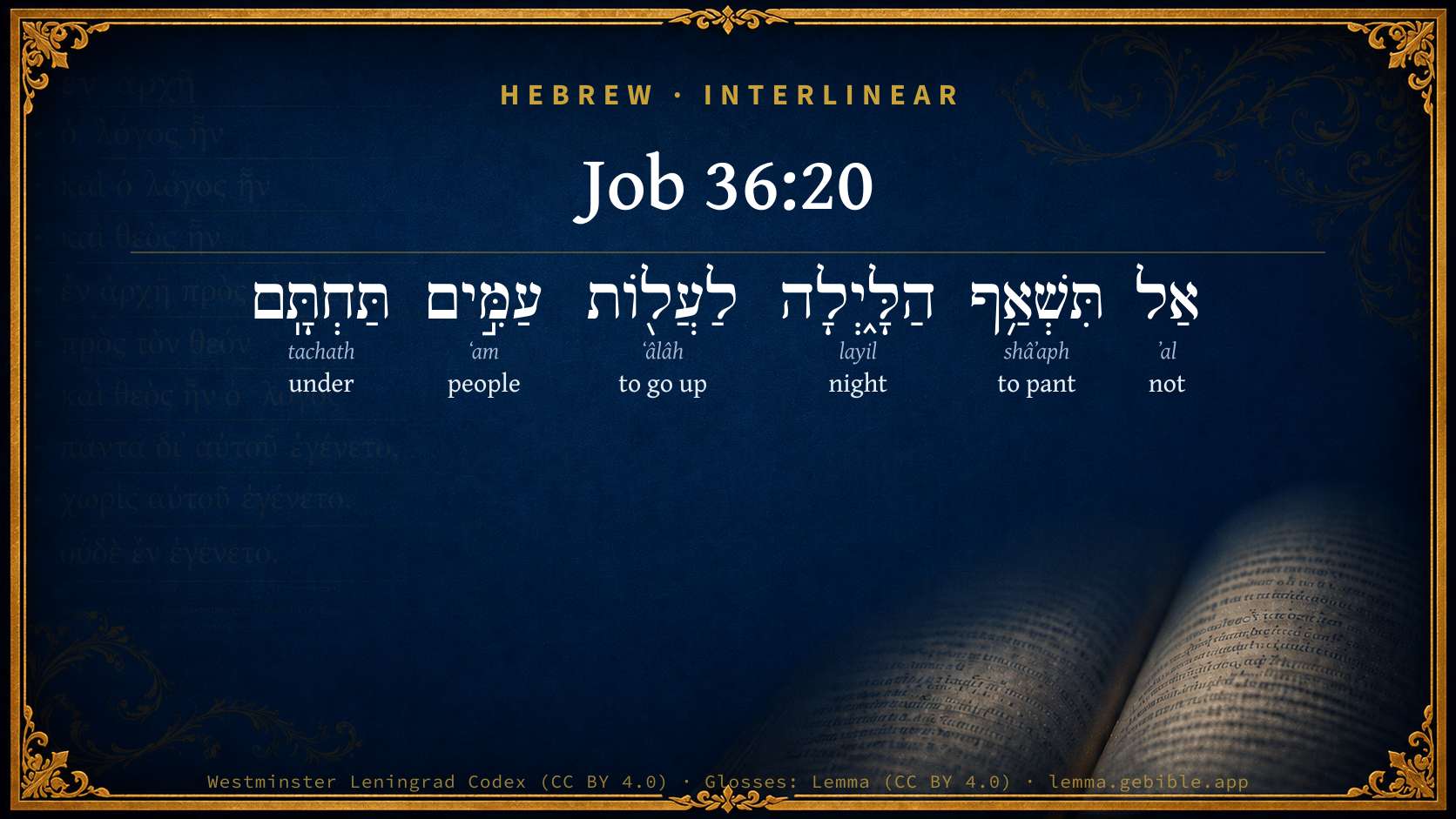
Job 36:20

Hebrew (Westminster Leningrad Codex) Job 36:20 appears in the Hebrew Old Testament. The text above is from the Westminster Leningrad Codex. Each word links to its Strong’s number, a concise gloss, and parsing drawn from the Open Scriptures Hebrew Bible morphology. Click any word for its full Brown-Driver-Briggs (BDB) entry.
Download image
Cite this verse

Job 36:20 (World English Bible). Public Domain. Lemma interlinear Bible study tool, https://lemma.gebible.app/v/job/36/20.

Show BibTeX & RIS
BibTeX
RIS
English Translation
Don't desire the night, When people are cut off in their place.
World English Bible · Public Domain
Download a study sheet

One document with this verse’s original text, its word-by-word gloss line, the meaning frame, cross-references with their text, attributed commentary, and full source and license credits — printable, and it pastes into notes with its structure intact.

This verse Autodidact and up

Study sheet (.html) Plain text (.txt)

A passage Seminary Student

Up to 50 verses in one chapter. A passage sheet keeps up to 6 commentary sources and 12 cross-references per verse, in the order this page ranks them, and says so on the sheet whenever that leaves anything out. Ask for a single verse and you get the Autodidact verse sheet above.

Everything on this page stays free to read, with no account — the sheet is a download of what is already on screen, not access to it.

Want to remove ads? Support Godless Engineer
Compare translations 3

The same verse in 3 English versions, stacked beneath the original-language interlinear above. Click any original word for its lexicon entry.

Each is an independent rendering of the whole verse — the interlinear is not word-aligned to these translations.

Highlighted words mark where these versions differ — a whole-verse word diff, not a word-by-word alignment.

  • World English Bible Public Domain
    Don't desire the night, When people are cut off in their place.
  • King James Version Public Domain
    Desire not the night, when people are cut off in their place.
  • unfoldingWord Literal Text CC BY-SA 4.0
    Do not desire the night, to the departing of peoples their place.

unfoldingWord Literal Text — © unfoldingWord, licensed CC BY-SA 4.0. Word-aligned USFM3 via Door43 (git.door43.org/unfoldingWord/en_ult).

Versions to compare (up to 4)

3 of 4 selected

Show all 18 translations

Every available English version of this verse, each an independent rendering of the whole verse.

  • World English Bible Public Domain
    Don't desire the night, When people are cut off in their place.
  • Berean Standard Bible Public Domain
    Do not long for the night, when people vanish from their homes.
  • Majority Standard Bible Public Domain
    Do not long for the night, when people vanish from their homes.
  • King James Version Public Domain
    Desire not the night, when people are cut off in their place.
  • American Standard Version (1901) Public Domain
    Desire not the night, When peoples are cut off in their place.
  • Revised Version (1885) Public Domain
    Desire not the night, when peoples are cut off in their place.
  • Geneva Bible (1599) Public Domain
    Be not carefull in the night, howe he destroyeth the people out of their place.
  • Douay-Rheims (1899) Public Domain
    Prolong not the night that people may come up for them.
  • Young's Literal Translation Public Domain
    Desire not the night, For the going up of peoples in their stead.
  • Literal Standard Version CC BY-SA 4.0
    Do not desire the night, || For the going up of peoples in their stead.
  • Unlocked Literal Bible CC BY-SA 4.0
    Do not desire the night, to commit sin against others, when peoples are cut off in their place.
  • unfoldingWord Literal Text CC BY-SA 4.0
    Do not desire the night, to the departing of peoples their place.
  • Darby Bible Public Domain
    Desire not the night, when peoples are cut off from their place.
  • World Messianic Bible Public Domain
    Don’t desire the night, when people are cut off in their place.
  • Webster's Bible Public Domain
    Desire not the night, when people are cut off in their place.
  • Free Bible Version CC BY-SA 4.0
    Do not long for the night when people are suddenly taken away.
  • Bible in Basic English Public Domain
    ...
  • JPS Tanakh (1917) Public Domain
    Desire not the night, when peoples are cut off in their place.

Literal Standard Version (2020), Covenant Press — licensed CC BY-SA 4.0. Text via the HelloAO Bible API (eBible.org). Unlocked Literal Bible (unfoldingWord) — licensed CC BY-SA 4.0. Text via the HelloAO Bible API (eBible.org). unfoldingWord Literal Text — © unfoldingWord, licensed CC BY-SA 4.0. Word-aligned USFM3 via Door43 (git.door43.org/unfoldingWord/en_ult). Free Bible Version, Dr. Jonathan Gallagher — licensed CC BY-SA 4.0. Text via the HelloAO Bible API (eBible.org).

Word by word

More ways to search: Search by grammar → Find every occurrence → Compare this word →

Practice this passage: Drill this verse → Learn its vocabulary →

תִּשְׁאַ֥ף
shâʼaph
H7602
“to pant”
Verb, Qal, Jussive, 2nd Person, Masculine, Singular
Part of Speech
Verb
Stem
Qal
Form
Jussive
Person
2nd Person
Gender
Masculine
Number
Singular
Full BDB Definition

Origin: a primitive root

TWOT: 2305 , 2306

to gasp, pant, pant after, long for, breathe heavily - (Qal) - to gasp, pant after, snuff up - to gasp or pant (with desire), pant after, be eager for - to thirst for one's blood (from actions of animals) (figuratively) - to crush, trample, trample upon - (Qal) to trample upon, crush
  1. אַל ʼal H408 “not” Particle, Negative
  2. הַלָּ֑יְלָה layil H3915 “the · night” Particle, Definite Article + Noun, Common, Masculine, Singular, Absolute
  3. לַעֲל֖וֹת ʻâlâh H5927 “to go up” Preposition + Verb, Qal, Infinitive Construct
  4. עַמִּ֣ים ʻam H5971 “peoples” Noun, Common, Masculine, Plural, Absolute
  5. תַּחְתָּֽם tachath H8478 “under · them” Preposition + Suffix, Personal, 3rd Person, Masculine, Plural

About this verse

These counts appear in no published source. They are computed here, from the morphology-tagged text and Lemma’s own curated glosses. What Lemma adds →

6
words
6
distinct lemmas
Wisdom
section

Notable vocabulary

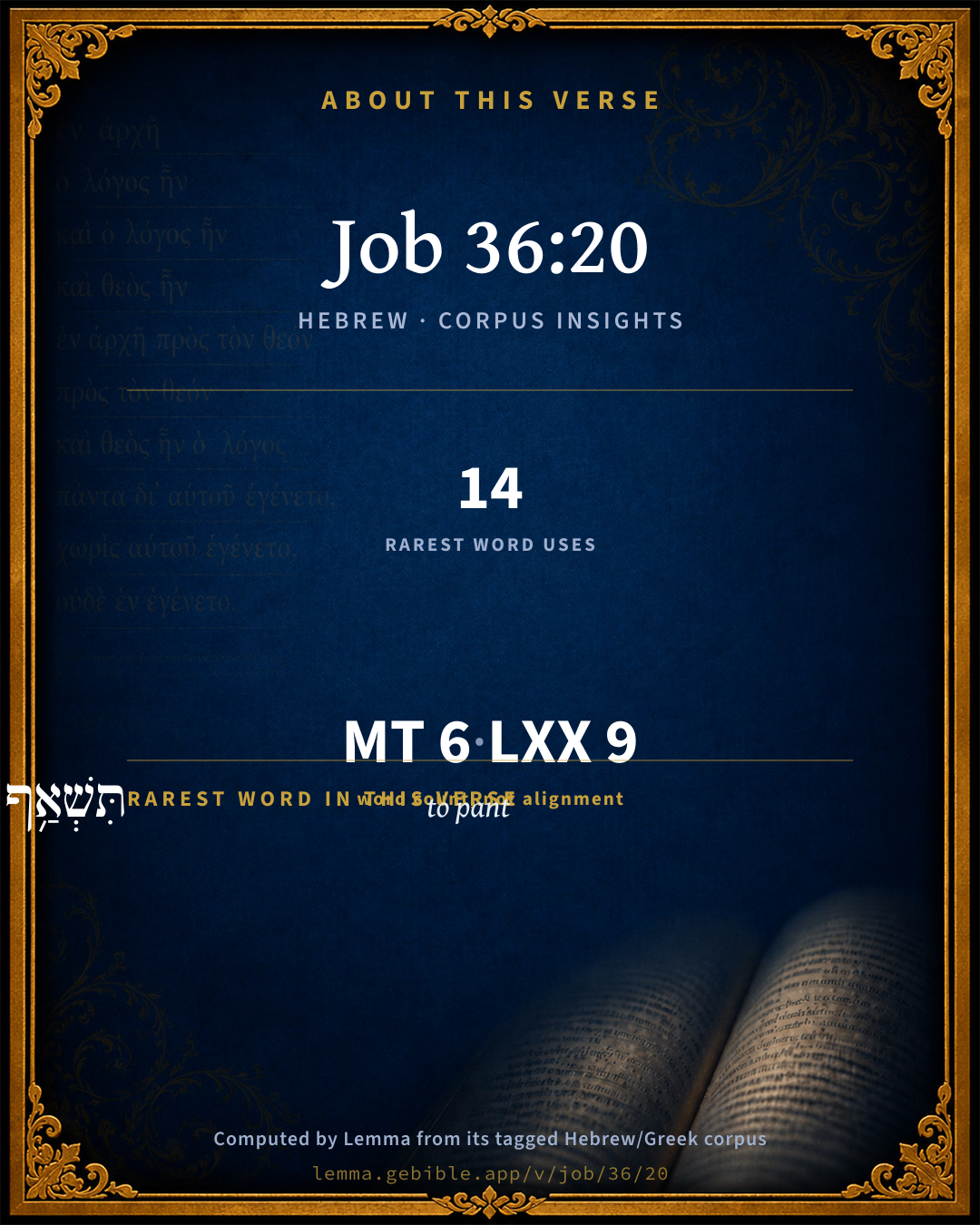
The rarest word here is תִּשְׁאַ֥ף to pant H7602 — appearing just 14 times in the whole Hebrew Bible.

Shared distinctive vocabulary

תִּשְׁאַ֥ף to pant H7602 occurs in 14 verses of the Hebrew Bible. Also found in:

Grammatical profile

  • 2 verbs
  • 2 nouns
  • 1 preposition
  • 1 particle

Verb forms

  • תִּשְׁאַ֥ף Qal · Jussive
  • לַעֲל֖וֹת Qal · Infinitive Construct

Hebrew & Septuagint length

In English translation the verse runs 12 words from the Hebrew and 20 from the Septuagint (LXX English) — the Septuagint runs noticeably longer here. See the side-by-side →

A rough comparison of the two English renderings, which tokenize alike — not a word-level alignment.

Word counts can differ between the Hebrew and the Greek without any difference in meaning — e.g. the Hebrew direct-object marker אֵת has no separate Greek word, and Greek often adds the article ὁ.

In the original languages it is 6 Hebrew tokens and 9 Greek tokens — but the two are counted differently (Hebrew bundles its prefixes and suffixes into one token; the Greek is in lemma form), so that isn’t a like-for-like length.

Cross-references

15

Topical passages linked to Job 36:20 in the Treasury of Scripture Knowledge — connected by theme and wording, ordered by reader-vote popularity; previews shown in the World English Bible.

  • Exodus 12:29 It happened at midnight, that Yahweh struck all the firstborn in the land of Egypt, from the firstborn of Pharaoh who sat on his throne to the firstborn of the captive who was in the dungeon; and all the firstborn of cattle.
  • 2 Kings 19:35 It happened that night, that the angel of Yahweh went forth, and struck in the camp of the Assyrians one hundred eighty-five thousand: and when men arose early in the morning, behold, these were all dead bodies.
  • Job 34:20 In a moment they die, even at midnight; The people are shaken and pass away, The mighty are taken away without hand.
  • Job 34:25 Therefore he takes knowledge of their works. He overturns them in the night, so that they are destroyed.
  • Job 3:20–21 "Why is light given to him who is in misery, Life to the bitter in soul,
  • Job 6:9 Even that it would please God to crush me; That he would let loose his hand, and cut me off!
  • Job 7:15 So that my soul chooses strangling, Death rather than my bones.
  • Job 14:13 "Oh that you would hide me in Sheol, That you would keep me secret, until your wrath is past, That you would appoint me a set time, and remember me!
  • Job 17:13–14 If I look for Sheol as my house, If I have spread my couch in the darkness,
  • Proverbs 14:32 The wicked is brought down in his calamity, But in death, the righteous has a refuge.
  • Ecclesiastes 11:3 If the clouds are full of rain, they empty themselves on the earth; And if a tree falls toward the south, or toward the north, In the place where the tree falls, there shall it be.
  • Daniel 5:30 In that night Belshazzar the Chaldean King was slain.
  • Luke 12:20 "But God said to him, 'You foolish one, tonight your soul is required of you. The things which you have prepared--whose will they be?'
  • Acts 1:25 to take part in this ministry and apostleship from which Judas fell away, that he might go to his own place."
  • 1 Thessalonians 5:2–3 For you yourselves know well that the day of the Lord comes like a thief in the night.

Cross-references courtesy of OpenBible.info (CC BY 4.0).

Hebrew and Greek witnesses Masoretic Hebrew ↔ Greek Septuagint

The same verse in the two great witnesses to the Old Testament, shown verse-for-verse.

Here the Septuagint runs noticeably longer than the Hebrew — LXX2012 (modern English Septuagint) 20 words vs World English Bible 12. A rough length comparison of the two English translations, not a word-level alignment — read both below.

These are two independent witnesses, not word-aligned to each other, and the Septuagint is shown in lemma (dictionary) form.

Hebrew Job 36:20 Masoretic · Westminster Leningrad Codex

אַל תִּשְׁאַ֥ף הַלָּ֑יְלָה לַעֲל֖וֹת עַמִּ֣ים תַּחְתָּֽם

Don't desire the night, When people are cut off in their place.

World English Bible · Public Domain

Greek LXX Job 36:20 Septuagint · lemma form

μή ἐκἕλκω ὁ νύξ τοῦ ἀναβαίνω λαός ἀντί αὐτός

And draw not forth all the mighty men by night, so that the people should go up instead of them.

LXX2012 (modern English Septuagint) · Public Domain

On this verse, Albert Barnes' Notes on the Bible discusses the Septuagint’s reading. Read the note in Commentary ↓

Hebrew: Westminster Leningrad Codex (CC BY 4.0). Greek: Septuagint (public domain); English from LXX2012 (modern English Septuagint) (Public Domain). How the Septuagint differs from the Hebrew →

Commentary

Notes on Job 36:20 from classic Christian and Jewish commentators (each source and its license shown beneath its notes). The classic Christian expositions comment on the surrounding passage and are grouped to its opening verse, so a note may address several verses; the Jewish commentaries on the Tanakh (Rashi and others) are per-verse, so they appear only where the commentator wrote on this verse.

Lemma curates 59 commentaries, every one of them public domain or Creative Commons licensed, each selected and text-cleaned for this edition rather than reprinted as found. About our sources →

Trapp's Complete Commentary

John Trapp

Job 36:20 Desire not the night, when people are cut off in their place.

Ver. 20. Desire not the night, &c.] That is, as some sense it, do not thou peevishly desire death, {see Job 7:15} lest it come too soon, and it do by thee as it doth by many a one, whom it cuts off in judgment. For surely in the state thou art now in thou oughtest to fear an extraordinary kind of death, an inlet to eternal destruction, as in the deluge, Sodom, and Egypt. Others render it thus, Neither let it disquiet thee in the night, how people are destroyed out of their place; that is, in the night season, when thy mind is void of cares, puzzle not thyself how and why some nations perish, and not others, but rather rest thyself upon God’s providence and unsearchable wisdom, and trouble not thy head in searching out the cause of this so sudden misfortune. Brentius makes this the sense, Noli impie agere, Desire not the night; that is, deal not wickedly by complaining against God, and impatiently bearing his hand; as thieves and adulterers desire the night for despatch of their deeds of darkness. Think not thou to hide thyself in the dark from the dint of God’s displeasure.

When people are cut off in their place] Heb. ascend under them; i.e. rise, that they may fall, Psa 102:10; as the light of a candle, when it is ready to go out, flieth up, and then vanisheth away; or as the corn is first taken up by the hand of the reaper, and then cut off, and laid flat on the ground.

John Trapp, A Commentary or Exposition upon All the Books of the Old and New Testament (1647–1656) — public domain. Text from a community e-Sword module.

Joseph Benson's Commentary

Job 36:20-21. Desire not the night — The night of death, which Job had often desired, for then thou art irrecoverably gone: take heed of thy foolish and often-repeated desire of death, lest God inflict it upon thee in anger. When people are cut off in their place — By which individuals, and even whole nations and bodies of people, are sometimes cut off in wrath, in their several places where they are: or, are suddenly taken away before they can remove out of the place where the stroke of God finds them; or, in the place where they are settled and surrounded with all manner of comforts and friends, all which cannot prevent their being cut off. Take heed, regard not iniquity — Hebrew, אל תפן, al teepen, look not to it; namely, with an approving or desiring eye, as this expression is used Pro 23:31. This hast thou chosen rather than affliction — Thou hast chosen rather to quarrel with God, and censure his judgments, than humbly and quietly, submit to them, and wait upon God by faith and prayer for deliverance in his due time and appointed way.

Joseph Benson's Commentary on the Old and New Testaments (1811–1818) — public domain. Text from a community e-Sword module.

Geneva Bible (1599)

Geneva Bible translators

Be not thou curious in seeking the cause of God’s judgments, when he destroyeth any.

Geneva Bible (1599) marginal notes — public domain. Text via Bolls.life.

Jamieson, Fausset & Brown

Robert Jamieson, A. R. Fausset & David Brown

Desire--pant for. Job had wished for death (Job 3:3-9, &c.).

night-- (Joh 9:4).

when--rather, "whereby."

cut off--literally, "ascend," as the corn cut and lifted upon the wagon or stack (Job 36:26); so "cut off," "disappear."

in their place--literally, "under themselves"; so, without moving from their place, on the spot, suddenly (Job 40:12) [MAURER]. UMBREIT'S translation: "To ascend (which is really, as thou wilt find to thy cost, to descend) to the people below" (literally, "under themselves"), answers better to the parallelism and the Hebrew. Thou pantest for death as desirable, but it is a "night" or region of darkness; thy fancied ascent (amelioration) will prove a descent (deterioration) (Job 10:22); therefore desire it not.

Jamieson, Fausset & Brown — Commentary Critical and Explanatory on the Whole Bible (1871) — public domain (CC PDM 1.0). Text via the HelloAO Bible API.

Adam Clarke's Commentary

Verse 20. Desire not the night] Thou hast wished for death; (here called night;) desire it not; leave that with God. If he hear thee, and send death, thou mayest be cut off in a way at which thy soul would shudder.

Adam Clarke's Commentary on the Bible (1810–1826) — public domain. Text from a community e-Sword/MySword module.

Ellicott's Commentary for English Readers

(20) Desire not the night—i.e., of death, as Job had done (Job_16:22; Job_17:13, &c., Job_19:27), or as, at all events, his words might be understood. For “people,” read peoples: i.e., nations.

A Bible Commentary for English Readers, edited by Charles John Ellicott (1878–1897) — public domain. Text from a community e-Sword module.

The Cambridge Bible for Schools and Colleges

gen. ed. J. J. S. Perowne

20–21. Elihu continues his warning to Job.

20. Desire not that night

When the peoples are cut off in their place;

21. Take heed, turn not unto iniquity,

For this thou choosest rather than affliction.

20. The “night” is as usual a figure for destruction and judgment. By this destroying judgment of God nations are “taken away” in their place, i. e. on the spot, suddenly and without power of escape; and Job is warned against desiring, lit. panting for, such a judgment. Job had often desired to meet God in judgment, and there may be a reference to this in the words, but the passage contains a general warning against Job’s rebellious words and demeanour towards God, and means “Act not as if thou soughtest to bring on thyself the dark and sudden judgment day of calamity when nations are swept away in their place.”

The Cambridge Bible for Schools and Colleges (gen. ed. J. J. S. Perowne; Cambridge University Press, 1878–1918) — public domain. Text from a community e-Sword module.

John Gill's Exposition

Desire not the night,.... Either in a literal sense, which Job might do; not for secrecy to commit sin, as the thief, murderer, and adulterer do; Elihu had no such suspicion of Job; nor for ease and rest, which he expected not; nor would his sores admit thereof; his nights were wearisome, and when come he wished they were gone, Job 7:2; but either for retirement, that he might muse and consider, and endeavour to search and find out the reason of God's dealing with men, in cutting off sometimes such great numbers together. Elihu suggests, that such a search was altogether vain and to no purpose; he would never be able to find out the reason of these things: or rather for shelter from the eye and hand of God; as nothing before mentioned could ward off his stroke, so neither could the night or darkness preserve from it; see Psa 139:11. Or else the words may be taken in a figurative sense; either of the night of calamity and distress, he might be tempted to desire and wish for, to come upon his enemies; or rather of the night of death, he wished for himself, as he often had done; in doing which Elihu suggests he was wrong; not considering that if God should take him away with a stroke, and he not be humbled and brought to repentance, what would be the consequence of it;

when people are cut off in their place; as sometimes they are in the night, literally taken; just in the place where they stood or lay down, without moving elsewhere, or stirring hand or foot as it were. So Amraphel, and the kings with him, as Jarchi observes, were cut off in the night, the firstborn of Egypt, the Midianites and Sennacherib's army, Gen 14:15; and so in the night of death, figuratively, the common passage of all men, as Mr. Broughton observes, who renders the words, "for people's passage to their place".

John Gill's Exposition of the Whole Bible (1746–1763) — public domain (CC PDM 1.0). Text via the HelloAO Bible API.

Albert Barnes' Notes on the Bible

Desire not the night - That is, evidently, “the night of death.” The darkness of the night is an emblem of death, and it is not uncommon to speak of death in this manner; see Joh 9:4, “The night cometh, when no man can work.” Elihu seems to have supposed that Job might have looked forward to death as to a time of release; that so far from “dreading” what he had said would come, that God would cut him off at a stroke, it might be the very thing which he desired, and which he anticipated would be an end of his sufferings. Indeed Job had more than once expressed some such sentiment, and Elihu designs to meet that state of mind, and to charge him not to look forward to death as relief. If his present state of mind continued, he says, he would perish under the “wrath” of God; and death in such a manner, great as might be his sufferings here, could not be desirable.

When people are cut off in their place - On this passage, Schultens enumerates no less than “fifteen” different interpretations which have been given, and at the end of this enumeration remarks that he “waits for clearer light to overcome the shades of this night.” Rosenmullcr supposes it means,” Long not for the night, in which nations go under themselves;” that is, in which they go down to the inferior regions, or in which they perish. Noyes renders it, “To which nations are taken away to their place.” Urnbroil renders it, “Pant not for the night, to go down to the people who dwell under thee;” that is, to the Shades, or to those that dwell in Sheol. Prof. Lee translates it, “Pant not for the night, for the rising of the populace from their places.” Coverdale, “Prolong not thou the time, until there come a night for thee to set other people in thy stead.” The Septuagint, “Do not draw out the night, that the people may come instead of them;” that is, to their assistance.

Dr. Good “Neither long thou for the night, for the vaults of the nations underneath them;” and supposes that the reference is to the “catacombs,” or mummy-pits that were employed for burial-places. These are but specimens of the interpretations which have been proposed for this passage, and it is easy to see that there is little prospect of being able to explain it in a satisfactory manner. The principal difficulty in the passage is in the word rendered “cut off,” (עלה ‛âlâh) which means “to go up, to ascend,” and in the incongruity between that and the word rendered in their place (תחתם tachthâm), which literally means “under them.” A literal translation of the passage is, “Do not desire the night to ascend to the people under them;” but I confess I cannot understand the passage, after all the attempts made to explain it. The trauslation given by Umbreit, seems best to agree with the connection, but I am unable to see that the Hebrew would bear this. See, however, his Note on the passage. The word עלה ‛âlâh he understands here in the sense of “going away,” or “bearing away,” and the pbrase the “people under them,” as denoting the “Shades” in the world beneath us. The whole expression then would be equivalent to a wish “to die” - with the expectation that there would be a change for the better, or a release from present sufferings. Elihu admonishes Job not to indulge such a wish, for it would be no gain for a man to die in the state of mind in which he then was.

Albert Barnes' Notes on the Bible (1834–1885) — public domain. Text from a community e-Sword/MySword module.

Haydock's Catholic Bible Commentary

Prolong not the night, &c. Prolong not causes that are brought before thee, but dispatch, by early rising, the business of them that come up to thee. (Challoner) --- Septuagint, "and all the men of power do not withdraw in the night," from just punishment. Theodotion adds, "that the people may come up against them," to demand vengeance. Do strict justice both to the rich and to the poor, without pity or fear. (Haydock) --- This text is very obscure; and the Hebrew may have different meanings, which do not, however, seem well connected with the rest. "Plant not after night, when people retire home;" (Calmet) or Protestants, "are cut off in their place." (Haydock) --- Delay not to banish temptations, or they will increase. (St. Gregory xxvi. 38.) (Worthington)

George Leo Haydock (1774–1849), Haydock's Catholic Family Bible and Commentary, 1859 edition — public domain. Excludes Psalms (Douay-Rheims chapter numbering differs from Protestant) and Deuterocanonical books (Catholic canon only).

Matthew Poole's English Annotations

Desire not the night; either,

1. Properly, that in it thou mayst find some ease or rest, as men usually do. But this Job did not much desire, for he complains that his nights were as restless as his days. Or rather,

2. Metaphorically, the night of death, which is called the night both in Scripture, as Joh 9:4, and in other writers; and which Job had oft and earnestly desired, and even thirsted after, as this verb notes. See Job 7:15. And this seems best to agree with the foregoing counsel, Job 36:18, beware lest he take thee away with his stroke; for then, saith he, thou art irrecoverably lost and gone; and therefore take heed of thy foolish and oft-repeated desire of death, lest God inflict it upon thee in great anger. When; or, by which; which words are oft understood in divers texts of Scripture. People; even whole nations and bodies of people, which are all God’s creatures as well as thou, and yet are not spared by him, but cut off in wrath, and many of them sent from one death to another; take heed therefore thou be not added to the number.

Are cut off, Heb. are made to ascend, i.e. to vanish, or perish, or die, as this verb is oft used, as Job 18:16; Psa 102:24.

In their place; in their several places where they are; or suddenly, before they can remove out of the place where the hand and stroke of God finds them; or in the place where they are settled and surrounded with all manner of comforts, and supports, and friends, all which could not prevent their being cut off. Possibly this phrase may allude to that expression of Job’s, Job 29:18, I shall die in my nest.

Matthew Poole's English Annotations on the Holy Bible (1683–1685) — public domain. Text from a community e-Sword/MySword module.

Whedon's Commentary on the Bible

Daniel D. Whedon

20. The night — Night is used figuratively for death, (Job_34:20; Job_34:25,) or for destruction heightened by night. Psa_91:5. It may mean his own death, or the retributive death of others; Job having spoken of night in the latter sense, so as possibly to awaken on the part of Elihu suspicious of malevolence, though unjustly.

Cut off — Same as in Job_5:26, and Psa_102:24, (literally, “go up,”) and here spoken in general of removal by death to sheol, the world beneath them, (thus Conant and Carey,) or “beneath where the nations are,” (Hitzig;) but better, as in Job_40:12, in their place — the place of their power and pride. The latter clause of the verse explains the former. In sublime language (Job_3:13-19) Job had expressed his desire that he might join the mighty dead; a description which must have profoundly impressed the youthful listener Elihu. He now replies, Not for the night, not “for the going up of the nations,” should Job long, (same as in Job_7:2;) they are going up fast enough, — this “innumerable caravan that moves to that mysterious realm” of death, — without Job’s panting to join them. Job’s time to “be gathered” will come soon enough without all this ado.

Daniel D. Whedon (gen. ed.), Commentary on the Old and New Testaments (1874–1909) — public domain. Text from a community e-Sword module.

The Pulpit Commentary

Desire not the night, when people (rather, peoples) are cut off in their place. This is an allusion to Job"s repeatedly expressed desire to be cut off at once, and laid in the grave. (Job_6:9 Job_7:15 Job_14:13, etc.) Elihu holds that such a desire is wrongful. It certainly implies a want of complete resignation to the Divine will.

The Pulpit Commentary (1880–1919), ed. H.D.M. Spence-Jones & Joseph S. Exell — public domain. Text from a community e-Sword module.

John Wesley's Explanatory Notes

The night - The night of death, which Job had often desired, for then, thou art irrecoverably gone: take heed of thy foolish and often repeated desire of death, lest God inflict it upon thee in anger.

John Wesley, Explanatory Notes Upon the Whole Bible (1754–1765) — public domain. Text via the GEBible commentary corpus.

Rashi

Rabbi Shlomo Yitzchaki (Rashi)

Do not yearn for the night That is to say that you should not choose other sufferings. Do not yearn for, or desire the night that came to Amraphel, to Egypt, and to Sennacherib, to take away peoples from the world when they are in their place in tranquility, for they perished both from this world and from the world to come.

are taken away Heb. לעלות, like (Ps. 102:25), “do not take me away (תעלני) in the midst of my days.”

Rashi on the Tanakh — English translations: “The Judaica Press complete Tanach with Rashi, translated by A. J. Rosenberg” (CC BY 4.0); “Pentateuch with Rashi's commentary by M. Rosenbaum and A.M. Silbermann, 1929-1934” (public domain); “The Metsudah Tanach series, Lakewood, N.J” (CC BY 4.0); and “The Book of Joshua, Metsudah Publications, 1997” (CC BY 4.0). Text via Sefaria.

Lesson kit

Teaching starters — assembled from the data on this page, not authored interpretation. Every prompt links to the verse data it draws on. Edit before teaching.

Job, in the Wisdom, opens this verse with 6 words (6 distinct Hebrew lemmas). Its most distinctive word is shâʼaph (“to pant”). The Greek Septuagint runs longer here. A historical commentator’s framing appears above. Read the whole chapter for the surrounding context.

Discussion questions

  1. What does “to pant” (shâʼaph) contribute to the verse as a whole?
  2. Job 5:5 shares the word «to pant» with this verse. How do the two illuminate each other?
  3. Compared with the Hebrew, the Septuagint runs longer here. What questions does that raise?
  4. The translations on this page render this verse differently — a whole-verse word diff, not a word-by-word alignment. What might account for the different wordings?
  5. The verb «תִּשְׁאַ֥ף» is Qal Jussive. How does its form color the action?
  6. Reading how Trapp's Complete Commentary and Joseph Benson's Commentary read this verse, where do the two commentators agree and where do they part?

Things to notice

Reading settings

Reading text

Shown beneath each verse's original-language words.

Old Testament
Old Testament edition

Read the OT as the Masoretic Hebrew (MT) or the Greek Septuagint (LXX).

English shown for the Greek Septuagint (in the Hebrew ↔ Greek comparison).

Comparing translations? Open the Compare panel on any verse page to stack up to four side by side.