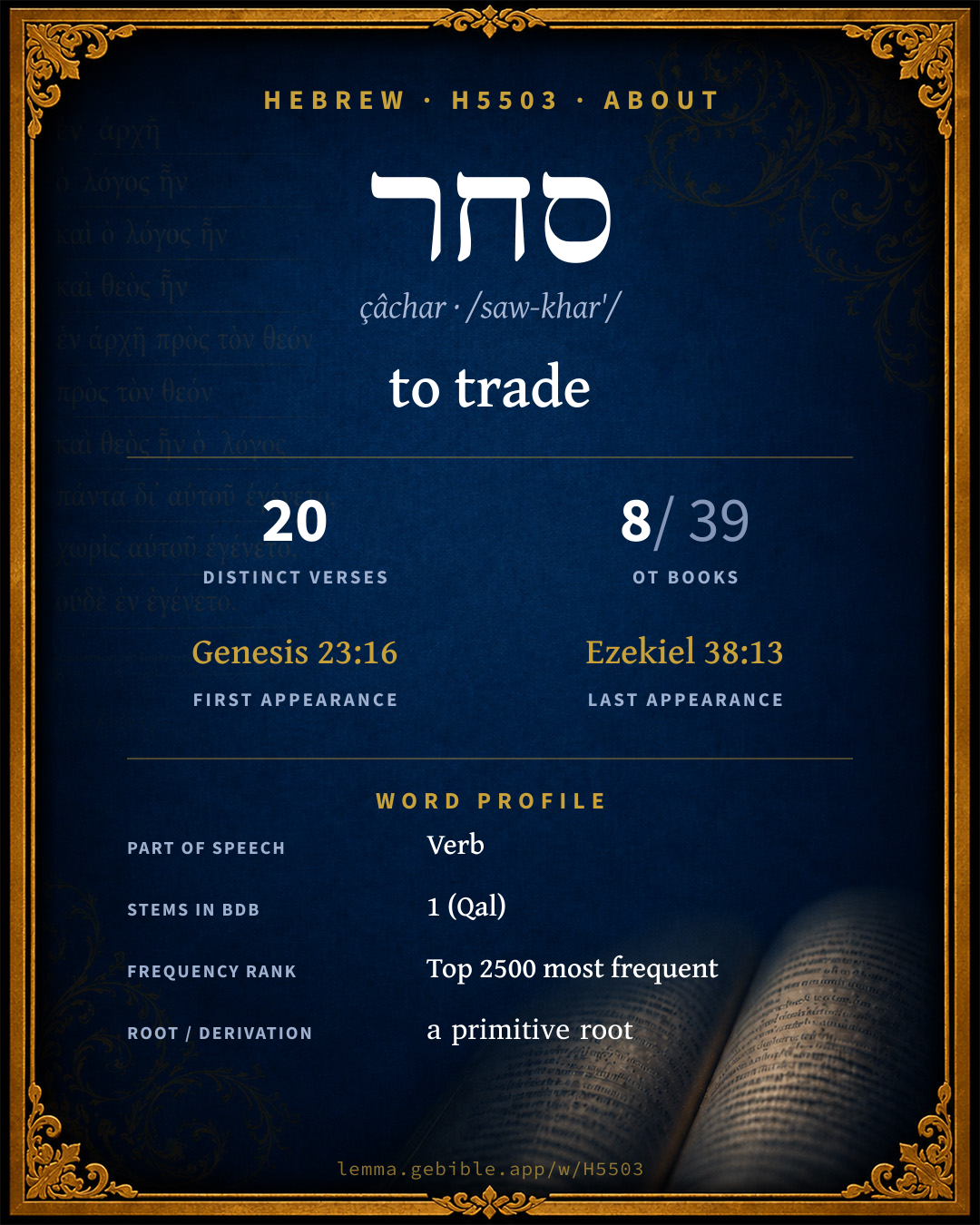
סָחַר
to trade
‘to trade’ is one of 2 main senses fuller range ↓
Full lexicon entry — Brown-Driver-Briggs (BDB)
From Brown-Driver-Briggs (BDB)
Where this word appears
See every Qal verb in the Hebrew Bible →
Grammar key — what these labels mean
Part of speech
- Verb
- An action or state-of-being word.
Stem
- Qal
- The basic, simple active stem — the plain form of the verb (“he wrote”). Here: ‘go about’
Form
- Participle Active
- A verbal adjective expressing ongoing or characteristic action (“writing / one who writes”).
- Imperfect
- An incomplete, ongoing, or future action (“he will / would write”).
- Imperative
- A direct command (“write!”).
- Perfect
- A completed action or state — Hebrew marks aspect (completeness) more than strict tense (“he wrote”).
State
- Construct
- A noun bound to a following noun in a possessive / “of” relationship (the construct chain).
- Absolute
- The independent form of a noun, not bound to a following word.
Person
- 3rd Person
- The one spoken about (“he / she / it / they”).
- 2nd Person
- The one addressed (“you”).
Gender
- Feminine
- Grammatically feminine.
- Masculine
- Grammatically masculine.
- Common
- Either gender — not distinguished for this form.
Number
- Singular
- One.
- Plural
- More than one (in Hebrew, generally three or more).
Grammatical forms 10 distinct
- Verb, Qal, Participle Active, Masculine, Plural, Construct 7 times (33%)
- Verb, Qal, Participle Active, Feminine, Singular, Construct 3 times (14%)
- Verb, Qal, Participle Active, Masculine, Plural, Absolute 3 times (14%)
- Verb, Qal, Participle Active, Masculine, Singular, Absolute 2 times (10%)
- Verb, Qal, Imperfect, 3rd Person, Masculine, Plural 1 time (5%)
- Verb, Qal, Imperative, 2nd Person, Masculine, Plural 1 time (5%)
- Verb, Pealal, Perfect, 3rd Person, Masculine, Singular 1 time (5%)
- Verb, Qal, Imperfect, 2nd Person, Masculine, Plural 1 time (5%)
+2 more forms (2 occurrences)
Parsed forms decoded from the imported morphology (morphhb / Westminster Leningrad Codex — WLC text public domain, morphhb tagging CC BY 4.0), counted across 21 parsed occurrences — not distinct verses.
Every verse where H5503 appears — 20 distinct verses across 8 books. Click any verse to open its interlinear word-by-word view. Verse text shown in the World English Bible for context — . Each verse’s Hebrew form is shown with its reference; the English is not keyword-highlighted, since the data carries no word-level English alignment. Use “Compare translations” on any verse to read it across multiple English versions. This concordance covers the Hebrew Bible; Septuagint (Greek Old Testament) occurrences are not indexed here.
Genesis 5 verses
- Genesis 23:16 לַ/סֹּחֵֽר prep det + Qal ptcp.act ms Abraham listened to Ephron. Abraham weighed to Ephron the silver which he had named in the audience of the children of Heth, four hundred shekels of silver, according to the current merchants' standard.
- Genesis 34:10 וּ/סְחָר֔וּ/הָ conj + Qal impv 2mp + sfx pers 3fs You shall dwell with us: and the land will be before you. Live and trade in it, and get possessions in it."
- Genesis 34:21 וְ/יִסְחֲר֣וּ conj + Qal impf 3mp "These men are peaceful with us. Therefore let them live in the land and trade in it. For, behold, the land is large enough for them. Let us take their daughters to us for wives, and let us give them our daughters.
- Genesis 37:28 סֹֽחֲרִ֗ים Qal ptcp.act mp Midianites who were merchants passed by, and they drew and lifted up Joseph out of the pit, and sold Joseph to the Ishmaelites for twenty pieces of silver. They brought Joseph into Egypt.
- Genesis 42:34 תִּסְחָֽרוּ Qal impf 2mp Bring your youngest brother to me. Then I will know that you are not spies, but that you are honest men. So I will deliver your brother to you, and you shall trade in the land.'"
1 Kings 1 verse
2 Chronicles 2 verses
- 2 Chronicles 1:16 סֹחֲרֵ֣י Qal ptcp.act mp cs The horses which Solomon had were brought out of Egypt and from Kue; the king's merchants purchased them from Kue.
- 2 Chronicles 9:14 וְ/הַ/סֹּחֲרִ֖ים conj + ptcl def.art + Qal ptcp.act mp besides that which the traders and merchants brought: and all the kings of Arabia and the governors of the country brought gold and silver to Solomon.
Psalms 1 verse
Proverbs 1 verse
Isaiah 3 verses
- Isaiah 23:2 סֹחֵ֥ר Qal ptcp.act ms cs Be still, you inhabitants of the coast, you whom the merchants of Sidon, that pass over the sea, have replenished.
- Isaiah 23:8 סֹחֲרֶ֨י/ה֙ Qal ptcp.act mp cs + sfx pers 3fs Who has purposed this against Tyre, the giver of crowns, whose merchants are princes, whose traffickers are the honorable of the earth?
- Isaiah 47:15 סֹחֲרַ֣יִ/ךְ Qal ptcp.act mp cs + sfx pers 2fs Thus shall the things be to you in which you have labored: those who have trafficked with you from your youth shall wander everyone to his quarter; there shall be none to save you.
Jeremiah 1 verse
Ezekiel 6 verses
- Ezekiel 27:12 סֹחַרְתֵּ֖/ךְ Qal ptcp.act fs cs + sfx pers 2fs Tarshish was your merchant by reason of the multitude of all kinds of riches; with silver, iron, tin, and lead, they traded for your wares.
- Ezekiel 27:16 סֹחַרְתֵּ֖/ךְ Qal ptcp.act fs cs + sfx pers 2fs Syria was your merchant by reason of the multitude of your handiworks: they traded for your wares with emeralds, purple, and embroidered work, and fine linen, and coral, and rubies.
- Ezekiel 27:18 סֹחַרְתֵּ֛/ךְ Qal ptcp.act fs cs + sfx pers 2fs Damascus was your merchant for the multitude of your handiworks, by reason of the multitude of all kinds of riches, with the wine of Helbon, and white wool.
- Ezekiel 27:21 סֹחֲרֵ֣י סֹחֲרָֽיִ/ךְ Qal ptcp.act mp cs Qal ptcp.act mp cs + sfx pers 2fs Arabia, and all the princes of Kedar, they were the merchants of your hand; in lambs, and rams, and goats, in these were they your merchants.
- Ezekiel 27:36 סֹֽחֲרִים֙ Qal ptcp.act mp The merchants among the peoples hiss at you; you are become a terror, and you shall nevermore have any being.
- Ezekiel 38:13 וְ/סֹחֲרֵ֨י conj + Qal ptcp.act mp cs Sheba, and Dedan, and the merchants of Tarshish, with all the young lions of it, shall tell you, Are you come to take the spoil? have you assembled your company to take the prey? to carry away silver and gold, to take away cattle and goods, to take great spoil?
About this entry
At a glance — auto-summarized from this page’s data, not written by a person. Every figure links to its source below. This summary describes the numbers; it doesn’t interpret them.
“to trade” is the headline sense of the Hebrew verb סחר (çâchar). First canonically at Genesis 23:16, it enters the text early. The Hebrew Bible uses it across 20 verses — uncommon. More than a quarter of its appearances fall in Ezekiel. Carrying more than one sense, it rewards its full sense range. See the sense tree, 20-verse concordance, and the renderings breakdown below.
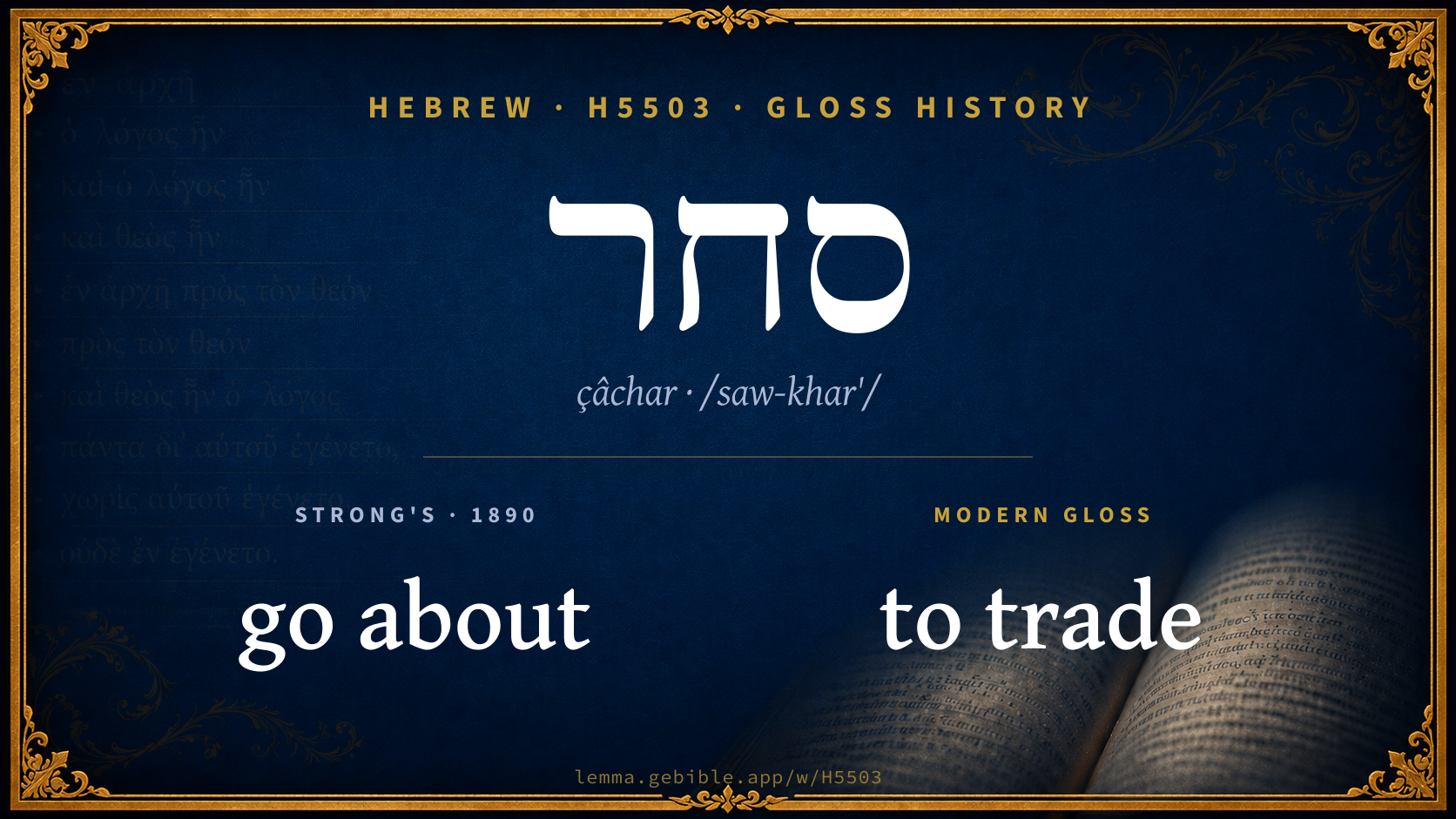
Gloss history
Strong's 1890 vs modern scholarship
About this word
Strong's H5503 catalogs a Hebrew word from the Hebrew Old Testament.
These counts are not copied from any lexicon or concordance. They are computed here, from the morphology-tagged Hebrew Old Testament. What Lemma adds →
- 20
- distinct verses
- The word appears in 20 distinct verses.
- 8 / 39
- OT books
- The word appears in 8 of 39 Old Testament books.
- #1,462
- by frequency
- Top 2500 most frequent Hebrew words (rank 1,462 of 8,640 Hebrew words by occurrence).
View all 20 occurrences in the concordance →
By section of the Old Testament
By traditional corpus
Conventional, traditional groupings — biblical authorship is debated, so this is a traditional corpus grouping, not an authorship claim. Each share is this word’s portion of its verses in that division of the Hebrew canon. Each figure is a share of the word’s 20 distinct verses.
- Prophets (Nevi'im) 11 verses · 55%
- Torah (Pentateuch) 5 verses · 25%
- Writings (Ketuvim) 4 verses · 20%
How translations render this word
Counts come from each version’s own published word-to-Strong’s tagging or interlinear alignment — an approximate guide to how each version renders this word, not a word-level alignment the data otherwise carries. Because each total is that version’s own tagged count, the per-version totals vary from one another and need not match the appearance or distinct-verse counts above. These counts may also differ from a printed concordance because Lemma counts each distinctly tagged rendering and does not collapse phrase taggings into a single head-word total. This is a fixed set of word-tagged versions (KJV, ASV, BSB, ULT) and does not change with the reading translation you choose elsewhere. Each version’s license is shown beside its name below (and on Sources).
- King James Version: Merchants 6×, Was thy merchant 3×, Trade 2×
- American Standard Version: Merchants 4×, Was thy merchant 3×, 's merchants 2×
- Berean Standard Bible: Merchants 4×, Traders 3×, Trade 2×
- unfoldingWord Literal Text: Merchants 3×, Traders 3×, Traders of 2×
King James Version Public Domain
Renders H5503 across 20 tagged occurrences — most commonly:
Plus 9 renderings that appear only once — usually multi-word phrases or single function words the recovered tagging swept in, not distinct renderings. Not rendered by a distinct English word in 1 further occurrence.
American Standard Version Public Domain
Renders H5503 across 19 tagged occurrences — most commonly:
Plus 8 renderings that appear only once — usually multi-word phrases or single function words the recovered tagging swept in, not distinct renderings.
Berean Standard Bible Public Domain
Renders H5503 across 21 tagged occurrences — most commonly:
Plus 12 renderings that appear only once — usually multi-word phrases or single function words the recovered tagging swept in, not distinct renderings.
unfoldingWord Literal Text CC BY-SA 4.0
Renders H5503 across 22 tagged occurrences — most commonly:
Plus 14 renderings that appear only once — usually multi-word phrases or single function words the recovered tagging swept in, not distinct renderings.
Senses in the full BDB
What do BDB’s symbols mean?
BDB uses these scholarly abbreviations:
| Symbol | Meaning |
|---|---|
| 𝔊 | the Septuagint (the ancient Greek translation, LXX) |
| 𝔙 | the Vulgate (the Latin translation) |
| 𝔖 | the Syriac version (the Peshitta) |
| 𝔗 | the Targum (the Aramaic translation) |
| ψ | the Psalms |
| √ | root (the underlying root or stem) |
| ‖ | parallel passage (a synonymous or contrasted parallel) |
| † | the dagger: every passage where the word occurs is cited |
The 3 senses and sub-senses the full Brown-Driver-Briggs lexicon distinguishes for this word, in lexicon order (not ranked by frequency), with BDB’s own verbatim wording and sub-sense lettering. Shown in Hebrew script with BDB’s own scholarly abbreviations. The condensed entry is in the Lexicon Entry tab. See also the Forms in the corpus table below.
Qal
- Pf. 3 pl. סָֽחֲרוּ Je 14:18; Impf. 3 mpl. יִסְחֲרוּ Gn 34:21; 2 mpl. תִּסְחָ֑רוּ Gn 42:34; Imv. mpl. sf. סְחָרוּהָ Gn 34:10; Pt. סֹחֵר Gn 23:16, סוֹחֵר Pr 31:14; cstr. סֹחֵר Is 23:2; fs. sf. סֹחַרְתֵּךְ Ez 27:12, 16, 18 + סֹחֲרֹתַיִךְ v 15 (v. infr.); mpl. סֹחֲרִים Gn 37:28 + 2 times; cstr. סֹחֲרֵי 1 K 10:28 + 3 times; sf. סֹחֲרַיִךְ Is 47:15, -רָ֑יִךְ Ez 27:21, -רֶיהָ Is 23:8;— e.g. Jeremiah 14:18
- 1. go about, to and fro (i.e. go about one’s affairs, carry on one’s business) in, c. acc. אֶרֶץ Gn 42:34 (E), 34:10, 21 (P); c. אֶל־אֶרֶץ Je 14:18, but dub., 𝔊 Gf Hi Or CoHpt RothstKau journey unto a land which they have not known. e.g. Genesis 42:34
- 2. Pt. = subst. a trafficker, trader (who goes about with wares, etc.) Gn 23:16 (P), 37:28 (E), Is 23:2, 8; 47:15 1 K 10:28 = 2 Ch 1:16, Ez 27:21(×2), 36; 38:13; + תָּרִים 2 Ch 9:14; f., of a city or country, Ez 27:12, 16, 18; also in v 15 read סֹחֲרֹתַיִךְ for MT (ידך) סְחֹרַת Sm Co Berthol Toy. Peʿalʿal. Pf. 3 ms. לִבִּי סְחַרְחַר ψ 38:11 (Ges§ 55 e) my heart palpitates (+ עֲזָבַנִי כֹחִי). e.g. Genesis 23:16
Senses from the full Brown-Driver-Briggs lexicon (Brown, Driver, Briggs; Oxford 1906 — public domain), digitized via Sefaria, supplemented by the OpenScriptures HebrewLexicon (CC BY 4.0). Full attribution on Sources.
Word origin
vb. go around, about, travel about in (NH id., go about as merchant, pedlar, perhaps denom. from סוֹחֵר (Jastr); 𝔗 סְחַר, אַסְחַר 4 PS2593 (rare), especially Chr Pal. Aramaic v. SchwallyIdiot. 61 f.; Assyrian saḫâru, turn, surround, Tel Am. return WklTA Gloss.; 𝔗 surround (often), and deriv.; Arabic سَخَرَ is mock at, deride);—
— Brown-Driver-Briggs (Oxford 1906, public domain), digitized via Sefaria, supplemented by the OpenScriptures HebrewLexicon (CC BY 4.0). See Sources.
Origin: a primitive root
Jastrow Dictionary
A second Hebrew/Aramaic lexicon for comparison, covering Aramaic and post-biblical (Talmudic, Targumic, Midrashic) usage that the biblical-Hebrew BDB does not. Matched by lemma rather than by Strong’s number, so a lemma may carry more than one Jastrow headword (shown separately below), and the entries cover usage well beyond the Bible.
סָחַר
- (b. h.) to go around; esp. to travel as a merchant.—[Num. R. s. 13 אינה סוחרת, read, as Yalk. Lev. 554, a. Yalk. Prov. 959 סוֹרַחַת, v. סָרַח III.]—Denom. סוֹחֵר.
סְחַר
- 1. to go around, turn (corresp. to h. סָבַב). Targ. Koh. XII, 5. Targ. Cant. III, 2 (ed. Vien. Af.); a. fr. (V. Af.).
- 2. to trade. Gen. R. s. 52 אזלת … סַחְרת בה וכ׳ thou wentest to Egypt and tradedst with her (Sarah), thou hast come here and tradest with her.
- to go around. Targ. Koh. l. c. Targ. Lam. I, 6.
- 1. to surround, enclose. Targ. Josh. VI, 3; 11; 14 (interch. with Pe.); a. fr.
- 2. to go about. Targ. II Chr. XVII, 9.
- 3. to lead about, to move. Targ. O. Ex. XIII, 18. Targ. I Sam. V, 8; a. fr.
- 4. (cmp. סָבַב Hif.) to recline around the table, to dine. Targ. Ex. XXXII, 6. Targ. I Sam. XX, 5; a. fr.
- 1. to turn around, turn to or from, to be carried around. Targ. O. Gen. XLII, 24. Targ. O. Ex. X, 10 (v. Berl. Targ. O. II, p. 22). Targ. O. Num. XXXIV, 4, sq. (some ed. Pe., others Af.). Targ. I Sam. V, 8; a. fr.
- 2. to be seated at the table. Targ. Ps. I, 1. Targ. Gen. XXVII, 19.
סַחַר
- enclosure, v. סהר.
A Dictionary of the Targumim, the Talmud Babli and Yerushalmi, and the Midrashic Literature (Marcus Jastrow; London, Luzac, 1903) — Public Domain. Digitized via Sefaria. Digitized via Sefaria. Full attribution on Sources.
Forms in the corpus
The 18 distinct written forms H5503 takes in the Hebrew Bible, most frequent first — each parse links to that stem’s occurrences in the concordance. Hebrew forms include their vowel points and cantillation, so a single lemma takes many written forms.
Same root — word family
Other BDB entries built from the same root as H5503, grouped by Strong’s listed origin. These share a root / origin per the lexicon — not necessarily a shared meaning. Each links to that word’s own entry.
Derived from this word
- מסחר miçchâr H4536 merchandise
- סחר çachar H5504 traffic
- סחר çâchar H5505 traffic
- סחרה çᵉchôrâh H5506 merchandise
- סחרה çôchêrâh H5507 buckler
Compare all same-root words → Showing 4 of 6 — not the complete family. They share a root, not necessarily a meaning.
Septuagint verse parallels
This word appears in 20 verses that also exist in the Greek Old Testament (Septuagint), out of the 20 Hebrew verses it occurs in. You can read those verses in Greek by switching the Old Testament edition to the Septuagint.
Read these verses in the Septuagint
- Genesis 23:16
- 1 Kings 10:28
- 2 Chronicles 1:16
- Psalms 38:10
- Proverbs 31:14
- Isaiah 23:2
- Jeremiah 14:18
- Ezekiel 27:12
This is a verse-level parallel only — the same verses exist in both the Hebrew and Greek Old Testaments. No word-level Hebrew↔Greek correspondence is claimed: the data carries no such alignment, so no Greek word is shown as this Hebrew word’s translation. Coverage is not total — the Septuagint omits the deuterocanon and renumbers the Psalms, so some Hebrew verses have no direct Greek parallel.