
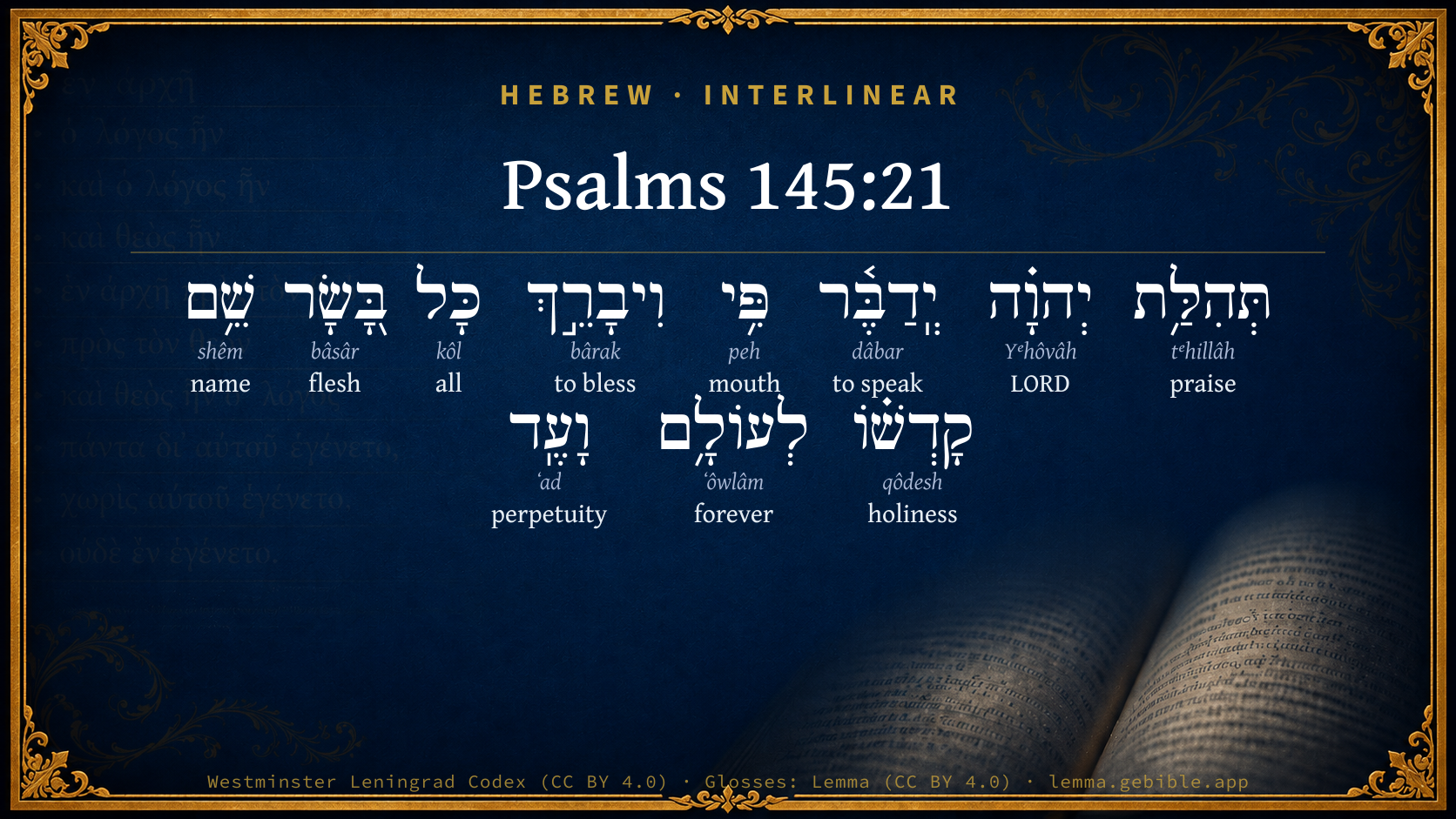
Psalms 145:21

Hebrew (Westminster Leningrad Codex) Psalms 145:21 appears in the Hebrew Old Testament. The text above is from the Westminster Leningrad Codex. Each word links to its Strong’s number, a concise gloss, and parsing drawn from the Open Scriptures Hebrew Bible morphology. Click any word for its full Brown-Driver-Briggs (BDB) entry.
Download image
Cite this verse

Psalms 145:21 (World English Bible). Public Domain. Lemma interlinear Bible study tool, https://lemma.gebible.app/v/psalms/145/21.

Show BibTeX & RIS
BibTeX
RIS
English Translation
My mouth will speak the praise of Yahweh. Let all flesh bless his holy name forever and ever.
World English Bible · Public Domain
Download a study sheet

One document with this verse’s original text, its word-by-word gloss line, the meaning frame, cross-references with their text, attributed commentary, and full source and license credits — printable, and it pastes into notes with its structure intact.

This verse Autodidact and up

Study sheet (.html) Plain text (.txt)

A passage Seminary Student

Up to 50 verses in one chapter. A passage sheet keeps up to 6 commentary sources and 12 cross-references per verse, in the order this page ranks them, and says so on the sheet whenever that leaves anything out. Ask for a single verse and you get the Autodidact verse sheet above.

Everything on this page stays free to read, with no account — the sheet is a download of what is already on screen, not access to it.

Want to remove ads? Support Godless Engineer
Compare translations 3

The same verse in 3 English versions, stacked beneath the original-language interlinear above. Click any original word for its lexicon entry.

Each is an independent rendering of the whole verse — the interlinear is not word-aligned to these translations.

Highlighted words mark where these versions differ — a whole-verse word diff, not a word-by-word alignment.

  • World English Bible Public Domain
    My mouth will speak the praise of Yahweh. Let all flesh bless his holy name forever and ever.
  • King James Version Public Domain
    My mouth shall speak the praise of the LORD: and let all flesh bless his holy name for ever and ever.
  • unfoldingWord Literal Text CC BY-SA 4.0
    My mouth will speak the praise of Yahweh, and all flesh will bless the name of his holiness forever and ever.

unfoldingWord Literal Text — © unfoldingWord, licensed CC BY-SA 4.0. Word-aligned USFM3 via Door43 (git.door43.org/unfoldingWord/en_ult).

Versions to compare (up to 4)

3 of 4 selected

Show all 17 translations

Every available English version of this verse, each an independent rendering of the whole verse.

  • World English Bible Public Domain
    My mouth will speak the praise of Yahweh. Let all flesh bless his holy name forever and ever.
  • Berean Standard Bible Public Domain
    My mouth will declare the praise of the LORD; let every creature bless His holy name forever and ever.
  • Majority Standard Bible Public Domain
    My mouth will declare the praise of the LORD; let every creature bless His holy name forever and ever.
  • King James Version Public Domain
    My mouth shall speak the praise of the LORD: and let all flesh bless his holy name for ever and ever.
  • American Standard Version (1901) Public Domain
    My mouth shall speak the praise of Jehovah; And let all flesh bless his holy name for ever and ever.
  • Revised Version (1885) Public Domain
    My mouth shall speak the praise of the LORD; and let all flesh bless his holy name for ever and ever.
  • Geneva Bible (1599) Public Domain
    My mouth shall speake the prayse of the Lord, and all flesh shall blesse his holy Name for euer and euer.
  • Young's Literal Translation Public Domain
    The praise of Jehovah my mouth speaketh, And all flesh doth bless His holy name, To the age and for ever!
  • Literal Standard Version CC BY-SA 4.0
    My mouth speaks the praise of YHWH, || And all flesh blesses His Holy Name, || For all time and forever!
  • Unlocked Literal Bible CC BY-SA 4.0
    My mouth will speak out the praise of Yahweh; let all mankind bless his holy name forever and ever.
  • unfoldingWord Literal Text CC BY-SA 4.0
    My mouth will speak the praise of Yahweh, and all flesh will bless the name of his holiness forever and ever.
  • Darby Bible Public Domain
    My mouth shall speak the praise of Jehovah; and let all flesh bless his holy name for ever and ever.
  • World Messianic Bible Public Domain
    My mouth will speak the praise of the LORD. Let all flesh bless his holy name forever and ever.
  • Webster's Bible Public Domain
    My mouth shall speak the praise of the LORD: and let all flesh bless his holy name for ever and ever.
  • Free Bible Version CC BY-SA 4.0
    I will speak in praise of the Lord, and may everyone honor his holy character, forever and ever.
  • Bible in Basic English Public Domain
    My mouth will give praise to the Lord; let all flesh be blessing his holy name for ever and ever.
  • JPS Tanakh (1917) Public Domain
    My mouth shall speak the praise of the LORD; and let all flesh bless His holy name for ever and ever.

Literal Standard Version (2020), Covenant Press — licensed CC BY-SA 4.0. Text via the HelloAO Bible API (eBible.org). Unlocked Literal Bible (unfoldingWord) — licensed CC BY-SA 4.0. Text via the HelloAO Bible API (eBible.org). unfoldingWord Literal Text — © unfoldingWord, licensed CC BY-SA 4.0. Word-aligned USFM3 via Door43 (git.door43.org/unfoldingWord/en_ult). Free Bible Version, Dr. Jonathan Gallagher — licensed CC BY-SA 4.0. Text via the HelloAO Bible API (eBible.org).

Word by word

More ways to search: Search by grammar → Find every occurrence → Compare this word →

Practice this passage: Drill this verse → Learn its vocabulary →

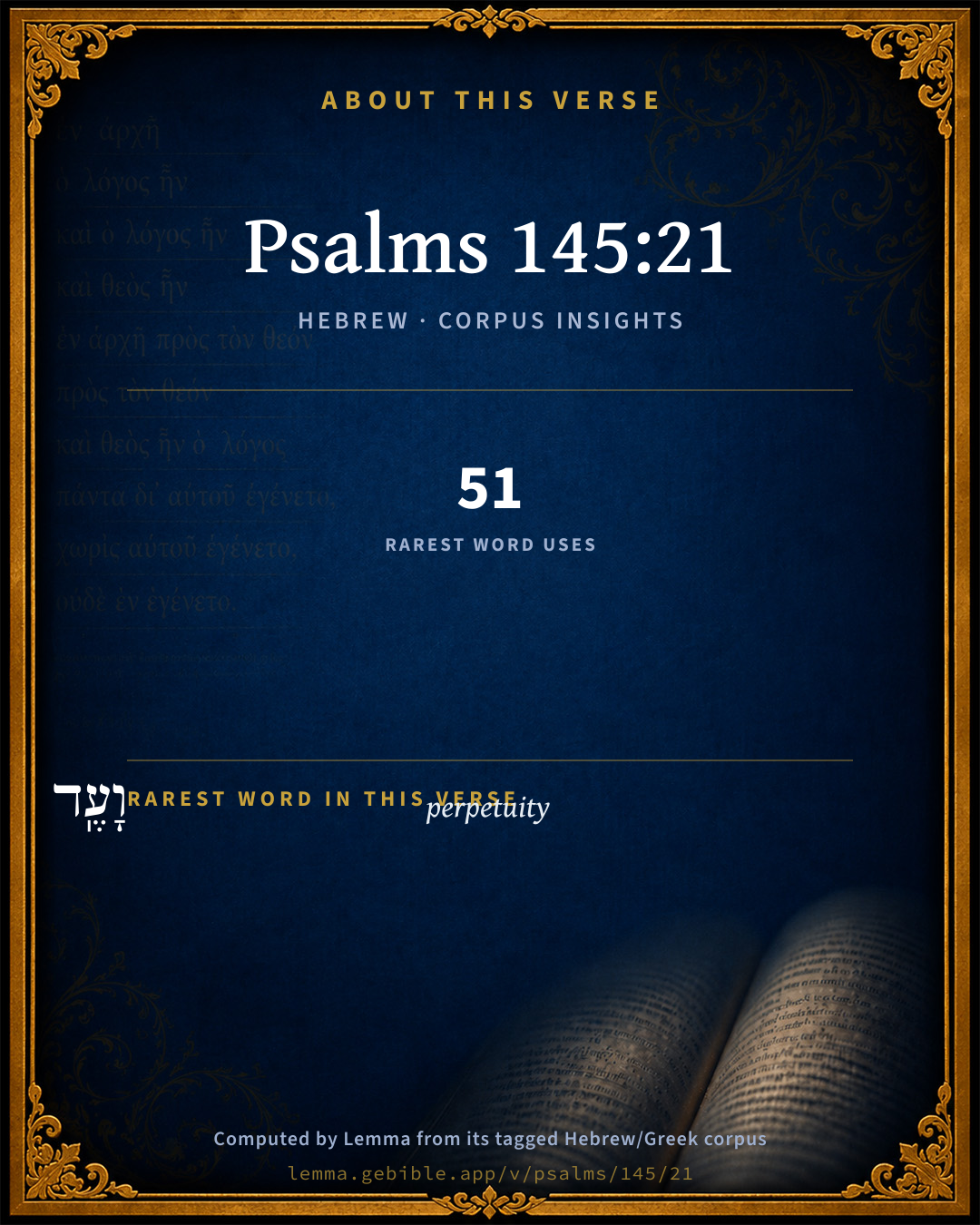
וָעֶֽד
ʻad
H5703
“and · perpetuity”
Conjunction + Noun, Common, Masculine, Singular, Absolute
Part of Speech
Conjunction + Noun
Type
Common
Gender
Masculine
Number
Singular
State
Absolute
Full BDB Definition

Origin: from H5710

TWOT: 1565a

perpetuity, for ever, continuing future - ancient (of past time) - for ever (of future time) - of continuous existence - for ever (of God's existence)
  1. תְּהִלַּ֥ת tᵉhillâh H8416 “praise of” Noun, Common, Feminine, Singular, Construct
  2. יְהוָ֗ה Yᵉhôvâh H3068 “LORD” Noun, Proper
  3. יְֽדַבֶּ֫ר dâbar H1696 “to speak” Verb, Piel, Imperfect, 3rd Person, Masculine, Singular
  4. פִּ֥י peh H6310 “mouth · my” Noun, Common, Masculine, Singular, Construct + Suffix, Personal, 1st Person, Common, Singular
  5. וִיבָרֵ֣ךְ bârak H1288 “and · to bless” Conjunction + Verb, Piel, Imperfect, 3rd Person, Masculine, Singular
  6. כָּל kôl H3605 “all of” Noun, Common, Masculine, Singular, Construct
  7. בָּ֭שָׂר bâsâr H1320 “flesh” Noun, Common, Masculine, Singular, Absolute
  8. שֵׁ֥ם shêm H8034 “name of” Noun, Common, Masculine, Singular, Construct
  9. קָדְשׁ֗וֹ qôdesh H6944 “holiness · his” Noun, Common, Masculine, Singular, Construct + Suffix, Personal, 3rd Person, Masculine, Singular
  10. לְעוֹלָ֥ם ʻôwlâm H5769 “to/for · forever” Preposition + Noun, Common, Masculine, Singular, Absolute

About this verse

These counts appear in no published source. They are computed here, from the morphology-tagged text and Lemma’s own curated glosses. What Lemma adds →

11
words
11
distinct lemmas
Wisdom
section

Shared distinctive vocabulary

וָעֶֽד perpetuity H5703 occurs in 49 verses of the Hebrew Bible. Also found in:

Grammatical profile

  • 2 verbs
  • 9 nouns

Verb forms

  • יְֽדַבֶּ֫ר Piel · Imperfect
  • וִיבָרֵ֣ךְ Piel · Imperfect

Hebrew & Septuagint length

In English translation the verse runs 18 words from the Hebrew and 21 from the Septuagint (LXX English) — closely comparable.

A rough comparison of the two English renderings, which tokenize alike — not a word-level alignment.

Word counts can differ between the Hebrew and the Greek without any difference in meaning — e.g. the Hebrew direct-object marker אֵת has no separate Greek word, and Greek often adds the article ὁ.

Cross-references

15

Topical passages linked to Psalms 145:21 in the Treasury of Scripture Knowledge — connected by theme and wording, ordered by reader-vote popularity; previews shown in the World English Bible.

  • Psalms 71:8 My mouth shall be filled with your praise, With your honor all the day.
  • Psalms 51:15 Lord, open my lips. My mouth shall declare your praise.
  • Psalms 150:6 Let everything that has breath praise Yah! Praise Yah!
  • Psalms 30:12 To the end that my heart may sing praise to you, and not be silent. Yahweh my God, I will give thanks to you forever!
  • Psalms 71:15 My mouth will tell about your righteousness, And of your salvation all day, Though I don't know its full measure.
  • Psalms 71:23–24 My lips shall shout for joy! My soul, which you have redeemed, sings praises to you!
  • Psalms 117:1–2 Praise Yahweh, all you nations! Extol him, all you peoples!
  • Psalms 145:1–2 I will exalt you, my God, the King. I will praise your name forever and ever.
  • Revelation 5:11–14 I saw, and I heard something like a voice of many angels around the throne, the living creatures, and the elders; and the number of them was ten thousands of ten thousands, and thousands of thousands;
  • Psalms 65:2 You who hear prayer, To you all men will come.
  • Psalms 67:3–4 Let the peoples praise you, God. Let all the peoples praise you.
  • Psalms 86:9 All nations you have made will come and worship before you, Lord. They shall glorify your name.
  • Psalms 89:1 I will sing of the loving kindness of Yahweh forever. With my mouth, I will make known your faithfulness to all generations.
  • Psalms 103:22 Praise Yahweh, all you works of his, In all places of his dominion. Praise Yahweh, my soul.
  • Psalms 145:5 Of the glorious majesty of your honor, Of your wondrous works, I will meditate.

Cross-references courtesy of OpenBible.info (CC BY 4.0).

Hebrew and Greek witnesses Masoretic Hebrew ↔ Greek Septuagint

The same verse in the two great witnesses to the Old Testament, shown verse-for-verse.

You’re reading Greek Psalm 144 (Hebrew Psalm 145). The Septuagint counts the superscription, so verse numbers can differ from the Hebrew — chapter-level alignment, not verse-by-verse. Numbering follows Rahlfs.

These are two independent witnesses, not word-aligned to each other, and the Septuagint is shown in lemma (dictionary) form.

Hebrew Psalms 145:21 Masoretic · Westminster Leningrad Codex

תְּהִלַּ֥ת יְהוָ֗ה יְֽדַבֶּ֫ר פִּ֥י וִיבָרֵ֣ךְ כָּל בָּ֭שָׂר שֵׁ֥ם קָדְשׁ֗וֹ לְעוֹלָ֥ם וָעֶֽד

My mouth will speak the praise of Yahweh. Let all flesh bless his holy name forever and ever.

World English Bible · Public Domain

Greek LXX Greek Psalm 144:21 Septuagint · lemma form

αἴνεσις κύριος λαλέω ὁ στόμα ἐγώ καί εὐλογέω πᾶς σάρξ ὁ ὄνομα ὁ ἅγιος αὐτός εἰς ὁ αἰών καί εἰς ὁ αἰών ὁ αἰών

My mouth shall speak the praise of the Lord: and let all flesh bless his holy name for ever and ever.

LXX2012 (modern English Septuagint) · Public Domain

Hebrew: Westminster Leningrad Codex (CC BY 4.0). Greek: Septuagint (public domain); English from LXX2012 (modern English Septuagint) (Public Domain). How the Septuagint differs from the Hebrew →

Commentary

Notes on Psalms 145:21 from classic Christian and Jewish commentators (each source and its license shown beneath its notes). The classic Christian expositions comment on the surrounding passage and are grouped to its opening verse, so a note may address several verses; the Jewish commentaries on the Tanakh (Rashi and others) are per-verse, so they appear only where the commentator wrote on this verse.

Lemma curates 59 commentaries, every one of them public domain or Creative Commons licensed, each selected and text-cleaned for this edition rather than reprinted as found. About our sources →

Adam Clarke's Commentary

Verse 21. Let all flesh bless his holy name] He is good to all, wants to save all, actually feeds and preserves all. And as near as שמר shamar is to שמד shamad, so near is he a Saviour to those who stand on the brink of destruction, if they will look to him.

For the application of all this Psalm to the Church of Christ, see the analysis.

ANALYSIS OF THE HUNDRED AND FORTY-FIFTH PSALM

This hymn is most excellent, both as it regards matter and style. The matter is praise to God; the style, the Hebrew alphabet, the better to assist our memories in recording God's praise.

This Psalm contains, -

I. A proem, or protestation to praise God, Ps 145:1-2.

II. A celebration of Divine praises through the whole Psalm, from these arguments: -

I. From the greatness of God, Ps 145:3.

II. From his wonderful works, Ps 145:4, which he distinguishes under the following heads: -

1. They are glorious and beautiful, majestic and wonderful, Ps 145:5.

2. Marvellous, and full of terror, Ps 145:6.

3. Amiable, and full of goodness, Ps 145:7-9. But all wonderful.

III. From his kingdom, and government of it, and in it, Ps 145:10-21.

IV. A conclusion, Ps 145:21, in which he performs his protestation of praising God.

I. In the two first verses the psalmist acquaints us what he will do with the whole.

1. "I will extol, I will bless, I will praise."

2. "Thee, my God, my King." I am thy servant, though an earthly king.

3. "Every day," c. No day shall pass without my praising thee.

4. "For ever and ever." I shall now begin, and a succession of men will continue to hymn and praise thee till the consummation of all things.

II. The first thing he praises God for is his essence. Great.

I. "Great is the Lord, and greatly to be praised." Of course this follows: -

"And his greatness is unsearchable." Past our weak capacity to comprehend higher than the heavens, deeper than hell, having no end. Or if great here refer to him as King, then in respect to the extension of his empire over every living creature, he is great; he rules over the hearts of the children of men, over their thoughts and affections, and nothing is hidden from his sight.

II. From the essence of God the psalmist passes to his works and effects, which yet set forth his praise: "One generation shall praise," c. Each age is an eyewitness of thy mighty acts and mercy. From a general consideration of these works he then particularizes: -

1. "For the heavens declare," c. The sun, moon, and stars, in their splendour, magnitude, and perpetual motion, show forth God's honour and majesty.

2. A second kind of works are the terrible acts of his justice, such as the deluge, the fire of Sodom, Pharaoh's overthrow in the Red Sea, the earth opening to swallow up Korah, Dathan, and Abiram.

Then there follow his acts of love and mercy, spoken of at large.

1. "Thy great works shall abundantly utter," &c. Thy bounty shall make all generations eloquent in thy praise, and shall sing of thy righteousness, in exhibiting thy promised blessings, in bestowing temporal benefits but above all, in the gifts of thy grace: - In the incarnation, passion, resurrection, ascension, the coming of the Holy Ghost, calling of the Gentiles, justification, sanctification, and eternal life for all these, and each of them, men shall abundantly utter thy righteousness.

2. "The Lord is gracious," c.

3. "The Lord is good to all," &c.

4. "His tender mercies are over," &c. Even to the most wicked, God gives time and opportunity for repentance, before he cuts them off.

III. The prophet having sung of God's great works in glory, terror, and mercy, now adds, "All thy works shall praise thee, O Lord." And now he begins a new matter, the erection of his peculiar kingdom in his Church: "A peculiar people," &c. His saints. These will continue to mark thy wonders, and sing to thy glory: these, thy saints, shall bless thee for all and in all thy acts. "They shall speak of the glory of thy kingdom," &c. "To make known to the sons of men," &c. "Thy kingdom is an everlasting kingdom," &c. Now the power and glory of Christ's kingdom differ in a fourfold manner from that of the sons of men.

1. The kings on earth require obedience from their subjects they exact subsidies, tributes, taxes, c.

2. Earthly kings glory in their power, and rejoice in their dignity but their crown is full of thorns, anxiety, care, c.

3. Earthly kings reign but for a time, Christ for ever. 1. "They shall speak of the glory," &c. Excelling all others. 2. "To make known," &c. Thy acts far beyond theirs 3. "Thy kingdom is an everlasting kingdom," &c. Not so theirs.

The prophet having described Christ's kingdom, begins to extol the qualities and virtues of a good king, which agrees with Christ.

I. His veracity.

II. His probity: "The Lord is faithful," &c.

III. This is another quality of a good king, so to govern his subjects that they fall not, or to raise them if fallen. Christ sustains and upholds his people, or restores them if they fall from him and return by repentance to him this was exemplified in David, Peter, the prodigal, c. "The eyes of all," &c. "Thou openest thine hand," &c.

IV. Liberality and bounty are excellent qualities in a king who cares for his subjects, and may properly be applied to Christ, who provides for his Church in all things. And -

1. "The eyes of all wait upon thee." In expectation.

2. "And thou givest," &c. It is a gift, not a debt.

3. "Their meat." Every thing fit for them.

4. "In due season." When fit and necessary.

5. "Thou openest thine hand." Givest bountifully.

6. "And satisfiest," &c. The covetous always want content is from God.

7. "The desire of every living thing," c. "The Lord is righteous," &c.

V. This is another virtue of a good king, and refers to Christ. "The Lord is nigh unto all them," &c.

VI. This is the sixth quality of a good king, to show himself ready of access to all who implore his aid.

1. Faith. For he that prays without it will not be answered.

2. Hope and confidence. He prays not seriously who hopes not to be heard.

3. Love. No man prays who hates God.

4. Desire. Nor that desires not to obtain.

5. Attention and intention, without which prayer is idle. "The Lord will fulfil," &c.

VII. The seventh quality of a good king is to grant petitions.

1. "He will fulfil," &c. But with limitation: "So they fear him."

2. "He also will hear their cry." When it is earnest and sincere.

3. "And will save them:" "The Lord preserveth all them," &c.

VIII. The eighth quality of a good king is to spare the humble and destroy the proud. Parcere subjectis, et debellare superbos. - VIRGIL. Which Christ will do he preserves his martyrs in patience, and then receives them into glory.

IV. The conclusion is an acclamation, and answers to the beginning of the Psalm.

1. "My mouth shall speak," &c. This will I do while I live.

2. "And let all flesh," &c. And let all follow his example in giving due praise to this bountiful God.

Adam Clarke's Commentary on the Bible (1810–1826) — public domain. Text from a community e-Sword/MySword module.

Trapp's Complete Commentary

John Trapp

Psa 145:21 My mouth shall speak the praise of the LORD: and let all flesh bless his holy name for ever and ever.

Ver. 21. My mouth shall speak, &c.] This he had oft before promised; but engageth again, that he may not start back.

And let all flesh] But especially men, good men; for high words beseem not a fool. But it well becometh the saints to be thankful, nec servire Deo solum sedet adulari, as Tertullian speaks.

John Trapp, A Commentary or Exposition upon All the Books of the Old and New Testament (1647–1656) — public domain. Text from a community e-Sword module.

J. A. Alexander on Psalms

Joseph Addison Alexander

21. (Psa 145:21) The praise of Jehovah shall my mouth speak, and all flesh shall bless his holy name for ever, or retaining the idiomatic form of the original, all flesh shall bless the name of his holiness (or his name of holiness) to eternity and perpetuity. The use of the word praise connects this verse with the title or inscription in Psa 145:1, which is thereby justified or proved to be correct. All flesh, as in Psa 65:2. His holy name, as in Psa 33:21.

Joseph Addison Alexander, The Psalms Translated and Explained (1850) — public domain. Text from a community e-Sword module.

Geneva Bible (1599)

Geneva Bible translators

That is, all men shall be bound to praise him.

Geneva Bible (1599) marginal notes — public domain. Text via Bolls.life.

Jamieson, Fausset & Brown

Robert Jamieson, A. R. Fausset & David Brown

(Compare Psa 33:21).

all flesh-- (Psa 65:2). The Psalm ends, as it began, with ascriptions of praise, in which the pious will ever delight to join.

Next: Psalms Chapter 147

Jamieson, Fausset & Brown — Commentary Critical and Explanatory on the Whole Bible (1871) — public domain (CC PDM 1.0). Text via the HelloAO Bible API.

Ellicott's Commentary for English Readers

(21) Holy name.—As in Psa_33:21; Psa_103:1; Psa_105:3.

A Bible Commentary for English Readers, edited by Charles John Ellicott (1878–1897) — public domain. Text from a community e-Sword module.

The Cambridge Bible for Schools and Colleges

gen. ed. J. J. S. Perowne

21. Israel’s own resolution is fixed; but nothing less can satisfy its aspirations than a universal and unending chorus of praise from all mankind, evoked by the revelation of His absolute and perfect holiness.

The Cambridge Bible for Schools and Colleges (gen. ed. J. J. S. Perowne; Cambridge University Press, 1878–1918) — public domain. Text from a community e-Sword module.

John Gill's Exposition

My mouth shall speak the praise of the Lord,.... Always, at all times, as long as he lived; and particularly when all the Lord's people shall be brought safe to glory, and the wicked destroyed; when, as Kimchi observes, he should live again with the dead that shall be raised;

and let all flesh bless his holy name for ever and ever; not every animal, or irrational creature; not carnal men, but spiritual men; such as are praying ones, that come to a God hearing prayer: these should be praising ones; such who have hearts of flesh given them, and are sensible of divine favours, as well as of their sinfulness and unworthiness; Jews and Gentiles, all sorts of men called by grace, all flesh on whom the Spirit of God is poured; these are all excited to praise and bless the holy name of the Redeemer, with the words and by the example of the psalmist. And thus the psalm ends as it begun, with praise and blessing.

Next: Psalms Chapter 146

John Gill's Exposition of the Whole Bible (1746–1763) — public domain (CC PDM 1.0). Text via the HelloAO Bible API.

Albert Barnes' Notes on the Bible

My mouth shall speak the praise of the Lord - That is, I will utter his praise. In view of all these things, in view of his character and doings, I will praise him. I will be found among those who honor him; who acknowledge him as the true God; who render homage for what he is, and thanks for what he has done.

And let all flesh bless his holy name forever and ever - All people; all that dwell upon the earth. Let his praise be universal and eternal. This is the language of true piety; all in whose bosom there is any true religion will heartily say Amen. No desire of a pious heart is more constant and strong than that God should be praised, adored, honored by all intelligent creatures; that he should be known and acknowledged in all the earth as the true God; that his praise should ascend from all parts of the universe forever. See the notes at Psa 100:1-5.

Albert Barnes' Notes on the Bible (1834–1885) — public domain. Text from a community e-Sword/MySword module.

The Treasury of David

Charles H. Spurgeon

Ver. 21. My mouth shall speak the praise of the LORD. Whatever others may do, I will not be silent in the praise of the Lord: whatever others may speak upon, my topic is fixed once for all: I will speak the praise of Jehovah. I am doing it, and I will do it as long as I breathe. And let all flesh bless his holy name for ever and ever. Praise is no monopoly for one, even though he be a David; others are debtors, let them also be songsters. All men of every race, condition, or generation should unite to glorify God. No man need think that he will be rejected when he comes with his personal note of praise; all are permitted, invited, and exhorted to magnify the Lord. Specially should his holiness be adored: this is the crown, and in a certain sense the sum, of all his attributes. Only holy hearts will praise the holy name, or character of the Lord; oh, that all flesh were sanctified, then would the sanctity of God be the delight of all. Once let the song begin and there will be no end to it. It shall go on for ever and a clay, as the old folks used to say. If there were two forevers, or twenty forevers, they ought all to be spent in the praises of the ever living, ever blessing, ever blessed JEHOVAH. Blessed be the Lord for ever for having revealed to us his name, and blessed be that name as he has revealed it; yea, blessed be he above all that we can know, or think, or say. Our hearts revel in the delight of praising him. Our mouth, our mind, our lip, our life shall be our Lord's throughout this mortal existence, and when time shall be no more.

Ver. 21. Individual praise suggests the desire for universal praise. We like company in a good deed; we perceive the inadequacy of our own song; we desire others to be happy; we long to see that done which is right and good.

Charles H. Spurgeon's The Treasury of David (1869–1885) — public domain. Psalms only. Text from a community e-Sword/MySword module.

Whedon's Commentary on the Bible

Daniel D. Whedon

21. David comes to the end of the Hebrew alphabet, but not to the end of his gratitude and praise. All flesh, here, means all the human race. It is something more than a wish that is here expressed; it is a prophetic glimpse of the time when, from the rising of the sun to the going down of the same, the Lord’s name shall be praised, and David’s tehillah—the Hebrew name for this psalm—be sung by every nation, and kindred, and tongue, and people.

Daniel D. Whedon (gen. ed.), Commentary on the Old and New Testaments (1874–1909) — public domain. Text from a community e-Sword module.

The Pulpit Commentary

My mouth shall speak the praise of the Lord. The "psalm of praise" (title) ends as it began (vers. 1, 2) with the strong determination of the psalmist that he at least will praise Jehovah. Others, he hopes, will join with him, and all flesh bless his holy Name (literally, the Name of his holiness) forever and ever; but for this result he can only wish and hope and pray he cannot ensure it. But he can, and does, fulfill his own duty in the matter.

The Pulpit Commentary (1880–1919), ed. H.D.M. Spence-Jones & Joseph S. Exell — public domain. Text from a community e-Sword module.

Rashi

Rabbi Shlomo Yitzchaki (Rashi)

My mouth will speak the praise of the Lord and also all flesh will bless His holy name forever and ever.

Rashi on the Tanakh — English translations: “The Judaica Press complete Tanach with Rashi, translated by A. J. Rosenberg” (CC BY 4.0); “Pentateuch with Rashi's commentary by M. Rosenbaum and A.M. Silbermann, 1929-1934” (public domain); “The Metsudah Tanach series, Lakewood, N.J” (CC BY 4.0); and “The Book of Joshua, Metsudah Publications, 1997” (CC BY 4.0). Text via Sefaria.

Lesson kit

Teaching starters — assembled from the data on this page, not authored interpretation. Every prompt links to the verse data it draws on. Edit before teaching.

Psalms, in the Wisdom, opens this verse with 11 words (11 distinct Hebrew lemmas). Its most distinctive word is ʻad (“perpetuity”). A historical commentator’s framing appears above. Read the whole chapter for the surrounding context.

Discussion questions

  1. The word ʻad carries the sense “perpetuity.” How does it shape the verse?
  2. How does Exodus 15:18, which shares the word «perpetuity», read alongside this verse?
  3. These translations render this verse differently; the difference is in the English rendering, not the original. What questions does that raise?
  4. «יְֽדַבֶּ֫ר» is a Piel Imperfect verb. How does that grammatical form shape the action described?
  5. Compare how Adam Clarke's Commentary and Trapp's Complete Commentary read this verse. Where do they agree or differ?

Things to notice

Reading settings

Reading text

Shown beneath each verse's original-language words.

Old Testament
Old Testament edition

Read the OT as the Masoretic Hebrew (MT) or the Greek Septuagint (LXX).

English shown for the Greek Septuagint (in the Hebrew ↔ Greek comparison).

Comparing translations? Open the Compare panel on any verse page to stack up to four side by side.