
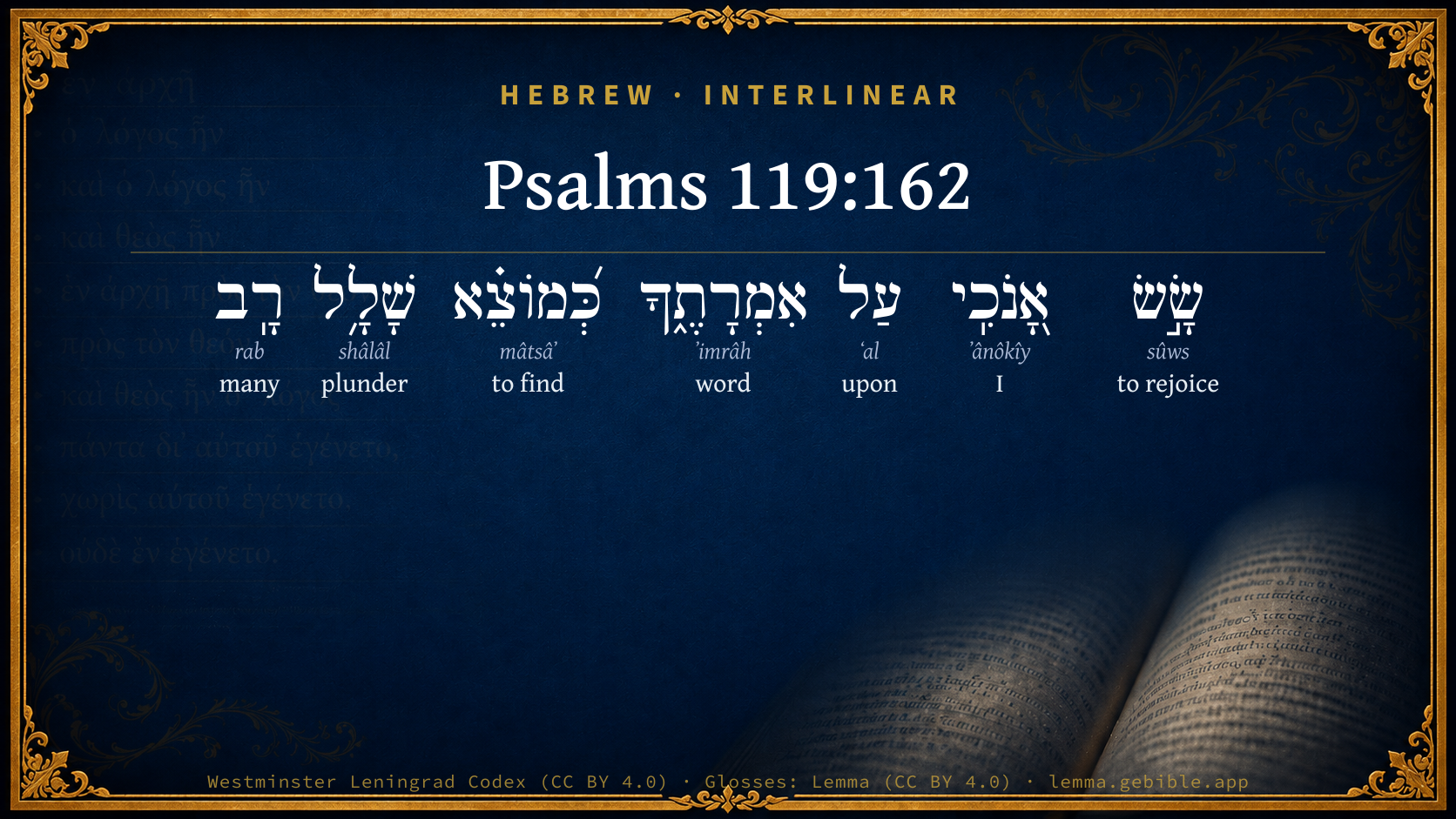
Psalms 119:162

Hebrew (Westminster Leningrad Codex) Psalms 119:162 appears in the Hebrew Old Testament. The text above is from the Westminster Leningrad Codex. Each word links to its Strong’s number, a concise gloss, and parsing drawn from the Open Scriptures Hebrew Bible morphology. Click any word for its full Brown-Driver-Briggs (BDB) entry.
Download image
Cite this verse

Psalms 119:162 (World English Bible). Public Domain. Lemma interlinear Bible study tool, https://lemma.gebible.app/v/psalms/119/162.

Show BibTeX & RIS
BibTeX
RIS
English Translation
I rejoice at your word, As one who finds great spoil.
World English Bible · Public Domain
Download a study sheet

One document with this verse’s original text, its word-by-word gloss line, the meaning frame, cross-references with their text, attributed commentary, and full source and license credits — printable, and it pastes into notes with its structure intact.

This verse Autodidact and up

Study sheet (.html) Plain text (.txt)

A passage Seminary Student

Up to 50 verses in one chapter. A passage sheet keeps up to 6 commentary sources and 12 cross-references per verse, in the order this page ranks them, and says so on the sheet whenever that leaves anything out. Ask for a single verse and you get the Autodidact verse sheet above.

Everything on this page stays free to read, with no account — the sheet is a download of what is already on screen, not access to it.

Want to remove ads? Support Godless Engineer
Compare translations 3

The same verse in 3 English versions, stacked beneath the original-language interlinear above. Click any original word for its lexicon entry.

Each is an independent rendering of the whole verse — the interlinear is not word-aligned to these translations.

Highlighted words mark where these versions differ — a whole-verse word diff, not a word-by-word alignment.

  • World English Bible Public Domain
    I rejoice at your word, As one who finds great spoil.
  • King James Version Public Domain
    I rejoice at thy word, as one that findeth great spoil.
  • unfoldingWord Literal Text CC BY-SA 4.0
    I am rejoicing over your word, like one finding great plunder.

unfoldingWord Literal Text — © unfoldingWord, licensed CC BY-SA 4.0. Word-aligned USFM3 via Door43 (git.door43.org/unfoldingWord/en_ult).

Versions to compare (up to 4)

3 of 4 selected

Show all 17 translations

Every available English version of this verse, each an independent rendering of the whole verse.

  • World English Bible Public Domain
    I rejoice at your word, As one who finds great spoil.
  • Berean Standard Bible Public Domain
    I rejoice in Your promise like one who finds great spoil.
  • Majority Standard Bible Public Domain
    I rejoice in Your promise like one who finds great spoil.
  • King James Version Public Domain
    I rejoice at thy word, as one that findeth great spoil.
  • American Standard Version (1901) Public Domain
    I rejoice at thy word, As one that findeth great spoil.
  • Revised Version (1885) Public Domain
    I rejoice at thy word, as one that findeth great spoil.
  • Geneva Bible (1599) Public Domain
    I reioyce at thy worde, as one that findeth a great spoyle.
  • Young's Literal Translation Public Domain
    I do rejoice concerning Thy saying, As one finding abundant spoil.
  • Literal Standard Version CC BY-SA 4.0
    I rejoice concerning Your saying, || As one finding abundant spoil.
  • Unlocked Literal Bible CC BY-SA 4.0
    I rejoice at your word like one who finds great plunder.
  • unfoldingWord Literal Text CC BY-SA 4.0
    I am rejoicing over your word, like one finding great plunder.
  • Darby Bible Public Domain
    I have joy in thy ùword, as one that findeth great spoil.
  • World Messianic Bible Public Domain
    I rejoice at your word, as one who finds great plunder.
  • Webster's Bible Public Domain
    I rejoice at thy word, as one that findeth great spoil.
  • Free Bible Version CC BY-SA 4.0
    Your word makes me so happy—I'm like someone who discovers immense treasure.
  • Bible in Basic English Public Domain
    I am delighted by your saying, like a man who makes discovery of great wealth.
  • JPS Tanakh (1917) Public Domain
    I rejoice at Thy word, as one that findeth great spoil.

Literal Standard Version (2020), Covenant Press — licensed CC BY-SA 4.0. Text via the HelloAO Bible API (eBible.org). Unlocked Literal Bible (unfoldingWord) — licensed CC BY-SA 4.0. Text via the HelloAO Bible API (eBible.org). unfoldingWord Literal Text — © unfoldingWord, licensed CC BY-SA 4.0. Word-aligned USFM3 via Door43 (git.door43.org/unfoldingWord/en_ult). Free Bible Version, Dr. Jonathan Gallagher — licensed CC BY-SA 4.0. Text via the HelloAO Bible API (eBible.org).

Word by word

More ways to search: Search by grammar → Find every occurrence → Compare this word →

Practice this passage: Drill this verse → Learn its vocabulary →

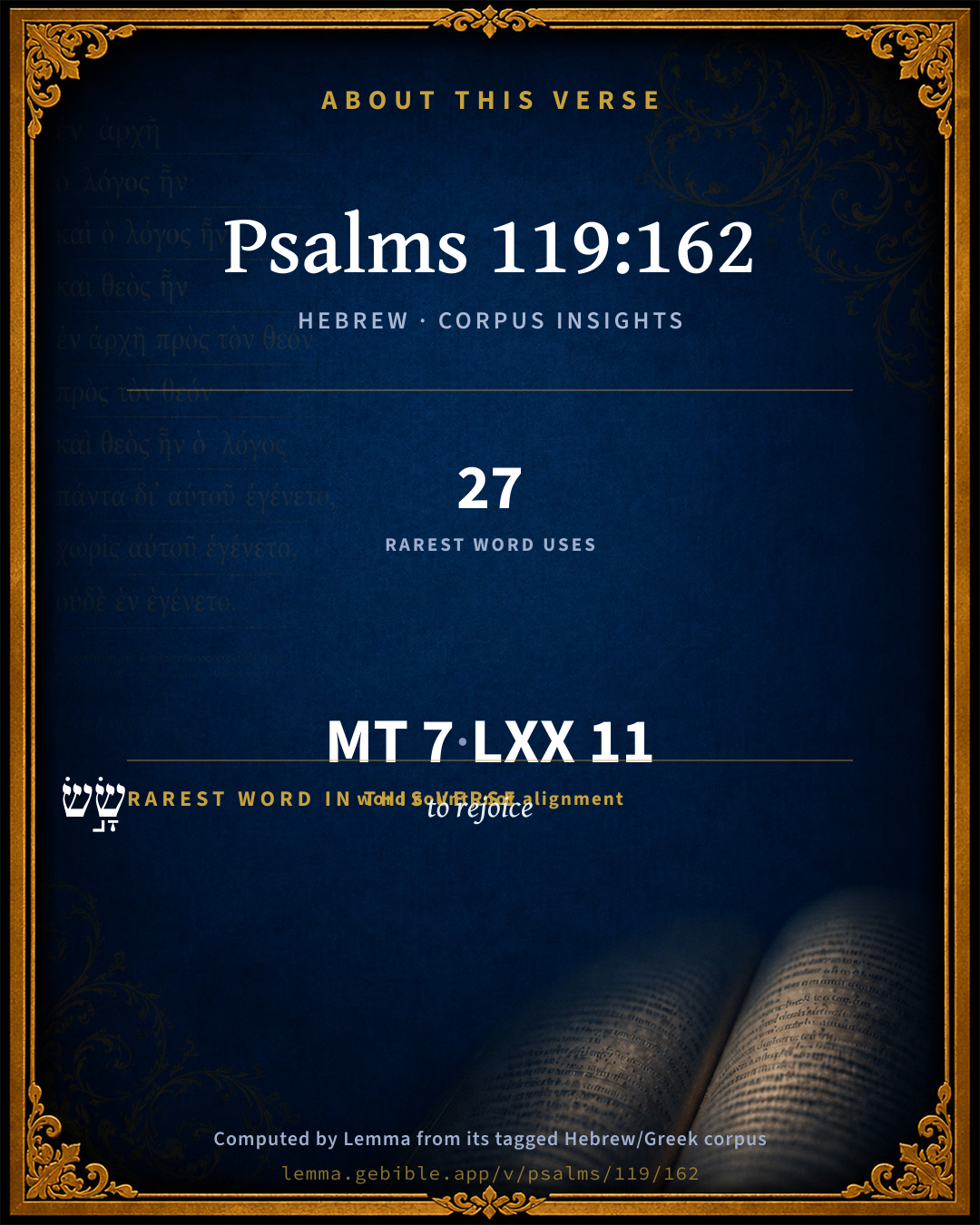
About this verse

These counts appear in no published source. They are computed here, from the morphology-tagged text and Lemma’s own curated glosses. What Lemma adds →

7
words
7
distinct lemmas
Wisdom
section

Shared distinctive vocabulary

שָׂ֣שׂ to rejoice H7797 occurs in 24 verses of the Hebrew Bible. Also found in:

Grammatical profile

  • 2 verbs
  • 2 nouns
  • 1 adjective
  • 1 pronoun
  • 1 preposition

Verb forms

  • שָׂ֣שׂ Qal · Participle Active
  • כְּ֝מוֹצֵ֗א Qal · Participle Active

Hebrew & Septuagint length

In English translation the verse runs 11 words from the Hebrew and 13 from the Septuagint (LXX English) — closely comparable.

A rough comparison of the two English renderings, which tokenize alike — not a word-level alignment.

Word counts can differ between the Hebrew and the Greek without any difference in meaning — e.g. the Hebrew direct-object marker אֵת has no separate Greek word, and Greek often adds the article ὁ.

In the original languages it is 7 Hebrew tokens and 11 Greek tokens — but the two are counted differently (Hebrew bundles its prefixes and suffixes into one token; the Greek is in lemma form), so that isn’t a like-for-like length.

Cross-references

6

Topical passages linked to Psalms 119:162 in the Treasury of Scripture Knowledge — connected by theme and wording, ordered by reader-vote popularity; previews shown in the World English Bible.

  • Jeremiah 15:16 Your words were found, and I ate them; and your words were to me a joy and the rejoicing of my heart: for I am called by your name, Yahweh, God of hosts.
  • Psalms 119:72 The law of your mouth is better to me than thousands of pieces of gold and silver.
  • Psalms 119:111 I have taken your testimonies as a heritage forever, For they are the joy of my heart.
  • 1 Samuel 30:16 When he had brought him down, behold, they were spread abroad over all the ground, eating and drinking, and dancing, because of all the great spoil that they had taken out of the land of the Philistines, and out of the land of Judah.
  • Isaiah 9:3 You have multiplied the nation, you have increased their joy: they joy before you according to the joy in harvest, as men rejoice when they divide the spoil.
  • Proverbs 16:19 It is better to be of a lowly spirit with the poor, Than to divide the plunder with the proud.

Cross-references courtesy of OpenBible.info (CC BY 4.0).

Hebrew and Greek witnesses Masoretic Hebrew ↔ Greek Septuagint

The same verse in the two great witnesses to the Old Testament, shown verse-for-verse.

You’re reading Greek Psalm 118 (Hebrew Psalm 119). The Septuagint counts the superscription, so verse numbers can differ from the Hebrew — chapter-level alignment, not verse-by-verse. Numbering follows Rahlfs.

These are two independent witnesses, not word-aligned to each other, and the Septuagint is shown in lemma (dictionary) form.

Hebrew Psalms 119:162 Masoretic · Westminster Leningrad Codex

שָׂ֣שׂ אָ֭נֹכִֽי עַל אִמְרָתֶ֑ךָ כְּ֝מוֹצֵ֗א שָׁלָ֥ל רָֽב

I rejoice at your word, As one who finds great spoil.

World English Bible · Public Domain

Greek LXX Greek Psalm 118:162 Septuagint · lemma form

ἀγαλλιάομαι ἐγώ ἐπί ὁ λόγιον σύ ὡς ὁ εὑρίσκω σκῦλον πολύς

I will exult because of your oracles, as one that finds much spoil.

LXX2012 (modern English Septuagint) · Public Domain

Hebrew: Westminster Leningrad Codex (CC BY 4.0). Greek: Septuagint (public domain); English from LXX2012 (modern English Septuagint) (Public Domain). How the Septuagint differs from the Hebrew →

Commentary

Notes on Psalms 119:162 from classic Christian and Jewish commentators (each source and its license shown beneath its notes). The classic Christian expositions comment on the surrounding passage and are grouped to its opening verse, so a note may address several verses; the Jewish commentaries on the Tanakh (Rashi and others) are per-verse, so they appear only where the commentator wrote on this verse.

Lemma curates 59 commentaries, every one of them public domain or Creative Commons licensed, each selected and text-cleaned for this edition rather than reprinted as found. About our sources →

Trapp's Complete Commentary

John Trapp

Psa 119:162 I rejoice at thy word, as one that findeth great spoil.

Ver. 162. I rejoice at thy word] Libenter omnibus omnes opes concesserim, &c., I would gladly leave all the wealth in the world to others, saith Cicero (Epist. lib. 9), so that I might without disturbance live and die in the study of learning. What marvel, then, that David was so taken with heavenly learning?

As one that findeth great spoil] Which as it Cometh oft unexpectedly (and is therefore the better welcome), so the profit is usually very great (as was at the sack of Constantinople), and the pleasure (besides the honour) is no less than the profit, because gotten from an enemy. George Fransperg, a general in the Imperial army, under the conduct of Charles Bourbon, that sacked Rome in the time of Pope Clement VII, caused a halter to be carried near his colours, saying that with that he would hang the pope, the better to encourage his soldiers, who were almost all Lutherans, whom he promised to lead to Rome; showing them the great opportunity they had to enrich themselves with the spoils of that city (Hist. of the Counc. of Trent, p. 43).

John Trapp, A Commentary or Exposition upon All the Books of the Old and New Testament (1647–1656) — public domain. Text from a community e-Sword module.

The Biblical Illustrator

Joseph S. Exell

Psa_119:162

I rejoice at Thy Word, as one that findeth great spoil.

Great spoil

How often is this idea repeated in Scripture! It is developed by our Lord in several of His parables, and touches us all very nearly.

I. The discovery of the unexpected. Religion is full of surprises. A flash of Divine light will startle us with some new meaning in every line. The religious man is ever finding.

1. He finds new depths of his own possibilities.

2. He finds new regions of intense existence.

3. He finds new glories in all he sees.

4. He finds the unfathomable height of infinite love.

5. He finds the unspeakable wisdom of almighty purposes. The deeper he digs the more he discovers.

II. The obtaining great possessions--Finding great spoil.

1. Finding implies obtaining without cost. He who obtains eternal life does so without money and without price.

2. Finding implies activity. It may not mean seeking, for we may find without seeking. But no man can find unless he has his eyes open. The possession discovered is great. There is nothing mean in Gods kingdom--all is great. What is greater than soul-life? What is greater than heaven? What is greater than eternity? Great spoil! (Homilist.)

Great spoil

It is a figure taken from men of war, who, after they have overcome their enemy, divide the plunder among them. This expression is most natural as coming from David. David had been a soldier from his youth up, and he knew personally and literally what it was to divide the spoil. How I like to hear men both in prayer and praise speak like themselves! So must it be with the soldier: if cold, dead propriety rules him you will not know whether he is a soldier or a citizen; but let him grow enthusiastic, and his speech betrayeth him; wars and rumours of wars are in his utterances; he sings and prays to martial music.

I. This great joy is sometimes aroused by the fact that there is a Word of God.

1. This is true if we regard the Scriptures as a revealing of God. After going up and down in the world searching after Deity it is a great delight to come upon a book in which the one only living and true God has unveiled Himself to those who care to behold Him. It is a great find for a man to discover that after all he is not left in a fog to grope his way, but that God has kindled a sun that honest hearts may walk in the light of it and in that light see all things clearly.

2. We also prize it as the guide of our life. This Book tells us the right and bids us follow it; it teaches us the way of wisdom, and the path of understanding, and supplies motives for walking therein.

3. More than this, a word from God apprehended in the soul is a sure pledge of mercy. Consider what words those words of God are; how full of love, and grace, and tenderness.

4. Holy Scripture, when it comes to us with power as the Word of God, is the beginning of communion with God.

II. Frequently the joy of the believer in the Word arises out of his having had to battle to obtain a grasp of it.

1. We have had to fight over certain doctrines before we could really come at them.

2. What a fight there is sometimes over a promise.

3. Sometimes the hardest fight is round a precept.

4. A sharp warfare often goes on over the threatenings.

5. Yet, once more, this is true about the Word which reveals Christ. We know not Christ aright till we are conformed to what we know of Him. If Christ be lovely we shall not understand that loveliness till we are in a measure lovely ourselves. We must get to be like Him; and oh, when we do, then every lineament of that dear face will be conspicuously and transcendentally charming to us, because we have come to it through suffering.

III. At times the joy of the believer lies in enjoying Gods Word without any fighting at all.

1. The Word of the Lord is often as spoil found, not fought for. The promise lies before me on the way, and I find it, and by the law of the kingdom of grace it becomes mine for the finding. What joy is this?

2. The spoil, however, must have cost somebody else most dear, though it has cost us nothing. Ah, what a fight--Gethsemane and Calvary! Life, light, peace, joy, holiness, immortality, heaven,--all these are brought back by our great Conqueror, who has taken the prey from the mighty, and brought back the lawful captives, leading captivity captive. O, brethren, we do rejoice when we get a hold of the precious treasures of the Word as Jesus Christs spoil, fought for by Himself, and then distributed to us.

IV. There is a joy arising out of the very fact that Holy Scripture may be considered to be a spoil.

1. A spoil is the end of the uncertainty. When a man has in experience fought up to confidence in the Word of the Lord, or has had it effectually laid home by the Holy Spirit to his own soul, then he reaches the end of the controversy so far as he himself is concerned: he is dividing the spoil, for he says, We have known and believed the love which God hath, etc.

2. It is the weakening of the adversary for any future attacks; for when they divide the spoil they say to one another, The invaders will be here again, no doubt, before long; but they will not have this great gun to turn upon us; we have spiked it. They may again take up arms; but their force is broken. Every doubt a man conquers by resting on the infallible Word has weakened the power of unbelief within him, and strengthened his faith.

3. In dividing the spoil there is always a sense of victory, and so there is in believing Gods Word. In getting firm hold upon the faithful testimony of our God, we achieve a conquest over doubts, fears, disquietudes, and all our proud judgments of God.

4. In dividing the spoil there is profit, pleasure, and honour. When we can say that the things which God has revealed are ours, then we are rich beyond a misers dream; and when we can hold them against all comers, then that which we believe becomes our honour and gives glory to us, and glory to faith, and chief glory to Him who wrought our faith in us by His almighty Spirit.

5. The spoil is a prophecy of rest, and so is that delightful dividing up of the Word of God, and the appropriation thereof by faith. Ah, said the Romans when they spoiled old Carthage, we shall never see another Hannibal at our gates, nor dread the ships of Carthage in our seas. They had overcome their most potent adversary when they utterly spoiled her, and when they looked for a long period of peace. And that is the joy of receiving the Word. When we can believe that Jesus took our sins, and suffered for them on the tree, we are no more troubled as to the guilt of sin. When we believe that our heavenly Father overrules all things for the good of His people, then sorrow and sighing, fear and fretting flee away. (C. H. Spurgeon.)

The Biblical Illustrator, edited by Joseph S. Exell (c. 1880s–1900s) — public domain. Text from a community e-Sword module.

J. A. Alexander on Psalms

Joseph Addison Alexander

162. (Psa 119:162) Rejoicing (am) I over thy saying, like (one) finding much spoil. The participle indicates continued and habitual rejoicing. Thy saying, that which thou hast said, thy law with its attendant promises.

Joseph Addison Alexander, The Psalms Translated and Explained (1850) — public domain. Text from a community e-Sword module.

Matthew Henry's Commentary

Here is, 1. The pleasure David took in the word of God. He rejoiced at it, rejoiced that God had made such a discovery of his mind, that Israel was blessed with that light when other nations sat in darkness, that he was himself let into the understanding of it and had had experience of the power of it. He took a pleasure in reading it, hearing it, and meditating on it, and every thing he met with in it was agreeable to him. He had just now said that his heart stood in awe of his word, and yet here he declares that he rejoiced in it. The more reverence we have for the word of God the more joy we shall find in it. 2. The degree of that pleasure - as one that finds great spoil. This supposes a victory over the enemy. It is through much opposition that a soul comes to this, to rejoice in God's word. But, besides the pleasure and honour of a conquest, there is great advantage gained by the plunder of the field, which adds much to the joy. By the word of God we become more than conquerors, that is, unspeakable gainers.

Matthew Henry's Commentary on the Whole Bible (1708–1710) — public domain (CC PDM 1.0). Text via the HelloAO Bible API.

Adam Clarke's Commentary

Verse 162. As one that findeth great spoil.] שלל רב shalal rab. This appears to refer to such spoil as is acquired by stripping the dead in a field of battle, taking the rich garments of the slain chiefs; or it may refer to plunder in general. As God opened his eyes he beheld wonders in his law; and each discovery of this kind was like finding a prize.

Adam Clarke's Commentary on the Bible (1810–1826) — public domain. Text from a community e-Sword/MySword module.

John Calvin's Commentaries

162. I have rejoiced at thy word as one who hath found great spoil No gain, it is well known, brings greater joy than that which conquerors acquire from the spoil of their enemies; for to the gain there is added the glory of triumph; and when profit comes on a sudden, the delight experienced is from that circumstance the greater. This is the reason why David compares the knowledge he had obtained of heavenly doctrine with spoils rather than with other riches; for by these words he intimates that his greatest joy was derived from the word of God, to which no gain however desirable could at all approach. From this was learn that he was contented with the word of God as a thing in which was all his delight, and in which he found solid felicity; which could not be, but, in the way of his first withdrawing his heart from all depraved desires. Nor is it wonderful to find David placing the whole sum of a happy life in the word of God, in which he well knew the treasure of eternal life to be included and offered to him by means of free adoption.

John Calvin's Commentaries (1540-1563) — public domain. Text from the Calvin Translation Society English edition (1840s-50s) via the Christian Classics Ethereal Library (ccel.org). Calvin's coverage is partial (roughly two-thirds of the Bible); uncommented books and verses are honest gaps, never fabricated. The 19th-century editor's footnotes and remarks are omitted so the notes are faithfully Calvin's own voice.

Ellicott's Commentary for English Readers

(162) Comp. Isa_9:3.

A Bible Commentary for English Readers, edited by Charles John Ellicott (1878–1897) — public domain. Text from a community e-Sword module.

The Cambridge Bible for Schools and Colleges

gen. ed. J. J. S. Perowne

162. Holy awe is not inconsistent with holy joy. Cp. Psa_119:119-120; Mat_28:8.

as one &c.] Cp. Isa_9:3.

The Cambridge Bible for Schools and Colleges (gen. ed. J. J. S. Perowne; Cambridge University Press, 1878–1918) — public domain. Text from a community e-Sword module.

John Gill's Exposition

My soul hath kept thy testimonies,.... The word of God, which he kept cordially and heartily; and in his heart, laid it up there; and with his whole soul observed the doctrines and kept the precepts of it;

and I love them exceedingly; and kept them from a principle of love, and not with mercenary and selfish views; and this love was exceeding great, not cold nor lukewarm, but ardent and fervent, love in the superlative degree.

John Gill's Exposition of the Whole Bible (1746–1763) — public domain (CC PDM 1.0). Text via the HelloAO Bible API.

Albert Barnes' Notes on the Bible

I rejoice at thy word, as one that findeth great spoil - Plunder in a camp; prey; booty: as the hunter or the warrior, when he lights on great and unexpected success.

Albert Barnes' Notes on the Bible (1834–1885) — public domain. Text from a community e-Sword/MySword module.

The Treasury of David

Charles H. Spurgeon

Ver. 162. I rejoice at thy word, as one that findeth great spoil. His awe did not prevent his joy; his fear of God was not of the kind which perfect love casts out, but of the sort which it nourishes. He trembled at the word of the Lord, and yet rejoiced at it. He compares his joy to that of one who has been long in battle, and has at last won the victory and is dividing the spoil. This usually falls to the lot of princes, and though David was not one with them in their persecutions, yet he had his victories, and his spoil was equal to their greatest gains. The profits made in searching the Scriptures were greater than the trophies of war. We too have to fight for divine truth; every doctrine costs us a battle, but when we gain a full understanding of it by personal struggles it becomes doubly precious to us. In these days godly men have a full share of battling for the word of God; may we have for our spoil a firmer hold upon the priceless word. Perhaps, however, the Psalmist may have rejoiced as one who comes upon hidden treasure for which lie had not fought, in which case we find the analogy in the man of God who, while reading the Bible, makes grand and blessed discoveries of the grace of God laid up for him, discoveries which surprise him, for he looked not to find such a prize. Whether we come by the truth as finders or as warriors fighting for it, the heavenly treasure should be equally dear to us. With what quiet joy does the ploughman steal home with his golden find! How victors shout as they share the plunder! How glad should that man be who has discovered his portion in the promises of holy writ, and is able to enjoy it for himself, knowing by the witness of the Holy Spirit that it is all his own.

Ver. 162. I rejoice at thy word, as one that findeth great spoil. He never came to an ordinance but as a soldier to the spoil, after a great battle, as having a constant warfare with his corruptions that fought against his soul. Now he comes to see what God will say to him, and he will make himself a saver or gainer, and get a booty out of every commandment, promise, or threatening he hears. John Cotton (1585-1652), in "The way of life."

Ver. 162. I rejoice at thy word. "Euripides, "saith the orator, "hath in his well composed tragedies more sentiments than sayings; " and Thucydides hath so stuffed every syllable of his history with substance, that the one runs parallel along with the other; Lysias's works are so well couched that you cannot take out the least word but you take away the whole sense with it; and Phocion had a special faculty of speaking much in a few words. The Cretians, in Plato's time (however degenerated in St. Paul's), were more weighty than wordy; Timanthes was famous in this, that in his pictures more things were intended than deciphered; and of Homer it is said that none could ever peer him for poetry. Then how much more apt and apposite are these high praises to the book of God, rightly called the Bible or the book as if it were, as indeed it is, both for fitness of terms and fulness of truth, the only book to winch (as Luther saith) all the books in the world are but waste paper. It is called the word, by way of eminency, because it must be the butt and boundary of all our words; and the scripture, as the lord paramount above all other words or writings of men collected into volumes, there being, as the Rabbins say, a mountain of sense hanging upon every tittle of it, whence may be gathered flowers and phrases to polish our speeches with, even sound words, that have a healing property in them, far above all filed phrases of human elocution. Thomas Adams.

Ver. 162. As one that findeth great spoil. This expressive image may remind us of the inward conflict to be endured in acquiring the spoils of this precious word. It is so contrary to our natural taste and temper, that habitual self-denial and struggle with the indisposition of the heart can alone enable us to "find the spoil." But what "great spoil" is divided as the fruit of the conflict! How rich and abundant is the recompense of the "good soldier of Jesus Christ, "who is determined through the power of the Spirit to "endure hardness, "until he overcome the reluctance of his heart to this spiritual duty. He shall "rejoice in finding great spoil." Sometimes as the spoil with which the lepers enriched themselves in the Syrian camp it may be found unexpectedly. Sometimes we see the riches and treasures contained in a passage or doctrine, long before we can make it our own. And often when we gird ourselves to the conflict with indolence, and wanderings, under the weakness of our spiritual perceptions and the power of unbelief, many a prayer, and many a sigh is sent up for Divine aid, before we are crowned with victory, and are enabled, as the fruit of our conquest joyfully to appropriate the word to our present need and distress. Charles Bridges.

Ver. 162.

1. The treasure hid: "great spoil" hidden in the divine word.

2. The treasure found: "as one that findeth, "etc.

(a) By reading.

(b) By meditation.

(c) By prayer.

3. The treasure enjoyed: "I rejoice, "etc.

G.R.

Ver. 162. David's joy over God's word he compares to the joy of the warrior when he finds great spoil.

1. This great joy is sometimes aroused by the fact that there is a word of God.

(a) The Scriptures are a revealing of God.

(b) The guide of our life.

(c) A sure pledge of mercy.

(d) The beginning of communion with God.

(e) The instrument of usefulness.

2. Frequently the joy of the believer in the word arises out of his having had to battle to obtain a grasp of it.

(a) We have had to fight over certain doctrines before we

could really come at them.

(b) The same may be said of the promises.

(c) Of the precepts.

(d) Of the threatenings.

(e) Even about the word which reveals Christ.

3. At times the joy of the believer lies in enjoying God's word without any fighting at all: "One that findeth."

4. There is a joy arising out of the very fact that Holy Scripture may be considered to be a spoil.

(a) A spoil is the end of uncertainty.

(b) It is the weakening of the adversary for any future

attacks.

(c) It gives a sense of victory.

(d) There is, in dividing the spoil, profit, pleasure, and

honour.

(e) The spoiling of the enemy is a prophecy of rest. See

"Spurgeon's Sermons, "No. 1641: "Great Spoil."

Psalms 119:163*

Charles H. Spurgeon's The Treasury of David (1869–1885) — public domain. Psalms only. Text from a community e-Sword/MySword module.

The Pulpit Commentary

I rejoice at thy Word, as one that findeth great spoil. We must not limit this to the promises contained in God"s Law. The psalmist views the precepts of the Law as a real treasure (vers. 14, 72, 127), since they make him wise unto salvation.

Finding spoil.

The contrast suggested is between the possible aims a man may set before him. He may want to gain material success, wealth, fame, position-things which the psalmist satirizes cleverly by calling them "spoil." lie may want to gain that personal culture, that perfecting of character, which is the true end of life, and which God"s Word is the supreme agency for attaining. "The profits made in searching the Scriptures are greater far than the trophies or spoils of war.

I THE JOY OF FINDING THIS WORLD"S TREASURE. This is indicated in our Lord"s parable. "The kingdom of heaven is like unto treasure hid in a field; the which when a man hath found, he hideth, and for joy thereof goeth and selleth all that he hath, and buyeth that field." Worldly treasure is gained in two ways by the persistent labor of a life, and by the accident of fortuitous circumstances. But the joy is chiefly felt when the treasure is found, lighted on, unexpectedly gained; as when success suddenly attends a business venture, a vein of precious metal or a spring of mineral oil is struck, or a fortune is left us. Then it is thought that we are to be specially congratulated, and we heartily congratulate ourselves. A higher joy ought to be found in getting treasure as the result of a lifelong labor; but then the capacity for enjoyment too often wears out with the labor. Treasure accidentally gained too often demoralizes. Treasure gained by force of will too often becomes temptation and a snare. Treasure gained worthily fails to satisfy the soul.

II THE JOY OF FINDING THE TREASURE OF GOD"S WORD. Did we but think rightly, and get free from the enslaving power of the physical and the temporal, we should see that the treasures of character, of the interior life, of the soul, which is the self, are the treasures which should bring real joy to us. And the truths, counsels, promises, of God"s Word are the treasures that enrich the soul, that alone satisfy, alone meet the needs of the man, who is essentially a spiritual being, and alone bear relation to that continuity of life which is man"s prerogative. R.T.

The Pulpit Commentary (1880–1919), ed. H.D.M. Spence-Jones & Joseph S. Exell — public domain. Text from a community e-Sword module.

Rashi

Rabbi Shlomo Yitzchaki (Rashi)

I rejoice over Your word Over Your promise that You promised me. Another explanation: Over one of Your enigmatic statements, when I understand it. Our Rabbis, however, interpreted it as referring to circumcision, for [when] David was in the bathhouse and saw himself without zizith, without tefillin, and without Torah, he said, “Woe is to me, for I am naked of all commandments.” As soon as he thought of the circumcision, he rejoiced and said when he emerged (from the bathhouse), “I rejoice over Your word.” [This refers to] circumcision, which was first given with a saying (אמירה), and not with speaking (דיבור), as it is said (Gen. 17:9): “And God said (ויאמר) to Abraham, ‘And you shall keep My covenant.’”

Rashi on the Tanakh — English translations: “The Judaica Press complete Tanach with Rashi, translated by A. J. Rosenberg” (CC BY 4.0); “Pentateuch with Rashi's commentary by M. Rosenbaum and A.M. Silbermann, 1929-1934” (public domain); “The Metsudah Tanach series, Lakewood, N.J” (CC BY 4.0); and “The Book of Joshua, Metsudah Publications, 1997” (CC BY 4.0). Text via Sefaria.

Lesson kit

Teaching starters — assembled from the data on this page, not authored interpretation. Every prompt links to the verse data it draws on. Edit before teaching.

Psalms, in the Wisdom, opens this verse with 7 words (7 distinct Hebrew lemmas). Its most distinctive word is sûws (“to rejoice”). A historical commentator’s framing appears above. Read the whole chapter for the surrounding context.

Discussion questions

  1. What does “to rejoice” (sûws) contribute to the verse as a whole?
  2. Deuteronomy 28:63 shares the word «to rejoice» with this verse. How do the two illuminate each other?
  3. The translations on this page render this verse differently — a whole-verse word diff, not a word-by-word alignment. What might account for the different wordings?
  4. The verb «שָׂ֣שׂ» is Qal Participle Active. How does its form color the action?
  5. Reading how Trapp's Complete Commentary and The Biblical Illustrator read this verse, where do the two commentators agree and where do they part?

Things to notice

Reading settings

Reading text

Shown beneath each verse's original-language words.

Old Testament
Old Testament edition

Read the OT as the Masoretic Hebrew (MT) or the Greek Septuagint (LXX).

English shown for the Greek Septuagint (in the Hebrew ↔ Greek comparison).

Comparing translations? Open the Compare panel on any verse page to stack up to four side by side.