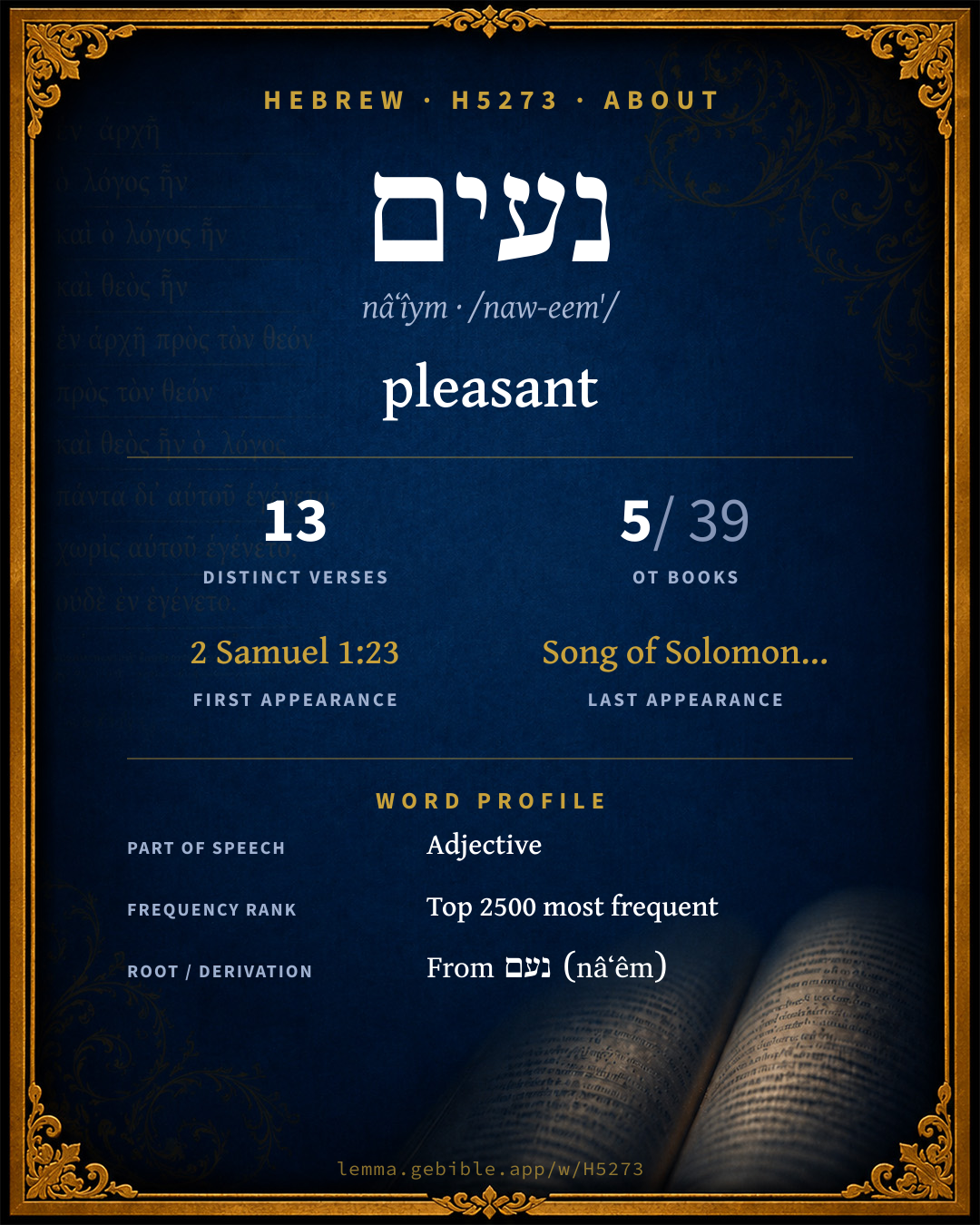
נָעִים
pleasant
also: delightful, sweet, lovely, agreeable fuller range ↓
Full lexicon entry — Brown-Driver-Briggs (BDB)
From Brown-Driver-Briggs (BDB)
Where this word appears
See every Absolute-state word in the Hebrew Bible →
Grammar key — what these labels mean
Part of speech
- Adjective
- A word that describes or qualifies a noun.
State
- Absolute
- The independent form of a noun, not bound to a following word.
- Construct
- A noun bound to a following noun in a possessive / “of” relationship (the construct chain).
Gender
- Masculine
- Grammatically masculine.
- Feminine
- Grammatically feminine.
Number
- Singular
- One.
- Plural
- More than one (in Hebrew, generally three or more).
Grammatical forms
- Adjective, Adjective, Masculine, Singular, Absolute 7 times (54%)
- Adjective, Adjective, Masculine, Plural, Absolute 4 times (31%)
- Adjective, Adjective, Feminine, Plural, Absolute 1 time (8%)
- Adjective, Adjective, Masculine, Singular, Construct 1 time (8%)
Parsed forms decoded from the imported morphology (morphhb / Westminster Leningrad Codex — WLC text public domain, morphhb tagging CC BY 4.0), counted across 13 parsed occurrences — not distinct verses.
Every verse where H5273 appears — 13 distinct verses across 5 books. Click any verse to open its interlinear word-by-word view. Verse text shown in the World English Bible for context — . Each verse’s Hebrew form is shown with its reference; the English is not keyword-highlighted, since the data carries no word-level English alignment. Use “Compare translations” on any verse to read it across multiple English versions. This concordance covers the Hebrew Bible; Septuagint (Greek Old Testament) occurrences are not indexed here.
2 Samuel 2 verses
- 2 Samuel 1:23 וְ/הַ/נְּעִימִם֙ conj + ptcl def.art + Adjective Adjective mp Saul and Jonathan were lovely and pleasant in their lives, In their death they were not divided: They were swifter than eagles, They were stronger than lions.
- 2 Samuel 23:1 וּ/נְעִ֖ים conj + Adjective Adjective ms cs Now these are the last words of David. David the son of Jesse says, The man who was raised on high says, The anointed of the God of Jacob, The sweet psalmist of Israel:
Job 1 verse
Psalms 6 verses
- Psalms 16:6 בַּ/נְּעִמִ֑ים prep det + Adjective Adjective mp The lines have fallen to me in pleasant places. Yes, I have a good inheritance.
- Psalms 16:11 נְעִמ֖וֹת adj Adjective fp You will show me the path of life. In your presence is fullness of joy. In your right hand there are pleasures forevermore.
- Psalms 81:2 נָעִ֣ים adj Adjective ms Raise a song, and bring here the tambourine, The pleasant lyre with the harp.
- Psalms 133:1 נָּעִ֑ים adj Adjective ms See how good and how pleasant it is For brothers to live together in unity!
- Psalms 135:3 נָעִֽים adj Adjective ms Praise Yah, for Yahweh is good. Sing praises to his name, for that is pleasant.
- Psalms 147:1 נָ֝עִים adj Adjective ms Praise Yah, For it is good to sing praises to our God; For it is pleasant and fitting to praise him.
Proverbs 3 verses
- Proverbs 22:18 נָ֭עִים adj Adjective ms For it is a pleasant thing if you keep them within you, If all of them are ready on your lips.
- Proverbs 23:8 הַ/נְּעִימִֽים ptcl def.art + Adjective Adjective mp The morsel which you have eaten you shall vomit up, And lose your good words.
- Proverbs 24:4 וְ/נָעִֽים conj + Adjective Adjective ms By knowledge the rooms are filled With all rare and beautiful treasure.
Song of Solomon 1 verse
About this entry
At a glance — auto-summarized from this page’s data, not written by a person. Every figure links to its source below. This summary describes the numbers; it doesn’t interpret them.
נעים — transliterated nâʻîym — is a Hebrew adjective carrying the sense “pleasant.” Debuting at 2 Samuel 1:23, it then recurs through the corpus. The Hebrew Bible uses it across 13 verses — uncommon. More than a third of its appearances fall in Psalms. Alongside “pleasant” the lexicon also lists “delightful”, “sweet”, and “lovely” — part of its full sense range. Each statement above links to its evidence; the full detail follows below.
Gloss history
Strong's 1890 vs modern scholarship
About this word
Strong's H5273 catalogs a Hebrew word from the Hebrew Old Testament.
These counts are not copied from any lexicon or concordance. They are computed here, from the morphology-tagged Hebrew Old Testament. What Lemma adds →
- 13
- distinct verses
- The word appears in 13 distinct verses.
- 5 / 39
- OT books
- The word appears in 5 of 39 Old Testament books.
- #2,001
- by frequency
- Top 2500 most frequent Hebrew words (rank 2,001 of 8,640 Hebrew words by occurrence).
View all 13 occurrences in the concordance →
By section of the Old Testament
By traditional corpus
Conventional, traditional groupings — biblical authorship is debated, so this is a traditional corpus grouping, not an authorship claim. Each share is this word’s portion of its verses in that division of the Hebrew canon. Each figure is a share of the word’s 13 distinct verses.
- Writings (Ketuvim) 11 verses · 85%
- Prophets (Nevi'im) 2 verses · 15%
How translations render this word
Counts come from each version’s own published word-to-Strong’s tagging or interlinear alignment — an approximate guide to how each version renders this word, not a word-level alignment the data otherwise carries. Because each total is that version’s own tagged count, the per-version totals vary from one another and need not match the appearance or distinct-verse counts above. These counts may also differ from a printed concordance because Lemma counts each distinctly tagged rendering and does not collapse phrase taggings into a single head-word total. This is a fixed set of word-tagged versions (KJV, ASV, BSB, ULT) and does not change with the reading translation you choose elsewhere. Each version’s license is shown beside its name below (and on Sources).
BDB lists this Strong’s number as 2 distinct words (homographs). Each count above pools all of them and is not split by sense — see the Senses section below. A low-frequency rendering may belong to a different one of those words, not the primary meaning.
- King James Version†: Pleasant 4×, Is pleasant 2×, Sweet 2×
- American Standard Version†: Pleasant 4×, Is pleasant 2×, Sweet 2×
- Berean Standard Bible†: Delightful 2×, Pleasant 2×
- unfoldingWord Literal Text†: Pleasant 6×, Delightful 2×, Is pleasant 2×
King James Version Public Domain
Renders H5273 across 13† tagged occurrences — most commonly:
Plus 5 renderings that appear only once — usually multi-word phrases or single function words the recovered tagging swept in, not distinct renderings.
American Standard Version Public Domain
Renders H5273 across 13† tagged occurrences — most commonly:
Plus 5 renderings that appear only once — usually multi-word phrases or single function words the recovered tagging swept in, not distinct renderings.
Berean Standard Bible Public Domain
Renders H5273 across 13† tagged occurrences — most commonly:
Plus 9 renderings that appear only once — usually multi-word phrases or single function words the recovered tagging swept in, not distinct renderings.
unfoldingWord Literal Text CC BY-SA 4.0
Renders H5273 across 15† tagged occurrences — most commonly:
Plus 5 renderings that appear only once — usually multi-word phrases or single function words the recovered tagging swept in, not distinct renderings.
Senses in the full BDB
What do BDB’s symbols mean?
BDB uses these scholarly abbreviations:
| Symbol | Meaning |
|---|---|
| 𝔊 | the Septuagint (the ancient Greek translation, LXX) |
| 𝔙 | the Vulgate (the Latin translation) |
| 𝔖 | the Syriac version (the Peshitta) |
| 𝔗 | the Targum (the Aramaic translation) |
| ψ | the Psalms |
| √ | root (the underlying root or stem) |
| ‖ | parallel passage (a synonymous or contrasted parallel) |
| † | the dagger: every passage where the word occurs is cited |
The 2 senses and sub-senses the full Brown-Driver-Briggs lexicon distinguishes for this word, in lexicon order (not ranked by frequency), with BDB’s own verbatim wording and sub-sense lettering. Shown in Hebrew script with BDB’s own scholarly abbreviations. The condensed entry is in the Lexicon Entry tab. See also the Forms in the corpus table below.
נעים I pleasant, delightful (poet.)
- 1. delightful הַנֶּאֱהָבִים וְהַנּ׳ בְּחַיֵּיהֶם 2 S 1:23 (of Saul and Jonath.); of wealth, הוֹן יָקָר וְנ׳ Pr 24:4; words Pr 23:8; of acts, etc.: מַה־טּוֹב וּמַה־נּ׳ שֶׁבֶת אַחִים גַּם־יָ֑חַד ψ 133:1; singing praises to י׳, 135:3; 147:1; keeping wise teachings Pr 22:18; as subst. = delight יְכַלּוּ יְמֵיהֶם בַּטּוֹב וּשְׁנֵיהֶם בַּנְּעִימִים Jb 36:11 (of earthly prosperity); of spiritual delights ψ 16:6, 11. e.g. 2 Samuel 1:23
- 2. lovely, beautiful (physically), Ct 1:16 (‖ יָפֶה).—ψ 81:3; 2 S 23:1 v. ii. נָעִים sub II. נעם. e.g. Song of Solomon 1:16
נעים II perhaps singing, sweetly sounding, musical
Senses from the full Brown-Driver-Briggs lexicon (Brown, Driver, Briggs; Oxford 1906 — public domain), digitized via Sefaria, supplemented by the OpenScriptures HebrewLexicon (CC BY 4.0). Full attribution on Sources.
Word origin
I. adj. pleasant, delightful (poet.);—abs. נ׳ Pr 22:18 +; cstr. נְעִים 2 S 23:1; pl. נְעִמִים ψ 16:6, נְעִימִם 2 S 1:23, נְעִימִים Pr 23:8; f. נְעִמוֹת ψ 16:11;—
II. adj. perhaps singing, sweetly sounding, musical;—abs. כִּנּוֹר נ׳ ψ 81:3 sweetly-sounding lyre; cstr., as subst., נְעִים זְמִרוֹת יִשׂ׳ 2 S 23:1 Israel’s sweet singer of songs (cf. Dr 2 S 8:10 Löhr; 𝔙 egregius psaltes Israel, and so Ges Ew al., from I. נעם; joy of the songs of Isr. HPS, cf. Klo Kit).
— Brown-Driver-Briggs (Oxford 1906, public domain), digitized via Sefaria, supplemented by the OpenScriptures HebrewLexicon (CC BY 4.0). See Sources.
Derived from נעם (nâʻêm) (H5276) — to be pleasant.
Jastrow Dictionary
A second Hebrew/Aramaic lexicon for comparison, covering Aramaic and post-biblical (Talmudic, Targumic, Midrashic) usage that the biblical-Hebrew BDB does not. Matched by lemma rather than by Strong’s number, so a lemma may carry more than one Jastrow headword (shown separately below), and the entries cover usage well beyond the Bible.
נָעִים I
- pleasing, lovely. Ruth R. to II, 5 כיון שראה אותה נ׳ ומעשיה נאים when he saw that she was lovely and her conduct becoming.—Pl. נְעִימִים; נְעִימוֹת. Ib. מעשיה נאים ונ׳ her conduct is becoming and lovely. Midr. Till. to Ps. V כל מה שנתתה לנו טובים ונ׳ הם all the things which thou hast given us are good and pleasing. Gen. R. s. 23, v. נַעֲמָה. Cant. R. to IV, 4 כולכם נ׳ וחסידים וכ׳ all of you are welcome, all of you are pious &c.; a. e.
נָעִים
- Targ. Y. Ex. XIX, 19.
נָעִים II
- Naʿim (Nain), in Isachar. Gen. R. s. 98.
A Dictionary of the Targumim, the Talmud Babli and Yerushalmi, and the Midrashic Literature (Marcus Jastrow; London, Luzac, 1903) — Public Domain. Digitized via Sefaria. Digitized via Sefaria. Full attribution on Sources.
Forms in the corpus
The 13 distinct written forms H5273 takes in the Hebrew Bible, most frequent first — each parse links to that state’s occurrences in the concordance. Hebrew forms include their vowel points and cantillation, so a single lemma takes many written forms.
Same root — word family
Other BDB entries built from the same root as H5273, grouped by Strong’s listed origin. These share a root / origin per the lexicon — not necessarily a shared meaning. Each links to that word’s own entry.
Derives from
Shares the same root
Proper names from this root
People and places named from this root — a name, not an additional meaning of the word.
Compare all same-root words → Showing 4 of 6 — not the complete family. 1 of the same-root words is a proper name (a person or place). They share a root, not necessarily a meaning.
Septuagint verse parallels
This word appears in 13 verses that also exist in the Greek Old Testament (Septuagint), out of the 13 Hebrew verses it occurs in. You can read those verses in Greek by switching the Old Testament edition to the Septuagint.
Read these verses in the Septuagint
This is a verse-level parallel only — the same verses exist in both the Hebrew and Greek Old Testaments. No word-level Hebrew↔Greek correspondence is claimed: the data carries no such alignment, so no Greek word is shown as this Hebrew word’s translation. Coverage is not total — the Septuagint omits the deuterocanon and renumbers the Psalms, so some Hebrew verses have no direct Greek parallel.