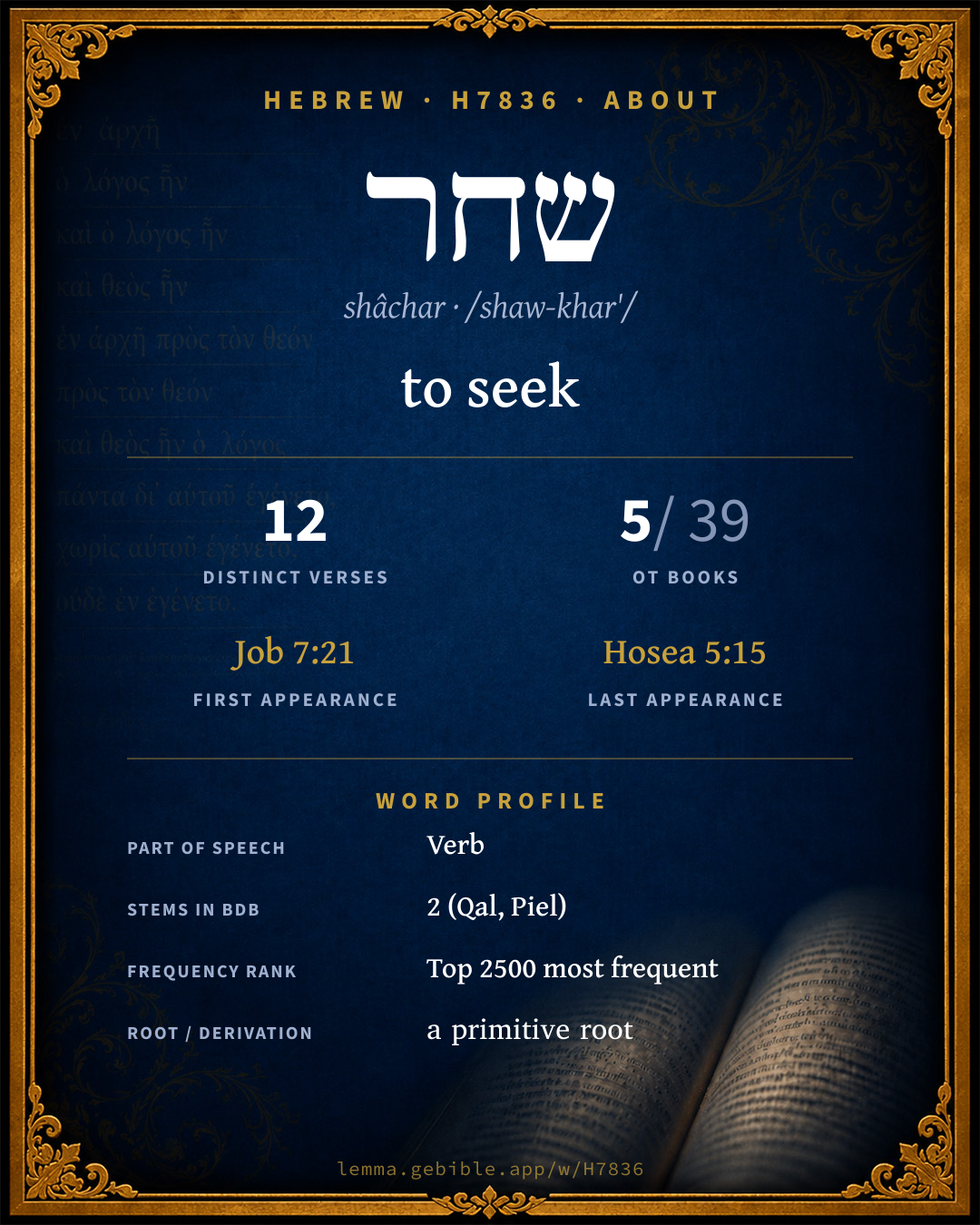
שָׁחַר
to seek
‘to seek’ is one of 3 main senses fuller range ↓
Full lexicon entry — Brown-Driver-Briggs (BDB)
From Brown-Driver-Briggs (BDB)
Where this word appears
See every Piel verb in the Hebrew Bible →
Grammar key — what these labels mean
Part of speech
- Verb
- An action or state-of-being word.
Stem
- Piel
- An intensive or resultative active stem.
- Qal
- The basic, simple active stem — the plain form of the verb (“he wrote”).
Form
- Imperfect
- An incomplete, ongoing, or future action (“he will / would write”).
- Sequential Perfect
- A perfect with prefixed waw continuing a preceding imperfect or command (waw-consecutive perfect).
- Participle Active
- A verbal adjective expressing ongoing or characteristic action (“writing / one who writes”).
- Infinitive Construct
- A bound verbal noun, frequently with prepositions (“to write / in writing”).
- Perfect
- A completed action or state — Hebrew marks aspect (completeness) more than strict tense (“he wrote”).
State
- Construct
- A noun bound to a following noun in a possessive / “of” relationship (the construct chain).
- Absolute
- The independent form of a noun, not bound to a following word.
Person
- 1st Person
- The speaker (“I / we”).
- 3rd Person
- The one spoken about (“he / she / it / they”).
- 2nd Person
- The one addressed (“you”).
Gender
- Common
- Either gender — not distinguished for this form.
- Masculine
- Grammatically masculine.
Number
- Singular
- One.
- Plural
- More than one (in Hebrew, generally three or more).
Grammatical forms 9 distinct
- Verb, Piel, Imperfect, 1st Person, Common, Singular 2 times (17%)
- Verb, Piel, Imperfect, 3rd Person, Masculine, Plural 2 times (17%)
- Verb, Piel, Participle Active, Masculine, Plural, Construct 2 times (17%)
- Verb, Piel, Sequential Perfect, 2nd Person, Masculine, Singular 1 time (8%)
- Verb, Piel, Sequential Perfect, 3rd Person, Common, Plural 1 time (8%)
- Verb, Piel, Infinitive Construct 1 time (8%)
- Verb, Piel, Imperfect, 2nd Person, Masculine, Singular 1 time (8%)
- Verb, Piel, Perfect, 3rd Person, Masculine, Singular 1 time (8%)
+1 more form (1 occurrence)
Parsed forms decoded from the imported morphology (morphhb / Westminster Leningrad Codex — WLC text public domain, morphhb tagging CC BY 4.0), counted across 12 parsed occurrences — not distinct verses.
Every verse where H7836 appears — 12 distinct verses across 5 books. Click any verse to open its interlinear word-by-word view. Verse text shown in the World English Bible for context — . Each verse’s Hebrew form is shown with its reference; the English is not keyword-highlighted, since the data carries no word-level English alignment. Use “Compare translations” on any verse to read it across multiple English versions. This concordance covers the Hebrew Bible; Septuagint (Greek Old Testament) occurrences are not indexed here.
Job 3 verses
- Job 7:21 וְ/שִׁ֖חֲרְתַּ֣/נִי conj + Piel wpf 2ms + sfx pers 1cs Why do you not pardon my disobedience, and take away my iniquity? For now shall I lie down in the dust. You will seek me diligently, but I shall not be."
- Job 8:5 תְּשַׁחֵ֣ר Piel impf 2ms If you want to seek God diligently, Make your supplication to the Almighty.
- Job 24:5 מְשַׁחֲרֵ֣י Piel ptcp.act mp cs Behold, as wild donkeys in the desert, They go forth to their work, seeking diligently for food; The wilderness yields them bread for their children.
Psalms 2 verses
- Psalms 63:1 אֲֽשַׁחֲ֫רֶ֥/ךָּ Piel impf 1cs + sfx pers 2ms God, you are my God. I will earnestly seek you. My soul thirsts for you, My flesh longs for you, In a dry and weary land, where there is no water.
- Psalms 78:34 וְ/שִֽׁחֲרוּ conj + Piel wpf 3cp When he killed them, then they inquired after him. They returned and sought God earnestly.
Proverbs 5 verses
- Proverbs 1:28 יְ֝שַׁחֲרֻ֗/נְנִי Piel impf 3mp + sfx pers 1cs Then will they call on me, but I will not answer. They will seek me diligently, but they will not find me;
- Proverbs 7:15 לְ/שַׁחֵ֥ר prep + Piel inf.cs Therefore I came out to meet you, To diligently seek your face, And I have found you.
- Proverbs 8:17 וּ֝/מְשַׁחֲרַ֗/י conj + Piel ptcp.act mp cs + sfx pers 1cs I love those who love me. Those who seek me diligently will find me.
- Proverbs 11:27 שֹׁ֣חֵֽר Qal ptcp.act ms He who diligently seeks good seeks favor, But he who searches after evil, it shall come to him.
- Proverbs 13:24 שִֽׁחֲר֥/וֹ Piel pf 3ms + sfx pers 3ms One who spares the rod hates his son, But one who loves him is careful to discipline him.
Isaiah 1 verse
Hosea 1 verse
About this entry
At a glance — auto-summarized from this page’s data, not written by a person. Every figure links to its source below. This summary describes the numbers; it doesn’t interpret them.
The Hebrew verb שחר centers on the idea of “to seek.” First canonically at Job 7:21, it enters the text early. It turns up in 12 verses across 5 books, an uncommon footprint. The word gravitates to Proverbs (42%), then Job and Psalms. Across 2 stems, its meaning turns on the binyan (Qal, Piel). Dig into 12-verse concordance and the renderings breakdown below.
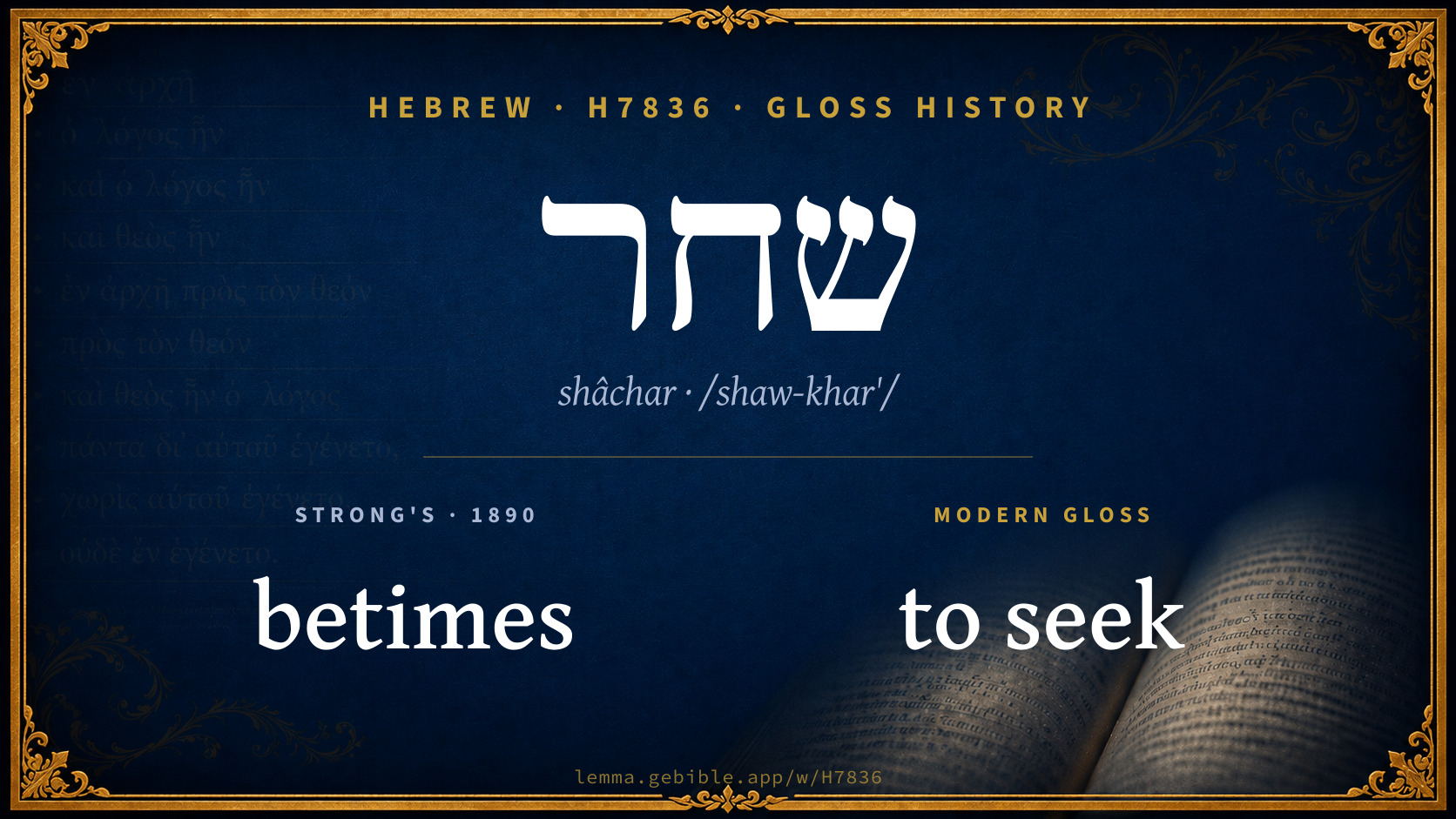
Gloss history
Strong's 1890 vs modern scholarship
About this word
Strong's H7836 catalogs a Hebrew word from the Hebrew Old Testament.
These counts are not copied from any lexicon or concordance. They are computed here, from the morphology-tagged Hebrew Old Testament. What Lemma adds →
- 12
- distinct verses
- The word appears in 12 distinct verses.
- 5 / 39
- OT books
- The word appears in 5 of 39 Old Testament books.
- #2,101
- by frequency
- Top 2500 most frequent Hebrew words (rank 2,101 of 8,640 Hebrew words by occurrence).
View all 12 occurrences in the concordance →
By section of the Old Testament
By traditional corpus
Conventional, traditional groupings — biblical authorship is debated, so this is a traditional corpus grouping, not an authorship claim. Each share is this word’s portion of its verses in that division of the Hebrew canon. Each figure is a share of the word’s 12 distinct verses.
- Writings (Ketuvim) 10 verses · 83%
- Prophets (Nevi'im) 2 verses · 17%
How translations render this word
Counts come from each version’s own published word-to-Strong’s tagging or interlinear alignment — an approximate guide to how each version renders this word, not a word-level alignment the data otherwise carries. Because each total is that version’s own tagged count, the per-version totals vary from one another and need not match the appearance or distinct-verse counts above. These counts may also differ from a printed concordance because Lemma counts each distinctly tagged rendering and does not collapse phrase taggings into a single head-word total. This is a fixed set of word-tagged versions (KJV, ASV, BSB, ULT) and does not change with the reading translation you choose elsewhere. Each version’s license is shown beside its name below (and on Sources).
BDB lists this Strong’s number as 2 distinct words (homographs). Each count above pools all of them and is not split by sense — see the Senses section below. A low-frequency rendering may belong to a different one of those words, not the primary meaning.
- King James Version†: Betimes 2×
- American Standard Version†: Betimes 1×, Diligently 1×, Earnestly 1×
- Berean Standard Bible†: They will earnestly seek me 2×
- unfoldingWord Literal Text†: Diligently seek 1×, Diligently seek me 1×, Diligently seeks him 1×
King James Version Public Domain
Renders H7836 across 13† tagged occurrences — most commonly:
Plus 11 renderings that appear only once — usually multi-word phrases or single function words the recovered tagging swept in, not distinct renderings.
American Standard Version Public Domain
Renders H7836 across 13† tagged occurrences — most commonly:
Plus other, less common renderings.
Berean Standard Bible Public Domain
Renders H7836 across 12† tagged occurrences — most commonly:
Plus 10 renderings that appear only once — usually multi-word phrases or single function words the recovered tagging swept in, not distinct renderings.
unfoldingWord Literal Text CC BY-SA 4.0
Renders H7836 across 12† tagged occurrences — most commonly:
Senses in the full BDB
Hebrew verbs can shift meaning by stem (binyan): Qal is the basic action, Niphal is often passive or reflexive, Piel often intensifies or makes it factitive, and Hiphil is typically causative. The senses below are grouped under the stem BDB assigns to each.
What do BDB’s symbols mean?
BDB uses these scholarly abbreviations:
| Symbol | Meaning |
|---|---|
| 𝔊 | the Septuagint (the ancient Greek translation, LXX) |
| 𝔙 | the Vulgate (the Latin translation) |
| 𝔖 | the Syriac version (the Peshitta) |
| 𝔗 | the Targum (the Aramaic translation) |
| ψ | the Psalms |
| √ | root (the underlying root or stem) |
| ‖ | parallel passage (a synonymous or contrasted parallel) |
| † | the dagger: every passage where the word occurs is cited |
The 3 senses and sub-senses the full Brown-Driver-Briggs lexicon distinguishes for this word, in lexicon order (not ranked by frequency), with BDB’s own verbatim wording and sub-sense lettering. Shown in Hebrew script with BDB’s own scholarly abbreviations. The condensed entry is in the Lexicon Entry tab. See also the Forms in the corpus table below.
שחר I be black (NH שָׁחוֹר and deriv., black, blackness, etc., Ecclus 25
Qal
- Pf. שׁ׳, of skin Jb 30:30. e.g. Job 30:30
שחר II denom. look early, diligently for (late
Qal
- Pt. שֹׁחֵר טוֹב Pr 11:27 (‖ בִּקֵּשׁ, דָּרַשׁ), elsewhere e.g. Proverbs 11:27
Piel
- c. acc. (sf.) Pf. 3 ms. sf. שִׁחֲרוֹ מוּסָר Pr 13:24 seeks him early (with) discipline (chastises him betimes); 2 ms. sf. consec. וְשִׁחַרְתַּ֫נִי וְאֵינֶנִּי Jb 7:21; lit. Inf. לְשַׁחֵר פָּנֶיךָ Pr 7:15; of wild asses, Pt. מְשַׁחֲרֵי לַטָּ֑רֶף Jb 24:5 (Ges§ 130 u) seeking eagerly for their food; usually of seeking God (י׳) earnestly, Pf. וְשִׁחֲרוּ־אֵל ψ 78:34 (‖ דָּרַשׁ), Impf. 2 ms. תְּשַׁהֵר אֶל־אֵל Jb 8:5 (si vera l.), 3 mpl. sf. יְשַׁחֲרֻנְנִי (Ges§ 60 e) Ho 5:15 (‖ בִּקֵּשׁ), + 6:3 (v. שַׁחַר), and, acc. wisdom, Pr 1:28, Pt. sf. מְשַׁחֲרַי Pr 8:17; seek with longing, long for (י׳), אֲשַׁחֲרֶ֑ךָּ Is 26:9 ψ 63:2. e.g. Proverbs 13:24
Senses from the full Brown-Driver-Briggs lexicon (Brown, Driver, Briggs; Oxford 1906 — public domain), digitized via Sefaria, supplemented by the OpenScriptures HebrewLexicon (CC BY 4.0). Full attribution on Sources.
Word origin
I. vb. be black (NH שָׁחוֹר and deriv., black, blackness, etc., Ecclus 25:17 Hiph. make black; Aramaic שְׁחַר (Jastr Dalm), Aph. grow black, so ܫܚܰܪ, ܫܘܽܚܳܪܳܐ coal; JägerBAS ii. 295 cp. Assyrian šûru, coal);
II. vb.denom. look early, diligently for (late; orig. look for dawn);—
— Brown-Driver-Briggs (Oxford 1906, public domain), digitized via Sefaria, supplemented by the OpenScriptures HebrewLexicon (CC BY 4.0). See Sources.
Origin: a primitive root
Jastrow Dictionary
A second Hebrew/Aramaic lexicon for comparison, covering Aramaic and post-biblical (Talmudic, Targumic, Midrashic) usage that the biblical-Hebrew BDB does not. Matched by lemma rather than by Strong’s number, so a lemma may carry more than one Jastrow headword (shown separately below), and the entries cover usage well beyond the Bible.
שָׁחַר I
- to break through, dig; to search, seek. Midr. Till. to Ps. CXIX, 9 ששוקדים ושׁוֹחֲרִים וכ׳ they watch, and search, and investigate &c.
- to pass through a cavity or a groove. Bets. 35ᵇ (ref. to Mish. ib. V, 1 ומאן דתני מַשְׁחִירִין וכ׳ nor is he wrong who reads mashḥirin (in place of משילין, referring for evidence to השחור, v. שָׁחוֹר II).
- (cmp. כָּרָה) to choose, select. Gen. R. s. 39 שִׁחַרְתִּיךָ לי, v. רֶחֶם; Yalk. Ps. 869.
שְׁחַר
- , to search, inquire. Targ. Is. VIII, 20.
שָׁחַר II
- to be charred, black.—V. שָׁחוֹר I.
- 1. to blacken. Y. Ḥag. II, 77ᵈ הִשְׁחִירוּ פניהן וכ׳ they made their faces as black as the bottom of a pot, i.e. they ruined their reputation. Sabb. 152ᵃ (ref. to Koh. XI, 10) דברים … מַשְׁחִירִים וכ׳ certain things which a man does in his young days make his face look black (sickly) in his old age; a. e. e.g. Ecclesiastes 11:10
- 2. to become black. Y. Bets. II, end, 61ᵈ הִשְׁחִירוּ שיניו וכ׳ his teeth were black from fasting; Y. Sabb. V, end, 7ᶜ; Ḥag. 22ᵇ הוּשְׁחֲרוּ שיניו (Hof.; Ms. M. פניו). Ex. R. s. 1 (play on אשחור, II Chr. I, 24) שחִשְׁחִירוּ פניו בתעניות his face was black from fasting. Y. Shebi. VI, 36ᵈ bot. מכיון שה׳ as soon as it (the onion in the ground) gets black. Y. Snh. VIII, beg. 26ᵃ הִשְׁחִירָה הקדרה, v. בָּשַׁל; a. e. e.g. 2 Chronicles 1:24
- to become black, v. supra.
שְׁחַר ²
- to get black. Succ. 33ᵇ דאַשְׁחוּר אימת when did they (the berries on the myrtle branch) become black?
- to blacken. B. Mets. 117ᵇ דקא"ל קא מְשַׁחְרַת לי לכותלאי Ms. M. (differ. in ed., v. שַׁחְרוּרִיתָא) he may say to him, thou wilt make my wall black (by living in my house).—Part. pass. מְשַׁחַר; f. מְשַׁחְרָא; pl. מְשַׁחְרֵי; מְשַׁחְרָן. Yoma 28ᵇ מכי מש׳ כותלי when the walls begin to grow dark (are no longer shone upon by the sun), v. כּוֹתְלָא. Ber. 28ᵃ חזנהו … דמש׳ he saw that the walls of his room were sooty. Lam. R. to I, 1 רבתי (חד מאת׳ 8) רישיה גריע ומְשַׁחְרִין אפוי (not ושיחרור) his head shaved, and his face blackened; a. e.
שָׁחַר III
- Hif. הִשְׁחִיר (denom. of שַׁחַר) to be early in doing; to get up early. Lev. R. s. 19, beg. מי שמַשְׁחִיר וכ׳, v. עָרַב II. Midr. Sam. ch. V ע"י שה׳ והעריב בהן because he was engaged in their study early and late; a. e.
- (b. h.) same, to do a thing early or diligently. Ex. R. s. 1 (ref. to Prov. XIII, 24) לפי ששִׁחֲרוֹ מוסר וכ׳ because he corrected him betimes (or earnestly), he loved him. Ib. היה יצחק מְשַׁחֵר מוסר ליעקב וכ׳ Isaac trained Jacob &c. e.g. Proverbs 13:24
שְׁחַר ³
- Ex. R. s. 47 למדו תורה דשְׁחִירִין ודקרין בלילה (ed. Wil. דשַׁחְרִין, some ed. דשִׁיחֲרִין) learn the Law from those who get up early (to study), and who read (teach) by night, opp. אִימְּטִין q. v.
- same. Targ. Is. XXIX, 20 (h. text שקד).
שְׁחַר IV
- (cmp. שחרר, v.חרם), Pa. שַׁחֵר [to declare a thing or man free, ownerless property,] to confiscate, press into public service. Targ. O. Num. XVI, 15 שָׁחַרִית ed. Berl. (Mss. שְׁחָרִ׳, שַׁחֲרֵית, שָׁחָרִ׳, v. Berl. O. II, p. 42; Y. I שְׁחָרִית). Targ. I Sam. XII, 3.—Ber. 56ᵃ חזית דמְשַׁחְרֵי לך פרסאי וכ׳ (Ms. M. דמשחדי, corr. acc.) thou shalt see in thy dream that the Parthians press thee into service &c. Ib. דמשחדי לך רומאי Ms. M. (corr. acc.; ed. אתו רומאי ושבו לך).—Part. pass. Pe. שָׁחִיר; f. שְׁחִירְתָּא sent abroad. Targ. Hos. VII, 11 כיונה ש׳ דאיתנסבן בנהא ed. Lag. (ed. שְׁרִיתֲתָא, q. v.) as a dove sent abroad when her young were taken away (h. text פותה, v. Midr. Till. to Ps. LXXXIV).
שַׁחַר
- morning dawn, early morning. Ber. IV, 1 תפלת הש׳ the morning prayer. Ib. I, 4 בש׳ מברך וכ׳ when reading the Sh’mʿa in the morning prayer, you recite two benedictions &c. Tam. IV, 1 של ש׳ (sub. תמיד) the daily offering of the morning; a. v. fr.—עמוד הש׳, v. עַמּוּד.—אילת הש׳, v. אַיָּלָה.—Pl. שְׁחָרִין, v. שַׁחֲרִית.
A Dictionary of the Targumim, the Talmud Babli and Yerushalmi, and the Midrashic Literature (Marcus Jastrow; London, Luzac, 1903) — Public Domain. Digitized via Sefaria. Digitized via Sefaria. Full attribution on Sources.
Forms in the corpus
The 12 distinct written forms H7836 takes in the Hebrew Bible, most frequent first — each parse links to that stem’s occurrences in the concordance. Hebrew forms include their vowel points and cantillation, so a single lemma takes many written forms.
Same root — word family
Other BDB entries built from the same root as H7836, grouped by Strong’s listed origin. These share a root / origin per the lexicon — not necessarily a shared meaning. Each links to that word’s own entry.
Derived from this word
- משחר mishchâr H4891 dawn
- שחר shâchar H7835 to be black
- שחר shachar H7837 dawn
- שחרות shachărûwth H7839 blackness
Proper names from this root
People and places named from this root — a name, not an additional meaning of the word.
Compare all same-root words → Showing 4 of 6 — not the complete family. 1 of the same-root words is a proper name (a person or place). They share a root, not necessarily a meaning.
Septuagint verse parallels
This word appears in 11 verses that also exist in the Greek Old Testament (Septuagint), out of the 12 Hebrew verses it occurs in. You can read those verses in Greek by switching the Old Testament edition to the Septuagint.
Read these verses in the Septuagint
This is a verse-level parallel only — the same verses exist in both the Hebrew and Greek Old Testaments. No word-level Hebrew↔Greek correspondence is claimed: the data carries no such alignment, so no Greek word is shown as this Hebrew word’s translation. Coverage is not total — the Septuagint omits the deuterocanon and renumbers the Psalms, so some Hebrew verses have no direct Greek parallel.