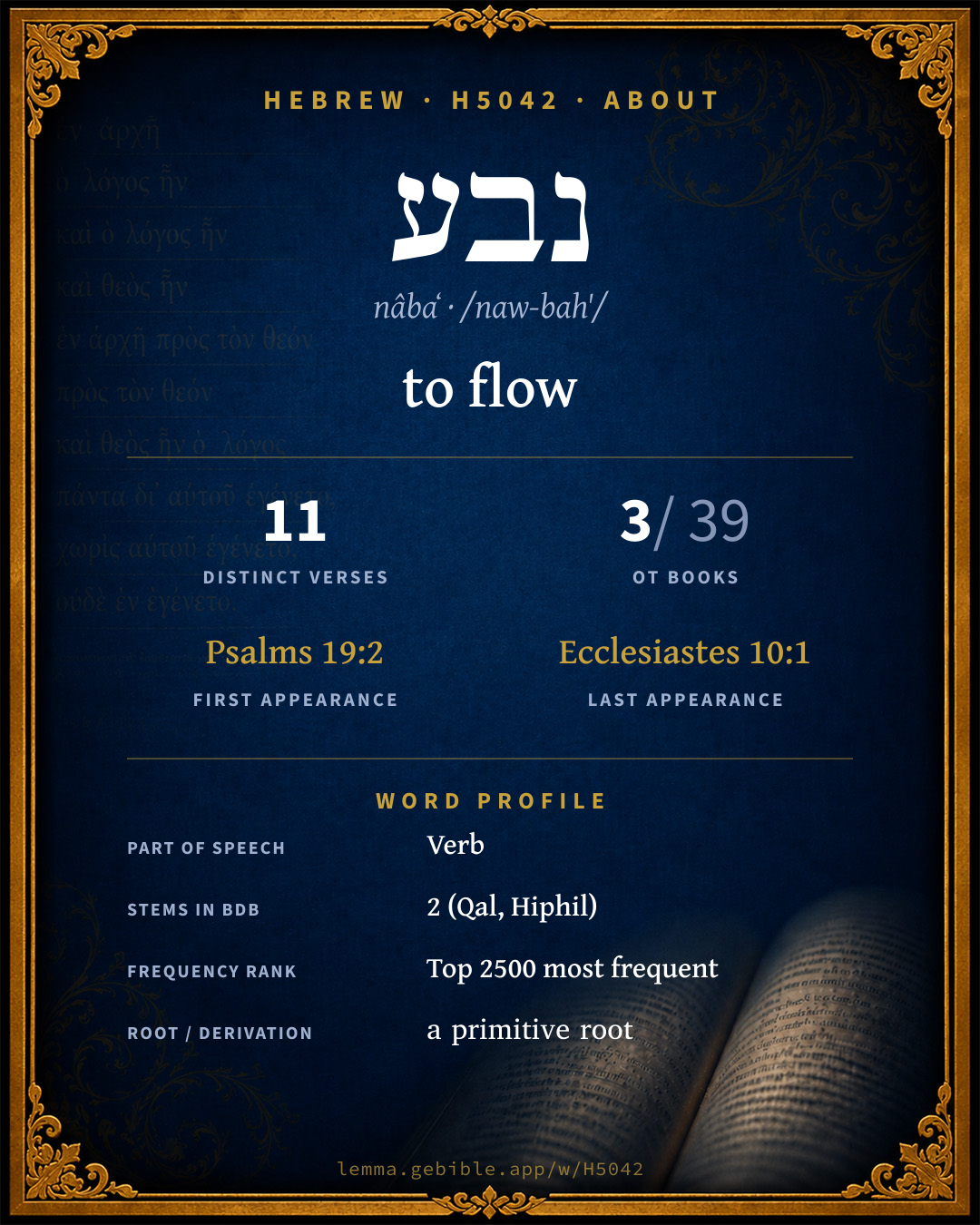
נָבַע
to flow
also: pour out, pour, gush forth, spring fuller range ↓
Full lexicon entry — Brown-Driver-Briggs (BDB)
From Brown-Driver-Briggs (BDB)
Where this word appears
See every Hiphil verb in the Hebrew Bible →
Grammar key — what these labels mean
Part of speech
- Verb
- An action or state-of-being word.
Stem
- Hiphil
- The causative active stem (“he caused / brought about”). Here: ‘pour out’
- Qal
- The basic, simple active stem — the plain form of the verb (“he wrote”).
Form
- Imperfect
- An incomplete, ongoing, or future action (“he will / would write”).
- Cohortative
- A first-person volitional form expressing wish or resolve (“let me / let us write”).
- Participle Active
- A verbal adjective expressing ongoing or characteristic action (“writing / one who writes”).
State
- Absolute
- The independent form of a noun, not bound to a following word.
Person
- 3rd Person
- The one spoken about (“he / she / it / they”).
- 1st Person
- The speaker (“I / we”).
Gender
- Masculine
- Grammatically masculine.
- Common
- Either gender — not distinguished for this form.
- Feminine
- Grammatically feminine.
Number
- Singular
- One.
- Plural
- More than one (in Hebrew, generally three or more).
Grammatical forms
- Verb, Hiphil, Imperfect, 3rd Person, Masculine, Singular 4 times (36%)
- Verb, Hiphil, Imperfect, 3rd Person, Masculine, Plural 3 times (27%)
- Verb, Hiphil, Cohortative, 1st Person, Common, Singular 2 times (18%)
- Verb, Hiphil, Imperfect, 3rd Person, Feminine, Singular 1 time (9%)
- Verb, Qal, Participle Active, Masculine, Singular, Absolute 1 time (9%)
Parsed forms decoded from the imported morphology (morphhb / Westminster Leningrad Codex — WLC text public domain, morphhb tagging CC BY 4.0), counted across 11 parsed occurrences — not distinct verses.
Every verse where H5042 appears — 11 distinct verses across 3 books. Click any verse to open its interlinear word-by-word view. Verse text shown in the World English Bible for context — . Each verse’s Hebrew form is shown with its reference; the English is not keyword-highlighted, since the data carries no word-level English alignment. Use “Compare translations” on any verse to read it across multiple English versions. This concordance covers the Hebrew Bible; Septuagint (Greek Old Testament) occurrences are not indexed here.
Psalms 6 verses
- Psalms 19:2 יַבִּ֣יעַֽ Hiphil impf 3ms Day after day they pour forth speech, And night after night they display knowledge.
- Psalms 59:7 יַבִּ֘יע֤וּ/ן Hiphil impf 3mp + sfx n Behold, they spew with their mouth. Swords are in their lips, "For," they say, "who hears us?"
- Psalms 78:2 אַבִּ֥יעָה Hiphil coh 1cs I will open my mouth in a parable. I will utter dark sayings of old,
- Psalms 94:4 יַבִּ֣יעוּ Hiphil impf 3mp They pour out arrogant words. All the evil-doers boast.
- Psalms 119:171 תַּבַּ֣עְנָה Hiphil impf 3fs Let my lips utter praise, For you teach me your statutes.
- Psalms 145:7 יַבִּ֑יעוּ Hiphil impf 3mp They will utter the memory of your great goodness, And will sing of your righteousness.
Proverbs 4 verses
- Proverbs 1:23 אַבִּ֣יעָה Hiphil coh 1cs Turn at my reproof. Behold, I will pour out my spirit on you. I will make known my words to you.
- Proverbs 15:2 יַבִּ֥יעַ Hiphil impf 3ms The tongue of the wise commends knowledge, But the mouth of fools gush out folly.
- Proverbs 15:28 יַבִּ֥יעַ Hiphil impf 3ms The heart of the righteous weighs answers, But the mouth of the wicked gushes out evil.
- Proverbs 18:4 נֹ֝בֵ֗עַ Qal ptcp.act ms The words of a man's mouth are like deep waters. The fountain of wisdom is like a flowing brook.
Ecclesiastes 1 verse
About this entry
At a glance — auto-summarized from this page’s data, not written by a person. Every figure links to its source below. This summary describes the numbers; it doesn’t interpret them.
The Hebrew verb נבע centers on the idea of “to flow.” Psalms dominates its distribution — 6 of 11 verses. Spanning 11 verses in 3 books, it ranks among the uncommon words of the Hebrew Bible. Its earliest occurrence is Psalms 19:2. Read the stem: it spans 2 stems, including Qal and Hiphil. Dig into 11-verse concordance and the renderings breakdown below.
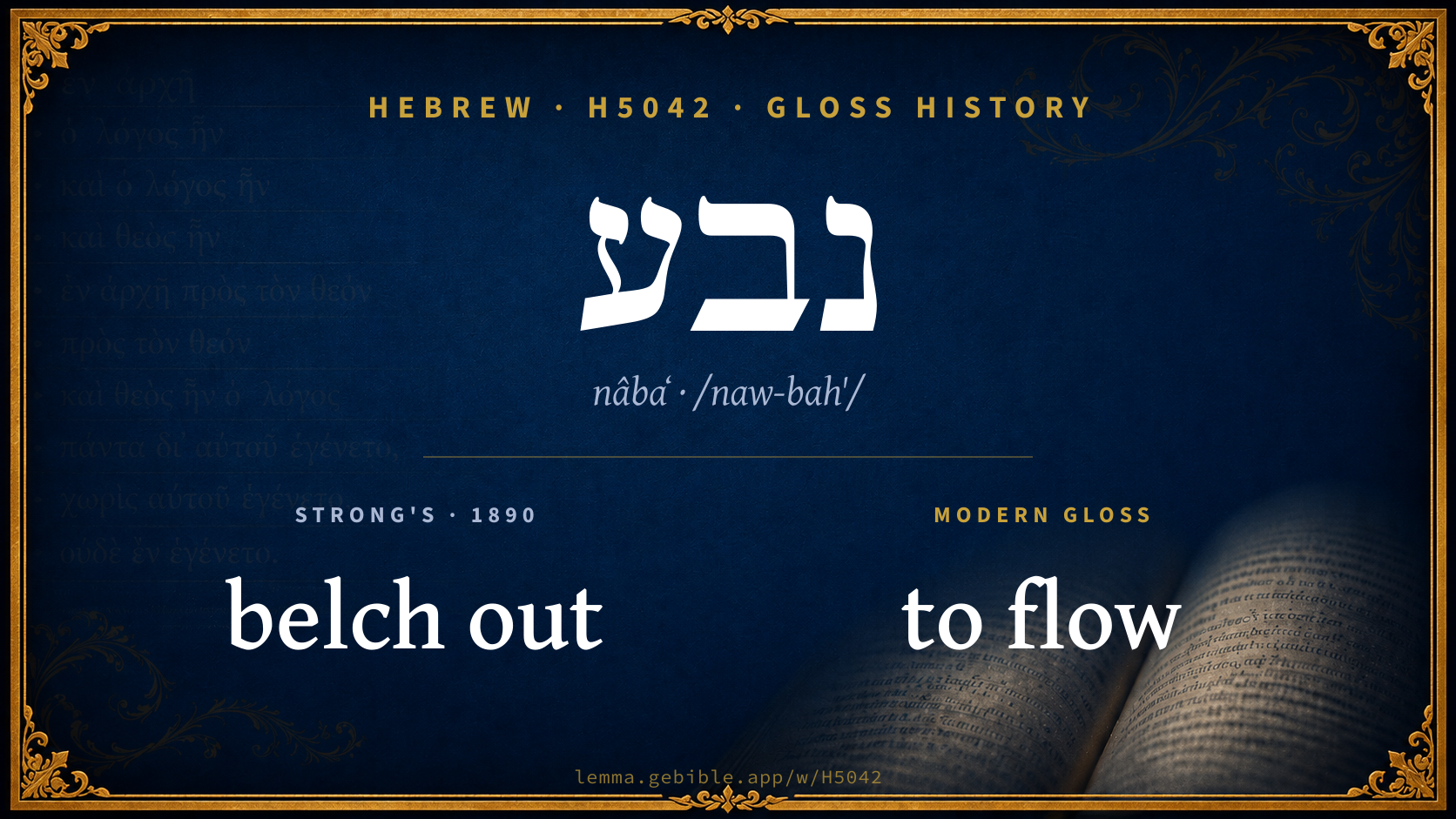
Gloss history
Strong's 1890 vs modern scholarship
About this word
Strong's H5042 catalogs a Hebrew word from the Hebrew Old Testament.
These counts are not copied from any lexicon or concordance. They are computed here, from the morphology-tagged Hebrew Old Testament. What Lemma adds →
- 11
- distinct verses
- The word appears in 11 distinct verses.
- 3 / 39
- OT books
- The word appears in 3 of 39 Old Testament books.
- #2,210
- by frequency
- Top 2500 most frequent Hebrew words (rank 2,210 of 8,640 Hebrew words by occurrence).
View all 11 occurrences in the concordance →
Most concentrated in
- Psalms 6 verses 55%
- Proverbs 4 verses 36%
- Ecclesiastes 1 verse 9%
By section of the Old Testament
By traditional corpus
Conventional, traditional groupings — biblical authorship is debated, so this is a traditional corpus grouping, not an authorship claim. Each share is this word’s portion of its verses in that division of the Hebrew canon. Each figure is a share of the word’s 11 distinct verses.
- Writings (Ketuvim) 11 verses · 100%
How translations render this word
Counts come from each version’s own published word-to-Strong’s tagging or interlinear alignment — an approximate guide to how each version renders this word, not a word-level alignment the data otherwise carries. Because each total is that version’s own tagged count, the per-version totals vary from one another and need not match the appearance or distinct-verse counts above. These counts may also differ from a printed concordance because Lemma counts each distinctly tagged rendering and does not collapse phrase taggings into a single head-word total. This is a fixed set of word-tagged versions (KJV, ASV, BSB, ULT) and does not change with the reading translation you choose elsewhere. Each version’s license is shown beside its name below (and on Sources).
- King James Version: Behold i will pour out 1×, Behold they belch out 1×, Flowing 1×
- American Standard Version: Behold 2×
- Berean Standard Bible: Blurts out 1×, Bring 1×, I will utter 1×
- unfoldingWord Literal Text: Gushes forth 2×
King James Version Public Domain
Renders H5042 across 11 tagged occurrences — most commonly:
American Standard Version Public Domain
Renders H5042 across 12 tagged occurrences — most commonly:
Plus 10 renderings that appear only once — usually multi-word phrases or single function words the recovered tagging swept in, not distinct renderings.
Berean Standard Bible Public Domain
Renders H5042 across 11 tagged occurrences — most commonly:
unfoldingWord Literal Text CC BY-SA 4.0
Renders H5042 across 15 tagged occurrences — most commonly:
Plus 13 renderings that appear only once — usually multi-word phrases or single function words the recovered tagging swept in, not distinct renderings.
Senses in the full BDB
Hebrew verbs can shift meaning by stem (binyan): Qal is the basic action, Niphal is often passive or reflexive, Piel often intensifies or makes it factitive, and Hiphil is typically causative. The senses below are grouped under the stem BDB assigns to each.
What do BDB’s symbols mean?
BDB uses these scholarly abbreviations:
| Symbol | Meaning |
|---|---|
| 𝔊 | the Septuagint (the ancient Greek translation, LXX) |
| 𝔙 | the Vulgate (the Latin translation) |
| 𝔖 | the Syriac version (the Peshitta) |
| 𝔗 | the Targum (the Aramaic translation) |
| ψ | the Psalms |
| √ | root (the underlying root or stem) |
| ‖ | parallel passage (a synonymous or contrasted parallel) |
| † | the dagger: every passage where the word occurs is cited |
The 5 senses and sub-senses the full Brown-Driver-Briggs lexicon distinguishes for this word, in lexicon order (not ranked by frequency), with BDB’s own verbatim wording and sub-sense lettering. Shown in Hebrew script with BDB’s own scholarly abbreviations. The condensed entry is in the Lexicon Entry tab. See also the Forms in the corpus table below.
Qal
- Pt. נַ֫חַל נֹבֵעַ Pr 18:4 a flowing wady, metaph. of מְקוֹר חָכְמָה. e.g. Proverbs 18:4
Hiphil
- Impf. יַבִּיעַ ψ 19:3 + 3 times; אַבִּ֫יעָה ψ 78:2 Pr 1:23; יַבִּ֫יעוּ ψ 94:4; 145:7; יַבִּיעוּן ψ 59:8; 3 fpl. תַּבַּ֫עְנָה ψ 119:171;— pour out, emit, cause to bubble, belch forth: e.g. Psalms 19:3
- 1. pour out, fig. אַבִּיעָה לָכֶם רוּחִי Pr 1:23 (‖ אוֹדִ֫יעָה דְבָרַי אֶתְכֶם). e.g. Proverbs 1:23
- 2. cause to bubble, ferment זְבוּבֵי מָ֫וֶת יַבְאִישׁ יַבִּיעַ שֶׁמֶן רוֹקֵ֑חַ Ec 10:1. e.g. Ecclesiastes 10:1
- 3. fig., usually of speech, pour forth, emit, belch forth, emphat. expression: פִּי רְשָׁעִים יַבִּיעַ רָעוֹת Pr 15:28 (opp. לֵב צַדִּיק יֶהְגֶּה לַעֲנוֹת) i.e. the righteous considers before he speaks, the wicked bursts out with reckless utterance; פִּי כְסִילִים יַבִּיעַ אִוֶּלֶת Pr 15:2 (opp. לְשׁוֹן חֲכָמִים תֵּיטִיב דָּ֑עַת); יַבִּ֫יעוּ יְדַבְּרוּ עָתָק ψ 94:4 (‖ יִתְאַמְּרוּ כָּל־פֹּעֲלֵי אָ֑וֶן); יַבּ׳ בְּפִיהֶם 59:8 (‖ חֲרָבוֹת בְּשִׂפְתוֹתֵיהֶם); in good sense, אַבִּ֫יעָה חִידוֹת 78:2 (‖ אֶפְתְּחָה בְּמָשָׁל פִּי); תַּבַּעְנָה שְׂפָתַי תְּהִלָּה 119:171; זֵכֶר רַב־טוּבְךָ יַבִּ֑יעוּ 145:7 (‖ וְצִדְקָֽתְךָ יְרַנֵּ֑נוּ, cf. also v 6); metaph. יוֹם לְיוֹם יַבּ׳ אֹמֶר 19:3, i.e. though silent, it really pours forth speech. e.g. Proverbs 15:28
Senses from the full Brown-Driver-Briggs lexicon (Brown, Driver, Briggs; Oxford 1906 — public domain), digitized via Sefaria, supplemented by the OpenScriptures HebrewLexicon (CC BY 4.0). Full attribution on Sources.
Word origin
vb. flow, spring, bubble up, poet. and late (NH id. (rare); Assyrian nabû, id., DlHWB 442; Arabic نَبَعَ well or issue forth (of water); Aramaic ܢܒܰܥ, נְבַע; Ethiopic ነብዐ ii. weep, አንብዕ tear(s));—
— Brown-Driver-Briggs (Oxford 1906, public domain), digitized via Sefaria, supplemented by the OpenScriptures HebrewLexicon (CC BY 4.0). See Sources.
Origin: a primitive root
Jastrow Dictionary
A second Hebrew/Aramaic lexicon for comparison, covering Aramaic and post-biblical (Talmudic, Targumic, Midrashic) usage that the biblical-Hebrew BDB does not. Matched by lemma rather than by Strong’s number, so a lemma may carry more than one Jastrow headword (shown separately below), and the entries cover usage well beyond the Bible.
נָבַע
- 1. to burst forth; to flow, gush. Ned. 41ᵇ מעין הנוֹבֵעַ, a bubbling spring, v. בּוּרְדָּם.
- 2. to give forth, utter. Midr. Till. to Ps. XVI והיו נוֹבְעוֹת וכ׳ and they (the kidneys) poured forth wisdom &c.; Midr. Till. to Ps. I; Gen. R. s. 61Gen. R. s. 61, beg.; Tanḥ. Vayigg. 11 והיו נוֹבְעִין וכ׳; a. e.
- 1. to cause bubbling, fermenting (of ointment). Koh. R. to X, 1 זבוב … אינו מבאיש ומַבִּיעַ וכ׳ one dead fly does not spoil and cause to ferment the ointment of the apothecary, but by a single sin which one commits &c. (ib. IX, 18).
- 2. to utter (speech). Ib. מַבִּיעִים דברים they utter words (of praise).
נְבַע
- Targ. Y. Gen. XXVI, 21; a. e.—Part. נְבִיעַ. Targ. Prov. XVIII, 4.—[Targ. Job VI, 10 וְאַבּוּעַ some ed., read: וַאֲבוּעַ, v. בּוּעַ a. בְּעַע.]
- as preced. Hif. Targ. Prov. I, 23. Ib. XV, 28; a. fr.—Taan. 25ᵇ (first time in Hebr. Dict.) אַבַּע מימיך (Ms. M. first time אֵי) let thy waters spring forth. B. Bath. 151ᵇ; Keth. 91ᵃ מחינא לכו בסילוא דלא מַבַּע דמא we shall strike you with the thorn which makes no blood flow (i.e. excommunication). Sabb. 88ᵃ וקא מַבְּעָן אצבעתיה דמא blood burst forth from his fingers.
A Dictionary of the Targumim, the Talmud Babli and Yerushalmi, and the Midrashic Literature (Marcus Jastrow; London, Luzac, 1903) — Public Domain. Digitized via Sefaria. Digitized via Sefaria. Full attribution on Sources.
Forms in the corpus
The 10 distinct written forms H5042 takes in the Hebrew Bible, most frequent first — each parse links to that stem’s occurrences in the concordance. Hebrew forms include their vowel points and cantillation, so a single lemma takes many written forms.
| Form | Parsing | Example | Uses |
|---|---|---|---|
| יַבִּ֥יעַ | Verb, Hiphil, Imperfect, 3rd Person, Masculine, Singular | Proverbs 15:2 | 2 |
| אַבִּ֣יעָה | Verb, Hiphil, Cohortative, 1st Person, Common, Singular | Proverbs 1:23 | 1 |
| אַבִּ֥יעָה | Verb, Hiphil, Cohortative, 1st Person, Common, Singular | Psalms 78:2 | 1 |
| יַבִּ֑יעוּ | Verb, Hiphil, Imperfect, 3rd Person, Masculine, Plural | Psalms 145:7 | 1 |
| יַבִּ֖יעַ | Verb, Hiphil, Imperfect, 3rd Person, Masculine, Singular | Ecclesiastes 10:1 | 1 |
| יַבִּ֘יע֤וּ/ן | Verb, Hiphil, Imperfect, 3rd Person, Masculine, Plural | Psalms 59:7 | 1 |
| יַבִּ֣יעַֽ | Verb, Hiphil, Imperfect, 3rd Person, Masculine, Singular | Psalms 19:2 | 1 |
| יַבִּ֣יעוּ | Verb, Hiphil, Imperfect, 3rd Person, Masculine, Plural | Psalms 94:4 | 1 |
| נֹ֝בֵ֗עַ | Verb, Qal, Participle Active, Masculine, Singular, Absolute | Proverbs 18:4 | 1 |
| תַּבַּ֣עְנָה | Verb, Hiphil, Imperfect, 3rd Person, Feminine, Singular | Psalms 119:171 | 1 |
Same root — word family
Other BDB entries built from the same root as H5042, grouped by Strong’s listed origin. These share a root / origin per the lexicon — not necessarily a shared meaning. Each links to that word’s own entry.
Derived from this word
Compare all same-root words → They share a root, not necessarily a meaning.
Septuagint verse parallels
This word appears in 10 verses that also exist in the Greek Old Testament (Septuagint), out of the 11 Hebrew verses it occurs in. You can read those verses in Greek by switching the Old Testament edition to the Septuagint.
Read these verses in the Septuagint
This is a verse-level parallel only — the same verses exist in both the Hebrew and Greek Old Testaments. No word-level Hebrew↔Greek correspondence is claimed: the data carries no such alignment, so no Greek word is shown as this Hebrew word’s translation. Coverage is not total — the Septuagint omits the deuterocanon and renumbers the Psalms, so some Hebrew verses have no direct Greek parallel.