Ruth 3:16

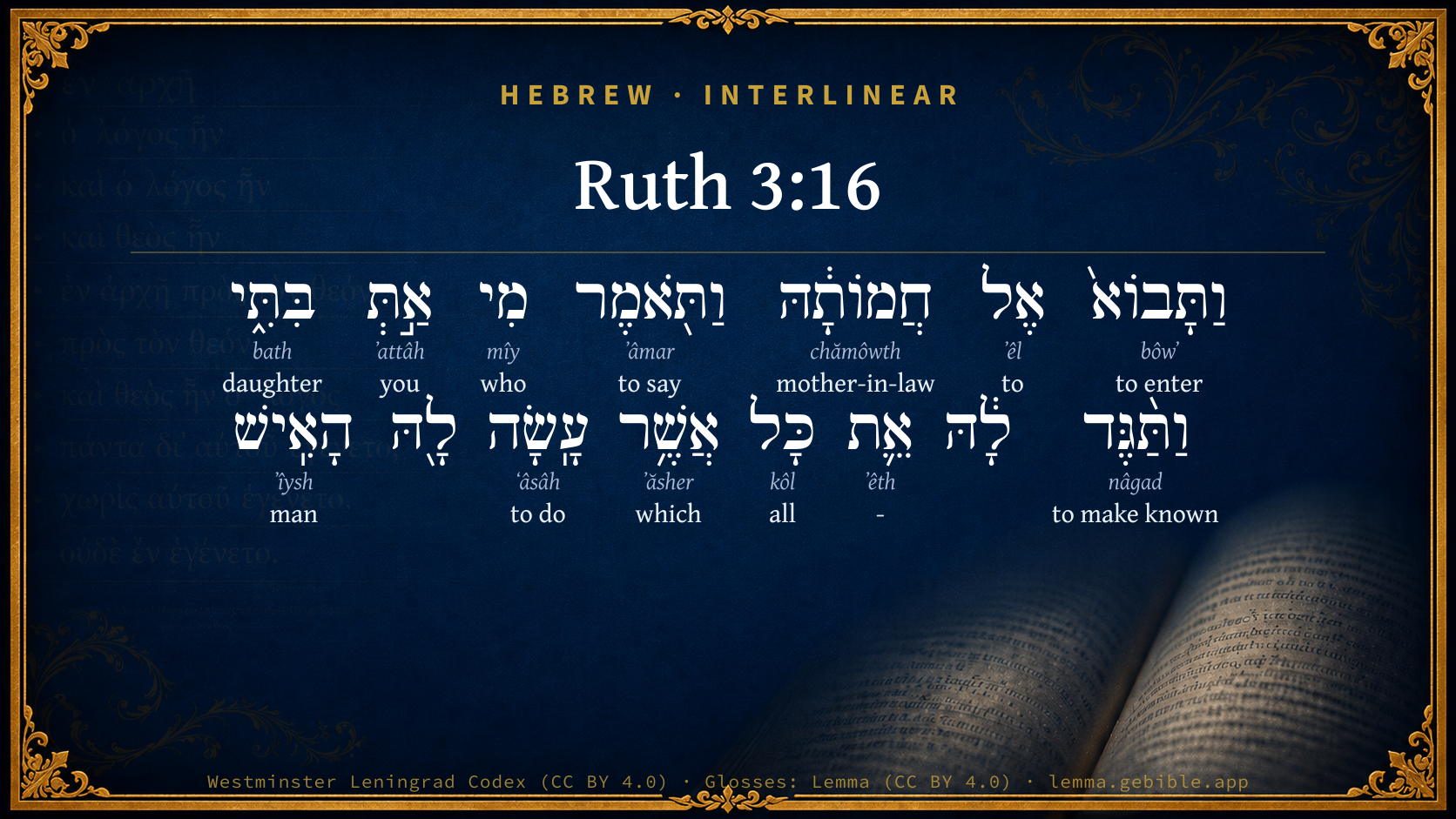
Hebrew (Westminster Leningrad Codex) Ruth 3:16 appears in the Hebrew Old Testament. The text above is from the Westminster Leningrad Codex. Each word links to its Strong’s number, a concise gloss, and parsing drawn from the Open Scriptures Hebrew Bible morphology. Click any word for its full Brown-Driver-Briggs (BDB) entry.
Download image
Cite this verse

Ruth 3:16 (World English Bible). Public Domain. Lemma interlinear Bible study tool, https://lemma.gebible.app/v/ruth/3/16.

Show BibTeX & RIS
BibTeX
RIS
English Translation
When she came to her mother-in-law, she said, Who are you, my daughter? She told her all that the man had done to her.
World English Bible · Public Domain
Download a study sheet

One document with this verse’s original text, its word-by-word gloss line, the meaning frame, cross-references with their text, attributed commentary, and full source and license credits — printable, and it pastes into notes with its structure intact.

This verse Autodidact and up

Study sheet (.html) Plain text (.txt)

A passage Seminary Student

Up to 50 verses in one chapter. A passage sheet keeps up to 6 commentary sources and 12 cross-references per verse, in the order this page ranks them, and says so on the sheet whenever that leaves anything out. Ask for a single verse and you get the Autodidact verse sheet above.

Everything on this page stays free to read, with no account — the sheet is a download of what is already on screen, not access to it.

Want to remove ads? Support Godless Engineer
Compare translations 3

The same verse in 3 English versions, stacked beneath the original-language interlinear above. Click any original word for its lexicon entry.

Each is an independent rendering of the whole verse — the interlinear is not word-aligned to these translations.

Highlighted words mark where these versions differ — a whole-verse word diff, not a word-by-word alignment.

  • World English Bible Public Domain
    When she came to her mother-in-law, she said, Who are you, my daughter? She told her all that the man had done to her.
  • King James Version Public Domain
    And when she came to her mother in law, she said, Who art thou, my daughter? And she told her all that the man had done to her.
  • unfoldingWord Literal Text CC BY-SA 4.0
    Then she came to her mother-in-law, and she said, “Who are you, my daughter?” Then she told her everything that the man had done for her.

unfoldingWord Literal Text — © unfoldingWord, licensed CC BY-SA 4.0. Word-aligned USFM3 via Door43 (git.door43.org/unfoldingWord/en_ult).

Versions to compare (up to 4)

3 of 4 selected

Show all 18 translations

Every available English version of this verse, each an independent rendering of the whole verse.

  • World English Bible Public Domain
    When she came to her mother-in-law, she said, Who are you, my daughter? She told her all that the man had done to her.
  • Berean Standard Bible Public Domain
    When Ruth returned to her mother-in-law, Naomi asked her, “How did it go, my daughter?” Then Ruth told her all that Boaz had done for her.
  • Majority Standard Bible Public Domain
    When Ruth returned to her mother-in-law, Naomi asked her, “How did it go, my daughter?” Then Ruth told her all that Boaz had done for her.
  • King James Version Public Domain
    And when she came to her mother in law, she said, Who art thou, my daughter? And she told her all that the man had done to her.
  • American Standard Version (1901) Public Domain
    And when she came to her mother-in-law, she said, Who art thou, my daughter? And she told her all that the man had done to her.
  • Revised Version (1885) Public Domain
    And when she came to her mother in law, she said, Who art thou, my daughter? And she told her all that the man had done to her.
  • Geneva Bible (1599) Public Domain
    And when she came to her mother in law, she sayd, Who art thou, my daughter? And she tolde her all that the man had done to her,
  • Douay-Rheims (1899) Public Domain
    And came to her mother in law; who said to her: What hast thou done, daughter? And she told her all that the man had done to her.
  • Young's Literal Translation Public Domain
    And she cometh in unto her mother-in-law, and she saith, `Who `art' thou, my daughter?' and she declareth to her all that the man hath done to her.
  • Literal Standard Version CC BY-SA 4.0
    And she comes to her mother-in-law, and she says, “Who [are] you, my daughter?” And she declares to her all that the man has done to her.
  • Unlocked Literal Bible CC BY-SA 4.0
    When Ruth came to her mother-in-law, she said, “How did you do, my daughter?” Then Ruth told her all that the man had done for her.
  • unfoldingWord Literal Text CC BY-SA 4.0
    Then she came to her mother-in-law, and she said, “Who are you, my daughter?” Then she told her everything that the man had done for her.
  • Darby Bible Public Domain
    And she came to her mother-in-law; and she said, Who art thou, my daughter? And she told her all that the man had done to her.
  • World Messianic Bible Public Domain
    When she came to her mother-in-law, she said, “How did it go, my daughter?” She told her all that the man had done for her.
  • Webster's Bible Public Domain
    And when she came to her mother-in-law, she said, Who art thou, my daughter? And she told her all that the man had done to her.
  • Free Bible Version CC BY-SA 4.0
    Ruth went to her mother-in-law, who asked her, “How did it go for you, my daughter?” So Ruth told her everything that Boaz had done for her.
  • Bible in Basic English Public Domain
    And when she came back her mother-in-law said to her, How did it go with you, my daughter? And she gave her an account of all the man had done to her.
  • JPS Tanakh (1917) Public Domain
    And when she came to her mother-in-law, she said: 'Who art thou, my daughter?' And she told her all that the man had done to her.

Literal Standard Version (2020), Covenant Press — licensed CC BY-SA 4.0. Text via the HelloAO Bible API (eBible.org). Unlocked Literal Bible (unfoldingWord) — licensed CC BY-SA 4.0. Text via the HelloAO Bible API (eBible.org). unfoldingWord Literal Text — © unfoldingWord, licensed CC BY-SA 4.0. Word-aligned USFM3 via Door43 (git.door43.org/unfoldingWord/en_ult). Free Bible Version, Dr. Jonathan Gallagher — licensed CC BY-SA 4.0. Text via the HelloAO Bible API (eBible.org).

Word by word

More ways to search: Search by grammar → Find every occurrence → Compare this word →

Practice this passage: Drill this verse → Learn its vocabulary →

חֲמוֹתָ֔הּ
chămôwth
H2545
“mother-in-law · her”
Noun, Common, Feminine, Singular, Construct + Suffix, Personal, 3rd Person, Feminine, Singular
Part of Speech
Noun
Type
Common
Gender
Feminine
Number
Singular
State
Construct
Full BDB Definition

Origin: from H2524

TWOT: 674b

mother-in-law, husband's mother
  1. וַתָּבוֹא֙ bôwʼ H935 “and · to enter” Conjunction + Verb, Qal, Sequential Imperfect, 3rd Person, Feminine, Singular
  2. אֶל ʼêl H413 “to” Preposition
  3. וַתֹּ֖אמֶר ʼâmar H559 “and · to say” Conjunction + Verb, Qal, Sequential Imperfect, 3rd Person, Feminine, Singular
  4. מִי mîy H4310 “who” Particle, Interrogative
  5. אַ֣תְּ ʼattâh H859 “you” Pronoun, Personal, 2nd Person, Feminine, Singular
  6. בִּתִּ֑י bath H1323 “daughter · my” Noun, Common, Feminine, Singular, Construct + Suffix, Personal, 1st Person, Common, Singular
  7. וַתַּ֨גֶּד nâgad H5046 “and · to make known” Conjunction + Verb, Hiphil, Sequential Imperfect, 3rd Person, Feminine, Singular
  8. אֵ֛ת ʼêth H853 “-” Particle, Direct Object
  9. כָּל kôl H3605 “all” Noun, Common, Masculine, Singular, Absolute
  10. אֲשֶׁ֥ר ʼăsher H834 “which” Particle, Relative
  11. עָֽשָׂה ʻâsâh H6213 “to do” Verb, Qal, Perfect, 3rd Person, Masculine, Singular
  12. הָאִֽישׁ ʼîysh H376 “the · man” Particle, Definite Article + Noun, Common, Masculine, Singular, Absolute

About this verse

These counts appear in no published source. They are computed here, from the morphology-tagged text and Lemma’s own curated glosses. What Lemma adds →

15
words
13
distinct lemmas
Historical
section

Notable vocabulary

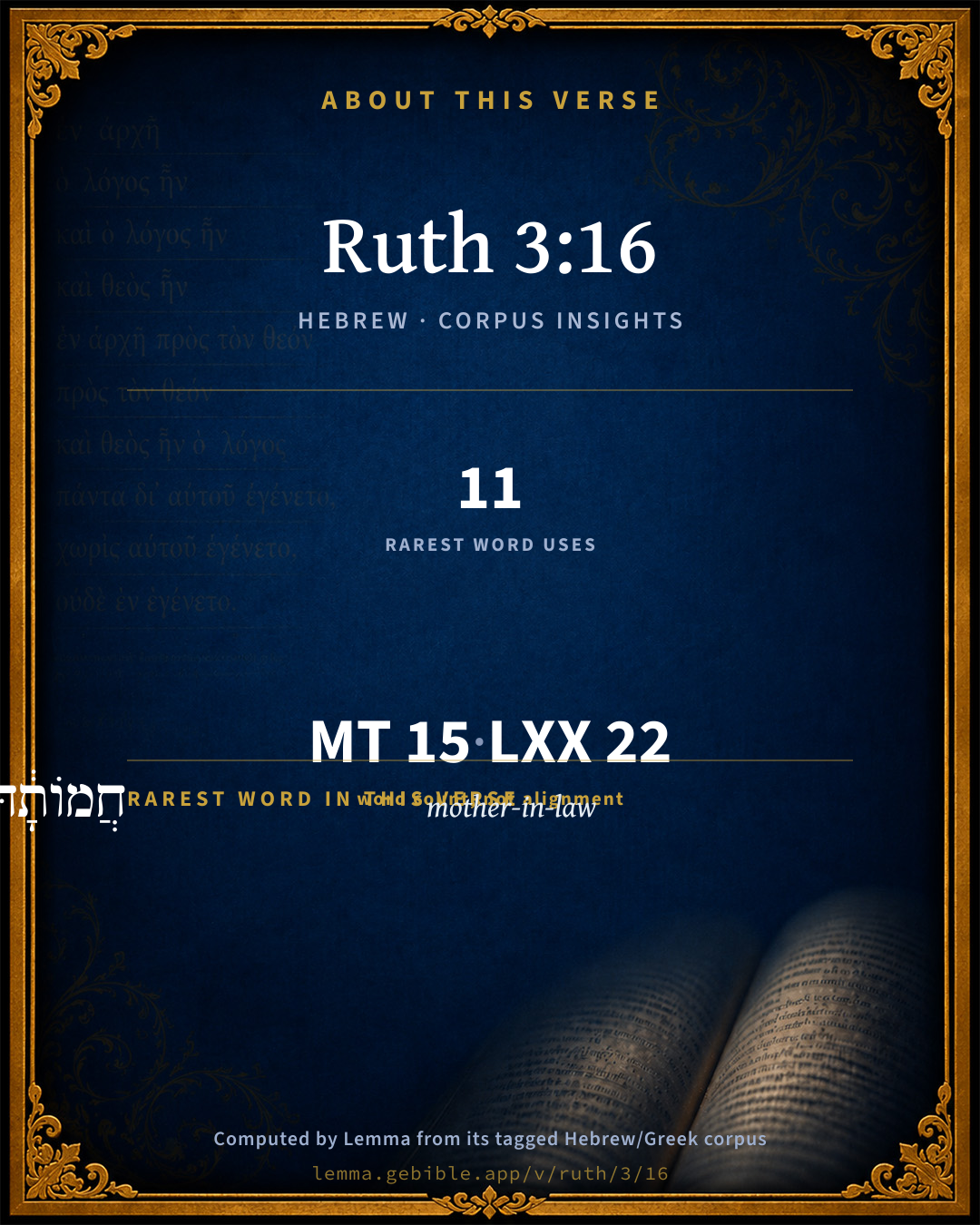
The rarest word here is חֲמוֹתָ֔הּ mother-in-law H2545 — appearing just 11 times in the whole Hebrew Bible.

Shared distinctive vocabulary

חֲמוֹתָ֔הּ mother-in-law H2545 occurs in 10 verses of the Hebrew Bible. Also found in:

Grammatical profile

  • 4 verbs
  • 4 nouns
  • 1 pronoun
  • 3 prepositions
  • 3 particles

Verb forms

  • וַתָּבוֹא֙ Qal · Sequential Imperfect
  • וַתֹּ֖אמֶר Qal · Sequential Imperfect
  • וַתַּ֨גֶּד Hiphil · Sequential Imperfect
  • עָֽשָׂה Qal · Perfect

Hebrew & Septuagint length

In English translation the verse runs 24 words from the Hebrew and 26 from the Septuagint (LXX English) — closely comparable.

A rough comparison of the two English renderings, which tokenize alike — not a word-level alignment.

Word counts can differ between the Hebrew and the Greek without any difference in meaning — e.g. the Hebrew direct-object marker אֵת has no separate Greek word, and Greek often adds the article ὁ.

In the original languages it is 15 Hebrew tokens and 22 Greek tokens — but the two are counted differently (Hebrew bundles its prefixes and suffixes into one token; the Greek is in lemma form), so that isn’t a like-for-like length.

Hebrew and Greek witnesses Masoretic Hebrew ↔ Greek Septuagint

The same verse in the two great witnesses to the Old Testament, shown verse-for-verse.

These are two independent witnesses, not word-aligned to each other, and the Septuagint is shown in lemma (dictionary) form.

Hebrew Ruth 3:16 Masoretic · Westminster Leningrad Codex

וַתָּבוֹא֙ אֶל חֲמוֹתָ֔הּ וַתֹּ֖אמֶר מִי אַ֣תְּ בִּתִּ֑י וַתַּ֨גֶּד לָ֔הּ אֵ֛ת כָּל אֲשֶׁ֥ר עָֽשָׂה לָ֖הּ הָאִֽישׁ

When she came to her mother-in-law, she said, Who are you, my daughter? She told her all that the man had done to her.

World English Bible · Public Domain

Greek LXX Ruth 3:16 Septuagint · lemma form

καί ρουθ εἰςἔρχομαι πρός ὁ πενθερά αὐτός ὁ δέ εἶπον τίς εἰμί θυγάτηρ καί εἶπον αὐτός πᾶς ὅσος ποιέω αὐτός ὁ ἀνήρ

And Ruth went in to her mother-in-law, and she said to her, My daughter! and Ruth told her all that the man had done to her.

LXX2012 (modern English Septuagint) · Public Domain

Hebrew: Westminster Leningrad Codex (CC BY 4.0). Greek: Septuagint (public domain); English from LXX2012 (modern English Septuagint) (Public Domain). How the Septuagint differs from the Hebrew →

Commentary

Notes on Ruth 3:16 from classic Christian and Jewish commentators (each source and its license shown beneath its notes). The classic Christian expositions comment on the surrounding passage and are grouped to its opening verse, so a note may address several verses; the Jewish commentaries on the Tanakh (Rashi and others) are per-verse, so they appear only where the commentator wrote on this verse.

Lemma curates 59 commentaries, every one of them public domain or Creative Commons licensed, each selected and text-cleaned for this edition rather than reprinted as found. About our sources →

Trapp's Complete Commentary

John Trapp

Rth 3:16 And when she came to her mother in law, she said, Who [art] thou, my daughter? And she told her all that the man had done to her.

Ver. 16. And when she came to her mother-in-law.] To whom she now made haste for three reasons, as is well observed: {a} (1.) For the danger of the way, being so early before day; (2.) The burden she bare, to be eased thereof; (3.) Her joy, to impart to her mother her happy success. The same reasons should prevail with us, to flee home to heaven: (1.) The danger we are in while in this dark world; (2.) The burden of sin; (3.) The joy we conceive of our future happiness.

Who art thou, my daughter?] Poor folk fear no robbing. It is bootless, we say, to rob a spittle.

All that the man had done unto her.] That is, Said unto her. Dei (sic et bonorum) dicere est facere. A good man’s promise is a done thing, as we call it.

{a} Bernard.

John Trapp, A Commentary or Exposition upon All the Books of the Old and New Testament (1647–1656) — public domain. Text from a community e-Sword module.

Joseph Benson's Commentary

Rth 3:16-17. Who art thou, my daughter? — Or rather, Is it thou, my daughter? He said to me, Go not empty unto thy mother-in-law — There is no mention made before of Boaz thus speaking to her, but it is not unusual for the sacred writers, in the relation of a fact or event, to omit many little circumstances which they occasionally mention afterward. It is likely that Boaz intended this corn chiefly for Naomi, as he was that day either about to marry Ruth himself, or to provide her another husband.

Joseph Benson's Commentary on the Old and New Testaments (1811–1818) — public domain. Text from a community e-Sword module.

Geneva Bible (1599)

Geneva Bible translators

Perceiving by her coming home, that he had not taken her to his wife, she was astonied.

Geneva Bible (1599) marginal notes — public domain. Text via Bolls.life.

Ellicott's Commentary for English Readers

(16) who art thou?—We can hardly view this as a simple question as to Ruth’s identity, but rather as meaning, how hast thou fared?

A Bible Commentary for English Readers, edited by Charles John Ellicott (1878–1897) — public domain. Text from a community e-Sword module.

The Cambridge Bible for Schools and Colleges

gen. ed. J. J. S. Perowne

16. Who art thou] i.e. how art thou? how hast thou fared? Cf. Gen_27:18.

The Cambridge Bible for Schools and Colleges (gen. ed. J. J. S. Perowne; Cambridge University Press, 1878–1918) — public domain. Text from a community e-Sword module.

John Gill's Exposition

And when she came to her mother in law,.... To Naomi, in Bethlehem:

she said, who art thou, my daughter? it being near dusk, she could not discern her, or perhaps she put the question before she opened the door and saw her; though one would think, if Ruth had called to her, she would have known her voice: rather therefore the particle may be rendered, "what" or "how" (c), instead of "who"; and the sense be, what had befallen her? what success had she had? how had things gone with her? was she married or not? or rather, had she got a promise of it? or was it likely that she should be married? with which the answer agrees:

and she told her all that the man had done to her; what kindness he had shown her, what promises he had made to her, that either he, or a nearer kinsman, would marry her, and redeem her husband's estate.

(c) "quid egisti?" V. L. "quid tibi?" Tigurine version; so R. Jonah in Aben Ezra, & Abendana in loc. "quomodo tu filia mea?" Nold. p. 602. No. 1626.

John Gill's Exposition of the Whole Bible (1746–1763) — public domain (CC PDM 1.0). Text via the HelloAO Bible API.

Albert Barnes' Notes on the Bible

Who art thou, my daughter? - In the dim twilight Rth 3:14 her mother was not sure at first who the young woman was, who sought admittance into the house.

Albert Barnes' Notes on the Bible (1834–1885) — public domain. Text from a community e-Sword/MySword module.

Haydock's Catholic Bible Commentary

What, &c. Hebrew, "Who art thou?" It was yet so dark that she did not know her. (Calmet)

George Leo Haydock (1774–1849), Haydock's Catholic Family Bible and Commentary, 1859 edition — public domain. Excludes Psalms (Douay-Rheims chapter numbering differs from Protestant) and Deuterocanonical books (Catholic canon only).

Matthew Poole's English Annotations

Who art thou, my daughter? either, first, She did not distinctly know who she was, because it was dark, and so calls her daughter only in general, as elder women call the younger. But she could as easily have discerned who she was, as what her age was. Or, secondly, This is not a question of doubting, but of wonder, as if she had said, Art thou in very deed my daughter? I can hardly believe it. How comest thou hither in this manner, and thus early?

Matthew Poole's English Annotations on the Holy Bible (1683–1685) — public domain. Text from a community e-Sword/MySword module.

Whedon's Commentary on the Bible

Daniel D. Whedon

16. Who art thou, my daughter — That is, In what character dost thou return — as the espoused of Boaz, or only still a desolate widow?

Daniel D. Whedon (gen. ed.), Commentary on the Old and New Testaments (1874–1909) — public domain. Text from a community e-Sword module.

The Pulpit Commentary

And she went to her mother-in-law. And she said, Who art thou, my daughter? And she narrated to her all that the man had done to her. The question, "Who art thou, my daughter?" is not put by Naomi, as Drusius supposes, because it was still so dusk that she could not properly distinguish Ruth. The address, "My daughter," shows that she had no difficulty in determining who the visitor was. But there is something arch intended. "Art thou Boaz"s betrothed?" Michaelis translates, "What art thou?" Unwarrantably as regards the letter, but correctly as regards the spirit of the interrogatory.

The question Who art thou? sprang from Naomi"s hope that the entire scheme would issue in success.

The Pulpit Commentary (1880–1919), ed. H.D.M. Spence-Jones & Joseph S. Exell — public domain. Text from a community e-Sword module.

John Wesley's Explanatory Notes

Who art thou? - This is not a question of doubting, but of wonder, as if she had said, Art thou in very deed my daughter? I can hardly believe it. How camest thou hither in this manner, and thus early?

John Wesley, Explanatory Notes Upon the Whole Bible (1754–1765) — public domain. Text via the GEBible commentary corpus.

Keil & Delitzsch

C. F. Keil & F. Delitzsch

When Ruth returned home, her mother-in-law asked her, "Who art thou?" i.e., as what person, in what circumstances dost thou come? The real meaning is, What hast thou accomplished? Whereupon she related all that the man had done (cf. Rut 3:10-14), and that he had given her six measures of barley for her mother. The Masorites have supplied אלי after אמר, as at Rut 3:5, but without any necessity. The mother-in-law drew from this the hope that Boaz would now certainly carry out the matter to the desired end. "Sit still," i.e., remain quietly at home (see Gen 38:11), "till thou hearest how the affair turn out," namely, whether the nearer redeemer mentioned by Boaz, or Boaz himself, would grant her the Levirate marriage. The expression "fall," in this sense, is founded upon the idea of the falling of the lot to the ground; it is different in Ezr 7:20. "For the man will not rest unless he has carried the affair to an end this day." כּי־אם, except that, as in Lev 22:6, etc. (see Ewald, 356, b).

Keil & Delitzsch — Biblical Commentary on the Old Testament (1861–1891) — public domain (CC PDM 1.0). Text via the HelloAO Bible API. (Old Testament only.)

unfoldingWord translationNotes

Door43 World Missions Community

How did you do, my daughter?

What Ruth meant by this question can be made more clear. AT: "What happened, my daughter?" or "How did Boaz act toward you?" (See: Assumed Knowledge and Implicit Information)

all that the man had done

"all that Boaz had done"

Do not go empty

"Do not go empty-handed" or "Do not go with nothing" or "Be sure to take something"

finished this thing

This refers to the decision about who will buy Naomi's property and marry Ruth.

translationWords

barley

unfoldingWord translationNotes — © Distant Shores Media and the Door43 World Missions Community, licensed CC BY-SA 4.0. Source: git.door43.org/Door43/en_tn.

Ibn Ezra

Rabbi Abraham ibn Ezra

"Who are you, my daughter?" It is possible that she didn't see her until she opened the door for her to enter, as is customary. The scripture abbreviates it to say 'I am Ruth, your daughter'. Similar to 'they called him and he ate bread', and it's written 'and Moses agreed'. Rabbi Jonah the grammarian says, 'מי' means 'what', and the meaning is 'what happened to you'. He told me that it is similar to 'What is your name?' (Judges 13:17), because the use of 'מי' in such a context is not found with a human. In my opinion, 'שמך' (your name) is a proper noun, and therefore 'מי' relates to the context.

"What the man did to her. The oath."

Ibn Ezra on the Tanakh — English translations: “Sefaria Community Translation” (CC0 1.0 (public-domain dedication)); “Yalkut, Sifsei Chachomim Chumash, Metsudah Publications, 2009” (CC BY 4.0); and “Commentary of Ibn Ezra on Isaiah - trans. by M. Friedlander, 1873” (public domain). Text via Sefaria.

Lesson kit

Teaching starters — assembled from the data on this page, not authored interpretation. Every prompt links to the verse data it draws on. Edit before teaching.

Ruth, in the Historical, opens this verse with 15 words (13 distinct Hebrew lemmas). Its most distinctive word is chămôwth (“mother-in-law”). A historical commentator’s framing appears above. Read the whole chapter for the surrounding context.

Discussion questions

  1. What does “mother-in-law” (chămôwth) contribute to the verse as a whole?
  2. How does Ruth 1:14, which shares the word «mother-in-law», read alongside this verse?
  3. The translations on this page render this verse differently — a whole-verse word diff, not a word-by-word alignment. What might account for the different wordings?
  4. «וַתָּבוֹא֙» is a Qal Sequential Imperfect verb. How does that grammatical form shape the action described?
  5. Compare how Trapp's Complete Commentary and Joseph Benson's Commentary read this verse. Where do they agree or differ?

Things to notice

Reading settings

Reading text

Shown beneath each verse's original-language words.

Old Testament
Old Testament edition

Read the OT as the Masoretic Hebrew (MT) or the Greek Septuagint (LXX).

English shown for the Greek Septuagint (in the Hebrew ↔ Greek comparison).

Comparing translations? Open the Compare panel on any verse page to stack up to four side by side.