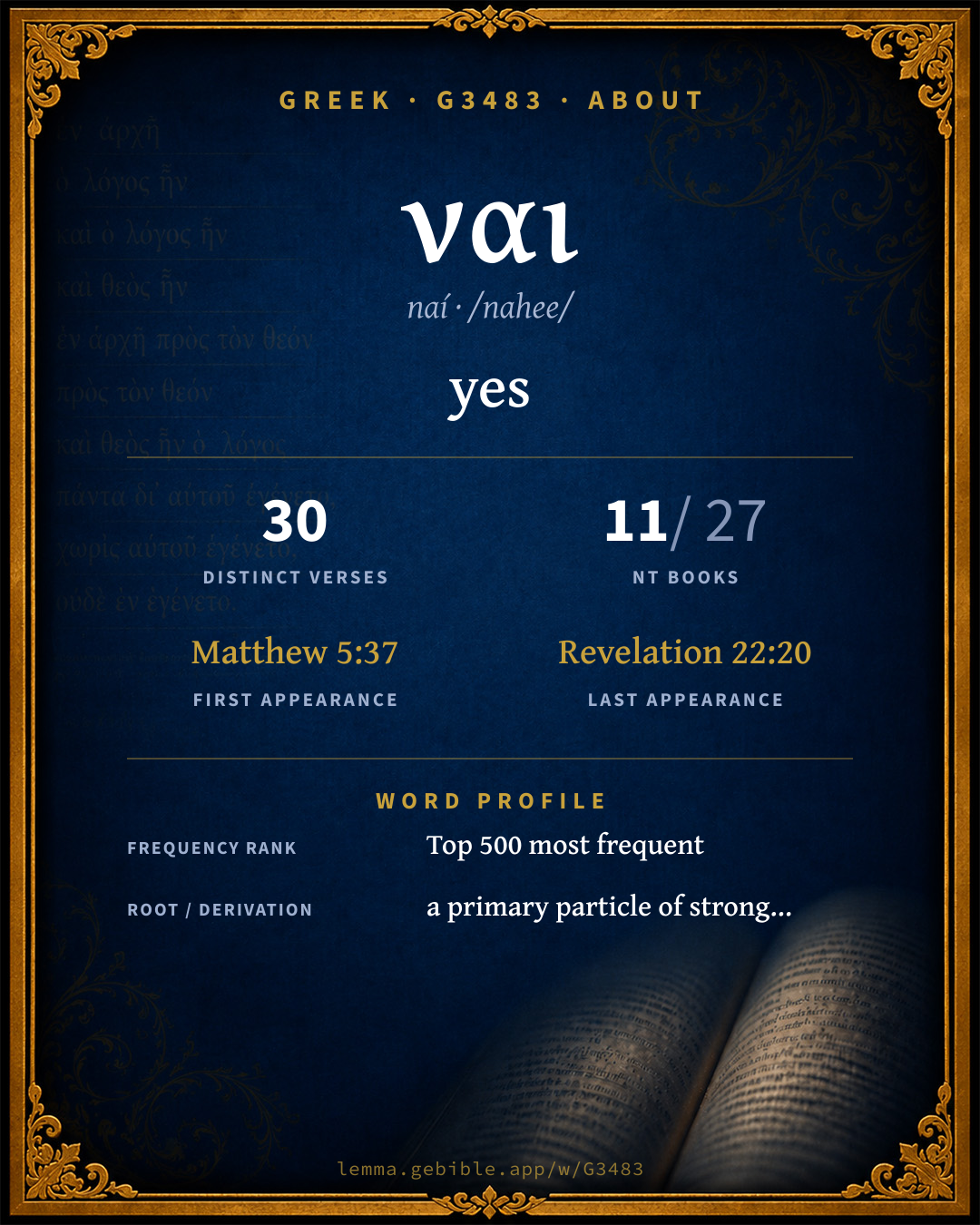
ναί
yes
Full lexicon entry — Thayer's Greek Lexicon
From Thayer's Greek Lexicon
Where this word appears
Grammar key — what these labels mean
Part of speech
- Particle
- A short, often untranslatable function word adding nuance or connection.
Every verse where G3483 appears — 30 distinct verses across 11 books. Click any verse to open its interlinear word-by-word view. Verse text shown in the World English Bible for context — . Each verse’s Greek form is shown with its reference; the English is not keyword-highlighted, since the data carries no word-level English alignment. Use “Compare translations” on any verse to read it across multiple English versions. This concordance covers the Greek New Testament; Septuagint (Greek Old Testament) occurrences of this word are not indexed here.
Matthew 8 verses
- Matthew 5:37 ναὶ ναί ptcl ptcl But let your 'Yes' be 'Yes' and your 'No' be 'no.' Whatever is more than these is of the evil one.
- Matthew 9:28 ναί ptcl When he had come into the house, the blind men came to him. Jesus said to them, "Do you believe that I am able to do this?" They told him, "Yes, Lord."
- Matthew 11:9 ναί ptcl But why did you go out? To see a prophet? Yes, I tell you, and much more than a prophet.
- Matthew 11:26 ναί ptcl Yes, Father, for so it was well-pleasing in your sight.
- Matthew 13:51 ναί ptcl Jesus said to them, "Have you understood all these things?" They answered him, "Yes, Lord."
- Matthew 15:27 ναί ptcl But she said, "Yes, Lord, but even the dogs eat the crumbs which fall from their masters' table."
- Matthew 17:25 ναί ptcl He said, "Yes." When he came into the house, Jesus anticipated him, saying, "What do you think, Simon? From whom do the kings of the earth receive toll or tribute? From their children, or from strangers?"
- Matthew 21:16 ναί ptcl and said to him, "Do you hear what these are saying?" Jesus said to them, "Yes. Did you never read, 'Out of the mouth of babes and nursing babies you have perfected praise?'"
Mark 1 verse
Luke 4 verses
- Luke 7:26 ναί ptcl But what did you go out to see? A prophet? Yes, I tell you, and much more than a prophet.
- Luke 10:21 ναί ptcl In that same hour Jesus rejoiced in the Holy Spirit, and said, "I thank you, O Father, Lord of heaven and earth, that you have hidden these things from the wise and understanding, and revealed them to little children. Yes, Father, for so it was well-pleasing in your sight."
- Luke 11:51 ναί ptcl from the blood of Abel to the blood of Zachariah, who perished between the altar and the sanctuary.' Yes, I tell you, it will be required of this generation.
- Luke 12:5 ναί ptcl But I will warn you whom you should fear. Fear him, who after he has killed, has power to cast into Gehenna. Yes, I tell you, fear him.
John 3 verses
- John 11:27 ναί ptcl She said to him, "Yes, Lord. I have come to believe that you are the Christ, God's Son, he who comes into the world."
- John 21:15 ναί ptcl So when they had eaten their breakfast, Jesus said to Simon Peter, "Simon, son of Jonah, do you love me more than these?" He said to him, "Yes, Lord; you know that I have affection for you." He said to him, "Feed my lambs."
- John 21:16 ναί ptcl He said to him again a second time, "Simon, son of Jonah, do you love me?" He said to him, "Yes, Lord; you know that I have affection for you." He said to him, "Tend my sheep."
Acts 2 verses
Romans 1 verse
2 Corinthians 4 verses
- 2 Corinthians 1:17 ναὶ ναὶ ptcl ptcl When I therefore was thus determined, did I show fickleness? Or the things that I purpose, do I purpose according to the flesh, that with me there should be the "Yes, yes" and the "No, no?"
- 2 Corinthians 1:18 ναὶ ptcl But as God is faithful, our word toward you was not "Yes and no."
- 2 Corinthians 1:19 ναὶ ναὶ ptcl ptcl For the Son of God, Jesus Christ, who was preached among you by us, by me, Silvanus, and Timothy, was not "Yes and no," but in him is "Yes."
- 2 Corinthians 1:20 ναί ptcl For however many are the promises of God, in him is the "Yes." Therefore also through him is the "Amen," to the glory of God through us.
Philippians 1 verse
Philemon 1 verse
James 1 verse
Revelation 4 verses
- Revelation 1:7 ναί ptcl Behold, he is coming with the clouds, and every eye will see him, including those who pierced him. All the tribes of the earth will mourn over him. Even so, Amen.
- Revelation 14:13 ναί ptcl I heard the voice from heaven saying, "Write, 'Blessed are the dead who die in the Lord from now on.'" "Yes," says the Spirit, "that they may rest from their labors; for their works follow with them."
- Revelation 16:7 ναί ptcl I heard the altar saying, "Yes, Lord God, the Almighty, true and righteous are your judgments."
- Revelation 22:20 ναί ptcl He who testifies these things says, "Yes, I come quickly." Amen! Yes, come, Lord Jesus.
About this entry
At a glance — auto-summarized from this page’s data, not written by a person. Every figure links to its source below. This summary describes the numbers; it doesn’t interpret them.
ναι — transliterated naí — is a Greek word carrying the sense “yes.” The King James Version usually renders it “yea,” while modern versions prefer “yes” (Berean Standard Bible) — see the renderings breakdown. With 30 verses in 11 books, it is a moderately common word in the Greek New Testament. Its uses concentrate in Matthew (27% of all occurrences). Debuting at Matthew 5:37, it then recurs through the corpus. Each statement above links to its evidence; the full detail follows below.
Gloss history
Strong's 1890 vs modern scholarship

About this word
Strong's G3483 catalogs a Greek word from the Greek New Testament.
These counts are not copied from any lexicon or concordance. They are computed here, from the morphology-tagged Greek New Testament. What Lemma adds →
- 30
- distinct verses
- The word appears in 30 distinct verses.
- 11 / 27
- NT books
- The word appears in 11 of 27 New Testament books.
- #424
- by frequency
- Top 500 most frequent Greek words (rank 424 of 5,347 Greek words by occurrence).
View all 30 occurrences in the concordance →
Most concentrated in
- Matthew 8 verses 27%
- Luke 4 verses 13%
- 2 Corinthians 4 verses 13%
By section of the New Testament
By traditional corpus
Conventional, traditional groupings — biblical authorship is debated, so this is a traditional corpus grouping, not an authorship claim. Some books belong to more than one corpus (Luke is in both the Gospels and the Lukan corpus, and so on), so these shares overlap and need not total 100%. Each figure is a share of the word’s 30 distinct verses.
- Gospels 16 verses · 53%
- Johannine 7 verses · 23%
- Pauline corpus 7 verses · 23%
- Lukan (Luke–Acts) 6 verses · 20%
- Revelation 4 verses · 13%
- General (Catholic) Epistles 1 verse · 3%
How translations render this word
Counts come from each version’s own published word-to-Strong’s tagging or interlinear alignment — an approximate guide to how each version renders this word, not a word-level alignment the data otherwise carries. Because each total is that version’s own tagged count, the per-version totals vary from one another and need not match the appearance or distinct-verse counts above. These counts may also differ from a printed concordance because Lemma counts each distinctly tagged rendering and does not collapse phrase taggings into a single head-word total. This is a fixed set of word-tagged versions (KJV, ASV, BSB, ULT) and does not change with the reading translation you choose elsewhere. Each version’s license is shown beside its name below (and on Sources).
- King James Version: Yea 22×, So 5×, Yes 3×
- American Standard Version: Yea 30×, So 2×
- Berean Standard Bible: Yes 33×
- unfoldingWord Literal Text: Yes 34×
King James Version Public Domain
Renders G3483 across 34 tagged occurrences — most commonly:
Plus 4 renderings that appear only once — usually multi-word phrases or single function words the recovered tagging swept in, not distinct renderings.
American Standard Version Public Domain
Renders G3483 across 34 tagged occurrences — most commonly:
Plus 2 renderings that appear only once — usually multi-word phrases or single function words the recovered tagging swept in, not distinct renderings. Not rendered by a distinct English word in 1 further occurrence.
Berean Standard Bible Public Domain
Renders G3483 across 34 tagged occurrences — most commonly:
Plus 1 rendering that appears only once — usually multi-word phrases or single function words the recovered tagging swept in, not distinct renderings.
unfoldingWord Literal Text CC BY-SA 4.0
Renders G3483 across 35 tagged occurrences — most commonly:
Plus 1 rendering that appears only once — usually multi-word phrases or single function words the recovered tagging swept in, not distinct renderings.
Senses in Thayer's
The 1 sense Thayer's distinguishes for this word, in lexicon order (not ranked by frequency or importance). The full entry — with sub-senses — is in the Lexicon Entry tab.
- yea, verily, truly, assuredly, even so
Word origin
Origin: a primary particle of strong affirmation
A primary particle of strong affirmation; yes : - even so surely truth verily yea yes.
— Strong’s Exhaustive Concordance (1890), public domain.
Forms in the corpus
The 2 distinct written forms G3483 takes in the Greek New Testament, most frequent first — each parse links to that case’s occurrences in the concordance.
| Form | Parsing | Example | Uses |
|---|---|---|---|
| ναί naí | Particle | Matthew 5:37 | 24 |
| ναὶ naì | Particle | Matthew 5:37 | 10 |
Same root — word family
Other Thayer's entries built from the same root as G3483, grouped by Strong’s listed origin. These share a root / origin per the lexicon — not necessarily a shared meaning. Each links to that word’s own entry.
Derived from this word
Compare all same-root words → They share a root, not necessarily a meaning.
Septuagint usage
The same Greek word ναι appears 5 times in the Greek Old Testament (Septuagint), across 5 verses in 4 books.
- 5
- LXX occurrences
- Tagged occurrences of this Greek word in the Septuagint.
- 5
- verses
- Distinct Septuagint verses containing this word.
- 4 / 39
- OT books
- The word appears in 4 of the 39 Old Testament books.
Sample Septuagint occurrences
- Genesis 17:19 ναί
- Judges 1:31 ναϊ
- Job 19:4 ναί
- Isaiah 48:7 ναί
Septuagint occurrences (same lexeme)
Every verse where the same Strong’s number (G3483) appears in the Greek Septuagint. Verse text shown in the World English Bible for context; the Greek form is the matched word — the English is not keyword-highlighted.
- Genesis 17:19 ναί God said, "No, but Sarah, your wife, will bear you a son. You shall call his name Isaac. I will establish my covenant with him for an everlasting covenant for his seed after him.
- Genesis 42:21 ναί They said one to another, "We are most assuredly guilty concerning our brother, in that we saw the distress of his soul, when he begged us, and we wouldn't listen. Therefore this distress has come on us."
- Judges 1:31 ναϊ Asher didn't drive out the inhabitants of Acco, nor the inhabitants of Sidon, nor of Ahlab, nor of Achzib, nor of Helbah, nor of Aphik, nor of Rehob;
- Job 19:4 ναί If it is true that I have erred, My error remains with myself.
- Isaiah 48:7 ναί They are created now, and not from of old; and before this day you didn't hear them; lest you should say, Behold, I knew them.
These are occurrences of the same Greek lexeme (G3483) in the Septuagint — not a translation of any one Hebrew word. The store carries no word-level Hebrew↔Greek alignment, so no Hebrew original is asserted here. Counts come from the recovered LXX Strong's tagging — high-frequency vocabulary is well covered, while rare or late forms may be untagged — so they reflect tagged occurrences and may slightly undercount.