
Luke 9:31

Greek (Tischendorf 8th ed.) Luke 9:31 appears in the Greek New Testament. The text above is from the Tischendorf 8th edition. Each word links to its Strong’s number and a concise gloss. Click any word for its full Thayer’s Greek Lexicon entry.
Download image
Cite this verse

Luke 9:31 (World English Bible). Public Domain. Lemma interlinear Bible study tool, https://lemma.gebible.app/v/luke/9/31.

Show BibTeX & RIS
BibTeX
RIS
English Translation
who appeared in glory, and spoke of his departure, which he was about to accomplish at Jerusalem.
World English Bible · Public Domain
Highlights
  • 1 first appearance in the Greek New Testament
Full analysis ↓
Download a study sheet

One document with this verse’s original text, its word-by-word gloss line, the meaning frame, cross-references with their text, attributed commentary, and full source and license credits — printable, and it pastes into notes with its structure intact.

This verse Autodidact and up

Study sheet (.html) Plain text (.txt)

A passage Seminary Student

Up to 50 verses in one chapter. A passage sheet keeps up to 6 commentary sources and 12 cross-references per verse, in the order this page ranks them, and says so on the sheet whenever that leaves anything out. Ask for a single verse and you get the Autodidact verse sheet above.

Everything on this page stays free to read, with no account — the sheet is a download of what is already on screen, not access to it.

Want to remove ads? Support Godless Engineer
Compare translations 3

The same verse in 3 English versions, stacked beneath the original-language interlinear above. Click any original word for its lexicon entry.

Each is an independent rendering of the whole verse — the interlinear is not word-aligned to these translations.

Highlighted words mark where these versions differ — a whole-verse word diff, not a word-by-word alignment.

  • World English Bible Public Domain
    who appeared in glory, and spoke of his departure, which he was about to accomplish at Jerusalem.
  • King James Version Public Domain
    Who appeared in glory, and spake of his decease which he should accomplish at Jerusalem.
  • unfoldingWord Literal Text CC BY-SA 4.0
    who were seen in glory, speaking about his departure, which he was about to fulfill in Jerusalem.

unfoldingWord Literal Text — © unfoldingWord, licensed CC BY-SA 4.0. Word-aligned USFM3 via Door43 (git.door43.org/unfoldingWord/en_ult).

Versions to compare (up to 4)

3 of 4 selected

Show all 19 translations

Every available English version of this verse, each an independent rendering of the whole verse.

  • World English Bible Public Domain
    who appeared in glory, and spoke of his departure, which he was about to accomplish at Jerusalem.
  • Berean Standard Bible Public Domain
    They appeared in glory and spoke about His departure, which He was about to accomplish at Jerusalem.
  • Majority Standard Bible Public Domain
    They appeared in glory and spoke about His departure, which He was about to accomplish at Jerusalem.
  • King James Version Public Domain
    Who appeared in glory, and spake of his decease which he should accomplish at Jerusalem.
  • American Standard Version (1901) Public Domain
    who appeared in glory, and spake of his decease which he was about to accomplish at Jerusalem.
  • Revised Version (1885) Public Domain
    who appeared in glory, and spake of his decease which he was about to accomplish at Jerusalem.
  • Geneva Bible (1599) Public Domain
    Which appeared in glory, and tolde of his departing, which he shoulde accomplish at Hierusalem.
  • Douay-Rheims (1899) Public Domain
    Appearing in majesty. And they spoke of his decease that he should accomplish in Jerusalem.
  • Young's Literal Translation Public Domain
    who having appeared in glory, spake of his outgoing that he was about to fulfil in Jerusalem,
  • Literal Standard Version CC BY-SA 4.0
    who having appeared in glory, spoke of His outgoing that He was about to fulfill in Jerusalem,
  • Unlocked Literal Bible CC BY-SA 4.0
    who appeared in glorious splendor. They spoke about his departure, which he was about to bring to completion in Jerusalem.
  • unfoldingWord Literal Text CC BY-SA 4.0
    who were seen in glory, speaking about his departure, which he was about to fulfill in Jerusalem.
  • Darby Bible Public Domain
    who, appearing in glory, spoke of his departure which he was about to accomplish in Jerusalem.
  • World Messianic Bible Public Domain
    who appeared in glory and spoke of his departure, which he was about to accomplish at Jerusalem.
  • Webster's Bible Public Domain
    Who appeared in glory, and spoke of his decease which he should accomplish at Jerusalem.
  • Free Bible Version CC BY-SA 4.0
    They spoke about his death, which would soon happen in Jerusalem.
  • Bible in Basic English Public Domain
    Who were seen in glory and were talking of his death which was about to take place in Jerusalem.
  • Text-Critical English NT CC BY 4.0
    who appeared in glory and were speaking about his departure, which he was about to bring to fulfillment in Jerusalem.
  • Tyndale New Testament (1534) Public Domain
    which appered gloriously and spake of his departinge which he shuld ende at Ierusalem.

Literal Standard Version (2020), Covenant Press — licensed CC BY-SA 4.0. Text via the HelloAO Bible API (eBible.org). Unlocked Literal Bible (unfoldingWord) — licensed CC BY-SA 4.0. Text via the HelloAO Bible API (eBible.org). unfoldingWord Literal Text — © unfoldingWord, licensed CC BY-SA 4.0. Word-aligned USFM3 via Door43 (git.door43.org/unfoldingWord/en_ult). Free Bible Version, Dr. Jonathan Gallagher — licensed CC BY-SA 4.0. Text via the HelloAO Bible API (eBible.org).

Word by word

More ways to search: Search by grammar → Find every occurrence → Compare this word →

Practice this passage: Drill this verse → Learn its vocabulary →

ἔξοδον
éxodos
G1841
“departure”
Noun, Accusative, Singular, Feminine
Part of Speech
Noun
Case
Accusative
Number
Singular
Gender
Feminine
Full Thayer's Definition

Origin: from G1537 and G3598

TDNT: 06:43,7

1. exit i.e. departure 2. the close of one's career, one's final fate 3. departure from life, decease
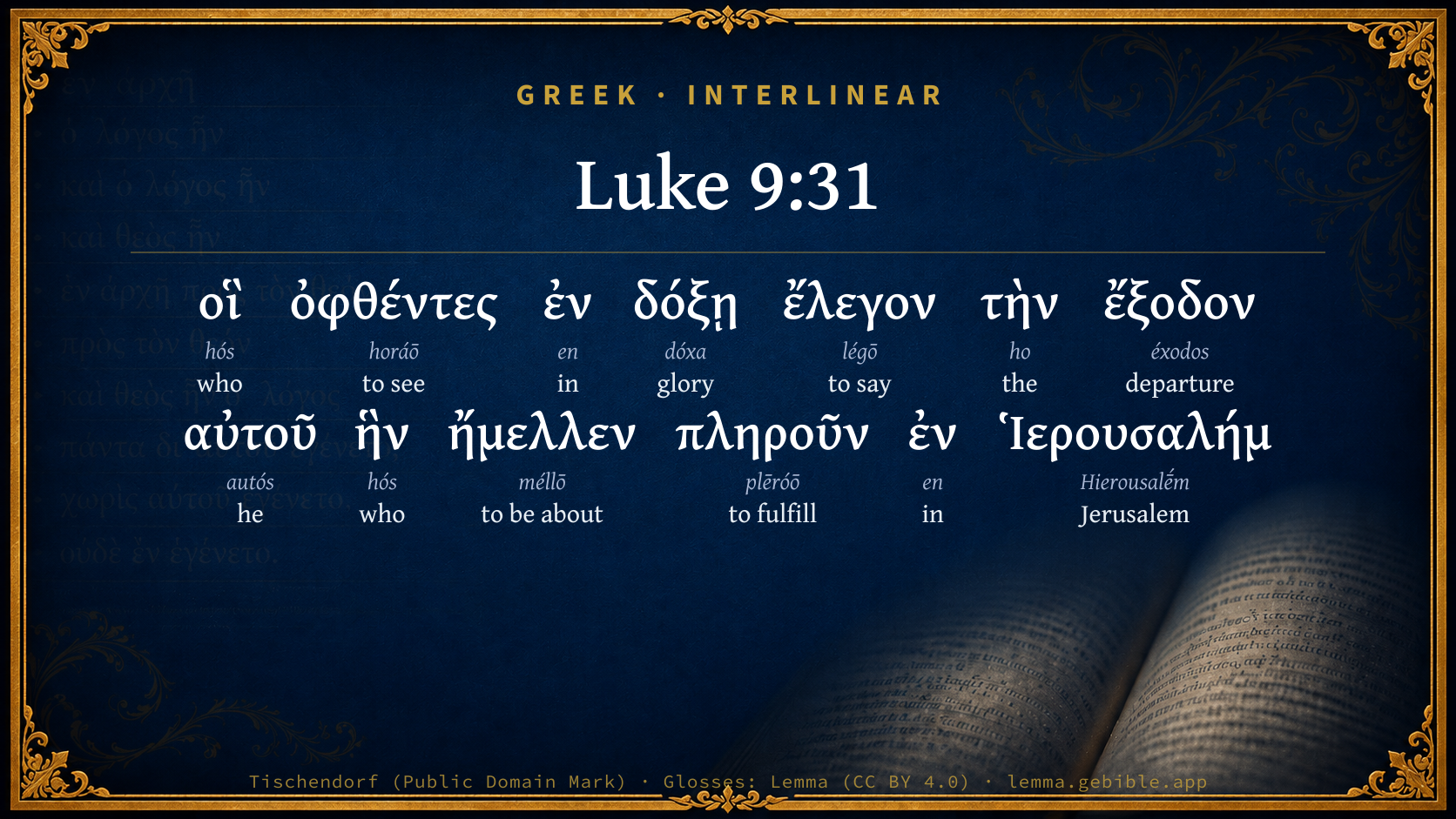
  1. οἳ hós G3739 “who” Relative pronoun, Nominative, Plural, Masculine
  2. ὀφθέντες horáō G3708 “to see” Verb, Aorist, Passive, Participle, Nominative, Plural, Masculine
  3. ἐν en G1722 “in” Preposition
  4. δόξῃ dóxa G1391 “glory” Noun, Dative, Singular, Feminine
  5. ἔλεγον légō G3004 “to say” Verb, Imperfect, Active, Indicative, 3rd person, Plural
  6. τὴν ho G3588 “the” Article, Accusative, Singular, Feminine
  7. αὐτοῦ autós G846 “he” Personal pronoun, Genitive, Singular, Masculine
  8. ἣν hós G3739 “who” Relative pronoun, Accusative, Singular, Feminine
  9. ἤμελλεν méllō G3195 “to be about” Verb, Imperfect, Active, Indicative, 3rd person, Singular, Attic form
  10. πληροῦν plēróō G4137 “to fulfill” Verb, Present, Active, Infinitive
  11. ἐν en G1722 “in” Preposition
  12. Ἱερουσαλήμ Hierousalḗm G2419 “Jerusalem” Noun, Proper, indeclinable

About this verse

These counts appear in no published source. They are computed here, from the morphology-tagged text and Lemma’s own curated glosses. What Lemma adds →

13
words
11
distinct lemmas
Gospels
section

Notable vocabulary

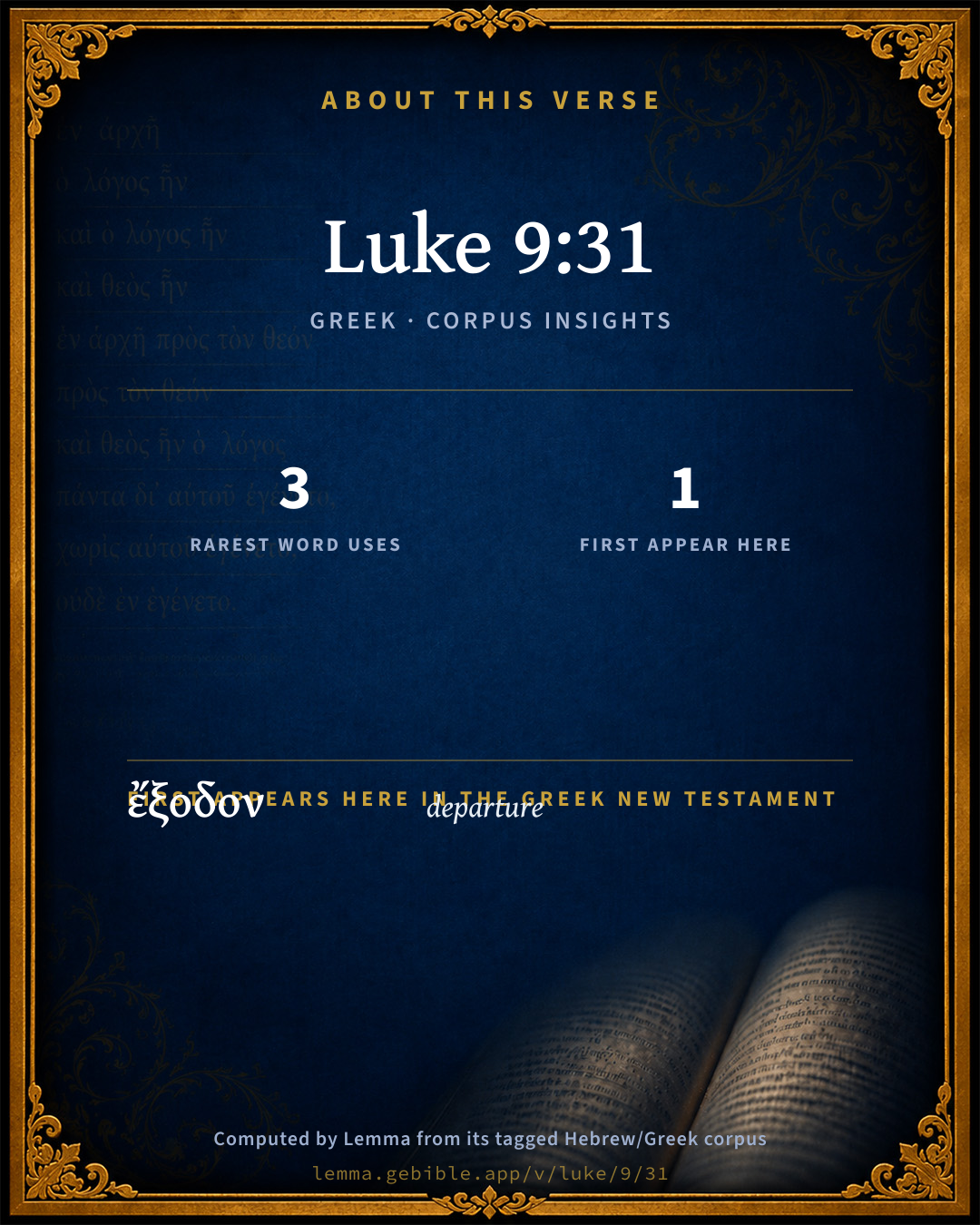
The rarest word here is ἔξοδον departure G1841 — appearing just 3 times in the whole Greek New Testament.

First appearance in Scripture

This word makes its first canonical appearance in the Greek New Testament here:

  • ἔξοδον departure G1841

Shared distinctive vocabulary

ἔξοδον departure G1841 occurs in 3 verses of the Greek New Testament. Also found in:
Repetition

Words recur within this verse:

Cross-references

12

Topical passages linked to Luke 9:31 in the Treasury of Scripture Knowledge — connected by theme and wording, ordered by reader-vote popularity; previews shown in the World English Bible.

  • Philippians 3:21 who will change the body of our humiliation to be conformed to the body of his glory, according to the working by which he is able even to subject all things to himself.
  • 1 Peter 1:11–12 searching for who or what kind of time the Spirit of Christ, which was in them, pointed to, when he predicted the sufferings of Christ, and the glories that would follow them.
  • 1 Peter 5:10 But may the God of all grace, who called you to his eternal glory by Christ Jesus, after you have suffered a little while, perfect, establish, strengthen, and settle you.
  • 2 Peter 1:15 Yes, I will make every effort that you may always be able to remember these things even after my departure.
  • Luke 9:22 saying, "The Son of Man must suffer many things, and be rejected by the elders, chief priests, and scribes, and be killed, and the third day be raised up."
  • Luke 13:32–34 He said to them, "Go and tell that fox, 'Behold, I cast out demons and perform cures today and tomorrow, and the third day I complete my mission.
  • John 1:29 The next day, he saw Jesus coming to him, and said, "Behold, the Lamb of God, who takes away the sin of the world!
  • Colossians 3:4 When Christ, our life, is revealed, then you will also be revealed with him in glory.
  • Revelation 5:6–12 I saw in the midst of the throne and of the four living creatures, and in the midst of the elders, a Lamb standing, as though it had been slain, having seven horns, and seven eyes, which are the seven Spirits of God, sent out into all the earth.
  • Revelation 7:14 I told him, "My lord, you know." He said to me, "These are those who came out of the great tribulation. They washed their robes, and made them white in the Lamb's blood.
  • 1 Corinthians 1:23–24 but we preach Christ crucified; a stumbling block to Jews, and foolishness to Greeks,
  • 2 Corinthians 3:18 But we all, with unveiled face beholding as in a mirror the glory of the Lord, are transformed into the same image from glory to glory, even as from the Lord, the Spirit.

Cross-references courtesy of OpenBible.info (CC BY 4.0).

Commentary

Notes on Luke 9:31 from classic Christian and Jewish commentators (each source and its license shown beneath its notes). The classic Christian expositions comment on the surrounding passage and are grouped to its opening verse, so a note may address several verses; the Jewish commentaries on the Tanakh (Rashi and others) are per-verse, so they appear only where the commentator wrote on this verse.

Lemma curates 59 commentaries, every one of them public domain or Creative Commons licensed, each selected and text-cleaned for this edition rather than reprinted as found. About our sources →

Tyndale Open Study Notes

Tyndale Open Resources

9:31 his exodus from this world: The Greek word exodos means “departure.” As the exodus from Egypt was God’s great act of deliverance in the Old Testament, so Jesus’ exodus from this world—his death, resurrection, and ascension—was God’s great act of deliverance in the New Testament. Jesus would accomplish a new and greater exodus.

Tyndale Open Study Notes — © Tyndale Open Resources, licensed CC BY-SA 4.0. Text via the HelloAO Bible API.

Bengel's Gnomon

Johann Albrecht Bengel

Luk 9:31. Ἐν δόξῃ, in glory) They were like their Lord in this scene [and seem to have obtained a greater degree of glory after the death and glorification of Christ. These two personages are a sample of the coming resurrection and transfiguration.—V. g.]—ἔξοδον, His departure [decease]) out of the world. Comp. Heb 13:12-13. The same word occurs, 2Pe 1:15.[82] The subject was a great one: the term describing it a very weighty one, wherein are contained the Passion, Cross, Death, Resurrection, and Ascension of Christ. The antithetic word is ΕἼΣΟΔΟς, His entrance into the world, Act 13:24.

[82] Appropriately it was used by one who had himself been an eye-witness of the transfiguration, and who was divinely taught the connection of the ἔξοδος with the δόξα, 1Pe 1:11.—ED. and TRANSL.

Bengel's Gnomon of the New Testament — English translation (T&T Clark, Edinburgh, 1860) — public domain. Text from a community e-Sword module.

Expositor's Greek Testament

ed. W. Robertson Nicoll

Luk 9:31 . ἐν δόξῃ : this is peculiar to Lk. ἔλεγον , were speaking about. Kypke thinks more is meant: speaking with praise ( cum laude aliquid commemorare ). One could have accepted this sense had Peter’s opposition been reported. τὴν ἔξοδον , decease, death; so in 2Pe 1:15 . Other words for death are ἔκβασις (Heb 13:7 ), ἄφιξις (Act 20:29 ), ἀνάλυσις (2Ti 4:6 ). Perhaps the exodus here spoken of should be taken comprehensively as including death, resurrection and ascension. (So Kypke, also Godet.) πληροῦν in that case will mean “pass through all the stages”. But against this wide sense is ἐν Ἱερουσαλήμ .

The Expositor's Greek Testament, edited by W. Robertson Nicoll (1897–1910) — public domain. Text from a community e-Sword module.

Geneva Bible (1599)

Geneva Bible translators

What death he should die in Jerusalem.

Geneva Bible (1599) marginal notes — public domain. Text via Bolls.life.

Jamieson, Fausset & Brown

Robert Jamieson, A. R. Fausset & David Brown

spake--"were speaking."

of his decease--"departure"; beautiful euphemism (softened term) for death, which Peter, who witnessed the scene, uses to express his own expected death, and the use of which single term seems to have recalled the whole by a sudden rush of recollection, and occasioned that delightful allusion to this scene which we find in Pe2 1:15-18.

which he should accomplish--"was to fulfil."

at Jerusalem--Mark the historical character and local features which Christ's death assumed to these glorified men--as important as it is charming--and see on Luk 2:11. What now may be gathered from this statement? (1) That a dying Messiah is the great article of the true Jewish theology. For a long time the Church had fallen clean away from the faith of this article, and even from a preparedness to receive it. But here we have that jewel raked out of the dunghill of Jewish traditions, and by the true representatives of the Church of old made the one subject of talk with Christ Himself. (2) The adoring gratitude of glorified men for His undertaking to accomplish such a decease; their felt dependence upon it for the glory in which they appeared; their profound interest in the progress of it, their humble solaces and encouragements to go through with it; and their sense of its peerless and overwhelming glory. "Go, matchless, adored One, a Lamb to the slaughter! rejected of men, but chosen of God and precious; dishonored, abhorred, and soon to be slain by men, but worshipped by cherubim, ready to be greeted by all heaven. In virtue of that decease we are here; our all is suspended on it and wrapped up in it. Thine every step is watched by us with ineffable interest; and though it were too high an honor to us to be permitted to drop a word of cheer into that precious but now clouded spirit, yet, as the first-fruits of harvest; the very joy set before Him, we cannot choose but tell Him that what is the depth of shame to Him is covered with glory in the eyes of Heaven, that the Cross to Him is the Crown to us, that that 'decease' is all our salvation and all our desire." And who can doubt that such a scene did minister deep cheer to that spirit? It is said they "talked" not to Him, but "with Him"; and if they told Him how glorious His decease was, might He not fitly reply, "I know it, but your voice, as messengers from heaven come down to tell it Me, is music in Mine ears."

Jamieson, Fausset & Brown — Commentary Critical and Explanatory on the Whole Bible (1871) — public domain (CC PDM 1.0). Text via the HelloAO Bible API.

Adam Clarke's Commentary

Verse 31. His decease] την εξοδον αυτον, That going out (or death) of his. That peculiar kind of death - its nature, circumstances, and necessity being considered. Instead of εξοδον, thirteen MSS. have δοξαν, glory. They spoke of that glory of his, which he was about to fill up (πληρουν) at Jerusalem. The AEthiopic unites both readings. The death of Jesus was his glory, because, by it, he gained the victory over sin, death, and hell, and purchased salvation and eternal glory for a lost world.

Adam Clarke's Commentary on the Bible (1810–1826) — public domain. Text from a community e-Sword/MySword module.

Ellicott's Commentary for English Readers

(31) Spake of his decease.—St. Luke’s is the only narrative that names the subject of the words that passed between our Lord and Moses and Elias. The use of the word “decease” (exodos) instead of “death” is remarkable: (1) because it had not been commonly so used by Greek authors; (2) because in its wider range of meaning it covered all the special phenomena connected with the close of the ministry of the Lawgiver and the Tishbite (comp. Deu_34:5-6; 2Ki_2:11), and not less so, the Resurrection and Ascension of our Lord, as well as the Crucifixion; (3) as meeting us in close connection with a reference to the Transfiguration in 2Pe_1:15.

Which he should accomplish.—Literally, which He was about to accomplish.

A Bible Commentary for English Readers, edited by Charles John Ellicott (1878–1897) — public domain. Text from a community e-Sword module.

The Cambridge Bible for Schools and Colleges

gen. ed. J. J. S. Perowne

31. spake of his decease] The word used is exodos, ‘departure’—a very unusual word for death, which also occurs in this connexion in 2Pe_1:15. The reading doxan, ‘glory,’ though known to St Chrysostom, is only supported by a few cursives. Exodos is, as Bengel says, a very weighty word, involving His passion, cross, death, resurrection, and ascension.

The Cambridge Bible for Schools and Colleges (gen. ed. J. J. S. Perowne; Cambridge University Press, 1878–1918) — public domain. Text from a community e-Sword module.

John Gill's Exposition

And it came to pass, as they departed from him,.... That is, as Moses and Elias departed from Christ; or "when they began to depart", as the Syriac version renders it; or "would depart", as the Arabic and Persic versions; seemed desirous of going, or made some signal or other by which the disciples perceived they were about to go; for, as yet, they were not gone;

Peter said unto Jesus, master, it is good for us to be here, let us make three tabernacles, one for thee, and one for Moses, and one for Elias; See Gill on Mat 17:4.

not knowing what he said, nor "what to say", as Mark observes, being in a surprise, and not in a situation to consider and weigh things well, whether what he said was right and proper, or not; See Gill on Mat 17:4

John Gill's Exposition of the Whole Bible (1746–1763) — public domain (CC PDM 1.0). Text via the HelloAO Bible API.

Trapp's Complete Commentary

John Trapp

30 And, behold, there talked with him two men, which were Moses and Elias:

31 Who appeared in glory, and spake of his decease which he should accomplish at Jerusalem.

Ver. 31. And spake of his decease] Gr. of his exodus; in reference to that expedition or departure of Israel out of Egypt (την εξοδον). It signifieth a translating from a condition and state of hardship; and is also used by St Peter, 2Pe 1:15. Death to the saints is but an out going to heaven, Php 1:21, a loosing from the shore of life, and launching out into the main of immortality.

John Trapp, A Commentary or Exposition upon All the Books of the Old and New Testament (1647–1656) — public domain. Text from a community e-Sword module.

Haydock's Catholic Bible Commentary

They spoke of his decease,[2] or his departure out of this world. St. Peter useth the same Greek word for his death. (2 Peter i. 15.) (Witham)

===============================

[BIBLIOGRAPHY]

Excessum, Greek: exodon. Mr. Bois, the canon of Ely, shews it a proper word for death. So 2 Peter i. 15. post obitum meum, Greek: meta ten emen exodon.

George Leo Haydock (1774–1849), Haydock's Catholic Family Bible and Commentary, 1859 edition — public domain. Excludes Psalms (Douay-Rheims chapter numbering differs from Protestant) and Deuterocanonical books (Catholic canon only).

Whedon's Commentary on the Bible

Daniel D. Whedon

31. Spake of his decease—The three evangelists tell us that the two talked with Jesus, but Luke alone informs us what was the topic of the conversation. They conversed about his approaching sufferings; and in what tone appears from the remarkable phrase which follows, namely, the decease which he should accomplish. His death was viewed as a great voluntary work to be achieved.

Daniel D. Whedon (gen. ed.), Commentary on the Old and New Testaments (1874–1909) — public domain. Text from a community e-Sword module.

The Pulpit Commentary

Who appeared in glory. Why were these two chosen as the Lord"s companions on that solemn night? Probably

(1) because they were what may be termed the two great representative men of the chosen race of Israel. The one was the human author of the Divine Law which for so many centuries had been the guide and teacher of the covenant people. The other had been the most illustrious of that great order of prophets who, during the centuries of their eventful history as a nation, had, under the commission of the Most Highest, kept alight the torch of the knowledge of the one true God. And

(2) because these men alone of the race of Israel apparently had kept their earthly bodies as the shrines of their immortal spirits. Elijah, we know, was translated alive into the other and the grander world; and as for Moses, God, his heavenly Friend, closed his eyes, and then hid his body from mortal sight, and, the mysterious words of Jude (ver. 9) would seem to tell us, from mortal corruption. And spake of his decease which he should accomplish at Jerusalem. Why was this the chosen subject of the august conference between the Lord and the heavenly pair?

(3) In all reverence we may feel that one reason for the visit of these blessed spirits on that solemn night was the strengthening the sinless Sufferer himself. The vista which lay immediately before Jesus, of rejection, desertion, the death of agony, and the dreadful sufferings which preceded it, all this had been very present before him lately. He had dwelt upon these things, we know, to his own. He had pondered over them, no doubt, often when alone. It was not only in Gethsemane that his "soul was sorrowful even unto death." As in the garden-agony "appeared to him an angel from heaven strengthening him," so here on the mount came to him these glorified spirits for the same blessed purpose of ministering. And it was to help the three disciples. Their wavering faith would surely be strengthened if the words which they heard from those heavenly visitants dwelt with reverent awe and admiration on the circumstances of their Master"s self-sacrificing career of agony and suffering. It must be remembered that a few days earlier they had listened to him, when he spoke to them of these things, with shrink-iv g terror and incredulous amazement. They would now know what was thought of all this in the courts of heaven.

The Pulpit Commentary (1880–1919), ed. H.D.M. Spence-Jones & Joseph S. Exell — public domain. Text from a community e-Sword module.

John Wesley's Explanatory Notes

In glory - Like Christ with whom they talked.

John Wesley, Explanatory Notes Upon the Whole Bible (1754–1765) — public domain. Text via the GEBible commentary corpus.

Cambridge Greek Testament for Schools and Colleges

31. τὴν ἔξοδον. ‘Departure’—a very unusual word for death, which also occurs in this connexion in 2Pe 1:15 (comp. exitus). The reading δόξαν, ‘glory,’ though known to St Chrysostom, is only supported by a few cursives. ἔξοδος is, as Bengel says, a very weighty word, involving His passion, cross, death, resurrection, and ascension. The same sense is found in Jos. Antt. IV. 8, § 2. See too Wis 3:2, “their departure is taken for misery.” Id. Luk 7:6. Comp. εἴσοδος in Act 13:24.

ἐν Ιερουσαλήμ. The murderers of the Prophets, Luk 13:33.

Cambridge Greek Testament for Schools and Colleges (Cambridge University Press, 1896; 21 vols, various authors incl. Carr, Maclear, Plummer, Farrar, Lumby, Moule, M. R. James, Simcox) — public domain. Text from a community e-Sword module.

Alford’s Greek Testament

Henry Alford

31.] This ἔξοδος could be no other than His death—see reff.

πληροῦν—to fulfil by divine appointment.

Henry Alford, The Greek Testament (1849–1861) — public domain. Text from a community e-Sword module.

International Critical Commentary

31, 32. Peculiar to Lk. See on 22:43.

τὴν ἔξοδον αὐτοῦ. His departure from this world by means of the Passion, Resurrection, and Ascension. Comp. the use of εἴσοδος in Act 13:24. For ἔξοδος in the sense of death see 2Pe 1:15; Wisd. 3:2, 7:6. That the Apostles heard this subject being discussed explains part of the meaning of the Transfiguration. It was to calm their minds, which had recently been disturbed by the prediction of Christ’s sufferings and deaths.2 The ἤμελλεν corresponds to δεῖ in ver. 22. It is all ordained by God, and is sure to take place; and when it takes place it may be regarded as a fulfilment (πληροῦν), and also as a filling, full. There were types and prophecies shadowing forth the Divne purpose, every detail of which must be gone through.

It is perhaps to be regretted that RV., retains “accomplish,” which is its freq. rendering of τελειόω (Joh 4:34, Joh 4:5:36; Act 20:24; Joh 17:4, etc.), instead of substituting “fulfil,” which is its freq. rendering of πληρόω (21:24, 22:16, 24:44; Act 1:16, etc.). And why not “exodus” here, and Heb 11:22, and 2Pe 1:15, for ἔξοδος?

βεβαρημένοι ὕπνῳ. In N.T. only the pass. of this verb is found, and the best writers do not use the pres. of either voice. In Mat 26:43 it is used of the eyes of these same three being heavy with sleep. comp. Luk 21:34; 2Co 1:8, 2Co 1:5:4; 1Ti 5:16.

διαγρηγορήσαντες δέ. “But having remained awake” in spite of this sleepiness would be the common meaning of the word;1 but perhaps here it means “having become thoroughly awake.” Syr-Sin. has “when they awoke.” It is a late word, and occurs nowhere else in N.T. or LXX. Lk. is fond of compounds with διά:—διαγινώσκειν, διαδέχεσθαι, διαλείπειν, διαλύειν, διανέμειν, διανυκτερεύειν, διαπονεῖσθαι, διαπορεῖν, διαπραγματεύεσθαι, etc.

As the invention of a later hand these two verses (31, 32) do not explain themselves. What is the motive for the invention? As a narrative of facts they throw much light on the whole situation.

International Critical Commentary — older volumes (1896–1929), various authors — public domain. Text from a community e-Sword module.

Vincent's Word Studies in the New Testament

Marvin R. Vincent

This verse is peculiar to Luke. Spake [ελεγον] . Imperfect, were speaking.

Decease [εξοδον] . The Rev. retains the word of the A. V., though it has, to modern ears, a somewhat formal sound. No word, however, could more accurately represent the original, which is compounded of ejx, out of, and oJdov, a journeying; and thus corresponds to the Latin decessus, a going away, whence the word decease. The Greek word is familiar to us as exodus, applied principally to the migration of the Hebrews from Egypt, and thus used at Heb 11:22, departing. In the mouth of Christ it covers the ideas both of death and ascension. Peter uses it of his own death (2Pe 1:15, where see note).

He should accomplish [εμελλεν πληρουν] . Better, as Rev., he was about to accomplish. "Accomplish," or "fulfil," is very significant with reference to Christ 's death. Moses and Joshua had begun an exodus from Egypt, but had not accomplished the going out of God 's people from this present world. See Heb 3:18; Heb 4:8.

Marvin R. Vincent, Word Studies in the New Testament (1887–1900) — public domain. Text from a community e-Sword/MySword module.

Lesson kit

Teaching starters — assembled from the data on this page, not authored interpretation. Every prompt links to the verse data it draws on. Edit before teaching.

Luke, in the Gospels, opens this verse with 13 words (11 distinct Greek lemmas). Its most distinctive word is éxodos (“departure”). A historical commentator’s framing appears above. Read the whole chapter for the surrounding context.

Discussion questions

  1. What does “departure” (éxodos) contribute to the verse as a whole?
  2. The word “departure” first appears here in Scripture. What is being introduced at this debut?
  3. Hebrews 11:22 shares the word «departure» with this verse. How do the two illuminate each other?
  4. “who” occurs 2× in this one verse. What is the effect of the repetition?
  5. These translations render this verse differently. What is at stake in choosing one wording over another?
  6. Reading how Tyndale Open Study Notes and Bengel's Gnomon read this verse, where do the two commentators agree and where do they part?

Things to notice

  • 1 word makes its first canonical appearance in Scripture here.
  • These translations choose different wording for 11 words in this verse.
  • “who” occurs 2× in this single verse.
  • 11 distinct Greek lemmas span 13 words in this verse.

Reading settings

Reading text

Shown beneath each verse's original-language words.

Old Testament
Old Testament edition

Read the OT as the Masoretic Hebrew (MT) or the Greek Septuagint (LXX).

English shown for the Greek Septuagint (in the Hebrew ↔ Greek comparison).

Comparing translations? Open the Compare panel on any verse page to stack up to four side by side.