
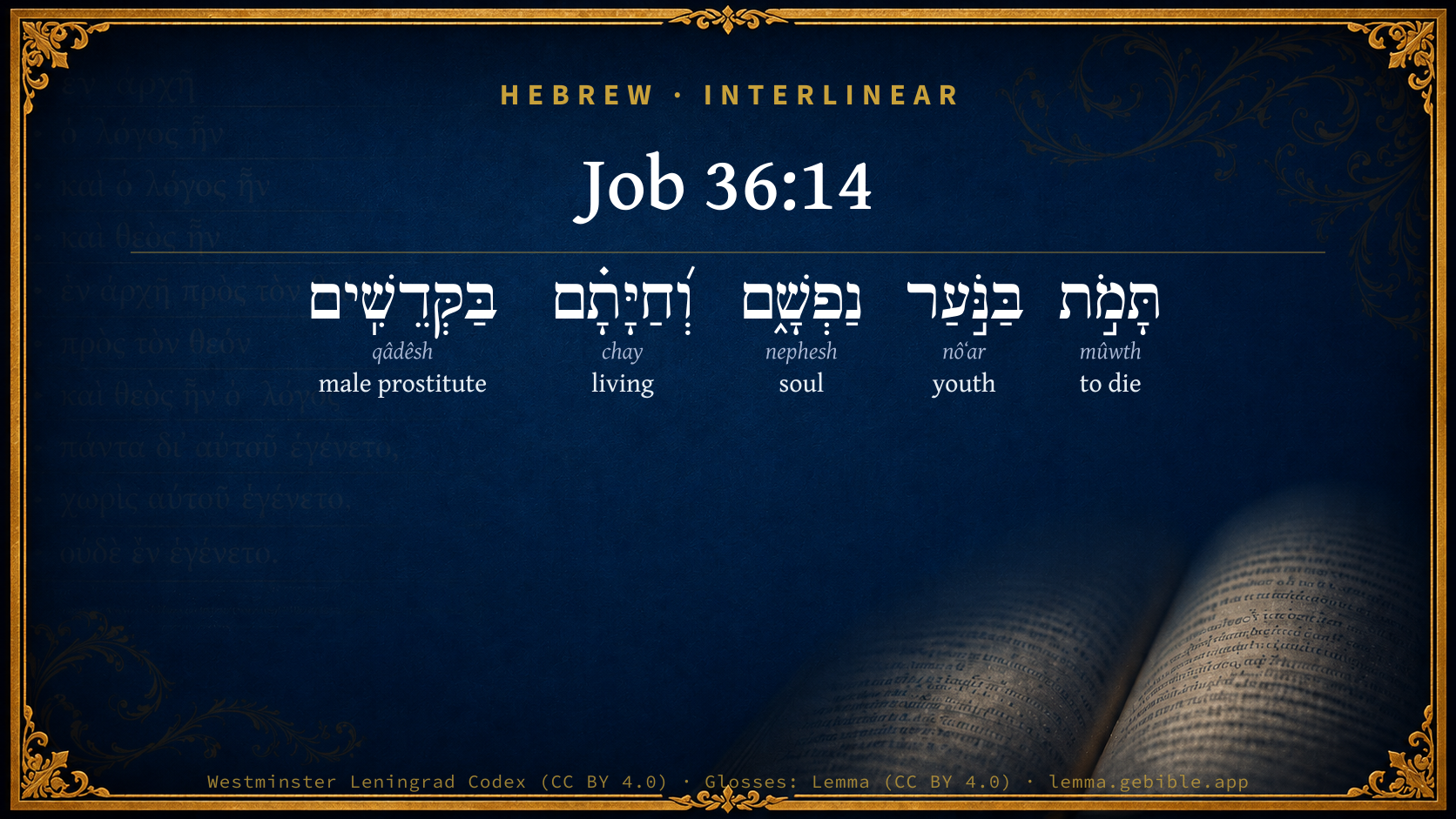
Job 36:14

Hebrew (Westminster Leningrad Codex) Job 36:14 appears in the Hebrew Old Testament. The text above is from the Westminster Leningrad Codex. Each word links to its Strong’s number, a concise gloss, and parsing drawn from the Open Scriptures Hebrew Bible morphology. Click any word for its full Brown-Driver-Briggs (BDB) entry.
Download image
Cite this verse

Job 36:14 (World English Bible). Public Domain. Lemma interlinear Bible study tool, https://lemma.gebible.app/v/job/36/14.

Show BibTeX & RIS
BibTeX
RIS
English Translation
They die in youth. Their life perishes among the unclean.
World English Bible · Public Domain
Download a study sheet

One document with this verse’s original text, its word-by-word gloss line, the meaning frame, cross-references with their text, attributed commentary, and full source and license credits — printable, and it pastes into notes with its structure intact.

This verse Autodidact and up

Study sheet (.html) Plain text (.txt)

A passage Seminary Student

Up to 50 verses in one chapter. A passage sheet keeps up to 6 commentary sources and 12 cross-references per verse, in the order this page ranks them, and says so on the sheet whenever that leaves anything out. Ask for a single verse and you get the Autodidact verse sheet above.

Everything on this page stays free to read, with no account — the sheet is a download of what is already on screen, not access to it.

Want to remove ads? Support Godless Engineer
Compare translations 3

The same verse in 3 English versions, stacked beneath the original-language interlinear above. Click any original word for its lexicon entry.

Each is an independent rendering of the whole verse — the interlinear is not word-aligned to these translations.

Highlighted words mark where these versions differ — a whole-verse word diff, not a word-by-word alignment.

  • World English Bible Public Domain
    They die in youth. Their life perishes among the unclean.
  • King James Version Public Domain
    They die in youth, and their life is among the unclean.
  • unfoldingWord Literal Text CC BY-SA 4.0
    Their soul dies in youth, and their life among the cultic prostitutes.

unfoldingWord Literal Text — © unfoldingWord, licensed CC BY-SA 4.0. Word-aligned USFM3 via Door43 (git.door43.org/unfoldingWord/en_ult).

Versions to compare (up to 4)

3 of 4 selected

Show all 18 translations

Every available English version of this verse, each an independent rendering of the whole verse.

  • World English Bible Public Domain
    They die in youth. Their life perishes among the unclean.
  • Berean Standard Bible Public Domain
    They die in their youth, among the male shrine prostitutes.
  • Majority Standard Bible Public Domain
    They die in their youth, among the male shrine prostitutes.
  • King James Version Public Domain
    They die in youth, and their life is among the unclean.
  • American Standard Version (1901) Public Domain
    They die in youth, And their life `perisheth' among the unclean.
  • Revised Version (1885) Public Domain
    They die in youth, and their life perisheth among the unclean.
  • Geneva Bible (1599) Public Domain
    Their soule dyeth in youth, and their life among the whoremongers.
  • Douay-Rheims (1899) Public Domain
    Their soul shall die in a storm, and their life among the effeminate.
  • Young's Literal Translation Public Domain
    Their soul dieth in youth, And their life among the defiled.
  • Literal Standard Version CC BY-SA 4.0
    Their soul dies in youth, || And their life among the defiled.
  • Unlocked Literal Bible CC BY-SA 4.0
    They die in their youth; their lives end among the cultic prostitutes.
  • unfoldingWord Literal Text CC BY-SA 4.0
    Their soul dies in youth, and their life among the cultic prostitutes.
  • Darby Bible Public Domain
    Their soul dieth in youth, and their life is among the unclean.
  • World Messianic Bible Public Domain
    They die in youth. Their life perishes among the unclean.
  • Webster's Bible Public Domain
    They die in youth, and their life is among the unclean.
  • Free Bible Version CC BY-SA 4.0
    They die in their youth; their lives end among the male temple prostitutes.
  • Bible in Basic English Public Domain
    They come to their end while they are still young, their life is short like that of those who are used for sex purposes in the worship of their gods.
  • JPS Tanakh (1917) Public Domain
    Their soul perisheth in youth, and their life as that of the depraved.

Literal Standard Version (2020), Covenant Press — licensed CC BY-SA 4.0. Text via the HelloAO Bible API (eBible.org). Unlocked Literal Bible (unfoldingWord) — licensed CC BY-SA 4.0. Text via the HelloAO Bible API (eBible.org). unfoldingWord Literal Text — © unfoldingWord, licensed CC BY-SA 4.0. Word-aligned USFM3 via Door43 (git.door43.org/unfoldingWord/en_ult). Free Bible Version, Dr. Jonathan Gallagher — licensed CC BY-SA 4.0. Text via the HelloAO Bible API (eBible.org).

Word by word

More ways to search: Search by grammar → Find every occurrence → Compare this word →

Practice this passage: Drill this verse → Learn its vocabulary →

About this verse

These counts appear in no published source. They are computed here, from the morphology-tagged text and Lemma’s own curated glosses. What Lemma adds →

5
words
5
distinct lemmas
Wisdom
section

Notable vocabulary

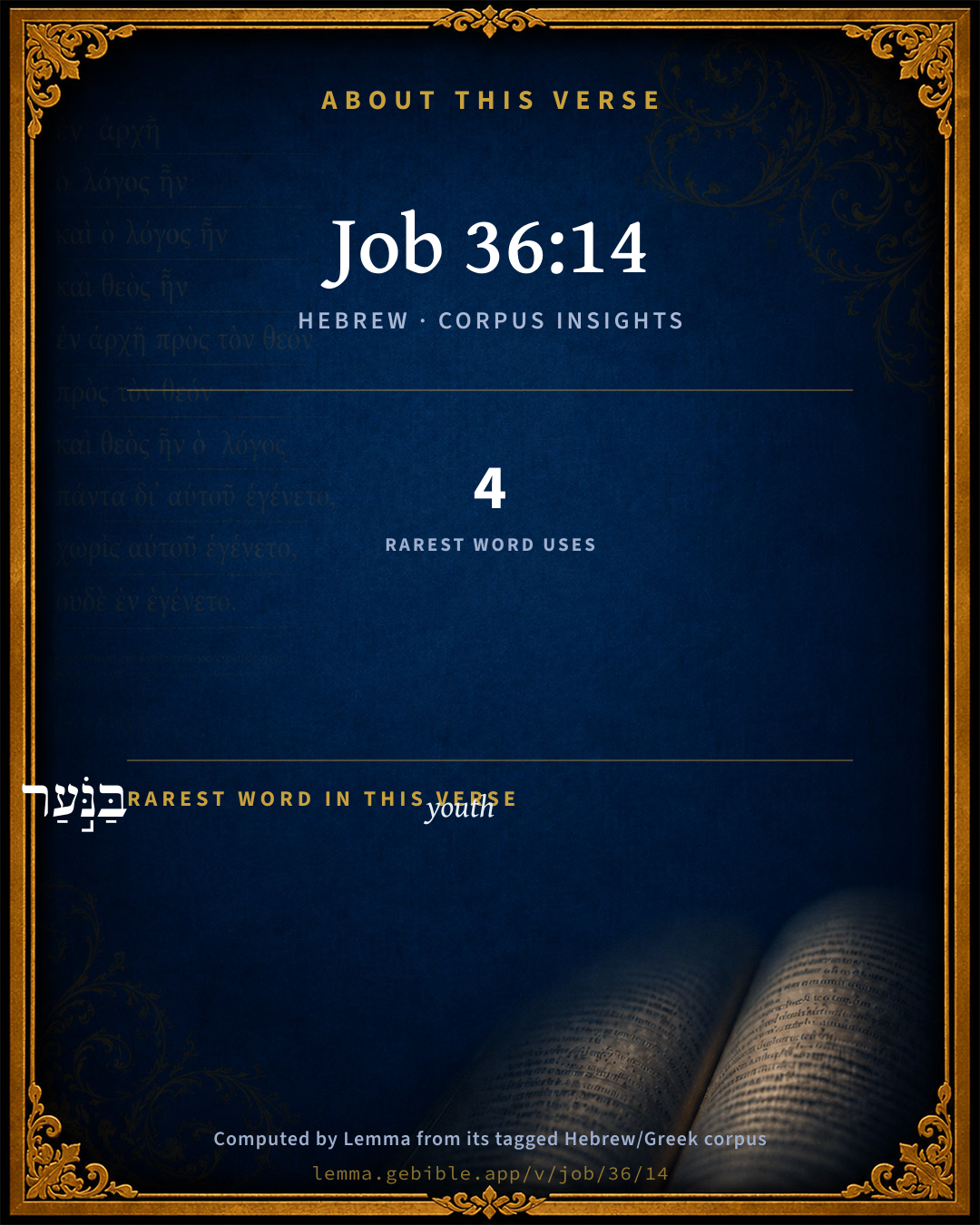
The rarest word here is בַּנֹּ֣עַר youth H5290 — appearing just 4 times in the whole Hebrew Bible.

Shared distinctive vocabulary

בַּנֹּ֣עַר youth H5290 occurs in 4 verses of the Hebrew Bible. Also found in:

Grammatical profile

  • 1 verb
  • 3 nouns
  • 1 adjective

Verb forms

  • תָּמֹ֣ת Qal · Jussive

Hebrew & Septuagint length

In English translation the verse runs 10 words from the Hebrew and 16 from the Septuagint (LXX English) — the Septuagint runs noticeably longer here. See the side-by-side →

A rough comparison of the two English renderings, which tokenize alike — not a word-level alignment.

Word counts can differ between the Hebrew and the Greek without any difference in meaning — e.g. the Hebrew direct-object marker אֵת has no separate Greek word, and Greek often adds the article ὁ.

Cross-references

9

Topical passages linked to Job 36:14 in the Treasury of Scripture Knowledge — connected by theme and wording, ordered by reader-vote popularity; previews shown in the World English Bible.

  • Deuteronomy 23:17 There shall be no prostitute of the daughters of Israel, neither shall there be a sodomite of the sons of Israel.
  • Job 15:32 It shall be accomplished before his time. His branch shall not be green.
  • Job 22:16 Who were snatched away before their time, Whose foundation was poured out as a stream,
  • Psalms 55:23 But you, God, will bring them down into the pit of destruction. Bloodthirsty and deceitful men shall not live out half their days, But I will trust in you.
  • Genesis 19:5 They called to Lot, and said to him, "Where are the men who came in to you this night? Bring them out to us, that we may have sex with them."
  • Genesis 19:24–25 Then Yahweh rained on Sodom and on Gomorrah sulfur and fire from Yahweh out of the sky.
  • Genesis 38:7–10 Er, Judah's firstborn, was wicked in the sight of Yahweh. Yahweh killed him.
  • Leviticus 10:1–2 Nadab and Abihu, the sons of Aaron, each took his censer, and put fire in it, and laid incense on it, and offered strange fire before Yahweh, which he had not commanded them.
  • Job 21:23–25 One dies in his full strength, Being wholly at ease and quiet.

Cross-references courtesy of OpenBible.info (CC BY 4.0).

Hebrew and Greek witnesses Masoretic Hebrew ↔ Greek Septuagint

The same verse in the two great witnesses to the Old Testament, shown verse-for-verse.

Here the Septuagint runs noticeably longer than the Hebrew — LXX2012 (modern English Septuagint) 16 words vs World English Bible 10. A rough length comparison of the two English translations, not a word-level alignment — read both below.

These are two independent witnesses, not word-aligned to each other, and the Septuagint is shown in lemma (dictionary) form.

Hebrew Job 36:14 Masoretic · Westminster Leningrad Codex

תָּמֹ֣ת בַּנֹּ֣עַר נַפְשָׁ֑ם וְ֝חַיָּתָ֗ם בַּקְּדֵשִֽׁים

They die in youth. Their life perishes among the unclean.

World English Bible · Public Domain

Greek LXX Job 36:14 Septuagint · lemma form

ἀποθνήσκω τοίνυν ἐν νεότης ὁ ψυχή αὐτός ὁ δέ ζωή αὐτός τιτρώσκω ὑπό ἄγγελος

Therefore let their soul die in youth, and their life be wounded by messengers of death.

LXX2012 (modern English Septuagint) · Public Domain

On this verse, Adam Clarke's Commentary discusses the Septuagint’s reading. Read the note in Commentary ↓

Hebrew: Westminster Leningrad Codex (CC BY 4.0). Greek: Septuagint (public domain); English from LXX2012 (modern English Septuagint) (Public Domain). How the Septuagint differs from the Hebrew →

Commentary

Notes on Job 36:14 from classic Christian and Jewish commentators (each source and its license shown beneath its notes). The classic Christian expositions comment on the surrounding passage and are grouped to its opening verse, so a note may address several verses; the Jewish commentaries on the Tanakh (Rashi and others) are per-verse, so they appear only where the commentator wrote on this verse.

Lemma curates 59 commentaries, every one of them public domain or Creative Commons licensed, each selected and text-cleaned for this edition rather than reprinted as found. About our sources →

Trapp's Complete Commentary

John Trapp

Job 36:14 They die in youth, and their life [is] among the unclean.

Ver. 14. They die in youth] They die before their time, as Solomon expresseth it; then, when it were better for them to do anything than to die, for they are killed with death, as Jezebel’s children were, Rev 2:20-23. Their soul dieth, as the Hebrew here hath it. Their soul perisheth among the boys, their life among the Sodomites, as Beza translateth this text, and thus paraphraseth. Therefore as accursed before God they die, and are reckoned among those impure young men whose youth, being spent in all filthiness and uncleanness, was subject to that most abominable lust which is not to be named. The sum of all is, saith Brentius, Hypocrita peribit turpiter, The hypocrite shall once come to a shameful end. And when the foul sinner shall be damned, what shall become of the fair professor? God will lead such forth with the workers of iniquity, yea, with the worst kind of sinners, Sodomites, for instance, shall he punish them.

John Trapp, A Commentary or Exposition upon All the Books of the Old and New Testament (1647–1656) — public domain. Text from a community e-Sword module.

Geneva Bible (1599)

Geneva Bible translators

They die of some vile death, and that before they come to age.

Geneva Bible (1599) marginal notes — public domain. Text via Bolls.life.

Jamieson, Fausset & Brown

Robert Jamieson, A. R. Fausset & David Brown

Rather (Deu 23:17), Their life is (ended) as that of (literally, "among") the unclean, prematurely and dishonorably. So the second clause answers to the first. A warning that Job make not common cause with the wicked (Job 34:36).

Jamieson, Fausset & Brown — Commentary Critical and Explanatory on the Whole Bible (1871) — public domain (CC PDM 1.0). Text via the HelloAO Bible API.

Adam Clarke's Commentary

Verse 14. They die in youth] Exactly what the psalmist says, "Bloody and deceitful men shall not live out half their days," Ps 55:23. Literally, the words of Elihu are, "They shall die in the youth of their soul."

Their life is among the unclean.] בקדשים bakedeshim, among the whores, harlots, prostitutes, and sodomites. In this sense the word is used, though it also signifies consecrated persons; but we know that in idolatry characters of this kind were consecrated to Baal and Ashtaroth, Venus, Priapus, &c. Mr. Good translates the rabble. The Septuagint: Their life shalt be wounded by the angels.

Adam Clarke's Commentary on the Bible (1810–1826) — public domain. Text from a community e-Sword/MySword module.

The Cambridge Bible for Schools and Colleges

gen. ed. J. J. S. Perowne

14. They die] lit. their soul dieth. They perish in the midst of their days.

is among the unclean] Or, perisheth among the unclean, i. e. like the unclean. They die prematurely or in debasement like the hierodouloi in the temples of Baal, comp. 1Ki_14:24; 1Ki_15:12.

The Cambridge Bible for Schools and Colleges (gen. ed. J. J. S. Perowne; Cambridge University Press, 1878–1918) — public domain. Text from a community e-Sword module.

John Gill's Exposition

They die in youth,.... They, or "their soul" (u); which, though that dies not, being immaterial and immortal; yet being the principal part of man, is put for the whole person, and which being taken away, the body dies. All men must die, but all do not die at an age; there is a common term of human life, Psa 90:10; some few exceed it, multitudes arrive not to it; such who die before it may be said to die in youth; it seems to signify premature and untimely death: the word signifies an "excussion", or violent shaking out; and the Vulgate Latin version is, "in a tempest"; in a tempest of divine wrath, and in a storm in their consciences, Job 27:20. Jarchi interprets it by suffocation or strangling;

and their life is among the unclean: all men are by nature unclean, and all that is in them; some are more notoriously and openly so than others, who give themselves over to lasciviousness, to work all uncleanness with greediness; such as whoremongers and fornicators, of whom Mr. Broughton understands those unclean persons; or Sodomites, of whom the word is sometimes used, Deu 23:17. And this may be understood either of the present life of hypocrites before they die; who are unclean persons themselves, whatever show of purity they make, and love to live and converse, at least privately, if not openly, with unclean persons, and die while they live with such and in their sins: or of their life after death; for wicked men live after death; their souls live in hell, and their bodies at the resurrection will be raised to life, and be reunited to their souls, and both together will live in endless punishment; and the life of hypocrites will be among such; as is a man in life, so he is at and after death; if filthy, filthy still; and such will have no admittance into the heavenly state, and with such impure ones, hypocrites will live for ever, Rev 21:8.

(u) "anima eorum", Pagninus, Montanus, Tigurine version, Vatablus, Junius & Tremellius, Piscator, &c.

John Gill's Exposition of the Whole Bible (1746–1763) — public domain (CC PDM 1.0). Text via the HelloAO Bible API.

Albert Barnes' Notes on the Bible

They die in youth - Margin, “Their soul dieth.” The word “soul” or “life” in the Hebrew is used to denote oneself. The meaning is, that they would soon be cut down, and share the lot of the openly wicked. If they amended their lives they might be spared, and continue to live in prosperity and honor; if they did not, whether openly wicked or hypocrites. they would be early cut off.

And their life is amnong the unclean - Margin, “Sodomites.” The idea is, that they would be treated in the same way as the most abandoned and vile of the race. No special favor would be shown to them because they were “professors” of religion, nor would this fact be a shield against the treatment which they deserved. They could not be classed with the righteous, and must, therefore, share the fate of the most worth mss and wicked of the race. The word rendered “unclean” (קדשׁים qâdêsh) is from קדשׁ qâdash, “to be pure or holy”; and in the Hiphil to regard as holy, to consecrate, or devote to the service of God, as e. g. a priest; Exo 28:41; Exo 29:1. Then it means to consecrate or devote to “any” service or purpose, as to an idol god. Hence, it means one consecrated or devoted to the service of Astarte, the goddess of the Sidonians or Venus, and as this worship was corrupt and licentious, the word means one who is licentious or corrupt compare Deu 23:18; 1Ki 14:24; Gen 38:21-22. Here it means the licentious, the corrupt, the abandoned; and the idea is, that if hypocrites did not repent under the inflictions of divine judgment, they would be dealt with in the same way as the most abandoned and vile. On the evidence that licentiousness constituted a part of the ancient worship of idols, see Spencer “de Legg. ritual Hebraedor.” Lib. ii. cap. iii. pp. 613, 614, Ed. 1732. Jerome renders this, “intereffoeminatos.” The Septuagint strangely enough has: “Let their life be wounded by angels.”

Albert Barnes' Notes on the Bible (1834–1885) — public domain. Text from a community e-Sword/MySword module.

Haydock's Catholic Bible Commentary

Storm. Hebrew and Septuagint, "in youth," (Haydock) being suddenly cut off, without having deplored the sins of their youth. (Calmet) --- Effeminate. Hebrew, "the consecrated" to prostitution. Eliu compares those who will not attend unto God, to the most infamous characters. (Calmet) --- Septuagint, "and let their life be taken away by the angels" (Haydock) of death, chap. xxxiii. 23. (Calmet) --- He may allude to the impure Sodomites. (Menochius)

George Leo Haydock (1774–1849), Haydock's Catholic Family Bible and Commentary, 1859 edition — public domain. Excludes Psalms (Douay-Rheims chapter numbering differs from Protestant) and Deuterocanonical books (Catholic canon only).

Matthew Poole's English Annotations

They die in youth; they provoke God to cut them off before their time. Heb. Their soul (i.e. they themselves) shall die in youth. Their life is; or, their life shall die or be extinct; which verb is understood out of the former clause, after the manner of the Hebrews.

The unclean; or, the filthy, or whoremongers, or sodomites; to whose destruction (which happened not long before this time) he may seem to allude. The sense is, they shall die by some dreadful and exemplary stroke of Divine vengeance.

Matthew Poole's English Annotations on the Holy Bible (1683–1685) — public domain. Text from a community e-Sword/MySword module.

Whedon's Commentary on the Bible

Daniel D. Whedon

14. They die — Better, as in margin, their soul dieth. (Hengstenberg, Hitzig, etc.) Soul is here in contrast with life in the second clause. “Passages like it in the Proverbs would support the idea of spiritual death.” — Tayler Lewis. Hypocrisy enervates, undermines, and destroys man’s moral being no less certainly than licentiousness does his physical being. The divine mind may class hypocrisy and licentiousness more closely together than we would deem possible, even as the hypocrite and catamite are here linked together in oneness of spiritual death.

The unclean — Or as in margin. Literally, the word means “those consecrated to the service of heathen deities.” It is a sad comment on idolatrous worship that it should enlist for its support the prostitution not only of women, but of men. The קדושׁים, “saints,” are those devoted to the worship of God: — the קדשׁים, the unclean, are those devoted to the worship of gods. The slight divergence of the words (the difference of a vav, ו) points back to a time when a divergence in the objects of worship took place, while still the philological link, at least, was one of consecration. The indescribable degradation developed through the worship of idols sets forth the heinousness of all vice which builds upon the perversion of true faith. Elihu introduces these degraded beings simply to point the moral that the seemingly righteous, whose true character affliction discloses, die, like these catamites, a premature and ugly death. The masculine vice referred to in the text spread its desolating blight over the most enlightened nations of antiquity, as still appears from the classics. The Persians, according to Herodotus, (i, 135,) learned it from the Greeks.

Daniel D. Whedon (gen. ed.), Commentary on the Old and New Testaments (1874–1909) — public domain. Text from a community e-Sword module.

The Pulpit Commentary

They die in youth; literally, their sold dieth in youth. The result is that, while they are still young, the vital strength of their soul is sapped; they "come to a premature end, like youths who have destroyed the spring of life by licentiousness" (Cook). And their life is among the unclean. (On the particular "uncleanness" intended, see Deu_23:17)

The Pulpit Commentary (1880–1919), ed. H.D.M. Spence-Jones & Joseph S. Exell — public domain. Text from a community e-Sword module.

John Wesley's Explanatory Notes

Die - They provoke God to cut them off before their time. Unclean - Or, Sodomites; to whose destruction, he may allude. They shall die by some exemplary stroke of Divine vengeance. Yea, and after death, their life is among the unclean, the unclean spirits, the devil and his angels, forver excluded from the new Jerusalem, into which no unclean thing shall enter.

John Wesley, Explanatory Notes Upon the Whole Bible (1754–1765) — public domain. Text via the GEBible commentary corpus.

Rashi

Rabbi Shlomo Yitzchaki (Rashi)

shall die by strangulation Their soul [shall die] by the strangulation that is upon them,

Rashi on the Tanakh — English translations: “The Judaica Press complete Tanach with Rashi, translated by A. J. Rosenberg” (CC BY 4.0); “Pentateuch with Rashi's commentary by M. Rosenbaum and A.M. Silbermann, 1929-1934” (public domain); “The Metsudah Tanach series, Lakewood, N.J” (CC BY 4.0); and “The Book of Joshua, Metsudah Publications, 1997” (CC BY 4.0). Text via Sefaria.

Lesson kit

Teaching starters — assembled from the data on this page, not authored interpretation. Every prompt links to the verse data it draws on. Edit before teaching.

Job, in the Wisdom, opens this verse with 5 words (5 distinct Hebrew lemmas). Its most distinctive word is nôʻar (“youth”). The Greek Septuagint runs longer here. A historical commentator’s framing appears above. Read the whole chapter for the surrounding context.

Discussion questions

  1. What does “youth” (nôʻar) contribute to the verse as a whole?
  2. How does Job 33:25, which shares the word «youth», read alongside this verse?
  3. The Septuagint runs longer here than the Hebrew. What might account for the difference?
  4. These translations render this verse differently. What is at stake in choosing one wording over another?
  5. «תָּמֹ֣ת» is a Qal Jussive verb. How does that grammatical form shape the action described?
  6. Compare how Trapp's Complete Commentary and Geneva Bible (1599) read this verse. Where do they agree or differ?

Things to notice

Reading settings

Reading text

Shown beneath each verse's original-language words.

Old Testament
Old Testament edition

Read the OT as the Masoretic Hebrew (MT) or the Greek Septuagint (LXX).

English shown for the Greek Septuagint (in the Hebrew ↔ Greek comparison).

Comparing translations? Open the Compare panel on any verse page to stack up to four side by side.