
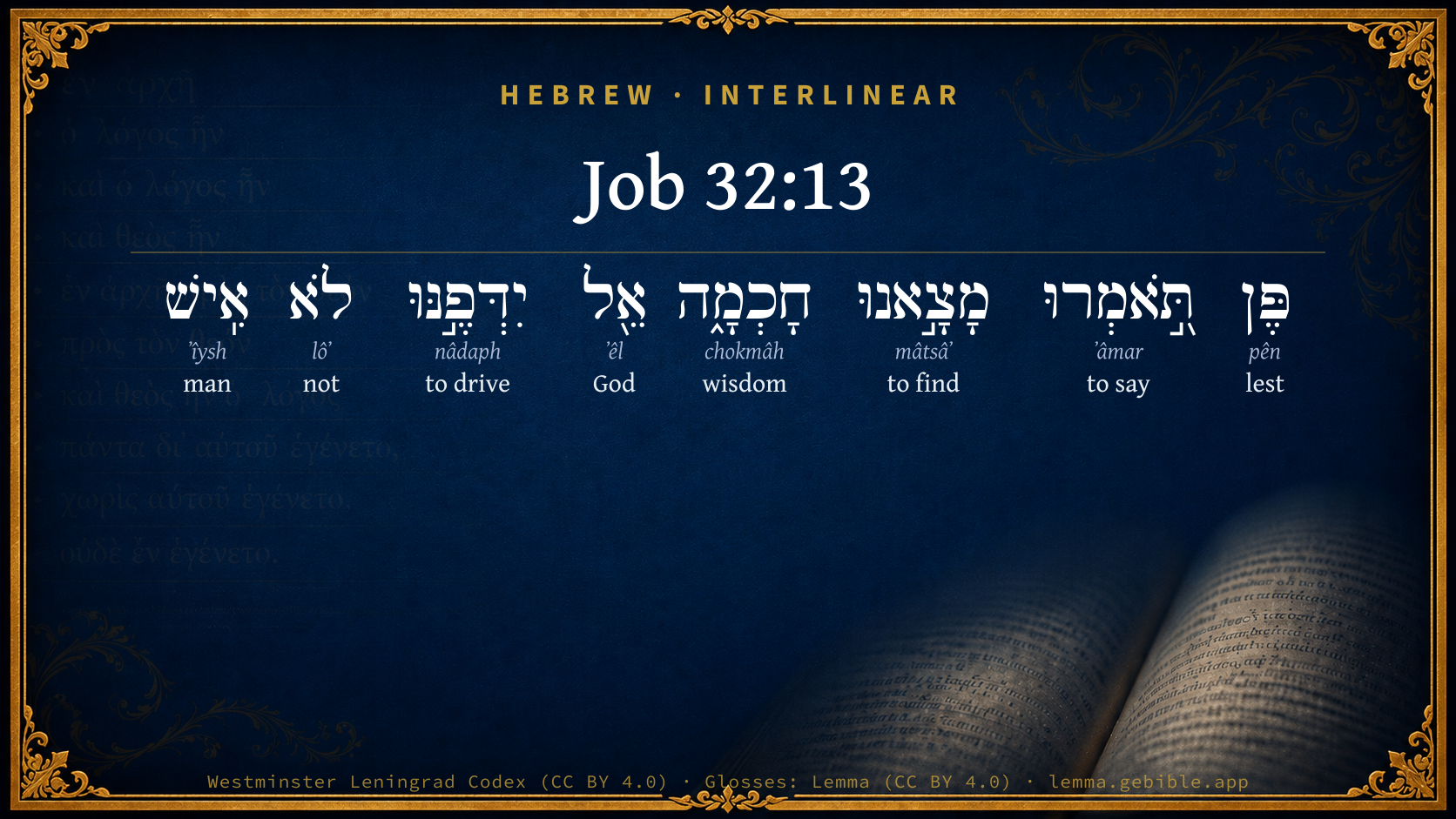
Job 32:13

Hebrew (Westminster Leningrad Codex) Job 32:13 appears in the Hebrew Old Testament. The text above is from the Westminster Leningrad Codex. Each word links to its Strong’s number, a concise gloss, and parsing drawn from the Open Scriptures Hebrew Bible morphology. Click any word for its full Brown-Driver-Briggs (BDB) entry.
Download image
Cite this verse

Job 32:13 (World English Bible). Public Domain. Lemma interlinear Bible study tool, https://lemma.gebible.app/v/job/32/13.

Show BibTeX & RIS
BibTeX
RIS
English Translation
Beware lest you say, 'We have found wisdom, God may refute him, not man:'
World English Bible · Public Domain
Download a study sheet

One document with this verse’s original text, its word-by-word gloss line, the meaning frame, cross-references with their text, attributed commentary, and full source and license credits — printable, and it pastes into notes with its structure intact.

This verse Autodidact and up

Study sheet (.html) Plain text (.txt)

A passage Seminary Student

Up to 50 verses in one chapter. A passage sheet keeps up to 6 commentary sources and 12 cross-references per verse, in the order this page ranks them, and says so on the sheet whenever that leaves anything out. Ask for a single verse and you get the Autodidact verse sheet above.

Everything on this page stays free to read, with no account — the sheet is a download of what is already on screen, not access to it.

Want to remove ads? Support Godless Engineer
Compare translations 3

The same verse in 3 English versions, stacked beneath the original-language interlinear above. Click any original word for its lexicon entry.

Each is an independent rendering of the whole verse — the interlinear is not word-aligned to these translations.

Highlighted words mark where these versions differ — a whole-verse word diff, not a word-by-word alignment.

  • World English Bible Public Domain
    Beware lest you say, 'We have found wisdom, God may refute him, not man:'
  • King James Version Public Domain
    Lest ye should say, We have found out wisdom: God thrusteth him down, not man.
  • unfoldingWord Literal Text CC BY-SA 4.0
    lest you say, ‘We have found wisdom!’ Let God refute him, not man.

unfoldingWord Literal Text — © unfoldingWord, licensed CC BY-SA 4.0. Word-aligned USFM3 via Door43 (git.door43.org/unfoldingWord/en_ult).

Versions to compare (up to 4)

3 of 4 selected

Show all 18 translations

Every available English version of this verse, each an independent rendering of the whole verse.

  • World English Bible Public Domain
    Beware lest you say, 'We have found wisdom, God may refute him, not man:'
  • Berean Standard Bible Public Domain
    So do not claim, ‘We have found wisdom; let God, not man, refute him.’
  • Majority Standard Bible Public Domain
    So do not claim, ‘We have found wisdom; let God, not man, refute him.’
  • King James Version Public Domain
    Lest ye should say, We have found out wisdom: God thrusteth him down, not man.
  • American Standard Version (1901) Public Domain
    Beware lest ye say, We have found wisdom; God may vanquish him, not man:
  • Revised Version (1885) Public Domain
    Beware lest ye say, We have found wisdom; God may vanquish him, not man:
  • Geneva Bible (1599) Public Domain
    Lest ye should say, We haue found wisedome: for God hath cast him downe, and no man.
  • Douay-Rheims (1899) Public Domain
    Lest you should say: We have found wisdom, God hath cast him down, not man.
  • Young's Literal Translation Public Domain
    Lest ye say, We have found wisdom, God doth thrust him away, not man.
  • Literal Standard Version CC BY-SA 4.0
    Lest you say, We have found wisdom, || God thrusts him away, not man.
  • Unlocked Literal Bible CC BY-SA 4.0
    Be careful not to say, 'We have found wisdom!' God will have to defeat Job; mere man cannot do it.
  • unfoldingWord Literal Text CC BY-SA 4.0
    lest you say, ‘We have found wisdom!’ Let God refute him, not man.
  • Darby Bible Public Domain
    That ye may not say, We have found out wisdom; ùGod will make him yield, not man.
  • World Messianic Bible Public Domain
    Beware lest you say, ‘We have found wisdom. God may refute him, not man;’
  • Webster's Bible Public Domain
    Lest ye should say, We have found out wisdom: God thrusteth him down, not man.
  • Free Bible Version CC BY-SA 4.0
    Don't say to yourselves, ‘We are so wise,’ for God will prove him wrong, not a human being.
  • Bible in Basic English Public Domain
    Take care that you do not say, Wisdom is here; God may overcome him, but not man.
  • JPS Tanakh (1917) Public Domain
    Beware lest ye say: 'We have found wisdom; God may vanquish him, not man!'

Literal Standard Version (2020), Covenant Press — licensed CC BY-SA 4.0. Text via the HelloAO Bible API (eBible.org). Unlocked Literal Bible (unfoldingWord) — licensed CC BY-SA 4.0. Text via the HelloAO Bible API (eBible.org). unfoldingWord Literal Text — © unfoldingWord, licensed CC BY-SA 4.0. Word-aligned USFM3 via Door43 (git.door43.org/unfoldingWord/en_ult). Free Bible Version, Dr. Jonathan Gallagher — licensed CC BY-SA 4.0. Text via the HelloAO Bible API (eBible.org).

Word by word

More ways to search: Search by grammar → Find every occurrence → Compare this word →

Practice this passage: Drill this verse → Learn its vocabulary →

About this verse

These counts appear in no published source. They are computed here, from the morphology-tagged text and Lemma’s own curated glosses. What Lemma adds →

8
words
8
distinct lemmas
Wisdom
section

Notable vocabulary

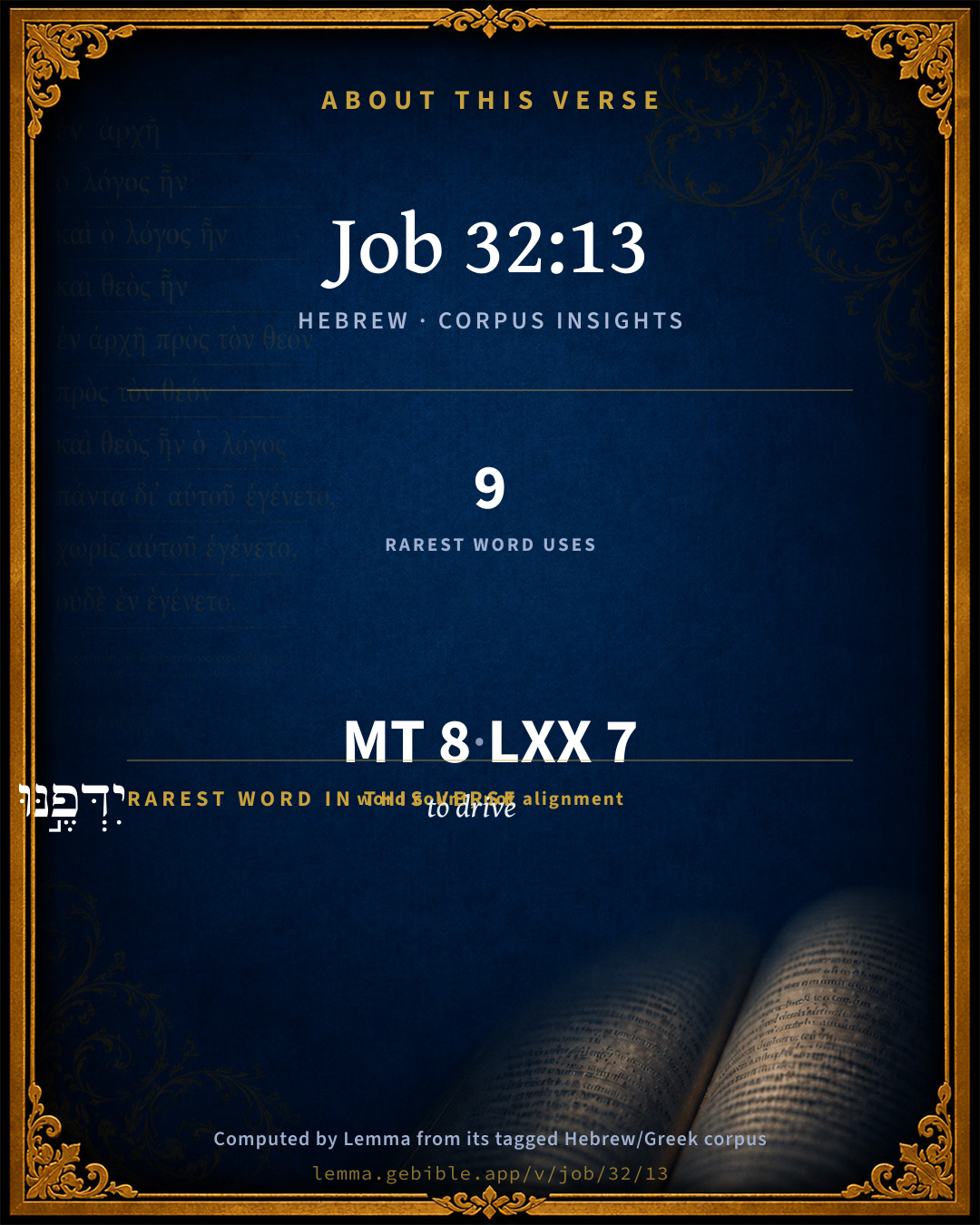
The rarest word here is יִדְּפֶ֣נּוּ to drive H5086 — appearing just 9 times in the whole Hebrew Bible.

Shared distinctive vocabulary

יִדְּפֶ֣נּוּ to drive H5086 occurs in 8 verses of the Hebrew Bible. Also found in:

Grammatical profile

  • 3 verbs
  • 3 nouns
  • 1 conjunction
  • 1 particle

Verb forms

  • תֹּ֣֭אמְרוּ Qal · Imperfect
  • מָצָ֣אנוּ Qal · Perfect
  • יִדְּפֶ֣נּוּ Qal · Imperfect

Hebrew & Septuagint length

In English translation the verse runs 14 words from the Hebrew and 15 from the Septuagint (LXX English) — closely comparable.

A rough comparison of the two English renderings, which tokenize alike — not a word-level alignment.

Word counts can differ between the Hebrew and the Greek without any difference in meaning — e.g. the Hebrew direct-object marker אֵת has no separate Greek word, and Greek often adds the article ὁ.

In the original languages it is 8 Hebrew tokens and 7 Greek tokens — but the two are counted differently (Hebrew bundles its prefixes and suffixes into one token; the Greek is in lemma form), so that isn’t a like-for-like length.

Cross-references

20

Topical passages linked to Job 32:13 in the Treasury of Scripture Knowledge — connected by theme and wording, ordered by reader-vote popularity; previews shown in the World English Bible.

  • Jeremiah 9:23 Thus says Yahweh, Don't let the wise man glory in his wisdom, neither let the mighty man glory in his might, don't let the rich man glory in his riches;
  • Isaiah 5:21 Woe to those who are wise in their own eyes, And prudent in their own sight!
  • 1 Corinthians 1:27–29 but God chose the foolish things of the world that he might put to shame those who are wise. God chose the weak things of the world, that he might put to shame the things that are strong;
  • 1 Corinthians 3:18 Let no one deceive himself. If anyone thinks that he is wise among you in this world, let him become a fool, that he may become wise.
  • Genesis 14:23 that I will not take a thread nor a shoe-latchet nor anything that is yours, lest you should say, 'I have made Abram rich.'
  • Judges 7:2 Yahweh said to Gideon, The people who are with you are too many for me to give the Midianites into their hand, lest Israel vaunt themselves against me, saying, My own hand has saved me.
  • Job 1:21 He said, "Naked I came out of my mother's womb, and naked shall I return there. Yahweh gave, and Yahweh has taken away. Blessed be the name of Yahweh."
  • Job 2:10 But he said to her, "You speak as one of the foolish women would speak. What? Shall we receive good at the hand of God, and shall we not receive evil?" In all this Job didn't sin with his lips.
  • Job 4:9 By the breath of God they perish, By the blast of his anger are they consumed.
  • Job 6:4 For the arrows of the Almighty are within me, My spirit drinks up their poison. The terrors of God set themselves in array against me.
  • Job 12:2 "No doubt, but you are the people, And wisdom shall die with you.
  • Job 15:8–10 Have you heard the secret counsel of God? Do you limit wisdom to yourself?
  • Job 19:6 Know now that God has subverted me, And has surrounded me with his net.
  • Job 19:21 "Have pity on me, have pity on me, you my friends; For the hand of God has touched me.
  • Isaiah 48:5 therefore I have declared it to you from of old; before it came to pass I shown it you; lest you should say, My idol has done them, and my engraved image, and my molten image, has commanded them.
  • Isaiah 48:7 They are created now, and not from of old; and before this day you didn't hear them; lest you should say, Behold, I knew them.
  • Ezekiel 28:3 behold, you are wiser than Daniel; there is no secret that is hidden from you;
  • Zechariah 12:7 Yahweh also will save the tents of Judah first, that the glory of the house of David and the glory of the inhabitants of Jerusalem not be magnified above Judah.
  • John 19:11 Jesus answered, "You would have no power at all against me, unless it were given to you from above. Therefore he who delivered me to you has greater sin."
  • 1 Corinthians 1:19–21 For it is written, "I will destroy the wisdom of the wise, I will bring the discernment of the discerning to nothing."

Cross-references courtesy of OpenBible.info (CC BY 4.0).

Hebrew and Greek witnesses Masoretic Hebrew ↔ Greek Septuagint

The same verse in the two great witnesses to the Old Testament, shown verse-for-verse.

These are two independent witnesses, not word-aligned to each other, and the Septuagint is shown in lemma (dictionary) form.

Hebrew Job 32:13 Masoretic · Westminster Leningrad Codex

פֶּן תֹּ֣֭אמְרוּ מָצָ֣אנוּ חָכְמָ֑ה אֵ֖ל יִדְּפֶ֣נּוּ לֹא אִֽישׁ

Beware lest you say, 'We have found wisdom, God may refute him, not man:'

World English Bible · Public Domain

Greek LXX Job 32:13 Septuagint · lemma form

ἵνα μή εἶπον εὑρίσκω σοφία κύριος προςτίθημι

lest you⌃ should say, We have found that we have added wisdom to the Lord.

LXX2012 (modern English Septuagint) · Public Domain

Hebrew: Westminster Leningrad Codex (CC BY 4.0). Greek: Septuagint (public domain); English from LXX2012 (modern English Septuagint) (Public Domain). How the Septuagint differs from the Hebrew →

Commentary

Notes on Job 32:13 from classic Christian and Jewish commentators (each source and its license shown beneath its notes). The classic Christian expositions comment on the surrounding passage and are grouped to its opening verse, so a note may address several verses; the Jewish commentaries on the Tanakh (Rashi and others) are per-verse, so they appear only where the commentator wrote on this verse.

Lemma curates 59 commentaries, every one of them public domain or Creative Commons licensed, each selected and text-cleaned for this edition rather than reprinted as found. About our sources →

Trapp's Complete Commentary

John Trapp

Job 32:13 Lest ye should say, We have found out wisdom: God thrusteth him down, not man.

Ver. 13. Lest ye should say, We have found out wisdom] Or, See that ye say not, We need not search out words, as Job 32:11. For, we have found out wisdom, rem acu pertigimus, we have hit the nail on the head, and said sufficient to convince him, if any reason would do it, while we affirm that

God thrusteth him down (as it were, with a thump on the back), and not man] Who might do amiss, but so cannot God; who, forasmuch as he fighteth against Job, tossing him as a tennis ball, or as the wind doth a withered leaf, from one affliction to another, who can doubt but that he holdeth him a wicked man? This, saith Elihu, is a very weak way of reasoning; therefore never please yourselves in it as convincing, Hoc argumentum tam facile diluitur quam vulpes comest pyrum, as one merrily phrased it. There is no judgment to be made of a person or cause by the good or evil success of things, since none out of hell ever suffered more than God’s dearest children: witness that little book of martyrs, Heb 11:1-40 Neither have any sped better here than those worst of men, Turks, Papists, persecutors, &c.

John Trapp, A Commentary or Exposition upon All the Books of the Old and New Testament (1647–1656) — public domain. Text from a community e-Sword module.

Geneva Bible (1599)

Geneva Bible translators

And flatter yourselves, as though you had overcome him.

Geneva Bible (1599) marginal notes — public domain. Text via Bolls.life.

Jamieson, Fausset & Brown

Robert Jamieson, A. R. Fausset & David Brown

This has been so ordered, "lest you should" pride yourselves on having overcome him by your "wisdom" (Jer 9:23, the great aim of the Book of Job); and that you may see, "God alone can thrust him down," that is, confute him, "not man." So Elihu grounds his confutation, not on the maxims of sages, as the friends did, but on his special commission from God (Job 32:8; Job 33:4, Job 33:6).

Jamieson, Fausset & Brown — Commentary Critical and Explanatory on the Whole Bible (1871) — public domain (CC PDM 1.0). Text via the HelloAO Bible API.

Adam Clarke's Commentary

Verse 13. We have found out wisdom] We by dint of our own wisdom and understanding, have found out the true system of God's providence; and have been able to account for all the sufferings and tribulations of Job. Had they been able to confute Job, they would have triumphed over him in their own self-sufficiency.

God thrusteth him down, not man.] This is no accidental thing that has happened to him: he is suffering under the just judgments of God, and therefore he must be the wicked man which we supposed him to be.

Adam Clarke's Commentary on the Bible (1810–1826) — public domain. Text from a community e-Sword/MySword module.

Ellicott's Commentary for English Readers

(13) Lest ye should say.—That is, “I resolved to speak, lest ye should think yourselves wise, and that God was afflicting him on account of his sins.” God is declaring his guilt in such a way that man’s opinion matters little.

A Bible Commentary for English Readers, edited by Charles John Ellicott (1878–1897) — public domain. Text from a community e-Sword module.

The Cambridge Bible for Schools and Colleges

gen. ed. J. J. S. Perowne

13–14. These verses mean,

13. Say not, We have found wisdom,

God may thrust him down, not man;

14. For he hath not directed his words against me, &c.

Elihu refuses to let the three friends excuse themselves for their failure to answer Job by the plea that they had found an unexpected wisdom in him, against which human logic was of no avail, and which only God could overcome. Job’s wisdom was not so invincible. It remained to be seen how it would come out of the encounter with another wisdom, different from that of the Friends:—Job had not yet replied to Elihu’s arguments, he has not directed his words against me (Job_32:14, cf. ch. Job_33:5), and these arguments would be found of another kind from those of the three friends.

The Cambridge Bible for Schools and Colleges (gen. ed. J. J. S. Perowne; Cambridge University Press, 1878–1918) — public domain. Text from a community e-Sword module.

John Gill's Exposition

Lest ye should say, we have found out wisdom,.... They were left to themselves, and not directed to take the proper methods of convincing Job, and answering his arguments; lest they should be wise in their own conceits, and attribute too much to themselves; or Elihu told them this, that they had not convicted Job, though they had condemned him, nor answered his arguments, though they had left off speaking; and this he was obliged to say, and that for the reason before observed: for all wisdom is of God, and not to be found out or acquired by men; not natural wisdom, that is not of men, but of God, and especially supernatural wisdom, or the knowledge of divine and spiritual things, and the reason of God's dealings with the sons of men in the different manner he does, see Job 28:12;

God thrusteth him down, not man: some think Elihu says this in reference to himself, whom God would make use of as an instrument to convince Job and answer his arguments; and that he would ascribe this not to himself, but to God; they took a natural way to convince Job, which failed, that they might not be proud of their own wisdom; he should take a more divine and spiritual method, and, if he succeeded, he should give all the glory to God, and ascribe nothing to himself: as in the conviction and conversion of a sinner, though ministers are instruments, it is not by might or power of men, but by the Spirit of the Lord of Hosts; it is God that thrusts down man from a vain opinion he has of himself; that convinces him of sin, that takes him off of his own righteousness, and humbles him, and lays him low at his feet: but they rather seem to be the words of Job's friends, as related by Elihu; and the sense is in connection with the former, either that they found it was the wisest method they could take with Job to be silent, and leave him to himself, lest they should add to his afflict; on; to which Jarchi inclines, who paraphrases it,

"we found wisdom by our silence, that we may not provoke him any more;''

which, if their sense, shows more tenderness and compassion than they had hitherto expressed, and answers pretty much to the advice given Co2 2:6; or else their meaning is, that they found it the best and wisest way to leave him with God, he being so obstinate and incorrigible that none but God could move him; it was not in the power of men, or of words used by men, to make him sensible of things; or rather the meaning is, Elihu was obliged to tell them, that none of them had convinced Job, or answered his arguments, lest they should say, we have found out a wise and strong argument, proving the charge brought against him, that he must be a wicked man and an hypocrite, since God has so sorely afflicted him, and thrust him down from all his grandeur and dignity; which no man could ever have done, and God would not, if he had not been the man we suppose him to be; now Elihu's view is to observe to them, that there was nothing in this argument convincing, in which they imagined so much wisdom lay. Job's afflictions, indeed, were of God, and not men; and which he often owns himself; but this was no proof or argument of his being a wicked man: Mr. Broughton renders the words,

"the Omnipotent doth toss him, not man.''

John Gill's Exposition of the Whole Bible (1746–1763) — public domain (CC PDM 1.0). Text via the HelloAO Bible API.

Albert Barnes' Notes on the Bible

Lest ye should say, We have found out wisdom - That is, this has been permitted and ordered in such a manner that it might be manifest that the truths which are to convince him come from God and not from man. You were not permitted to refute or convince him, for if you had been you would have been lifted up with pride, and would have attributed to yourselves what belongs to God. This is in accordance with the entire drift of the book, which is to introduce the Almighty himself to settle the controversy when human wisdom failed. They could not arrogate to themselves the claim that they had found out wisdom. They had been completely silenced by Job; they had no power to drive him from his positions; they could not explain the divine dealings so as to settle the great inquiry in which they had been engaged. Elihu proposes to do it, and to do it in such a way as to show that it could be accomplished only by that wisdom which is from above.

God thrusteth him down, not man - These are the words of Elihu. The meaning is, “God only can drive Job from his position, and show him the truth, and humble him. The wisdom of man fails. The aged, the experienced, and the wise have been unable to meet his arguments and bring him down from the positions which he has taken. That work can be done only by God himself, or by the wisdom which he only can give.” Accordingly Elihu, who proposes to meet the arguments of Job, makes no appeal to experience or observation; he does not ground what he says on the maxims of sages or the results of reflection, but proposes to adduce the precepts of wisdom which God had imparted to him; Job 33:4, Job 33:6. Other interpretations have, however, been given of this verse, but the above seems to me the most simple, and most in accordance with the scope of the passage.

Albert Barnes' Notes on the Bible (1834–1885) — public domain. Text from a community e-Sword/MySword module.

Haydock's Catholic Bible Commentary

Man. You seem to think this a convincing proof that Job is guilty: (Ven. Bede; Haydock) but it is no such thing. You would fain excuse yourselves from saying any more, for fear of causing him pain, which is already very great; and you vainly imagine that you may thus leave him to be judged by God. We must however convince Job. (Calmet)

George Leo Haydock (1774–1849), Haydock's Catholic Family Bible and Commentary, 1859 edition — public domain. Excludes Psalms (Douay-Rheims chapter numbering differs from Protestant) and Deuterocanonical books (Catholic canon only).

Matthew Poole's English Annotations

Lest ye should say; it is a defective speech, and may be thus supplied: Thus it was, or God thus left you to your own weakness, and mistakes, and impertinent discourses, lest ye should say, &c., i.e. lest you should ascribe the conquering or silencing of Job to your own wisdom, age, and experience; or lest you should boastingly say, We have discovered and said all that can or need be said in the cause, the sum and substance of the thing, that which may fully and finally end the controversy, which is contained in the following words.

God thrusteth him down, not man: these are alleged by Elihu, in the person of Job’s three friends, or as their words. The sense is, The stupendous judgments which are upon Job have not been brought upon him by man solely and originally, for then there might have been some ground for Job’s complaints, there might have been injustice or cruelty in them; but immediately by the hand of God, of that God, who being omniscient, and just, and true, and merciful, would never have dealt thus hardly with Job if he were not a hypocrite, and guilty of some very gross, though secret, sins; which is the ground-work of our discourses. But, saith Elihu, this argument doth not satisfy me, and therefore bear with me if I seek for better.

Matthew Poole's English Annotations on the Holy Bible (1683–1685) — public domain. Text from a community e-Sword/MySword module.

Whedon's Commentary on the Bible

Daniel D. Whedon

Second section. — Directly and exclusively addressing the three friends, for the first and last time, (save in the incidental allusion of Job_35:4,) Elihu declares his surprise and indignation at their failure to answer Job, and shows that this was due to their dealing in personal invective as the ground of his refutation rather than in the impartial and inoffensive principles of right and reason, Job_32:11-14.

13. We have found out wisdom — Lest, in case the friends had succeeded they should triumph over their victory, God reserves to himself the glory of refuting Job: He alone (through Elihu) “can thrust him down.” The secret of their failure was their inordinate vanity, (Job_12:2.) On this account God would not employ them as his instruments. According to Hengstenberg, Elihu “gives the reason for freely reminding the friends of their insufficiency. He would free them from their illusion.” “Their want of success bears witness against themselves, and proves nothing against the possibility that a fresh disputant may conquer Job.” — Hitzig. Zockler and Dillmann err in their interpretation: “We have come upon such superior wisdom in Job that only God can drive him out of the field;” thus attributing to the friends not only a concession of defeat, but an acknowledgment of Job’s superior wisdom. On the contrary, they seemingly ascribe their failure to a moral perversion in Job which none but God can subdue. Elihu quietly intimates that the agent for the accomplishment of this result is he himself.

Thrusteth him down — More correctly, putteth him to flight. נד is used also of the chasing away of smoke, chaff, etc. Psa_1:4; Psa_68:2.

Daniel D. Whedon (gen. ed.), Commentary on the Old and New Testaments (1874–1909) — public domain. Text from a community e-Sword module.

The Pulpit Commentary

Lest ye should say, We have found out wisdom; or, beware lest ye say, We have found wisdom (see the Revised Version). "Do not suppose, i.e. , that you have triumphed in the controversy, that your mode of meeting Job"s complaints is the wise and right one. The exact reverse is the case. You have not vanquished Job. On the contrary, he is unvanquished, and remains master of the field. If he is ever to be vanquished, it will not be by you. God thrusteth (rather, may thrust) him down, not man. A true prophecy! (see Job_40:1-14)

The Pulpit Commentary (1880–1919), ed. H.D.M. Spence-Jones & Joseph S. Exell — public domain. Text from a community e-Sword module.

John Wesley's Explanatory Notes

Left - God thus left you to your own weakness, lest you should ascribe the conquering or silencing of Job to your own wisdom. God - This is alleged by Elihu, in the person of Job's three friends; the sense is, the judgments which are upon Job, have not been brought upon him by man originally, but by the hand of God, for his gross, though secret sins: but, saith Elihu, this argument doth not satisfy me, and therefore bear with me if I seek for better.

John Wesley, Explanatory Notes Upon the Whole Bible (1754–1765) — public domain. Text via the GEBible commentary corpus.

unfoldingWord translationNotes

Door43 World Missions Community

General Information:

Elihu continues speaking to Job's friends.

We have found wisdom

This means that they believe that they have figured out what is wise. AT: "We have discovered what is wise"

to defeat Job

This speaks of God responding to Job and correcting him as if he were defeating him in battle. AT: "to refute Job" or "to answer Job" (See: Metaphor)

with your words

"by saying what you have said"

translationWords

wise

Job

word

unfoldingWord translationNotes — © Distant Shores Media and the Door43 World Missions Community, licensed CC BY-SA 4.0. Source: git.door43.org/Door43/en_tn.

Rashi

Rabbi Shlomo Yitzchaki (Rashi)

Lest you say You shall not say We have found wisdom by remaining silent in order not to provoke him anymore. for God will crush him and not a man You should not have belittled the honor of the Omnipresent thereby.

Rashi on the Tanakh — English translations: “The Judaica Press complete Tanach with Rashi, translated by A. J. Rosenberg” (CC BY 4.0); “Pentateuch with Rashi's commentary by M. Rosenbaum and A.M. Silbermann, 1929-1934” (public domain); “The Metsudah Tanach series, Lakewood, N.J” (CC BY 4.0); and “The Book of Joshua, Metsudah Publications, 1997” (CC BY 4.0). Text via Sefaria.

Lesson kit

Teaching starters — assembled from the data on this page, not authored interpretation. Every prompt links to the verse data it draws on. Edit before teaching.

Job, in the Wisdom, opens this verse with 8 words (8 distinct Hebrew lemmas). Its most distinctive word is nâdaph (“to drive”). A historical commentator’s framing appears above. Read the whole chapter for the surrounding context.

Discussion questions

  1. The word nâdaph carries the sense “to drive.” How does it shape the verse?
  2. Leviticus 26:36 shares the word «to drive» with this verse. How do the two illuminate each other?
  3. These translations render this verse differently. What is at stake in choosing one wording over another?
  4. The verb «תֹּ֣֭אמְרוּ» is Qal Imperfect. How does its form color the action?
  5. Reading how Trapp's Complete Commentary and Geneva Bible (1599) read this verse, where do the two commentators agree and where do they part?

Things to notice

Reading settings

Reading text

Shown beneath each verse's original-language words.

Old Testament
Old Testament edition

Read the OT as the Masoretic Hebrew (MT) or the Greek Septuagint (LXX).

English shown for the Greek Septuagint (in the Hebrew ↔ Greek comparison).

Comparing translations? Open the Compare panel on any verse page to stack up to four side by side.