
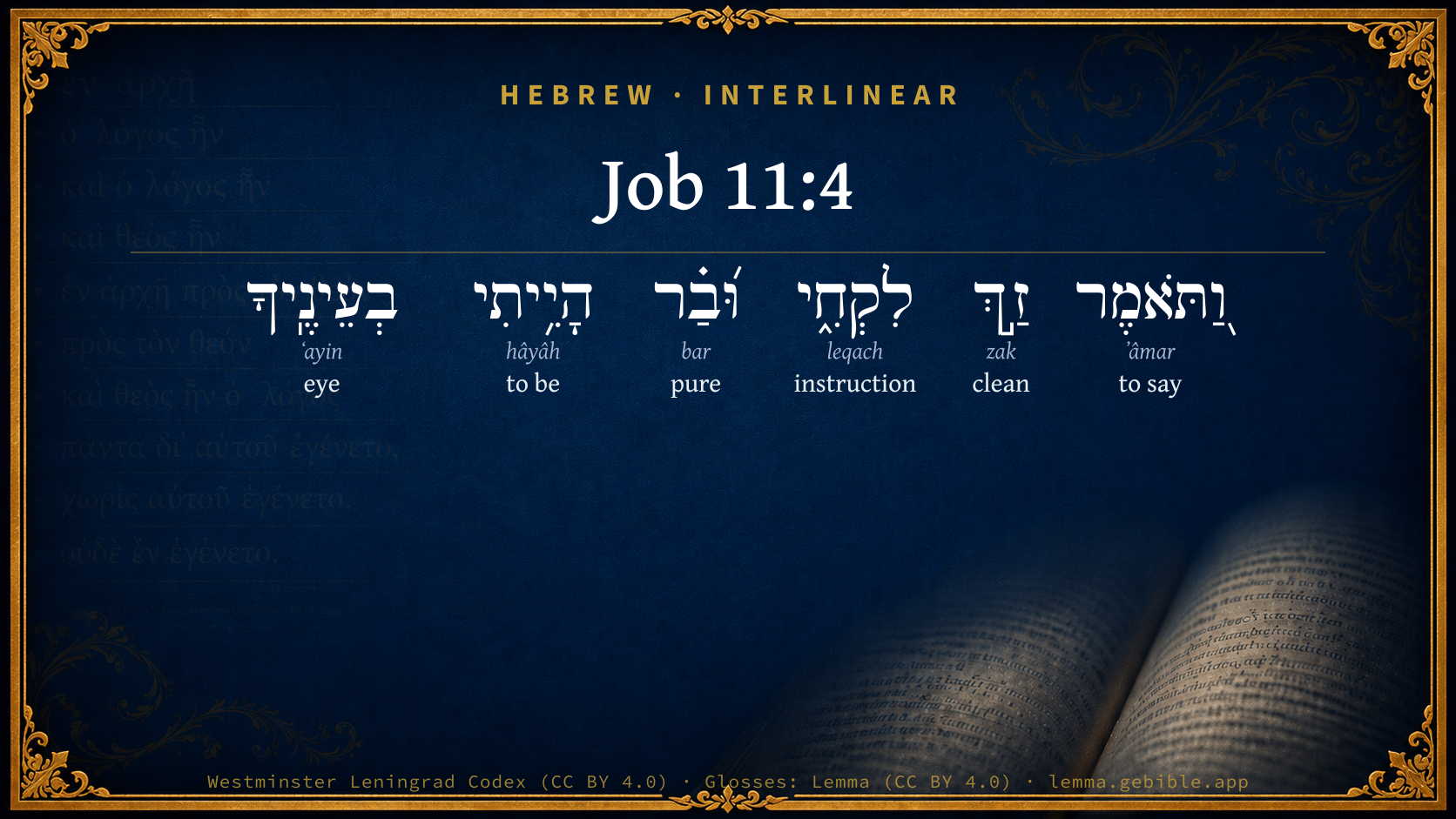
Job 11:4

Hebrew (Westminster Leningrad Codex) Job 11:4 appears in the Hebrew Old Testament. The text above is from the Westminster Leningrad Codex. Each word links to its Strong’s number, a concise gloss, and parsing drawn from the Open Scriptures Hebrew Bible morphology. Click any word for its full Brown-Driver-Briggs (BDB) entry.
Download image
Cite this verse

Job 11:4 (World English Bible). Public Domain. Lemma interlinear Bible study tool, https://lemma.gebible.app/v/job/11/4.

Show BibTeX & RIS
BibTeX
RIS
English Translation
For you say, 'My doctrine is pure, I am clean in your eyes.'
World English Bible · Public Domain
Highlights
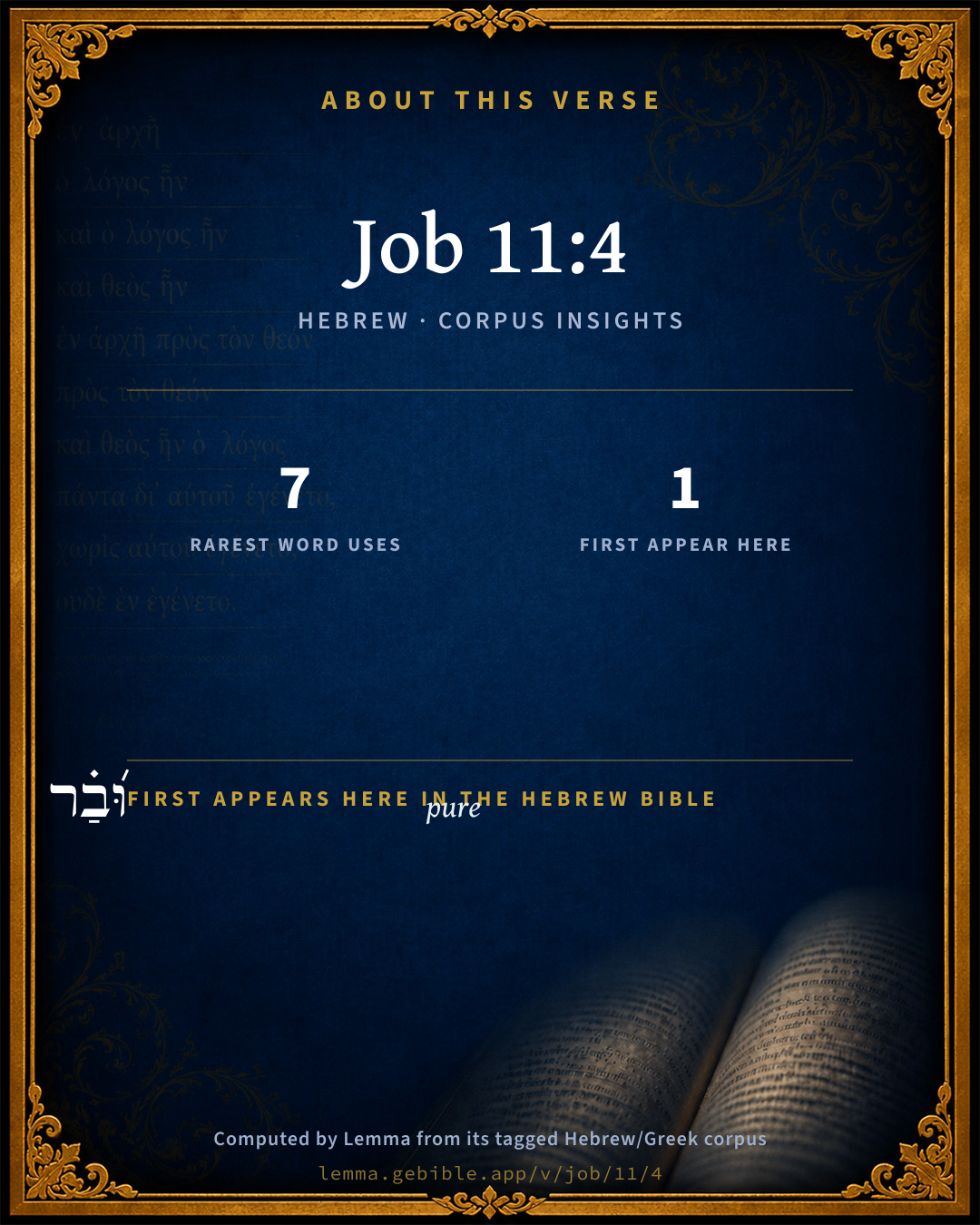
  • 1 first appearance in the Hebrew Bible
Full analysis ↓
Download a study sheet

One document with this verse’s original text, its word-by-word gloss line, the meaning frame, cross-references with their text, attributed commentary, and full source and license credits — printable, and it pastes into notes with its structure intact.

This verse Autodidact and up

Study sheet (.html) Plain text (.txt)

A passage Seminary Student

Up to 50 verses in one chapter. A passage sheet keeps up to 6 commentary sources and 12 cross-references per verse, in the order this page ranks them, and says so on the sheet whenever that leaves anything out. Ask for a single verse and you get the Autodidact verse sheet above.

Everything on this page stays free to read, with no account — the sheet is a download of what is already on screen, not access to it.

Want to remove ads? Support Godless Engineer
Compare translations 3

The same verse in 3 English versions, stacked beneath the original-language interlinear above. Click any original word for its lexicon entry.

Each is an independent rendering of the whole verse — the interlinear is not word-aligned to these translations.

Highlighted words mark where these versions differ — a whole-verse word diff, not a word-by-word alignment.

  • World English Bible Public Domain
    For you say, 'My doctrine is pure, I am clean in your eyes.'
  • King James Version Public Domain
    For thou hast said, My doctrine is pure, and I am clean in thine eyes.
  • unfoldingWord Literal Text CC BY-SA 4.0
    For you have said, ‘My doctrine is pure, and I am clean in your eyes.’

unfoldingWord Literal Text — © unfoldingWord, licensed CC BY-SA 4.0. Word-aligned USFM3 via Door43 (git.door43.org/unfoldingWord/en_ult).

Versions to compare (up to 4)

3 of 4 selected

Show all 18 translations

Every available English version of this verse, each an independent rendering of the whole verse.

  • World English Bible Public Domain
    For you say, 'My doctrine is pure, I am clean in your eyes.'
  • Berean Standard Bible Public Domain
    You have said, ‘My doctrine is sound, and I am pure in Your sight.’
  • Majority Standard Bible Public Domain
    You have said, ‘My doctrine is sound, and I am pure in Your sight.’
  • King James Version Public Domain
    For thou hast said, My doctrine is pure, and I am clean in thine eyes.
  • American Standard Version (1901) Public Domain
    For thou sayest, My doctrine is pure, And I am clean in thine eyes.
  • Revised Version (1885) Public Domain
    For thou sayest, My doctrine is pure, and I am clean in thine eyes.
  • Geneva Bible (1599) Public Domain
    For thou hast sayde, My doctrine is pure, and I am cleane in thine eyes.
  • Douay-Rheims (1899) Public Domain
    For thou hast said: My word is pure, and I am clean in thy sight.
  • Young's Literal Translation Public Domain
    And thou sayest, `Pure `is' my discourse, And clean I have been in Thine eyes.'
  • Literal Standard Version CC BY-SA 4.0
    And you say, My discourse [is] pure, || And I have been clean in Your eyes.
  • Unlocked Literal Bible CC BY-SA 4.0
    For you say to God, 'My beliefs are pure, I am blameless in your eyes.'
  • unfoldingWord Literal Text CC BY-SA 4.0
    For you have said, ‘My doctrine is pure, and I am clean in your eyes.’
  • Darby Bible Public Domain
    For thou sayest, My doctrine is pure, and I am clean in thine eyes.
  • World Messianic Bible Public Domain
    For you say, ‘My doctrine is pure. I am clean in your eyes.’
  • Webster's Bible Public Domain
    For thou hast said, My doctrine is pure, and I am clean in thy eyes.
  • Free Bible Version CC BY-SA 4.0
    You said, ‘What I teach is the pure truth,’ and ‘in God's eyes I am clean.’
  • Bible in Basic English Public Domain
    You may say, My way is clean, and I am free from sin in your eyes.
  • JPS Tanakh (1917) Public Domain
    And thou hast said: 'My doctrine is pure, and I am clean in Thine eyes.'

Literal Standard Version (2020), Covenant Press — licensed CC BY-SA 4.0. Text via the HelloAO Bible API (eBible.org). Unlocked Literal Bible (unfoldingWord) — licensed CC BY-SA 4.0. Text via the HelloAO Bible API (eBible.org). unfoldingWord Literal Text — © unfoldingWord, licensed CC BY-SA 4.0. Word-aligned USFM3 via Door43 (git.door43.org/unfoldingWord/en_ult). Free Bible Version, Dr. Jonathan Gallagher — licensed CC BY-SA 4.0. Text via the HelloAO Bible API (eBible.org).

Word by word

More ways to search: Search by grammar → Find every occurrence → Compare this word →

Practice this passage: Drill this verse → Learn its vocabulary →

About this verse

These counts appear in no published source. They are computed here, from the morphology-tagged text and Lemma’s own curated glosses. What Lemma adds →

6
words
6
distinct lemmas
Wisdom
section

Notable vocabulary

The rarest word here is וּ֝בַ֗ר pure H1249 — appearing just 7 times in the whole Hebrew Bible.

First appearance in Scripture

This word makes its first canonical appearance in the Hebrew Bible here:

  • וּ֝בַ֗ר pure H1249

Shared distinctive vocabulary

וּ֝בַ֗ר pure H1249 occurs in 7 verses of the Hebrew Bible. Also found in:

Grammatical profile

  • 2 verbs
  • 2 nouns
  • 2 adjectives

Verb forms

  • וַ֭תֹּאמֶר Qal · Sequential Imperfect
  • הָיִ֥יתִי Qal · Perfect

Hebrew & Septuagint length

In English translation the verse runs 13 words from the Hebrew and 13 from the Septuagint (LXX English) — the same length.

A rough comparison of the two English renderings, which tokenize alike — not a word-level alignment.

Word counts can differ between the Hebrew and the Greek without any difference in meaning — e.g. the Hebrew direct-object marker אֵת has no separate Greek word, and Greek often adds the article ὁ.

Cross-references

9

Topical passages linked to Job 11:4 in the Treasury of Scripture Knowledge — connected by theme and wording, ordered by reader-vote popularity; previews shown in the World English Bible.

  • Job 10:7 Although you know that I am not wicked, There is no one who can deliver out of your hand.
  • Job 6:10 Be it still my consolation, Yes, let me exult in pain that doesn't spare, That I have not denied the words of the Holy One.
  • Job 6:29–30 Please return. Let there be no injustice; Yes, return again, my cause is righteous.
  • Job 7:20 If I have sinned, what do I do to you, you watcher of men? Why have you set me as a mark for you, So that I am a burden to myself?
  • Job 9:2–3 "Truly I know that it is so, But how can man be just with God?
  • Job 14:4 Who can bring a clean thing out of an unclean? Not one.
  • Job 34:5–6 For Job has said, 'I am righteous, God has taken away my right:
  • Job 35:2 "Do you think this to be your right, Or do you say, 'My righteousness is more than God's,'
  • 1 Peter 3:15 But sanctify the Lord God in your hearts; and always be ready to give an answer to everyone who asks you a reason concerning the hope that is in you, with humility and fear:

Cross-references courtesy of OpenBible.info (CC BY 4.0).

Hebrew and Greek witnesses Masoretic Hebrew ↔ Greek Septuagint

The same verse in the two great witnesses to the Old Testament, shown verse-for-verse.

These are two independent witnesses, not word-aligned to each other, and the Septuagint is shown in lemma (dictionary) form.

Hebrew Job 11:4 Masoretic · Westminster Leningrad Codex

וַ֭תֹּאמֶר זַ֣ךְ לִקְחִ֑י וּ֝בַ֗ר הָיִ֥יתִי בְעֵינֶֽיךָ

For you say, 'My doctrine is pure, I am clean in your eyes.'

World English Bible · Public Domain

Greek LXX Job 11:4 Septuagint · lemma form

μή γάρ λέγω ὅτι καθαρός εἰμί ὁ ἔργον καί ἄμεμπτος ἐναντίον αὐτός

For say not, I am pure in my works, and blameless before him.

LXX2012 (modern English Septuagint) · Public Domain

On this verse, Albert Barnes' Notes on the Bible discusses the Septuagint’s reading. Read the note in Commentary ↓

Hebrew: Westminster Leningrad Codex (CC BY 4.0). Greek: Septuagint (public domain); English from LXX2012 (modern English Septuagint) (Public Domain). How the Septuagint differs from the Hebrew →

Commentary

Notes on Job 11:4 from classic Christian and Jewish commentators (each source and its license shown beneath its notes). The classic Christian expositions comment on the surrounding passage and are grouped to its opening verse, so a note may address several verses; the Jewish commentaries on the Tanakh (Rashi and others) are per-verse, so they appear only where the commentator wrote on this verse.

Lemma curates 59 commentaries, every one of them public domain or Creative Commons licensed, each selected and text-cleaned for this edition rather than reprinted as found. About our sources →

Trapp's Complete Commentary

John Trapp

Job 11:4 For thou hast said, My doctrine [is] pure, and I am clean in thine eyes.

Ver. 4. For thou hast said] Thou hast confidently affirmed; and this he makes to be a loud lie, and not an idle word only. But where and when had Job said it? Did not Zophar openly play the sophister, so interpreting what Job had spoken, Job 6:10; Job 9:22; Job 10:7, in defence of his innocence, as if Job had maintained that he was free from all sin; whereas, notwithstanding, he had very often witnessed and confessed himself to be a sinner, insomuch as that albeit he were without sin, yet he could not be accounted clear and pure in the sight of God? But Zophar took these for good words only, and was therefore so sharply set against him. So Cyril and Theodoret mistook one another, and objected heresy mutually; when afterwards it appeared that they were both of one judgment. Charity would have taught Zophar to have taken Job in a better sense, and to have said of him, as Cruciger did of Luther, eum commodius sentire quam loquitur dum effervescit, that he held right, though in his heat he spake not so fitly as might be wished. Good men’s words are reverenter glossanda (as one said of the laws), to have a reverent gloss put upon them, and not, by a spiritual unmannerliness, to be taken with the left hand, when they might and ought to be taken with the right.

My doctrine is pure] Clear as crystal, transparent as a crystal glass with a light in the midst; you may see through it, and find no flaw or filth in it. Job was no professed preacher, yet he had "not concealed the words of the Holy One," Job 6:10. As he had received the knowledge of the truth from parents and teachers (the word here rendered doctrine comes from a root that signifieth to receive), so he had freely and purely imparted it to others, commending it unto them as sound and sincere, and therefore well worthy of all acceptation. But that which troubled Zophar and his two fellows was, that Job should affirm that God did afflict good men in this world as heavily as bad men, which yet was an irrefragable truth, such as Job resolved to live and die in.

And I am clean in thine eyes] i.e. I am not sinless, but sincere and upright, no hypocrite (as you have charged me), no worker of iniquity, but one that would be cleansed from all filthiness of flesh and spirit, and do, by the daily practice of mortification, purify myself as God is pure. More than this Job said not, though Zophar thought he did, and therefore wisheth in the next words that God himself would convince him of his error.

John Trapp, A Commentary or Exposition upon All the Books of the Old and New Testament (1647–1656) — public domain. Text from a community e-Sword module.

Joseph Benson's Commentary

Job 11:4. Thou hast said, My doctrine — Concerning God and his providence; is pure — That is, true and certain. The word לקחי, likchi, according to R. Levi, signifies consuetudo mea, et dispositio mea, my way and manner of life; the same that St. Paul calls η βιωσις μου; my way of life. See Chappelow. And I am clean in thine eyes — I am innocent before God: I have not sinned either by my former actions or by my present expressions. But Zophar aggravates and perverts Job’s words; for he did not deny that he was a sinner in God’s sight; but only that he was a hypocrite or ungodly man, as they thought him to be.

Joseph Benson's Commentary on the Old and New Testaments (1811–1818) — public domain. Text from a community e-Sword module.

Tyndale Open Study Notes

Tyndale Open Resources

11:4 My beliefs are pure: Job was not defining doctrine but defending his own integrity.

Tyndale Open Study Notes — © Tyndale Open Resources, licensed CC BY-SA 4.0. Text via the HelloAO Bible API.

Geneva Bible (1599)

Geneva Bible translators

He chargeth Job with this, that he should say, that the thing which he spake was true, and that he was without sin in the sight of God.

Geneva Bible (1599) marginal notes — public domain. Text via Bolls.life.

Jamieson, Fausset & Brown

Robert Jamieson, A. R. Fausset & David Brown

doctrine--purposely used of Job's speeches, which sounded like lessons of doctrine (Deu 32:2; Pro 4:2).

thine--addressed to God. Job had maintained his sincerity against his friends suspicions, not faultlessness.

Jamieson, Fausset & Brown — Commentary Critical and Explanatory on the Whole Bible (1871) — public domain (CC PDM 1.0). Text via the HelloAO Bible API.

Adam Clarke's Commentary

Verse 4. My doctrine is pure] לקחי likchi, "my assumptions." What I assume or take as right, and just, and true, are so; the precepts which I have formed, and the practice which I have founded on them, are all correct and perfect. Job had not exactly said, My doctrine and way of life are pure, and I am clean in thine eyes; but he had vindicated himself from their charges of secret sins and hypocrisy, and appealed to God for his general uprightness and sincerity: but Zophar here begs the question, in order that he may have something to say, and room to give vent to his invective.

Adam Clarke's Commentary on the Bible (1810–1826) — public domain. Text from a community e-Sword/MySword module.

Ellicott's Commentary for English Readers

(4) Clean in thine eyes is variously referred to God, to mortal men (Job_11:3), and to Job himself (Job_32:1). The first seems most to be preferred, for at all events Job had hypothetically spoken of himself as righteous before God (Job_10:15). (Comp. Job_9:30. &c.) Zophar, therefore, who professes superior wisdom, desires that God would show Job how far short he falls of it: that He would show him the hidden things, the secrets of wisdom; for sound wisdom is manifold: it has many aspects, and lies as it were fold over fold in unexpected complexities, defying the shallow and unscrutinising gaze; and were He to do this, Job would find out to his dismay that God still credited him part of the penalty due to him.

A Bible Commentary for English Readers, edited by Charles John Ellicott (1878–1897) — public domain. Text from a community e-Sword module.

The Cambridge Bible for Schools and Colleges

gen. ed. J. J. S. Perowne

4. For thou hast said] Better, and sayest, explaining what his mockery consists in.

My doctrine is pure] Job had not used precisely such words. Zophar gives what he understands as the gist of his contention.

and I am clean in thine eyes] Perhaps rather, I was clean, when plunged into my afflictions. The words are those of Job addressed to God, which Zophar recalls, cf. ch. Job_9:21, Job_10:7. It is probable that this clause explains what Zophar means by the preceding clause, “my doctrine is pure.” Job’s “doctrine,” which Zophar considers an example of “mockery,” is not his general principles, but this particular point, that God afflicts a man whom He knows to be righteous. Zophar quite justly discovers here a novel doctrine to which he certainly had not been accustomed. But connected with this particular assertion of Job’s were his views on human destiny in general, ch. Job_7:1, and on the character of God’s government, ch. Job_9:1-23. The two preceding speakers had assumed that Job’s principles were identical with their own, and anticipated that a few good advices in the line of these principles would bring the man to a right mind. Zophar begins to surmise that they have a more obstinate disease to cure than they had looked for, and that Job’s principles, instead of being identical with theirs, cut clean athwart them. This discovery accounts for the rather unworthy tone of his language. His irritation was natural. He had never met a man with such ideas as those of Job before, and he is driven out of patience and decorum by his new theories. Elihu is even more shocked, and thinks that such another as Job does not exist, ch. Job_34:6.

The Cambridge Bible for Schools and Colleges (gen. ed. J. J. S. Perowne; Cambridge University Press, 1878–1918) — public domain. Text from a community e-Sword module.

John Gill's Exposition

For thou hast said,.... What follows is produced to support the charge, especially of lying, which seems to be founded on what he had said in Job 6:10,

my doctrine is pure; free from error, unadulterated, unmixed, not blended with Heathenish principles and human doctrines; but tending to purity of heart and life, as every word of God, and doctrine that comes from him, is pure, yea, very pure, like silver purified seven times; and such was Job's doctrine which he "received" from God, "took" (y) up and professed, taught and delivered to others, so far as was agreeable to the will of God, and the revelation he had then made: and it appears that Job had very clear and sublime notions of God, of his being and perfections, of his works of nature, providence, and grace; of Christ his living Redeemer, of redemption and justification by him, and of the resurrection of the dead; and had purer and better notions of divine things than his friends had, and spoke better things of God than they did, God himself being witness, Job 42:7; some interpret this of the purity of his life and conversation: he is further charged with saying:

and I am clean in thine eyes: speaking to God, as Jarchi observes; and indeed so he was, and every believer is, in an evangelic sense; as to the new man, which is created in righteousness and true holiness, is without sin, and cannot commit it; and as washed from all sin in the blood of Christ, and as clothed with his righteousness, in which the saints are faultless before the throne, and are unblamable and irreprovable in the sight of God: but Zophar's meaning is, that Job had asserted that he was entirely free from sin in himself, was wholly without it, and did not commit any; and had appealed to God, as knowing it to be true; and which he seems to have grounded on what he had said, Job 10:7; through a mistake of his sense; which was not that he was free from sin entirely, but from any gross notorious sin, or from a wicked course of living, and particularly from the sin of hypocrisy, his friends suggested he was guilty of; otherwise he confesses himself a sinner, and prays for the pardon of his sins, and disclaims perfection in himself; see Job 7:20; and indeed there is no creature in itself clean in the sight of God, either angels or men; every man is naturally unclean; no good man is without sin, without the being, indwelling, and commission of it; nor will any truly gracious man say he is; he knows otherwise, and acknowledges it; he that says he is must be an ignorant man, or a vain and pharisaical man; yea, must not say the truth: some have suspected the first part of the words to be Job's, "and I am clean": and the other Zophar's explaining them; that is, "in thine eyes" (z); in his own apprehension, as if he had a high and conceited opinion of himself.

(y) "doctrina aut oratio mea et sententia mente accepta", Michaelis; so Cocceius; "id quid ab aliis acceptum", Drusius. (z) Vid. Schultens in loc.

John Gill's Exposition of the Whole Bible (1746–1763) — public domain (CC PDM 1.0). Text via the HelloAO Bible API.

Albert Barnes' Notes on the Bible

My doctrine is pure - The Septuagint instead of the word “doctrine” here reads “deeds,” ἔργοις ergois; the Syriac, “thou sayest I have acted justly.” But the word used here (לקח leqach) means properly “fair speech” or “taking arguments,” that by which one is “taken” or captivated, from לקח lâqach, “to take.” Then it means doctrine, or instruction, Pro 1:5; Pro 9:9. Here it means the views which Job had expressed. Dr. Good supposes that it means “conduct,” a word which would suit the connection, but the Hebrew is not used in this sense.

And I am clean in thine eyes - In the eyes of God, or in his sight. This was a false charge. Job had never maintained that he was perfect (compare the notes at Job 9:20); he had only maintained that he was not such a sinner as his friends maintained that he was, a hypocrite, and a man eminent for guilt. His lack of absolute perfection he was ever ready to admit and mourn over.

Albert Barnes' Notes on the Bible (1834–1885) — public domain. Text from a community e-Sword/MySword module.

Haydock's Catholic Bible Commentary

Sight. Job had just said the reverse, chap. ix. 2. (St. Chrysostom)

George Leo Haydock (1774–1849), Haydock's Catholic Family Bible and Commentary, 1859 edition — public domain. Excludes Psalms (Douay-Rheims chapter numbering differs from Protestant) and Deuterocanonical books (Catholic canon only).

Matthew Poole's English Annotations

My doctrine, concerning God and his providence. Pure, i.e. true and certain.

I am clean in thine eyes; I am innocent before God; I have not sinned, either by my former actions, or by my present expressions. Thou standest wholly upon thy justification. But Zophar aggravates and perverts Job’s words, for he did not deny that he was a sinner in God’s sight, Job 7:20,21; 9:2,3; 10:14, but only that he was a hypocrite or ungodly man, as they made him.

Matthew Poole's English Annotations on the Holy Bible (1683–1685) — public domain. Text from a community e-Sword/MySword module.

Whedon's Commentary on the Bible

Daniel D. Whedon

4. Doctrine is pure — Not that he had used just such an expression, but this was the quintessence of Job’s speech.

Daniel D. Whedon (gen. ed.), Commentary on the Old and New Testaments (1874–1909) — public domain. Text from a community e-Sword module.

The Pulpit Commentary

For thou hast said, My doctrine is pure. Job had certainly not said this in so many words. In fact, he had not spoken of his "doctrine" (jql), nor had he called either his doctrine or his conduct absolutely pure (z). But, no doubt, he had maintained, in a certain sense, his innocency; not, indeed, his entire freedom from sin or guilt, but his honest endeavour to serve God and lead a good life. This was the real point disputed between him and his "comforters;" they argued, from his sufferings, that he must be a "chief sinner;" he maintained, from the testimony of his conscience, that he was free from all heinous sins. And I am clean in thine eyes. (see Job_9:30 Job_10:7)

The Pulpit Commentary (1880–1919), ed. H.D.M. Spence-Jones & Joseph S. Exell — public domain. Text from a community e-Sword module.

John Wesley's Explanatory Notes

Doctrine - Concerning God and his providence. Clean - I am innocent before God; I have not sinned either by my former actions, or by my present expressions. But Zophar perverts Job's words, for he did not deny that he was a sinner, but only that he was an hypocrite.

John Wesley, Explanatory Notes Upon the Whole Bible (1754–1765) — public domain. Text via the GEBible commentary corpus.

unfoldingWord translationNotes

Door43 World Missions Community

My beliefs are pure

"My understanding is correct"

I am blameless in your eyes

The eyes represent sight, which is a metaphor for God's evaluation of Job. Possible meanings are 1) that Job is saying that God judges him as blameless. AT: "You say that I am blameless" or 2) that Job believes he has been blameless and that God should judge him as blameless. AT: "You should recognize that I am blameless" (See: Metaphor)

that God would speak ... open his lips against you

The words "open his lips" are a metonym that means speak. These two phrases mean the same thing and are used together to emphasize Zophar's desire that God would speak harshly against Job. (See: Metonymy and Parallelism)

that he would show ... secrets of wisdom

What the "secrets of wisdom" are can be stated clearly. AT: "that he would show you that you are suffering because of your sin" (See: Assumed Knowledge and Implicit Information)

God demands from you less than your iniquity deserves

Demanding from Job represents punishing Job. AT: "God is punishing you less than you deserve" (See: Metaphor)

translationWords

God

believe

pure

blameless

wise

know

iniquity

unfoldingWord translationNotes — © Distant Shores Media and the Door43 World Missions Community, licensed CC BY-SA 4.0. Source: git.door43.org/Door43/en_tn.

Rashi

Rabbi Shlomo Yitzchaki (Rashi)

You said to the Holy One, blessed be He, ‘My doctrine is pure, and I was clean in Your eyes.’

Rashi on the Tanakh — English translations: “The Judaica Press complete Tanach with Rashi, translated by A. J. Rosenberg” (CC BY 4.0); “Pentateuch with Rashi's commentary by M. Rosenbaum and A.M. Silbermann, 1929-1934” (public domain); “The Metsudah Tanach series, Lakewood, N.J” (CC BY 4.0); and “The Book of Joshua, Metsudah Publications, 1997” (CC BY 4.0). Text via Sefaria.

Lesson kit

Teaching starters — assembled from the data on this page, not authored interpretation. Every prompt links to the verse data it draws on. Edit before teaching.

Job, in the Wisdom, opens this verse with 6 words (6 distinct Hebrew lemmas). Its most distinctive word is bar (“pure”). A historical commentator’s framing appears above. Read the whole chapter for the surrounding context.

Discussion questions

  1. What does “pure” (bar) contribute to the verse as a whole?
  2. This is the first place “pure” appears in Scripture (first appears here). What does its debut here establish?
  3. How does Psalms 19:8, which shares the word «pure», read alongside this verse?
  4. The translations on this page render this verse differently — a whole-verse word diff, not a word-by-word alignment. What might account for the different wordings?
  5. «וַ֭תֹּאמֶר» is a Qal Sequential Imperfect verb. How does that grammatical form shape the action described?
  6. Compare how Trapp's Complete Commentary and Joseph Benson's Commentary read this verse. Where do they agree or differ?

Things to notice

  • 1 word makes its first canonical appearance in Scripture here.
  • These translations choose different wording for 4 words in this verse.
  • 6 distinct Hebrew lemmas span 6 words in this verse.

Reading settings

Reading text

Shown beneath each verse's original-language words.

Old Testament
Old Testament edition

Read the OT as the Masoretic Hebrew (MT) or the Greek Septuagint (LXX).

English shown for the Greek Septuagint (in the Hebrew ↔ Greek comparison).

Comparing translations? Open the Compare panel on any verse page to stack up to four side by side.