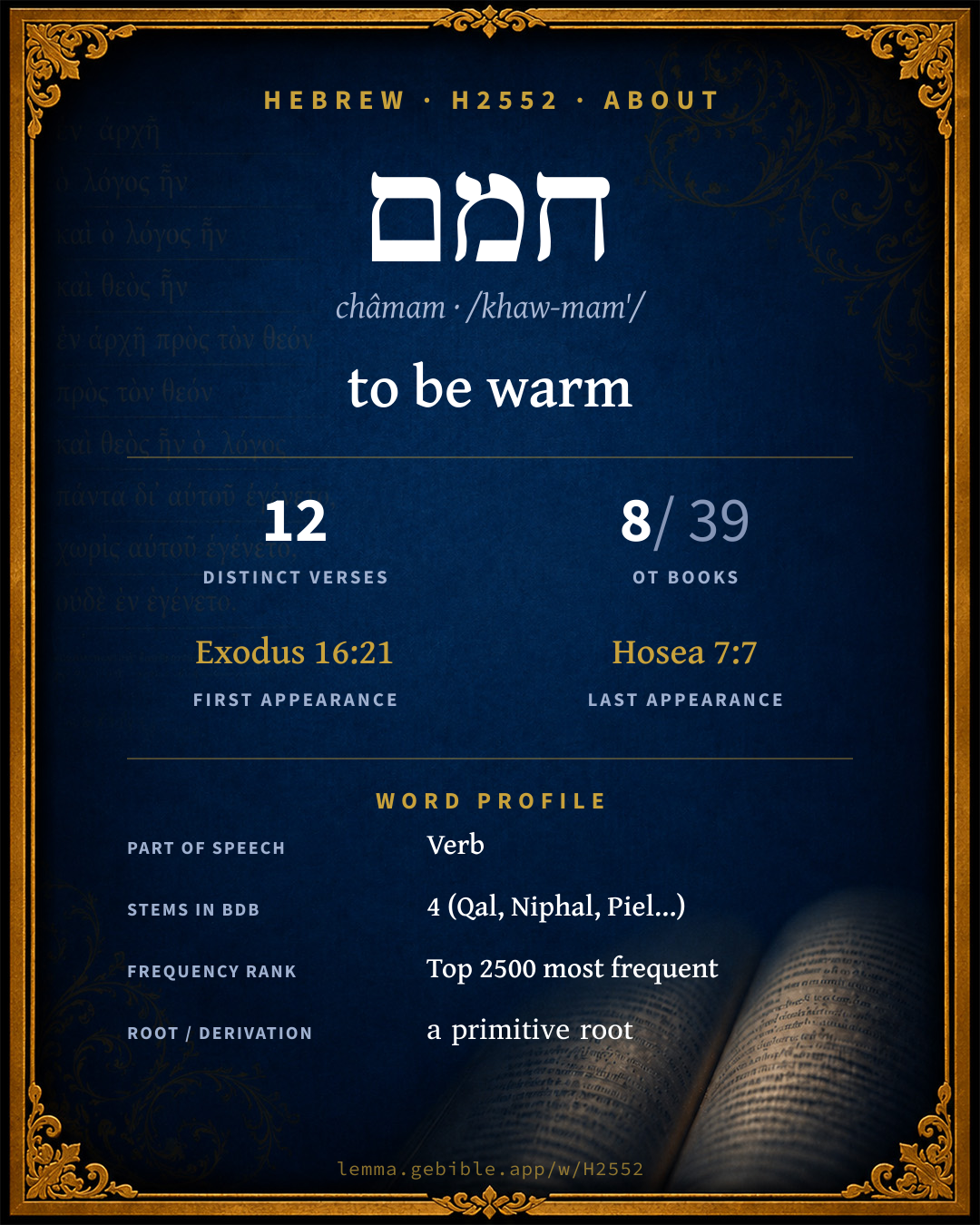
חָמַם
to be warm
‘to be warm’ is one of 4 main senses fuller range ↓
Full lexicon entry — Brown-Driver-Briggs (BDB)
From Brown-Driver-Briggs (BDB)
Where this word appears
See every Qal verb in the Hebrew Bible →
Grammar key — what these labels mean
Part of speech
- Verb
- An action or state-of-being word.
Stem
- Qal
- The basic, simple active stem — the plain form of the verb (“he wrote”). Here: ‘lit.’
- Niphal
- Usually the simple passive or reflexive of the Qal (“he was written”).
- Piel
- An intensive or resultative active stem.
- Hithpael
- The reflexive or reciprocal stem (the subject acts on itself).
Form
- Sequential Perfect
- A perfect with prefixed waw continuing a preceding imperfect or command (waw-consecutive perfect).
- Sequential Imperfect
- An imperfect with prefixed waw — the standard past-narrative form (waw-consecutive imperfect).
- Perfect
- A completed action or state — Hebrew marks aspect (completeness) more than strict tense (“he wrote”).
- Infinitive Construct
- A bound verbal noun, frequently with prepositions (“to write / in writing”).
- Participle Active
- A verbal adjective expressing ongoing or characteristic action (“writing / one who writes”).
- Imperfect
- An incomplete, ongoing, or future action (“he will / would write”).
State
- Absolute
- The independent form of a noun, not bound to a following word.
Person
- 3rd Person
- The one spoken about (“he / she / it / they”).
- 1st Person
- The speaker (“I / we”).
Gender
- Masculine
- Grammatically masculine.
- Feminine
- Grammatically feminine.
- Common
- Either gender — not distinguished for this form.
Number
- Singular
- One.
- Plural
- More than one (in Hebrew, generally three or more).
Grammatical forms 10 distinct
- Verb, Qal, Sequential Perfect, 3rd Person, Masculine, Singular 2 times (15%)
- Verb, Qal, Sequential Imperfect, 3rd Person, Masculine, Singular 2 times (15%)
- Verb, Qal, Perfect, 3rd Person, Masculine, Singular 2 times (15%)
- Verb, Qal, Infinitive Construct 1 time (8%)
- Verb, Niphal, Participle Active, Masculine, Plural, Absolute 1 time (8%)
- Verb, Piel, Imperfect, 3rd Person, Feminine, Singular 1 time (8%)
- Verb, Qal, Imperfect, 3rd Person, Masculine, Plural 1 time (8%)
- Verb, Qal, Imperfect, 3rd Person, Masculine, Singular 1 time (8%)
+2 more forms (2 occurrences)
Parsed forms decoded from the imported morphology (morphhb / Westminster Leningrad Codex — WLC text public domain, morphhb tagging CC BY 4.0), counted across 13 parsed occurrences — not distinct verses.
Every verse where H2552 appears — 12 distinct verses across 8 books. Click any verse to open its interlinear word-by-word view. Verse text shown in the World English Bible for context — . Each verse’s Hebrew form is shown with its reference; the English is not keyword-highlighted, since the data carries no word-level English alignment. Use “Compare translations” on any verse to read it across multiple English versions. This concordance covers the Hebrew Bible; Septuagint (Greek Old Testament) occurrences are not indexed here.
Exodus 1 verse
1 Kings 1 verse
2 Kings 1 verse
Job 2 verses
Psalms 1 verse
Ecclesiastes 1 verse
Isaiah 4 verses
- Isaiah 44:15 וַ/יָּ֔חָם conj + Qal wimpf 3ms Then shall it be for a man to burn; and he takes of it, and warms himself; yes, he kindles it, and bakes bread: yes, he makes a god, and worships it; he makes it an engraved image, and falls down to it.
- Isaiah 44:16 יָחֹם֙ חַמּוֹתִ֖י Qal impf 3ms Qal pf 1cs He burns part of it in the fire; with part of it he eats flesh; he roasts roast, and is satisfied; yes, he warms himself, and says, Aha, I am warm, I have seen the fire.
- Isaiah 47:14 לַ/חְמָ֔ם prep + Qal inf.cs Behold, they shall be as stubble; the fire shall burn them; they shall not deliver themselves from the power of the flame: it shall not be a coal to warm at, nor a fire to sit before.
- Isaiah 57:5 הַ/נֵּֽחָמִים֙ ptcl def.art + Niphal ptcp.act mp you who inflame yourselves among the oaks, under every green tree; who kill the children in the valleys, under the clefts of the rocks?
Hosea 1 verse
About this entry
At a glance — auto-summarized from this page’s data, not written by a person. Every figure links to its source below. This summary describes the numbers; it doesn’t interpret them.
The Hebrew verb חמם centers on the idea of “to be warm.” The verb spans 4 stems, from Qal to Niphal. It turns up in 12 verses across 8 books, an uncommon footprint. The word gravitates to Isaiah (33%), then Job and Exodus. Its earliest occurrence is Exodus 16:21. Dig into 12-verse concordance and the renderings breakdown below.
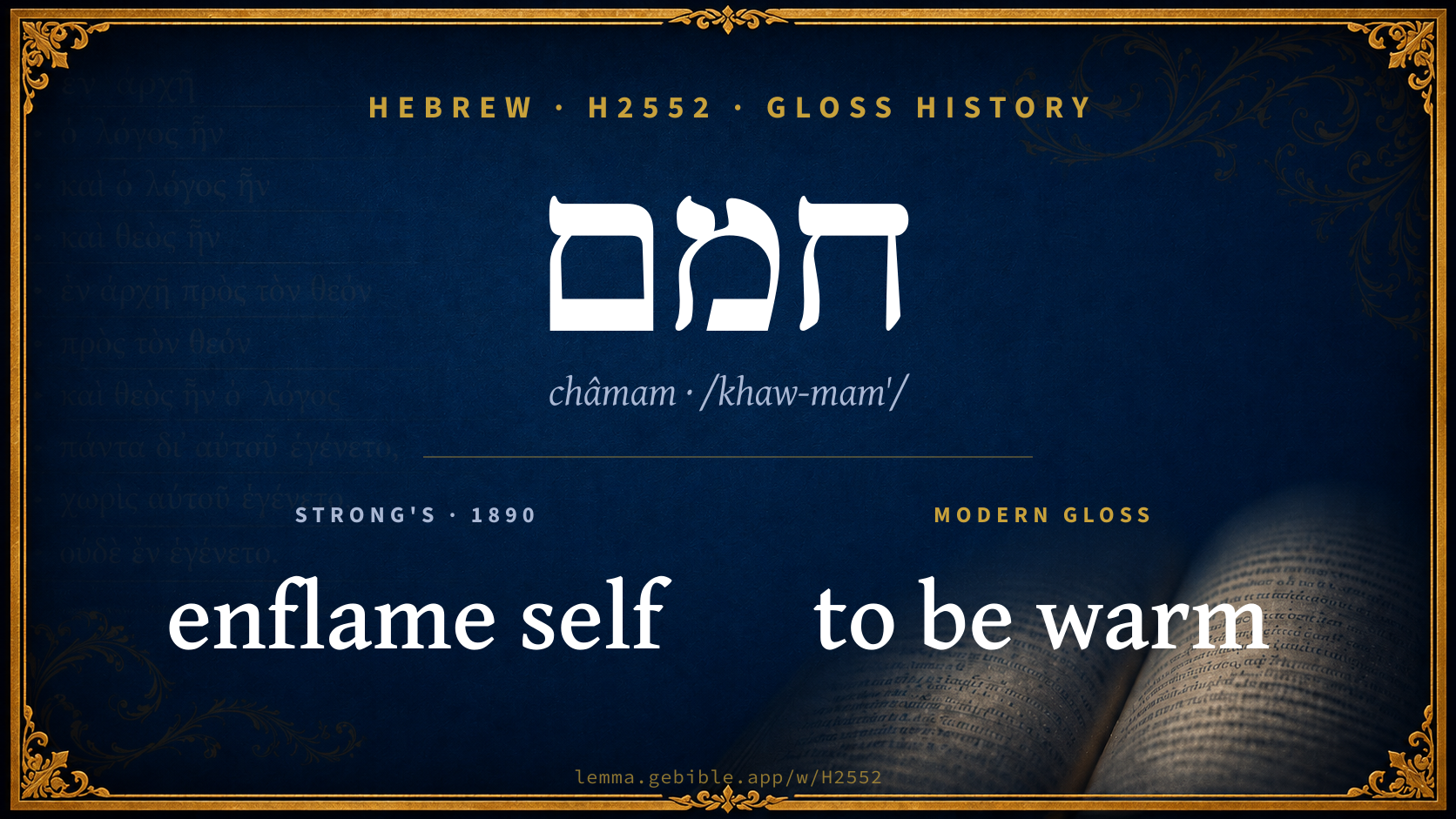
Gloss history
Strong's 1890 vs modern scholarship
About this word
Strong's H2552 catalogs a Hebrew word from the Hebrew Old Testament.
These counts are not copied from any lexicon or concordance. They are computed here, from the morphology-tagged Hebrew Old Testament. What Lemma adds →
- 12
- distinct verses
- The word appears in 12 distinct verses.
- 8 / 39
- OT books
- The word appears in 8 of 39 Old Testament books.
- #2,001
- by frequency
- Top 2500 most frequent Hebrew words (rank 2,001 of 8,640 Hebrew words by occurrence).
View all 12 occurrences in the concordance →
By section of the Old Testament
By traditional corpus
Conventional, traditional groupings — biblical authorship is debated, so this is a traditional corpus grouping, not an authorship claim. Each share is this word’s portion of its verses in that division of the Hebrew canon. Each figure is a share of the word’s 12 distinct verses.
- Prophets (Nevi'im) 7 verses · 58%
- Writings (Ketuvim) 4 verses · 33%
- Torah (Pentateuch) 1 verse · 8%
How translations render this word
Counts come from each version’s own published word-to-Strong’s tagging or interlinear alignment — an approximate guide to how each version renders this word, not a word-level alignment the data otherwise carries. Because each total is that version’s own tagged count, the per-version totals vary from one another and need not match the appearance or distinct-verse counts above. These counts may also differ from a printed concordance because Lemma counts each distinctly tagged rendering and does not collapse phrase taggings into a single head-word total. This is a fixed set of word-tagged versions (KJV, ASV, BSB, ULT) and does not change with the reading translation you choose elsewhere. Each version’s license is shown beside its name below (and on Sources).
- King James Version: Enflaming 1×, He were not warmed 1×, I am warm 1×
- American Standard Version: I am warm 1×, May get heat 1×, Me 1×
- Berean Standard Bible: Grew hot 2×
- unfoldingWord Literal Text: And 2×, Became hot 2×
King James Version Public Domain
Renders H2552 across 13 tagged occurrences — most commonly:
Plus other, less common renderings.
American Standard Version Public Domain
Renders H2552 across 13 tagged occurrences — most commonly:
Plus other, less common renderings.
Berean Standard Bible Public Domain
Renders H2552 across 20 tagged occurrences — most commonly:
Plus 18 renderings that appear only once — usually multi-word phrases or single function words the recovered tagging swept in, not distinct renderings. Not rendered by a distinct English word in 1 further occurrence.
unfoldingWord Literal Text CC BY-SA 4.0
Renders H2552 across 16 tagged occurrences — most commonly:
Plus 12 renderings that appear only once — usually multi-word phrases or single function words the recovered tagging swept in, not distinct renderings.
7 senses and sub-senses in the full BDB
Hebrew verbs can shift meaning by stem (binyan): Qal is the basic action, Niphal is often passive or reflexive, Piel often intensifies or makes it factitive, and Hiphil is typically causative. The senses below are grouped under the stem BDB assigns to each. This entry also uses Hithpael (reflexive or reciprocal).
What do BDB’s symbols mean?
BDB uses these scholarly abbreviations:
| Symbol | Meaning |
|---|---|
| 𝔊 | the Septuagint (the ancient Greek translation, LXX) |
| 𝔙 | the Vulgate (the Latin translation) |
| 𝔖 | the Syriac version (the Peshitta) |
| 𝔗 | the Targum (the Aramaic translation) |
| ψ | the Psalms |
| √ | root (the underlying root or stem) |
| ‖ | parallel passage (a synonymous or contrasted parallel) |
| † | the dagger: every passage where the word occurs is cited |
The 7 senses and sub-senses the full Brown-Driver-Briggs lexicon distinguishes for this word, in lexicon order (not ranked by frequency), with BDB’s own verbatim wording and sub-sense lettering. Shown in Hebrew script with BDB’s own scholarly abbreviations. The condensed entry is in the Lexicon Entry tab. See also the Forms in the corpus table below.
Qal
- Pf. חַם ψ 39:4; Ex 16:21; וְחַם consec. 1 K 1:2; Ec 4:11; חַמּוֹתִ֫י Is 44:16; Impf. יָחֹם Is 44:16; וַיָּ֫חָם 2 K 4:34; Is 44:15; יִחַם (יֵ K3) 1 K 1:1; יֵחַם Dt 19:6; יֵחָ֑ם Ec 4:11; 3 fs. תֵּחַם Ez 24:11; יֵחַמּוּ Ho 7:7; וַיֶּחֱמוּ Gn 30:39; וַיֵּחַמְנָה v 38 (last seven forms could be also from יחם q.v.; but no decisive evidence that this √ is used in Qal; they are placed under חמם by Thes Ew§ 193 a Ol§ 243 b; v. also Köi. 365, 417 ff., who on account of יחם Pi. Inf. Gn 30:41; 31:10, der. last two, needlessly, from יחם); Inf. לַחְמָם Is 47:14, cf. Jb 30:4 (where, however, ל׳ is from לֶחֶם Mich Di unles (Luzz Che) we read לְחַמֵּם Pi. Inf. in both); חֹם 1 S 11:9; Hg 1:6; Ne 7:3; sf. חֻמּוֹ Jb 6:17; חֻמָּם Je 51:39;— e.g. Psalms 39:4
- 1. lit., be or grow warm Ex 16:21 (P; subj. שֶׁמֶשׁ), cf. 1 S 11:9; Ne 7:3 and Jb 6:17 (sf. of impers. subj.); from fire Is 44:15, 16(×2) 47:14 (cf. supr.); natural heat 1 K 1:1, 2 (by personal contact), so 2 K 4:34; Ec 4:11(×2), from clothing Hg 1:6; of Jerusalem under fig. of pot or caldron Ez 24:11. e.g. Exodus 16:21
- 2. fig., subj. לִבִּי ψ 39:4 (‖ בַּהֲגִיגִי תִבְעַר־אֵשׁ), cf. Dt 19:6; of conspirators Ho 7:7; Chaldeans Je 51:39. e.g. Psalms 39:4
- 3. of heat in conception (animals) Gn 30:38, 39 (cf. יחם). e.g. Genesis 30:38
Niphal
- Pt. נֵחָמִים באלים Is 57:5 (Köi.371), inflame oneself with, of idolatry. e.g. Isaiah 57:5
Piel
- Impf. 3 fs. תְּחַמֵּם Jb 39:14 keep eggs warm (of ostrich). e.g. Job 39:14
Hithpael
- Impf. יִתְחַמָּם warm oneself Jb 31:20 מִגֵּז כְּבָשִׂים by means of fleece of sheep. e.g. Job 31:20
Senses from the full Brown-Driver-Briggs lexicon (Brown, Driver, Briggs; Oxford 1906 — public domain), digitized via Sefaria, supplemented by the OpenScriptures HebrewLexicon (CC BY 4.0). Full attribution on Sources.
Word origin
vb. be or become warm (NH id., Pi., make warm, Aramaic ܚܰܡ, חֲמַם be warm; Arabic حَمَّ become hot, of water; also heat, kindle fire in)—
— Brown-Driver-Briggs (Oxford 1906, public domain), digitized via Sefaria, supplemented by the OpenScriptures HebrewLexicon (CC BY 4.0). See Sources.
Origin: a primitive root
Jastrow Dictionary
A second Hebrew/Aramaic lexicon for comparison, covering Aramaic and post-biblical (Talmudic, Targumic, Midrashic) usage that the biblical-Hebrew BDB does not. Matched by lemma rather than by Strong’s number, so a lemma may carry more than one Jastrow headword (shown separately below), and the entries cover usage well beyond the Bible.
חֲמָם
- (v. next w.; cmp. ἄμωμον, v. Sm. Ant. s. v.) amomum, an Indian (also Syriac) spice. Ukts. III, 5 (some ed. incorr. חמס); Nidd. 51ᵇ חימות (corr. acc.); Sifré Deut. 107 חימום; Y. Erub. IX, end, 25ᵈ חכם (corr. acc.); Y. Ḥag. III, 79ᶜ חמה (corr. acc.).—Gen. R. s. 45, beg. הִ׳ היא צריכה (הימוס, corr. acc.) she needs amomum (as medicine for sterility). Cmp. הִימַלְתָּא, אַמִּיתָא.
חָמַם
- (b. h.) to be warm, hot; [(of color) to be dark, red; (of taste) to be pungent, sour, bitter]. Part. חָם, q. v.
- to heat, warm, boil. Y. Ned. IV, 38ᶜ bot. לחַמֵּם בו את ידיו to warm his hands against it (the bread). Gen. R. s. 14, end מְחַמֶּמֶת הגוף keeps the body warm. Sabb. 40ᵇ ומְחַמַּמְתָּהּ וכ׳ and warms it (her hand) before the fire; a. fr.
- same. Bets. II, 5 לא יֵחֵם וכ׳ one must not prepare warm water for &c. Sabb. 40ᵃ התחילו … להָחֵם בשבת the bathers began to heat (the water) on the Sabbath; a. fr.—Part. מֵיחֵם, מֵחֵם, pl. מְחַמִּין. Ib.ᵇ; Tosef. ib. III (IV), 7 מיחם אדם וכ׳ (ed. Zuck. מייחם, read: מֵיחֵים), v. אְלוּנְטִית I; [Y. ib. XIX, 17ᵃ bot. מחמין הוא אדם (read as ib. IX, 12ᵃ bot. מְחַמֵּם הוא וכ׳].—Ib. אם מפני הסכנה מְחַמִּין לו וכ׳ if it is for the sake of averting danger to life, may we not even boil water on the Sabbath?—Bets. 22ᵃ; a. v. fr.
- to be warmed. Sabb. III, 5 (41ᵃ) בשביל שיֵחַמּוּ that they become warm; Sabb. 41ᵇ שיֵחוֹמּוּ; Tosef. ib. III (IV), 5 שׁיֵיחַמּוּ; a. e.
- same. Sabb. 134ᵇ שהוּחַמּוּ, v. חָם II. Y. Bets. II, 61ᶜ; a. fr.—B. Mets. VI, 3 הוּחַמָּה the animal was overtaken by the heat.
- to warm one’s self; to become heated. Bets. II, 5; Tosef. Sabb. l. c. Tam. I, 1. Ab. II, 10 הוי מִתְחַמֵּם וכ׳ warm thyself by the fire of the scholars (try to associate with them); a. fr.—Y. Sot. I, 16ᶜ bot. נתח׳ was heated (had pollution). Gen. R. s. 24 מִתְחַמְּמִים, מִתְחַמְּמוֹת conceived
חֲמַם
- Targ. O. Gen. XVIII, 1; a. e.; v. חוּם
- to warm, heat.—Part. pass. מְחַמַּם. Targ. Hos. VII, 7.
- to heat, excite, v. חוּם.—2) אַחְמַם to become hot; to have pollution. Nidd. 43ᵃ כל אחְמוּמֵי והדר א׳ וכ׳ getting heated once and again immediately after.
- 1. to warm one’s self. Targ. Y. II, Gen. XVIII, 1.—Sabb. 110ᵇ כד איח׳ ed. (Ms. M. אַחְ׳, v. supra) when he had warmed himself.—*
- 2. to restrain one’s anger. Targ. II Esth. V, 10 [prob. to be read: ואִתְחַמַּס, v. חֲמַס; cmp. חֲסַן].
A Dictionary of the Targumim, the Talmud Babli and Yerushalmi, and the Midrashic Literature (Marcus Jastrow; London, Luzac, 1903) — Public Domain. Digitized via Sefaria. Digitized via Sefaria. Full attribution on Sources.
Forms in the corpus
The 13 distinct written forms H2552 takes in the Hebrew Bible, most frequent first — each parse links to that stem’s occurrences in the concordance. Hebrew forms include their vowel points and cantillation, so a single lemma takes many written forms.
Same root — word family
Other BDB entries built from the same root as H2552, grouped by Strong’s listed origin. These share a root / origin per the lexicon — not necessarily a shared meaning. Each links to that word’s own entry.
Derived from this word
Proper names from this root
People and places named from this root — a name, not an additional meaning of the word.
Compare all same-root words → 1 of the same-root words is a proper name (a person or place). They share a root, not necessarily a meaning.
Septuagint verse parallels
This word appears in 12 verses that also exist in the Greek Old Testament (Septuagint), out of the 12 Hebrew verses it occurs in. You can read those verses in Greek by switching the Old Testament edition to the Septuagint.
Read these verses in the Septuagint
- Exodus 16:21
- 1 Kings 1:2
- 2 Kings 4:34
- Job 31:20
- Psalms 39:3
- Ecclesiastes 4:11
- Isaiah 44:15
- Hosea 7:7
This is a verse-level parallel only — the same verses exist in both the Hebrew and Greek Old Testaments. No word-level Hebrew↔Greek correspondence is claimed: the data carries no such alignment, so no Greek word is shown as this Hebrew word’s translation. Coverage is not total — the Septuagint omits the deuterocanon and renumbers the Psalms, so some Hebrew verses have no direct Greek parallel.