Jeremiah 42:13

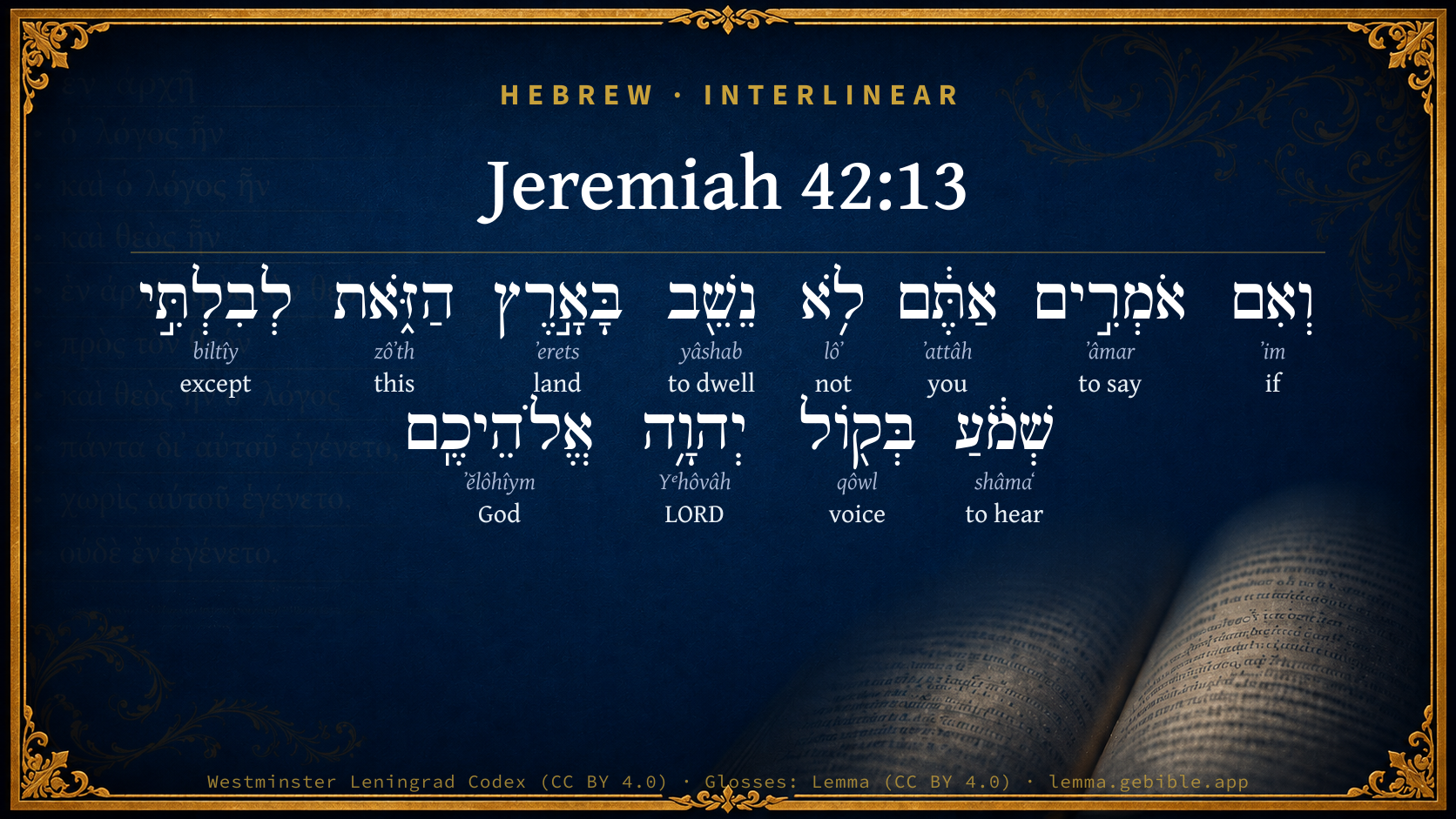
Hebrew (Westminster Leningrad Codex) Jeremiah 42:13 appears in the Hebrew Old Testament. The text above is from the Westminster Leningrad Codex. Each word links to its Strong’s number, a concise gloss, and parsing drawn from the Open Scriptures Hebrew Bible morphology. Click any word for its full Brown-Driver-Briggs (BDB) entry.
Download image
Cite this verse

Jeremiah 42:13 (World English Bible). Public Domain. Lemma interlinear Bible study tool, https://lemma.gebible.app/v/jeremiah/42/13.

Show BibTeX & RIS
BibTeX
RIS
English Translation
But if you say, We will not dwell in this land; so that you don't obey the voice of Yahweh your God,
World English Bible · Public Domain
Download a study sheet

One document with this verse’s original text, its word-by-word gloss line, the meaning frame, cross-references with their text, attributed commentary, and full source and license credits — printable, and it pastes into notes with its structure intact.

This verse Autodidact and up

Study sheet (.html) Plain text (.txt)

A passage Seminary Student

Up to 50 verses in one chapter. A passage sheet keeps up to 6 commentary sources and 12 cross-references per verse, in the order this page ranks them, and says so on the sheet whenever that leaves anything out. Ask for a single verse and you get the Autodidact verse sheet above.

Everything on this page stays free to read, with no account — the sheet is a download of what is already on screen, not access to it.

Want to remove ads? Support Godless Engineer
Compare translations 3

The same verse in 3 English versions, stacked beneath the original-language interlinear above. Click any original word for its lexicon entry.

Each is an independent rendering of the whole verse — the interlinear is not word-aligned to these translations.

Highlighted words mark where these versions differ — a whole-verse word diff, not a word-by-word alignment.

  • World English Bible Public Domain
    But if you say, We will not dwell in this land; so that you don't obey the voice of Yahweh your God,
  • King James Version Public Domain
    But if ye say, We will not dwell in this land, neither obey the voice of the LORD your God,
  • unfoldingWord Literal Text CC BY-SA 4.0
    But suppose that you say, “We will not stay in this land”—if you do not listen to my voice, the voice of Yahweh your God.

unfoldingWord Literal Text — © unfoldingWord, licensed CC BY-SA 4.0. Word-aligned USFM3 via Door43 (git.door43.org/unfoldingWord/en_ult).

Versions to compare (up to 4)

3 of 4 selected

Show all 18 translations

Every available English version of this verse, each an independent rendering of the whole verse.

  • World English Bible Public Domain
    But if you say, We will not dwell in this land; so that you don't obey the voice of Yahweh your God,
  • Berean Standard Bible Public Domain
    But if you say, ‘We will not stay in this land,’ and you thus disobey the voice of the LORD your God,
  • Majority Standard Bible Public Domain
    But if you say, ‘We will not stay in this land,’ and you thus disobey the voice of the LORD your God,
  • King James Version Public Domain
    But if ye say, We will not dwell in this land, neither obey the voice of the LORD your God,
  • American Standard Version (1901) Public Domain
    But if ye say, We will not dwell in this land; so that ye obey not the voice of Jehovah your God,
  • Revised Version (1885) Public Domain
    But if ye say, We will not dwell in this land; so that ye obey not the voice of the LORD your God;
  • Geneva Bible (1599) Public Domain
    But if ye say, We will not dwell in this land, neither heare the voyce of the Lord your God,
  • Douay-Rheims (1899) Public Domain
    But if you say: We will not dwell in this land, neither will we hearken to the voice of the Lord our God,
  • Young's Literal Translation Public Domain
    `And if ye are saying, We do not dwell in this land -- not to hearken to the voice of Jehovah your God,
  • Literal Standard Version CC BY-SA 4.0
    And if you are saying, We do not dwell in this land—not to listen to the voice of your God YHWH,
  • Unlocked Literal Bible CC BY-SA 4.0
    But suppose that you say, “We will not stay in this land”—if you do not listen to my voice, the voice of Yahweh your God.
  • unfoldingWord Literal Text CC BY-SA 4.0
    But suppose that you say, “We will not stay in this land”—if you do not listen to my voice, the voice of Yahweh your God.
  • Darby Bible Public Domain
    But if ye say, We will not dwell in this land; so as not to hearken unto the voice of Jehovah your God,
  • World Messianic Bible Public Domain
    “‘But if you say, “We will not dwell in this land,” so that you don’t obey the LORD your God’s voice,
  • Webster's Bible Public Domain
    But if ye say, We will not dwell in this land, neither obey the voice of the LORD your God,
  • Free Bible Version CC BY-SA 4.0
    But if you say, “We won't stay here in this country,” and by doing so disobey what the Lord your God says;
  • Bible in Basic English Public Domain
    But if you say, We have no desire to go on living in this land; and do not give ear to the voice of the Lord your God,
  • JPS Tanakh (1917) Public Domain
    But if ye say: We will not abide in this land; so that ye hearken not to the voice of the LORD your God;

Literal Standard Version (2020), Covenant Press — licensed CC BY-SA 4.0. Text via the HelloAO Bible API (eBible.org). Unlocked Literal Bible (unfoldingWord) — licensed CC BY-SA 4.0. Text via the HelloAO Bible API (eBible.org). unfoldingWord Literal Text — © unfoldingWord, licensed CC BY-SA 4.0. Word-aligned USFM3 via Door43 (git.door43.org/unfoldingWord/en_ult). Free Bible Version, Dr. Jonathan Gallagher — licensed CC BY-SA 4.0. Text via the HelloAO Bible API (eBible.org).

Word by word

More ways to search: Search by grammar → Find every occurrence → Compare this word →

Practice this passage: Drill this verse → Learn its vocabulary →

לְבִלְתִּ֣י
biltîy
H1115
“to/for · except”
Preposition + Conjunction
Part of Speech
Preposition + Conjunction
Full BDB Definition

Origin: constructive fem. of H1086 (equivalent to H1097 )

TWOT: 246i

not, except (substantive) - not (adverb) - except (after preceding negation) (adverb) - except (after an implied or expressed negation) (conjunction) - so as not, in order not (with preposition) - an account of not, because...not (with preposition) - until not (with preposition)
  1. וְאִם ʼim H518 “and · if” Conjunction + Conjunction
  2. אֹמְרִ֣ים ʼâmar H559 “saying” Verb, Qal, Participle Active, Masculine, Plural, Absolute
  3. אַתֶּ֔ם ʼattâh H859 “you” Pronoun, Personal, 2nd Person, Masculine, Plural
  4. לֹ֥א lôʼ H3808 “not” Particle, Negative
  5. נֵשֵׁ֖ב yâshab H3427 “to dwell” Verb, Qal, Imperfect, 1st Person, Common, Plural
  6. בָּאָ֣רֶץ ʼerets H776 “in/at the · land” Preposition, Determined + Noun, Common, Both, Singular, Absolute
  7. הַזֹּ֑את zôʼth H2063 “the · this” Particle, Definite Article + Pronoun, Demonstrative, Feminine, Singular
  8. שְׁמֹ֔עַ shâmaʻ H8085 “to hear” Verb, Qal, Infinitive Construct
  9. בְּק֖וֹל qôwl H6963 “in/at · voice of” Preposition + Noun, Common, Masculine, Singular, Construct
  10. יְהוָ֥ה Yᵉhôvâh H3068 “LORD” Noun, Proper
  11. אֱלֹהֵיכֶֽם ʼĕlôhîym H430 “God(s) · your” Noun, Common, Masculine, Plural, Construct + Suffix, Personal, 2nd Person, Masculine, Plural

About this verse

These counts appear in no published source. They are computed here, from the morphology-tagged text and Lemma’s own curated glosses. What Lemma adds →

12
words
12
distinct lemmas
Prophets
section

Grammatical profile

  • 3 verbs
  • 4 nouns
  • 2 pronouns
  • 2 conjunctions
  • 1 particle

Verb forms

  • אֹמְרִ֣ים Qal · Participle Active
  • נֵשֵׁ֖ב Qal · Imperfect
  • שְׁמֹ֔עַ Qal · Infinitive Construct

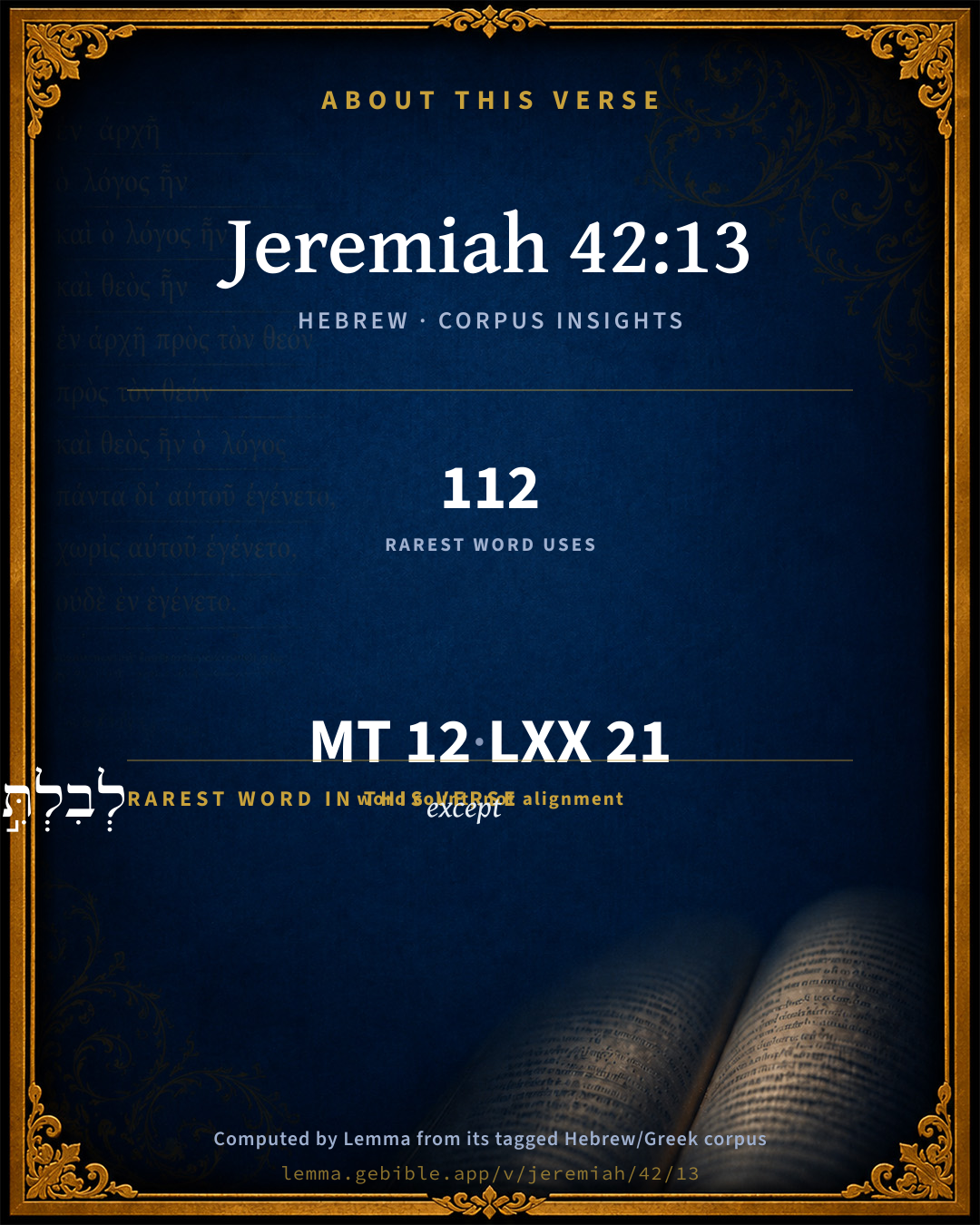
Hebrew & Septuagint length

In the original languages it is 12 Hebrew tokens and 21 Greek tokens — but the two are counted differently (Hebrew bundles its prefixes and suffixes into one token; the Greek is in lemma form), so that isn’t a like-for-like length.

Cross-references

3

Topical passages linked to Jeremiah 42:13 in the Treasury of Scripture Knowledge — connected by theme and wording, ordered by reader-vote popularity; previews shown in the World English Bible.

  • Jeremiah 44:16 As for the word that you have spoken to us in the name of Yahweh, we will not listen to you.
  • Exodus 5:2 Pharaoh said, "Who is Yahweh, that I should listen to his voice to let Israel go? I don't know Yahweh, and moreover I will not let Israel go."
  • Jeremiah 42:10 If you will still abide in this land, then will I build you, and not pull you down, and I will plant you, and not pluck you up; for I repent me of the evil that I have done to you.

Cross-references courtesy of OpenBible.info (CC BY 4.0).

Hebrew and Greek witnesses Masoretic Hebrew ↔ Greek Septuagint

The same verse in the two great witnesses to the Old Testament, shown verse-for-verse.

These are two independent witnesses, not word-aligned to each other, and the Septuagint is shown in lemma (dictionary) form.

Hebrew Jeremiah 42:13 Masoretic · Westminster Leningrad Codex

וְאִם אֹמְרִ֣ים אַתֶּ֔ם לֹ֥א נֵשֵׁ֖ב בָּאָ֣רֶץ הַזֹּ֑את לְבִלְתִּ֣י שְׁמֹ֔עַ בְּק֖וֹל יְהוָ֥ה אֱלֹהֵיכֶֽם

But if you say, We will not dwell in this land; so that you don't obey the voice of Yahweh your God,

World English Bible · Public Domain

Greek LXX Structure differs

In the Septuagint, Jeremiah is about an eighth shorter than the Hebrew and arranges its material differently — the Oracles Against the Nations (Hebrew chapters 46–51) appear in the middle of the Greek book, after 25:13. Because the chapter and verse boundaries do not line up, a verse-for-verse comparison with the Hebrew is not shown.

A verse-for-verse comparison isn’t shown here because the chapters and verses don’t line up. Switch to the LXX edition with the MT / LXX toggle above to read the Greek directly.

Hebrew: Westminster Leningrad Codex (CC BY 4.0). Greek: Septuagint (public domain); English from a public-domain English Septuagint. How the Septuagint differs from the Hebrew →

Targum (Aramaic paraphrase)

1

The Targum is the ancient Jewish Aramaic paraphrase of the Hebrew Scriptures — an interpretive translation, not the Hebrew text itself. Onkelos (literal) and Pseudo-Jonathan (expansive) render the Torah, and Jonathan the Prophets. Coverage is partial: where no permissively-licensed English translation exists for a verse, only the Aramaic is shown. This is verse-level text, not a word-by-word alignment to the Hebrew.

  1. Targum Jonathan Prophets (Joshua–Malachi)
    וְאִם אָמְרִין אַתּוּן לָא נִתֵּיב בְּאַרְעָא הַדָא בְּדִיל דְלָא לְקַבָּלָא לְמֵימְרָא דַייָ אֱלָהָכוֹן:

    (no public-domain English translation for this verse)

    Targum Jonathan — Aramaic: “Mikraot Gedolot” (public domain). English: “Sefaria Community Translation” (CC0 1.0 (public-domain dedication)); “London "Chaldee Paraphrase," 1871” (public domain). Text via Sefaria.

Commentary

Notes on Jeremiah 42:13 from classic Christian and Jewish commentators (each source and its license shown beneath its notes). The classic Christian expositions comment on the surrounding passage and are grouped to its opening verse, so a note may address several verses; the Jewish commentaries on the Tanakh (Rashi and others) are per-verse, so they appear only where the commentator wrote on this verse.

Lemma curates 59 commentaries, every one of them public domain or Creative Commons licensed, each selected and text-cleaned for this edition rather than reprinted as found. About our sources →

Trapp's Complete Commentary

John Trapp

Jer 42:13 But if ye say, We will not dwell in this land, neither obey the voice of the LORD your God,

Ver. 13. But if ye say, We will not dwell in this land.] Because more barren than Egypt, and besides beset with many and mighty enemies

Neither obey the voice of the Lord your God.] Which you ought to do, whatever come of it, since rebellion is as witchcraft. {1Sa 15:22-23}

John Trapp, A Commentary or Exposition upon All the Books of the Old and New Testament (1647–1656) — public domain. Text from a community e-Sword module.

Joseph Benson's Commentary

Jer 42:13-18. But if ye say, We will not dwell in this land, neither obey — Hebrew, לבלתי שׁמע, so as not to obey. If they did not continue in their own land, they disobeyed the voice of the Lord. Saying, No; we will go into the land of Egypt, where we shall see no war, &c. — Their great sin was unbelief: they would not take the promise of God as a security to them for a quiet and peaceable abode, and a supply of all their wants, in Judea: but they resolved to go into Egypt, where they expected to have a greater certainty of peace and plenty. Therefore the Lord declares by his prophet, that the evils which they feared in Canaan should overtake them with double violence in Egypt, namely, both the sword and famine, by which they should die, and that they should be an execration and an astonishment: a curse and a reproach: (Jer 42:18,) as God had threatened to make the inhabitants of Jerusalem, Jer 24:9; Jer 29:18, where see the notes. And ye shall see this place no more — And in this, saith God, will I deal worse with you than with those who were carried captive to Babylon; many of them shall return, after the time fixed for the duration of their captivity is expired, but you shall return into this land no more. There was this aggravation in the sin of those Jews to whom God was now speaking by his prophet, that they had lately seen his words, by the same prophet, fully verified; yet would not take warning, but ran into the same sin of unbelief.

Joseph Benson's Commentary on the Old and New Testaments (1811–1818) — public domain. Text from a community e-Sword module.

Keil & Delitzsch

C. F. Keil & F. Delitzsch

The threatening if, in spite of warning and against God's will, they should still persist in going to Egypt. The protasis of the conditional sentence begun in Jer 42:13, "If ye say," etc., extends onwards through Jer 42:14; the apodosis is introduced co-ordinately with the commencement of Jer 42:15, "Now therefore," etc. קול שׁופר, "the sound of war-trumpet," as in Jer 4:19. On "hungering after bread," cf. Amo 8:11. הלחם (with the article) is the bread necessary for life. "The remnant of Judah" is to be understood of those who still remained in the land, as is shown by Jer 42:2; see also Jer 42:19, Jer 43:5; Jer 44:12, Jer 44:14. The warning given in Jer 42:16 contains the idea that the very evil which they feared would come on them in Judah will befall them in Egypt. There they shall perish by sword, famine, and plague, since Nebuchadnezzar will conquer Egypt; cf. Jer 43:8-13.

Keil & Delitzsch — Biblical Commentary on the Old Testament (1861–1891) — public domain (CC PDM 1.0). Text via the HelloAO Bible API. (Old Testament only.)

Tyndale Open Study Notes

Tyndale Open Resources

42:13-22 Jeremiah had already prophesied Egypt’s destiny; it would be destroyed by the Babylonians (46:2-26). This remnant of Judah would walk into the path of the Lord’s judgment if they continued on to Egypt.

Tyndale Open Study Notes — © Tyndale Open Resources, licensed CC BY-SA 4.0. Text via the HelloAO Bible API.

Jamieson, Fausset & Brown

Robert Jamieson, A. R. Fausset & David Brown

if ye say, &c.--avowed rebellion against God, who had often (Deu 17:16), as now, forbidden their going to Egypt, lest they should be entangled in its idolatry.

Jamieson, Fausset & Brown — Commentary Critical and Explanatory on the Whole Bible (1871) — public domain (CC PDM 1.0). Text via the HelloAO Bible API.

John Calvin's Commentaries

God having promised, that the counsel he gave to the Jews would be good and safe, now, on the other hand, threatens them, that if they disobeyed, everything they would attempt would end miserably. They had not expressly asked whether it would be for their good to go into Egypt, or whether it would be pleasing to God; but God, who penetrates into all hidden purposes, anticipated them, and declared that their going would be unhappy, if they fled into Egypt. We hence see how the Prophet, or rather God himself, who spoke by his servant, tried by all means to keep them in the way of duty.

He then says, If ye say, We shall not dwell in this land, it shall be ill with you, he says: but before he denounced punishment, he shewed that they deserved to be destroyed, if they went to Egypt; for had the thing been in itself lawful, yet to attempt such a thing against the express will of God was, as we know, an impious and a diabolical presumption and rashness. God had forbidden them specifically in his Law ever to set their hearts on Egypt, (Deuteronomy 17:16;) and he had often confirmed the same thing by his Prophets, (Isaiah 30:2; Isaiah 31:1;) and now again he seals the former prophecies, as he expressly forbids them to go to Egypt. The Prophet then sets this crime before their eyes: “If ye flee into Egypt, what is it that compels you? even because ye will not obey God.” There is then great weight in these words, Nor obey the voice of Jehovah your God; as though he had said, that they could not think of Egypt, except they designedly, as it were, rejected the authority of God, and resisted his counsel.

John Calvin's Commentaries (1540-1563) — public domain. Text from the Calvin Translation Society English edition (1840s-50s) via the Christian Classics Ethereal Library (ccel.org). Calvin's coverage is partial (roughly two-thirds of the Bible); uncommented books and verses are honest gaps, never fabricated. The 19th-century editor's footnotes and remarks are omitted so the notes are faithfully Calvin's own voice.

John Gill's Exposition

Saying, no, but we will go into the land of Egypt,.... It was all one as if they had said, no, we will not obey the voice of the Lord to continue in our own land; we are determined to go into Egypt, induced by the following reasons:

where we shall see no war; either internal, or with a foreign enemy; as both of late in their own land, and which they feared would be again; but promised themselves exemption from both in the land of Egypt, and therefore coveted to dwell there:

nor hear the sound of the trumpet; neither hear of wars nor rumours of wars; not the sound of the trumpet in the armies of the enemy, or among themselves, to gather together and prepare for battle; or, as Jarchi thinks, the sound of the trumpet blown by the watchman, giving notice to the people of the approach of an enemy:

nor have hunger of bread; as they had had while Judea was invaded and Jerusalem besieged, and a foreign army in the land; and though they had no reason to fear this now, yet they thought they should be more out of the danger of it in Egypt, a fruitful country, overflowed by the Nile:

and there will we dwell; in peace, prosperity, and safety: this was their resolution, to go and abide there; and this their confidence, that such would be their happy state.

John Gill's Exposition of the Whole Bible (1746–1763) — public domain (CC PDM 1.0). Text via the HelloAO Bible API.

Matthew Poole's English Annotations

Our translation a little darkens the sense, translating the Hebrew particle בלתי

neither, which signifies no more than not, or by no means, Num 14:16; 1Sa 2:2; 20:26; Hos 13:4; and it is certain here is but one thing spoken of, for the thing wherein they disobeyed the voice of the Lord was not continuing in their own land, but going into the land of Egypt.

Matthew Poole's English Annotations on the Holy Bible (1683–1685) — public domain. Text from a community e-Sword/MySword module.

The Pulpit Commentary

Vers. 13-18. A land to be avoided.

How solemn and urgent this warning! Let us ask why it was needed, why God seemed thus to cast doubt on the power of the people to obey him.

I THE PERILOUS LAND WAS NEAR. They were right in the way to Egypt, having, indeed, moved Egyptwards rather than in any other direction. (Jer_41:17)

II IT HAD OBVIOUS ATTRACTIONS.

1. It seemed to be a land of peace. Egypt had been locked to as a friend and ally. The desolation of Jerusalem had come from the north. When people have been going through a time of war and siege, peace is naturally the blessing put in front of their thoughts. And is not this a good thing, it may be asked? Yes, surely, if peace be desired on high grounds, and from a horror of discord among men. But men may seek it simply to escape from disturbance and from loss of life and property. Their seeking of peace may be a sign of cowardice and altogether groveling aims. Danger may be escaped by the outer man, only to be concentrated more effectually on the man within.

2. It would be a land of bread. Another recommendation of a land which it was unquestionably right, for men to attend to. Egypt was one of the great granaries of the ancient world. But it did not therefore follow that it was a land to live in. Israelites, in particular, needed to recollect how their fathers, beginning by going to Egypt for bread, ended by sinking into most oppressive bondage. Besides, even the land of bread was at times a land of famine.

3. It consequently looked a land to dwell in. God is the God of his people only when they are in their proper place. He was God of the exiles in Babylon, because their going into Babylon was of his operation. But those who went to Egypt in search of mere immunity from toil and inglorious ease could not expect to have the Divine favour. They wanted to get the great ends of life without discipline, sacrifice, and endurance.

III THE VAIN PURPOSE TO ESCAPE FROM EVIL. God tries to make the people understand that they take the germs and principles of evil with them. What we find in any place depends on what we bring; and what we bring we must, in process of time, inevitably find. What had there been to hinder the land of Israel from being a land of peace and a land of bread? Nothing but the faithlessness and general wickedness of the people. We cannot sow wickedness in one place, and then hope to go and reap only good things in some other place. God can turn any place, however fruitful, into a wilderness; and, on the other hand, we know how Jesus made a wilderness a place to feed five thousand men. Jehovah spoke with all this severity to these people to make them understand how hard a thing real obedience was. Y.

The Pulpit Commentary (1880–1919), ed. H.D.M. Spence-Jones & Joseph S. Exell — public domain. Text from a community e-Sword module.

unfoldingWord translationNotes

Door43 World Missions Community

if you do not listen to my voice, the voice of Yahweh your God

Here "voice" represents a command. To not obey is like the people did not hear Yahweh's command. AT: "if you do not obey my commands, even though I am Yahweh, your God" (See: Metonymy)

where we will not see any war, where we will not hear the sound of the trumpet

Both of these phrases describe being at war by the ability to see or hear it. AT: "where we will not experience the hardships of war" (See: Parallelism)

we will not go hungry for food

Being hungry for food is used to describe famine. (See: Metonymy)

translationWords

voice

Egypt

trumpet

unfoldingWord translationNotes — © Distant Shores Media and the Door43 World Missions Community, licensed CC BY-SA 4.0. Source: git.door43.org/Door43/en_tn.

Lesson kit

Teaching starters — assembled from the data on this page, not authored interpretation. Every prompt links to the verse data it draws on. Edit before teaching.

Jeremiah, in the Prophets, opens this verse with 12 words (12 distinct Hebrew lemmas). Its most distinctive word is biltîy (“except”). A historical commentator’s framing appears above. Read the whole chapter for the surrounding context.

Discussion questions

  1. The word biltîy carries the sense “except.” How does it shape the verse?
  2. How does Jeremiah 44:16, which shares this passage’s theme, read alongside this verse?
  3. These translations render this verse differently. What is at stake in choosing one wording over another?
  4. «אֹמְרִ֣ים» is a Qal Participle Active verb. How does that grammatical form shape the action described?
  5. Compare how Trapp's Complete Commentary and Joseph Benson's Commentary read this verse. Where do they agree or differ?

Things to notice

Reading settings

Reading text

Shown beneath each verse's original-language words.

Old Testament
Old Testament edition

Read the OT as the Masoretic Hebrew (MT) or the Greek Septuagint (LXX).

English shown for the Greek Septuagint (in the Hebrew ↔ Greek comparison).

Comparing translations? Open the Compare panel on any verse page to stack up to four side by side.