1 Kings 18:34

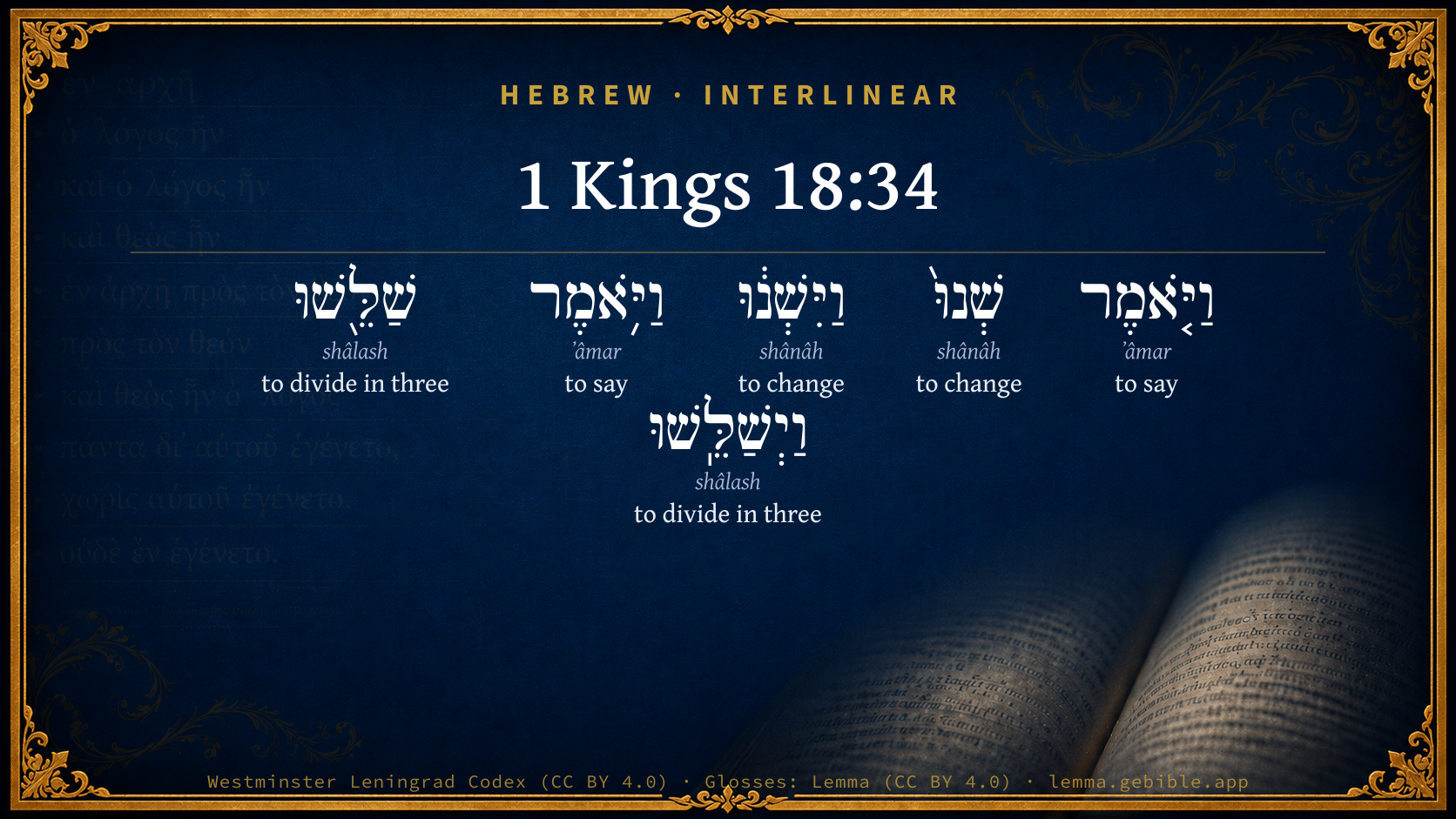
Hebrew (Westminster Leningrad Codex) 1 Kings 18:34 appears in the Hebrew Old Testament. The text above is from the Westminster Leningrad Codex. Each word links to its Strong’s number, a concise gloss, and parsing drawn from the Open Scriptures Hebrew Bible morphology. Click any word for its full Brown-Driver-Briggs (BDB) entry.
Download image
Cite this verse

1 Kings 18:34 (World English Bible). Public Domain. Lemma interlinear Bible study tool, https://lemma.gebible.app/v/1-kings/18/34.

Show BibTeX & RIS
BibTeX
RIS
English Translation
He said, Do it the second time; and they did it the second time. He said, Do it the third time; and they did it the third time.
World English Bible · Public Domain
Download a study sheet

One document with this verse’s original text, its word-by-word gloss line, the meaning frame, cross-references with their text, attributed commentary, and full source and license credits — printable, and it pastes into notes with its structure intact.

This verse Autodidact and up

Study sheet (.html) Plain text (.txt)

A passage Seminary Student

Up to 50 verses in one chapter. A passage sheet keeps up to 6 commentary sources and 12 cross-references per verse, in the order this page ranks them, and says so on the sheet whenever that leaves anything out. Ask for a single verse and you get the Autodidact verse sheet above.

Everything on this page stays free to read, with no account — the sheet is a download of what is already on screen, not access to it.

Want to remove ads? Support Godless Engineer
Compare translations 3

The same verse in 3 English versions, stacked beneath the original-language interlinear above. Click any original word for its lexicon entry.

Each is an independent rendering of the whole verse — the interlinear is not word-aligned to these translations.

Highlighted words mark where these versions differ — a whole-verse word diff, not a word-by-word alignment.

  • World English Bible Public Domain
    He said, Do it the second time; and they did it the second time. He said, Do it the third time; and they did it the third time.
  • King James Version Public Domain
    And he said, Do it the second time. And they did it the second time. And he said, Do it the third time. And they did it the third time.
  • unfoldingWord Literal Text CC BY-SA 4.0
    And he said, “Fill four jars water, and pour on the burnt offering and on the wood.” And he said, “Do a second time,” and they did a second time. And he said, “Do a third time,” and they did a third time.

unfoldingWord Literal Text — © unfoldingWord, licensed CC BY-SA 4.0. Word-aligned USFM3 via Door43 (git.door43.org/unfoldingWord/en_ult).

Versions to compare (up to 4)

3 of 4 selected

Show all 18 translations

Every available English version of this verse, each an independent rendering of the whole verse.

  • World English Bible Public Domain
    He said, Do it the second time; and they did it the second time. He said, Do it the third time; and they did it the third time.
  • Berean Standard Bible Public Domain
    and said, “Fill four waterpots and pour the water on the offering and on the wood.” “Do it a second time,” he said, and they did it a second time. “Do it a third time,” he said, and they did it a third time.
  • Majority Standard Bible Public Domain
    and said, “Fill four waterpots and pour the water on the offering and on the wood.” “Do it a second time,” he said, and they did it a second time. “Do it a third time,” he said, and they did it a third time.
  • King James Version Public Domain
    And he said, Do it the second time. And they did it the second time. And he said, Do it the third time. And they did it the third time.
  • American Standard Version (1901) Public Domain
    And he said, Do it the second time; and they did it the second time. And he said, Do it the third time; and they did it the third time.
  • Revised Version (1885) Public Domain
    And he said, Do it the second time; and they did it the second time. And he said, Do it the third time; and they did it the third time.
  • Geneva Bible (1599) Public Domain
    And said, Fill foure barrels with water, and powre it on the burnt offring and on the wood. Againe he said, Doe so againe. And they did so the second time. And he sayde, Doe it the third time. And they did it the third time.
  • Douay-Rheims (1899) Public Domain
    And he said: Fill four buckets with water, and pour it upon the burnt offering, and upon the wood. And again he said: Do the same the second time. And when they had done it the second time, he said: Do the same also the third time. And they did so the third time.
  • Young's Literal Translation Public Domain
    and he saith, `Do `it' a second time;' and they do `it' a second time; and he saith, `Do `it' a third time;' and they do `it' a third time;
  • Literal Standard Version CC BY-SA 4.0
    and he says, “Do [it] a second time”; and they do [it] a second time; and he says, “Do [it] a third time”; and they do [it] a third time;
  • Unlocked Literal Bible CC BY-SA 4.0
    Then he said, “Do it a second time,” and they did it a second time. Once more he said, “Do it a third time,” and they did it a third time.
  • unfoldingWord Literal Text CC BY-SA 4.0
    And he said, “Fill four jars water, and pour on the burnt offering and on the wood.” And he said, “Do a second time,” and they did a second time. And he said, “Do a third time,” and they did a third time.
  • Darby Bible Public Domain
    And he said, Do it the second time. And they did it the second time. And he said, Do it the third time. And they did it the third time.
  • World Messianic Bible Public Domain
    He said, “Do it a second time;” and they did it the second time. He said, “Do it a third time;” and they did it the third time.
  • Webster's Bible Public Domain
    And he said, Do it the second time. And they did it the second time. And he said, Do it the third time. And they did it the third time.
  • Free Bible Version CC BY-SA 4.0
    “Do it again,” he said. So they did. “Do it for a third time,” he said. So they did it for the third time.
  • Bible in Basic English Public Domain
    And he said, Do it a third time, and they did it a third time.
  • JPS Tanakh (1917) Public Domain
    And he said: 'Fill four jars with water, and pour it on the burnt-offering, and on the wood.' And he said: 'Do it the second time'; and they did it the second time. And he said: 'Do it the third time'; and they did it the third time.

Literal Standard Version (2020), Covenant Press — licensed CC BY-SA 4.0. Text via the HelloAO Bible API (eBible.org). Unlocked Literal Bible (unfoldingWord) — licensed CC BY-SA 4.0. Text via the HelloAO Bible API (eBible.org). unfoldingWord Literal Text — © unfoldingWord, licensed CC BY-SA 4.0. Word-aligned USFM3 via Door43 (git.door43.org/unfoldingWord/en_ult). Free Bible Version, Dr. Jonathan Gallagher — licensed CC BY-SA 4.0. Text via the HelloAO Bible API (eBible.org).

Word by word

More ways to search: Search by grammar → Find every occurrence → Compare this word →

Practice this passage: Drill this verse → Learn its vocabulary →

About this verse

These counts appear in no published source. They are computed here, from the morphology-tagged text and Lemma’s own curated glosses. What Lemma adds →

6
words
3
distinct lemmas
Historical
section

Notable vocabulary

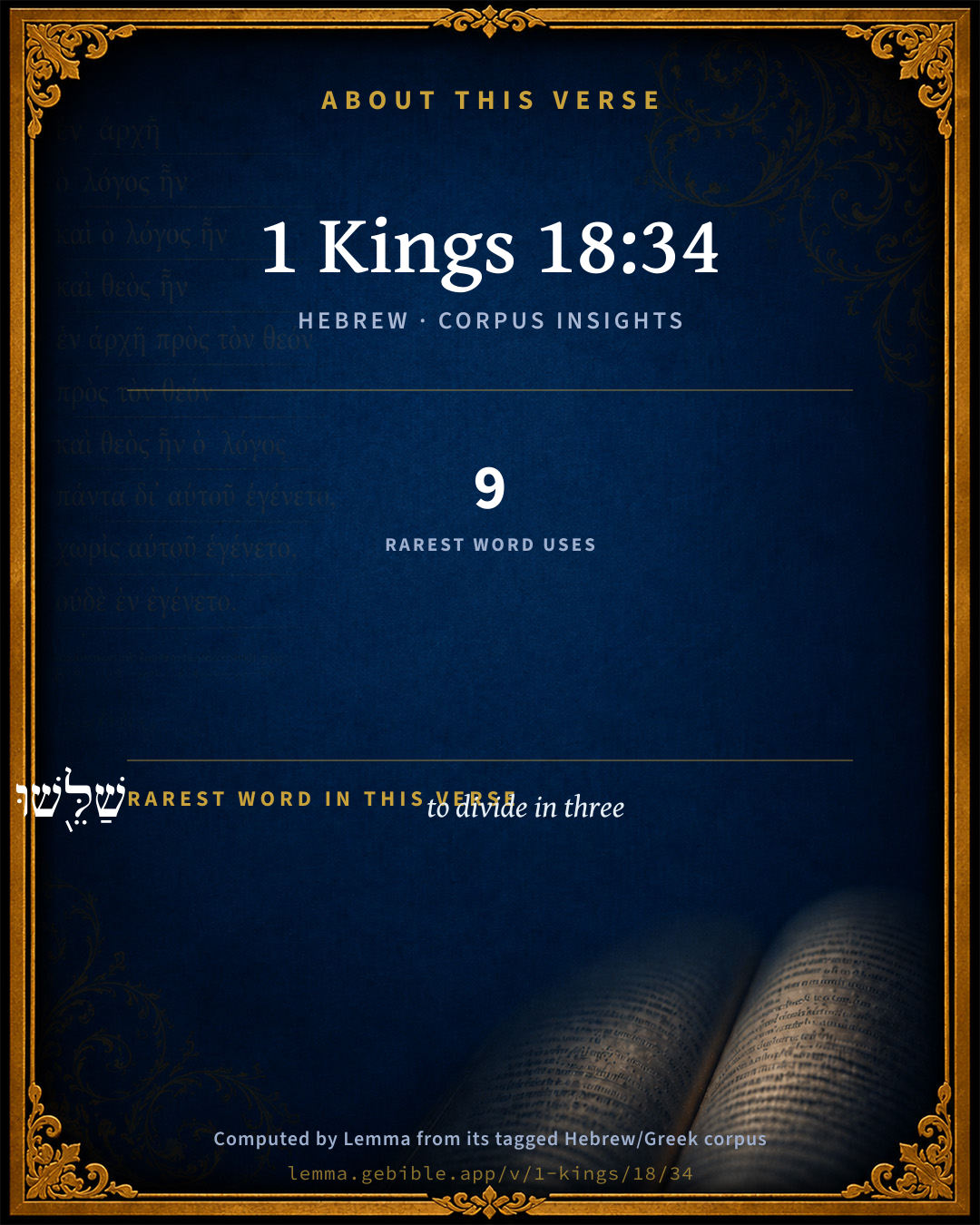
The rarest word here is שַׁלֵּ֖שׁוּ to divide in three H8027 — appearing just 9 times in the whole Hebrew Bible.

Shared distinctive vocabulary

שַׁלֵּ֖שׁוּ to divide in three H8027 occurs in 6 verses of the Hebrew Bible. Also found in:

Grammatical profile

  • 6 verbs

Verb forms

  • וַיֹּ֤אמֶר Qal · Sequential Imperfect
  • שְׁנוּ֙ Qal · Imperative
  • וַיִּשְׁנ֔וּ Qal · Sequential Imperfect
  • וַיֹּ֥אמֶר Qal · Sequential Imperfect
  • שַׁלֵּ֖שׁוּ Piel · Imperative
  • וַיְשַׁלֵּֽשׁוּ Piel · Sequential Imperfect

Repetition

Words recur within this verse — often emphatic in Hebrew:

  • וַיֹּ֤אמֶר to say H559 ×2
  • שְׁנוּ֙ to change H8138 ×2
  • שַׁלֵּ֖שׁוּ to divide in three H8027 ×2

Hebrew & Septuagint length

In English translation the verse runs 28 words from the Hebrew and 30 from the Septuagint (LXX English) — closely comparable.

A rough comparison of the two English renderings, which tokenize alike — not a word-level alignment.

Word counts can differ between the Hebrew and the Greek without any difference in meaning — e.g. the Hebrew direct-object marker אֵת has no separate Greek word, and Greek often adds the article ὁ.

Cross-references

2

Topical passages linked to 1 Kings 18:34 in the Treasury of Scripture Knowledge — connected by theme and wording, ordered by reader-vote popularity; previews shown in the World English Bible.

  • 2 Corinthians 4:2 But we have renounced the hidden things of shame, not walking in craftiness, nor handling the word of God deceitfully; but by the manifestation of the truth commending ourselves to every man's conscience in the sight of God.
  • 2 Corinthians 8:21 Having regard for honorable things, not only in the sight of the Lord, but also in the sight of men.

Cross-references courtesy of OpenBible.info (CC BY 4.0).

Hebrew and Greek witnesses Masoretic Hebrew ↔ Greek Septuagint

The same verse in the two great witnesses to the Old Testament, shown verse-for-verse.

These are two independent witnesses, not word-aligned to each other, and the Septuagint is shown in lemma (dictionary) form.

Hebrew 1 Kings 18:34 Masoretic · Westminster Leningrad Codex

וַיֹּ֤אמֶר שְׁנוּ֙ וַיִּשְׁנ֔וּ וַיֹּ֥אמֶר שַׁלֵּ֖שׁוּ וַיְשַׁלֵּֽשׁוּ

He said, Do it the second time; and they did it the second time. He said, Do it the third time; and they did it the third time.

World English Bible · Public Domain

Greek LXX 1 Kings 18:34 Septuagint · lemma form

καί εἶπον λαμβάνω ἐγώ τέσσαρες ὑδρία ὕδωρ καί ἐπιχέω ἐπί ὁ ὁλοκαύτωμα καί ἐπί ὁ σχίδαξ καί ποιέω οὕτως καί εἶπον δευτερόω καί δευτερόω καί εἶπον τρισσόω καί τρισσεύω

And he said, Do it the second time. And they did it the second time. And he said, Do it the third time. And they did it the third time.

LXX2012 (modern English Septuagint) · Public Domain

Hebrew: Westminster Leningrad Codex (CC BY 4.0). Greek: Septuagint (public domain); English from LXX2012 (modern English Septuagint) (Public Domain). How the Septuagint differs from the Hebrew →

Targum (Aramaic paraphrase)

1

The Targum is the ancient Jewish Aramaic paraphrase of the Hebrew Scriptures — an interpretive translation, not the Hebrew text itself. Onkelos (literal) and Pseudo-Jonathan (expansive) render the Torah, and Jonathan the Prophets. Coverage is partial: where no permissively-licensed English translation exists for a verse, only the Aramaic is shown. This is verse-level text, not a word-by-word alignment to the Hebrew.

  1. Targum Jonathan Prophets (Joshua–Malachi)
    וַאֲמַר מְלוּ אַרְבַּע כַּדִין מַיָא וַאֲרִיקוּ עַל עֲלָתָא וְעַל אָעַיָא וַאֲמַר תְּנוֹ וּתְנוֹ וַאֲמַר תַּלִיתוּ וּתְלִיתוּ:

    (no public-domain English translation for this verse)

    Targum Jonathan — Aramaic: “Mikraot Gedolot” (public domain). English: “Sefaria Community Translation” (CC0 1.0 (public-domain dedication)); “London "Chaldee Paraphrase," 1871” (public domain). Text via Sefaria.

Commentary

Notes on 1 Kings 18:34 from classic Christian and Jewish commentators (each source and its license shown beneath its notes). The classic Christian expositions comment on the surrounding passage and are grouped to its opening verse, so a note may address several verses; the Jewish commentaries on the Tanakh (Rashi and others) are per-verse, so they appear only where the commentator wrote on this verse.

Lemma curates 59 commentaries, every one of them public domain or Creative Commons licensed, each selected and text-cleaned for this edition rather than reprinted as found. About our sources →

Trapp's Complete Commentary

John Trapp

1Ki 18:34 And he said, Do [it] the second time. And they did [it] the second time. And he said, Do [it] the third time. And they did [it] the third time.

Ver. 34. Do it the third time.] The twelve barrels might also point to the same thing as the twelve stones. {1Ki 18:31}

John Trapp, A Commentary or Exposition upon All the Books of the Old and New Testament (1647–1656) — public domain. Text from a community e-Sword module.

John Gill's Exposition

And it came to pass, at the time of the offering of the evening sacrifice,.... Which the people of God at Jerusalem were now attending to:

that Elijah the prophet came near; to the altar he had built, and on which he had laid the sacrifice:

and said; in prayer to God:

Lord God of Abraham, Isaac, and Jacob; the covenant God of the ancestors of his people, though they had now so fully departed from him:

let it be known this day that thou art God in Israel; and that there is no other:

and that I am thy servant; a true worshipper of him, and his faithful prophet and minister:

and that I have done all these things at thy word; restrained rain from the earth for some years past, and now had convened Israel, and the false prophets, together, that by a visible sign from heaven it might be known who was the true God; all which he did not of himself, but by the impulse, direction, and, commandment of the Lord.

John Gill's Exposition of the Whole Bible (1746–1763) — public domain (CC PDM 1.0). Text via the HelloAO Bible API.

Haydock's Catholic Bible Commentary

Time. So that the wood was less disposed to catch fire. (Menochius)

George Leo Haydock (1774–1849), Haydock's Catholic Family Bible and Commentary, 1859 edition — public domain. Excludes Psalms (Douay-Rheims chapter numbering differs from Protestant) and Deuterocanonical books (Catholic canon only).

The Pulpit Commentary

And he said, Do it the second time. And they did it the second time. Heb. Repeat, and they repeated. And he said, Do it the third time. And they did it the third time. (See note on 1Ki_17:21)

The Pulpit Commentary (1880–1919), ed. H.D.M. Spence-Jones & Joseph S. Exell — public domain. Text from a community e-Sword module.

Rashi

Rabbi Shlomo Yitzchaki (Rashi)

Pitchers with water. To make the miracle even greater.

And pour them. Elisha (poured) on his hands, and his fingers became like springs, and the ditch became full. This is the meaning of what is stated, “Here is Elisha the son of Shofot who poured water on Eliyahu’s hands,” and a miracle took place with the water through him, [i.e.,] he is worthy that a miracle should take place with water through him.

Rashi on the Tanakh — English translations: “The Judaica Press complete Tanach with Rashi, translated by A. J. Rosenberg” (CC BY 4.0); “Pentateuch with Rashi's commentary by M. Rosenbaum and A.M. Silbermann, 1929-1934” (public domain); “The Metsudah Tanach series, Lakewood, N.J” (CC BY 4.0); and “The Book of Joshua, Metsudah Publications, 1997” (CC BY 4.0). Text via Sefaria.

Lesson kit

Teaching starters — assembled from the data on this page, not authored interpretation. Every prompt links to the verse data it draws on. Edit before teaching.

1 Kings, in the Historical, opens this verse with 6 words (3 distinct Hebrew lemmas). Its most distinctive word is shâlash (“to divide in three”). A historical commentator’s framing appears above. Read the whole chapter for the surrounding context.

Discussion questions

  1. How does “to divide in three” (shâlash) shape what this verse is saying?
  2. How does Genesis 15:9, which shares the word «to divide in three», read alongside this verse?
  3. What does the repetition of “to say” (2× in this one verse) do in this verse?
  4. These translations render this verse differently. What is at stake in choosing one wording over another?
  5. «וַיֹּ֤אמֶר» is a Qal Sequential Imperfect verb. How does that grammatical form shape the action described?
  6. Compare how Trapp's Complete Commentary and John Gill's Exposition read this verse. Where do they agree or differ?

Things to notice

  • These translations choose different wording for 8 words in this verse.
  • “to say” occurs 2× in this single verse.
  • 3 distinct Hebrew lemmas span 6 words in this verse.

Reading settings

Reading text

Shown beneath each verse's original-language words.

Old Testament
Old Testament edition

Read the OT as the Masoretic Hebrew (MT) or the Greek Septuagint (LXX).

English shown for the Greek Septuagint (in the Hebrew ↔ Greek comparison).

Comparing translations? Open the Compare panel on any verse page to stack up to four side by side.