
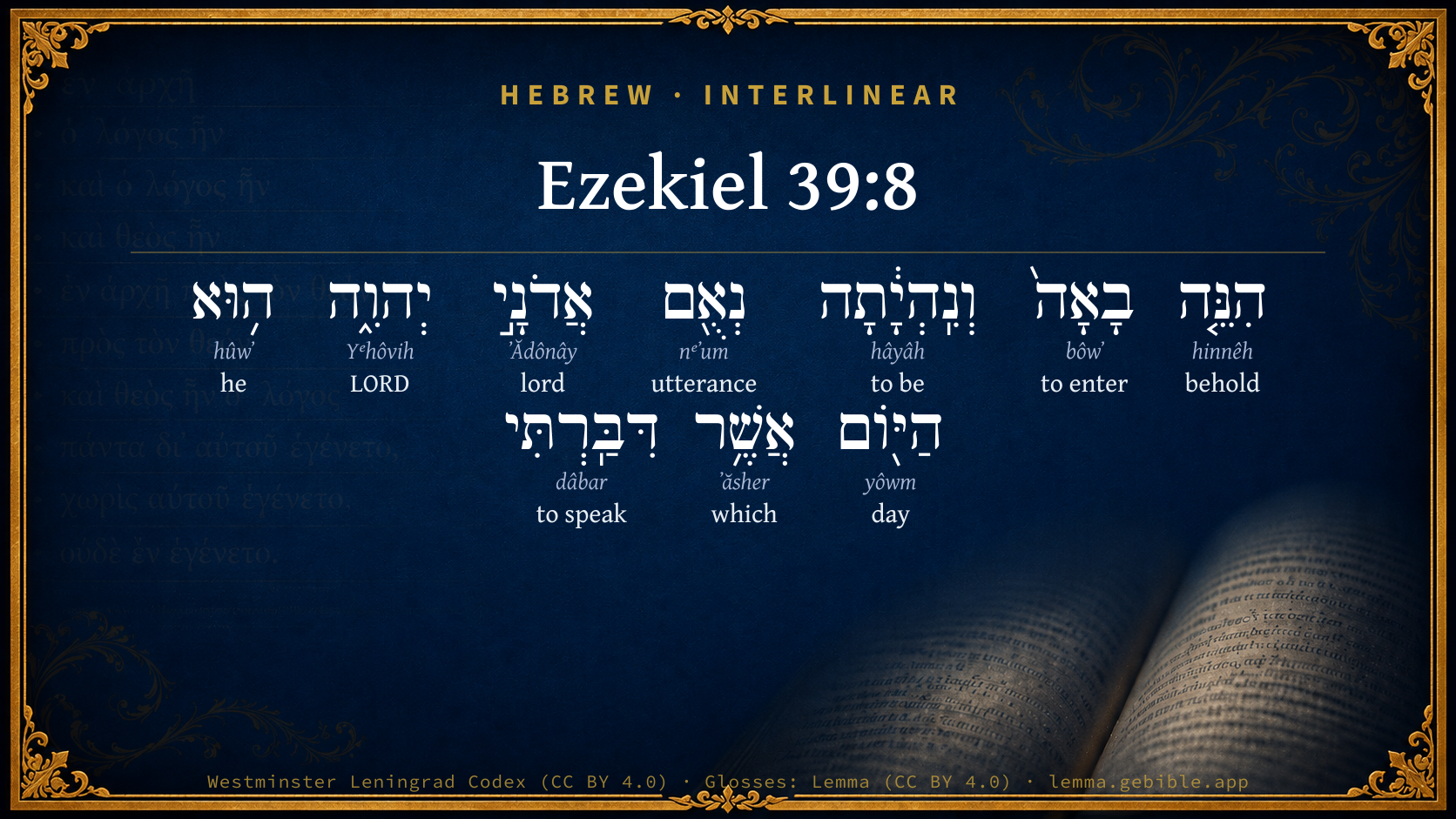
Ezekiel 39:8

Hebrew (Westminster Leningrad Codex) Ezekiel 39:8 appears in the Hebrew Old Testament. The text above is from the Westminster Leningrad Codex. Each word links to its Strong’s number, a concise gloss, and parsing drawn from the Open Scriptures Hebrew Bible morphology. Click any word for its full Brown-Driver-Briggs (BDB) entry.
Download image
Cite this verse

Ezekiel 39:8 (World English Bible). Public Domain. Lemma interlinear Bible study tool, https://lemma.gebible.app/v/ezekiel/39/8.

Show BibTeX & RIS
BibTeX
RIS
English Translation
Behold, it comes, and it shall be done, says the Lord Yahweh; this is the day about which I have spoken.
World English Bible · Public Domain
Download a study sheet

One document with this verse’s original text, its word-by-word gloss line, the meaning frame, cross-references with their text, attributed commentary, and full source and license credits — printable, and it pastes into notes with its structure intact.

This verse Autodidact and up

Study sheet (.html) Plain text (.txt)

A passage Seminary Student

Up to 50 verses in one chapter. A passage sheet keeps up to 6 commentary sources and 12 cross-references per verse, in the order this page ranks them, and says so on the sheet whenever that leaves anything out. Ask for a single verse and you get the Autodidact verse sheet above.

Everything on this page stays free to read, with no account — the sheet is a download of what is already on screen, not access to it.

Want to remove ads? Support Godless Engineer
Compare translations 3

The same verse in 3 English versions, stacked beneath the original-language interlinear above. Click any original word for its lexicon entry.

Each is an independent rendering of the whole verse — the interlinear is not word-aligned to these translations.

Highlighted words mark where these versions differ — a whole-verse word diff, not a word-by-word alignment.

  • World English Bible Public Domain
    Behold, it comes, and it shall be done, says the Lord Yahweh; this is the day about which I have spoken.
  • King James Version Public Domain
    Behold, it is come, and it is done, saith the Lord GOD; this is the day whereof I have spoken.
  • unfoldingWord Literal Text CC BY-SA 4.0
    Behold! The day is coming, and it will take place—this is the Lord Yahweh’s declaration.

unfoldingWord Literal Text — © unfoldingWord, licensed CC BY-SA 4.0. Word-aligned USFM3 via Door43 (git.door43.org/unfoldingWord/en_ult).

Versions to compare (up to 4)

3 of 4 selected

Show all 18 translations

Every available English version of this verse, each an independent rendering of the whole verse.

  • World English Bible Public Domain
    Behold, it comes, and it shall be done, says the Lord Yahweh; this is the day about which I have spoken.
  • Berean Standard Bible Public Domain
    Yes, it is coming, and it will surely happen, declares the Lord GOD. This is the day of which I have spoken.
  • Majority Standard Bible Public Domain
    Yes, it is coming, and it will surely happen, declares the Lord GOD. This is the day of which I have spoken.
  • King James Version Public Domain
    Behold, it is come, and it is done, saith the Lord GOD; this is the day whereof I have spoken.
  • American Standard Version (1901) Public Domain
    Behold, it cometh, and it shall be done, saith the Lord Jehovah; this is the day whereof I have spoken.
  • Revised Version (1885) Public Domain
    Behold, it cometh, and it shall be done, saith the Lord GOD; this is the day whereof I have spoken.
  • Geneva Bible (1599) Public Domain
    Beholde, it is come, and it is done, sayeth the Lord God: and this is the day whereof I haue spoken.
  • Douay-Rheims (1899) Public Domain
    Behold it cometh, and it is done, saith the Lord God: this is the day whereof I have spoken.
  • Young's Literal Translation Public Domain
    Lo, it hath come, and it hath been done, An affirmation of the Lord Jehovah, It `is' the day of which I spake.
  • Literal Standard Version CC BY-SA 4.0
    Behold, it has come, and it has been done, || A declaration of Lord YHWH, || It [is] the day of which I spoke.
  • Unlocked Literal Bible CC BY-SA 4.0
    Behold! The day is coming, and it will take place—this is the Lord Yahweh's declaration.
  • unfoldingWord Literal Text CC BY-SA 4.0
    Behold! The day is coming, and it will take place—this is the Lord Yahweh’s declaration.
  • Darby Bible Public Domain
    Behold, it cometh, and shall be done, saith the Lord Jehovah. This is the day whereof I have spoken.
  • World Messianic Bible Public Domain
    Behold, it comes, and it will be done,” says the Lord GOD. “This is the day about which I have spoken.
  • Webster's Bible Public Domain
    Behold, it is come, and it is done, saith the Lord GOD; this is the day of which I have spoken.
  • Free Bible Version CC BY-SA 4.0
    Yes, it's coming! It will definitely happen, declares the Lord God. This is the day that I have spoken about.
  • Bible in Basic English Public Domain
    See, it is coming and it will be done, says the Lord; this is the day of which I have given word.
  • JPS Tanakh (1917) Public Domain
    Behold, it cometh, and it shall be done, saith the Lord GOD; This is the day whereof I have spoken.

Literal Standard Version (2020), Covenant Press — licensed CC BY-SA 4.0. Text via the HelloAO Bible API (eBible.org). Unlocked Literal Bible (unfoldingWord) — licensed CC BY-SA 4.0. Text via the HelloAO Bible API (eBible.org). unfoldingWord Literal Text — © unfoldingWord, licensed CC BY-SA 4.0. Word-aligned USFM3 via Door43 (git.door43.org/unfoldingWord/en_ult). Free Bible Version, Dr. Jonathan Gallagher — licensed CC BY-SA 4.0. Text via the HelloAO Bible API (eBible.org).

Word by word

More ways to search: Search by grammar → Find every occurrence → Compare this word →

Practice this passage: Drill this verse → Learn its vocabulary →

יְהוִ֑ה
Yᵉhôvih
H3069
“LORD”
Noun, Proper
Part of Speech
Noun
Type
Proper
Full BDB Definition

Origin: a variation of ( H3068 ) [used after ( H136 ), and pronounced by Jews as H430 , in order to prevent the repetition of the same sound, since they elsewhere pronounce 03068 as 0136]

TWOT: None

Jehovah - used primarily in the combination 'Lord Jehovah'
  1. הִנֵּ֤ה hinnêh H2009 “behold” Particle, Demonstrative
  2. בָאָה֙ bôwʼ H935 “entering” Verb, Qal, Participle Active, Feminine, Singular, Absolute
  3. וְנִֽהְיָ֔תָה hâyâh H1961 “and · to be” Conjunction + Verb, Niphal, Sequential Perfect, 3rd Person, Feminine, Singular
  4. נְאֻ֖ם nᵉʼum H5002 “utterance of” Noun, Common, Masculine, Singular, Construct
  5. אֲדֹנָ֣י ʼĂdônây H136 “Lord · my” Noun, Common, Masculine, Plural, Construct + Suffix, Personal, 1st Person, Common, Singular
  6. ה֥וּא hûwʼ H1931 “he” Pronoun, Personal, 3rd Person, Masculine, Singular
  7. הַיּ֖וֹם yôwm H3117 “the · day” Particle, Definite Article + Noun, Common, Masculine, Singular, Absolute
  8. אֲשֶׁ֥ר ʼăsher H834 “which” Particle, Relative
  9. דִּבַּֽרְתִּי dâbar H1696 “to speak” Verb, Piel, Perfect, 1st Person, Common, Singular

About this verse

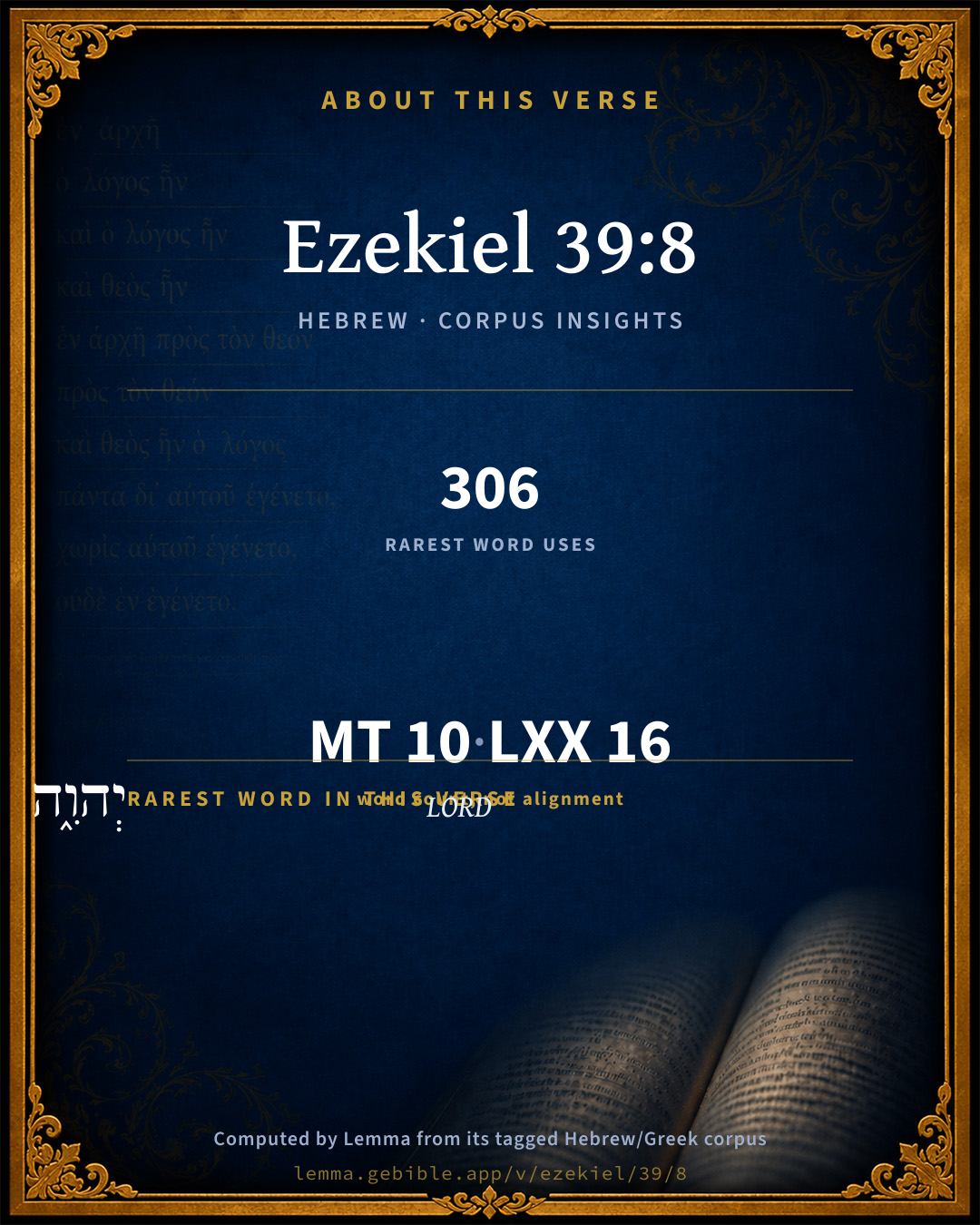
These counts appear in no published source. They are computed here, from the morphology-tagged text and Lemma’s own curated glosses. What Lemma adds →

10
words
10
distinct lemmas
Prophets
section

Grammatical profile

  • 3 verbs
  • 4 nouns
  • 1 pronoun
  • 2 particles

Verb forms

  • בָאָה֙ Qal · Participle Active
  • וְנִֽהְיָ֔תָה Niphal · Sequential Perfect
  • דִּבַּֽרְתִּי Piel · Perfect

Hebrew & Septuagint length

In English translation the verse runs 21 words from the Hebrew and 25 from the Septuagint (LXX English) — closely comparable.

A rough comparison of the two English renderings, which tokenize alike — not a word-level alignment.

Word counts can differ between the Hebrew and the Greek without any difference in meaning — e.g. the Hebrew direct-object marker אֵת has no separate Greek word, and Greek often adds the article ὁ.

In the original languages it is 10 Hebrew tokens and 16 Greek tokens — but the two are counted differently (Hebrew bundles its prefixes and suffixes into one token; the Greek is in lemma form), so that isn’t a like-for-like length.

Cross-references

6

Topical passages linked to Ezekiel 39:8 in the Treasury of Scripture Knowledge — connected by theme and wording, ordered by reader-vote popularity; previews shown in the World English Bible.

  • Ezekiel 38:17 Thus says the Lord Yahweh: Are you he of whom I spoke in old time by my servants the prophets of Israel, who prophesied in those days for [many] years that I would bring you against them?
  • Isaiah 33:10–12 Now will I arise, says Yahweh; now will I lift up myself; now will I be exalted.
  • Ezekiel 7:2–10 You, son of man, thus says the Lord Yahweh to the land of Israel, An end: the end is come on the four corners of the land.
  • 2 Peter 3:8 But don't forget this one thing, beloved, that one day is with the Lord as a thousand years, and a thousand years as one day.
  • Revelation 16:17 The seventh poured out his bowl into the air. A loud voice came forth out of the temple of heaven, from the throne, saying, "It is done!"
  • Revelation 21:6 He said to me, "It is done! I am the Alpha and the Omega, the Beginning and the End. I will give freely to him who is thirsty from the spring of the water of life.

Cross-references courtesy of OpenBible.info (CC BY 4.0).

Hebrew and Greek witnesses Masoretic Hebrew ↔ Greek Septuagint

The same verse in the two great witnesses to the Old Testament, shown verse-for-verse.

These are two independent witnesses, not word-aligned to each other, and the Septuagint is shown in lemma (dictionary) form.

Hebrew Ezekiel 39:8 Masoretic · Westminster Leningrad Codex

הִנֵּ֤ה בָאָה֙ וְנִֽהְיָ֔תָה נְאֻ֖ם אֲדֹנָ֣י יְהוִ֑ה ה֥וּא הַיּ֖וֹם אֲשֶׁ֥ר דִּבַּֽרְתִּי

Behold, it comes, and it shall be done, says the Lord Yahweh; this is the day about which I have spoken.

World English Bible · Public Domain

Greek LXX Ezekiel 39:8 Septuagint · lemma form

ἰδού ἥκω καί γιγνώσκω ὅτι εἰμί λέγω κύριος κύριος οὗτος εἰμί ὁ ἡμέρα ἐν ὅς λαλέω

Behold it is come, and you shall know that it shall be, says the Lord God; this is the day concerning which I have spoken.

LXX2012 (modern English Septuagint) · Public Domain

Hebrew: Westminster Leningrad Codex (CC BY 4.0). Greek: Septuagint (public domain); English from LXX2012 (modern English Septuagint) (Public Domain). How the Septuagint differs from the Hebrew →

Targum (Aramaic paraphrase)

1

The Targum is the ancient Jewish Aramaic paraphrase of the Hebrew Scriptures — an interpretive translation, not the Hebrew text itself. Onkelos (literal) and Pseudo-Jonathan (expansive) render the Torah, and Jonathan the Prophets. Coverage is partial: where no permissively-licensed English translation exists for a verse, only the Aramaic is shown. This is verse-level text, not a word-by-word alignment to the Hebrew.

  1. Targum Jonathan Prophets (Joshua–Malachi)
    הָא אַתְיָא וְתִתְקַיֵם אֲמַר יְיָ אֱלֹהִים הוּא יוֹמָא דִי גְזָרֵית בְּמֵימְרִי:

    (no public-domain English translation for this verse)

    Targum Jonathan — Aramaic: “Mikraot Gedolot” (public domain). English: “Sefaria Community Translation” (CC0 1.0 (public-domain dedication)); “London "Chaldee Paraphrase," 1871” (public domain). Text via Sefaria.

Commentary

Notes on Ezekiel 39:8 from classic Christian and Jewish commentators (each source and its license shown beneath its notes). The classic Christian expositions comment on the surrounding passage and are grouped to its opening verse, so a note may address several verses; the Jewish commentaries on the Tanakh (Rashi and others) are per-verse, so they appear only where the commentator wrote on this verse.

Lemma curates 59 commentaries, every one of them public domain or Creative Commons licensed, each selected and text-cleaned for this edition rather than reprinted as found. About our sources →

Matthew Henry's Commentary

Though this prophecy was to have its accomplishment in the latter days, yet it is here spoken of as if it were already accomplished, because it is certain (Eze 39:8): "Behold it has come, and it is done; it is as sure to be done when the time shall come as if it were done already; this is the day whereof I have long and often spoken, and, though it has been long in coming, yet at length it has come." Thus it was said unto John (Rev 21:6), It is done. To represent the routing of the army of Gog as very great, here are three things specified as the consequences of it. It was God himself that gave the defeat; we do not find that the people of Israel drew a sword or struck a stroke: but,

I. They shall burn their weapons, their bows and arrows, which fell out of their hands (Eze 39:3), their shields and bucklers, their javelins, spears, leading staves, truncheons, and half-pikes, every thing that is combustible. They shall not lay them up in their armouries, nor reserve them for their own use, lest they should be tempted to put a confidence in them, but they shall burn them; not all at once, for a bonfire (to what purpose would be that waste?) but as they had occasion to use them for fuel in their houses, instead of other fire-wood, so that they should have no occasion to take wood out of the field or forests for seven years together (Eze 39:10), such vast quantities of weapons shall there be left upon the open field where the enemy fell, and in the roads which they passed in their flight. The weapons were dry and fitter for fuel than green wood; and, by saving the wood in their coppices and forests, they gave it time to grow. Though the mountains of Israel produce plenty of all good things, yet it becomes the people of Israel to be good husbands of their plenty and to save what they can for the benefit of those that come after them, as Providence shall give them opportunity to do so. We may suppose that when those who dwelt in the cities of Israel came forth to spoil those who spoiled them, and make reprisals upon them, they found upon them silver, and gold, and ornaments; yet no mention is made of any thing particularly that they converted to their own use but the wood of the weapons for fuel, which is one of the necessaries of human life, to teach us to think it enough if we be well supplied with those, though we have but little of the delights and gaieties of it and of those things which we may very well live without. And every time they put fuel to the fire, and warmed themselves at it, they would be put in mind of the number and strength of their enemies, and the imminent peril they were in of falling into their hands, which would help to enlarge their hearts in thankfulness to that God who had so wonderfully, so seasonably, delivered them. As they sat by the fire with their children about them (their fire-side), they might from it take occasion to tell them what great things God had done for them.

II. They shall bury their dead. Usually, after a battle, when many are slain, the enemy desire time to bury their own dead. But here the slaughter shall be so general that there shall not be a sufficient number of the enemies left alive to bury the dead. And, besides, the slain lie so dispersed on the mountains of Israel that it would be a work of time to find them out; and therefore it is left to the house of Israel to bury them as a piece of triumph in their overthrow. 1. A place shall be appointed on purpose for the burying of them, the valley of the passengers, on the east of the sea, either the salt sea or the sea of Tiberias, a valley through which there was great passing and repassing of travellers between Egypt and Chaldea. There shall be such a multitude of dead bodies, putrefying above ground, with such a loathsome stench, that the travellers who go that way shall be forced to stop their noses. See what vile bodies ours are; when the soul has been a little while from them the smell of them becomes offensive, no smell more nauseous or more noxious. There therefore where the greatest number lay slain shall the burying-place be appointed. In the place where the tree falls there let it lie. And it shall be called, The valley of Hamon-gog, that is, of the multitude of Gog; for that was the thing which was in a particular manner to be had in remembrance. How numerous the forces of the enemy were which God defeated and destroyed for the defence of his people Israel! 2. A considerable time shall be spent in burying them, no less than seven months (Eze 39:12), which is a further intimation that the slain of the Lord in this action should be many and that great care should be taken by the house of Israel to leave none unburied, that so they might cleanse the land from the ceremonial pollution it contracted by the lying of so many dead corpses unburied in it, for the prevention of which it was appointed that those who were hanged on a tree should be speedily taken down and buried, Deut, Eze 21:23. This is an intimation that times of eminent deliverances should be times of reformation. The more God has done for the saving of a land from ruin the more the inhabitants should do for the cleansing of the land from sin. 3. Great numbers shall be employed in this work: All the people of the land shall be ready to lend a helping hand to it, Eze 39:13. Note, Every one should contribute the utmost he can in his place towards the cleansing of the land from the pollutions of it, and from every thing that is a reproach to it. Sin is a common enemy, which every man should take up arms against. In publico discrimine unusquisque homo miles est - In the season of public danger every man becomes a soldier. And whoever shall assist in this work it shall be to them a renown; though the office of grave-makers, or common scavengers of the country, seem but mean, yet, when it is for the cleansing and purifying of the land from dead works, it shall be mentioned to their honour. Note, Acts of humanity add much to the renown of God's Israel; it is a credit to religion when those that profess it are ready to every good work; and a good work it is to bury the dead, yea, though they be strangers and enemies to the commonwealth of Israel, for even they shall rise again. It shall be a renown to them in the day when God will be glorified. Note, It is for the glory of God when his Israel do that which adorns their profession; others will see their good works and glorify their Father, Mat 5:16. And when God is honoured he will put honour upon his people. His glory is their renown. 4. Some particular persons shall make it their business to search out the dead bodies, or any part of them that should remain unburied. The people of the land will soon grow weary of burying the pollutions of the country, and therefore they shall appoint men of continual employment, that shall apply themselves to it and do nothing else till the land be thoroughly cleansed; for, otherwise, that which is every one's work would soon become nobody's work. Note, Those that are engaged in public work, especially for the cleansing and reforming of a land, ought to be men of continual employments, men that will stick to what they undertake and go through with it, men that will apply themselves to it; and those that will do good according to their opportunities will find themselves continually employed. 5. Even the passengers shall be ready to give information to those whose business it is to cleanse the land of what public nuisances they meet with, which call for their assistance. Those that pass through the land, though they will not stay to bury the dead themselves, lest they should contract a ceremonial pollution, will yet give notice of those that they find unburied. If they but discover a bone, they will set up a sign, that the buriers may come and bury it, and that, till it is buried, others may take need of touching it, for which reason their sepulchres among the Jews were whitened, that people might keep at a distance from them. Note, When good work is to be done every one should lend a hand to further it, even the passengers themselves, who must not think themselves unconcerned, in a common calamity, or a common iniquity, to put a stop to it. Those whose work it is to cleanse the land must not countenance any thing in it that is defiling; though it were not the body, but only the bone, of a man, that was found unburied, they must encourage those who will give information of it (private information, by a sign, concealing the informer), that they may take it away, and bury it out of sight. Nay, after the end of seven months, which was allowed them for this work, when all is taken away that appeared at first view, they shall search for more, that what is hidden may be brought to light; they shall search out iniquity till they find none. In memory of this they shall give a new name to their city. It shall be called Hamonah - The multitude. O what a multitude of our enemies have we of this city buried! Thus shall they cleanse the land, with all this care, with all this pains, Eze 39:16. Note, After conquering there must be cleansing. Moses appointed those Israelites that had been employed in the war with the Midianites to purify themselves, Num 31:24. Having received special favours from God, let us cleanse ourselves from all filthiness.

III. The birds and beasts of prey shall rest upon the carcases of the slain while they remain unburied and it shall be impossible to prevent them, Eze 39:17, etc. We find a great slaughter represented by this figure, Rev 19:17, etc., which is borrowed from this.

1. There is a general invitation given, Eze 39:17. It is to the fowl of every wing and to every beast of the field, from the greatest to the least, that preys upon carcases, from the eagle to the raven, from the lion to the dog; let them all gather themselves on every side; here is meat enough for them, and they are all welcome. Let them come to God's sacrifice, to his feast; so the margin reads it. Note, The judgments of God, executed upon sin and sinners, are both a sacrifice and a feast, a sacrifice to the justice of God and a feast to the faith and hope of God's people. When God broke the head of leviathan, he gave him to be meat to Israel, Psa 74:14. The righteous shall rejoice as at a feast when he sees the vengeance, and shall wash his foot, as at a feast, in the blood of the wicked. This sacrifice is upon the mountains of Israel; these are the high places, the altars, where God has been dishonoured by the idolatries of the people, but where he will now glorify himself in the destruction of his enemies.

2. There is great preparation made: They shall eat the flesh of the mighty and drink the blood of the princes of the earth, Eze 39:18, Eze 39:19. (1.) It is the flesh and blood of men that they shall be treated with. This has sometimes been an instance of the rebellion of the inferior creatures against man their master, which is an effect of his rebellion against God his Maker. (2.) It is the flesh and blood of great men, here called rams, and bullocks, and great goats, all of them fatlings of Bashan. It is the blood of the princes of the earth that they shall regale themselves with. What a mortification is this to the princes of the blood, as they call themselves, that God can make that blood, that royal blood, which swells their veins, a feast for the birds and beasts of prey! (3.) It is the flesh and blood of wicked men, the enemies of God's church and people, that they are invited to. They had accounted the Israel of God as sheep for the slaughter, and now they shall themselves be so accounted; they had thus used the dead bodies of Gods' servants (Psa 79:2), or would have done, and now it shall come upon themselves.

3. They shall all be fed, they shall all be feasted to the full (Eze 39:19, Eze 39:20): "You shall eat fat, and drink blood, which are satiating surfeiting things. The sacrifice is great and the feast upon the sacrifice is accordingly: You shall be filled at my table." Note, God keeps a table for the inferior creatures; he provides food for all flesh. The eyes of all wait upon him, and he satisfies their desires, for he keeps a plentiful table. And if the birds and beasts shall be filled at God's table, which he has prepared for them, much more shall his children be abundantly satisfied with the goodness of his house, even of his holy temple. They shall be filled with horses and chariots; that is, those who ride in the chariots, mighty men and men of war, who triumphed over nations, are now themselves triumphed over by the ravens of the valley and the young eagles, Pro 30:17. They thought to make an easy prey of God's Israel, and now they are themselves an easy prey to the birds and beasts. See how evil pursues sinners even after death. This exposing of their bodies to be a prey is but a type and sign of those terrors which, after death, shall prey upon their consciences (which the poetical fictions represented by a vulture continually pecking at the heart), and this shame is but an earnest of the everlasting shame and contempt they shall rise to.

IV. This shall redound very much both to the glory of God and to the comfort and satisfaction of his people. 1. It shall be much for the honour of God, for the heathen shall hereby be made to know that he is the Lord (Eze 39:21): All the heathen shall see and observe my judgments that I have executed, and thereby my glory shall be set among them. This principle shall be admitted and established among them more than ever, that the God of Israel is a great and glorious God. He is known to be so even among the heathen, that have not, or read not, his written word, by the judgments which he executes. 2. It shall be much for the satisfaction of his people; for they shall hereby be made to know that he is their God (Eze 39:22): The house of Israel shall know, abundantly to their comfort, that I am the Lord their God from that day and forward. (1.) He will be so from that day and forward. God's present mercies are pledges and assurances of further mercies. If God evidence to us that he is our God he assures us that he will never leave us. This God is our God for ever and ever. (2.) They shall know it with more satisfaction from that day and forward. They had sometimes been ready to question whether the Lord was with them or no; but the events of this day shall silence their doubts, and, the matter being thus settled and made clear, it shall not be doubted of for the future. As boasting in themselves is hereby for ever excluded, so boasting in God is hereby for ever secured.

Matthew Henry's Commentary on the Whole Bible (1708–1710) — public domain (CC PDM 1.0). Text via the HelloAO Bible API.

Trapp's Complete Commentary

John Trapp

Eze 39:8 Behold, it is come, and it is done, saith the Lord GOD; this [is] the day whereof I have spoken.

Ver. 8. Behold, it is come, and it is done.] It is as good as done. So, "Babylon is fallen" - i.e., It will fall certainly, quickly, utterly.

This is the day.] O dieculam illam! O that short time. When shall it once be? O mora! Christe veni. O delay! Christ, come.

John Trapp, A Commentary or Exposition upon All the Books of the Old and New Testament (1647–1656) — public domain. Text from a community e-Sword module.

The Biblical Illustrator

Joseph S. Exell

Eze_39:8

Behold, it is come, and it is done, saith the Lord God; this is the day whereof I have spoken.

Christmas Day

We should search the whole range of Scripture in vain for words more forcibly bringing home to our minds all the great truths upon which the Christian loves to dwell on this our own peculiar and joyful Festival.

I. It is come.

1. Pardon and salvation are come to sinful man: they that have long sat in the darkness of unatoned transgression, have now seen that true light which is given to be the guide of their feet along the paths of pleasantness, into the way of which peace is the beginning, and joy is the end. The message is come, which alone can bind up the broken heart, and speak comfort to the troubled spirit.

2. Reconciliation with the Father is come for all but those who wilfully reject the means that His Son has given.

3. In the coming of the Son of Man upon earth, there is a special blessing come unto us. By His birth, as on this day, into the flesh, we are born again into the Spirit.

II. It is done. The power of the tempter is once and forever subdued, his usurped dominion is done away. Not that in the great event this day before us, the whole scheme of redemption is brought to its full accomplishment: to perfect that scheme, greater things yet must come to pass. Not till the Saviour had died upon the Cross; and descended into the abodes of death; and raised Himself from the silent grave on the third day; and ascended with His reassumed body, to the place which He had ever occupied at the right hand of the Father; and from that high place had sent down the gifts of the promised Spirit for the perfecting of the saints, for the work of the ministry; not till all this had come to pass, was the whole glorious scheme of mans redemption complete in all its full and free loving kindness. Yet may we still, on this beginning of joyful tidings which came to us even now, say with the Prophet in the spirit of joy and thankfulness, It is done. From this event all the rest naturally and connectedly springs. Even among those who saw the promises from afar off, there was a sure word of prophecy; whereunto they did well that they took heed, as unto a light that shineth in a dark place. Ezekiel looked unto the promised redemption as clearly when he said, Behold, it is come, and it is done, saith the Lord God; this is the day of which I have spoken; as when the aged Simeon held the infant Jesus in his arms, and with abundant thankfulness exclaimed, Lord, now lettest Thou, etc. Lessons--

1. He who came unto us as a little child, expects in every true follower of His, that mind of guileless simplicity which is the mind of little children. And then, as newborn babes, we are further to desire the sincere milk of the word, that we may grow thereby.

2. Let us remember, in the midst of all our thankfulness for the great mercy of which this day is the celebration, to have some sobering and self-humbling thoughts. If it is fitting, on the one hand, that our hearts should be filled with joy, as we think upon His love to man, it is no less fitting, on the other hand, that we should remember the sin of man, which brought the Saviour from His throne on high.

3. Let us not think of the newborn King, and yet forget the new commandment which He gave unto us; that commandment was, that we should love one another, and it was a new commandment, because it placed Christian charity on a new and higher footing.

4. With all these glorious sayings, which in the services of this day are brought before us at one view, with all these still sounding in your ears, reflect continually on the great privileges that you enjoy, and the clear light of revelation, in the fulness of which you have your portion. And not only think of these things, but let me beseech you, in the words of St. Paul, that ye walk worthy of the vocation, etc. (H. W. Sulivan, M. A.)

.

The Biblical Illustrator, edited by Joseph S. Exell (c. 1880s–1900s) — public domain. Text from a community e-Sword module.

Joseph Benson's Commentary

Eze 39:8-10. Behold, it is come, it is done, saith the Lord — The time appointed for this great destruction is come, and it is the last and finishing stroke of God’s justice upon the enemies of his church and truth. The prophet here speaks in the rapture of prophecy of this event, determined and fixed in the counsels of God, as already completed: see the margin. They that dwell in the city shall set on fire and burn the weapons — In token of an entire conquest, and that such a lasting peace should ensue that there should be no more need of warlike preparations. Weapons here include all the instruments of war, engines, carriages, wagons, &c. Bishop Lowth observes, on Isa 9:4, that some heathen nations burned heaps of arms to the supposed god of victory, and that among the Romans this act was an emblem of peace. Among God’s people it might show their trust in him as their defender. And they shall burn them with fire seven years — The victory shall be so great, that, during this period of time, they shall suffice for fires on the mountains and in the open fields, where the slain shall fall, and whither the inhabitants of the adjoining cities shall occasionally go forth. Or by seven years we may understand a long time, a certain number being put for an uncertain one. And the meaning may be, There shall be in the country so great a quantity of military weapons, that they shall serve the people a long time for fuel. We should remember that they do not make very large fires in those hot countries. Mariana, in his Spanish History, b. 2. c. 24, relates, that after the victory which the Spaniards gained over the Saracens in 1212, they found so many spears and other warlike weapons of wood, as served them four years for fuel: see Calmet. They shall spoil those that spoiled them — See the margin.

Joseph Benson's Commentary on the Old and New Testaments (1811–1818) — public domain. Text from a community e-Sword module.

F. W. Grant's Numerical Bible

Section 5 (Eze 39:8-16).

Almighty strength: the glory brought to Israel through its exercise.

{Verse 11, ’passers-by.’ This probably refers to some usual route of communication between the country east and that west of the Dead Sea. In view of the use of this same word in vers. 14, 15, it can hardly be applied to the hosts of Gog, as some suggest. The "passers-by" are evidently distinct from the "men of continual employment." May not the reference be, as Kiel suggests, to "travellers who pass through the land?" If so, and they are called upon with those men of special appointment to engage in burying the dead as they pass through the land, instead of going by the usual route of the valley, it being closed (ver. 11), we may see how in this way the knowledge of what God had done to Gog would be carried to distant peoples, for travellers thus made to serve either in burying or setting up signs would naturally inquire concerning the details of this signal event, and spread the news as they travelled. Thus would Israel’s renown and Jehovah’s glory be made known, as v. 13 intimates. -(J. Bloore).

’Hamon-Gog.’ meaning, "multitude of Gog."}

Judgment executed upon proud flesh always leaves its aftermath to which the torch must be applied, or for which the grave must be dug. The collapse of every self-willed fleshly plan leaves that which must be removed or buried out of sight as loathsome and corrupt. Who that has experienced deliverance out of a snare by God’s blight falling upon some cherished plan conceived in the will of the flesh, has not found plenty to burn and bury? Yet it is thus we spoil the spoiler and plunder the plunderer, while the graves of our lust are a memorial, warning by the lessons they teach, but leading the exercised soul to confidence in an ever faithful God, so that after all He is glorified.

The prophet is first assured of the absolute certainty of these events. It is the day of which Jehovah has spoken (Eze 38:18-19), the day referred to in the many prophecies already mentioned. The arms of a stricken foe are usually gathered and preserved as trophies, or if fit for use stored in the arsenals of the victor. Not so here; they are consumed by fire. Might not Israel have future use for all this vast store? Would it not be prudence to preserve it? Why? They who dwelt in peace without walls or gates or bars had not used a weapon to strike the foe! They had not been called to fight, Jehovah had accomplished the overthrow. It was like that of the ancient Assyrian host, the foreshadow of Gog, when the angel of the Lord went forth and smote 185,000, and "behold, they were all dead corpses" (Isa 37:36) . The day for sword and spear had passed. The fires that burned for seven years would witness to this, as also to Israel’s confidence being in Jehovah. For how different a purpose to that of Gog shall then the gathering of the nations to Jerusalem be (Isa 2:1-4).

The land is now cleansed of its defilement through death by the burial of Gog’s multitude. This place of a grave will abide a memorial to posterity; they who pass by will stop there to consider Jehovah’s judgment. Geographically this valley is difficult to locate, though the language suggests the vicinity of the Dead Sea, and also a route of general communication between the land and the east of the sea. That the lesson may not be forgotten the valley shall be called Hamon-Gog, "multitude of Gog," and a city shall bear a name memorializing this judgment.

This burial of the slain shall be for Israel a renown. It will give them a name of fame, of honor, before all nations. They bury the foe, instead of being buried under the weight of Gog’s avalanche. This is so, because it is the day upon which Jehovah is glorified in overcoming their enemies.

F. W. Grant, The Numerical Bible (4th ed., 1903) — public domain. Text from a community e-Sword module.

Geneva Bible (1599)

Geneva Bible translators

That is, this plague is fully determined, in my counsel, and cannot be changed.

Geneva Bible (1599) marginal notes — public domain. Text via Bolls.life.

Jamieson, Fausset & Brown

Robert Jamieson, A. R. Fausset & David Brown

it is come . . . it is done--The prediction of the salvation of My people, and the ruin of their enemy, is come to pass--is done: expressing that the event foretold is as certain as if it were already accomplished.

Jamieson, Fausset & Brown — Commentary Critical and Explanatory on the Whole Bible (1871) — public domain (CC PDM 1.0). Text via the HelloAO Bible API.

The Cambridge Bible for Schools and Colleges

gen. ed. J. J. S. Perowne

8. The words vividly bring into the presence of the speaker the great catastrophe. Rev_16:17; Rev_21:6.

The Cambridge Bible for Schools and Colleges (gen. ed. J. J. S. Perowne; Cambridge University Press, 1878–1918) — public domain. Text from a community e-Sword module.

John Gill's Exposition

Behold, it is come, and it is done, saith the Lord God,.... That is, the salvation of his people, and the destruction of their enemies; the prophecy concerning all this is come to pass, and the whole is accomplished; thus, because of the certainty thereof, it is represented as if the time was actually come, and the thing was really done; for the event is as sure as if it was now fulfilled:

this is the day whereof I have spoken; by the Prophet Ezekiel and others; See Gill on Eze 38:17.

John Gill's Exposition of the Whole Bible (1746–1763) — public domain (CC PDM 1.0). Text via the HelloAO Bible API.

Matthew Poole's English Annotations

It, this prophecy, to be fulfilled in the destruction of Gog, the rescue of God’s people, and magnifying the name of God, is come; as sure as if already come; or, as if already done; nor shall it be too long ere, in effect, and fully, it shall be done.

The day; that notable day of recompences against the last great enemies of Christ and the church.

I have spoken, by Ezekiel now, and by others see Eze 38:17.

Matthew Poole's English Annotations on the Holy Bible (1683–1685) — public domain. Text from a community e-Sword/MySword module.

Whedon's Commentary on the Bible

Daniel D. Whedon

8-10. Though in reality far in the distance (Eze_38:8), Jehovah already sees the day of Gog’s overthrow, when the weapons of his army and hand staves (or, riding sticks, Num_22:27) shall so cover the earth that the villages shall need no other fuel, but “shall make fires of them seven years” (Eze_39:9, R.V., and Eze_39:10). The seven years mentioned — like all the other numbers of Ezekiel — is symbolical. Seven is the holy number of purification, completion, and perfection. (See Introduction, “Symbolism of Ezekiel.”)

Daniel D. Whedon (gen. ed.), Commentary on the Old and New Testaments (1874–1909) — public domain. Text from a community e-Sword module.

The Pulpit Commentary

Behold! it is come. "The words which a man might speak on he-holding his purpose accomplished are, with Ezekiel"s Bold anthropomorphism, put into the mouth of Jehovah" (Plumptre).

HOMILETICS.

God"s purpose accomplished.

The prophet does not dream dreams of idle fancy, build castles in the air, or terrify men with nightmares of unreal judgments. The Word of God comes true. The predicted day arrives, the promised action is performed is come, and it is done.

I IN CREATION. God spake, and it was done. He said, "Let there be light; and light was." The creative word was with power. Men plan great things, but they are quite incompetent to carry the best of them out. The greater the artist is the more he must feel that his execution falls lamentably short of his design. It is not so with God. When he carries out his idea in his work it can be said of each stage of creation, "And God saw that it was good." He is mighty to perform all his will.

II IN REDEMPTION. This new creation was a harder work than the first creation. No human agent could accomplish it, and God"s own arm brought salvation. But though it involved the sacrifice of his Son, he carried out his great design of redeeming the lost world. The dying Jesus exclaimed, "It is finished!" The application of this redemption is not yet complete. The promise concerning this is, "He shall see of the travail of his soul, and shall be satisfied". (Isa_53:11) But St. Peter lookedforward to the grand restitution of all things, when all shall be brought in subjection to Christ. (Act_3:21) We know that he who has begun a good work in us is able to finish it. (Php_1:6)

III IN JUDGMENT. If God accomplishes his designs in creation and redemption, it cannot be supposed that he will fail to carry them out in regard to judgment. Delay is no proof of failure, for the long-promised Messiah was slow to appear, yet in due lime Christ was born. The mercy of God is no sign of the failure of judgment, for God was as merciful when he threatened wrath as he will be when the time comes for executing the threat. The day of judgment, that dreadful "day of the Lord," as the prophets called it, came to the nations and to Israel with fearful calamities. Assuredly it will come, and its work will be done also among all sinners.

IV IN PROVIDENCE. God made great promises to Abraham, and the patriarch did not live to reap their accomplishment. Yet God was true to his word. All the might of Egypt could not frustrate God"s gracious designs. He has great purposes for his people now. Satan may oppose the execution of them; sin, unbelief, and worldliness may rise up against them. Yet God will not desert his own inheritance. Indeed, he does now accomplish his gracious providential designs in spite of all opposition.

V IN OBEDIENCE. There is one region in which the purpose of God is more slow to realize itself. That is the region of human will. There man is free to resist its demands for obedience. God"s kingdom has not yet fully come, his will is not yet done on earth as it is in heaven. But we pray for this glorious consummation. It is our duty to labor to help it on. If God"s design is accomplished in every other respect, it is monstrous for man"s stubborn will to hold out against it. The spirit of the life of Christ I come to do thy will, O God is the spirit which should animate his people.

The Pulpit Commentary (1880–1919), ed. H.D.M. Spence-Jones & Joseph S. Exell — public domain. Text from a community e-Sword module.

John Wesley's Explanatory Notes

It is come - As sure as if already come. The day - That notable day of recompences against the last great enemies of the church.

John Wesley, Explanatory Notes Upon the Whole Bible (1754–1765) — public domain. Text via the GEBible commentary corpus.

Lesson kit

Teaching starters — assembled from the data on this page, not authored interpretation. Every prompt links to the verse data it draws on. Edit before teaching.

Ezekiel, in the Prophets, opens this verse with 10 words (10 distinct Hebrew lemmas). Its most distinctive word is Yᵉhôvih (“LORD”). A historical commentator’s framing appears above. Read the whole chapter for the surrounding context.

Discussion questions

  1. What does “LORD” (Yᵉhôvih) contribute to the verse as a whole?
  2. How does Ezekiel 38:17, which shares this passage’s theme, read alongside this verse?
  3. The translations on this page render this verse differently — a whole-verse word diff, not a word-by-word alignment. What might account for the different wordings?
  4. «בָאָה֙» is a Qal Participle Active verb. How does that grammatical form shape the action described?
  5. Compare how Matthew Henry's Commentary and Trapp's Complete Commentary read this verse. Where do they agree or differ?

Things to notice

Reading settings

Reading text

Shown beneath each verse's original-language words.

Old Testament
Old Testament edition

Read the OT as the Masoretic Hebrew (MT) or the Greek Septuagint (LXX).

English shown for the Greek Septuagint (in the Hebrew ↔ Greek comparison).

Comparing translations? Open the Compare panel on any verse page to stack up to four side by side.