
Ezekiel 28:11

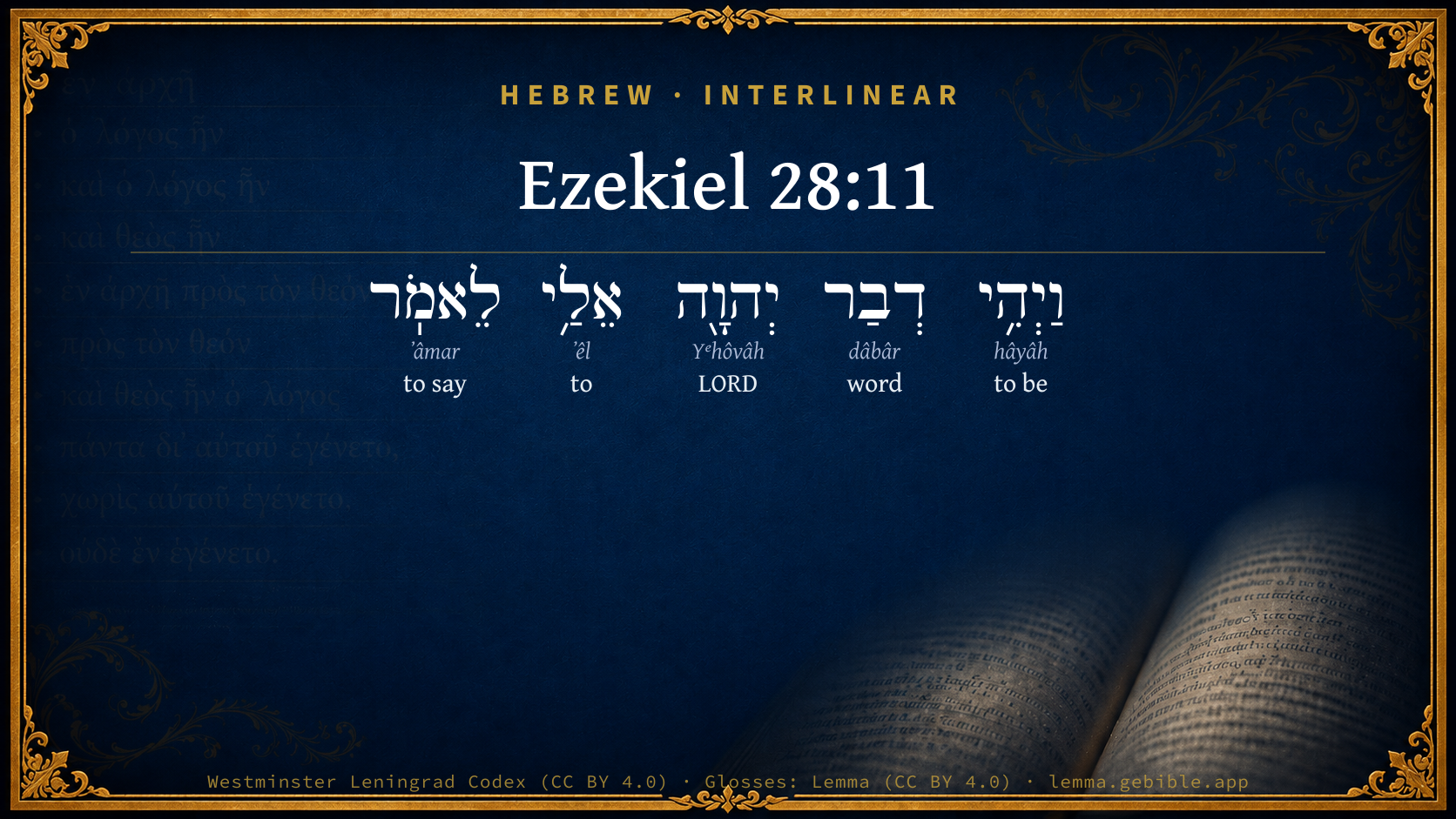
Hebrew (Westminster Leningrad Codex) Ezekiel 28:11 appears in the Hebrew Old Testament. The text above is from the Westminster Leningrad Codex. Each word links to its Strong’s number, a concise gloss, and parsing drawn from the Open Scriptures Hebrew Bible morphology. Click any word for its full Brown-Driver-Briggs (BDB) entry.
Download image
Cite this verse

Ezekiel 28:11 (World English Bible). Public Domain. Lemma interlinear Bible study tool, https://lemma.gebible.app/v/ezekiel/28/11.

Show BibTeX & RIS
BibTeX
RIS
English Translation
Moreover the word of Yahweh came to me, saying,
World English Bible · Public Domain
Download a study sheet

One document with this verse’s original text, its word-by-word gloss line, the meaning frame, cross-references with their text, attributed commentary, and full source and license credits — printable, and it pastes into notes with its structure intact.

This verse Autodidact and up

Study sheet (.html) Plain text (.txt)

A passage Seminary Student

Up to 50 verses in one chapter. A passage sheet keeps up to 6 commentary sources and 12 cross-references per verse, in the order this page ranks them, and says so on the sheet whenever that leaves anything out. Ask for a single verse and you get the Autodidact verse sheet above.

Everything on this page stays free to read, with no account — the sheet is a download of what is already on screen, not access to it.

Want to remove ads? Support Godless Engineer
Compare translations 3

The same verse in 3 English versions, stacked beneath the original-language interlinear above. Click any original word for its lexicon entry.

Each is an independent rendering of the whole verse — the interlinear is not word-aligned to these translations.

Highlighted words mark where these versions differ — a whole-verse word diff, not a word-by-word alignment.

  • World English Bible Public Domain
    Moreover the word of Yahweh came to me, saying,
  • King James Version Public Domain
    Moreover the word of the LORD came unto me, saying,
  • unfoldingWord Literal Text CC BY-SA 4.0
    The word of Yahweh came again to me, saying,

unfoldingWord Literal Text — © unfoldingWord, licensed CC BY-SA 4.0. Word-aligned USFM3 via Door43 (git.door43.org/unfoldingWord/en_ult).

Versions to compare (up to 4)

3 of 4 selected

Show all 18 translations

Every available English version of this verse, each an independent rendering of the whole verse.

  • World English Bible Public Domain
    Moreover the word of Yahweh came to me, saying,
  • Berean Standard Bible Public Domain
    Again the word of the LORD came to me, saying,
  • Majority Standard Bible Public Domain
    Again the word of the LORD came to me, saying,
  • King James Version Public Domain
    Moreover the word of the LORD came unto me, saying,
  • American Standard Version (1901) Public Domain
    Moreover the word of Jehovah came unto me, saying,
  • Revised Version (1885) Public Domain
    Moreover the word of the LORD came unto me, saying,
  • Geneva Bible (1599) Public Domain
    Moreouer the word of the Lord came vnto me, saying,
  • Douay-Rheims (1899) Public Domain
    And the word of the Lord came to me, saying: Son of man, take up a lamentation upon the king of Tyre:
  • Young's Literal Translation Public Domain
    And there is a word of Jehovah unto me, saying:
  • Literal Standard Version CC BY-SA 4.0
    And there is a word of YHWH to me, saying,
  • Unlocked Literal Bible CC BY-SA 4.0
    The word of Yahweh came again to me, saying,
  • unfoldingWord Literal Text CC BY-SA 4.0
    The word of Yahweh came again to me, saying,
  • Darby Bible Public Domain
    And the word of Jehovah came unto me, saying,
  • World Messianic Bible Public Domain
    Moreover the LORD’s word came to me, saying,
  • Webster's Bible Public Domain
    Moreover the word of the LORD came to me, saying,
  • Free Bible Version CC BY-SA 4.0
    Another message from the Lord came to me, saying,
  • Bible in Basic English Public Domain
    Then the word of the Lord came to me, saying,
  • JPS Tanakh (1917) Public Domain
    Moreover the word of the LORD came unto me, saying:

Literal Standard Version (2020), Covenant Press — licensed CC BY-SA 4.0. Text via the HelloAO Bible API (eBible.org). Unlocked Literal Bible (unfoldingWord) — licensed CC BY-SA 4.0. Text via the HelloAO Bible API (eBible.org). unfoldingWord Literal Text — © unfoldingWord, licensed CC BY-SA 4.0. Word-aligned USFM3 via Door43 (git.door43.org/unfoldingWord/en_ult). Free Bible Version, Dr. Jonathan Gallagher — licensed CC BY-SA 4.0. Text via the HelloAO Bible API (eBible.org).

Word by word

More ways to search: Search by grammar → Find every occurrence → Compare this word →

Practice this passage: Drill this verse → Learn its vocabulary →

About this verse

These counts appear in no published source. They are computed here, from the morphology-tagged text and Lemma’s own curated glosses. What Lemma adds →

5
words
5
distinct lemmas
Prophets
section

Grammatical profile

  • 2 verbs
  • 2 nouns
  • 1 preposition

Verb forms

  • וַיְהִ֥י Qal · Sequential Imperfect
  • לֵאמֹֽר Qal · Infinitive Construct

Hebrew & Septuagint length

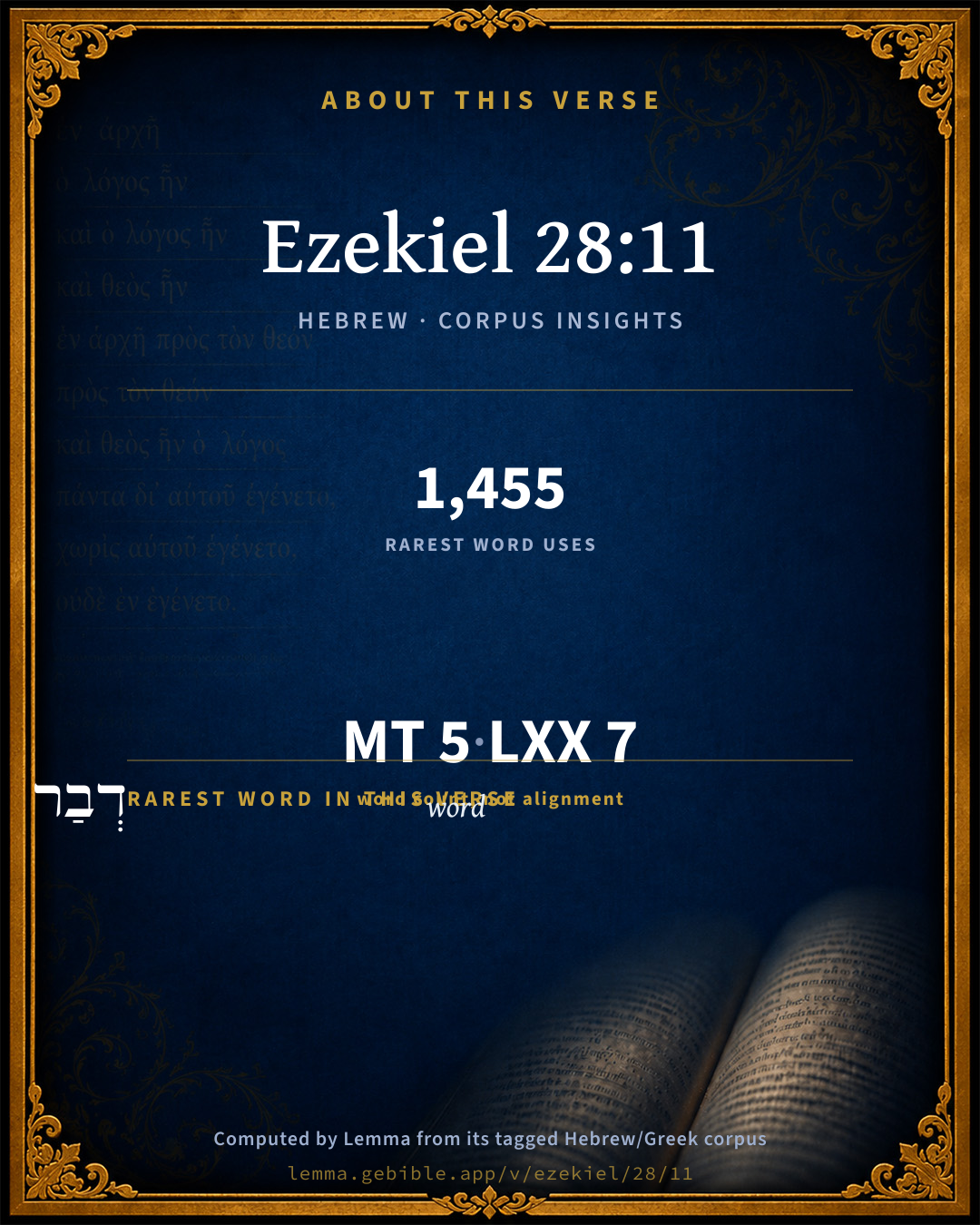
In English translation the verse runs 9 words from the Hebrew and 10 from the Septuagint (LXX English) — closely comparable.

A rough comparison of the two English renderings, which tokenize alike — not a word-level alignment.

Word counts can differ between the Hebrew and the Greek without any difference in meaning — e.g. the Hebrew direct-object marker אֵת has no separate Greek word, and Greek often adds the article ὁ.

In the original languages it is 5 Hebrew tokens and 7 Greek tokens — but the two are counted differently (Hebrew bundles its prefixes and suffixes into one token; the Greek is in lemma form), so that isn’t a like-for-like length.

Hebrew and Greek witnesses Masoretic Hebrew ↔ Greek Septuagint

The same verse in the two great witnesses to the Old Testament, shown verse-for-verse.

These are two independent witnesses, not word-aligned to each other, and the Septuagint is shown in lemma (dictionary) form.

Hebrew Ezekiel 28:11 Masoretic · Westminster Leningrad Codex

וַיְהִ֥י דְבַר יְהוָ֖ה אֵלַ֥י לֵאמֹֽר

Moreover the word of Yahweh came to me, saying,

World English Bible · Public Domain

Greek LXX Ezekiel 28:11 Septuagint · lemma form

καί γίγνομαι λόγος κύριος πρός ἐγώ λέγω

And the word of the Lord came to me, saying,

LXX2012 (modern English Septuagint) · Public Domain

On this verse, Keil & Delitzsch discusses the Septuagint’s reading. Read the note in Commentary ↓

Hebrew: Westminster Leningrad Codex (CC BY 4.0). Greek: Septuagint (public domain); English from LXX2012 (modern English Septuagint) (Public Domain). How the Septuagint differs from the Hebrew →

Targum (Aramaic paraphrase)

1

The Targum is the ancient Jewish Aramaic paraphrase of the Hebrew Scriptures — an interpretive translation, not the Hebrew text itself. Onkelos (literal) and Pseudo-Jonathan (expansive) render the Torah, and Jonathan the Prophets. Coverage is partial: where no permissively-licensed English translation exists for a verse, only the Aramaic is shown. This is verse-level text, not a word-by-word alignment to the Hebrew.

  1. Targum Jonathan Prophets (Joshua–Malachi)
    וַהֲוָה פִּתְגַם נְבוּאָה מִן קֳדָם יְיָ עִמִי לְמֵימָר:

    (no public-domain English translation for this verse)

    Targum Jonathan — Aramaic: “Mikraot Gedolot” (public domain). English: “Sefaria Community Translation” (CC0 1.0 (public-domain dedication)); “London "Chaldee Paraphrase," 1871” (public domain). Text via Sefaria.

Commentary

Notes on Ezekiel 28:11 from classic Christian and Jewish commentators (each source and its license shown beneath its notes). The classic Christian expositions comment on the surrounding passage and are grouped to its opening verse, so a note may address several verses; the Jewish commentaries on the Tanakh (Rashi and others) are per-verse, so they appear only where the commentator wrote on this verse.

Lemma curates 59 commentaries, every one of them public domain or Creative Commons licensed, each selected and text-cleaned for this edition rather than reprinted as found. About our sources →

Trapp's Complete Commentary

John Trapp

Eze 28:11 Moreover the word of the LORD came unto me, saying,

Ver. 11. Moreover the word.] See on Eze 18:1.

John Trapp, A Commentary or Exposition upon All the Books of the Old and New Testament (1647–1656) — public domain. Text from a community e-Sword module.

Keil & Delitzsch

C. F. Keil & F. Delitzsch

Lamentation over the King of Tyre

Eze 28:11. And the word of Jehovah came to me, saying, Eze 28:12. Son of man, raise a lamentation over the king of Tyre, and say to him, Thus saith the Lord Jehovah, Thou seal of a well-measured building, full of wisdom and perfect in beauty. Eze 28:13. In Eden, the garden of God, was thou; all kinds of precious stones were thy covering, cornelian, topaz, and diamond, chrysolite, beryl, and jasper, sapphire, carbuncle, and emerald, and gold: the service of thy timbrels and of thy women was with thee; on the day that thou wast created, they were prepared. Eze 28:14. Thou wast a cherub of anointing, which covered, and I made thee for it; thou wast on a holy mountain of God; thou didst walk in the midst of fiery stones. Eze 28:15. Thou wast innocent in thy ways from the day on which thou wast created, until iniquity was found in thee. Eze 28:16. On account of the multitude of thy commerce, thine inside was filled with wrong, and thou didst sin: I will therefore profane thee away from the mountain of God; and destroy thee, O covering cherub, away from the fiery stones! Eze 28:17. Thy heart has lifted itself up because of thy beauty, thou hast corrupted thy wisdom together with thy splendour: I cast thee to the ground, I give thee up for a spectacle before kings. Eze 28:18. Through the multitude of thy sins in thine unrighteous trade thou hast profaned thy holy places; I therefore cause fire to proceed from the midst of thee, which shall devour thee, and make thee into ashes upon the earth before the eyes of all who see thee. Eze 28:19. All who know thee among the peoples are amazed at thee: thou hast become a terror, and art gone for ever. - The lamentation over the fall of the king of Tyre commences with a picture of the super-terrestrial glory of his position, so as to correspond to his self-deification as depicted in the foregoing word of God. In Eze 28:12 he is addressed as חתם תּכנית. This does not mean, "artistically wrought signet-ring;" for חתם does not stand for חתם , but is a participle of חתם , to seal. There is all the more reason for adhering firmly to this meaning, that the following predicate, מלא חכמה, is altogether inapplicable to a signet-ring, though Hitzig once more scents a corruption of the text in consequence. תּכנית, from תּכן, to weigh, or measure off, does not mean perfection (Ewald), beauty (Ges.), faon (Hitzig), or symmetry (Hvernick); but just as in Eze 43:10, the only other passage in which it occurs, it denotes the measured and well-arranged building of the temple, so here it signifies a well-measured and artistically arranged building, namely, the Tyrian state in its artistic combination of well-measured institutions (Kliefoth). This building is sealed by the prince, inasmuch as he imparts to the state firmness, stability, and long duration, when he possesses the qualities requisite for a ruler. These are mentioned afterwards, namely, "full of wisdom, perfect in beauty." If the prince answers to his position, the wisdom and beauty manifest in the institutions of the state are simply the impress received from the wisdom and beauty of his own mind. The prince of Tyre possessed such a mind, and therefore regarded himself as a God (Eze 28:2). His place of abode, which is described in Eze 28:13 and Eze 28:14, corresponded to his position. Ezekiel here compares the situation of the prince of Tyre with that of the first man in Paradise; and then, in Eze 28:15 and Eze 28:16, draws a comparison between his fall and the fall of Adam. As the first man was placed in the garden of God, in Eden, so also was the prince of Tyre placed in the midst of paradisaical glory. עדן is shown, by the apposition גּן אלהים, to be used as the proper name of Paradise; and this view is not to be upset by the captious objection of Hitzig, that Eden was not the Garden of God, but that this was situated in Eden (Gen 2:8). The fact that Ezekiel calls Paradise גּן־עדן in Eze 36:35, proves nothing more than that the terms Eden and Garden of God do not cover precisely the same ground, inasmuch as the garden of God only occupied one portion of Eden. But notwithstanding this difference, Ezekiel could use the two expressions as synonymous, just as well as Isaiah (Isa 51:3). And even if any one should persist in pressing the difference, it would not follow that בּעדן was corrupt in this passage, as Hitzig fancies, but simply that גן defined the idea of עדן more precisely - in other words, restricted it to the garden of Paradise.

There is, however, another point to be observed in connection with this expression, namely, that the epithet גן אלהים is used here and in Eze 31:8-9; whereas, in other places, Paradise is called גן יהוה (vid., Isa 51:3; Gen 13:10). Ezekiel has chosen Elohim instead of Jehovah, because Paradise is brought into comparison, not on account of the historical significance which it bears to the human race in relation to the plan of salvation, but simply as the most glorious land in all the earthly creation. the prince of Tyre, placed in the pleasant land, was also adorned with the greatest earthly glory. Costly jewels were his coverings, that is to say, they formed the ornaments of his attire. This feature in the pictorial description is taken from the splendour with which Oriental rulers are accustomed to appear, namely, in robes covered with precious stones, pearls, and gold. מסכּה, as a noun ἁπ. λεγ.., signifies a covering. In the enumeration of the precious stones, there is no reference to the breastplate of the high priest. For, in the first place, the order of the stones is a different one here; secondly, there are only nine stones named instead of twelve; and lastly, there would be no intelligible sense in such a reference, so far as we can perceive. Both precious stones and gold are included in the glories of Eden (vid., Gen 2:11-12). For the names of the several stones, see the commentary on Exo 28:17-20. The words 'מלאכת תּפּיך וגו' s - which even the early translators have entirely misunderstood, and which the commentators down to Hitzig and Ewald have made marvellous attempts to explain - present no peculiar difficulty, apart from the plural נקביך, which is only met with here. As the meaning timbrels, tambourins (aduffa), is well established for תּפּים, and in Sa1 10:5 and Isa 5:12 flutes are mentioned along with the timbrels, it has been supposed by some that נקבים must signify flutes here. But there is nothing to support such a rendering either in the Hebrew or in the other Semitic dialects. On the other hand, the meaning pala gemmarum (Vulgate), or ring-casket, has been quite arbitrarily forced upon the word by Jerome, Rosenmller, Gesenius, and many others. We agree with Hvernick in regarding נקבים as a plural of נקבה (foeminae), formed, like a masculine, after the analogy of נשׁים, פּלּגשׁים, etc., and account for the choice of this expression from the allusion to the history of the creation (Gen 1:27). The service (מלאכת, performance, as in Gen 39:11, etc.) of the women is the leading of the circular dances by the odalisks who beat the timbrels: "the harem-pomp of Oriental kings." This was made ready for the king on the day of his creation, i.e., not his birthday, but the day on which he became king, or commenced his reign, when the harem of his predecessor came into his possession with all its accompaniments. Ezekiel calls this the day of his creation, with special reference to the fact that it was God who appointed him king, and with an allusion to the parallel, underlying the whole description, between the position of the prince of Tyre and that of Adam in Paradise.

(Note: In explanation of the fact alluded to, Hvernick has very appropriately called attention to a passage of Athen. (xii. 8, p. 531), in which the following statement occurs with reference to Strato, the Sidonian king: "Strato, with flute-girls, and female harpers and players on the cithara, made preparations for the festivities, and sent for a large number of hetaerae from the Peloponnesus, and many signing-girls from Ionia, and young hetaerae from the whole of Greece, both singers and dancers." See also other passages in Brissonius, de regio Pers. princ. pp. 142-3.)

The next verse (Eze 28:14) is a more difficult one. אתּ is an abbreviation of אתּ, אתּה, as in Num 11:15; Deu 5:24 (see Ewald, 184a). The hap. leg. ממשׁח has been explained in very different ways, but mostly according to the Vulgate rendering, tu Cherub extentus et protegens, as signifying spreading out or extension, in the sense of "with outspread wings" (Gesenius and many others.). But משׁח does not mean either to spread out or to extend. The general meaning of the word is simply to anoint; and judging from משׁחח and משׁחה, portio, Lev 7:35 and Num 18:8, also to measure off, from which the idea of extension cannot possibly be derived. Consequently the meaning "anointing" is the only one that can be established with certainty in the case of the word ממשׁח. So far as the form is concerned, ממשׁח might be in the construct state; but the connection with הסּוכך, anointing, or anointed one, of the covering one, does not yield any admissible sense.

A comparison with Eze 28:16, where כּרוּב הסּוכך occurs again, will show that the ממשׁח, which stands between these two words in the verse before us, must contain a more precise definition of כּרוּב, and therefore is to be connected with כּרוּב in the construct state: cherub of anointing, i.e., anointed cherub. This is the rendering adopted by Kliefoth, the only commentator who has given the true explanation of the verse. ממשׁח is the older form, which has only been retained in a few words, such as מרמס in Isa 10:6, together with the tone-lengthened a (vid., Ewald, 160a). The prince of Tyre is called an anointed cherub, as Ephraem Syrus has observed, because he was a king even though he had not been anointed. הסּוכך is not an abstract noun, either here or in Nah 2:6, but a participle; and this predicate points back to Exo 25:20, "the cherubim covered (סוככים) the capporeth with their wings," and is to be explained accordingly. Consequently the king of Tyre is called a cherub, because, as an anointed king, he covered or overshadowed a sanctuary, like the cherubim upon the ark of the covenant. What this sanctuary was is evident from the remarks already made at Eze 28:2 concerning the divine seat of the king. If the "seat of God," upon which the king of Tyre sat, is to be understood as signifying the state of Tyre, then the sanctuary which he covered or overshadowed as a cherub will also be the Tyrian state, with its holy places and sacred things. In the next clause, וּנתתּיּך is to be taken by itself according to the accents, "and I have made thee (so)," and not to be connected with בּהר קדשׁ. We are precluded from adopting the combination which some propose - viz. "I set thee upon a holy mountain; thou wast a God" - by the incongruity of first of all describing the prince of Tyre as a cherub, and then immediately afterwards as a God, inasmuch as, according to the Biblical view, the cherub, as an angelic being, is simply a creature and not a God; and the fanciful delusion of the prince of Tyre, that he was an El (Eze 28:2), could not furnish the least ground for his being addressed as Elohim by Ezekiel. And still more are we precluded from taking the words in this manner by the declaration contained in Eze 28:16, that Jehovah will cast him out "from the mountain of Elohim," from which we may see that in the present verse also Elohim belongs to har, and that in Eze 28:16, where the mountain of God is mentioned again, the predicate קדשׁ is simply omitted for the sake of brevity, just as ממשׁח is afterwards omitted on the repetition of כּרוּב הסּוכך. The missing but actual object to נתתּיך can easily be supplied from the preceding clause, - namely, this, i.e., an overshadowing cherub, had God made him, by placing him as king in paradisaical glory. The words, "thou wast upon a holy mountain of God," are not to be interpreted in the sense suggested by Isa 14:13, namely, that Ezekiel was thinking of the mountain of the gods (Alborj) met with in Asiatic mythology, because it was there that the cherub had its home, as Hitzig and others suppose; for the Biblical idea of the cherub is entirely different from the heathen notion of the griffin keeping guard over gold. It is true that God placed the cherub as guardian of Paradise, but Paradise was not a mountain of God, nor even a mountainous land. The idea of a holy mountain of God, as being the seat of the king of Tyre, was founded partly upon the natural situation of Tyre itself, built as it was upon one or two rocky islands of the Mediterranean, and partly upon the heathen notion of the sacredness of this island as the seat of the Deity, to which the Tyrians attributed the grandeur of their state. To this we may probably add a reference to Mount Zion, upon which was the sanctuary, where the cherub covered the seat of the presence of God. For although the comparison of the prince of Tyre to a cherub was primarily suggested by the description of his abode as Paradise, the epithet הסּוכך shows that the place of the cherub in the sanctuary was also present to the prophet's mind. At the same time, we must not understand by הר Mount Zion itself. The last clause, "thou didst walk in the midst of (among) fiery stones," is very difficult to explain. It is admitted by nearly all the more recent commentators, that "stones of fire" cannot be taken as equivalent to "every precious stone" (Eze 28:13), both because the precious stones could hardly be called stones of fire on account of their brilliant splendour, and also being covered with precious stones is not walking in the midst of them. Nor can we explain the words, as Hvernick has done, from the account given by Herodotus (II 44) of the two emerald pillars in the temple of Hercules at Tyre, which shone resplendently by night; for pillars shining by night are not stones of fire, and the king of Tyre did not walk in the temple between these pillars. The explanation given by Hofmann and Kliefoth appears to be the correct one, namely, that the stones of fire are to be regarded as a wall of fire (Zac 2:9), which rendered the cherubic king of Tyre unapproachable upon his holy mountain.

In Eze 28:15, the comparison of the prince of Tyre to Adam in Paradise is brought out still more prominently. As Adam was created sinless, so was the prince of Tyre innocent in his conduct in the day of his creation, but only until perverseness was found in him. As Adam forfeited and lost the happiness conferred upon him through his fall, so did the king of Tyre forfeit his glorious position through unrighteousness and sin, and cause God to cast him from his eminence down to the ground. He fell into perverseness in consequence of the abundance of his trade (Eze 28:16). Because his trade lifted him up to wealth and power, his heart was filled with iniquity. מלוּ for מלאוּ, like מלו for מלוא in Eze 41:8, and נשׂוּ for נשׂאוּ in Eze 39:26. תּוכך is not the subject, but the object to מלוּ; and the plural מלוּ, with an indefinite subject, "they filled," is chosen in the place of the passive construction, because in the Hebrew, as in the Aramaean, active combinations are preferred to passive whenever it is possible to adopt them (vid., Ewald, 294b and 128b). מלא is used by Ezekiel in the transitive sense "to fill" (Eze 8:17 and Eze 30:11). תּוך, the midst, is used for the interior in a physical sense, and not in a spiritual one; and the expression is chosen with an evident allusion to the history of the fall. As Adam sinned by eating the forbidden fruit of the tree, so did the king of Tyre sin by filling himself with wickedness in connection with trade (Hvernick and Kliefoth). God would therefore put him away from the mountain of God, and destroy him. חלּל with מן is a pregnant expression: to desecrate away from, i.e., to divest of his glory and thrust away from. ואבּדך is a contracted form for ואאבּדך (vid., Ewald, 232h and 72c). - Eze 28:17 and Eze 28:18 contain a comprehensive description of the guilt of the prince of Tyre, and the approaching judgment is still further depicted. על cannot mean, "on account of thy splendour," for this yields no appropriate thought, inasmuch as it was not the splendour itself which occasioned his overthrow, but the pride which corrupted the wisdom requisite to exalt the might of Tyre, - in other words, tempted the prince to commit iniquity in order to preserve and increase his glory. We therefore follow the lxx, Syr., Ros., and others, in taking על in the sense of una cum, together with. ראוה is an infinitive form, like אהבה for ראות, though Ewald (238e) regards it as so extraordinary that he proposes to alter the text. ראה with ב is used for looking upon a person with malicious pleasure. בּעול רכלּתך shows in what the guilt (עון) consisted (עול is the construct state of עול). The sanctuaries (miqdâshim) which the king of Tyre desecrated by the unrighteousness of his commerce, are not the city or the state of Tyre, but the temples which made Tyre a holy island. These the king desecrated by bringing about their destruction through his own sin. Several of the codices and editions read מקדּשׁך in the singular, and this is the reading adopted by the Chaldee, Syriac, and Vulgate versions. If this were the true reading, the sanctuary referred to would be the holy mountain of God (Eze 28:14 and Eze 28:16). But the reading itself apparently owes its origin simply to this interpretation of the words. In the clause, "I cause fire to issue from the midst of thee," מתּוכך is to be understood in the same sense as תּוכך in Eze 28:16. The iniquity which the king has taken into himself becomes a fire issuing from him, by which he is consumed and burned to ashes. All who know him among the peoples will be astonished at his terrible fall (Eze 28:19, compare Eze 27:36).

If we proceed, in conclusion, to inquire into the fulfilment of these prophecies concerning Tyre and its king, we find the opinions of modern commentators divided. Some, for example Hengstenberg, Hvernick, Drechsler (on Isa 23), and others, assuming that, after a thirteen years' siege, Nebuchadnezzar conquered the strong Island Tyre, and destroyed it; while others - viz. Gesenius, Winer, Hitzig, etc. - deny the conquest by Nebuchadnezzar, or at any rate call it in question; and many of the earlier commentators suppose the prophecy to refer to Old Tyre, which stood upon the mainland. For the history of this dispute, see Hengstenberg, De rebus Tyriorum comment. (Berol. 1832); Hvernick, On Ezekiel, pp. 420ff.; and Movers, Phoenizier, II 1, pp. 427ff. - The denial of the conquest of Insular Tyre by the king of Babylon rests partly on the silence which ancient historians, who mention the siege itself, have maintained as to its result; and partly on the statement contained in Eze 29:17-20. - All that Josephus (Antt. x. 11. 1) is able to quote from the ancient historians on this point is the following: - In the first place, he states, on the authority of the third book of the Chaldean history of Berosus, that when the father of Nebuchadnezzar, on account of his own age and consequent infirmity, had transferred to his son the conduct of the war against the rebellious satrap in Egypt, Coelesyria, and Phoenicia, Nebuchadnezzar defeated him, and brought the whole country once more under his sway. But as the tidings reached him of the death of his father just at the same time, after arranging affairs in Egypt, and giving orders to some of his friends to lead into Babylon the captives taken from among the Judaeans, the Phoenicians, the Syrians, and the Egyptians, together with the heavy armed portion of the army, he himself hastened through the desert to Babylon, with a small number of attendants, to assume that government of the empire. Secondly, he states, on the authority of the Indian and Phoenician histories of Philostratus, that when Ithobal was on the throne, Nebuchadnezzar besieged Tyre for thirteen years. The accounts taken from Berosus are repeated by Josephus in his c. Apion (i. 19), where he also adds (20), in confirmation of their credibility, that there were writings found in the archives of the Phoenicians which tallied with the statement made by Berosus concerning the king of Chaldea (Nebuchadnezzar), viz., "that he conquered all Syria and Phoenicia;" and that Philostratus also agrees with this, since he mentions the siege of Tyre in his histories (μεμνημένος τῆς Τύρου πολιορκίας). In addition to this, for synchronistic purposes, Josephus (c. Ap. i. 21) also communicates a fragment from the Phoenician history, containing not only the account of the thirteen years' siege of Tyre by Nebuchadnezzar in the reign of Ithobal, but also a list of the kings of Tyre who followed Ithobal, down to the time of Cyrus of Persia.

(Note: The passage reads as follows: "In the reign of Ithobal the king, Nebuchadnezzar besieged Tyre for thirteen years. After him judges were appointed. Ecnibalus, the son of Baslachus, judged for two months; Chelbes, the son of Abdaeus, for ten months; Abbarus, the high priest, for three months; Myttonus and Gerastartus, the sons of Abdelemus, for six years; after whom Balatorus reigned for one year. When he died, they sent for and fetched Merbalus from Babylon, and he reigned four years. At his death they sent for his brother Eiramus, who reigned twenty years. During his reign, Cyrus ruled over the Persians.")

The siege of Tyre is therefore mentioned three times by Josephus, on the authority of Phoenician histories; but he never says anything of the conquest and destruction of that city by Nebuchadnezzar. From this circumstance the conclusion has been drawn, that this was all he found there. For if, it is said, the siege had terminated with the conquest of the city, this glorious result of the thirteen years' exertions could hardly have been passed over in silence, inasmuch as in Antt. x. 11. 1 the testimony of foreign historians is quoted to the effect that Nebuchadnezzar was "an active man, and more fortunate than the kings that were before him." But the argument is more plausible than conclusive. If we bear in mind that Berosus simply relates the account of a subjugation and devastation of the whole of Phoenicia, without even mentioning the siege of Tyre, and that it is only in Phoenician writings therefore that the latter is referred to, we cannot by any means conclude, from their silence as to the result or termination of the siege, that it ended gloriously for the Tyrians and with humiliation to Nebuchadnezzar, or that he was obliged to relinquish the attempt without success after the strenuous exertions of thirteen years. On the contrary, considering how all the historians of antiquity show the same anxiety, if not to pass over in silence, such events as were unfavourable to their country, at all events to put them in as favourable to their country, at all events to put them in as favourable a light as possible, the fact that the Tyrian historians observe the deepest silence as to the result of the thirteen years' siege of Tyre would rather force us to the conclusion that it was very humiliating to Tyre. And this could only be the case if Nebuchadnezzar really conquered Tyre at the end of thirteen years. If he had been obliged to relinquish the siege because he found himself unable to conquer so strong a city, the Tyrian historians would most assuredly have related this termination of the thirteen years' strenuous exertions of the great and mighty king of Babylon.

The silence of the Tyrian historians concerning the conquest of Tyre is no proof, therefore, that it did not really take place. But Eze 29:17-20 has also been quoted as containing positive evidence of the failure of the thirteen years' siege; in other words, of the fact that the city was not taken. We read in this passage, that Nebuchadnezzar caused his army to perform hard service against Tyre, and that neither he nor his army received any recompense for it. Jehovah would therefore give him Egypt to spoil and plunder as wages for this work of theirs in the service of Jehovah. Gesenius and Hitzig (on Isa 23) infer from this, that Nebuchadnezzar obtained no recompense for the severe labour of the siege, because he did not succeed in entering the city. But Movers (l.c. p. 448) has already urged in reply to this, that "the passage before us does not imply that the city was not conquered any more than it does the opposite, but simply lays stress upon the fact that it was not plundered. For nothing can be clearer in this connection than that what we are to understand by the wages, which Nebuchadnezzar did not receive, notwithstanding the exertions connected with his many years' siege, is simply the treasures of Tyre;" though Movers is of opinion that the passage contains an intimation that the siege was brought to an end with a certain compromise which satisfied the Tyrians, and infers, from the fact of stress being laid exclusively upon the neglected plundering, that the termination was of such a kind that plundering might easily have taken place, and therefore that Tyre was either actually conquered, but treated mildly from wise considerations, or else submitted to the Chaldeans upon certain terms. But neither of these alternatives can make the least pretension to probability. In Eze 29:20 it is expressly stated that "as wages, for which he (Nebuchadnezzar) has worked, I give him the land of Egypt, because they (Nebuchadnezzar and his army) have done it for me;" in other words, have done the work for me. When, therefore, Jehovah promises to give Egypt to Nebuchadnezzar as a reward or wages for the hard work which has been done for Him at Tyre, the words presuppose that Nebuchadnezzar had really accomplished against Tyre the task entrusted to him by God. But God had committed to him not merely the siege, but also the conquest and destruction of Tyre. Nebuchadnezzar must therefore have executed the commission, though without receiving the expected reward for the labour which he had bestowed; and on that account God would compensate him for his trouble with the treasures of Egypt. This precludes not only the supposition that the siege was terminated, or the city surrendered, on the condition that it should not be plundered, but also the idea that for wise reasons Nebuchadnezzar treated the city leniently after he had taken possession. In either case Nebuchadnezzar would not have executed the will of Jehovah upon Tyre in such a manner as to be able to put in any claim for compensation for the hard work performed. The only thing that could warrant such a claim would be the circumstance, that after conquering Tyre he found no treasures to plunder. And this is the explanation which Jerome has given of the passage ad litteram. "Nebuchadnezzar," he says, "being unable, when besieging Tyre, to bring up his battering-rams, besieging towers, and vineae close to the walls, on account of the city being surrounded by the sea, employed a very large number of men from his army in collecting rocks and piling up mounds of earth, so as to fill up the intervening sea, and make a continuous road to the island at the narrowest part of the strait. And when the Tyrians saw that the task was actually accomplished, and the foundations of the walls were being disturbed by the shocks from the battering-rams, they placed in ships whatever articles of value the nobility possessed in gold, silver, clothing, and household furniture, and transported them to the islands; so that when the city was taken, Nebuchadnezzar found nothing to compensate him for all his labour. And because he had done the will of God in all this, some years after the conquest of Tyre, Egypt was given to him by God."

(Note: Cyrill. Alex. gives the same explanation in his commentary on Isa 23.)

It is true that we have no historical testimony from any other quarter to support this interpretation. But we could not expect it in any of the writings which have come down to us, inasmuch as the Phoenician accounts extracted by Josephus simply contain the fact of the thirteen years' siege, and nothing at all concerning its progress and result. At the same time, there is the greatest probability that this was the case. If Nebuchadnezzar really besieged the city, which was situated upon an island inf the sea, he could not have contented himself with cutting off the supply of drinking water from the city simply on the land side, as Shalmanezer, the king of Assyria, is said to have done (vid., Josephus, Antt. ix. 14. 2), but must have taken steps to fill up the strait between the city and the mainland with a mound, that he might construct a road for besieging and assaulting the walls, as Alexander of Macedonia afterwards did. And the words of Eze 29:18, according to which every head was bald, and the skin rubbed off every shoulder with the severity of the toil, point indisputably to the undertaking of some such works as these. And if the Chaldeans really carried out their operations upon the city in this way, as the siege-works advanced, the Tyrians would not neglect any precaution to defend themselves as far as possible, in the event of the capture of the city. They would certainly send the possessions and treasures of the city by ship into the colonies, and thereby place them in security; just as, according to Curtius, iv. 3, they sent off their families to Carthage, when the city was besieged by Alexander.

This view of the termination of the Chaldean siege of Tyre receives a confirmation of no little weight from the fragment of Menander already given, relating to the succession of rulers in Tyre after the thirteen years' siege by Nebuchadnezzar. It is there stated that after Ithobal, Baal reigned for ten years, that judges (suffetes) were then appointed, nearly all of whom held office for a few months only; that among the last judges there was also a king Balatorus, who reigned for a year; that after this, however, the Tyrians sent to Babylon, and brought thence Merbal, and on his death Hiram, as kings, whose genuine Tyrian names undoubtedly show that they were descendants of the old native royal family. This circumstance proves not only that Tyre became a Chaldean dependency in consequence of the thirteen years' siege by Nebuchadnezzar, but also that the Chaldeans had led away the royal family to Babylonia, which would hardly have been the case if Tyre had submitted to the Chaldeans by a treaty of peace.

If, however, after what has been said, no well-founded doubt can remain as to the conquest of Tyre by Nebuchadnezzar, our prophecy was not so completely fulfilled thereby, that Tyre became a bare rock on which fishermen spread their nets, as is threatened in Eze 26:4-5, Eze 26:14. Even if Nebuchadnezzar destroyed its walls, and laid the city itself in ruins to a considerable extent, he did not totally destroy it, so that it was not restored. On the contrary, two hundred and fifty years afterwards, we find Tyre once more a splendid and powerful royal city, so strongly fortified, that Alexander the Great was not able to take it till after a siege of seven months, carried on with extraordinary exertions on the part of both the fleet and army, the latter attacking from the mainland by means of a mound of earth, which had been thrown up with considerable difficulty (Diod. Sic. xvii. 40ff.; Arrian, Alex. ii. 17ff.; Curtius, iv. 2-4). Even after this catastrophe it rose once more into a distinguished commercial city under the rule of the Seleucidae and afterwards of the Romans, who made it the capital of Phoenicia. It is mentioned as such a city in the New Testament (Mat 15:21; Act 21:3, Act 21:7); and Strabo (xvi. 2. 23) describes it as a busy city with two harbours and very lofty houses. But Tyre never recovered its ancient grandeur. In the first centuries of the Christian era, it is frequently mentioned as an archbishop's see. From a.d. 636 to a.d. 1125 it was under the rule of the Saracens, and was so strongly fortified, that it was not till after a siege of several months' duration that they succeeded in taking it. Benjamin of Tudela, who visited Tyre in the year 1060, describes it as a city of distinguished beauty, with a strongly fortified harbour, and surrounded by walls, and with the best glass and earthenware in the East. "Saladin, the conqueror of Palestine, broke his head against Tyre in the year 1189. But after Acre had been taken by storm in the year 1291 by the Sultan El-Ashraf, on the day following this conquest the city passed withou

Keil & Delitzsch — Biblical Commentary on the Old Testament (1861–1891) — public domain (CC PDM 1.0). Text via the HelloAO Bible API. (Old Testament only.)

Fairbairn on Ezekiel, Jonah & the Pastoral Epistles

Patrick Fairbairn

Eze 28:11. And the word of Jehovah came to me, saying,

Eze 28:12. Son of man, raise a lamentation over the king of Tyre, and say to him, Thus saith the Lord Jehovah, Thou sealest completeness, (Literally, according to the present text and punctuation, which I take to be correct, “Thou art the one sealing exactness.” For חוֹתֵם is the participle, and consequently means obsignans, sealing, the person sealing. Instead of תָּכְנִית, all the ancients appear to have read תָּבְנִית, as they give the sense of similitude or resemblance, and many moderns still prefer this to the received text. But this, of course, necessitates the further change of חוֹתָם for חוֹתֵם, seal for sealing; and is to be rejected as arbitrary. The noun is from הָּכַן, to weigh, to measure exactly, to level, etc.; hence applicable to any thing that is of an exact or perfect nature. In chap, 43:10, the prophet uses it of the complete or perfect pattern he had exhibited of the temple; and here more generally, of what is every way exact or complete. To say of the king of Tyre that he sealed up this, was, in other words, to declare him every way complete: he gave, as it were, the finishing stroke, the seal, to all that constitutes completeness; or, as we would now say it, he was a normal man—one formed after rule and pattern. Hence it is immediately explained by what follows: “full of wisdom and perfect in beauty;” in this stood his sealing completeness. Thus, without any alteration in the text, or even in the punctuation, we get a much more suitable meaning than can be obtained even by conjectural emendations. Take, for example, Hitzig’s: “Thou art a curiously wrought seal-ring,” a seal-ring full of wisdom. No wonder that, with such a commencement, he should have had to resort to many other alterations, and should have held the whole passage to be very corrupt.) full of wisdom, and perfect in beauty.

Eze 28:13. In Eden, the garden of God, thou wast; every precious stone was thy covering, the ruby, the topaz, and the diamond, the chrysolite, the onyx, and the jasper, the sapphire, the carbuncle, and the emerald, and gold; (The representation of the king of Tyre as the normal or perfect man, not unnaturally led the prophet back to the garden of Eden, where the man that really was such had his abode; and so he ironically represents this assumed pattern of perfection as having his local habitation there, in the normal land just as afterwards (Eze 31:8-9; Eze 36:35) the garden of Eden is variously employed by him as the region of ideal beauty and perfection. But occupying such a blessed region, all objects of natural preciousness and beauty of course lay at the king’s command; and as we are told in Genesis (chap. 2.) of the gold and the jewels with which that land originally abounded, so here the prophet speaks of them as forming the very apparel of the king. How much also Oriental monarchs are in the habit of bespangling and almost literally covering themselves with such things, is well known. A notion very early prevailed, that the precious stones here mentioned were those of the high-priest’s breastplate; and on that account, it is supposed, the LXX. translator made up their number to twelve. Even still Ewald and Hitzig think that respect was had to those sacred gems in this enumeration, and the former even regards the mention of them here as connected with an instrument of oracular wisdom and purposes of divination. The idea in any form is entirely gratuitous and out of place. The rendering of the names for the different jewels is what is now generally adopted. We deem it needless to enter into details.) the service of thy tambourines and of thy females were prepared with thee in the day when thou wast created. (Endless changes and arbitrary meanings have been resorted to from the earliest times, to lighten the difficulty of this last clause of Eze 28:13. I adhere to the received text, and the most natural meanings. תֻפִּים has no other signification in Scripture than tambourines, or kettle-drums, an instrument of music in frequent use among the Orientals, and commonly played on by women. נְקָבִים, on the other hand, is never found of a musical instrument, such as pipes, the rendering adopted by our translators and, many others. Indeed, as a plural word it never occurs at all; and the only single word which can be thought of is נְקֵבָה, female. Elsewhere, however, it is used only to denote the female sex, not precisely women; and there is besides the anomaly of a masculine instead of a feminine termination. Yet this is not without a parallel, as appears from such examples as נשים, women, and on the other side, אבות, fathers, the first with a masculine, the other with a feminine termination. I think, therefore, with Hävernick, that the objects denoted here are the musical instruments, tambourines, and the women who played on them; and that this peculiar word נְקֵבָה, female, rather than any other, was used, because of the reference, which the passage bears to Gen 1:27, “Male and female created he them.” Tambourines, and female musicians to play on them, were provided for this king of Tyre on the day of his creation; that is, from the very first, from the period of his being a king, he was surrounded with the customary pleasures, as well as the peculiar treasure, of kings. The royal house of Tyre (for it is of this at large that the discourse must be understood) had not, like many others, to work its way with difficulty and through arduous struggles, but started at once into the full possession of royal power and splendour; no sooner formed than, like Adam, surrounded with fitting attendants and paradisiacal delights. So already Michaelis: “All things poured in around thee which could minister to thy necessities, thy comfort, or even thy pleasure, as they did formerly to Adam in the garden of Eden, which God granted to him.”)

14. Thou art the cherub of anointing (an anointed or consecrated cherub) that overshadows; and I did set thee so; upon the holy mount of God thou wert, and thou didst walk among stones of fire. (Here, again, a great many expedients have been resorted to, both in the way of textual alterations, and extraordinary meanings. The chief verbal difficulty hangs on מִמְשַּׁח, which nowhere else occurs; and the Vulgate rendering of extentus (the LXX. omits it altogether) has led to the supposition that it was derived from some Aramaic root, signifying to extend. But there is no solid ground for this, though it has the authority of Gesenius. The Chaldaic version gives the sense of anointing, taking it as a derivative from מָשַׁח in its usual meaning. And one does not see why there might not be מָשַׁח, anointing, from מָשַׁח, as well as מִמְכָּר, sale, from מָכַר, or מִמְשַׁל, government, from מָשַׁח. Indeed, in this very chapter, in Eze 28:24, we have a verbal adjective formed in precisely the same way, מַמְאִיר from hiphil of מָאַר, bitter or painful, from to make bitter. Cherub of anointing would thus make substantially the same sense as the anointed cherub, כְּרוּב חַמַּשְׁחִית; the cherub that is consecrated to the Lord by the anointing oil. In regard to the next difficulty in the passage, which respects “the holy mountain of God on which he was,” Hävernick says, it would indeed be a wonderful representation, if the prophet described the king of Tyre as having been placed on Mount Sion, and he therefore renders a holy God’s mount, on which he was raised aloft, as a being of a higher nature, as one of those hill-gods, whom the Syrians worshipped (1Ki 20:23). But the holy hill of God can only be understood of a mount which has been consecrated by peculiar manifestations of Godhead therefore, either Mount Sinai, or Mount Sion, which is elsewhere named” the holy hill of God.” And if the king of Tyre could be placed in God’s garden, surely he might also be placed on God’s hill. The objection proceeds on a misapprehension of the nature of the representation. Hävernick is no happier in regard to the next expression, the stones of fire, amid which the king is said to have walked. He considers it to have respect to the worship of the Tyrian Hercules as the fire-god, and to the two pillars in his temple, the one of gold, the other of emerald, which were kept shining by night. But as Hitzig justly remarks, these were not stones, but pillars, and only one of them of stone, and even that not fiery, though resplendent. Besides, what a confusion would it make to throw together in one sentence God’s holy mount and any emblems of fire-worship in the city of Tyre! The reference seems to be to the description in Exodus 24, where Moses and the elders of Israel are said to have gone up to the mount to meet God, and to see “under his feet as it were a paved work of sapphire-stone,” while “the sight of the glory of the Lord was like devouring fire on the top of the mount.” It is just another mode of expressing the peculiar nearness of the King of Tyre to God: he was on God’s holy mount, where he trod, as it were, the very stones that are beneath the feet of God—stones of fire; for all is fire where God has his dwelling.)

15. Perfect wert thou in thy ways from the day of thy creation until iniquity was found in thee.

Eze 28:16. By the greatness of thy traffic they have filled thy midst with violence, and thou hast sinned; and I profane thee from the mount of God (i.e. cast thee from it as a polluted thing), and I destroy thee, thou cherub that overshadowest from the midst of the stones of fire. (This 16th verse also contains several difficulties; at least what have been regarded as such. The clause, “they have filled thy midst with violence,” which beyond all question is the literal rendering of the text, has been thought to give an unsuitable meaning—one applicable rather to the city as a whole than personally to the king—and hence supposed corruptions in the text, and also violent renderings. We refer only to Hävernick’s, who abides by the existing text, but forces it into a meaning strictly applicable to the king; therefore תָּוֶכְ must denote middle in the physical sense of venter, belly, or the body with respect to its middle part; and the plural verb must be explained by a peculiar construction, according to which an active is sometimes substituted in the place of a passive, even where it is not quite suitable; thus the sense is obtained, “they have filled thy body,” for “thou art filled as to thy body, with violence.” It is not sense after all. If it had been lust, or wickedness generally, that was represented as filling him, one could have made something of such an interpretation. And so, indeed, Hävernick shoves in frevei, wickedness, instead of violence, when he comes to give the general import, but without any right to do so. The Vulgate long ago gave substantially the same rendering: in multitudine negotiationis tuæ repleta sunt interiora tua iniquitate. But besides, no example can be produced of תָּוֶךְ ever signifying either the inward parts of a man or his body in general; though used with great frequency, it is always in the sense of midst—the middle of a great city, a people, or such like. Therefore I adopt, as the only natural rendering,” they have filled thy midst with violence;” which undoubtedly has respect to the city, but not, it must be remembered, without at the same time implicating the king. He, as head of the state, is to a certain extent identified with the whole of it; and he is evidently viewed in that light here. For when the prophet says, “by the greatness of thy traffic,” he plainly includes the state along with the king; and when he says further, that through this “his midst was filled with violence,” what does it indicate but that he had not ruled as he should have done, for righteousness? He had become the head of a state that was filled with violence; and so it is immediately added, “and thou hast sinned.” Thou hast not restrained the iniquity that prevails around thee; so far from it, thou art thyself also a transgressor. Thus understood, there is quite a natural meaning, and a regular progression of thought. It is admitted on all hands that the מָלוּ of the received text is for מָלְאוּ (which also stands in many codices), as מָלֵתִי for מָלֵאתִי in Job 32:18. The expression, “and I profane thee from the mount of God,” is quite similar to, “thou hast profaned his crown to the ground,” in Psa 89:39. In both cases it is a pregnant construction, and means that the person was dealt with as no longer sacred but profane, and as such was driven from the position of honour he had hitherto held to a despicable place.)

17. Thy heart hast been lifted up through thy beauty; thou hast corrupted thy wisdom together with thy splendour; I throw thee down to the earth, I lay thee before kings, that they may look upon thee. 18. Through the multitude of thine iniquities, by the dishonesty of thy traffic, thou hast profaned thy sanctuaries; (The sanctuaries which the king of Tyre is charged with having profaned, are to be understood of the sacred places with which the prophet had in the preceding verses associated him, viz. the holy mount of God, and the garden of God. It is his ideal position there, not his actual position in the city of Tyre, that is meant; for the latter could in no proper sense be called his sanctuary, still less, in the plural, his sanctuaries. And the fire, that is presently afterwards represented as going out of his midst and reducing him to ashes—so different as an instrument of destruction from the violent hands of strangers shortly before mentioned—was doubtless suggested by the stones of fire amid which in those ideal sanctuaries he had his abode. So far from finding it a good thing for him to have dwelt there, now that he had sinned, there would proceed thence, as it were, a consuming fire against him; his very elevation, having been abused, carried with it the element of his destruction.) and I make fire to go out from the midst of thee, it shall devour thee, and I will turn thee into ashes upon the earth before all that see thee.

Eze 28:19. All that know thee among the peoples shall be astonished at thee; thou shalt be ruins, and shalt be no more for ever.

It is clear from the very commencement of this singular passage, from the mention made here of the garden of Eden, that the representation contained in it is of an ideal character; that it is, in short, an historical parable. The kings of Tyre are first personified as one individual—an ideal man, and one complete in all natural excellence, perfect manhood. Not unnaturally so, since Tyre having sprung from a barren rock, and grown till she had become the mistress of the world’s commerce, was a kind of new creation in the earth as a state the most singular product in existence of human energy and enterprising skill. Therefore this ideal man, the representative of whatever there was of greatness and glory in Tyre, and in whom, consequently, the Tyrian spirit of self-elation and pride appear in full efflorescence, is ironically viewed by the prophet as the type of humanity in its highest states of existence upon earth. All that is best and noblest in the history of the past he sees, in imagination, meeting in this so-called beau-ideal of humanity. It was he who in primeval time trod the hallowed walks of paradise, and used at will its manifold treasures, and regaled himself with its corporeal delights. It was he who afterwards assumed the form of a cherub—ideal compound of the highest kinds of animal existence—type of humanity in its predestined state of ultimate completeness and glory; and as such, had a place assigned him among the consecrated symbols of God’s sanctuary in the holy mount, where, in the immediate presence of the Most High, he overshadowed the mercy-seat. Thus occupying the highest spheres of created life, and familiar even with the sight of the Divine glory, he knew what it was to dwell amidst the consuming fire, and to walk as on burning stones of sapphire. Whatever humanity has had, or has been typified to have, of dignity and honour in the past history of God’s administration, it has been thine to possess. So thou thinkest, thou ideal man, thou concentration of human excellence, thou quintessence of human greatness and pride. Thou thinkest that manhood’s divinest qualities, and most honourable conditions of being, belong peculiarly to thyself, since thou dost nobly peer above all and standest alone in thy glory. Let it be so. But thou art still a man, and, like humanity itself in its most favoured conditions, thou hast not been perfect before God, thou hast yielded thyself a servant to corruption. With creaturely waywardness and inconstancy thou hast gone astray on thy high places, and hast abused to the gratification of thine own lust and vanity the ample gifts and resources which should have been all employed in subservience to the will and glory of God. Therefore thou must be cast down from thy proud elevation; thou must lose thy cherubic nearness to God; the sacred and blissful haunts which thou hast defiled with thy abominations shall no longer know thee; and thou shalt henceforth be a monument to all of forfeited honours, abused privileges, and hopeless ruin.

Such we take to be the style and import of this vision. It is one of the most highly figurative representations in prophecy, and is only to be compared with Isaiah’s lamentation (in Isa 14:1.) over the downfall of the king of Babylon. It characteristically differs from this, however, in that while it moves with equal boldness and freedom in an ideal world, it clothes the ideal according to the usage of our prophet in an historical drapery, and beholds the past revived again in the personified existence of which it treats. But it is no wild play of fancy, or arbitrary indulgence of a lawless imagination. A sublime moral runs through the parable. It reads over again the great lesson of man’s weakness and degeneracy, and shows how inevitably the good, when unaccompanied by a really Divine element, turns in him to corruption and ruin. In the royal head of the state of Tyre a new trial was made of humanity with the greatest earthly advantages, he being endowed with the amplest resources of wealth and art, and placed on the loftiest pinnacle of the world’s wisdom and prosperity. But all in vain. The good only served, as in other cases, to feed the well-spring of human depravity; and the day of retribution could not fail to come with its recompenses of evil, and God’s justice be as conspicuously displayed in the overthrow of Tyre as his goodness had been in her singular rise and prosperity. So that the cry which the prophet would utter through this parabolical history in the ears of all is, that man in his best estate—with everything that art or nature can bring to his aid—is still corruption and vanity. The flesh can win nothing for itself that is really and permanently good. It carries in its bosom a principle of self-destruction, and the more that it can surround itself with the comforts and luxuries of life, the more does it pamper the godless pride of nature, and draw down upon itself calamity and destruction. Therefore “let not the wise man glory in his wisdom, neither let the mighty man glory in his might; let not the rich man glory in his riches; but let him that glorieth glory in this, that he understandeth and knoweth me, that I am the Lord which exercises loving-kindness, judgment, and righteousness in the earth; for in these things I delight, saith the Lord.”

Patrick Fairbairn — An Exposition of Ezekiel (1851), Jonah (1849), and The Pastoral Epistles (1874) — public domain. Text from a community e-Sword module.

Matthew Henry's Commentary

As after the prediction of the ruin of Tyre (ch. 26) followed a pathetic lamentation for it (ch. 27), so after the ruin of the king of Tyre is foretold it is bewailed.

I. This is commonly understood of the prince who then reigned over Tyre, spoken to, Eze 28:2. His name was Ethbaal, or Ithobalus, as Diodorus Siculus calls him that was king of Tyre when Nebuchadnezzar destroyed it. He was, it seems, upon all external accounts an accomplished man, very great and famous; but his iniquity was his ruin. Many expositors have suggested that besides the literal sense of this lamentation there is an allegory in it, and that it is an allusion to the fall of the angels that sinned, who undid themselves by their pride. And (as is usual in texts that have a mystical meaning) some passages here refer primarily to the king of Tyre, as that of his merchandises, others to the angels, as that of being in the holy mountain of God. But, if there be any thing mystical in it (as perhaps there may), I shall rather refer it to the fall of Adam, which seems to be glanced at, Eze 28:13. Thou hast been in Eden the garden of God, and that in the day thou wast created.

II. Some think that by the king of Tyre is meant the whole royal family, this including also the foregoing kings, and looking as far back as Hiram, king of Tyre. The then governor is called prince (Eze 28:2); but he that is here lamented is called king. The court of Tyre with its kings had for many ages been famous; but sin ruins it. Now we may observe two things here: -

1. What was the renown of the king of Tyre. He is here spoken of as having lived in great splendour, Eze 28:12-15. He as a man, but it is here owned that he was a very considerable man and one that made a mighty figure in his day. (1.) He far exceeded other men. Hiram and other kings of Tyre had done so in their time; and the reigning king perhaps had not come short of any of them: Thou sealest up the sum full of wisdom and perfect in beauty. But the powers of human nature and the prosperity of human life seemed in him to be at the highest pitch. He was looked upon to be as wise as the reason of men could make him, and as happy as the wealth of this world and the enjoyment of it could make him; in him you might see the utmost that both could do; and therefore seal up the sum, for nothing can be added; he is a complete man, perfect in suo genere - in his kind. (2.) He seemed to be as wise and happy as Adam in innocency (Eze 28:13): "Thou hast been in Eden, even in the garden of God; thou hast lived as it were in paradise all thy days, hast had a full enjoyment of every thing that is good for food or pleasant to the eyes, and an uncontroverted dominion over all about thee, as Adam had." One instance of the magnificence of the king of Tyre is, that he outdid all others princes in jewels, which those have the greatest plenty of that trade most abroad, as he did: Every precious stone was his covering. There is a great variety of precious stones; but he had of every sort and in such plenty that besides what were treasured up in his cabinet, and were the ornaments of his crown, he had his clothes trimmed with them; they were his covering. Nay (Eze 28:14), he walked up and down in the midst of the stones of fire, that is, these precious stones, which glittered and sparkled like fire. His rooms were in a manner set round with jewels, so that he walked in the midst of them, and then fancied himself as glorious as if, like God, he had been surrounded by so many angels, who are compared to a flame of fire. And, if he be such an admirer of precious stones as to think them as bright as angels, no wonder that he is such an admirer of himself as to think himself as great as God. Nine several sorts of previous stones are here named, which were all in the high priest's ephod. Perhaps they are particularly named because he, in his pride, used to speak particularly of them, and tell those about him, with a great deal of foolish pleasure, "This is such a precious stone, of such a value, and so and so are its virtues." Thus is he upbraided with his vanity. Gold is mentioned last, as far inferior in value to those precious stones; and he used to speak of it accordingly. Another thing that made him think his palace a paradise was the curious music he had, the tabrets and pipes, hand-instruments and wind-instruments. The workmanship of these was extraordinary, and they were prepared for him on purpose; prepared in thee, the pronoun is feminine - in thee, O Tyre! or it denotes that the king was effeminate in doting on such things. They were prepared in the day he was created, that is, either born, or created king; they were made on purpose to celebrate the joys either of his birthday or of his coronation-day. These he prided himself much in, and would have all that came to see his palace take notice of them. (3.) He looked like an incarnate angel (Eze 28:14): Thou art the anointed cherub that covers or protects; that is, he looked upon himself as a guardian angel to his people, so bright, so strong, so faithful, appointed to this office and qualified for it. Anointed kings should be to their subjects as anointed cherubim, that cover them with the wings of their power; and, when they are such, God will own them. Their advancement was from him: I have set thee so. Some think, because mention was made of Eden, that it refers to the cherub set on the east of Eden to cover it, Gen 3:24. He thought himself as able to guard his city from all invaders as that angel was for his charge. Or it may refer to the cherubim in the most holy place, whose wings covered the ark; he thought himself as bright as one of them. (4.) He appeared in as much splendour as the high priest when he was clothed with his garments for glory and beauty: "Thou wast upon the holy mountain of God, as president of the temple built on that holy mountain; thou didst look as great, and with as much majesty and authority, as ever the high priest did when he walked in the temple, which was garnished with precious stones (Ch2 3:6), and had his habit on, which had precious stones both in the breast and on the shoulders; in that he seemed to walk in the midst of the stones of fire." Thus glorious is the king of Tyre; at least he thinks himself so.

2. Let us now see what was the ruin of the king of Tyre, what it was that stained his glory and laid all this honour in the dust (Eze 28:15): "Thou wast perfect in thy ways; thou didst prosper in all thy affairs and every thing went well with thee; thou hadst not only a clear, but a bright reputation, from the day thou wast created, the day of thy accession to the throne, till iniquity was found in thee; and that spoiled all." This may perhaps allude to the deplorable case of the angels that fell, and of our first parents, both of whom were perfect in their ways till iniquity was found in them. And when iniquity was once found in him it increased; he grew worse and worse, as appears (Eze 28:18): "Thou hast defiled thy sanctuaries; thou hast lost the benefit of all that which thou thoughtest sacred, and in which, as in a sanctuary, thou thoughtest to take refuge; these thou hast defiled, and so exposed thyself by the multitude of thy iniquities." Now observe,

(1.) What the iniquity was that was the ruin of the king of Tyre. [1.] The iniquity of his traffic (so it is called, Eze 28:18), both his and his people's, for their sin is charged upon him, because he connived at it and set them a bad example (Eze 28:16):By the multitude of thy merchandise they have filled the midst of thee with violence, and thus thou hast sinned. The king had so much to do with his merchandise, and was so wholly intent upon the gains of that, that he took no care to do justice, to give redress to those that suffered wrong and to protect them from violence; nay, in the multiplicity of business, wrong was done to many by oversight; and in his dealings he made use of his power to invade the rights of those he dealt with. Note, Those that have much to do in the world are in great danger of doing much amiss; and it is hard to deal with many without violence to some. Trades are called mysteries; but too many make them mysteries of iniquity. [2.] His pride and vain-glory (Eze 28:17): "Thy heart was lifted up because of thy beauty; thou wast in love with thyself, and thy own shadow. And thus thou hast corrupted thy wisdom by reason of the brightness, the pomp and splendour, wherein thou livedst." He gazed so much upon this that it dazzled his eyes and prevented him from seeing his way. He appeared so puffed up with his greatness that it bereaved him both of his wisdom and of the reputation of it. He really became a fool in glorying. Those make a bad bargain for themselves that part with their wisdom for the gratifying of their gaiety, and, to please a vain humour, lose a real excellency.

(2.) What the ruin was that this iniquity brought him to. [1.] He was thrown out of his dignity and dislodged from his palace, which he took to be his paradise and temple (Eze 28:16): I will cast thee as profane out of the mountain of God. His kingly power was high as a mountain, setting him above others; it was a mountain of God, for the powers that be are ordained of God, and have something in them that is sacred; but, having abused his power, he is reckoned profane, and is therefore deposed and expelled. He disgraces the crown he wears, and so has forfeited it, and shall be destroyed from the midst of the stones of fire, the precious stones with which his palace was garnished, as the temple was; and they shall be no protection to him. [2.] He was exposed to contempt and disgrace, and trampled upon by his neighbours: "I will cast thee to the ground (Eze 28:17), will cast thee among the pavement-stones, from the midst of the precious stones, and will lay thee a rueful spectacle before kings, that they may behold thee and take warning by thee not to be proud and oppressive." [3.] He was quite consumed, his city and he in it: I will bring forth a fire from the midst of thee. The conquerors, when they have plundered the city, will kindle a fire in the heart of it, which shall lay it, and the palace particularly, in ashes. Or it may be taken more generally for the fire of God's judgments, which shall devour both prince and people, and bring all the glory of both to ashes upon the earth; and this fire shall be brought forth from the midst of thee. All God's judgments upon sinners take rise from themselves; they are devoured by a fire of their own kindling. [4.] He was hereby made a terrible example of divine vengeance. Thus he is reduced in the sight of all those that behold him (Eze 28:18): Those that know him shall be astonished at him, and shall wonder how one that stood so high could be brought so low. The king of Tyre's palace, like the temple at Jerusalem, when it is destroyed shall be an astonishment and a hissing, Ch2 7:20, Ch2 7:21. So fell the king of Tyre.

Matthew Henry's Commentary on the Whole Bible (1708–1710) — public domain (CC PDM 1.0). Text via the HelloAO Bible API.

John Gill's Exposition

Moreover the word of the Lord came unto me,.... After the prophecy concerning the ruin of the prince of Tyre, the word of the Lord came to the prophet, ordering him to take up a lamentation on the king of Tyre:

saying; as follows:

John Gill's Exposition of the Whole Bible (1746–1763) — public domain (CC PDM 1.0). Text via the HelloAO Bible API.

Albert Barnes' Notes on the Bible

The dirge of the prince of Tyre, answering to the dirge of the state. The passage is ironical; its main purpose is to depict all the glory, real or assumed, of “the prince of Tyrus,” in order to show how deplorable should be his ruin.

Eze 28:12

To “seal the sum” is to make up the whole measure of perfection. Compare the Septuagint

Eze 28:13

Thou hast been in Eden - “Thou” wast etc. The prince of Tyrus is ironically described as the first of creation; but at the same time the parallel is to be maintained in his fall from glory. Like Adam in the enjoyment of paradise, he shall be like Adam in his fall.

Every precious stone - All the stones here named are found in the High priest’s breastplate Exo 28:17-20, but their order is different, and three stones named in Exodus (the third row) are wanting. The prophet may purposely have varied the description because the number twelve (that of the tribes of Israel) had nothing to do with the prince of Tyrus, and he wished to portray, not a high priest, but a king, having in view a figure which was to a Jew, especially to a priest, the very type of magnificence.

Tabrets - (or, drums) and “pipes” were a common expression for festivity and triumph.

Eze 28:14

Thou art - Better,” Thou” wert. “the anointed cherub that covereth” In the temple the cherubim and all holy things were consecrated and anointed with oil (Exo 30:26 ff). The prince of Tyre was also anointed as a sovereign priest - covering or protecting the minor states, like the cherubim with outstretched wings covering the mercy-Seat.

Thou wast upon the holy mountain - As the cherub was in the temple on the holy mountain, so the prince of Tyre was presiding over the island-city, rising like a mountain from the deep.

Stones of fire - i. e., bright and shining. Decked with bright jewels, the prince walked among jewels in gorgeous splendor.

Eze 28:15

The “perfection” was false, unsuspected until the “iniquity” which lay beneath was found out.

Albert Barnes' Notes on the Bible (1834–1885) — public domain. Text from a community e-Sword/MySword module.

The Pulpit Commentary

Vers. 11-19. The glory and shame of Eden reproduced.

There is no reason why we should not regard the biblical narrative of Adam"s trial and fall as fact and as allegory also. There is no real discrepancy between these two principles of interpretation. We are bound to accept it as a narrative of historical fact. Yet it is also an outline picture of every man"s history. In each man"s case there is the Edenic period of innocence, there is the crisis of first temptation, there is the fall, and then the banishment from Edenic joy. The circumstances of the first probation are more clearly and vividly reproduced in the case of a young prince than in any other. Hence the application to the King of Tyre.

I THE KING CONSIDERED AS THE IDEAL MAN. Adam was placed in Eden as a monarch. He was placed in dominion over all creatures in earth, or air, or sea. This gave him a great "coin of vantage." In this respect he was made after the pattern of God he was God-like. All that ministered to his needs was within his reach. Not a thing was denied to him that could meet a want or satisfy a just desire. His home was stored with every form of beauteous vegetation and with every kind of precious gem.

And he was priest as well as king. He had access to God at all times. In him creation was summed up. In a similar position was the King of Tyrus placed. All material good was within his reach. There was no temptation to acquire wealth by unlawful means. Tyre and its possessions were to him as a garden, over which he could roam at large, He stood towards men in the stead of God the dispenser of truth and justice. He was gifted with robust health and with abundant wisdom. He had all that heart could wish. He was placed in an Eden of abundance Eden, the garden of God." Like Adam, he was on his trial.

II THE TEMPTATION. To every man temptation comes. If his heart be not set upon the acquisition of spiritual riches wisdom, holiness, and love he will desire inordinately the lower good, and will break through lawful restraints in order to possess it. This is the core and essence of temptation. In this way the King of Tyre was tested. He was set up by God to exemplify righteousness, and to administer justice among the people. Nor among his own subjects only, but from his high position "the mountain of God he could have disseminated righteous principles among all the nations with whom Tyre traded. Yet in this respect the king egregiously failed. His love of gain was too great was excessive. It overmastered his love of righteousness. What advantage he could not gain by fair and legitimate methods he extorted by violence. This is clear from Ver. 16, "By the multitude of thy merchandise they have filled the midst of thee with violence." If the king personally was not the prime instigator of these deeds, he connived at them through unprincipled or corrupt judges. His prosperity and glory made him vain and arrogant. Temptation came to pluck the forbidden fruit, and the king weakly yielded.

III THE CRIME. The crime was selfishness, covetousness, avarice. This favored and fortunate man was placed in the possession of abundance. There was one thing he might not do. He might not rob others to enrich himself. The possessions of the foreigner ought to have been as much respected and protected as his own. But the devil whispered in his ear counsels of unrighteous enrichment, and he listened, wavered, succumbed. "Iniquity was found in thee." "Thou hast corrupted thy wisdom;" i.e. thou hast twisted it into cunning and craftiness. "Thou hast defiled thy sanctuaries by the multitude of thine iniquities, by the iniquity of thy traffic." He had imagined that no higher power than himself would supervise his deeds. "God is not observant of such things," said his wily tempter. "Thou shalt not surely die." This was his crime. His very brightness his prosperity brought him into scenes of new temptation.

He might have blessed mankind; but he was set on selfish ends. He was in indecent haste to aggrandize self. He trampled on others" rights, on law and order, that he might swell his self-importance. He chafed against the idea that he, a king, was only a subject to a higher scepter. He would brook no interference with his proud will. This was his crime.

IV THE RAVISHMENT. "I will cast thee as profane out of the mountain of God.... I will cast thee to the ground, I will lay thee before kings, that they may behold thee." The exclusion from Eden is here repeated. The changes of fortune through which Adam passed, every one, in a measure, passes through also. "I will bring forth a fire from the midst of thee." No heavier punishment can be passed upon a man than banishment from God"s favor. Where God is, there is safety; where God is not, there is ruin. Where God is, there is heaven; where he is not, there is hell. To be forsaken of God this is despair and woe. God departed from Saul, and straightway he began to descend the slippery plane that landed him in destruction. Appearances are very delusive. The eye is easily deceived. Beneath a fair exterior of prosperity there is often incipient decay, yea, corruption hastening to final ruin. "Pride goeth before a fall." If we have made God our foe, not all the alliances and intrigues in the universe can save us from destruction. D.

Vers. 11-19. The insufficiency of circumstance, etc.

However we may interpret this imaginative passage (see Exposition), there are certain truths which are not only clear, but even brilliant to our sight as we regard it.

I THE INSUFFICIENCY OF FAVORABLE CIRCUMSTANCE. The Prince of Tyro was under such fortunate and enviable conditions that he is drawn by the prophet as a man who dwelt in the garden of Eden, in a perfect paradise; as one clothed with garments that shone with all precious stones; as one who was admitted, like the cherubim of the most holy place, to the very near presence of God; as one that stood, with the illustrious leader of Israel, on the sacred mount, and that saw, with him, the splendor of the Divine manifestation (Vers. 13, 14). Nothing was wanting that the craving heart of man could desire; he "sealed up the sum," or he "sealed completeness" (Fairbairn) (Ver. 12). He was "perfect in his ways" (Ver. 15); i.e. not perfect in the ways of wisdom and worth, but of pleasure and honor and privilege. He lacked nothing that would lend beauty or grandeur or delight to human life. But what availed it all without righteousness? No barrier of rocky walls or of surrounding sea would keep out the enemy when unrighteousness had bred corruption (Ver. 15), and corruption had ended in weakness and downfall. No wealth of favoring circumstance, no multiplication of earthly good, even though a man should have (as this king is imagined to have) the choicest advantages of different generations, will secure lasting good; that is only to be gained by righteousness, by a strong and virtuous character, by steadfast piety.

II THE PERIL OF GREAT EXALTATION. "He that is down need fear no fall;" but he that is exalted may suffer a terrible humiliation he may be cast out (or down) from the mountain on which he stood (Vers. 16, 17); he, the overshadowing cherub, may be ejected from the holy place, from the innermost chamber of sacred privilege, and be cast forth among the unholy (Ver. 16). Let those who are exalted beware, for there is an abasement possible to them of which the unprivileged have no need to be afraid. And they have no other security than in a humble heart, an obedient spirit, a life of integrity and devotion.

III THE PENALTY OF PROFANATION. Tyre had "corrupted its wisdom" (Ver. 17); had "profaned its sanctuaries" (Ver. 18). Its traffic should have been, as it might have been, carried on in honesty and equity; but it had been depraved, it had become lawless and dishonest; its streets, that should have been the highways of peaceful industry and happy fellowship, had became the places of violence and iniquity (Vers. 18 and 16). That which was intended for the practice and illustration of virtue and excellence had become the scene and source of wrong and guilt. Therefore the righteous Judge would "profane" it (Ver. 16; Fairbairn), would "cast it out as profane" (Authorized Version); the fires of retribution would devour it (Ver. 18); its sad and shameful end would excite the awe and even the terror of the beholder (Ver. 19). Profanation means penalty. If we do wrong to that human spirit of ours which comes to us from God, and in which we may closely resemble him; if we defile that human body in which the Son of God himself was once clothed, and which should be the very sanctuary or temple of the Divine; if we profane that human life of ours which should be so sacred in our sight and may be so charged with blessing and crowned with fruitfulness and beauty; then may we expect the severe condemnation and the serious visitation of the righteous Ruler of mankind. We have then "sinned "(Ver. 16); "iniquity is found" in us (Ver. 15). And there will come the wages of sin, the brand of iniquity loss, sorrow, shame, death. But to the penitent there is reconciliation and return; for though "the wages of sin is death," yet "the gift of God is eternal life. C.

Vers. 11-19. Man in impressive aspects.

the word of the Lord came unto me, saying, Son of man, take up a lamentation upon the King of Tyrus," etc. This lamentation for the Prince of Tyre presents considerable difficulties to the expositor. It has been interpreted from various points of view, which we need not discuss here. Different meanings also have been assigned to many of its clauses. Two things of great importance to a correct understanding of it, however, seem to us quite clear.

1. That in the King of Tyre here we have the representation of an ideal person, who stands for the Tyrian monarchy. "The kings of Type," says Fairbairn, "are personified as one individual, an ideal man one complete in all material excellence, perfect manhood.

2. That a deep vein of irony runs through the description of the perfections and splendors of this ideal prince. "This ideal man, the representative of whatever there was of greatness and glory in Type, and in whom the Tyrian spirit of self-elation and pride appears in full efflorescence, is ironically viewed by the prophet as the type of humanity in its highest states of existence upon earth. All that is best and noblest in the history of the past he sees in imagination meeting in this new beau-ideal of humanity." This irony implies that the Prince of Tyre had a very exaggerated sense of his own greatness and glory; otherwise it would be pointless anti inapt. This paragraph presents to us man in three impressive aspects.

I MAN IN A MOST EXALTED CONDITION AND MOST FELICITOUS CIRCUMSTANCES. (Vers. 12-15.)

1. Here is a most exalted condition. This condition is variously described. "Thou sealest up the sum" (Ver. 12). "To seal means to seal up and close that which is complete (cf. Dan_9:24; Job_9:7) To seal the sum is to make up the whole measure of perfection." The King of Tyre is said to be "full of wisdom: In our homily on the foregoing paragraph we noticed that he boasted of his wisdom (cf. Vers. 3-5). He was probably praised and flattered because of it. With truth Greenhill observes, "When princes know a little in anything, they are applauded and. magnified for knowing men; but if they have got some deeper insight into things than others, then they are deified." This king is also represented as "perfect in beauty:" In form and features, in expression and action, he deemed himself perfect. Or the Tyrians regarded their monarchy as perfect in its order and power and splendor. "Thou wast perfect in all thy ways from the day that thou wast created" (Ver. 15).

2. Here are most felicitous circumstances. (Vers. 13, 14.)

(1) Delightful residence. "Thou wast in Eden, the garden of God." The reference is probably to the luxuriousness and beauty and grandeur of Tyre. The king had lived there in the full enjoyment of its countless comforts and its various pleasures, realizing as it were a paradisiacal existence.

(2) Royal splendors. "Every precious stone was thy covering, the sardius, the topaz, and the diamond" etc. "The precious stones with which the king is bedecked bring the glory of his rank to outward view." He had jewels in great abundance, and rich variety, and of rare luster and beauty. Full many a gem of purest ray serene" glittered upon his person. Music is mentioned as another element of the royal state and glory. "The workmanship of thy tabrets and of thy pipes was in thee; in the day that thou wast created they were prepared." The accession of the king to the throne was celebrated with musical honors and rejoicings. Or perhaps the clause means that the Tyrian monarchy was thus inaugurated. In either case, music was one of the delights of the royal court of Tyre.

(3) Illustrious station (Ver. 14). "Thou wast the anointed cherub that covereth." The cherub was an ideal combination of creature life in highest forms and fullest perfection; and the cherubs in the temple were consecrated and anointed with oil. (Exo_40:9) And as a king the Prince of Tyre was anointed, and was looked up to, or looked upon himself, as the embodiment of perfection. Moreover, as the cherubim with outstretched wings covered the mercy-seat, so the King of Tyre covered his people with his protection. The prophet goes on to say, "Thou wast upon the holy mountain of God," which the "Speaker"s Commentary" explains thus: "The cherub was in the temple on the holy mountain, so the Prince of Tyre was presiding over the island-city, rising like a mountain from the deep." But "the holy mountain of God" may be simply a figure denoting a very exalted station. The prophet continues: "Thou hast walked up and down in the midst of the stones of fire." Various and conflicting are the interpretations of this clause. It probably means that his state apartments were decorated with precious stones like those mentioned in Ver. 13, (cf. Eze_1:27) and that he walked in the midst of their glittering splendor. Here, then, notwithstanding that the exact meaning of some parts of the text is uncertain, we have a picture of a man in very exalted condition and very felicitous circumstances.

II MAN IN A MOST EXALTED CONDITION AND MOST FELICITOUS CIRCUMSTANCES FALLING INTO HEINOUS SINS, (Vers. 16-18.) Unrighteousness was found in this exalted prince. Two forms of sin in particular are charged against him.

1. Injustice in commerce. "By the multitude of thy traffic they filled the midst of thee with violence, and thou hast sinned.... By the multitude of thine iniquities, in the unrighteousness of thy traffic, thou hast profaned thy sanctuaries." Great traffic occasions great temptation. When men are devoted to merchandise, their path is beset by moral perils. They will be tempted to achieve commercial success by unworthy or unrighteous means means which the unsophisticated conscience condemns as sinful, butwhich the commercial world allows and practices under plausible names. "The constant excitement of selfishness and covetousness connected with trade can only be effectually counteracted by the grace of God." "They that desire to be rich fall into a temptation and a snare," etc.. (1Ti_6:9, 1Ti_6:10)

2. Pride of person and position. "Thine heart was lifted up because of thy beauty, thou hast corrupted thy wisdom by reason of thy brightness." The pride of this prince has already met with deserved rebuke. "Thine heart is lifted up because of thy riches" (Ver. 5); "Thine heart is lifted up, and thou hast said, I am a god, I sit in the seat of God, in the midst of the seas" (Ver. 2). Secular prosperity often begets pride, and pride (as in the case of the King of Tyre) corrupts wisdom. Hengstenberg observes truly, "The foundation of wisdom is humility, which sees things as they are, has an open eye for its own weakness and the excellences of others, and is on its guard against dangerous undertakings, as David says in Psa_131:1, "O Lord, my heart is not haughty," etc. The "brightness" received into the heart blinds the eye, so that one regards himself alone as great, and everything else as small, and rushes wantonly into dangers for which he is not prepared, and enters on paths which lead to perdition; as, for example, Tyre undertook the combat against the flourishing Chaldea monarchy. God does not need to appear as a Deus ex machined in the judgment upon the proud, who wantonly brings himself to ruin.

III MAN IN EXALTED CONDITION AND FELICITOUS CIRCUMSTANCES, HAVING FALLEN INTO HEINOUS SINS, VISITED WITH SEVERE PUNISHMENT. Three features of the punishment of the proud Prince of Tyro are exhibited by the prophet.

1. His forcible removal from his exalted condition and felicitous circumstances. "Therefore have I cast thee as profane out of the mountain of God; and I have destroyed thee, O covering cherub, from the midst of the stones of fire." He had gloried in his wealth and power and grandeur, and he should be deprived of them all.

2. His open degradation. "I have cast thee to the ground, I have laid thee before kings, that they may behold thee." "Formerly," says Hengstenberg, "in its brightness a spectacle of wonder and envy for kings, Tyro is now become for them a spectacle of astonishment and spiteful joy in its terrible downfall". (cf. Eze_27:36) This was the appropriate punishment of excessive pride. The punishment corresponded with the sin. "When pride cometh, then cometh shame: but with the lowly is wisdom". (Pro_11:2 Pro_16:18 Pro_18:12)

3. His utter destruction. "Therefore have I brought forth a fire from the midst of thee, it hath devoured thee, and I have turned thee to ashes upon the earth in the sight of all them that behold thee." The fire signifies the wrath of God in the punishment of sin; and the effect of that wrath would be the complete destruction of the Tyrian monarchy. Here is an important fact. The destructive fire springs out of the midst of that which is to be destroyed. "All God"s judgments upon sinners take rise from themselves; they are devoured by a fire of their own kindling." "The fire of lust and covetous desire draws after it the other fire of judgment.

CONCLUSION. Several important lessons are enforced by this subject. We mention three of them.

1. The unsatisfactoriness of temporal prosperity when dissociated from righteous principles and intelligent piety.

2. The peculiar moral perils of successful traders, whether as communities or individuals.

3. The necessity of resisting the earliest risings of pride. W.J.

The Pulpit Commentary (1880–1919), ed. H.D.M. Spence-Jones & Joseph S. Exell — public domain. Text from a community e-Sword module.

Kretzmann's Popular Commentary

Paul E. Kretzmann

Lamentation over the King of Tyre

v. 11. Moreover, the word of the Lord, of Jehovah, the Lord of the covenant, came unto me, saying,

v. 12. Son of man, take up a lamentation, raising a mournful song, upon the king of Tyrus and say unto him, Thus saith the Lord God, Thou sealest up the sum, literally, "Thou sealer-up of the measure of perfection. " full of wisdom and perfect in beauty. The prince of Tyre had erected the building of Tyre’s wealth and beauty in perfection of symmetry and exactness of detail and, as it were, placed his seal upon the finished product, which was certainly wonderful in the eyes of men.

v. 13. Thou hast been in Eden, the garden of God, the outward aspect of Tyre being that of ideal loveliness, of the greatest earthly advantages, as a garden of God; every precious stone was thy covering, all possible magnificence was exhibited in the adornment of the city and particularly of the king’s person, the sardius, topaz, and the diamond, the beryl, or chrysolite, the onyx and the jasper, the sapphire, the emerald, or the chrysoprase, and the carbuncle, stones of varying degrees of hardness and of the most beautiful colors, and gold, for it was this metal in which the precious stones were set; the workmanship of thy tabrets and of thy pipes was prepared in thee in the day that thou wast created, literally, "the service of thy kettledrums and of thy women was ready for thee on the day of thy creation," that is, the prince of Tyre was born to the luxury of music and costly amusements, or he entered upon them on the day of his accession, he was accustomed to them from his earliest days.

v. 14. Thou art the anointed cherub that covereth, because he, as an anointed king, had the duty of protecting a nation of people, like a sanctuary in God’s care; and I have set thee so; thou wast upon the holy mountain of God, for he was God’s representative in governing the Tyrian state; thou hast walked up and down in the midst of the stones of fire, which, like a fiery wall erected by God, protected the king in his office. Note that the pictures throughout are taken from the true Temple-worship and from the functions of kings of Judah, with which Ezekiel was familiar.

v. 15. Thou wast perfect in thy ways, and therefore, in outer civic righteousness, acceptable to the Lord, from the day that thou wast created, which most likely means the day of his accession to the throne, till iniquity was found in thee, namely, when he made himself unworthy of his position on account of rebelliousness and perverseness.

v. 16. By the multitude of thy merchandise, that is, on account of the fact that the commerce of Tyre gave the state great power among the nations, they have filled the midst of thee with violence, the unrighteous mammon held in the city having this influence upon those in power, that it caused them to violate the rights of the poor and needy, and thou hast sinned, the prince with his people; therefore I will cast thee as profane out of the mountain of God, deposing him from his position as leader of the people; and I will destroy thee, O covering cherub, from the midst of the stones of fire. Cf v. 14.

v. 17. Thine heart was lifted up, in blasphemous self-elation, because of thy beauty, of which the ruler of Tyre was so inordinately proud, thou hast corrupted thy wisdom by reason of thy brightness, thinking that Tyre’s splendor would serve as an excuse for every form of sin and guilt; I will cast thee to the ground, dashing him to utter destruction, I will lay thee before kings that they may behold thee, as an example of God’s wrath upon such as are lifted up in sinful pride.

v. 18. Thou hast defiled thy sanctuaries, the special holy privileges which are given by the Lord to governments, by the multitude of thine iniquities, by the iniquity, the deep corruptness, of thy traffic; therefore will I bring forth a fire from the midst of thee, the prince’s iniquity itself becoming such a consuming fire; it shall devour thee, and I will bring thee to ashes upon the earth, thus completely consumed, in the sight of all them that behold thee, the surrounding nations being witnesses of Tyre’s complete overthrow.

v. 19. All they that know thee among the people, being acquainted with Tyre’s former position and wealth, shall be astonished at thee; thou shalt be a terror, an object of horror to others, and never shalt thou be any more. This prophecy, together with the entire cycle of prophecies, was fulfilled partly in the days of Nebuchadnezzar, but still more completely at the time of Alexander the Great. If rightly interpreted and on the basis of all available data, secular history invariably supports the historical descriptions given in the Bible.

Paul E. Kretzmann, Popular Commentary of the Bible (1921–1924) — public domain. Text from a community e-Sword module.

unfoldingWord translationNotes

Door43 World Missions Community

The word of Yahweh came again to me, saying, "Son

The idiom "The word of Yahweh came again to" is used to introduce a special message from God. See how you translated similar words in Ezekiel 18:1. AT: "Yahweh gave a message to me a second time. He said, 'Son" or "Yahweh spoke this second message to me: 'Son" (See: Idiom)

Son of man

"Son of a human being" or "Son of humanity." God calls Ezekiel this to emphasize that Ezekiel is only a human being. God is eternal and powerful, but humans are not. AT: "Mortal person" or "Human"

lift up

"sing"

You were the model of perfection

The abstract nouns "model" an d "perfection" can be translated using the words "completely" and "perfect." AT: "You were completely perfect" (See: Abstract Nouns)

full of wisdom and perfect in beauty

The abstract nouns "wisdom" and "beauty" can be translated using the adjectives "wise" and "beautiful." AT: "fully wise and perfectly beautiful" (See: Abstract Nouns)

Every precious stone covered you

"You wore every kind of precious stone"

ruby, topaz, emerald, chrysolite, onyx, jasper, sapphire, turquoise, and beryl

These are all precious stones of different colors. (See: Translate Unknowns)

settings and mountings

pieces of metal that hold the precious stones

It was on the day you were created that they were prepared

This can be stated in active form. AT: "I prepared them on the day that I created you" (See: Active or Passive)

prepared

"made ready"

translationWords

Lord Yahweh

lament

perfect

Eden

gold

create

unfoldingWord translationNotes — © Distant Shores Media and the Door43 World Missions Community, licensed CC BY-SA 4.0. Source: git.door43.org/Door43/en_tn.

Lesson kit

Teaching starters — assembled from the data on this page, not authored interpretation. Every prompt links to the verse data it draws on. Edit before teaching.

Ezekiel, in the Prophets, opens this verse with 5 words (5 distinct Hebrew lemmas). Its most distinctive word is dâbâr (“word”). A historical commentator’s framing appears above. Read the whole chapter for the surrounding context.

Discussion questions

  1. How does “word” (dâbâr) shape what this verse is saying?
  2. These translations render this verse differently; the difference is in the English rendering, not the original. What questions does that raise?
  3. «וַיְהִ֥י» is a Qal Sequential Imperfect verb. How does that grammatical form shape the action described?
  4. Compare how Trapp's Complete Commentary and Keil & Delitzsch read this verse. Where do they agree or differ?

Things to notice

Reading settings

Reading text

Shown beneath each verse's original-language words.

Old Testament
Old Testament edition

Read the OT as the Masoretic Hebrew (MT) or the Greek Septuagint (LXX).

English shown for the Greek Septuagint (in the Hebrew ↔ Greek comparison).

Comparing translations? Open the Compare panel on any verse page to stack up to four side by side.