
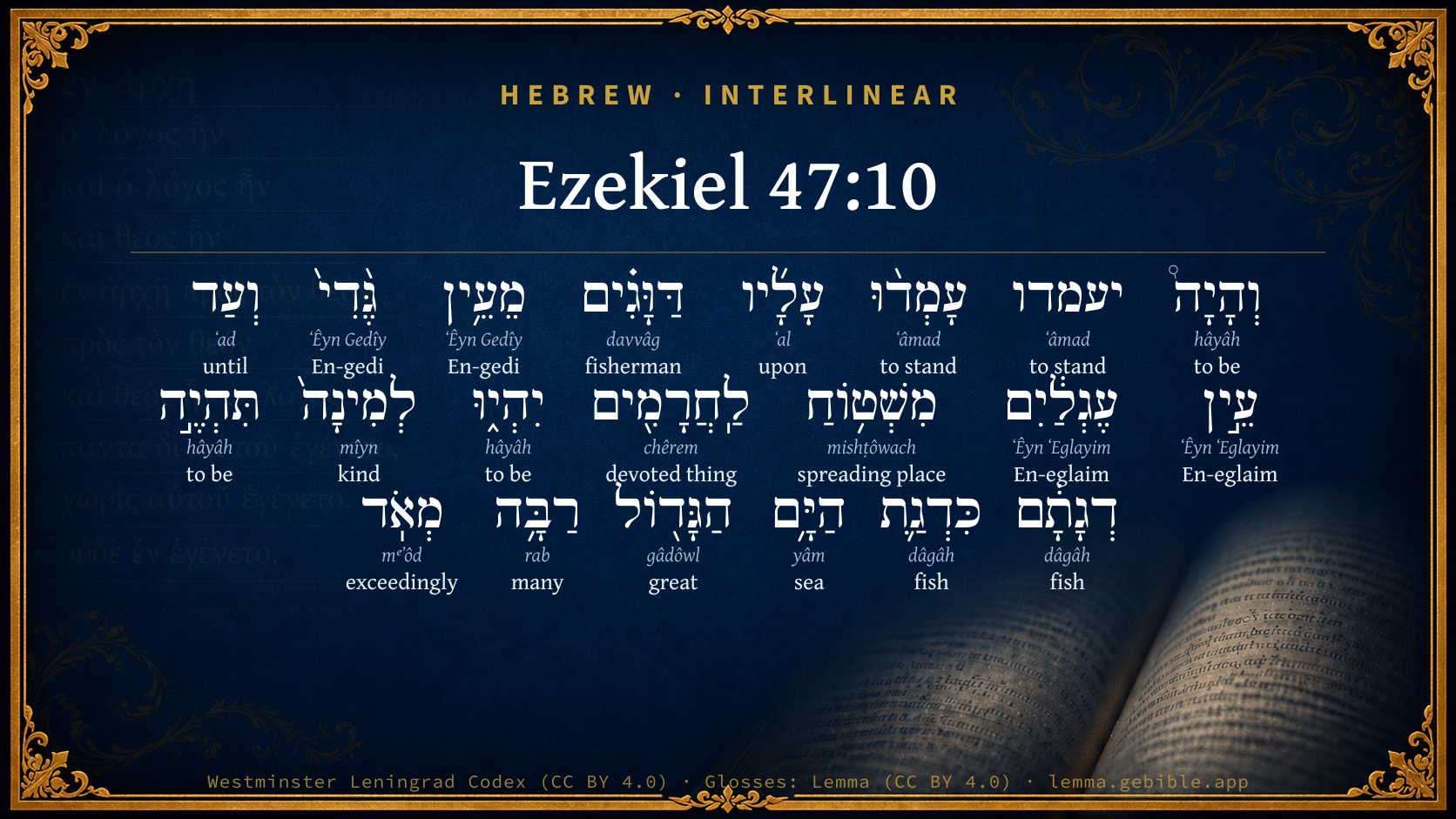
Ezekiel 47:10

Hebrew (Westminster Leningrad Codex) Ezekiel 47:10 appears in the Hebrew Old Testament. The text above is from the Westminster Leningrad Codex. Each word links to its Strong’s number, a concise gloss, and parsing drawn from the Open Scriptures Hebrew Bible morphology. Click any word for its full Brown-Driver-Briggs (BDB) entry.
Download image
Cite this verse

Ezekiel 47:10 (World English Bible). Public Domain. Lemma interlinear Bible study tool, https://lemma.gebible.app/v/ezekiel/47/10.

Show BibTeX & RIS
BibTeX
RIS
English Translation
It shall happen, that fishermen shall stand by it: from En Gedi even to En Eglaim shall be a place for the spreading of nets; their fish shall be after their kinds, as the fish of the great sea, exceeding many.
World English Bible · Public Domain
Highlights
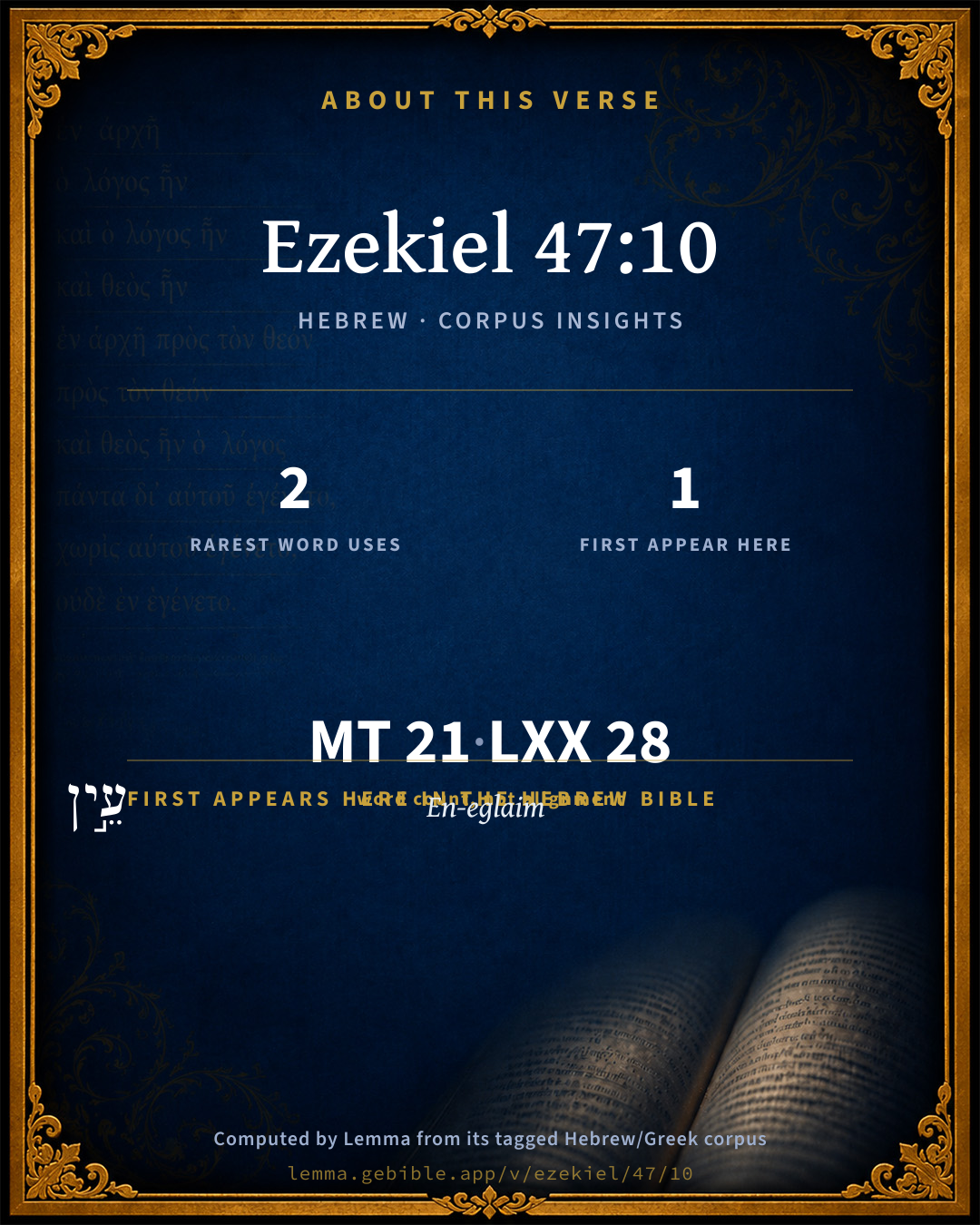
  • 1 first appearance in the Hebrew Bible
Full analysis ↓
Download a study sheet

One document with this verse’s original text, its word-by-word gloss line, the meaning frame, cross-references with their text, attributed commentary, and full source and license credits — printable, and it pastes into notes with its structure intact.

This verse Autodidact and up

Study sheet (.html) Plain text (.txt)

A passage Seminary Student

Up to 50 verses in one chapter. A passage sheet keeps up to 6 commentary sources and 12 cross-references per verse, in the order this page ranks them, and says so on the sheet whenever that leaves anything out. Ask for a single verse and you get the Autodidact verse sheet above.

Everything on this page stays free to read, with no account — the sheet is a download of what is already on screen, not access to it.

Want to remove ads? Support Godless Engineer
Compare translations 3

The same verse in 3 English versions, stacked beneath the original-language interlinear above. Click any original word for its lexicon entry.

Each is an independent rendering of the whole verse — the interlinear is not word-aligned to these translations.

Highlighted words mark where these versions differ — a whole-verse word diff, not a word-by-word alignment.

  • World English Bible Public Domain
    It shall happen, that fishermen shall stand by it: from En Gedi even to En Eglaim shall be a place for the spreading of nets; their fish shall be after their kinds, as the fish of the great sea, exceeding many.
  • King James Version Public Domain
    And it shall come to pass, that the fishers shall stand upon it from Engedi even unto Eneglaim; they shall be a place to spread forth nets; their fish shall be according to their kinds, as the fish of the great sea, exceeding many.
  • unfoldingWord Literal Text CC BY-SA 4.0
    Then it will happen that fishermen of En Gedi will stand by the water, and there will be a place to dry out the fishing nets by En Eglaim. There will be many kinds of fish in the Salt Sea, like the fish in the Great Sea for their abundance.

unfoldingWord Literal Text — © unfoldingWord, licensed CC BY-SA 4.0. Word-aligned USFM3 via Door43 (git.door43.org/unfoldingWord/en_ult).

Versions to compare (up to 4)

3 of 4 selected

Show all 18 translations

Every available English version of this verse, each an independent rendering of the whole verse.

  • World English Bible Public Domain
    It shall happen, that fishermen shall stand by it: from En Gedi even to En Eglaim shall be a place for the spreading of nets; their fish shall be after their kinds, as the fish of the great sea, exceeding many.
  • Berean Standard Bible Public Domain
    Fishermen will stand by the shore; from En-gedi to En-eglaim they will spread their nets to catch fish of many kinds, like the fish of the Great Sea.
  • Majority Standard Bible Public Domain
    Fishermen will stand by the shore; from En-gedi to En-eglaim they will spread their nets to catch fish of many kinds, like the fish of the Great Sea.
  • King James Version Public Domain
    And it shall come to pass, that the fishers shall stand upon it from Engedi even unto Eneglaim; they shall be a place to spread forth nets; their fish shall be according to their kinds, as the fish of the great sea, exceeding many.
  • American Standard Version (1901) Public Domain
    And it shall come to pass, that fishers shall stand by it: from En-gedi even unto En-eglaim shall be a place for the spreading of nets; their fish shall be after their kinds, as the fish of the great sea, exceeding many.
  • Revised Version (1885) Public Domain
    And it shall come to pass, that fishers shall stand by it: from En-gedi even unto En-eglaim shall be a place for the spreading of nets; their fish shall be after their kinds, as the fish of the great sea, exceeding many.
  • Geneva Bible (1599) Public Domain
    And then the fishers shall stand vpon it, and from En-gedi euen vnto En-eglaim, they shall spread out their nettes: for their fish shalbe according to their kindes, as the fishe of the maine sea, exceeding many.
  • Douay-Rheims (1899) Public Domain
    And the fishers shall stand over these waters, from Engaddi even to Engallim there shall be drying of nets: there shall be many sorts of the fishes thereof, as the fishes of the great sea, a very great multitude:
  • Young's Literal Translation Public Domain
    And it hath come to pass, fishers do stand by it, from En-Gedi even unto En-Eglaim; a spreading place of nets they are; according to their own kind is their fish, as the fish of the great sea, very many.
  • Literal Standard Version CC BY-SA 4.0
    And it has come to pass, fishers stand by it, from En-Gedi even to En-Eglaim; they are a spreading place for the nets; their fish are of the same kind as the fish of the Great Sea—very many.
  • Unlocked Literal Bible CC BY-SA 4.0
    Then it will happen that fishermen of En Gedi will stand by the water, and there will be a place to dry out the fishing nets by En Eglaim. There will be many kinds of fish in the Salt Sea, like the fish in the Great Sea for their abundance.
  • unfoldingWord Literal Text CC BY-SA 4.0
    Then it will happen that fishermen of En Gedi will stand by the water, and there will be a place to dry out the fishing nets by En Eglaim. There will be many kinds of fish in the Salt Sea, like the fish in the Great Sea for their abundance.
  • Darby Bible Public Domain
    And it shall come to pass, that fishers shall stand upon it; from En-gedi even unto En-eglaim shall be [a place] to spread forth nets: their fish shall be according to their kinds, as the fish of the great sea, exceeding many.
  • World Messianic Bible Public Domain
    It will happen that fishermen will stand by it. From En Gedi even to En Eglaim will be a place for the spreading of nets. Their fish will be after their kinds, as the fish of the great sea, exceedingly many.
  • Webster's Bible Public Domain
    And it shall come to pass, that the fishers shall stand upon it from En-gedi even to En-eglaim; they shall be a place to spread forth nets; their fish shall be according to their kinds, as the fish of the great sea, very numerous.
  • Free Bible Version CC BY-SA 4.0
    Fishermen will stand on the shore of the Dead Sea. They will be able to spread their nets from En-gedi to En-eglaim and catch many kinds of fish. There will be plenty of fish just like the Mediterranean Sea.
  • Bible in Basic English Public Domain
    And fishermen will take up their places by it: from En-gedi as far as En-eglaim will be a place for the stretching out of nets; the fish will be of every sort, like the fish of the Great Sea, a very great number.
  • JPS Tanakh (1917) Public Domain
    And it shall come to pass, that fishers shall stand by it from En-gedi even unto En-eglaim; there shall be a place for the spreading of nets; their fish shall be after their kinds, as the fish of the Great Sea, exceeding many.

Literal Standard Version (2020), Covenant Press — licensed CC BY-SA 4.0. Text via the HelloAO Bible API (eBible.org). Unlocked Literal Bible (unfoldingWord) — licensed CC BY-SA 4.0. Text via the HelloAO Bible API (eBible.org). unfoldingWord Literal Text — © unfoldingWord, licensed CC BY-SA 4.0. Word-aligned USFM3 via Door43 (git.door43.org/unfoldingWord/en_ult). Free Bible Version, Dr. Jonathan Gallagher — licensed CC BY-SA 4.0. Text via the HelloAO Bible API (eBible.org).

Word by word

More ways to search: Search by grammar → Find every occurrence → Compare this word →

Practice this passage: Drill this verse → Learn its vocabulary →

דַּוָּגִ֗ים
davvâg
H1728
“fishermen”
Noun, Common, Masculine, Plural, Absolute
Part of Speech
Noun
Type
Common
Gender
Masculine
Number
Plural
State
Absolute
Full BDB Definition

Origin: an orthographical variation of H1709 as a denominative [ H1771 ]

TWOT: 401d

fisherman, fisher
  1. וְהָיָה֩ hâyâh H1961 “and · to be” Conjunction + Verb, Qal, Sequential Perfect, 3rd Person, Masculine, Singular
  2. יעמדו ʻâmad H5975 “to stand” Verb, Qal, Imperfect, 3rd Person, Masculine, Plural
  3. עָמְד֨וּ ʻâmad H5975 “to stand” Verb, Qal, Perfect, 3rd Person, Common, Plural
  4. עָלָ֜יו ʻal H5921 “upon · him” Preposition + Suffix, Personal, 3rd Person, Masculine, Singular
  5. מֵעֵ֥ין ʻÊyn Gedîy H5872 “from · En-gedi” Preposition + Noun, Proper
  6. גֶּ֨דִי֙ ʻÊyn Gedîy H5872 “En-gedi” Noun, Proper
  7. וְעַד ʻad H5704 “and · until” Conjunction + Preposition
  8. עֵ֣ין ʻÊyn ʻEglayim H5882 “En-eglaim” Noun, Proper
  9. עֶגְלַ֔יִם ʻÊyn ʻEglayim H5882 “En-eglaim” Noun, Proper
  10. מִשְׁט֥וֹחַ mishṭôwach H4894 “spreading place” Noun, Common, Masculine, Singular, Absolute
  11. לַֽחֲרָמִ֖ים chêrem H2764 “to/for · devoted things” Preposition + Noun, Common, Masculine, Plural, Absolute
  12. יִהְי֑וּ hâyâh H1961 “to be” Verb, Qal, Imperfect, 3rd Person, Masculine, Plural
  13. לְמִינָה֙ mîyn H4327 “to/for · kind · her” Preposition + Noun, Common, Masculine, Singular, Construct + Suffix, Personal, 3rd Person, Feminine, Singular
  14. תִּהְיֶ֣ה hâyâh H1961 “to be” Verb, Qal, Imperfect, 3rd Person, Feminine, Singular
  15. דְגָתָ֔ם dâgâh H1710 “fish · their” Noun, Common, Feminine, Singular, Construct + Suffix, Personal, 3rd Person, Masculine, Plural
  16. כִּדְגַ֛ת dâgâh H1710 “like/as · fish of” Preposition + Noun, Common, Feminine, Singular, Construct
  17. הַיָּ֥ם yâm H3220 “the · sea” Particle, Definite Article + Noun, Common, Masculine, Singular, Absolute
  18. הַגָּד֖וֹל gâdôwl H1419 “the · great” Particle, Definite Article + Adjective, Adjective, Masculine, Singular, Absolute
  19. רַבָּ֥ה rab H7227 “many” Adjective, Adjective, Feminine, Singular, Absolute
  20. מְאֹֽד mᵉʼôd H3966 “exceedingly” Adverb

About this verse

These counts appear in no published source. They are computed here, from the morphology-tagged text and Lemma’s own curated glosses. What Lemma adds →

21
words
15
distinct lemmas
Prophets
section

Notable vocabulary

The rarest word here is דַּוָּגִ֗ים fisherman H1728 — appearing just 2 times in the whole Hebrew Bible.

First appearance in Scripture

This word makes its first canonical appearance in the Hebrew Bible here:

  • עֵ֣ין En-eglaim H5882

Shared distinctive vocabulary

דַּוָּגִ֗ים fisherman H1728 occurs in 2 verses of the Hebrew Bible. Also found in:

Grammatical profile

  • 5 verbs
  • 11 nouns
  • 2 adjectives
  • 2 prepositions
  • 1 adverb

Verb forms

  • וְהָיָה֩ Qal · Sequential Perfect
  • יעמדו Qal · Imperfect
  • עָמְד֨וּ Qal · Perfect
  • יִהְי֑וּ Qal · Imperfect
  • תִּהְיֶ֣ה Qal · Imperfect

Repetition

Words recur within this verse — often emphatic in Hebrew:

  • וְהָיָה֩ to be H1961 ×3
  • יעמדו to stand H5975 ×2
  • מֵעֵ֥ין En-gedi H5872 ×2
  • עֵ֣ין En-eglaim H5882 ×2
  • דְגָתָ֔ם fish H1710 ×2

Hebrew & Septuagint length

In English translation the verse runs 41 words from the Hebrew and 40 from the Septuagint (LXX English) — closely comparable.

A rough comparison of the two English renderings, which tokenize alike — not a word-level alignment.

Word counts can differ between the Hebrew and the Greek without any difference in meaning — e.g. the Hebrew direct-object marker אֵת has no separate Greek word, and Greek often adds the article ὁ.

In the original languages it is 21 Hebrew tokens and 28 Greek tokens — but the two are counted differently (Hebrew bundles its prefixes and suffixes into one token; the Greek is in lemma form), so that isn’t a like-for-like length.

Cross-references

16

Topical passages linked to Ezekiel 47:10 in the Treasury of Scripture Knowledge — connected by theme and wording, ordered by reader-vote popularity; previews shown in the World English Bible.

  • Matthew 4:19 He said to them, "Come after me, and I will make you fishers for men."
  • Numbers 34:6 For the western border, you shall have the great sea and the border [of it]: this shall be your west border.
  • Psalms 104:25 There is the sea, great and wide, In which are innumerable living things, Both small and large animals.
  • 2 Chronicles 20:2 Then there came some who told Jehoshaphat, saying, There comes a great multitude against you from beyond the sea from Syria; and, behold, they are in Hazazon Tamar (the same is En Gedi).
  • Ezekiel 47:15 This shall be the border of the land: On the north side, from the great sea, by the way of Hethlon, to the entrance of Zedad;
  • Ezekiel 48:28 By the border of Gad, at the south side southward, the border shall be even from Tamar to the waters of Meribath Kadesh, to the brook [of Egypt], to the great sea.
  • Matthew 13:47–50 "Again, the Kingdom of Heaven is like a dragnet, that was cast into the sea, and gathered some fish of every kind,
  • Mark 1:17 Jesus said to them, "Come after me, and I will make you into fishers for men."
  • Luke 5:4–10 When he had finished speaking, he said to Simon, "Put out into the deep, and let down your nets for a catch."
  • John 21:3–11 Simon Peter said to them, "I'm going fishing." They told him, "We are also coming with you." They immediately went out, and entered into the boat. That night, they caught nothing.
  • Joshua 15:62 and Nibshan, and the City of Salt, and En Gedi; six cities with their villages.
  • Joshua 23:4 Behold, I have allotted to you these nations that remain, to be an inheritance for your tribes, from the Jordan, with all the nations that I have cut off, even to the great sea toward the going down of the sun.
  • 1 Samuel 23:29 David went up from there, and lived in the strongholds of En Gedi.
  • Isaiah 49:12 Behold, these shall come from far; and, behold, these from the north and from the west; and these from the land of Sinim.
  • Isaiah 49:20 The children of your bereavement shall yet say in your ears, The place is too small for me; give place to me that I may dwell.
  • Ezekiel 26:5 She shall be a place for the spreading of nets in the midst of the sea; for I have spoken it, says the Lord Yahweh; and she shall become a spoil to the nations.

Cross-references courtesy of OpenBible.info (CC BY 4.0).

Hebrew and Greek witnesses Masoretic Hebrew ↔ Greek Septuagint

The same verse in the two great witnesses to the Old Testament, shown verse-for-verse.

These are two independent witnesses, not word-aligned to each other, and the Septuagint is shown in lemma (dictionary) form.

Hebrew Ezekiel 47:10 Masoretic · Westminster Leningrad Codex

וְהָיָה֩ יעמדו עָמְד֨וּ עָלָ֜יו דַּוָּגִ֗ים מֵעֵ֥ין גֶּ֨דִי֙ וְעַד עֵ֣ין עֶגְלַ֔יִם מִשְׁט֥וֹחַ לַֽחֲרָמִ֖ים יִהְי֑וּ לְמִינָה֙ תִּהְיֶ֣ה דְגָתָ֔ם כִּדְגַ֛ת הַיָּ֥ם הַגָּד֖וֹל רַבָּ֥ה מְאֹֽד

It shall happen, that fishermen shall stand by it: from En Gedi even to En Eglaim shall be a place for the spreading of nets; their fish shall be after their kinds, as the fish of the great sea, exceeding many.

World English Bible · Public Domain

Greek LXX Ezekiel 47:10 Septuagint · lemma form

καί ἵστημι ἐκεῖ ἁλιεύς ἀπό αινγαδιν ἕως αιναγαλιμ ψυγμός σαγήνη εἰμί κατά ἑαυτοῦ εἰμί καί ὁ ἰχθύς αὐτός ὡς ὁ ἰχθύς ὁ θάλασσα ὁ μέγας πλῆθος πολύς σφόδρα

And fishers shall stand there from Ingadin to Enagallim; it shall be a place to spread out nets upon; it shall be distinct; and the fishes thereof shall be as the fishes of the great sea, a very great multitude.

LXX2012 (modern English Septuagint) · Public Domain

Hebrew: Westminster Leningrad Codex (CC BY 4.0). Greek: Septuagint (public domain); English from LXX2012 (modern English Septuagint) (Public Domain). How the Septuagint differs from the Hebrew →

Targum (Aramaic paraphrase)

1

The Targum is the ancient Jewish Aramaic paraphrase of the Hebrew Scriptures — an interpretive translation, not the Hebrew text itself. Onkelos (literal) and Pseudo-Jonathan (expansive) render the Torah, and Jonathan the Prophets. Coverage is partial: where no permissively-licensed English translation exists for a verse, only the Aramaic is shown. This is verse-level text, not a word-by-word alignment to the Hebrew.

  1. Targum Jonathan Prophets (Joshua–Malachi)
    וִיהֵי אֲתַר לְמֵיקָם עֲלוֹהִי צְיָדִין מֵעֵין גֶדִי וְעַד עֵין עֶגְלַיִם מִשְׁטַח לְצַיָדִין יְהוֹן לְמִינְהוֹן יְהוֹן נוּנֵיהוֹן כְּנוּנֵי יַמָא רַבָּא סַגִי לַחֲדָא:

    (no public-domain English translation for this verse)

    Targum Jonathan — Aramaic: “Mikraot Gedolot” (public domain). English: “Sefaria Community Translation” (CC0 1.0 (public-domain dedication)); “London "Chaldee Paraphrase," 1871” (public domain). Text via Sefaria.

Commentary

Notes on Ezekiel 47:10 from classic Christian and Jewish commentators (each source and its license shown beneath its notes). The classic Christian expositions comment on the surrounding passage and are grouped to its opening verse, so a note may address several verses; the Jewish commentaries on the Tanakh (Rashi and others) are per-verse, so they appear only where the commentator wrote on this verse.

Lemma curates 59 commentaries, every one of them public domain or Creative Commons licensed, each selected and text-cleaned for this edition rather than reprinted as found. About our sources →

Trapp's Complete Commentary

John Trapp

Eze 47:10 And it shall come to pass, [that] the fishers shall stand upon it from Engedi even unto Eneglaim; they shall be a [place] to spread forth nets; their fish shall be according to their kinds, as the fish of the great sea, exceeding many.

Ver. 10. The fishers shall stand upon it.] Upon the Dead Sea, where formerly they had little enough to do. This sea is the wide world dead in sins and trespasses. {Eph 2:1} These fishers are Christ’s apostles and ministers, who are called fishers of men, {Mat 4:19} and their preaching compared to fishing. {Mat 13:47} They fish with various success, as did Peter; {Luk 5:5} but may enclose a great multitude, as he did; {Act 2:41} and as Farellus, who gained five cities to Christ, who brought them to hand by whole shoals. Histories tell us of five hundred and eighty Jews converted to the Christian faith at Axvernum by one Avitus, a bishop, and baptized. {a}

From Engedi.] Called also Hazazontamar; {2Ch 20:2} that is, the city of palms, where grew the best balsam in the world, though it were near to the Dead Sea. {b}

Even unto Eneglaim.] Which is likewise a place adjacent to the Dead Sea, where Jordan falleth into it, as Jerome testifieth.

They shall be a place to spread forth nets.] Dr Preston being asked why he preached so plainly, and did so much dilate his sermons, being of such abilities? answered, he was a fisherman. Now such, if they should wind up their net, and so cast it into the sea, they should catch nothing; but when they spread the net, they catch the fish. I spread my net, because I would catch souls, said he; and indeed he had a very happy hand at it. {c}

The fish shall be according to their kinds.] The sea, they say, hath as many kinds of living creatures as the earth hath. "There is that leviathan, and there are creeping things innumerable." {Psa 105:1-45}

{a} Pappi, Eccles. Hist. Epit., p. 214.

{b} Joseph., De Bel., lib. i. cap. 13.

{c} Mr Wall’s "None but Christ," p. 400.

John Trapp, A Commentary or Exposition upon All the Books of the Old and New Testament (1647–1656) — public domain. Text from a community e-Sword module.

Joseph Benson's Commentary

Eze 47:10. Fishers shall stand upon it from En-gedi unto En-eglaim — En- gedi was in the wilderness of Judah, Jos 15:61-62. De L’Isle places it toward the south-west point of the Dead sea; and En-eglaim is placed by the same writer at the north of the Dead sea, where Jordan runs into it. It is mentioned, Isa 15:8, as a place on the borders of Moab, which country lay on the east side of the Dead sea. Bishop Newcome, following the punctuation adopted by the Syriac, Vulgate, and Arabic, reads, From En-gedi even to En-eglaim there shall be a spreading forth of nets; by which is signified, that fishers should be employed along the whole coast of it, denoting the multitude of gospel preachers, all over the world, labouring to gain sinners to Christ. Their fish shall be according to their kinds, as the fish of the great sea — That is, the Mediterranean; exceeding many — Great multitudes of sinners, of all descriptions, in a thousand diversified forms of guilt and wretchedness, shall be brought to God by the word of these preachers, these fishers of men. So that this is a further amplification of what is said in Eze 47:8, that the waters should be healed, and strongly illustrates the salutary effect of the gospel, and the multitude of converts that should be made in the Gentile countries, even in the most idolatrous, ignorant, and wicked.

Joseph Benson's Commentary on the Old and New Testaments (1811–1818) — public domain. Text from a community e-Sword module.

Tyndale Open Study Notes

Tyndale Open Resources

47:10 From En-gedi, a town on the west side of the Dead Sea, to En-eglaim, a town on the east side, the Dead Sea would be brought from death to life. This water, so full of salt and other minerals that it is devoid of life, would teem with enough fish to support a major fishing industry.

Tyndale Open Study Notes — © Tyndale Open Resources, licensed CC BY-SA 4.0. Text via the HelloAO Bible API.

Geneva Bible (1599)

Geneva Bible translators

Signifying, that when God bestoweth his mercies in such abundance, the ministers shall by their preaching win many.

Which were cities at the corners of the salt or dead sea.

They shall be here of all sorts, and in as great abundance as in the great Ocean where they are bred.

Geneva Bible (1599) marginal notes — public domain. Text via Bolls.life.

Jamieson, Fausset & Brown

Robert Jamieson, A. R. Fausset & David Brown

En-gedi . . . En-eglaim--En-gedi (meaning "fountain of the kid"), anciently, Hazazon-Tamar, now Ain-Jidy; west of the Dead Sea; David's place of refuge from Saul. En-eglaim means "fountain of two calves," on the confines of Moab, over against En-gedi, and near where Jordan enters the Dead Sea (Isa 15:8). These two limits are fixed on, to comprise between them the whole Dead Sea.

fish . . . according to their kinds--JEROME quotes an ancient theory that "there are a hundred fifty-three kinds of fishes," all of which were taken by the apostles (Joh 21:11), and not one remained uncaptured; signifying that both the noble and baseborn, the rich and the poor, and every class, are being drawn out of the sea of the world to salvation. Compare Mat 13:47, the gospel net; the apostles being fishermen, at first literally, afterwards spiritually (Mat 4:19).

Jamieson, Fausset & Brown — Commentary Critical and Explanatory on the Whole Bible (1871) — public domain (CC PDM 1.0). Text via the HelloAO Bible API.

Adam Clarke's Commentary

Verse 10. The fishers shall stand upon it] On the above plan of interpretation these must mean -

1. The apostles of our Lord Jesus.

2. The preachers of the everlasting Gospel. See Mt 4:19.

From En-gedi] At the southern extremity of the Dead Sea.

Unto En-eglaim] At the northern extremity of the same.

Their fish shall be according to their kinds] Every kind of fish, and the fish all excellent of their kinds. All nations, and kindreds, and people shall be called by the Gospel; it shall not be an excluding system like that of Judaism, for its Author tasted death for every man.

Adam Clarke's Commentary on the Bible (1810–1826) — public domain. Text from a community e-Sword/MySword module.

Ellicott's Commentary for English Readers

(10) From En-gedi even unto En-eglaim.—En-gedi, “the fountain of the goat,” is a well-known copious spring about midway on the western coast of the Dead Sea. En-eglaim occurs only here, and has not been certainly identified. St. Jerome speaks of “Engallim” as at the junction of the Jordan with the sea, and near this point there is a fountain now known as Ain-el-Feshkhah. Others consider that the dual form of the name indicates “one of the double cities of Moab,” thus placing it on the eastern side of the sea, and this seems more probable, since the expression would then be equivalent to “the whole breadth of the sea.” Everywhere they shall stretch their nets, and the variety and abundance of the fish shall be as great as in “the great sea,” that is, the Mediterranean. This whole verse in regard to the fishermen is a striking illustration of Ezekiel’s way of carrying out the most ideal description into detail.

A Bible Commentary for English Readers, edited by Charles John Ellicott (1878–1897) — public domain. Text from a community e-Sword module.

The Cambridge Bible for Schools and Colleges

gen. ed. J. J. S. Perowne

10. En-gedi, the modern Ain Jidy, kid’s well, situated about the middle of the west shore of the Dead Sea. En-eglaim has not been identified; it probably lay N. toward the mouth of the Jordan. It has been supposed to be Ain Feshkah, Robinson ii. 489. The word differs in spelling from Eglaim, Isa_15:8, which probably lay to the south of the sea.

The Cambridge Bible for Schools and Colleges (gen. ed. J. J. S. Perowne; Cambridge University Press, 1878–1918) — public domain. Text from a community e-Sword module.

John Gill's Exposition

And it shall come to pass,.... In Gospel times: what follows had a fulfilment in the first times of the Gospel, and will have a greater in the latter times of it:

that the fishers shall stand upon it; upon the brink of the river, or the shore of the sea, whose waters will be healed by this river running into them. These "fishers" are the apostles of Christ, who, of fishermen, were made fishers of men by him; to whom he gave a call, and a commission, and gifts qualifying them to preach the Gospel; whereby they caught men, and brought them to Christ; and so were the instruments of saving them, even of great numbers, both in Judea, and in the Gentile world; of which some instances of their fishing, after their call to the ministry, were emblematical; Mat 4:18, likewise all other ministers of the Gospel are here meant, especially those that will be in the latter day; compared to fishers for the meanness and contemptibleness of their employment in the eyes of the world; for their labouriousness in it, and for their patient waiting for success therein; and for the bad weather, storms, and tempests, they are exposed unto, the reproach and persecution of men; and their being the happy means of drawing souls out of the abyss of sin and misery unto Christ, for life and salvation: and their "standing" upon the brink of the waters to catch fish may denote their constancy their work; their strict attachment to the doctrines of the Gospel, and their waiting for success in it.

From Engedi even unto Eneglaim; two places, which, according to Jerom, lay, the latter one at the entrance of the Dead sea, and the former at the end of it; but Reland (k) observes that this could not be, if Josephus is to be credited, who makes Engedi to be about forty miles from Jerusalem (l); therefore could not be far from the beginning of the Dead sea, and not where it ended; since the Dead sea, or the lake of Asphaltites, was in length seventy three miles, and, consequently, Engedi must be more than seventy five or ninety miles from Jerusalem; but that it was at the beginning of it is still further manifest from the same writer making the lake to be just such a number of miles from Jerusalem (m) as he does Engedi; and whereas Engedi was on the western shore of the lake, as appears from Pliny (n), it is probable there was another city on the eastern shore, opposite to it, called Eneglaim; and there was a city on that side, the name of which was Agallim, which, according to Eusebius, was eight miles from Areopolis: and so it may signify the extent of the Gospel ministry, which, in the latter day, will be from one end of the earth to the other; and which took a large circuit in the times of the apostles, and particularly by the Apostle Paul, Rom 15:19.

They shall be a place to spread forth nets; that is, the above said places shall be made use of for that purpose; which design the Gospel, and the ministry of it, compared to a net, for its meanness in the esteem of the world; and yet is a piece of curious artifice and wisdom, even the manifold wisdom of God, and is contrived for the gathering in of sinners to Christ; and, though it may be like a net "per accidens", the means of troubling the world, and drawing out the corruptions of the men of it; yet its principal design, and the use that is made of it, is to draw souls out of the depths of sin unto the grace of Christ; see Mat 13:47, the spreading and casting of nets design the preaching of the Gospel, and the opening and explaining the doctrines of it, which are shut up and hidden to men; and to do which requires wisdom and skill, strength, diligence, and patience, and is done at a venture; and sometimes is cast where fish are, and sometimes not; but here, and at this time, with great success.

For their fish shall be according to their kind, as the fish of the great sea, exceeding many: that is, there shall be fish of all sorts, small and great, and in large numbers, as in the great ocean, or as in the Mediterranean sea. These signify regenerated persons, who are born of water and the Spirit by the word of God, which is their element; they cannot live but in these waters of the sanctuary, and where the doctrines of grace are preached. Now many of all nations, and men of all ranks, will be called; kings, princes, nobles, as well as peasants; men high and low, rich and poor, and multitudes of them, like the fishes of the sea; which will be the case when the Jews will be converted, and the fulness of the Gentiles brought in.

(k) Palestina Illustrata, I. 2. p. 449. & l. 3. p. 763. (l) Antiqu. l. 9. c. 1. sect. 2. (m) Antiqu. l. 15. c. 6. sect 2. (n) Nat. Hist. l. 5. c. 17.

John Gill's Exposition of the Whole Bible (1746–1763) — public domain (CC PDM 1.0). Text via the HelloAO Bible API.

Albert Barnes' Notes on the Bible

“En-gedi” (see 1Sa 23:29) was about the middle of the western shore of the Dead Sea.

En-eglaim does not occur elsewhere. Its form indicates that it was one of the double cities of Moab (see Eze 25:9 note). It has been identified with “Ain-el-Feshkah” to the north on the western bank of the Dead Sea. On this supposition, “from En-eglaim to En-gedi” would be the line of coast from the most northern fountain to the principal fountain southward.

Albert Barnes' Notes on the Bible (1834–1885) — public domain. Text from a community e-Sword/MySword module.

Haydock's Catholic Bible Commentary

Engallim, or "the fountain of Gallim," in the tribe of Benjamin, Isaias xxv. 44.

George Leo Haydock (1774–1849), Haydock's Catholic Family Bible and Commentary, 1859 edition — public domain. Excludes Psalms (Douay-Rheims chapter numbering differs from Protestant) and Deuterocanonical books (Catholic canon only).

Matthew Poole's English Annotations

The fishers; men whose trade is to fish for livelihood and profit.

Shall stand; shall dispose of themselves about these waters; either on the shore along the river-side, or in boats on the sea, to take the fish.

Upon it; the sea, whose waters healed become fruitful.

From En-gedi; which lay on the south-west of the lake of Sodom, so near, that it is reported there are the trees which bring forth fruit beautiful to the eye, but touched with the hand fall into ashes; yet on those parts more remote from this sea, En-gedi affords excellent vines, Son 1:14, or gardens of balsam trees.

Unto En-eglaim; a city on the north-east of the Dead Sea, near which place Jordan runs into it, and they say it is a boundary town of Moab. Others will have it no proper, but a common name, and signifying the confluence of waters in any place; if so, it will be likeliest to be understood of that part of the Red Sea where Jordan and two lesser rivers run into it, at the north and north-east end of this sea.

A place to spread forth nets, all along on the west side of this sea, to dry them and fit them again.

According to their kinds; of all sorts.

As the fish of the great sea; for number, growth, and goodness for use.

Exceeding many, or great, of exceeding great bigness in their several kinds. All this is mystical, and fulfilled since Christ hath made his ministers, as he made his apostles, fishers of men.

Matthew Poole's English Annotations on the Holy Bible (1683–1685) — public domain. Text from a community e-Sword/MySword module.

The Pulpit Commentary

As another consequence of the inflowing of this river into the Dead Sea, it is stated that the fishers (rather, fishers, without the article) should stand upon its banks, from Engedi, even unto Englaim; there shall be a place to spread forth nets. The Revised Version more correctly renders, fishers shall stand by it; from Engedi even unto Eneglaim, shall be a place for the spreading of nets; or, more literally, a place of spreading, out for nets. (comp. Eze_26:5) Engedi, ydiG, ye, meaning "Fountain of the kid;" originally styled Hazezon-Tamar, (2Ch_20:2) now called Ain Jidy (Robinson," Bibl. Res.," 2:214), was situated in the middle of the west coast of the Dead Sea, and not at its southern extremity, as Jerome supposed. Englaim, ye, signifying "Fountain of two calves," was located by Jerome, who cars it En Gallim, at the northern extremity of the Dead Sea, and is usually identified with the modern Ain Feshkhah, or "Fountain of mist," at the northern end of the west coast, where the ruins of houses and a small tower have been discovered (Robinson, "Bibl. Res.," 2:220). Ewald cites Isa_15:8 toshow that Englaim was on the eastern shore of the Dead Sea, which, Smend notes, was given up by the prophet to the sons of the East.

The Pulpit Commentary (1880–1919), ed. H.D.M. Spence-Jones & Joseph S. Exell — public domain. Text from a community e-Sword module.

John Wesley's Explanatory Notes

En-gedi - Which lay on the southwest of the lake of Sodom. En-eglaim - A city on the northeast of the Dead-sea. To spread forth nets - All along on the west-side of this sea to dry them.

John Wesley, Explanatory Notes Upon the Whole Bible (1754–1765) — public domain. Text via the GEBible commentary corpus.

Rashi

Rabbi Shlomo Yitzchaki (Rashi)

And it will be [a place] beside which fishermen will stand etc., nets [Heb. לַחֲרָמִים,] for nets

their fish will be of many kinds לְמִינָה.] This does not have a “mappik hey,” and it means that its fish will be of many kinds of many kinds.

of many kinds [Heb. לְמִינָה,] a form of the word to denote a profusion of kinds, as in (Exod. 7:21): “And the fish וְהֲדָּגָה in the river”; (Isa. 21:2): “All sighs (אָנְחָתָה) have I brought to an end.”

Rashi on the Tanakh — English translations: “The Judaica Press complete Tanach with Rashi, translated by A. J. Rosenberg” (CC BY 4.0); “Pentateuch with Rashi's commentary by M. Rosenbaum and A.M. Silbermann, 1929-1934” (public domain); “The Metsudah Tanach series, Lakewood, N.J” (CC BY 4.0); and “The Book of Joshua, Metsudah Publications, 1997” (CC BY 4.0). Text via Sefaria.

Lesson kit

Teaching starters — assembled from the data on this page, not authored interpretation. Every prompt links to the verse data it draws on. Edit before teaching.

Ezekiel, in the Prophets, opens this verse with 21 words (15 distinct Hebrew lemmas). Its most distinctive word is davvâg (“fisherman”). A historical commentator’s framing appears above. Read the whole chapter for the surrounding context.

Discussion questions

  1. The word davvâg carries the sense “fisherman.” How does it shape the verse?
  2. This is the first place “En-eglaim” appears in Scripture (first appears here). What does its debut here establish?
  3. How does Jeremiah 16:16, which shares the word «fisherman», read alongside this verse?
  4. What does the repetition of “to be” (3× in this one verse) do in this verse?
  5. The translations on this page render this verse differently — a whole-verse word diff, not a word-by-word alignment. What might account for the different wordings?
  6. «וְהָיָה֩» is a Qal Sequential Perfect verb. How does that grammatical form shape the action described?
  7. Compare how Trapp's Complete Commentary and Joseph Benson's Commentary read this verse. Where do they agree or differ?

Things to notice

Reading settings

Reading text

Shown beneath each verse's original-language words.

Old Testament
Old Testament edition

Read the OT as the Masoretic Hebrew (MT) or the Greek Septuagint (LXX).

English shown for the Greek Septuagint (in the Hebrew ↔ Greek comparison).

Comparing translations? Open the Compare panel on any verse page to stack up to four side by side.