
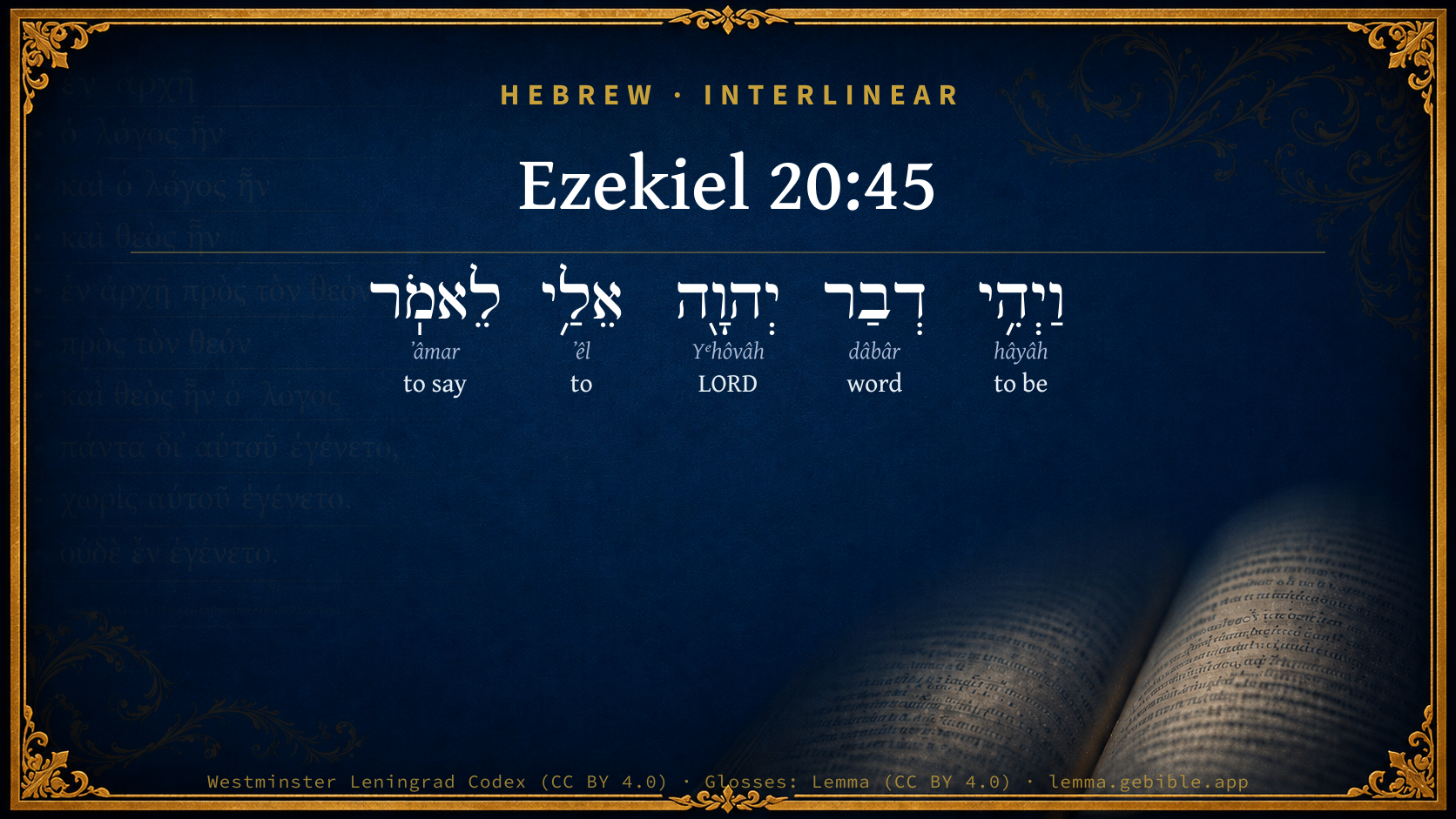
Ezekiel 20:45

Hebrew (Westminster Leningrad Codex) Ezekiel 20:45 appears in the Hebrew Old Testament. The text above is from the Westminster Leningrad Codex. Each word links to its Strong’s number, a concise gloss, and parsing drawn from the Open Scriptures Hebrew Bible morphology. Click any word for its full Brown-Driver-Briggs (BDB) entry.
Download image
Cite this verse

Ezekiel 20:45 (World English Bible). Public Domain. Lemma interlinear Bible study tool, https://lemma.gebible.app/v/ezekiel/20/45.

Show BibTeX & RIS
BibTeX
RIS
English Translation
The word of Yahweh came to me, saying,
World English Bible · Public Domain
Download a study sheet

One document with this verse’s original text, its word-by-word gloss line, the meaning frame, cross-references with their text, attributed commentary, and full source and license credits — printable, and it pastes into notes with its structure intact.

This verse Autodidact and up

Study sheet (.html) Plain text (.txt)

A passage Seminary Student

Up to 50 verses in one chapter. A passage sheet keeps up to 6 commentary sources and 12 cross-references per verse, in the order this page ranks them, and says so on the sheet whenever that leaves anything out. Ask for a single verse and you get the Autodidact verse sheet above.

Everything on this page stays free to read, with no account — the sheet is a download of what is already on screen, not access to it.

Want to remove ads? Support Godless Engineer
Compare translations 3

The same verse in 3 English versions, stacked beneath the original-language interlinear above. Click any original word for its lexicon entry.

Each is an independent rendering of the whole verse — the interlinear is not word-aligned to these translations.

Highlighted words mark where these versions differ — a whole-verse word diff, not a word-by-word alignment.

  • World English Bible Public Domain
    The word of Yahweh came to me, saying,
  • King James Version Public Domain
    Moreover the word of the LORD came unto me, saying,
  • unfoldingWord Literal Text CC BY-SA 4.0
    Then the word of Yahweh came to me, saying,

unfoldingWord Literal Text — © unfoldingWord, licensed CC BY-SA 4.0. Word-aligned USFM3 via Door43 (git.door43.org/unfoldingWord/en_ult).

Versions to compare (up to 4)

3 of 4 selected

Show all 18 translations

Every available English version of this verse, each an independent rendering of the whole verse.

  • World English Bible Public Domain
    The word of Yahweh came to me, saying,
  • Berean Standard Bible Public Domain
    Now the word of the LORD came to me, saying,
  • Majority Standard Bible Public Domain
    Now the word of the LORD came to me, saying,
  • King James Version Public Domain
    Moreover the word of the LORD came unto me, saying,
  • American Standard Version (1901) Public Domain
    And the word of Jehovah came unto me, saying,
  • Revised Version (1885) Public Domain
    And the word of the LORD came unto me, saying,
  • Geneva Bible (1599) Public Domain
    Moreouer, the worde of the Lord came vnto me, saying,
  • Douay-Rheims (1899) Public Domain
    And the word of the Lord came to me, saying:
  • Young's Literal Translation Public Domain
    And there is a word of Jehovah unto me, saying,
  • Literal Standard Version CC BY-SA 4.0
    And there is a word of YHWH to me, saying,
  • Unlocked Literal Bible CC BY-SA 4.0
    Then the word of Yahweh came to me, saying,
  • unfoldingWord Literal Text CC BY-SA 4.0
    Then the word of Yahweh came to me, saying,
  • Darby Bible Public Domain
    And the word of Jehovah came unto me, saying,
  • World Messianic Bible Public Domain
    The LORD’s word came to me, saying,
  • Webster's Bible Public Domain
    Moreover the word of the LORD came to me, saying,
  • Free Bible Version CC BY-SA 4.0
    Another message from the Lord came to me, saying,
  • Bible in Basic English Public Domain
    Then the word of the Lord came to me, saying,
  • JPS Tanakh (1917) Public Domain
    (21-1) And the word of the LORD came unto me, saying:

Literal Standard Version (2020), Covenant Press — licensed CC BY-SA 4.0. Text via the HelloAO Bible API (eBible.org). Unlocked Literal Bible (unfoldingWord) — licensed CC BY-SA 4.0. Text via the HelloAO Bible API (eBible.org). unfoldingWord Literal Text — © unfoldingWord, licensed CC BY-SA 4.0. Word-aligned USFM3 via Door43 (git.door43.org/unfoldingWord/en_ult). Free Bible Version, Dr. Jonathan Gallagher — licensed CC BY-SA 4.0. Text via the HelloAO Bible API (eBible.org).

Word by word

More ways to search: Search by grammar → Find every occurrence → Compare this word →

Practice this passage: Drill this verse → Learn its vocabulary →

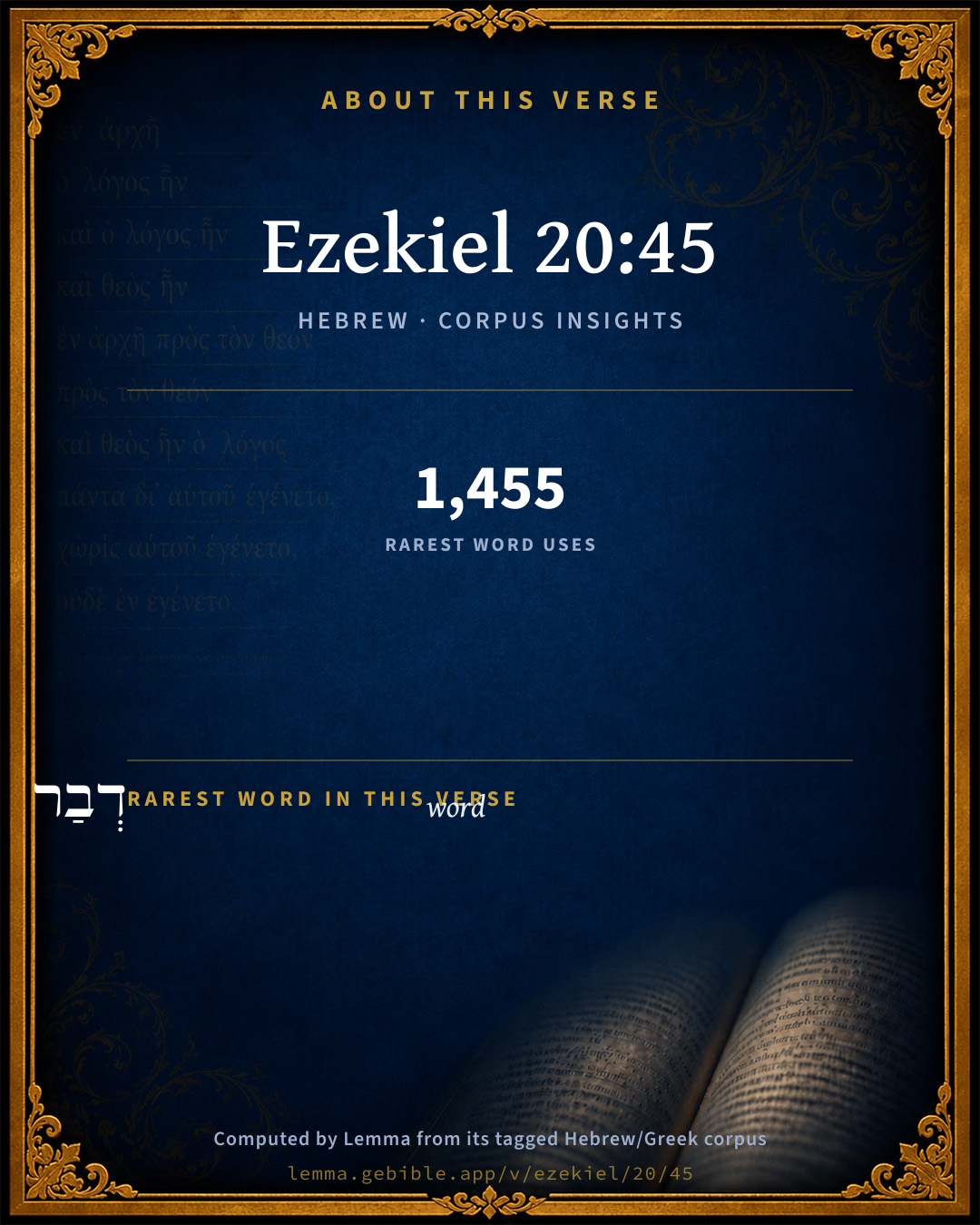
About this verse

These counts appear in no published source. They are computed here, from the morphology-tagged text and Lemma’s own curated glosses. What Lemma adds →

5
words
5
distinct lemmas
Prophets
section

Grammatical profile

  • 2 verbs
  • 2 nouns
  • 1 preposition

Verb forms

  • וַיְהִ֥י Qal · Sequential Imperfect
  • לֵאמֹֽר Qal · Infinitive Construct

Hebrew & Septuagint length

In English translation the verse runs 8 words from the Hebrew and 10 from the Septuagint (LXX English) — closely comparable.

A rough comparison of the two English renderings, which tokenize alike — not a word-level alignment.

Word counts can differ between the Hebrew and the Greek without any difference in meaning — e.g. the Hebrew direct-object marker אֵת has no separate Greek word, and Greek often adds the article ὁ.

Hebrew and Greek witnesses Masoretic Hebrew ↔ Greek Septuagint

The same verse in the two great witnesses to the Old Testament, shown verse-for-verse.

These are two independent witnesses, not word-aligned to each other, and the Septuagint is shown in lemma (dictionary) form.

Hebrew Ezekiel 20:45 Masoretic · Westminster Leningrad Codex

וַיְהִ֥י דְבַר יְהוָ֖ה אֵלַ֥י לֵאמֹֽר

The word of Yahweh came to me, saying,

World English Bible · Public Domain

Greek LXX Ezekiel 20:45 Septuagint · lemma form
And the word of the Lord came to me, saying,

LXX2012 (modern English Septuagint) · Public Domain

On this verse, Fairbairn on Ezekiel, Jonah & the Pastoral Epistles discusses the Septuagint’s reading. Read the note in Commentary ↓

Hebrew: Westminster Leningrad Codex (CC BY 4.0). Greek: Septuagint (public domain); English from LXX2012 (modern English Septuagint) (Public Domain). How the Septuagint differs from the Hebrew →

Commentary

Notes on Ezekiel 20:45 from classic Christian and Jewish commentators (each source and its license shown beneath its notes). The classic Christian expositions comment on the surrounding passage and are grouped to its opening verse, so a note may address several verses; the Jewish commentaries on the Tanakh (Rashi and others) are per-verse, so they appear only where the commentator wrote on this verse.

Lemma curates 59 commentaries, every one of them public domain or Creative Commons licensed, each selected and text-cleaned for this edition rather than reprinted as found. About our sources →

Ellicott's Commentary for English Readers

(45) Toward the south.—The parable of Eze_20:45-48 forms what might be called the text of the discourse in Ezekiel 21. The word south, here occurring three times, is represented in the Hebrew by three separate words, which mean, by their derivation, respectively, “on the right hand” (the orientals always supposing themselves to face the east when they speak of the points of the compass),” the brilliant or “mid-day direction,” and “the dry land,” a common name for the south of Palestine. Judæa is spoken of as “the south,” because, although actually nearly west from Babylon, it could only be approached by the Babylonians from the north, on account of the great intervening desert. Hence the prophets always speak of the armies of Babylon as coming from the north (see Note on Eze_1:4; Jer_1:14-15, &c.).

The forest of the south field, might be originally a mere poetic description of the land; but the figure is developed in the following verses, to make the forest the nation, and its trees the people which compose it.

A Bible Commentary for English Readers, edited by Charles John Ellicott (1878–1897) — public domain. Text from a community e-Sword module.

The Cambridge Bible for Schools and Colleges

gen. ed. J. J. S. Perowne

Ch. Eze_20:45 to Eze_21:32. The avenging sword of the Lord

The passage Eze_20:45-49 belongs to ch. 21 (as in Heb.). The time to which the chapter is to be assigned is the early period of Nebuchadnezzar’s movements westwards. The prophet foresees the coming desolation of Israel by the conqueror, which he expresses under the figure of a devouring fire, consuming all indiscriminately. The passage has two divisions, ch. Eze_20:45 to Eze_21:27, and Eze_21:28-32.

First division. Eze_20:45 to Eze_21:27.

(1) Eze_20:45-49. A conflagration shall be lighted in the forest of the south, which shall consume all, the green tree and the dry.

(2) Eze_21:1-5. Explanation: the sword of the Lord shall be on Jerusalem and her sanctuaries, and on the land of Israel. Righteous and wicked shall perish; and men shall know that the Lord hath drawn his sword.

(3) Eze_20:6-7. Agitation of the prophet at the thought of the coming desolation: so shall all men be agitated and confounded.

(4) Eze_20:8-17. Song of the sword—the sword of the Lord whetted and furbished against Jerusalem.

(5) Eze_20:18-27. He who is the sword or wields it, the king of Babylon. The prophet returning to the point from which he started represents the king of Babylon hesitating whether to march against Ammon or Jerusalem. He consults the oracle and the lot comes out “Jerusalem.”

Eze_20:45-49. Figure of a forest in which a great conflagration is kindled. The fire is unquenchable (Eze_20:47-48), it devours all alike, the green tree and the dry (Eze_20:47); all faces from north to south shall be scorched by it (Eze_20:47); and all flesh shall see that it is the hand of the Lord which has kindled so great a flame (Eze_20:48).

The Cambridge Bible for Schools and Colleges (gen. ed. J. J. S. Perowne; Cambridge University Press, 1878–1918) — public domain. Text from a community e-Sword module.

Trapp's Complete Commentary

John Trapp

Eze 20:45 Moreover the word of the LORD came unto me, saying,

Ver. 45. Moreover, &c.] See on Eze 18:1.

John Trapp, A Commentary or Exposition upon All the Books of the Old and New Testament (1647–1656) — public domain. Text from a community e-Sword module.

The Biblical Illustrator

Joseph S. Exell

Eze_20:45

All flesh shall see that I the Lord have kindled it.

A vision of Divine judgment

I. Divine judgment is a terrific fact. God has His ideas about conduct; has a care about His moral universe. His ideas, when uttered in what we solemnly call judgments, are appropriately uttered. The flood, the fire on the cities of the plain, the destruction of Jerusalem, the death of the Saviour, the ghastly mysteries of hell--all utter Gods judgments on evil.

II. Divine judgment wrought by human agency. Judges, and parliaments, and kings; the frown of friendship, the hiss of outraged conscience in the home, or the Church, or the State; the pursuit of the police detective, and the grip of the gaoler; the revolutions of nations, and the catastrophes of commerce, may all, however blindly, be human agents in Divine retribution.

III. Divine judgments marked by naturalness. Let a man recall his life, break it up into the seven ages Shakespeare depicts, and he will find the resultant of the sins of each age in the retribution he has to suffer. The sinner finds, as has been strikingly said, that just as by abusing the body he brings a curse on it, so by abusing the soul.

IV. Divine judgment is very comprehensive in its influence. It is in accordance with historic facts, philosophic theory, and moral rectitude, that man should bring blessing or evil upon his fellow man. This fact, first, illustrates the extent of human influence; second, suggests the accountability of man to man for his moral conduct.

V. Divine judgment benevolent in its purposes.

1. The revolutions of life are under Divine control.

2. The result of these revolutions will be the victory of righteousness.

All the processes of repentance and doubt, of spiritual and of mental struggle, are designed by God to lead not to perpetual anarchy and revolt, but the rest and peace of submission to Christ. (Urijah R. Thomas.)

The Biblical Illustrator, edited by Joseph S. Exell (c. 1880s–1900s) — public domain. Text from a community e-Sword module.

Joseph Benson's Commentary

Eze 20:45-49. Moreover, the word of the Lord, &c. — Here we have a new prophecy, with which Houbigant, following many learned commentators, begins the xxist chapter, and that very properly; for what is contained in that chapter is only an explanation of what is contained in the remainder of this. Son of man, set thy face toward the south — The prophets were generally commanded to turn themselves toward the places concerning which they were going to prophesy; and Ezekiel being now in Chaldea, near the river of Chebar, Judea lay to the south of him. And drop thy word, &c. — That is, prophesy. The gift of prophecy seems to be here compared to rain, or dew, distilling from heaven upon the earth, and refreshing and rendering it fruitful: see Deu 32:2. Such is the benefit of sound doctrine wherever it is received. And prophesy against the forest of the south field — By this is meant Jerusalem, the word forest being taken metaphorically for a city; either because its stately buildings resembled tall cedars standing in their several ranks, or, as Archbishop Secker supposes, from the number of its inhabitants. And say, Behold, I will kindle a fire in thee — By fire here is meant, not only the burning of literal fire, but every thing which destroys or consumes, as in Eze 19:12. Indeed, fire is often taken, in a general sense, for God’s severe judgments, which, it is here said, shall devour both the green tree and the dry, that is, the righteous as well as the wicked; the righteous being here, as elsewhere, compared to green and flourishing trees, and the wicked to dry and withered ones, such as are only fit for the fire. The flaming flame shall not be quenched — The evils I will send upon them shall not cease, till what I will has been accomplished. And all faces from the south to the north shall be burned — The destruction shall reach from one end of the land to the other: see Eze 21:2; Eze 21:4. Ah, Lord God! they say of me, Doth he not speak parables? — They make this an argument for disregarding what I say, that I use so many similitudes and metaphorical expressions, that they cannot understand my meaning. To take away all ground for this objection, God commands him, in the next chapter, to speak the same thing in plain words.

Joseph Benson's Commentary on the Old and New Testaments (1811–1818) — public domain. Text from a community e-Sword module.

Dummelow's Commentary on the Holy Bible

J. R. Dummelow

The Sword of the Lord against Jerusalem (and Ammon?)

Ezekiel 21 of the Hebrew Bible begins with Eze_20:45 of the English. It is mainly concerned with Jerusalem (Eze_20:45 to Eze_21:27), but has an appendix consisting of a short prophecy about Ammon, which has been interpreted in different ways (Eze_21:28-32).

(a) Against Jerusalem (Eze_20:45 to Eze_21:27)

An enigmatic parable of a forest fire in the S. (Eze_20:45-49) is explained as referring to the land of Israel, against which God's sword is drawn (Eze_21:1-5). Ezekiel's distress at the announcement is a sign of the dismay which all will feel when it comes to pass (Eze_20:6-7). A 'Song of the Sword' follows (Eze_20:8-17). Next comes a picture of Nebuchadrezzar halting on his march on Palestine, and consulting his oracles as to whether Jerusalem or Ammon should be attacked first. The omens decide for Jerusalem, which is doomed to capture, though its people make light of the heathen oracles (Eze_20:18-24). The prophecy ends with a denunciation of Zedekiah, and a hint of the future ideal king (Eze_20:25-27).

46, 47. Field.. forest of the south] Palestine lay almost due W. of Babylon, but the way between them took a circuit N. owing to the desert, and to one coming from Babylon, Palestine lay directly S. in the last stages of the journey.

J. R. Dummelow, A Commentary on the Holy Bible (Macmillan, 1909) — public domain. Text from a community e-Sword module.

Whedon's Commentary on the Bible

Daniel D. Whedon

BY VIVID SYMBOL AND WITH STRONG CRIES EZEKIEL PROPHESIES THE DESTRUCTION OF JERUSALEM WITH FIRE AND SWORD, Eze_20:45-49; Eze_21:1-27.

The last five verses of chap. 20 should be regarded as belonging to the opening of chap. 21. A conflagration is prophesied in the forest of the “south field” (that is, Palestine, Eze_20:45-48). This is the Lord’s chastisement. The destruction shall be great and men shall know that it is the Lord’s sword which is made bare (Ezekiel 21 :l-5). The prophet heaves bitter sighs and the hearts of all men melt before the sight of this drawn sword of the Lord (Eze_21:6-17) which is held in the hand of the king of Babylon (Eze_20:18-27).

Daniel D. Whedon (gen. ed.), Commentary on the Old and New Testaments (1874–1909) — public domain. Text from a community e-Sword module.

The Preacher's Complete Homiletical Commentary

Joseph S. Exell (gen. ed.)

(Eze_20:45-49)

EXEGETICAL NOTES. The destruction of Jerusalem under the image of a forest devoured by fire.

A comparison of these verses with Eze_21:2-5, shows that they belong properly to Ch. 21. They form the commencement of that chapter in the Hebrew Bible.

Eze_20:46. “Set thy face towards the south.” “There are three words in the Hebrew text of this verse to empress south. They are merely used as synonyms for the sake of varying the expression. The first signifies to be on the right, honoured with reference to the position of the quarter of the heavens when facing the east. The word is used both for the right hand and the south. The second word is of less frequent occurrence, and besides in our prophet, and once in the Pentateuch, is found only in Job and Ecclesiastes. The third word signifies to be dry, dried up: hence the south, where the heat of the sun is most severely felt. All the three terms specially apply here to the southern division of the Holy Land, of which at the time Jerusalem was the capital.”—(Henderson) “Drop thy word.” “A very common expression for prophetic discourse (Deu_32:2). It is suggested by the rain or the dew, and points to the place of its origin,—above, and also to the beneficial influence which it is intended to exert, and is used even when the discourse does not contain promises merely, but also threatening and judgment, as is the case here exclusively, and to a large extent also in Deuteronomy 32. May it not also hint at the concise, abrupt style of composition adopted in this chapter?”—(Lange) “The forest of the south field.” Forest is used figuratively to denote dense masses of people. The densely populated country of Judea 246 is intended. Ezekiel here declares the doom of the Southern kingdom, as Amos had declared the doom of the Northern kingdom (Amo_7:9; Amo_7:11; Amo_7:17).

Eze_20:47. “Every green tree in thee, and every dry tree.” The righteous and the wicked (Eze_21:3-4) Our Lord probably refers to this passage in St. Luk_23:31. “The flaming fire shall not be quenched.” The fierce flame of God’s jealousy (Son_8:6). “All faces.” “Every single thing in the forest, which is caught at once by the flame. From south to north, i.e., through the whole length of the land. From the terrible fierceness of the fire, which cannot be extinguished, every one will know that God has kindled it, that it has been sent in judgment.”—(Keil.)

Eze_20:49. “They say of Me, doth he not speak parables?” They wish to get rid of the application of the prophecy to themselves by describing it as obscure. They pretend not to understand it. “At the same time, it contains within itself a request that they may be explained. This request is granted; and the simile is first of all interpreted in Eze_21:1-7; and then still further explained in Eze_20:8, etc.”—(Keil.) “The riddle is easy to solve, and the prophet has to do with a sharp-witted people; but the hearers will not understand, because the truth is unpleasant to them, and retire with a certain irony behind the difficulty of the form, and make as if they did not understand. To take away this miserable excuse from them, to punish them for their ironical hardness of hearing, he expresses the same in clear and plain terms in the following passage.”—(Hengstenberg.)

HOMILETICS

(Eze_20:46.)

“Drop thy word towards the south.” Heb. Drop towards the south. The word properly signifies the dropping of the clouds, or rain, and is metaphorically put for prophesying and preaching. These are likened unto rain or the droppings thereof.

1. In respect of the flowing and succession of one drop after another. “The heavens dropped, the clouds also dropped water” (Jdg_5:4). So in prophesying, there is one word, one truth after another.

2. In respect to the influence thereof. The drops soak into the earth; so words have influence into men’s ears and hearts (Deu_32:2). As the rains and dews insinuate themselves into the grass and ground, so do words into the heads and hearts of men (Psa_119:130).

3. In respect to the trouble and hurt that oft rains and droppings produce. “A continual dropping in a very rainy day and a contentious woman are alike” (Pro_27:15), alike grievous, troublesome, wasting, and wearying; so prophesying of judgments and destruction is grievous and troubles much; it is like great rains and drops (2Ch_34:25). The Hebrew is, “shall drop upon this place.” There should be a storm, and such great drops of God’s wrath as should consume it. (Greenhill.)

The word of God is rightly likened to rain. Like rain, it descends from above, and not according to man’s will; it is also, like it, useful and beneficial; as rain flows down from rocks upon the fields, so the word of God upon the godless, and, on the other hand, into pious hearts; and, like the rain, it is not equally acceptable to all. (Fessel.)

THE PROPHECY OF JERUSALEM’S DESTRUCTION

(Eze_20:45-49.)

Consider this prophecy—

I. As to its form. This prophecy is uttered in a poetical form, most wild and rugged. The awful and the terrible, as well as the beautiful and tender, find their expression in poetry. The imagery here is that of a forest on fire, and its devouring flame raging beyond the control of man. The boldness of the image will account for the strange and wild forms of the expressions used, and the rapid transitions from one thought to another. We can only understand the style of the Bible, in its prophetic writings, when we consider the intensity and depth of those feelings which possessed the minds of the prophets.

II. As to its substance. The “forests” signify multitudes—the great masses of the population upon whom terrible judgments are about to fall.

1. The judgments are irresistible. The power of God, which is a righteous power, would be at work in them. The storms of the Almighty rush over the forest, and the trees must bend. Moreover, God sends fire, against which nothing can prevail. “The flaming fire shall not be quenched.”

2. The judgments fall even upon the righteous. “And it shall devour every green tree in thee, and every dry tree.” The “dry tree” would be fuel for the flame, but so great would be the destruction that even the “green tree” could not escape. Judgment would come even upon the house of God. Even the people of God have sins enough to bring upon them great calamities. “I will kindle a fire in thee,” in Jerusalem, the centre of religious life, of Church privileges. Like a raging fire, God’s judgments devour all before them.

3. The ungodly are admonished by the afflictions of the righteous. The prophet Zechariah warns the people that, when the great and noble among their countrymen fall, they cannot possibly escape, “Howl, fir tree, for the cedar is fallen” (Zec_11:2.) This is but another form of the Apostle’s statement; “If judgment first begin at the house of God, what shall the end be of them that obey not the gospel of Christ?” It is the very truth which the same apostle puts in the form of a question, “If the righteous scarcely be saved, where shall the ungodly and the sinner appear?” When our Lord bids the daughters of Jerusalem to weep for themselves for the destruction which was about to come upon their devoted city, He adds, “For if they do these things in the green tree, what shall be done in the dry?” (St. Luk_23:31). When the green tree cannot stand before the flame, how can the dry tree hope to escape! Christ was righteous, yet He did not escape the judgments of sin. He suffered for sin. “It pleased the Lord to bruise Him and to put Him to grief.” “He was numbered with the transgressors.” We can see how real a thing sin is, and how hateful in the sight of God, when we reflect how terribly the effects of it were visited upon Jesus Christ, the Righteous. And God employs judgments to purify His people; yet, even in their case, these are truly chastisements. God is specially severe in His judgments upon the chosen people, “You only have I known of all the families of the earth; therefore will I punish you for all your iniquities.” His very intimacy with them is put forward as a reason for leaving no iniquity unpunished. In all His dealings with His chosen, God has ever acted upon this principle. Witness the wanderings and sufferings of the patriarchs—the dispersions and captivities of Israel—the untimely death of Moses and of Aaron—the troubles of Eli—the sorrows of David—the present afflictions of the righteous. If the green trees thus suffer, the dry cannot be spared.

III. As to its reception. The prophecy is objected to as obscure, as a dark and mysterious saying. “Then said I, Ah, Lord God! they say of me, Doth he not speak parables?” As if they said, “He is a speaker of parables, a mere utterer of dark sayings.” There is probably a vein of irony in these words with which the hearers received the prophet’s message; as if they would thus speak, “It is a clever saying of things which sound very terrible, if we could only understand it.” Sinners never want excuses for neglecting the prophet’s message. Either the message is too dark and mysterious, or else it is too simple. If the prophet announces unwelcome truths, and touches their conscience, they cry out against him. If he threatens God’s judgments, he is not to their mind. They will have none but those who prophesy smooth things. Thus men find fault now with God’s revelation. If He says what we already know, we think it is superfluous: we do not want a revelation to teach us that. If He says one word beyond what nature or reason might have taught us, we say it is irrational. One plain declaration of the Bible we pronounce as inconsistent with probability, another as inconsistent with some human authority, another as inconsistent with God’s justice, and another as inconsistent, with Christian charity. And in the same way men treat the proofs and evidences of religion. One does not like miracles, and another objects to the very idea of prophecy. The one saying, that it is altogether unworthy of God to suspend His own laws; and the other, that it is unworthy of God to dignify human persons by the prediction of their names and deeds. Another will hear of nothing but the internal evidence of the truth, the goodness of the word spoken, the comfort conveyed to his own heart. And what each man does not personally like, he casts aside as of no value. Objections of this kind are often but mere excuses. The real repugnance is to the idea of being taught anything from God or His prophets. Neither the ministry of John the Baptist nor even of Christ Himself could please the evil generation of their day. “But wisdom is justified of her children.”

The Preacher's Complete Homiletical Commentary (gen. ed. Joseph S. Exell; Funk & Wagnalls, c. 1892) — public domain (pre-1929). A full-Bible homiletical/sermon-outline anthology covering 65 of 66 books (2 John is absent from the source module). Text from a community e-Sword module.

Keil & Delitzsch

C. F. Keil & F. Delitzsch

The Burning Forest

Eze 20:45. And the word of Jehovah came to me, saying, Eze 20:46. Son of man, direct thy face toward the south, and trickle down towards the south, and prophesy concerning the forest of the field in the south land; Eze 20:47. And say to the forest of the south land, Hear the word of Jehovah; Thus saith the Lord Jehovah, Behold, I kindle a fire in thee, which will consume in thee every green tree, and every dry tree: the blazing flame will not be extinguished, and all faces from the south to the north will be burned thereby. Eze 20:48. And all flesh shall see that I, Jehovah, have kindled it: it shall not be extinguished. Eze 20:49. And I said, Ah, Lord Jehovah! they say of me, Does he not speak in parables? - The prophet is to turn his face toward the south, and prophesy concerning the forest of the field there. הטּיף is used for prophesying, as in Amo 7:16 and Mic 2:6, Mic 2:11. The distinction between the three epithets applied to the south is the following: תּימן is literally that which lies on the right hand, hence the south is a particular quarter of the heavens; דּרום, which only occurs in Ezekiel and Ecclesiastes, with the exception of Deu 33:23 and Job 37:17, is derived from דּרר, to shine or emit streams of light, and probably signifies the brilliant quarter; נגב, the dry, parched land, is a standing epithet for the southern district of Palestine and the land of Judah (see the comm. on Jos 15:21). - The forest of the field in the south is a figure denoting the kingdom of Judah (נגב is in apposition to השּׂדה, and is appended to it as a more precise definition). שׂדה is not used here for a field, as distinguished from a city or a garden; but for the fields in the sense of country or territory, as in Gen 14:7 and Gen 32:3. In Eze 20:47, יער , forest of the south land, is the expression applied to the same object (הנגב, with the article, is a geographical term for the southern portion of Palestine). The forest is a figure signifying the population, or the mass of people. Individual men are trees. The green tree is a figurative representation of the righteous man, and the dry tree of the ungodly (Eze 21:3, compare Luk 23:31). The fire which Jehovah kindles is the fire of war. The combination of the synonyms להבת שׁלהבת, flame of the flaming brightness, serves to strengthen the expression, and is equivalent to the strongest possible flame, the blazing fire. כּל־פּנים, all faces are not human faces or persons, in which case the prophet would have dropped the figure; but pânim denotes generally the outside of things, which is the first to feel the force of the flame. "All the faces" of the forest are every single thing in the forest, which is caught at once by the flame. In Eze 21:4, kŏl-pânim (all faces) is interpreted by kŏl̇-bâsar (all flesh). From south to north, i.e., through the whole length of the land. From the terrible fierceness of the fire, which cannot be extinguished, every one will know that God has kindled it, that it has been sent in judgment. The words of the prophet himself, in Eze 20:49, presuppose that he has uttered these parabolic words in the hearing of the people, and that they have ridiculed them as obscure (mâshâl is used here in the sense of obscure language, words difficult to understand, as παραβολή also is in Mat 13:10). At the same time, it contains within itself request that they may be explained. This request is granted; and the simile is first of all interpreted in Eze 21:1-7, and then still further expanded in Eze 21:8.

Keil & Delitzsch — Biblical Commentary on the Old Testament (1861–1891) — public domain (CC PDM 1.0). Text via the HelloAO Bible API. (Old Testament only.)

Fairbairn on Ezekiel, Jonah & the Pastoral Epistles

Patrick Fairbairn

CHAPTER 20:45-49, 21.

THE VISION OF THE LORD’S FIRE AND SWORD.

THE five concluding verses in Eze 20:45-49, as already noticed, should evidently have been connected with Ezekiel 21, and are justly regarded by interpreters as a kind of general introduction to what follows, or a brief delineation under one aspect of what is afterwards more fully and explicitly described under another. The leading import of the vision is plain enough; but it is written throughout in a style so singularly abrupt, and in some parts so utterly enigmatical, that it may certainly be considered, as a whole, one of the darkest portions of Ezekiel’s writings. Even Horsley, who was not scrupulous in forcing a way where none naturally presented itself, has here simply left a record of his inability to proceed, in the brief note, “The difficulties of this passage are to me insuperable.” For once, at least, his ready resort to a change in the text proved insufficient to bring the necessary relief. Various emendations of the text have been suggested by late authors; but these, being of an entirely arbitrary and conjectural character, are incapable of yielding satisfaction, and are seldom even deserving of notice. I cannot, certainly, pretend to say that I see my way through all the obscurities of the passage, as it stands, and shall not hesitate to state my doubts as to the real meaning, where I have failed to get them removed. But the portions of this kind are not, after all, very numerous, and will be found to interfere comparatively little with the general import of the prophet’s communication.

For the greater facility and clearness of interpretation, we shall take the passage in successive portions.

Eze 20:45. And the word of the Lord came to me, saying,

Eze 20:46. Son of man, set thy face by the way on the right (south), and pour forth toward the south, and prophesy towards the forest of the field in the south.

Eze 20:47. And say to the forest of the south, Hear the word of Jehovah: Thus saith the Lord Jehovah, Behold, I am about to kindle a fire in thee; and it will devour every green tree in thee, and every dry tree; the glowing flame (The two words here used, לַהֶבֶת שַׁלְחֶבֶת are very like in sound, and also not very different in meaning, although they are not quite so synonymous as our translators have taken them to be. The second rather means ardent, glowing heat, than flame in the ordinary sense. What is meant is evidently a flame of intense fervency.) shall not be quenched, and all faces shall be scorched by it, (Here, as not unfrequently with Ezekiel, the figure is dropt, or rather, figure and reality are mingled together. He lets out the secret, that men are represented by the trees, when he speaks of all faces being burnt. (See similar violations in Eze 19:7, and various passages in Ezekiel 21.)) from the south to the north.

Eze 20:48. And all flesh shall see that I Jehovah have kindled it; it shall not be quenched.

Eze 20:49. And I said, Ah! Lord God, they say of me, Does he not speak in parables?

In this portion there is an obscurity, but it is an obscurity that arises simply from the want of precision in defining the exact sphere of the vision. That it indicates a severe and consuming judgment from the Lord upon some land and people, situated somewhere to the south of the prophet, admits of no doubt. For the substitution in one place of faces instead of trees, as the subjects of the burning, renders it manifest that the vision has respect to the inhabitants of a country. And when the conflagration is represented as falling upon every tree, the green as well as the dry, those that were apparently not fit as well as those that were fit fuel for the flame, this could only be meant to express the fearfully comprehensive character of the coming judgment, as not sparing even the better part, who might seem undeserving of such a visitation. It is in the same way, and with reference, doubtless, to this part of the vision, that our Lord, pointing from the troubles that were befalling himself, to those which were soon to befall the Jewish people, said, “For if they do these things in a green tree, what shall be done in the dry?” (Luk 23:31); if such things befall one who has done nothing to provoke them, what may be expected for those who are the fit objects of Heaven’s vengeance? or, if the righteous suffer thus, what must be the measure of severity that is preparing to overtake the wicked? So that by the green trees can only be understood the more righteous, and by the dry trees the more wicked portions of the community; they were all alike to be involved in the coming desolation. But who precisely were the people thus to be visited, or by what kind of instrumentality the desolation was to be brought upon them, the vision so far is entirely silent; and it might truly be said in this respect, that the prophet was speaking in parables. He notices the complaint that was sometimes made respecting the parabolical character of his communications, as if on this occasion, at least, it might justly be complained of. And he presently obtains from the Lord what may be called a duplicate of the vision, only of such a kind as served to make perfectly intelligible both who the objects of the foreseen calamity were, and who also were to be the instruments of inflicting these upon them.

Eze 21:1. And the word of the Lord came unto me, saying,

Eze 20:2. Son of man, set thy face toward Jerusalem, and pour forth toward the holy places, and prophesy toward the land of Israel.

Eze 20:3. And say to the land of Israel, Thus saith the Lord, Behold, I am against thee, and will draw forth my sword out of its scabbard, and will cut off from thee righteous and wicked.

Eze 20:4. Because I cut off from thee righteous and wicked, therefore my sword shall go forth out of its scabbard against all flesh from south to north.

Eze 20:5. And all flesh shall know that I Jehovah do make my sword to go forth out of its scabbard; nor shall it return again.

Eze 20:6. And thou, son of man, sigh with breaking of loins, and with bitterness sigh before their eyes.

Eze 20:7. And it shall be, when they say to thee, Wherefore dost thou sigh? that thou shalt say, For the tidings; because it comes, and every heart melts, and all hands hang down, and every spirit faints, and all knees become water; lo! it comes, and shall be brought to pass, saith the Lord Jehovah.

Here the darkness and ambiguity that hung over the earlier part of the vision, so far as the precise locality is concerned, is entirely removed. The region of judgment and desolation is now expressly determined to be the land of Israel, and more especially Jerusalem and its holy places. And if any doubt had remained as to the extent of meaning indicated in the former vision by the burning up of “every green and every dry tree,” the declaration that the sword to be presently drawn was to cut off both “the righteous and the wicked,” must have set it completely at rest. But the announcement that there was going to be such an indiscriminate and unsparing execution of judgment in Judea is startling, and presents an apparent contrariety to the command given in an earlier vision (Eze 9:4), to seal the fore heads of the righteous, as persons set apart and entrusted to the safe custody of God against the coming evil. It was, no doubt, the stumbling-block of this seeming contrariety which prompted the translator in the Septuagint to make a violent change in the text, so as to express the sense,” I will destroy out of thee the lawless and unjust” (ἐξολεθρεύσω ἐκ σοῦ ἄδικον καὶ ἄνομον.). But it is only on a superficial consideration that the one passage will appear at all contradictory to the other. For here, as is manifest from the whole nature of the representation, it is the merely external aspect of the visitation which the prophet has in his eye. The sword of the Lord’s judgment, he announced, was to pass through the land, and accomplish such a sweeping overthrow, that all, without exception, would be made to suffer in the fearful catastrophe. This did not prevent, however, but that there might be, in the midst of the outward calamities which were thus to burst like a mighty tempest over the land, a vigilant oversight maintained, and special interpositions of Providence exercised, in behalf of the pious remnant who still continued faithful to the covenant of God. It was this distinguishing goodness to some, even amid the horrors of a general desolation, which, as we showed before, was the real object of that sealing of God’s servants on the forehead in a former vision; while here, on the other hand, it is merely the general desolation itself which is contemplated by the prophet. And the very circumstance that he should now have looked so exclusively on the outward scene of carnage and distress, which he descried in the approaching future, seemed to say that this was to be the grand feature of the time, and that the special interpositions which were to be put forth in behalf of the better portion would be so few that they scarcely required to be taken into account. It is obvious, too, that the description given even of the general desolation must be understood with some limitation. For, that the sword should literally be unsheathed against all flesh from north to south in the land, and should cut off or destroy all within its borders, whether righteous or wicked, would not only be at variance with the other prophecies of Ezekiel, but would even not consist with the sequel of this prediction itself, which, as we shall see, still speaks of a purpose of mercy in behalf of the covenant-people. But undoubtedly he wished to convey the impression of a very fearful and overwhelming destruction. The immediate prospect of this national disaster had called his mind back again from the bright vision of distant glory he had unfolded at the close of the preceding communication, and as seeing all now overshadowed with gloom, his soul was filled with the deepest trouble and anguish. Agitated and rent, as he thus was, with the most painful and violent emotions, he naturally proceeds to give utterance to his feelings in abrupt sentences and plaintive reiterations.

Patrick Fairbairn — An Exposition of Ezekiel (1851), Jonah (1849), and The Pastoral Epistles (1874) — public domain. Text from a community e-Sword module.

F. W. Grant's Numerical Bible

Section 2 (Eze 20:45-49; Eze 21:1-32).

The sword upon the righteous and the wicked.

We are nearing the end of all this part of Ezekiel -the first Division. There is little more now than the reiterated announcement of judgment, which in the last chapter, the 24th, we see begun. Nebuchadnezzar has there begun the siege of the city, which we see him here contemplating. And with this commencement of what the prophet has announced, the word for the present ceases. There is no need and no use in any further announcement. The chapter before us shows the sword in Nebuchadnezzar’s hand as God’s judgment upon the land, a judgment so complete that it sweeps away the righteous and the wicked together; that is, the whole land was desolate. It is not meant that there is no discrimination between the righteous and the wicked, for this would contradict what we have had explicitly in a previous chapter as to the seal put upon those who sighed and cried before God for the abominations of the people, and who are, therefore, by this seal itself, put explicitly under the care of God whom they have honored. Nevertheless, the land is swept bare; the righteous and wicked suffer together in this respect. The sword is upon both; only, as we have already seen, and as is simple enough, that which is pure judgment for the one class is only a refining lire for the other, and God is in it carefully superintending the process which is to bring forth a perfect vessel for Himself.

1. First of all, it is insisted that one common doom is to envelop the whole of the land. God will be true to His own, but they cannot save from destruction that which is already devoted to it. God’s wrath is as a devouring fire, which lays hold of all that is before it, and that is the first point. "The word of Jehovah came unto me, saying, Son of man, set thy face towards the south" in which Judah and Jerusalem were), "and drop thy word towards the south, and prophesy against the forest of the south field." According to the idea here given, the cultivated "field" has, as it were, grown wild, grown into a forest, as we know was the case with Judah. (For a similar thought, the meaning of Kirjath-Jearim, "the city of the woods," may be compared in Joshua xv: 9. See Notes.) In such a case, the very fertility of the ground, and the care that may once have been bestowed upon it, only helps the luxuriance of the wild growth. It is the common story of perverted privileges and blessing of every kind. Thus the prophet is to address himself to "the forest of the south." God is bringing a fire upon it, which is of course the symbol of His wrath, although the wrath must in a sense be discriminative, which the fire is not. This is not a contradiction, however. The external calamity reaches all alike, and the green tree suffers with the dry, but God knows how to turn the suffering itself into blessing for His people, which eternity shall reveal; and in spite of all, as He has Himself said, the man that doeth righteousness shall live thereby.

But a flame is devouring the land from south to north. Why the direction here, when the inroad of the enemy was from north to south? It would seem that what is intimated is, what was according to the fact, that the destruction of Jerusalem would scatter the people mainly northward, as it did, and would follow them there.* It was to be the unmistakable evidence of God’s own judgment. God was to be glorified in it when His people were not glorifying, but dishonoring Him. The speech of the prophet, however, is as the people urge, in parables. God was dealing with them after their own fashion, for His plainest warnings had been but words to them; and, shut up in their own unbelief, there seemed no use in speaking more plainly. The ear that was opened would hear; and if it were realized that Jehovah was speaking, the very language of parable would only invite the more to search into the meaning of it.

{*The south was the place of light -under the sun -of privilege, and if the privileges of the light were not used, they became means of dryness. So the various words for "south" indicate the failure to enjoy privilege, and thus "I will curse your blessings" is fulfilled. The fire begins in the south, the place of privilege. "Begin at my house," and it reaches northward, to the mass of the people until all are consumed. -S. Ridout.}

2. Nevertheless, the word of Jehovah answers the voice of the people, and Ezekiel is instructed to speak plainly, to set his face towards Jerusalem, and drop his word toward the holy places, which, of course, were that no more, but only the witness against those who had destroyed them by their desecration. The prophecy is now to the whole land, and God says plainly that the sword, which they might then see drawn out of its sheath, was the sword of no mortal enemy merely, but His own; and as the fire devoured the green wood and the dry, so He would cut off out of the land the righteous and the wicked. The judgment was, as already declared, to be plainly his judgment. And if we follow Daniel to the court of the king of Babylon, we shall see how God took care to make known, in such a way that the heathen himself had to acknowledge it, His power and majesty, whose sanctuaries Nebuchadnezzar might seem to have overthrown. The king of Babylon was, as the chapter itself declares plainly, but an instrument in the hands of the Almighty who wielded all the power which Nebuchadnezzar would naturally ascribe to himself. In fact it was this which brought judgment upon him -a judgment which humbled his heart and brought him fully to own the Most High God, while the hearts of His own people remained intractable and rebellious. But it is not without sorrow, such as He never hesitates to attribute to Himself, that God inflicts this inevitable chastisement; and the sighing of the prophet, even with breaking of the loins and bitterness, is but the echo of what is in the heart of Him who bids him give vent thus to his human sorrow. As of old it was said, "In all their affliction He was afflicted," so it ever is, even when He whose delights are with the sons of men has to manifest Himself against them. The tears of the Lord over Jerusalem, when He took leave of it, witness with the anguish of the prophet. Yet He who wept could not spare; and that which threatened now would melt the heart and enfeeble the hands and make every spirit faint; and it was already upon them: "It cometh, it is even here, saith the Lord Jehovah."

3. Still, we have to be reminded once more of what is involved in this. It is not simply the judgment of a people, but of a people with whom were the promises of God; and it is this which for the time sets aside those promises, that they cannot be fulfilled. The sons of David, however much in rebellion against God, had nevertheless built themselves up in pride upon these very promises; and the heart of the righteous might plead with Him: Was He going to permit that the sweet assurances He had given be made void? Might they make mirth and say, as if from God’s side of things, "The sceptre of my Son despiseth every tree?"* Could it not make light of all human power, however firmly rooted, which would set itself in opposition against it? "The sceptre of my Son" shows the thought implied. Was it not, according to the second psalm, the One who could declare the decree that Jehovah had said to Him, "Thou art my Son; this day have I begotten Thee," who was appointed to rule upon God’s holy hill of Zion, and the very ends of the earth were to be given into His hands? And had it not been said in older prophecy, that the sceptre should not depart from Judah and a lawgiver from between his feet, until Shiloh came? (Gen 49:1-33.) How simple, it seemed, to put such things together, and think of it as faith itself, to resist the conviction of coming judgment. Yet, in spite of this, the prophet affirms that it is coming. The sword of the Lord, He has made it ready, furbished and sharpened it, that it should be as fully as possible effective, and this sword was to be against this people of Jehovah, and against all the princes of Israel; princes and people alike were to be given up to the sword. Yea, the test (in the event) was even now being made; and what if this sceptre that despiseth were actually to be no more? asks the Lord Jehovah.

{*"He that sitteth in the heavens shall laugh"; God’s sceptre, held by His Son, would lay low every thing that exalted itself against Him, would bring down the high tree and dry up the green tree. Hengstenberg makes this rod, despising every tree, to be the affliction which is now about to fall upon the people -so great that it eclipses ("despises") all former rods of affliction. But the explanation in the text is so lucid, appropriate and complete, that there can be little room for questioning it. -S. Ridout.}

How readily may His people misinterpret His plain words! How ready are we today to misinterpret them! How often do we hear that "the knowledge of the glory of the Lord is to cover the earth as the waters cover the sea" interpreted as being of course through the spread of Christianity -and this after nearly 2,000 years, which have manifested its incapacity to do this; and not merely this, but exhibited everywhere, as is so plain today, its capacity for decay -yet how many still look for this! And the very word which announces what is plainly opposite to such thoughts is made to confirm them: "Israel shall bud and blossom, and fill the face of the earth with fruit" -and are not we Christians the true Israel?

Thus we see the heart searched out in Ezekiel’s day; and here we have a glimpse, as it would seem, that we have not elsewhere, as to the perplexity which must have been in the hearts of many of such a day, faced with all those promises of triumph and blessing of which Scripture is full for them; and then, on the other hand, faced by the prophet now with this assurance of the coming desolation. But God’s word abides, and time will reconcile all these things. What concerned them now was to realize the Lord’s judgment upon His people, and its sure and swift coming. "Son of man, prophesy and smite thy hands together, and let the sword be doubled the third time:" the strokes of it growing only the more terrible to the end -perhaps, if we are to read the number symbolically, until the time of full manifestation. This is the sword which is soon to be busy in its dreadful work, and among the slain, the "great one," the sword which has penetrated to the king himself who is the "deadly wounded." Not that Zedekiah was himself slain in the siege or after it: we know he was not. His sons were slain before his eyes, and then those eyes that had been witness of the awful sorrow were put out, that they might see the light no more. As king, he lived no more; and his life after that, was it life? And still the sword swept on, melting every heart and multiplying the carcases so that men stumbled over them. And there was no escape from it: the threatening sword was against all their gates. Its very glitter was meant by God as prophesying the sure quenching in blood which was to follow. Jehovah turns to it and bids it do its work: gather up its strength, go to the right, turn to the left, finding its work unfailingly wherever it turned, for it could not miss worthy objects. And thus was Jehovah’s wrath: "I will smite my hands together, and I will cause my wrath to rest. I Jehovah have spoken."

4. The next word of Jehovah contemplates more the human instrument which is implied in all this. The sword is the sword of the king of Babylon, which, even if blindly, is none the less the instrument of the Hand which is over him continually. The prophet marks his course, the path that he is to pursue. He sees him pause, and hesitate, where the one road out of his land separates into two. The one road leads to Rabbah of the Ammonite; the other to Jerusalem, strong in its fortifications. There he stands at the parting of the way, practising his vain divination, shaking his arrows, inquiring of the teraphim, looking into the liver. In his right hand is the divination for Jerusalem, to lay siege to it. A poor thing in itself, against which men might build themselves up, as mere false divination of the heathen -they who had in Jehovah’s name sworn faithfulness to the king of Babylon and broken their oath! All right to scorn the heathen divination, but what about Jehovah who has been scorned and defied? "He bringeth the iniquity to remembrance that they may be taken." And thus the divination does not fail.

5. Divine government has not loosed its hand upon men in all this. Nay, it is the very thing that is coming out in its full reality. The "iniquity of the end" (which is bringing about the end) has taken place. The crown is gone from the head of the king of Israel, and the mitre of the high priest, which was supported by the crown, has to go also. That which still existed was to be no more. The wheel was going round! That which is low is to be exalted; that which is high is to be abased. "I will overturn, overturn, overturn it," says Jehovah; "and it shall be no more until He come whose right it is, and I will give it Him." Thus there is even here a gleam through the thunderclouds. All other hands are proved incompetent to wield this sceptre which God is taking for the time being from the line of David. There is One, however, who has right, and who will put forth His claim to it, and Judah’s rod of magistracy would

not cease until Shiloh comes. How sweet such a promise to a sorely-stricken heart! How sweet for us in our own day, revealing, as it does, the mystery of the breakdown of all things upon which we rest our human hopes, "until He comes whose right it is!" How we forget this, that the overturning is not something against His right, but contemplates it. Just as Israel’s desolate land with all its desolation speaks of a people for whom it is waiting, in God’s design, so the broken sceptre and the empty throne are only waiting for the One to come who surely will fulfil every promise, and outdo all that the heart can imagine or crave, in the blessing that He brings.

There is yet one final word: Ammon had escaped; the enemy of God’s people had gone scot-free. The king of Babylon had turned off to Jerusalem; and the enemy now can insult them as they will. Ammon, as we know, was an ancient enemy of Israel; and, as a type, shows still more the opposition of the heart to that which is of God. We may remind ourselves how in the days of Jephthah, and afterwards in the days of Saul, Ammon stood forth under its king Nahash. "the serpent," as bent upon taking from Israel the land that was their own. (Jdg 11:1-40 and 1Sa 11:1-15, Notes.) This is ever the work of the enemy of our souls -not merely to gain a victory over the people of God, but to take from them the very portion which God has given them. Israel’s sins, now at their height, bringing judgment upon them, the desolate land lay open to the attacks of the enemy. But God’s eye is upon it, and Ammon is not to escape. The sword is to prove itself as Jehovah’s sword in this way also. Misjudging altogether the work of God, as the enemy continually misjudges it, Ammon brings upon himself the wrath in which, as against others, he is rejoicing. "And I will blow upon thee," says the Lord, "with the fire of my wrath, and deliver thee into the hand of brutish men, skilful to destroy. Thou shalt be for fuel to the fire; thy blood shall be in the midst of the land; thou shalt not be remembered. For I Jehovah have spoken." Thus, where all seems wreck, and what God has done for His glory seems to have fully shared in this, yet Jehovah’s word stands forth unchanged in its utterance!

F. W. Grant, The Numerical Bible (4th ed., 1903) — public domain. Text from a community e-Sword module.

Tyndale Open Study Notes

Tyndale Open Resources

20:45-49 Like a parable, this prophecy both reveals and conceals its message, leading the people to complain that the prophet only talks in riddles (see Matt 13:10-17). It reveals the coming of an all-consuming judgment (a fire that will burn up every tree), but conceals who is being judged.

Tyndale Open Study Notes — © Tyndale Open Resources, licensed CC BY-SA 4.0. Text via the HelloAO Bible API.

Matthew Henry's Commentary

We have here a prophecy of wrath against Judah and Jerusalem, which would more fitly have begun the next chapter than conclude this; for it has no dependence on what goes before, but that which follows in the beginning of the next chapter is the explication of it, when the people complained that this was a parable which they understood not. In this parable, 1. It is a forest that is prophesied against, the forest of the south field, Judah and Jerusalem. These lay south from Babylon, where Ezekiel now was, and therefore he is directed to set his face towards the south (Eze 20:46), to intimate to them that God had set his face against them, was displeased with them, and determined to destroy them. But, though it be a message of wrath which he has to deliver, he must deliver it with mildness and tenderness; he must drop his word towards the south; his doctrine must distil as the rain (Deu 32:2), that people's hearts might be softened by it, as the earth by the river of God, which drops upon the pastures of the wilderness (Psa 65:12) and which a south land more especially calls for, Jos 15:19. Judah and Jerusalem are called forests, not only because they had been full of people, as a wood of trees, but because they had been empty of fruit, for fruit-trees grow not in a forest; and a forest is put in opposition to a fruitful field, Isa 32:15. Those that should have been as the garden of the Lord, and his vineyard, had become like a forest, all overgrown with briers and thorns; and those that are so, that bring not forth the fruits of righteousness, God's word prophesies against. 2. It is a fire kindled in his forest that is prophesied of, Eze 20:47. All those judgments which wasted and consumed both the city and the country-sword, famine, pestilence, and captivity, are signified by this fire. (1.) It is a fire of God's own kindling: I will kindle a fire in thee; the breath of the Lord is not as a drop, but as a stream, of brimstone to set it on fire, Isa 30:33. He that had been himself a protecting fire about Jerusalem is now a consuming fire in it. All flesh shall see by the fury of this fire, and the desolations it shall make, especially when they compare it with the sins which had made them fuel for this fire, that it is the Lord that has kindled it (Eze 20:48), as a just avenger of his own injured honour. (2.) This conflagration shall be general: all orders and degrees of men shall be devoured by it - young and old, rich and poor, high and low. Even green trees, which the fire does not easily fasten upon, shall be devoured by this fire; even good people shall some of them be involved in these calamities; and if this be done in the green trees, what shall be done in the dry? The dry trees shall be as tinder and touch-wood to this fire. All faces (that is, all that covers the face of the earth) from the south of Canaan to the north, from Beer-sheba to Dan, shall be burnt therein. (3.) The fire shall not be quenched; no attempts to give check to the dissolution shall prevail. When God will ruin a nation, who or what can save it?

Now observe, 1. The people's reflection upon the prophet on occasion of this discourse. They said, Does he not speak parables? This was the language either of their ignorance or infidelity (the plainest truths were as parables to them), or of their malice and ill-will to the prophet. Note. It is common for those who will not be wrought upon by the word to pick quarrels with it; it is either too plain or too obscure, too fine or too homely, too common or too singular; something or other is amiss in it. 2. The prophet's complaint to God: Ah, Lord God! they say so and so of me. Note, It is a comfort to us, when people speak ill of us unjustly, that we have a God to complain to.

Matthew Henry's Commentary on the Whole Bible (1708–1710) — public domain (CC PDM 1.0). Text via the HelloAO Bible API.

Jamieson, Fausset & Brown

Robert Jamieson, A. R. Fausset & David Brown

An introductory brief description in enigma of the destruction by fire and sword, detailed more explicitly in Eze. 21:1-32.

Jamieson, Fausset & Brown — Commentary Critical and Explanatory on the Whole Bible (1871) — public domain (CC PDM 1.0). Text via the HelloAO Bible API.

John Gill's Exposition

And say to the forest of the south,.... To the inhabitants of Jerusalem and Judea:

hear the word of the Lord; attend to it, and receive it, believe it, and take warning from it:

thus saith the Lord God, behold, I will kindle a fire in thee; in Jerusalem; meaning that he would send great calamities among them, the sword of the Chaldean army, famine, and pestilence; and that at last it should be burnt with fire, and the remainder of the inhabitants be carried captive:

and it shall devour every green tree, and every dry tree; all sorts of persons should be consumed by one or other of the above calamities, high and low, rich and poor, good and bad; and if good men should suffer, comparable to green trees, which fire will not so easily burn, not being fit fuel for it; then much more bad men, who were by far the most numerous, comparable to dry trees, and so fit fuel for the flames, and easily consumed thereby:

the flaming flame shall not be quenched or, the "flame, flame"; or, "the flame of flame" (o); signifying either the succession of these calamities one after another; or the force and strength of them, which should not be abated until the ruin of the city was completed:

and all faces from the south to the north shall be burnt therein; which some understand of an utter destruction of the Jews, either by sword, famine, and pestilence, or by captivity from Jerusalem or Judea unto Babylon; but rather the meaning is, that all the inhabitants thereof should suffer, from one end of it to the other, from Beersheba to Dan, the country lying in such a position.

(o) "flamma flamma, pro flamma continua et perpetua", Vatablus; "flamma inflamatissima", Junius & Tremellius, Polanus "flamma flammae", Montanus, Piscator.

John Gill's Exposition of the Whole Bible (1746–1763) — public domain (CC PDM 1.0). Text via the HelloAO Bible API.

Albert Barnes' Notes on the Bible

This paragraph is in the Hebrew text, Septuagint and Vulgate the beginning of Ezek. 21 to which it belongs, as it contains a prophecy delivered in a form which is there explained. It may, however, be regarded as a link between the foregoing and following prophecies, being a general introduction to seven words of judgment about to be pronounced in development of that which has just been delivered.

Eze 20:46

In this verse occur three Hebrew synonyms for “south,” denoting:

(1) the region on the right, Teman 1Sa 23:24;

(2) the region of dryness, Negeb Jos 15:4;

(3) the region of brightness, Darom Deu 33:23.

The variety of terms helps the force of the application. Chebar is in the north of Babylonia; from the north the Chaldaeans came upon Judaea (see the Eze 1:4 note).

Eze 20:47

Forest of the south - The land of Israel. See Eze 21:1-2.

Eze 20:49

Parables - Compare Eze 17:2. The meaning of the prophet was clear enough, if those whom he addressed had chosen to understand.

Albert Barnes' Notes on the Bible (1834–1885) — public domain. Text from a community e-Sword/MySword module.

Matthew Poole's English Annotations

A new prophecy, and which pertains, say some, to the next chapter, which is a large comment on this short prophecy in the three last verses, for the 45th and 46th are introductory.

Matthew Poole's English Annotations on the Holy Bible (1683–1685) — public domain. Text from a community e-Sword/MySword module.

The Pulpit Commentary

In the Hebrew the verses that follow form the opening of the next chapter. The Authorized Version follows the LXX, the Vulgate, and Luther. The section has clearly no connection with what has preceded, and, though fragmentary in its character, seems by the words, "set thy face," to connect itself with Eze_21:2, and to lead up to it. The words of ver. 45 imply, as always, an interval of silence and repose.

Vers. 45-49. The forest in flame.

In a nation, men"s minds are in every stage of development; a hundred phases of feeling prevail. Hence God, in his kindness, sent his instructions in every possible form, and adapted his reproofs to every state of mind to children as well as to men of riper years.

I THE PARABLE IMPLIES A RESEMBLANCE BETWEEN MEN AND FOREST TREES. Amid many differences, there are some resemblances, and it is on one of these resemblances that this admonition fastens. In the earlier stages of their life, trees grow better in clusters. They serve as a support to each other, and also as a protection against storms. But soon the roots rob nourishment, each from the other. The boughs shut out the light and air. They prevent the growth and hardening of the wood. They become mutually injurious. Sap diminishes. The branches dry and decay. So it is with men in society. Casting off the fear of God, they corrupt each other. They become one another"s tempters. Healthy growth ceases. Shutting out, each from the other, the light and sunshine from heaven, their proper life shrivels, epics up, and decays. They become combustible lit for burning.

II RESEMBLANCE BETWEEN GOD"S RIGHTEOUS ANGER AND MATERIAL FIRE. On these two resemblances the parable depends. As fire naturally lays hold of and destroys forest trees, be does God"s anger naturally lay hold of and destroy wicked men. There is a fixed and unalterable correspondence. "Be sure your sin will find you out!" You may as well swallow poison, and hope to live; you may as well set fire to gunpowder, and expect it not to explode; you may as well touch a galvanic current, and think to avoid any nervous sensation, as to sin, and not suffer penalty. Each is alike an eternal decree of the living God. As each plant has in it the potency to produce another plant, so every sin has in it the germ of destruction.

III PROXIMITY TO EVIL MEN CONSTITUTES A DANGER. All the trees in a forest are not equally dessicated. Yet such becomes the fierceness of the flame, fed by the drier trees, that those less dessicated are reduced to ashes. Men may be less guilty than their neighbours; they may flatter themselves that they are not so corrupt as others; nevertheless, it they do not separate themselves, or labour to improve their neighbours, they may be consumed in the general conflagration. The green trees were threatened with destruction along with the dry. Evil company is perilous. Each one has sin enough to draw down Divine anger.

IV MENTAL BLINDNESS IS A DISASTROUS EFFECT OF SIN. "Doth he not speak in parables?" The bulk of men say, "It is a pretty story. It has much literary beauty. The preacher was eloquent, imaginative, interesting." Yet they see not the moral significance, do not feel the points of application. The sermon well suited some absent person; it did not touch them. The eyes of conscience are put out. As it was in the day when Jesus spake his parables, so is it always. "Men see, but do not perceive; they hear, but do not understand." Today a thousand self-blinded men say, "The doom of the wicked is not so terrible as it seems; for the alarming language of Jesus Christ was only a parable." Yet a parable contains hidden truth, sometimes the most arousing. D.

Vers. 45-49 and Eze_21:1-7. A parable of judgment.

the word of the Lord came unto me, saying, Son of man, set thy lace towards the south," etc. Another chapter should certainly have been commenced at the forty-fifth verse of the twentieth chapter, as indeed it is in the Hebrew, LXX, and Vulgate. The first seven verses of the twenty-first chapter in the Authorized Version are an explanation of the parable of the preceding five verses.

I THE AUTHOR OF THIS JUDGMENT.

1. Divinely declared, "Thus saith the Lord God; Behold, I will kindle a fire in thee" (ver. 47); "Thus saith the Lord, Behold, I am against thee, and will draw forth my sword out of its sheath, and will cut off from thee the righteous and the wicked". (Eze_21:3) The Divine authorship of the judgments coming upon Jerusalem has been asserted already by the prophet many times in ch. 5., 6., 7., etc., in which places we have noticed the fact. The Chaldeans were the unconscious instruments in the hand of God tot accomplishing this judgment. He was himself the Author of it.

2. Generally recognized. "And all flesh shall see that I the Lord have kindled it: it shall not be quenched" (ver. 48); "That all flesh may know that I the Lord have drawn forth my sword out of its sheath: it shall not return any more". (Eze_21:5) The irresistibleness of the judgment would lead men to conclude that the Author of it was the Almighty. "If we see that all human plans and devices, even the most promising, come to nothing, we are led to the confession that we have to do with personal omnipotence and righteousness, against which the battle is unavailing." There are some disasters and distresses in which the thoughtful observer is almost compelled to recognize the presence and the power of the Supreme.

II THE SUBJECTS OF THIS JUDGMENT. "Son of man, set thy face toward the south, and drop thy word toward the south, and prophesy against the forest of the south field; and say to the forest of the south, Hear the word of the Lord; Thus saith the Lord God; Behold I will kindle a fire in thee .... Son of man, set thy face toward Jerusalem, and drop thy word toward the holy places, and prophesy against the land of Israel; and say to the land of Israel, Thus saith the Lord; Behold, I am against thee," etc. Ezekiel was now in Chaldea, of which the prophets generally spoke as the north country; not because it was strictly north of Palestine, but because its armies entered Palestine from the north by way of Syria, and in returning they travelled by the same northern way. Hence the south denotes Jerusalem and the land of Israel. And the people are spoken of as "the forest of the south." It has been suggested that the figure of a forest is employed in order to denote the density of the population. Others have suggested that it is used to indicate the fact that the people had degenerated from a noble vine or a fruitful field to an unproductive forest. But this at least is certain, that the judgment was about to be inflicted upon the Holy Land, the royal and sacred city, and the people chosen of God. Their former favours will not screen them from the righteous retribution of their sins. Their privileges will rather aggravate their punishment. They had presumed upon those privileges; they had abused God"s great goodness to them; and because they had done these things his judgment upon them will be all the more terrible. Here is solemn admonition to those who occupy eminent positions or possess exceptional privileges. (cf. Mat_11:20-24)

III THE NATURE OF THIS JUDGMENT.

1. It is destructive in its character. "Behold, I will kindle a fire in thee, and it shall devour every green tree in thee, and every dry tree...Behold, I am against thee, and will draw forth my sword out of its sheath, and will cut off from thee the righteous and the wicked." Fire and sword are employed to denote all the miseries and terrors which came upon the people in the siege and destruction of Jerusalem. Famine and pestilence, slaughter and captivity, then fell fiercely upon the people (cf. ch. 5., 6., 7).

2. It is general in its infliction. The fire "shall devour every green tree in thee, and every dry tree,...and all faces from the south to the north shall be burned therein I will cut off from thee the righteous and the wicked, therefore shall my sword go forth out of its sheath against all flesh from the south to the north." In national judgments the righteous suffer with the wicked, and the innocent with the guilty, so far as the outward calamities are concerned. But though the outward event be the same to all, its inward character is not. The righteous shall not be as the wicked. "God"s graces and comforts make a great difference when his providence seems to make none." So that this general character of the judgment "is not in contradiction with Eze_9:4, according to which the righteous amid the impending catastrophe are the object of the protecting and sustaining activity of God. For if two suffer the same, yet it is not the same. To those who love God must all things be for the best". (Rom_8:28) (Hengstenberg).

3. It is irresistible in its might. "The flaming flame shall not be quenched I the Lord have drawn forth my sword out of its sheath: it shall not return any more." The Jews in Jerusalem imagined that, with the aid of Egypt, they could safely bid defiance to the Chaldean forces; but those forces utterly overwhelmed them. When God is against either a man or a nation, they are unable to stand before their enemies. "Hast thou an arm like God? and canst thou thunder with a voice like him?" "He is wise in heart, and mighty in strength: who hath hardened himself against him, and prospered? "Thou, even thou, art to be feared: and who may stand in thy sight when once thou art angry?" "Kiss the Son, lest he be angry, and ye perish in the way," etc.. (Psa_2:12)

IV THE DISINCLINATION OF MEN TO CREDIT THE ANNOUNCEMENTS OF THIS JUDGMENT. "Thou said, I, Ah Lord God! they say of me, Doth he not speak parables?" Notice:

1. The mean attempt to cast upon the prophet the blame which was due to themselves. They said of the prophet, "Is he not a speaker of parables?" They did not want to understand his announcements to them. They could have understood them without difficulty had they been disposed to do so. The truths which he proclaimed were displeasing to them, and they would not recognize them. Then they disingenuously complained of the form in which he expressed his message. "Is he not a speaker of parables?" Their conduct in this respect finds its analogue in some hearers of the Christian ministry in our day. If the preacher"s style is figurative, he is too obscure speaker of parables;" if it be plain and unadorned, he is too simpleand homely; if it be logical, he is too dry; if it be fervid, he is too enthusiastic. They blame the preacher when the fault is in themselves they are out of sympathy with his message.

2. The adequate resource of a faithful servant of God when subject to discouragement. He can do as Ezekiel did, state his difficulties and trials to his Divine Master, and obtain from him consolation and inspiration. There are experiences in the lives of Christian ministers when nothing remains fur them but to seek the aid of him from whom they received their commission. They shall never seek his aid in vain, or find it insufficient.

V THE GRACE OF GOD IN GIVING REPEATED AND IMPRESSIVE ANNOUNCEMENTS OF THIS JUDGMENT. When the prophet complained to the Lord that the people spake of him as "a speaker of parables," he was not commanded to abandon them to their doom, but to deliver his message again and in another form. The merciful God was patient with the perverse people.

1. Here are repeated announcements of this judgment. Two are given in our text. Several have been already given by the prophet. And subsequently he delivered not a few. And in addition to these, Jeremiah was proclaiming in Jerusalem the approaching doom. God does not leave the wicked without many warnings of the consequences of their conduct.

2. Here are impressive announcements of this judgment.

(1) The spoken parable (vers. 47, 48). This was fitted to awaken attention, stimulate inquiry, and thus produce a deeper and more lasting impression of the truth conveyed.

(2) The acted sign. "Sigh therefore, thou son of man, with the breaking of thy loins," etc.. (Eze_21:6, Eze_21:7) This also was with the view of interesting the people, and leading them to ask," Wherefore Highest thou?" As Hengstenberg observes, "The endeavour is everywhere visible, to obtain by the clearness of the description a representation of the reality not yet existing, but already germinating, and in this way to withdraw the people from their delusions, and make penitence take the place of politics.

VI THE DISMAY OF THE PEOPLE ON THE ACTUAL ARRIVAL OF THIS JUDGMENT. "Every heart shall melt, and all hands shall be feeble, and every spirit shall faint, and all knees shall be weak as water: behold, it cometh, and shall be brought to pass, saith the Lord God." "They shall be compelled to experience in themselves what they perceive in the prophet. In all, courage gives place to terror, activity to prostration, counsel to perplexity. No one holds out any longer." (cf. Eze_7:17) (Schroder). The wicked who have been most self-confident and boastfully secure in time of peace and prosperity, will be most prostrate and terror stricken when confronted by stern calamity and distress. "The sound of a driven leaf shall chase them." Having forsaken God, and being deprived of the strength and courage of a calm and clear conscience, "terrors overtake them like waters," and utterly overwhelm them. if sinners persistently reject the mercy of God in Christ Jesus, the time will come when in abject dismay they will vainly seek to hide themselves "from the face of him that sitteth on the throne, and from the wrath of the Lamb". (Rev_6:15-17) Therefore "seek ye the Lord while he may be found, call ye upon him while he is near," etc.. W.J. (Isa_55:6, Isa_55:7)

The Pulpit Commentary (1880–1919), ed. H.D.M. Spence-Jones & Joseph S. Exell — public domain. Text from a community e-Sword module.

Kretzmann's Popular Commentary

Paul E. Kretzmann

The Picture of the Forest Fire

v. 45. Moreover, the word of the Lord came unto me, in a message of verbal inspiration, as always, saying,

v. 46. Son of man, set thy face toward the South, literally, toward the right hand, for the Jew always considered himself facing east, and drop thy word toward the South, in a constant dripping, more or less violently, and prophesy against the forest of the south field, where dryness and heat prevailed, namely, the southern part of Palestine, specifically of Judah,

v. 47. and say to the forest of the South, the densely populated districts of that section of the country, Hear the word of the Lord, Thus saith the Lord God, whose power and sovereignty is unquestioned, Behold, I will kindle a fire in thee, in the form of the various judgments which He would send upon them, and it shall devour every green tree in thee and every dry tree, fit and unfit, righteous and wicked alike, in an unsparing punishment; the flaming flame, the burst of fire kindled by His anger, shall not be quenched and all faces from the South to the North, all the inhabitants of the entire country included, shall be burned therein, struck by the punishment of the Lord in some manner.

v. 48. And all flesh shall see that I, the Lord, have kindled it; it shall not be quenched; no earthly power could stop the vengeance of the Lord, it would endure until it had accomplished His purpose.

v. 49. Then said I, Ah, Lord God! They say of me, Doth he not speak parables? Ezekiel thus complaining that his countrymen could not understand this form of message and therefore despised and rejected his warnings. When men do not want to understand the message of the Lord, they manage to find excuses of various kinds or, failing in this, ridicule His servants and their preaching.

Paul E. Kretzmann, Popular Commentary of the Bible (1921–1924) — public domain. Text from a community e-Sword module.

unfoldingWord translationNotes

Door43 World Missions Community

the word of Yahweh came

This is an idiom that is used to introduce something that God told his prophets or his people. See how you translated this in Ezekiel 3:16. AT: "Yahweh spoke this message" or "Yahweh spoke these words" (See: Idiom)

set your face toward the southern lands

This is a command to stare at the southern lands as a symbol of punishing the people there. See how you translated a similar phrase in Ezekiel 4:3. AT: "Stare at the southern lands" or "Stare at the southern lands so that they will be harmed" (See: Symbolic Action)

set your face

Here "face" is a metonym for attention or gaze, and "set your face" represents staring. AT: "stare" (See: Metonymy)

The fiery flame will not be quenched

This can be stated in active form. AT: "The fiery flame will not go out" or "No one will be able to quench the fiery flame" (See: Active or Passive)

every face from the south to the north will be burned

This can be stated in active form. AT: "the fire will burn every face from the south to the north" (See: Active or Passive)

every face from the south to the north

Here the word "face" represents the person. By mentioning the opposite directions, Yahweh refers to everyone who lives in the north, in the south, and everywhere in between. AT: "every person who lives in that area" (See: Synecdoche and Merism)

translationWords

face

prophet

Negev

declare

Yahweh

fire

devour

quench

unfoldingWord translationNotes — © Distant Shores Media and the Door43 World Missions Community, licensed CC BY-SA 4.0. Source: git.door43.org/Door43/en_tn.

Lesson kit

Teaching starters — assembled from the data on this page, not authored interpretation. Every prompt links to the verse data it draws on. Edit before teaching.

Ezekiel, in the Prophets, opens this verse with 5 words (5 distinct Hebrew lemmas). Its most distinctive word is dâbâr (“word”). A historical commentator’s framing appears above. Read the whole chapter for the surrounding context.

Discussion questions

  1. How does “word” (dâbâr) shape what this verse is saying?
  2. These translations render this verse differently; the difference is in the English rendering, not the original. What questions does that raise?
  3. The verb «וַיְהִ֥י» is Qal Sequential Imperfect. How does its form color the action?
  4. Reading how Ellicott's Commentary for English Readers and The Cambridge Bible for Schools and Colleges read this verse, where do the two commentators agree and where do they part?

Things to notice

Reading settings

Reading text

Shown beneath each verse's original-language words.

Old Testament
Old Testament edition

Read the OT as the Masoretic Hebrew (MT) or the Greek Septuagint (LXX).

English shown for the Greek Septuagint (in the Hebrew ↔ Greek comparison).

Comparing translations? Open the Compare panel on any verse page to stack up to four side by side.