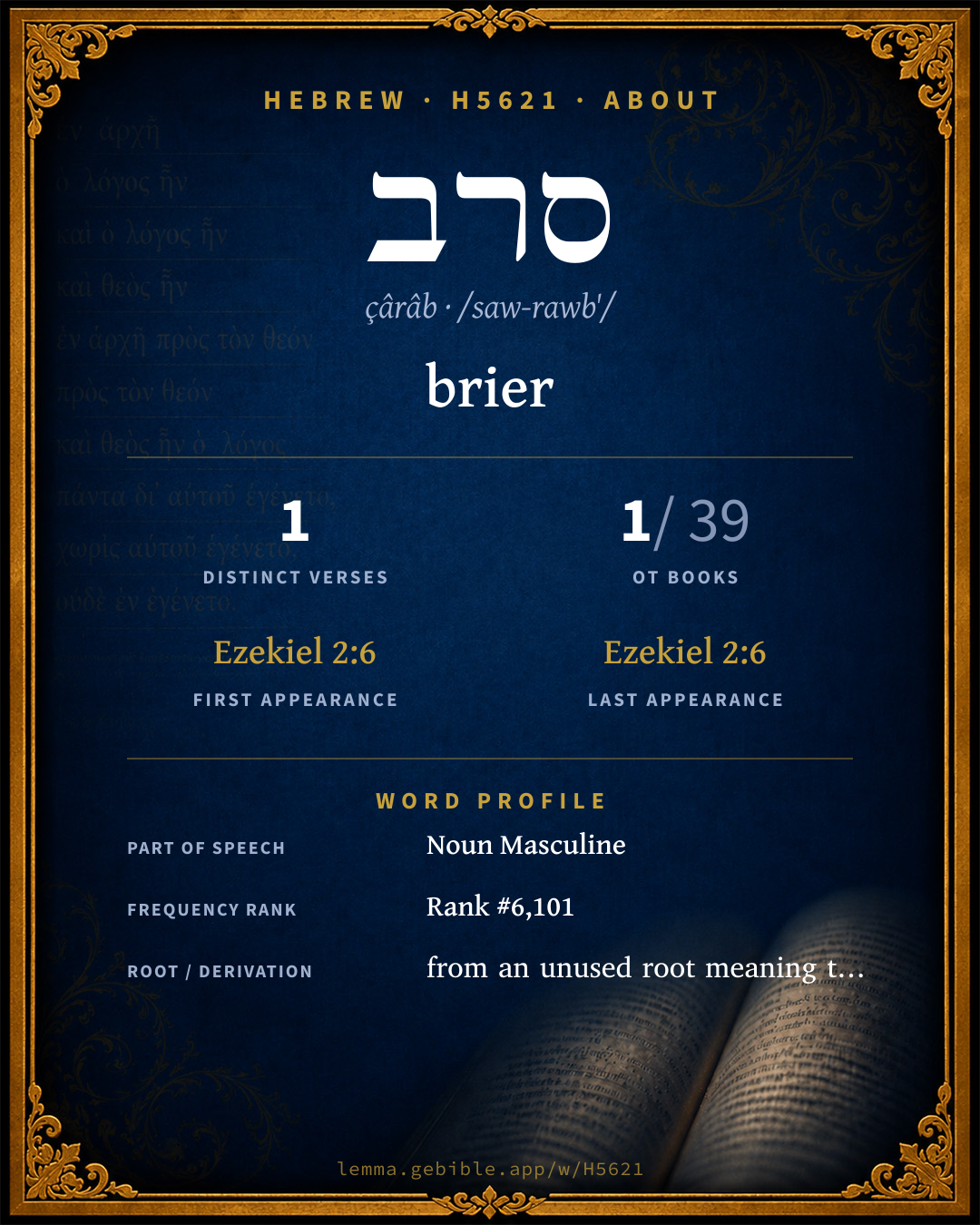
סָרָב
brier
‘brier’ is one of 2 main senses fuller range ↓
Full lexicon entry — Brown-Driver-Briggs (BDB)
From Brown-Driver-Briggs (BDB)
Where this word appears
Grammar key — what these labels mean
Part of speech
- Noun
- A naming word — a person, place, thing, or idea.
Noun type
- Common
- A common noun — a general class of person, place, or thing (“king,” “city,” “water”), not a specific name.
State
- Absolute
- The independent form of a noun, not bound to a following word.
Gender
- Masculine
- Grammatically masculine.
Number
- Plural
- More than one (in Hebrew, generally three or more).
Every verse where H5621 appears — 1 distinct verse across 1 book. Click any verse to open its interlinear word-by-word view. Verse text shown in the World English Bible for context — . Each verse’s Hebrew form is shown with its reference; the English is not keyword-highlighted, since the data carries no word-level English alignment. Use “Compare translations” on any verse to read it across multiple English versions. This concordance covers the Hebrew Bible; Septuagint (Greek Old Testament) occurrences are not indexed here.
Ezekiel 1 verse
About this entry
At a glance — auto-summarized from this page’s data, not written by a person. Every figure links to its source below. This summary describes the numbers; it doesn’t interpret them.
“brier” is the headline sense of the Hebrew noun סרב (çârâb). The Hebrew Bible uses it only 1 verse. It clusters heavily in Ezekiel, which alone accounts for 100% of its uses. Found nowhere else but Ezekiel 2:6. Catalogued under 2 senses, its meaning is not single-sense. The sections below give every sense, occurrence, and version rendering.
Gloss history
Strong's 1890 vs modern scholarship
About this word
Strong's H5621 catalogs a Hebrew word from the Hebrew Old Testament.
These counts are not copied from any lexicon or concordance. They are computed here, from the morphology-tagged Hebrew Old Testament. What Lemma adds →
- 1
- distinct verses
- The word appears in 1 distinct verse.
- 1 / 39
- OT books
- The word appears in 1 of 39 Old Testament books.
- #6,101
- by frequency
- Rank #6,101 (rank 6,101 of 8,640 Hebrew words by occurrence).
View all 1 occurrence in the concordance →
Most concentrated in
- Ezekiel 1 verse 100%
By section of the Old Testament
By traditional corpus
Conventional, traditional groupings — biblical authorship is debated, so this is a traditional corpus grouping, not an authorship claim. Each share is this word’s portion of its verses in that division of the Hebrew canon. Each figure is a share of the word’s 1 distinct verse.
- Prophets (Nevi'im) 1 verse · 100%
How translations render this word
Counts come from each version’s own published word-to-Strong’s tagging or interlinear alignment — an approximate guide to how each version renders this word, not a word-level alignment the data otherwise carries. Because each total is that version’s own tagged count, the per-version totals vary from one another and need not match the appearance or distinct-verse counts above. These counts may also differ from a printed concordance because Lemma counts each distinctly tagged rendering and does not collapse phrase taggings into a single head-word total. This is a fixed set of word-tagged versions (KJV, ASV, BSB, ULT) and does not change with the reading translation you choose elsewhere. Each version’s license is shown beside its name below (and on Sources).
- King James Version: Briers 1×
- American Standard Version: Briers 1×
- Berean Standard Bible: Briers 1×
- unfoldingWord Literal Text: Briers 1×
King James Version Public Domain
Renders H5621 across 1 tagged occurrence — most commonly:
American Standard Version Public Domain
Renders H5621 across 1 tagged occurrence — most commonly:
Berean Standard Bible Public Domain
Renders H5621 across 1 tagged occurrence — most commonly:
unfoldingWord Literal Text CC BY-SA 4.0
Renders H5621 across 1 tagged occurrence — most commonly:
Senses in BDB
The 2 senses BDB distinguishes for this word, in lexicon order (not ranked by frequency or importance). The full entry — with sub-senses — is in the Lexicon Entry tab.
- brier, rebel
- meaning dubious
Word origin
[ סָרָב ] n.m. rebel ?;—pl. abs. Ez 2:6; AV RV briers and thorns
— Brown-Driver-Briggs (Oxford 1906, public domain), digitized via Sefaria, supplemented by the OpenScriptures HebrewLexicon (CC BY 4.0). See Sources.
Origin: from an unused root meaning to sting
Jastrow Dictionary
A second Hebrew/Aramaic lexicon for comparison, covering Aramaic and post-biblical (Talmudic, Targumic, Midrashic) usage that the biblical-Hebrew BDB does not. Matched by lemma rather than by Strong’s number, so a lemma may carry more than one Jastrow headword (shown separately below), and the entries cover usage well beyond the Bible.
סָרַב
- , Pi. סֵירֵב (Saf. of רָב)
- 1. to assume importance, to allow one’s self to be coaxed; to decline an office. Pes. 86ᵇ מְסָרְבִין לקטן וכ׳ you may decline an offer from an inferior person than yourself, but not &c. Ber. 34ᵃ … העובר צריך לסָרֵב he who is asked to say the prayers, must first decline (wait to be asked again); ואם אינו מְסָרֵב וכ׳ and if he does not decline, he is like a dish without salt; ואם מסרב יותר מדאי וכ׳ but if he allows himself to be coaxed more than proper &c. Ib. פעם ראשונה יְסָרֵב וכ׳ when asked for the first time, he must decline, the second time &c., v. הִבְהֵב; Y. ib. V, 9ᶜ bot. בתחלה מסרב וכ׳.
- 2. (with ב; v. סִרְהֵב) [to be imperious,] to press, urge. Y. Dem. IV, 24ᵃ bot. לא יְסָרֵב וכ׳ one must not urge his neighbor to be his guest, when he knows that he will not accept; Tosef. B. Kam. VII, 8 המְסָרֵב בחבירו וכ׳ he who urges his neighbor to be his guest, when in his heart he does not mean to invite him; Y. Ab. Zar. I, 39ᶜ bot.; Tosef. B. Bath. VI, 14; Treat. Der. Er. ch. VIII; (Ḥull. 94ᵃ יסרהב). Tosef. Ned. IV, 8ᵃ; Ned. 21; a. e.
- 3. (= מָרָה) to rebel. Koh. R. to I, 16 הלב מסרב וכ׳ the heart is rebellious, as we read (Jer. V, 23). Midr, Till. to Ps. V, 11 (expl. מרו, ib.) שסֵרְבוּ כנגדך ed. Bub. (oth. ed. שרבו, corr. acc.) they rebelled against thee; Yalk. ib. 632; a. e. e.g. Jeremiah 5:23
סְרַב I
- , Pa. סָרֵיב ch. Same,
- 1. to decline, refuse (corresp. to b. h. מָאֵן).). Targ. Gen. XXXVII, 35; a. fr.
- 2. (with על) to rebel. Targ. Deut. I, 26. Targ. O. Gen. XXVI, 35. Targ. Ez. II, 6; a. fr.—V. מְסַרְבָּן.
סְרַב II
- , Pa. סָרֵיב (Saf. of ארב, ערב) [to interlace,] to confound (cmp. סרך). Targ. Lam. III, 9 ed. Lag. (Var. סראו!; ed. Amst. סרך; h. text עוה). Ib. 11 ed. Lag. (oth. ed. סרך; h. text סורר). Ib. 36 ed. Lag. (ed. oth. לסרכא; h. text לְעֵוֵּת).—Part. pass. Peil סָרִיב, סְרִיבָא; f. pl. סְרִיבָן. Targ. Koh. I, 15 ed. Ven. (oth. ed. סְרִיכָן; h. text מְעֻוָּת).
A Dictionary of the Targumim, the Talmud Babli and Yerushalmi, and the Midrashic Literature (Marcus Jastrow; London, Luzac, 1903) — Public Domain. Digitized via Sefaria. Digitized via Sefaria. Full attribution on Sources.
Septuagint verse parallels
This word appears in 1 verse that also exists in the Greek Old Testament (Septuagint), out of the 1 Hebrew verse it occurs in. You can read those verses in Greek by switching the Old Testament edition to the Septuagint.
Read these verses in the Septuagint
This is a verse-level parallel only — the same verses exist in both the Hebrew and Greek Old Testaments. No word-level Hebrew↔Greek correspondence is claimed: the data carries no such alignment, so no Greek word is shown as this Hebrew word’s translation. Coverage is not total — the Septuagint omits the deuterocanon and renumbers the Psalms, so some Hebrew verses have no direct Greek parallel.