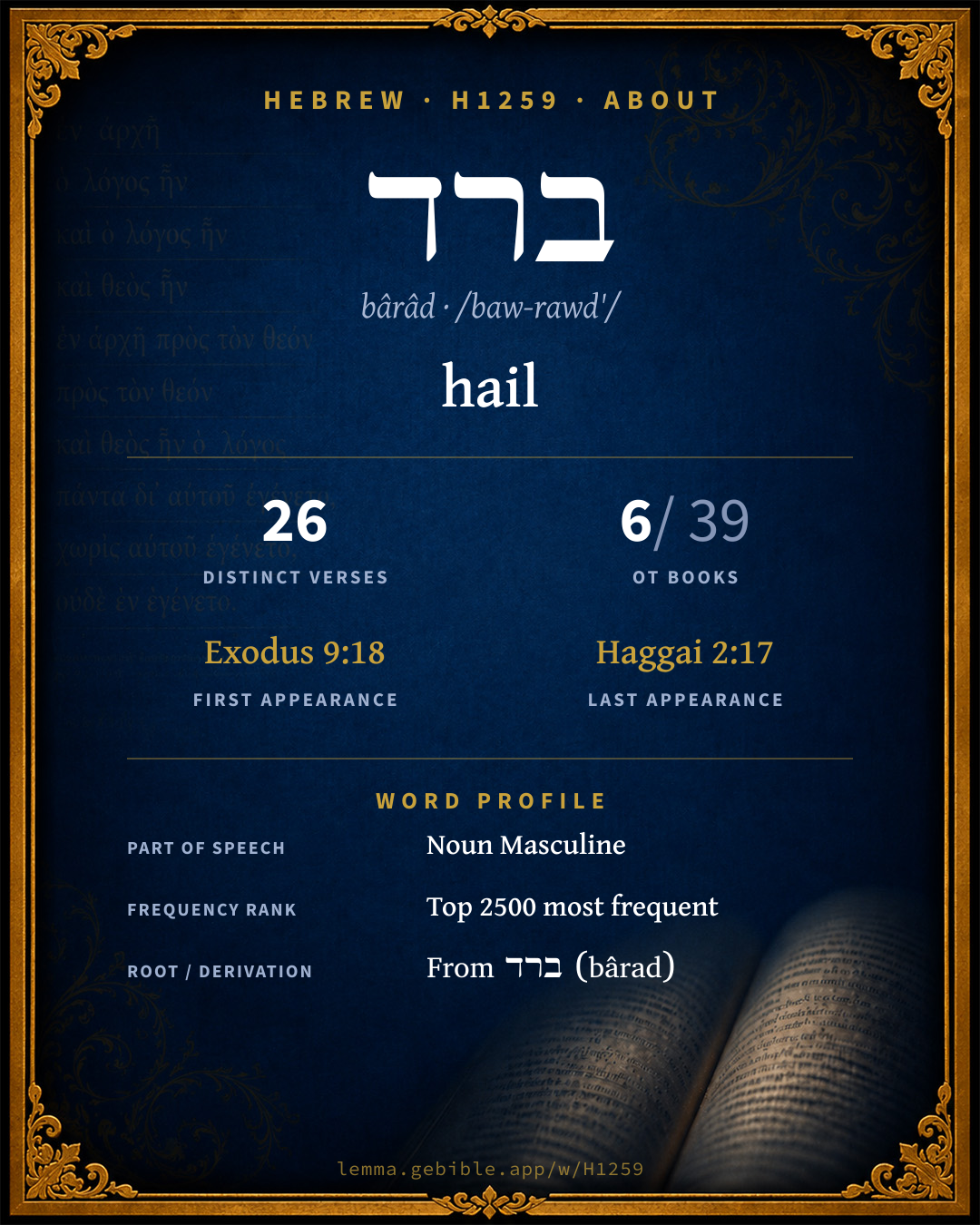
בָּרָד
hail
‘hail’ is one of 2 main senses fuller range ↓
Full lexicon entry — Brown-Driver-Briggs (BDB)
From Brown-Driver-Briggs (BDB)
Where this word appears
Grammar key — what these labels mean
Part of speech
- Noun
- A naming word — a person, place, thing, or idea.
Noun type
- Common
- A common noun — a general class of person, place, or thing (“king,” “city,” “water”), not a specific name.
State
- Absolute
- The independent form of a noun, not bound to a following word.
Gender
- Masculine
- Grammatically masculine.
Number
- Singular
- One.
Every verse where H1259 appears — 26 distinct verses across 6 books. Click any verse to open its interlinear word-by-word view. Verse text shown in the World English Bible for context — . Each verse’s Hebrew form is shown with its reference; the English is not keyword-highlighted, since the data carries no word-level English alignment. Use “Compare translations” on any verse to read it across multiple English versions. This concordance covers the Hebrew Bible; Septuagint (Greek Old Testament) occurrences are not indexed here.
Exodus 14 verses
- Exodus 9:18 בָּרָ֖ד n c ms Behold, tomorrow about this time I will cause it to rain a very grievous hail, such as has not been in Egypt since the day it was founded even until now.
- Exodus 9:19 הַ/בָּרָ֖ד ptcl def.art + n c ms Now therefore command that all of your cattle and all that you have in the field be brought into shelter. Every man and animal that is found in the field, and isn't brought home, the hail shall come down on them, and they shall die."'"
- Exodus 9:22 בָרָ֖ד n c ms Yahweh said to Moses, "Stretch forth your hand toward the sky, that there may be hail in all the land of Egypt, on man, and on animal, and on every herb of the field, throughout the land of Egypt."
- Exodus 9:23 וּ/בָרָ֔ד בָּרָ֖ד conj + n c ms n c ms Moses stretched forth his rod toward the heavens, and Yahweh sent thunder, hail, and lightning flashed down to the earth. Yahweh rained hail on the land of Egypt.
- Exodus 9:24 בָרָ֔ד הַ/בָּרָ֑ד n c ms ptcl def.art + n c ms So there was very severe hail, and lightning mixed with the hail, such as had not been in all the land of Egypt since it became a nation.
- Exodus 9:25 הַ/בָּרָ֜ד הַ/בָּרָ֔ד ptcl def.art + n c ms ptcl def.art + n c ms The hail struck throughout all the land of Egypt all that was in the field, both man and animal; and the hail struck every herb of the field, and broke every tree of the field.
- Exodus 9:26 בָּרָֽד n c ms Only in the land of Goshen, where the children of Israel were, there was no hail.
- Exodus 9:28 וּ/בָרָ֑ד conj + n c ms Pray to Yahweh; for there has been enough of mighty thunderings and hail. I will let you go, and you shall stay no longer."
- Exodus 9:29 וְ/הַ/בָּרָד֙ conj + ptcl def.art + n c ms Moses said to him, "As soon as I have gone out of the city, I will spread abroad my hands to Yahweh. The thunders shall cease, neither shall there be any more hail; that you may know that the earth is Yahweh's.
- Exodus 9:33 וְ/הַ/בָּרָ֔ד conj + ptcl def.art + n c ms Moses went out of the city from Pharaoh, and spread abroad his hands to Yahweh; and the thunders and hail ceased, and the rain was not poured on the earth.
- Exodus 9:34 וְ/הַ/בָּרָ֛ד conj + ptcl def.art + n c ms When Pharaoh saw that the rain and the hail and the thunders were ceased, he sinned yet more, and hardened his heart, he and his servants.
- Exodus 10:5 הַ/בָּרָ֔ד ptcl def.art + n c ms and they shall cover the surface of the earth, so that one won't be able to see the earth. They shall eat the residue of that which has escaped, which remains to you from the hail, and shall eat every tree which grows for you out of the field.
- Exodus 10:12 הַ/בָּרָֽד ptcl def.art + n c ms Yahweh said to Moses, "Stretch out your hand over the land of Egypt for the locusts, that they may come up on the land of Egypt, and eat every herb of the land, even all that the hail has left."
- Exodus 10:15 הַ/בָּרָ֑ד ptcl def.art + n c ms For they covered the surface of the whole earth, so that the land was darkened, and they ate every herb of the land, and all the fruit of the trees which the hail had left. There remained nothing green, either tree or herb of the field, through all the land of Egypt.
Joshua 1 verse
Job 1 verse
Psalms 6 verses
- Psalms 18:12 בָּ֝רָ֗ד n c ms At the brightness before him his thick clouds passed, Hailstones and coals of fire.
- Psalms 18:13 בָּ֝רָ֗ד n c ms Yahweh also thundered in the sky, The Most High uttered his voice: Hailstones and coals of fire.
- Psalms 78:47 בַּ/בָּרָ֣ד prep det + n c ms He destroyed their vines with hail, Their sycamore-fig trees with frost.
- Psalms 78:48 לַ/בָּרָ֣ד prep det + n c ms He gave over their cattle also to the hail, And their flocks to hot thunderbolts.
- Psalms 105:32 בָּרָ֑ד n c ms He gave them hail for rain, With lightning in their land.
- Psalms 148:8 וּ֭/בָרָד conj + n c ms Lightning and hail, snow and clouds; Stormy wind, fulfilling his word;
Isaiah 3 verses
- Isaiah 28:2 בָּרָ֖ד n c ms Behold, the Lord has a mighty and strong one; as a tempest of hail, a destroying storm, as a tempest of mighty waters overflowing, will he cast down to the earth with the hand.
- Isaiah 28:17 בָרָד֙ n c ms I will make justice the line, and righteousness the plummet; and the hail shall sweep away the refuge of lies, and the waters shall overflow the hiding-place.
- Isaiah 30:30 בָּרָֽד n c ms Yahweh will cause his glorious voice to be heard, and will show the lighting down of his arm, with the indignation of [his] anger, and the flame of a devouring fire, with a blast, and tempest, and hailstones.
Haggai 1 verse
About this entry
At a glance — auto-summarized from this page’s data, not written by a person. Every figure links to its source below. This summary describes the numbers; it doesn’t interpret them.
ברד (bârâd) is a Hebrew noun most often rendered “hail.” Exodus dominates its distribution — 14 of 26 verses. Spanning 26 verses in 6 books, it ranks among the moderately common words of the Hebrew Bible. Scripture first uses it in Exodus 9:18. Ranging over 2 senses, it is not a single-sense word. For the data behind this summary, explore the sense tree and the renderings breakdown below.
Gloss history
Strong's 1890 vs modern scholarship
About this word
Strong's H1259 catalogs a Hebrew word from the Hebrew Old Testament.
These counts are not copied from any lexicon or concordance. They are computed here, from the morphology-tagged Hebrew Old Testament. What Lemma adds →
- 26
- distinct verses
- The word appears in 26 distinct verses.
- 6 / 39
- OT books
- The word appears in 6 of 39 Old Testament books.
- #1,160
- by frequency
- Top 2500 most frequent Hebrew words (rank 1,160 of 8,640 Hebrew words by occurrence).
View all 26 occurrences in the concordance →
By section of the Old Testament
By traditional corpus
Conventional, traditional groupings — biblical authorship is debated, so this is a traditional corpus grouping, not an authorship claim. Each share is this word’s portion of its verses in that division of the Hebrew canon. Each figure is a share of the word’s 26 distinct verses.
- Torah (Pentateuch) 14 verses · 54%
- Writings (Ketuvim) 7 verses · 27%
- Prophets (Nevi'im) 5 verses · 19%
How translations render this word
Counts come from each version’s own published word-to-Strong’s tagging or interlinear alignment — an approximate guide to how each version renders this word, not a word-level alignment the data otherwise carries. Because each total is that version’s own tagged count, the per-version totals vary from one another and need not match the appearance or distinct-verse counts above. These counts may also differ from a printed concordance because Lemma counts each distinctly tagged rendering and does not collapse phrase taggings into a single head-word total. This is a fixed set of word-tagged versions (KJV, ASV, BSB, ULT) and does not change with the reading translation you choose elsewhere. Each version’s license is shown beside its name below (and on Sources).
- King James Version: Hail 21×
- American Standard Version: Hail 19×, Hailstones 3×
- Berean Standard Bible: Hail 22×, Hailstones 4×
- unfoldingWord Literal Text: Hail 27×, Hailstones 2×
King James Version Public Domain
Renders H1259 across 28 tagged occurrences — most commonly:
Plus 7 renderings that appear only once — usually multi-word phrases or single function words the recovered tagging swept in, not distinct renderings. Not rendered by a distinct English word in 1 further occurrence.
American Standard Version Public Domain
Renders H1259 across 28 tagged occurrences — most commonly:
Plus 6 renderings that appear only once — usually multi-word phrases or single function words the recovered tagging swept in, not distinct renderings.
Berean Standard Bible Public Domain
Renders H1259 across 27 tagged occurrences — most commonly:
Plus 1 rendering that appears only once — usually multi-word phrases or single function words the recovered tagging swept in, not distinct renderings. Not rendered by a distinct English word in 2 further occurrences.
unfoldingWord Literal Text CC BY-SA 4.0
Renders H1259 across 30 tagged occurrences — most commonly:
Plus 1 rendering that appears only once — usually multi-word phrases or single function words the recovered tagging swept in, not distinct renderings.
Senses in BDB
The 2 senses BDB distinguishes for this word, in lexicon order (not ranked by frequency or importance). The full entry — with sub-senses — is in the Lexicon Entry tab.
- hail
- of God's judgment (figuratively)
Word origin
n.m. Ex 9:18 hail (Arabic بَرَدٌ, Aramaic בְּרַד, ܒܰܪܕܳܐ; also Sab. ברדם, cold DHMZMG 1875, 607)—בָּרָד Ex 9:18 + 28 times;—hail, c. המטיר י׳ Ex 9:18, 23, c. נתן י׳ 9:23; also Ex 9:19, 22, 24, 25, 25, 26; 10:5, 12, 15; ‖ קֹלֹת thunder Ex 9:23, 28, 29, 33, ‖ קֹלֹת & מָטָר Ex 9:34, ‖ אשׁ lightning 9:24; all JE, Egyptian plague; cf. ψ 78:47, 48; 105:32; another great hailstorm Jos 10:11 (E), where אַבְנֵי הַבּ׳; further, in theoph ψ 18:13 (‖ גחלי־אשׁ) 2 S 22:13 om. by error; del. however in ψ 18:14 cf. De Che etc.; אוצרות ב׳ Jb 38:22, אשׁ וב׳ שׁלג וקיטור ψ 148:8, ירקון וב׳ Hg 2:17; in sim. Is 28:2 זרם ב׳ שׁער; fig. Is 28:17; 30:30 (אבן ב׳)—fig. of judgment of י׳.
— Brown-Driver-Briggs (Oxford 1906, public domain), digitized via Sefaria, supplemented by the OpenScriptures HebrewLexicon (CC BY 4.0). See Sources.
Derived from ברד (bârad) (H1258) — to hail.
Jastrow Dictionary
A second Hebrew/Aramaic lexicon for comparison, covering Aramaic and post-biblical (Talmudic, Targumic, Midrashic) usage that the biblical-Hebrew BDB does not. Matched by lemma rather than by Strong’s number, so a lemma may carry more than one Jastrow headword (shown separately below), and the entries cover usage well beyond the Bible.
בָּרָד
- , v. ברר) [bright, white,] hail (v. Ges. H. Dict. s. v.). Mikv. VII, 1; a. fr.—אבן הב׳ block of ice (or hail stone). Ib.; v. next w.
A Dictionary of the Targumim, the Talmud Babli and Yerushalmi, and the Midrashic Literature (Marcus Jastrow; London, Luzac, 1903) — Public Domain. Digitized via Sefaria. Digitized via Sefaria. Full attribution on Sources.
Forms in the corpus
The 22 distinct written forms H1259 takes in the Hebrew Bible, most frequent first — each parse links to that state’s occurrences in the concordance. Hebrew forms include their vowel points and cantillation, so a single lemma takes many written forms.
| Form | Parsing | Example | Uses |
|---|---|---|---|
| בָּרָ֖ד | Noun, Common, Masculine, Singular, Absolute | Exodus 9:18 | 3 |
| הַ/בָּרָ֔ד | Noun, Common, Masculine, Singular, Absolute | Exodus 9:25 | 3 |
| בָּ֝רָ֗ד | Noun, Common, Masculine, Singular, Absolute | Psalms 18:12 | 2 |
| בָּרָֽד | Noun, Common, Masculine, Singular, Absolute | Exodus 9:26 | 2 |
| הַ/בָּרָ֑ד | Noun, Common, Masculine, Singular, Absolute | Exodus 9:24 | 2 |
| בָרָ֔ד | Noun, Common, Masculine, Singular, Absolute | Exodus 9:24 | 1 |
| בָרָ֖ד | Noun, Common, Masculine, Singular, Absolute | Exodus 9:22 | 1 |
| בָרָד֙ | Noun, Common, Masculine, Singular, Absolute | Isaiah 28:17 | 1 |
| בַּ/בָּרָ֣ד | Noun, Common, Masculine, Singular, Absolute | Psalms 78:47 | 1 |
| בָּרָ֑ד | Noun, Common, Masculine, Singular, Absolute | Psalms 105:32 | 1 |
| בָּרָ֣ד | Noun, Common, Masculine, Singular, Absolute | Job 38:22 | 1 |
| הַ/בָּרָ֖ד | Noun, Common, Masculine, Singular, Absolute | Exodus 9:19 | 1 |
| הַ/בָּרָ֜ד | Noun, Common, Masculine, Singular, Absolute | Exodus 9:25 | 1 |
| הַ/בָּרָֽד | Noun, Common, Masculine, Singular, Absolute | Exodus 10:12 | 1 |
| וְ/הַ/בָּרָ֔ד | Noun, Common, Masculine, Singular, Absolute | Exodus 9:33 | 1 |
| וְ/הַ/בָּרָ֛ד | Noun, Common, Masculine, Singular, Absolute | Exodus 9:34 | 1 |
| וְ/הַ/בָּרָד֙ | Noun, Common, Masculine, Singular, Absolute | Exodus 9:29 | 1 |
| וּ/בַ/בָּרָ֔ד | Noun, Common, Masculine, Singular, Absolute | Haggai 2:17 | 1 |
| וּ/בָרָ֑ד | Noun, Common, Masculine, Singular, Absolute | Exodus 9:28 | 1 |
| וּ/בָרָ֔ד | Noun, Common, Masculine, Singular, Absolute | Exodus 9:23 | 1 |
| וּ֭/בָרָד | Noun, Common, Masculine, Singular, Absolute | Psalms 148:8 | 1 |
| לַ/בָּרָ֣ד | Noun, Common, Masculine, Singular, Absolute | Psalms 78:48 | 1 |
Same root — word family
Other BDB entries built from the same root as H1259, grouped by Strong’s listed origin. These share a root / origin per the lexicon — not necessarily a shared meaning. Each links to that word’s own entry.
Derives from
Shares the same root
Proper names from this root
People and places named from this root — a name, not an additional meaning of the word.
Compare all same-root words → 1 of the same-root words is a proper name (a person or place). They share a root, not necessarily a meaning.
Septuagint verse parallels
This word appears in 24 verses that also exist in the Greek Old Testament (Septuagint), out of the 26 Hebrew verses it occurs in. You can read those verses in Greek by switching the Old Testament edition to the Septuagint.
Read these verses in the Septuagint
This is a verse-level parallel only — the same verses exist in both the Hebrew and Greek Old Testaments. No word-level Hebrew↔Greek correspondence is claimed: the data carries no such alignment, so no Greek word is shown as this Hebrew word’s translation. Coverage is not total — the Septuagint omits the deuterocanon and renumbers the Psalms, so some Hebrew verses have no direct Greek parallel.