
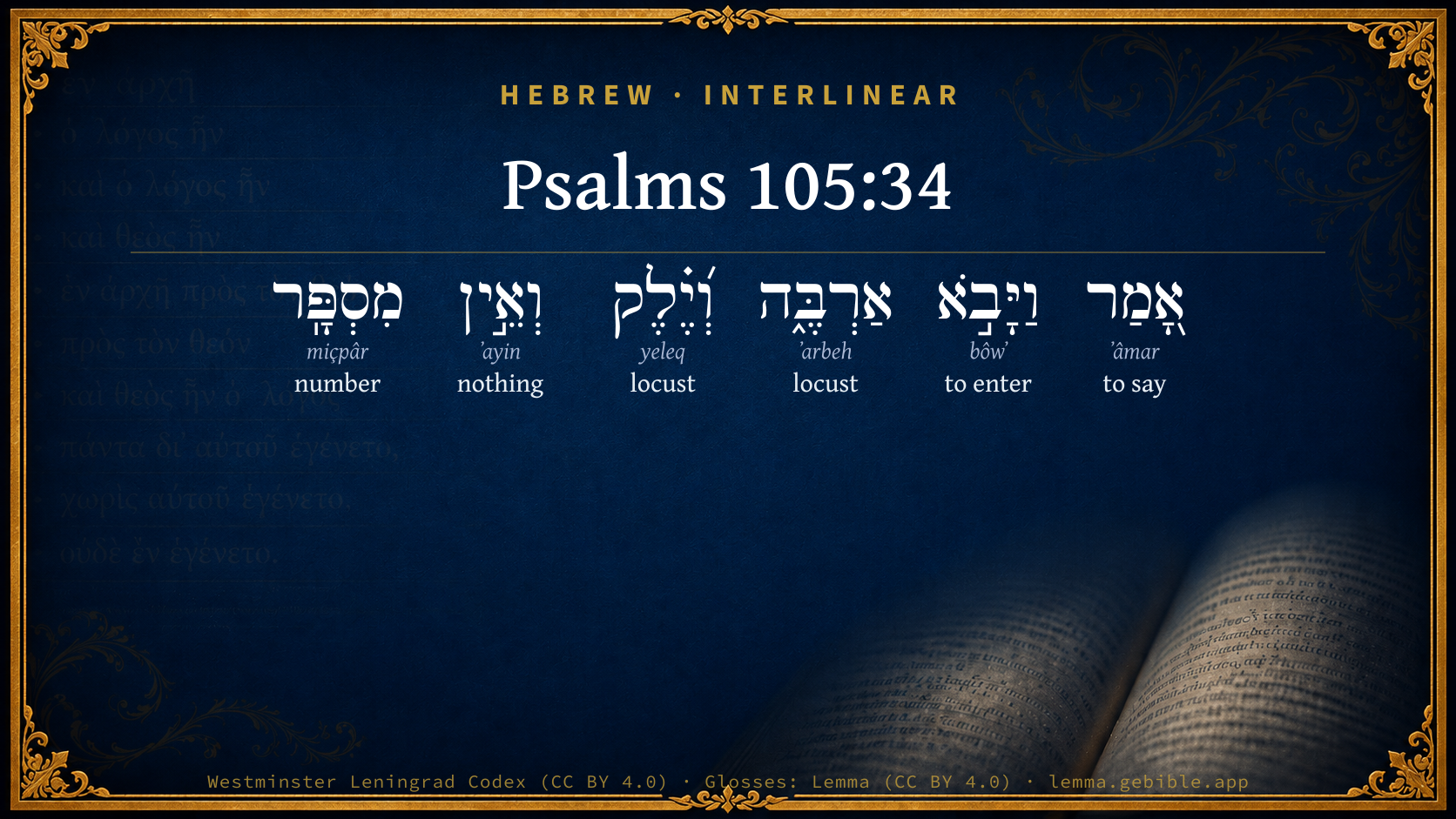
Psalms 105:34

Hebrew (Westminster Leningrad Codex) Psalms 105:34 appears in the Hebrew Old Testament. The text above is from the Westminster Leningrad Codex. Each word links to its Strong’s number, a concise gloss, and parsing drawn from the Open Scriptures Hebrew Bible morphology. Click any word for its full Brown-Driver-Briggs (BDB) entry.
Download image
Cite this verse

Psalms 105:34 (World English Bible). Public Domain. Lemma interlinear Bible study tool, https://lemma.gebible.app/v/psalms/105/34.

Show BibTeX & RIS
BibTeX
RIS
English Translation
He spoke, and the locusts came, And the grasshoppers, without number,
World English Bible · Public Domain
Highlights
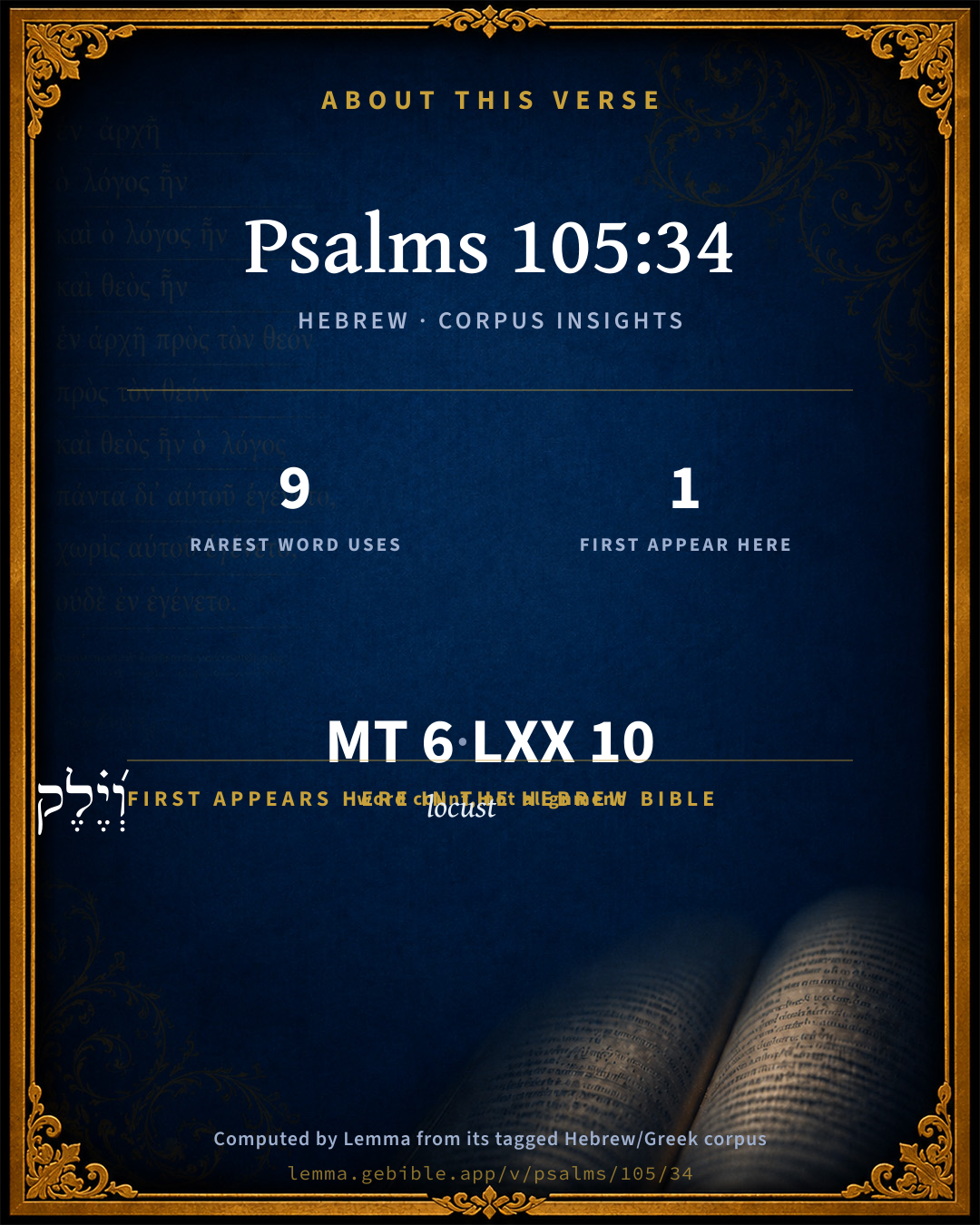
  • 1 first appearance in the Hebrew Bible
Full analysis ↓
Download a study sheet

One document with this verse’s original text, its word-by-word gloss line, the meaning frame, cross-references with their text, attributed commentary, and full source and license credits — printable, and it pastes into notes with its structure intact.

This verse Autodidact and up

Study sheet (.html) Plain text (.txt)

A passage Seminary Student

Up to 50 verses in one chapter. A passage sheet keeps up to 6 commentary sources and 12 cross-references per verse, in the order this page ranks them, and says so on the sheet whenever that leaves anything out. Ask for a single verse and you get the Autodidact verse sheet above.

Everything on this page stays free to read, with no account — the sheet is a download of what is already on screen, not access to it.

Want to remove ads? Support Godless Engineer
Compare translations 3

The same verse in 3 English versions, stacked beneath the original-language interlinear above. Click any original word for its lexicon entry.

Each is an independent rendering of the whole verse — the interlinear is not word-aligned to these translations.

Highlighted words mark where these versions differ — a whole-verse word diff, not a word-by-word alignment.

  • World English Bible Public Domain
    He spoke, and the locusts came, And the grasshoppers, without number,
  • King James Version Public Domain
    He spake, and the locusts came, and caterpillers, and that without number,
  • unfoldingWord Literal Text CC BY-SA 4.0
    He spoke, and the locust came, and the young locust, and there was no number.

unfoldingWord Literal Text — © unfoldingWord, licensed CC BY-SA 4.0. Word-aligned USFM3 via Door43 (git.door43.org/unfoldingWord/en_ult).

Versions to compare (up to 4)

3 of 4 selected

Show all 18 translations

Every available English version of this verse, each an independent rendering of the whole verse.

  • World English Bible Public Domain
    He spoke, and the locusts came, And the grasshoppers, without number,
  • Berean Standard Bible Public Domain
    He spoke, and the locusts came—young locusts without number.
  • Majority Standard Bible Public Domain
    He spoke, and the locusts came—young locusts without number.
  • King James Version Public Domain
    He spake, and the locusts came, and caterpillers, and that without number,
  • American Standard Version (1901) Public Domain
    He spake, and the locust came, And the grasshopper, and that without number,
  • Revised Version (1885) Public Domain
    He spake, and the locust came, and the cankerworm, and that without number,
  • Geneva Bible (1599) Public Domain
    He spake, and the grashoppers came, and caterpillers innumerable,
  • Douay-Rheims (1899) Public Domain
    He spoke, and the locust came, and the bruchus, of which there was no number.
  • Young's Literal Translation Public Domain
    He hath said, and the locust cometh, And the cankerworm -- innumerable,
  • Literal Standard Version CC BY-SA 4.0
    He has commanded, and the locust comes, || And the cankerworm—innumerable,
  • Unlocked Literal Bible CC BY-SA 4.0
    He spoke, and the locusts came, so many locusts.
  • unfoldingWord Literal Text CC BY-SA 4.0
    He spoke, and the locust came, and the young locust, and there was no number.
  • Darby Bible Public Domain
    He spoke, and the locust came, and the cankerworm, even without number;
  • World Messianic Bible Public Domain
    He spoke, and the locusts came with the grasshoppers, without number.
  • Webster's Bible Public Domain
    He spoke, and the locusts came, and caterpillars, and that without number,
  • Free Bible Version CC BY-SA 4.0
    He gave the command, and swarms of locusts came—countless locusts:
  • Bible in Basic English Public Domain
    At his word the locusts came, and young locusts more than might be numbered,
  • JPS Tanakh (1917) Public Domain
    He spoke, and the locust came, and the canker-worm without number,

Literal Standard Version (2020), Covenant Press — licensed CC BY-SA 4.0. Text via the HelloAO Bible API (eBible.org). Unlocked Literal Bible (unfoldingWord) — licensed CC BY-SA 4.0. Text via the HelloAO Bible API (eBible.org). unfoldingWord Literal Text — © unfoldingWord, licensed CC BY-SA 4.0. Word-aligned USFM3 via Door43 (git.door43.org/unfoldingWord/en_ult). Free Bible Version, Dr. Jonathan Gallagher — licensed CC BY-SA 4.0. Text via the HelloAO Bible API (eBible.org).

Word by word

More ways to search: Search by grammar → Find every occurrence → Compare this word →

Practice this passage: Drill this verse → Learn its vocabulary →

About this verse

These counts appear in no published source. They are computed here, from the morphology-tagged text and Lemma’s own curated glosses. What Lemma adds →

6
words
6
distinct lemmas
Wisdom
section

Notable vocabulary

The rarest word here is וְ֝יֶ֗לֶק locust H3218 — appearing just 9 times in the whole Hebrew Bible.

First appearance in Scripture

This word makes its first canonical appearance in the Hebrew Bible here:

  • וְ֝יֶ֗לֶק locust H3218

Shared distinctive vocabulary

וְ֝יֶ֗לֶק locust H3218 occurs in 7 verses of the Hebrew Bible. Also found in:

Grammatical profile

  • 2 verbs
  • 3 nouns
  • 1 particle

Verb forms

  • אָ֭מַר Qal · Perfect
  • וַיָּבֹ֣א Qal · Sequential Imperfect

Hebrew & Septuagint length

In English translation the verse runs 11 words from the Hebrew and 9 from the Septuagint (LXX English) — closely comparable.

A rough comparison of the two English renderings, which tokenize alike — not a word-level alignment.

Word counts can differ between the Hebrew and the Greek without any difference in meaning — e.g. the Hebrew direct-object marker אֵת has no separate Greek word, and Greek often adds the article ὁ.

In the original languages it is 6 Hebrew tokens and 10 Greek tokens — but the two are counted differently (Hebrew bundles its prefixes and suffixes into one token; the Greek is in lemma form), so that isn’t a like-for-like length.

Cross-references

5

Topical passages linked to Psalms 105:34 in the Treasury of Scripture Knowledge — connected by theme and wording, ordered by reader-vote popularity; previews shown in the World English Bible.

  • Exodus 10:12–15 Yahweh said to Moses, "Stretch out your hand over the land of Egypt for the locusts, that they may come up on the land of Egypt, and eat every herb of the land, even all that the hail has left."
  • Psalms 78:46 He gave also their increase to the caterpillar, And their labor to the locust.
  • Joel 2:25 I will restore to you the years that the swarming locust has eaten, The great locust, the grasshopper, and the caterpillar, My great army, which I sent among you.
  • Joel 1:4–7 What the swarming locust has left, the great locust has eaten. What the great locust has left, the grasshopper has eaten. What the grasshopper has left, the caterpillar has eaten.
  • Revelation 9:3–10 Then out of the smoke came forth locusts on the earth, and power was given to them, as the scorpions of the earth have power.

Cross-references courtesy of OpenBible.info (CC BY 4.0).

Hebrew and Greek witnesses Masoretic Hebrew ↔ Greek Septuagint

The same verse in the two great witnesses to the Old Testament, shown verse-for-verse.

You’re reading Greek Psalm 104 (Hebrew Psalm 105). The Septuagint counts the superscription, so verse numbers can differ from the Hebrew — chapter-level alignment, not verse-by-verse. Numbering follows Rahlfs.

These are two independent witnesses, not word-aligned to each other, and the Septuagint is shown in lemma (dictionary) form.

Hebrew Psalms 105:34 Masoretic · Westminster Leningrad Codex

אָ֭מַר וַיָּבֹ֣א אַרְבֶּ֑ה וְ֝יֶ֗לֶק וְאֵ֣ין מִסְפָּֽר

He spoke, and the locusts came, And the grasshoppers, without number,

World English Bible · Public Domain

Greek LXX Greek Psalm 104:34 Septuagint · lemma form

εἶπον καί ἔρχομαι ἀκρίς καί βροῦχος ὅς οὐ εἰμί ἀριθμός

He spoke, and the locust came, and caterpillars innumerable,

LXX2012 (modern English Septuagint) · Public Domain

Hebrew: Westminster Leningrad Codex (CC BY 4.0). Greek: Septuagint (public domain); English from LXX2012 (modern English Septuagint) (Public Domain). How the Septuagint differs from the Hebrew →

Commentary

Notes on Psalms 105:34 from classic Christian and Jewish commentators (each source and its license shown beneath its notes). The classic Christian expositions comment on the surrounding passage and are grouped to its opening verse, so a note may address several verses; the Jewish commentaries on the Tanakh (Rashi and others) are per-verse, so they appear only where the commentator wrote on this verse.

Lemma curates 59 commentaries, every one of them public domain or Creative Commons licensed, each selected and text-cleaned for this edition rather than reprinted as found. About our sources →

Trapp's Complete Commentary

John Trapp

Psa 105:34 He spake, and the locusts came, and caterpillers, and that without number,

Ver. 34. He spake, and the locusts came] These are called God’s great army, and their terrible invasion is graphically described, Joe 2:3-5, &c.

John Trapp, A Commentary or Exposition upon All the Books of the Old and New Testament (1647–1656) — public domain. Text from a community e-Sword module.

J. A. Alexander on Psalms

Joseph Addison Alexander

34. (Psa 105:34) He said, and the arbeh came, and the yelek, and (that) without number. The two Hebrew words, here retained, denote varieties of the locust, and have no equivalents in English. See above, on Psa 78:46, where the first word here stands second, and the place of the other is supplied by hasil, another distinctive term of the same kind. Without number, literally there is no number. See the same expression, Psa 104:25.

Joseph Addison Alexander, The Psalms Translated and Explained (1850) — public domain. Text from a community e-Sword module.

Geneva Bible (1599)

Geneva Bible translators

He showeth that all creatures are armed against man when God is his enemy, as at his commandment the grasshoppers destroyed the land.

Geneva Bible (1599) marginal notes — public domain. Text via Bolls.life.

John Calvin's Commentaries

34. He spake, and the grasshopper came This calamity, which was brought upon the fields, could not be attributed to Fortune; for the grasshoppers made their appearance suddenly and in countless multitudes, so that they covered all the land of Egypt. The miracle was very evident from the word spoken, by which it was introduced. Its being announced as to happen, removed all doubt of its being the work of the Most High. Accordingly, it is expressly said, that grasshoppers and caterpillars rushed in at the commandment of God, as if soldiers should run to battle at the sound of the trumpet. Whenever these insects molest us and destroy the fruits of the earth, they are assuredly the scourges of God, but it is here intended to point out an extraordinary work of his hand. In fine, the prophet recites the last miracle, which was wrought by the angel on the night previous to the departure of the people, when he slew all the first-born throughout Egypt. I only take a hasty and passing glance at this history, as I have, in like manner, done of the other facts preceding, because they have been more copiously treated elsewhere, and at this time it is sufficient for us to know the design of the sacred writer. He, however, amplifies this display of the Divine power by a repetition, declaring that the first-born and the flower of their strength were destroyed Some translate, but unhappily, The beginning of their sorrow. As man’s strength shows itself in generation, the Hebrews term the first-begotten the beginning of strength, as we have explained on Genesis 49:3, —

“Reuben, thou art my first-born, my might, and the beginning of my strength.”

John Calvin's Commentaries (1540-1563) — public domain. Text from the Calvin Translation Society English edition (1840s-50s) via the Christian Classics Ethereal Library (ccel.org). Calvin's coverage is partial (roughly two-thirds of the Bible); uncommented books and verses are honest gaps, never fabricated. The 19th-century editor's footnotes and remarks are omitted so the notes are faithfully Calvin's own voice.

Ellicott's Commentary for English Readers

(34) Caterpillars.—To the locust, ‘aarbeh, alone mentioned in Exodus, the psalmist adds, as a poetical synonym to suit his parallelism, caterpillar (yelek), a word occurring in Joe_1:4; Joe_2:25; Nah_3:15; Jer_51:14; Jer_51:27. By derivation the word means “licker” (comp. Num_22:4), and is possibly used in a wide or general sense for insects of the locust kind. (See Bible Educator, IV. 294.)

A Bible Commentary for English Readers, edited by Charles John Ellicott (1878–1897) — public domain. Text from a community e-Sword module.

The Cambridge Bible for Schools and Colleges

gen. ed. J. J. S. Perowne

34, 35. The eighth plague, Exo_10:1 ff.; Psa_78:46. The Heb. word yĕlĕq, R.V. cankerworm, as A.V. in Joe_1:4, is not used in Exodus. It probably denotes the locust in its larva state.

The Cambridge Bible for Schools and Colleges (gen. ed. J. J. S. Perowne; Cambridge University Press, 1878–1918) — public domain. Text from a community e-Sword module.

John Gill's Exposition

He spake, and the locusts came,.... A great army of them, and covered the land, that it was even darkened by them; and were such as had never been seen before, or ever were since; this is the eighth plague, Exo 10:12, with these compare the locusts in Rev 9:3.

And caterpillars, and that without number; of these no mention is made in Exodus; they seem to be one of the kinds of locusts, or a different word is here used for the same, and so Kimchi interprets it; some render it the white locust; it has its name from licking up the herbs and grass of the field; as the other name for the locust seems to be taken from its great abundance and increase.

John Gill's Exposition of the Whole Bible (1746–1763) — public domain (CC PDM 1.0). Text via the HelloAO Bible API.

The Treasury of David

Charles H. Spurgeon

Ver. 34. Locusts came, and caterpillars, and that without number. In this country, and in all the dominions of Prete Janni, is a very great and horrible plague, which is an innumerable company of locusts, which eat and consume all the corn and trees; and the number of them is so great, as it is incredible; and with their multitude they cover the earth and fill the air in such wise, that it is a hard matter to be able to see the sun...We travelled five days journey through places wholly waste and destroyed, wherein millet had been sown, which had stalks as great as those we set in our vineyards, and we saw them all broken and beaten down as if a tempest had been there; and this the locusts did. The trees were without leaves, and the bark of them was all devoured; and no grass was there to be seen, for they had eaten up all things; and if we had not been warned and advised to carry victual with us, we and our cattle had perished. This country was all covered with locusts without wings; and they told us these were the seed of them which had eaten up all, and that as soon as their wings were grown they would seek after the old ones. The number of them was so great, that I shall not speak of it, because I shall not be believed: but this! will say, that I saw men, women, and children sit as forlorn and dead among the locusts. Samuel Purchas, 1577-1628.

Ver. 34. Locusts and caterpillars. God did not bring the same plague twice; but when there was occasion for another, it was still a new one; for he has many arrows in his quiver. Matthew Henry.

Ver. 34. Without number. A swarm of locusts, which was observed in India in 1825, occupied a space of forty English square miles, contained at least forty millions of locusts in one line, and cast a long shadow on the earth. And Major Moore thus describes an immense army of these animals which ravaged the Mahratta country: "The column they composed extended five hundred miles; and so compact was it when on the wing, that like an eclipse, it completely hid the sun, so that no shadow was cast by any object." Brown, in his travels in Africa, states that an area of nearly two thousand square miles was literally covered by them; and Kirby and Spence mention that a column of them was so immense, that they took four hours to fly over the spot where the observer stood. M. Kalisch.

Ver. 34. Came...and that without number.

Onward they came, a dark continuous cloud

Of congregated myriads number less;

The rushing of whose wings was as the sound

Of some broad river, headlong in its course,

Plunged from a mountain summit; or the roar

Of a wild ocean in the autumnal storm,

Shattering its billows on a shore of rocks,

Onward they came, the winds impelled them on. Robert Southey, 1774-1843.

Psalms 105:35*

Charles H. Spurgeon's The Treasury of David (1869–1885) — public domain. Psalms only. Text from a community e-Sword/MySword module.

Whedon's Commentary on the Bible

Daniel D. Whedon

34. Locusts… caterpillars—These words must signify either different species of the locust family, or different stages of their propagation. The former seems quite probable, for the larva, or unwinged locust, does not fly, and could not be brought in by a “wind.” In Exodus 10, only the ארבה, (arbeh, the common name for locust,) is mentioned, while in the text the arbeh and ילק, yelek, and in the parallel place, (Psa_78:46,) the arbah and חסיל, hhaseel, are named. But neither yelek nor hhaseel is ever translated “locust” in our English Version, but the former always “caterpillar,” and the latter either canker-worm or caterpillar. The distinction is seen Joe_1:4 : “That which the ‘locust’ (arbeh) hath left hath the canker-worm (yelek) eaten, and that which the yelek hath left hath the ‘caterpillar’ (hhaseel) eaten.” These words may be used, in the text and Psa_78:46, interchangeably for greater variety of diction, but it would rather seem, upon a comparison of all the places where they occur, that they denote different species of “locust,” which have not yet been clearly identified. This idea greatly aggravates the features of the judgment upon Pharaoh, as leaving the land absolutely waste and barren in their track.

Daniel D. Whedon (gen. ed.), Commentary on the Old and New Testaments (1874–1909) — public domain. Text from a community e-Sword module.

The Pulpit Commentary

He spake, and the locusts came. (see Exo_10:13, Exo_10:14) And caterpillars. Either a kind of locust, or the locust at one period of its growth. Not mentioned in Exodus. And that without number . (see Exo_10:14, Exo_10:15)

The Pulpit Commentary (1880–1919), ed. H.D.M. Spence-Jones & Joseph S. Exell — public domain. Text from a community e-Sword module.

unfoldingWord translationNotes

Door43 World Missions Community

so many locusts

"there were so many locusts"

The locusts ate up all of the vegetation ... They ate up all the crops of the ground

These two phrase have basically the same meaning and are used together for emphasis. AT: "The insects ate all the plants and all the crops in the land" (See: Parallelism)

He killed every firstborn in their land, the firstfruits of all their strength

Here the second phrase about the "firstfruits" is used to describe the "firstborn" in the first phrase. AT: "He killed every firstborn in their land, which were the firstfruits of all their strength" or "Then Yahweh killed the oldest son in every house of the people of Egypt" (See: Parallelism and Metaphor)

translationWords

firstborn

firstfruits

unfoldingWord translationNotes — © Distant Shores Media and the Door43 World Missions Community, licensed CC BY-SA 4.0. Source: git.door43.org/Door43/en_tn.

Lesson kit

Teaching starters — assembled from the data on this page, not authored interpretation. Every prompt links to the verse data it draws on. Edit before teaching.

Psalms, in the Wisdom, opens this verse with 6 words (6 distinct Hebrew lemmas). Its most distinctive word is yeleq (“locust”). A historical commentator’s framing appears above. Read the whole chapter for the surrounding context.

Discussion questions

  1. How does “locust” (yeleq) shape what this verse is saying?
  2. This is the first place “locust” appears in Scripture (first appears here). What does its debut here establish?
  3. How does Jeremiah 51:14, which shares the word «locust», read alongside this verse?
  4. These translations render this verse differently. What is at stake in choosing one wording over another?
  5. «אָ֭מַר» is a Qal Perfect verb. How does that grammatical form shape the action described?
  6. Compare how Trapp's Complete Commentary and J. A. Alexander on Psalms read this verse. Where do they agree or differ?

Things to notice

Reading settings

Reading text

Shown beneath each verse's original-language words.

Old Testament
Old Testament edition

Read the OT as the Masoretic Hebrew (MT) or the Greek Septuagint (LXX).

English shown for the Greek Septuagint (in the Hebrew ↔ Greek comparison).

Comparing translations? Open the Compare panel on any verse page to stack up to four side by side.