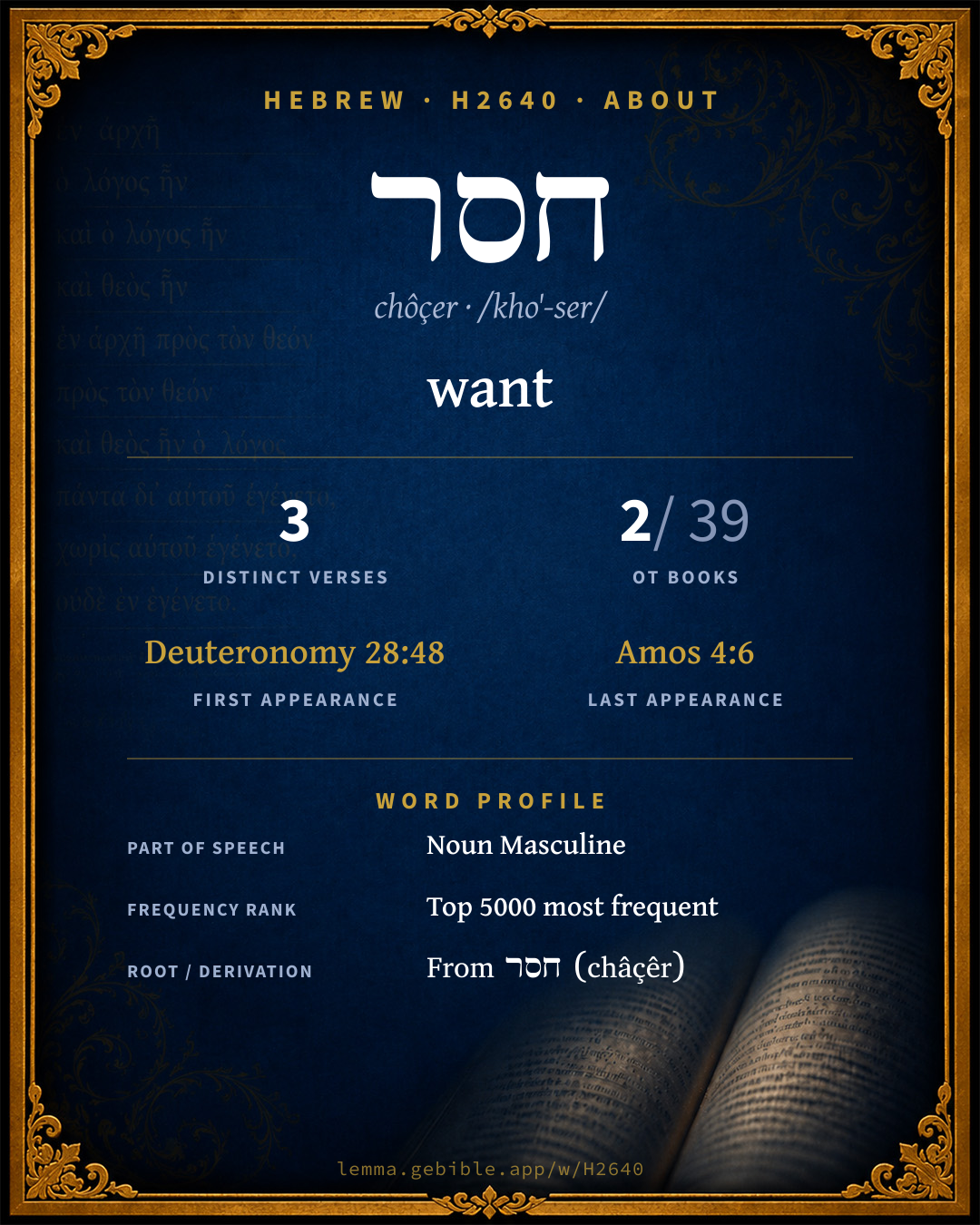
חֹ֫סֶר
want
Full lexicon entry — Brown-Driver-Briggs (BDB)
From Brown-Driver-Briggs (BDB)
Where this word appears
Grammar key — what these labels mean
Noun type
- Common
- A common noun — a general class of person, place, or thing (“king,” “city,” “water”), not a specific name.
State
- Construct
- A noun bound to a following noun in a possessive / “of” relationship (the construct chain).
Gender
- Masculine
- Grammatically masculine.
Number
- Singular
- One.
Every verse where H2640 appears — 3 distinct verses across 2 books. Click any verse to open its interlinear word-by-word view. Verse text shown in the World English Bible for context — . Each verse’s Hebrew form is shown with its reference; the English is not keyword-highlighted, since the data carries no word-level English alignment. Use “Compare translations” on any verse to read it across multiple English versions. This concordance covers the Hebrew Bible; Septuagint (Greek Old Testament) occurrences are not indexed here.
Deuteronomy 2 verses
- Deuteronomy 28:48 וּ/בְ/חֹ֣סֶר conj + prep + n c ms cs therefore shall you serve your enemies whom Yahweh shall send against you, in hunger, and in thirst, and in nakedness, and in want of all things: and he shall put a yoke of iron on your neck, until he have destroyed you.
- Deuteronomy 28:57 בְּ/חֹֽסֶר prep + n c ms cs and toward her young one who comes out from between her feet, and toward her children whom she shall bear; for she shall eat them for want of all things secretly, in the siege and in the distress with which your enemy shall distress you in your gates.
Amos 1 verse
About this entry
At a glance — auto-summarized from this page’s data, not written by a person. Every figure links to its source below. This summary describes the numbers; it doesn’t interpret them.
The Hebrew noun חסר centers on the idea of “want.” It occurs a mere 3 verses across Scripture. Deuteronomy dominates its distribution — 2 of 3 verses. First canonically at Deuteronomy 28:48, it enters the text early. Related forms include חסר, חסיר and חסר. For the data behind this summary, explore the sense tree and the renderings breakdown below.
Gloss history
Strong's 1890 vs modern scholarship
About this word
Strong's H2640 catalogs a Hebrew word from the Hebrew Old Testament.
These counts are not copied from any lexicon or concordance. They are computed here, from the morphology-tagged Hebrew Old Testament. What Lemma adds →
- 3
- distinct verses
- The word appears in 3 distinct verses.
- 2 / 39
- OT books
- The word appears in 2 of 39 Old Testament books.
- #4,179
- by frequency
- Top 5000 most frequent Hebrew words (rank 4,179 of 8,640 Hebrew words by occurrence).
View all 3 occurrences in the concordance →
Most concentrated in
- Deuteronomy 2 verses 67%
- Amos 1 verse 33%
By section of the Old Testament
By traditional corpus
Conventional, traditional groupings — biblical authorship is debated, so this is a traditional corpus grouping, not an authorship claim. Each share is this word’s portion of its verses in that division of the Hebrew canon. Each figure is a share of the word’s 3 distinct verses.
- Torah (Pentateuch) 2 verses · 67%
- Prophets (Nevi'im) 1 verse · 33%
How translations render this word
Counts come from each version’s own published word-to-Strong’s tagging or interlinear alignment — an approximate guide to how each version renders this word, not a word-level alignment the data otherwise carries. Because each total is that version’s own tagged count, the per-version totals vary from one another and need not match the appearance or distinct-verse counts above. These counts may also differ from a printed concordance because Lemma counts each distinctly tagged rendering and does not collapse phrase taggings into a single head-word total. This is a fixed set of word-tagged versions (KJV, ASV, BSB, ULT) and does not change with the reading translation you choose elsewhere. Each version’s license is shown beside its name below (and on Sources).
- King James Version: Want 3×
- American Standard Version: Want 3×
- Berean Standard Bible: Lack 2×
- unfoldingWord Literal Text: Lack of 2×
King James Version Public Domain
Renders H2640 across 3 tagged occurrences — most commonly:
American Standard Version Public Domain
Renders H2640 across 3 tagged occurrences — most commonly:
Berean Standard Bible Public Domain
Renders H2640 across 3 tagged occurrences — most commonly:
Plus 1 rendering that appears only once — usually multi-word phrases or single function words the recovered tagging swept in, not distinct renderings.
unfoldingWord Literal Text CC BY-SA 4.0
Renders H2640 across 3 tagged occurrences — most commonly:
Plus 1 rendering that appears only once — usually multi-word phrases or single function words the recovered tagging swept in, not distinct renderings.
Senses in BDB
The 1 sense BDB distinguishes for this word, in lexicon order (not ranked by frequency or importance). The full entry — with sub-senses — is in the Lexicon Entry tab.
- want, lack, want of, lack of
Word origin
חֹ֫סֶר n.[m.] want, lack
— Brown-Driver-Briggs (Oxford 1906, public domain), digitized via Sefaria, supplemented by the OpenScriptures HebrewLexicon (CC BY 4.0). See Sources.
Derived from חסר (châçêr) (H2637) — to lack.
Jastrow Dictionary
A second Hebrew/Aramaic lexicon for comparison, covering Aramaic and post-biblical (Talmudic, Targumic, Midrashic) usage that the biblical-Hebrew BDB does not. Matched by lemma rather than by Strong’s number, so a lemma may carry more than one Jastrow headword (shown separately below), and the entries cover usage well beyond the Bible.
חָסַר
- [to scrape off,] to diminish, take off; to be diminished, less; to want, miss; to be imperfect. Snh. 68ᵃ ולא חָסַרְתִּי מרבותי וכ׳ yet I skimmed of the knowledge of my teachers no more than a dog takes who licks out of the sea. Ib. ולא חֲסָרוּנִי וכ׳ they skimmed of my knowledge &c.; Cant. R. to I, 3 לא חֲסַרְתִּיהָ וכ׳ what wisdom I skimmed of the Law, was no more than &c., v. זַכְרוּת. Ib. רבותי חֲסָרוּהָ וכ׳ my teachers carried off at least a real smattering of it &c. B. Kam. 20ᵃ bot. מאי חֲסַרְתִּיךָ what loss have I occasioned to thee?—Ib.ᵇ, a. fr. זה נהנה … חָסֵר the one profits while the other loses nothing (therefore can claim no damages). Lev. R. s. 1 מה חָסַרְתָּ, v. דֵּעָה. Men. 30ᵃ, a. e. is it possible ס"ת ח׳ אות וכ׳ that the Book of the Law wanted one letter yet (to be written) &c.?—Pesik. R. s. 3 (ref. to מתה עלי, Gen. XLVIII, 7) שחֲסרְתִּיהָ for I miss her; a. fr. e.g. Genesis 48:7
- to lessen, omit; to deprive. Ker. 6ᵃ חי׳ אחת וכ׳ if he left out one of its ingredients. Erub. 13ᵃ שמא אתה מְחַסֵּר וכ׳ for if thou omit one letter. Koh. R. to I, 15 (ref. to חסרון, ib.) משאדם מְחַ׳ עצמו וכ׳ as soon as a man deprives himself of the words of the Law (neglecting them); ib. מַחֲסִיר (Hif.). Y. Snh. XI, beg. 30ᵃ אפי׳ לא חי׳ even if on inflicting an injury (v. חַבּוּרָה) he did not create a diminution (open wound); a. fr.—Part. pass. מְחוּסָּר, constr. מְחוּסַּר wanting, requiring. R. Hash. 6ᵃ מח׳ זמן wanting time, i.e. too young for sacrifice. Ker. II, 1 מח׳ כפרה requires a ceremony of atonement (before he may partake of a sacred meal). Gen. R. s. 32, a. e. מח׳ אמנה, v. אֲמָנָה I. Ḥull. 25ᵃ, v. חֲטִיטָה.—Y. B. Mets. V, 10ᶜ bot. מח׳ מעשה אחד wanting one action to be available; a. fr.—Pl. constr. מְחוּסְּרֵי. Ker. l. c. ארבעה מ׳ וכ׳ there are four persons requiring a ceremony of atonement before being permitted &c., v. supra; a. fr.
- same, v. supra.
חֲסַר
- Targ. Y. Ex. XVI, 18 (O. ed. Berl. חַסָּר, oth. ed. חֲסַר, חַסִּיר) had less. Targ. Deut. II, 7; a. fr.—Nidd. 68ᵃ חַסְרַת, v. דּוּדָא; a. e.
- 1. same, v. supra.—2)
- to lessen, deprive, reduce. Targ. Ps. VIII, 6. Targ. Koh. IV, 8; a. fr.—Snh. 22ᵃ חַסְּרֵיה וכ׳ v. גַּנָּבָא; a. e.—Part. pass. מְחַסַּר (v. preced. Pi.) wanting. Targ. Y. Num. XI, 32.—Bets. 24ᵃ; Bekh. 39ᵃ, a. fr. חַסּוּרֵי מְחַסְּרָא (or מִיחַסְּרָא Ithpa.) the relation is defective (a clause has been omitted).
חָסֵר II
- 1. wanting, defective; less. Sabb. VII, 2 ארבעים ח׳ אחת forty (labors) less one. B. Bath. VII, 2, v. הֵן. Ib. 89ᵇ מדה ח׳ וכ׳ a measure too small or too large. Tosef. Taan. I, 2 אם … השנה ח׳ if the year had a deficiency of rain; Y. ib. I, 64ᵇ; a. fr.—Pl. חֲסֵירִים, … רִין; חֲסֵירוֹת. Macc. 23ᵃ חֲסֵירֵי כח of feeble physics; a. fr.—Esp. a) (calendar) חָסֵר a defective month (of 29 days), opp. מלא of thirty days. B. Mets. 59ᵇ ואיחליף מלא לח׳ … and he made a mistake between a full and a defective month (thought it was the thirtieth day of the preceding month). R. Hash. 19ᵇ; a. fr.—Pl. as ab. Ib.— b) (orthogr.) a defective writing, omission of the vowel letter, opp. מלא (plene), e. g. חֹדֶשׁ, plene חוֹדֶשׁ.—Pl. f. חֲסֵירוֹת. Erub. 13ᵃ; Kidd. 30ᵃ ח׳ ויתרות the rules concerning defective and plene; a. fr.
- 2. creating a defect. Ḥag. 3ᵇ (ref. to Koh. XII, 11) אי מה … ח׳ וכ׳ you might think, as the nail (driven in) creates a hole and not an addition, אף ד"ת חֲסֵירִין וכ׳ so do the words of the Law &c.; Yalk. Koh. 989 end אף ד"ת מְחַסְּרִין וכ׳. e.g. Ecclesiastes 12:11
חָסֵר
- Targ. I Kings XI, 22. Targ. I Sam. XXI, 16; a. fr.—Targ. II Esth. III, 8 חד ח׳ one month is defective (of 29 days).—Pl. חֲסֵרִין, חֲסֵי׳. Targ. Prov. XXVII, 12 (ed. Wil. חַסְרִין, v. חֲסַר).—Targ. II Esth. l. c. (ed. Lag. חֲסוֹרִין) starving
*חֶסֶר
- (preced.) diminution. Keth. 66ᵇ, v. מֶלַח.
A Dictionary of the Targumim, the Talmud Babli and Yerushalmi, and the Midrashic Literature (Marcus Jastrow; London, Luzac, 1903) — Public Domain. Digitized via Sefaria. Digitized via Sefaria. Full attribution on Sources.
Forms in the corpus
The 3 distinct written forms H2640 takes in the Hebrew Bible, most frequent first — each parse links to that state’s occurrences in the concordance. Hebrew forms include their vowel points and cantillation, so a single lemma takes many written forms.
| Form | Parsing | Example | Uses |
|---|---|---|---|
| בְּ/חֹֽסֶר | Noun, Common, Masculine, Singular, Construct | Deuteronomy 28:57 | 1 |
| וְ/חֹ֣סֶר | Noun, Common, Masculine, Singular, Construct | Amos 4:6 | 1 |
| וּ/בְ/חֹ֣סֶר | Noun, Common, Masculine, Singular, Construct | Deuteronomy 28:48 | 1 |
Same root — word family
Other BDB entries built from the same root as H2640, grouped by Strong’s listed origin. These share a root / origin per the lexicon — not necessarily a shared meaning. Each links to that word’s own entry.
Derives from
Shares the same root
- חסיר chaççîyr H2627 lacking
- חסר châçêr H2638 needy
- חסר cheçer H2639 poverty
- חסרון cheçrôwn H2642 deficiency
- מחסור machçôwr H4270 need
Proper names from this root
People and places named from this root — a name, not an additional meaning of the word.
Compare all same-root words → Showing 4 of 8 — not the complete family. 1 of the same-root words is a proper name (a person or place). They share a root, not necessarily a meaning.
Septuagint verse parallels
This word appears in 3 verses that also exist in the Greek Old Testament (Septuagint), out of the 3 Hebrew verses it occurs in. You can read those verses in Greek by switching the Old Testament edition to the Septuagint.
Read these verses in the Septuagint
This is a verse-level parallel only — the same verses exist in both the Hebrew and Greek Old Testaments. No word-level Hebrew↔Greek correspondence is claimed: the data carries no such alignment, so no Greek word is shown as this Hebrew word’s translation. Coverage is not total — the Septuagint omits the deuterocanon and renumbers the Psalms, so some Hebrew verses have no direct Greek parallel.