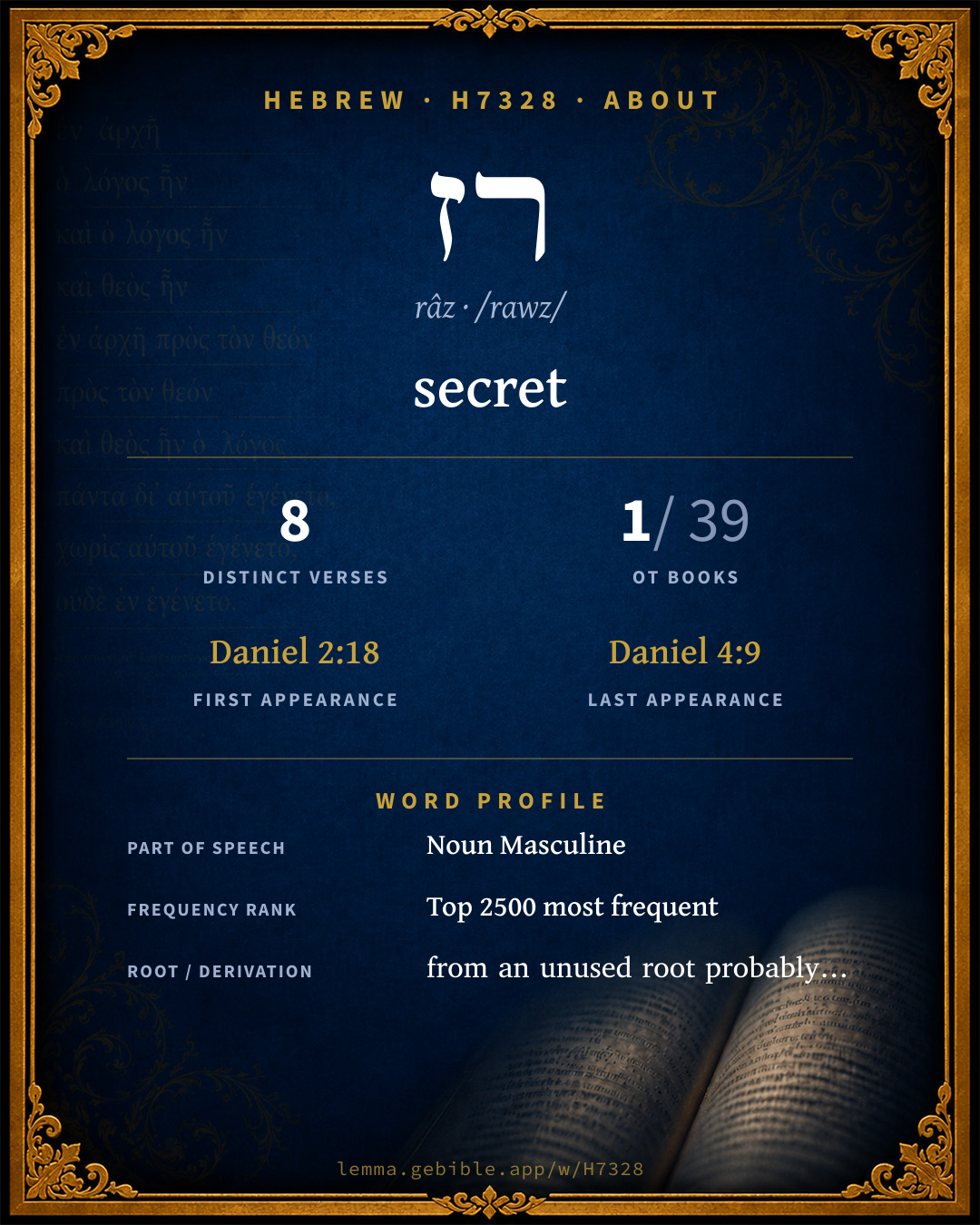
רָז
secret
Full lexicon entry — Brown-Driver-Briggs (BDB)
From Brown-Driver-Briggs (BDB)
Where this word appears
Grammar key — what these labels mean
Part of speech
- Noun
- A naming word — a person, place, thing, or idea.
Noun type
- Common
- A common noun — a general class of person, place, or thing (“king,” “city,” “water”), not a specific name.
State
- Absolute
- The independent form of a noun, not bound to a following word.
Gender
- Masculine
- Grammatically masculine.
Number
- Plural
- More than one (in Hebrew, generally three or more).
- Singular
- One.
Grammatical forms
- Particle, Definite Article 6 times (67%)
- Noun, Common, Masculine, Plural, Absolute 2 times (22%)
- Noun, Common, Masculine, Singular, Absolute 1 time (11%)
Parsed forms decoded from the imported morphology (morphhb / Westminster Leningrad Codex — WLC text public domain, morphhb tagging CC BY 4.0), counted across 9 parsed occurrences — not distinct verses.
Every verse where H7328 appears — 8 distinct verses across 1 book. Click any verse to open its interlinear word-by-word view. Verse text shown in the World English Bible for context — . Each verse’s Hebrew form is shown with its reference; the English is not keyword-highlighted, since the data carries no word-level English alignment. Use “Compare translations” on any verse to read it across multiple English versions. This concordance covers the Hebrew Bible; Septuagint (Greek Old Testament) occurrences are not indexed here.
Daniel 8 verses
- Daniel 2:18 רָזָ֖/ה n c ms det + ptcl def.art that they would desire mercies of the God of heaven concerning this secret; that Daniel and his companions should nor perish with the rest of the wise men of Babylon.
- Daniel 2:19 רָזָ֣/ה n c ms det + ptcl def.art Then was the secret revealed to Daniel in a vision of the night. Then Daniel blessed the God of heaven.
- Daniel 2:27 רָזָ/ה֙ n c ms det + ptcl def.art Daniel answered before the king, and said, The secret which the king has demanded can neither wise men, enchanters, magicians, nor soothsayers, show to the king;
- Daniel 2:28 רָזִ֔ין n c mp but there is a God in heaven who reveals secrets, and he has made known to the king Nebuchadnezzar what shall be in the latter days. Your dream, and the visions of your head on your bed, are these:
- Daniel 2:29 רָזַיָּ֛/א n c mp det + ptcl def.art as for you, O king, your thoughts came [into your mind] on your bed, what should happen hereafter; and he who reveals secrets has made known to you what shall happen.
- Daniel 2:30 רָזָ֥/א n c ms det + ptcl def.art But as for me, this secret is not revealed to me for any wisdom that I have more than any living, but to the intent that the interpretation may be made known to the king, and that you may know the thoughts of your heart.
- Daniel 2:47 רָזִ֑ין רָזָ֥/ה n c mp n c ms det + ptcl def.art The king answered to Daniel, and said, Of a truth your God is the God of gods, and the Lord of kings, and a revealer of secrets, seeing you have been able to reveal this secret.
- Daniel 4:9 רָ֖ז n c ms Belteshazzar, master of the magicians, because I know that the spirit of the holy gods is in you, and no secret troubles you, tell me the visions of my dream that I have seen, and the interpretation of it.
About this entry
At a glance — auto-summarized from this page’s data, not written by a person. Every figure links to its source below. This summary describes the numbers; it doesn’t interpret them.
“secret” is the headline sense of the Hebrew noun רז (râz). More than three-quarters of its appearances fall in Daniel. It appears 8 verses across 1 book of the Hebrew Bible, among its uncommon vocabulary. First canonically at Daniel 2:18, it enters the text early. Where the King James Version says “secret,” newer translations reach for “mystery” (Berean Standard Bible); the renderings breakdown has the detail. See the sense tree, 8-verse concordance, and the renderings breakdown below.
Gloss history
Strong's 1890 vs modern scholarship
About this word
Strong's H7328 catalogs a Hebrew word from the Hebrew Old Testament.
These counts are not copied from any lexicon or concordance. They are computed here, from the morphology-tagged Hebrew Old Testament. What Lemma adds →
- 8
- distinct verses
- The word appears in 8 distinct verses.
- 1 / 39
- OT books
- The word appears in 1 of 39 Old Testament books.
- #2,481
- by frequency
- Top 2500 most frequent Hebrew words (rank 2,481 of 8,640 Hebrew words by occurrence).
View all 8 occurrences in the concordance →
Most concentrated in
- Daniel 8 verses 100%
By section of the Old Testament
By traditional corpus
Conventional, traditional groupings — biblical authorship is debated, so this is a traditional corpus grouping, not an authorship claim. Each share is this word’s portion of its verses in that division of the Hebrew canon. Each figure is a share of the word’s 8 distinct verses.
- Writings (Ketuvim) 8 verses · 100%
How translations render this word
Counts come from each version’s own published word-to-Strong’s tagging or interlinear alignment — an approximate guide to how each version renders this word, not a word-level alignment the data otherwise carries. Because each total is that version’s own tagged count, the per-version totals vary from one another and need not match the appearance or distinct-verse counts above. These counts may also differ from a printed concordance because Lemma counts each distinctly tagged rendering and does not collapse phrase taggings into a single head-word total. This is a fixed set of word-tagged versions (KJV, ASV, BSB, ULT) and does not change with the reading translation you choose elsewhere. Each version’s license is shown beside its name below (and on Sources).
- King James Version: Secret 5×, Secrets 3×
- American Standard Version: Secret 5×, Secrets 3×
- Berean Standard Bible: Mystery 6×, Mysteries 3×
- unfoldingWord Literal Text: Mystery 6×, Mysteries 3×
King James Version Public Domain
Renders H7328 across 9 tagged occurrences — most commonly:
Plus 1 rendering that appears only once — usually multi-word phrases or single function words the recovered tagging swept in, not distinct renderings.
American Standard Version Public Domain
Renders H7328 across 9 tagged occurrences — most commonly:
Plus 1 rendering that appears only once — usually multi-word phrases or single function words the recovered tagging swept in, not distinct renderings.
Berean Standard Bible Public Domain
Renders H7328 across 9 tagged occurrences — most commonly:
unfoldingWord Literal Text CC BY-SA 4.0
Renders H7328 across 10 tagged occurrences — most commonly:
Plus 1 rendering that appears only once — usually multi-word phrases or single function words the recovered tagging swept in, not distinct renderings.
Senses in BDB
The 1 sense BDB distinguishes for this word, in lexicon order (not ranked by frequency or importance). The full entry — with sub-senses — is in the Lexicon Entry tab.
- secret
Word origin
Origin: from an unused root probably meaning to attenuate, ie (fig) hide
Jastrow Dictionary
A second Hebrew/Aramaic lexicon for comparison, covering Aramaic and post-biblical (Talmudic, Targumic, Midrashic) usage that the biblical-Hebrew BDB does not. Matched by lemma rather than by Strong’s number, so a lemma may carry more than one Jastrow headword (shown separately below), and the entries cover usage well beyond the Bible.
רָז
- (רזז or רוז, cmp. רוֹזֵן)
- 1. strength, foundation (corresp. to יְסוֹד, סוֹד). Snh. 42ᵃ (ref. to ולרוזנים, Prov. XXXI, 4) העוסקים ברָזוֹ של עולם וכ׳ those engaged in the foundation of the world (administration of justice) must abstain from strong drink. e.g. Proverbs 31:4
- 2. (corresp. to סוֹד) secret. Ib. 94ᵃ (ref. to Is. XXIV, 16) אמר שר העולם … רָזִי לי רזי לי the genius of the world said, Master of the world, do the will of this righteous man (Ezekiel) (make him the Messiah); then a divine voice went forth saying, my secret is mine &c. (v. Targ. a. Vulgate Is. l. c.). Sabb. 88ᵃ מי גילה לבני רז זה וכ׳ who revealed to my children this secret by which the ministering angels are guided?; a. e.—Pl. רָזִים. Snh. 70ᵇ (ref. to Prov. l. c.) מי שכל רָזֵי עולם גלוים וכ׳ should he to whom all secrets of the world are revealed, drink wine and be drunk?; Tanḥ. Sh’moth 1; Num. R. s. 104. Deut. R. s. 11 גליתי רָזֵיהֶם וכ׳ I revealed their (the angels’) secret to the sons of man; a. e.—[Y. M. Kat. I, 80ᶜ bot., read as Y. Snh. VI, 23ᵈ bot. בארזים, v. אֲרָזִין.] e.g. Isaiah 24:16
רָז ²
- Targ. Is. XXIV, 16 רָז אגר וכ׳ (constr.) the secret of reward … and of punishment. Targ. Am. III, 7 (h. text סוד). Targ. Ez. XXVIII, 3 (h. text סתום). Targ. O. Gen. XLIX, 6 (council). Targ. Ps. XCI, 1 (h. text סתר). Targ. I Sam. XVIII, 22 ברַז (h. text בלט). Targ. Y. Deut. XIII, 7 ברז; a. e.—Pl. רָזִין, רָזַיָּא, רָזֵי. Targ. Esth. VI, 1. Targ. II Kings VI, 11.—Snh. 31ᵃ דין גלי ר׳ this man is a revealer of secrets; a. e.
A Dictionary of the Targumim, the Talmud Babli and Yerushalmi, and the Midrashic Literature (Marcus Jastrow; London, Luzac, 1903) — Public Domain. Digitized via Sefaria. Digitized via Sefaria. Full attribution on Sources.
Forms in the corpus
The 9 distinct written forms H7328 takes in the Hebrew Bible, most frequent first — each parse links to that state’s occurrences in the concordance. Hebrew forms include their vowel points and cantillation, so a single lemma takes many written forms.
| Form | Parsing | Example | Uses |
|---|---|---|---|
| רָ֖ז | Noun, Common, Masculine, Singular, Absolute | Daniel 4:9 | 1 |
| רָזִ֑ין | Noun, Common, Masculine, Plural, Absolute | Daniel 2:47 | 1 |
| רָזִ֔ין | Noun, Common, Masculine, Plural, Absolute | Daniel 2:28 | 1 |
| רָזַיָּ֛/א | Particle, Definite Article | Daniel 2:29 | 1 |
| רָזָ/ה֙ | Particle, Definite Article | Daniel 2:27 | 1 |
| רָזָ֖/ה | Particle, Definite Article | Daniel 2:18 | 1 |
| רָזָ֣/ה | Particle, Definite Article | Daniel 2:19 | 1 |
| רָזָ֥/א | Particle, Definite Article | Daniel 2:30 | 1 |
| רָזָ֥/ה | Particle, Definite Article | Daniel 2:47 | 1 |
Septuagint verse parallels
This word appears in 8 verses that also exist in the Greek Old Testament (Septuagint), out of the 8 Hebrew verses it occurs in. You can read those verses in Greek by switching the Old Testament edition to the Septuagint.
Read these verses in the Septuagint
This is a verse-level parallel only — the same verses exist in both the Hebrew and Greek Old Testaments. No word-level Hebrew↔Greek correspondence is claimed: the data carries no such alignment, so no Greek word is shown as this Hebrew word’s translation. Coverage is not total — the Septuagint omits the deuterocanon and renumbers the Psalms, so some Hebrew verses have no direct Greek parallel.