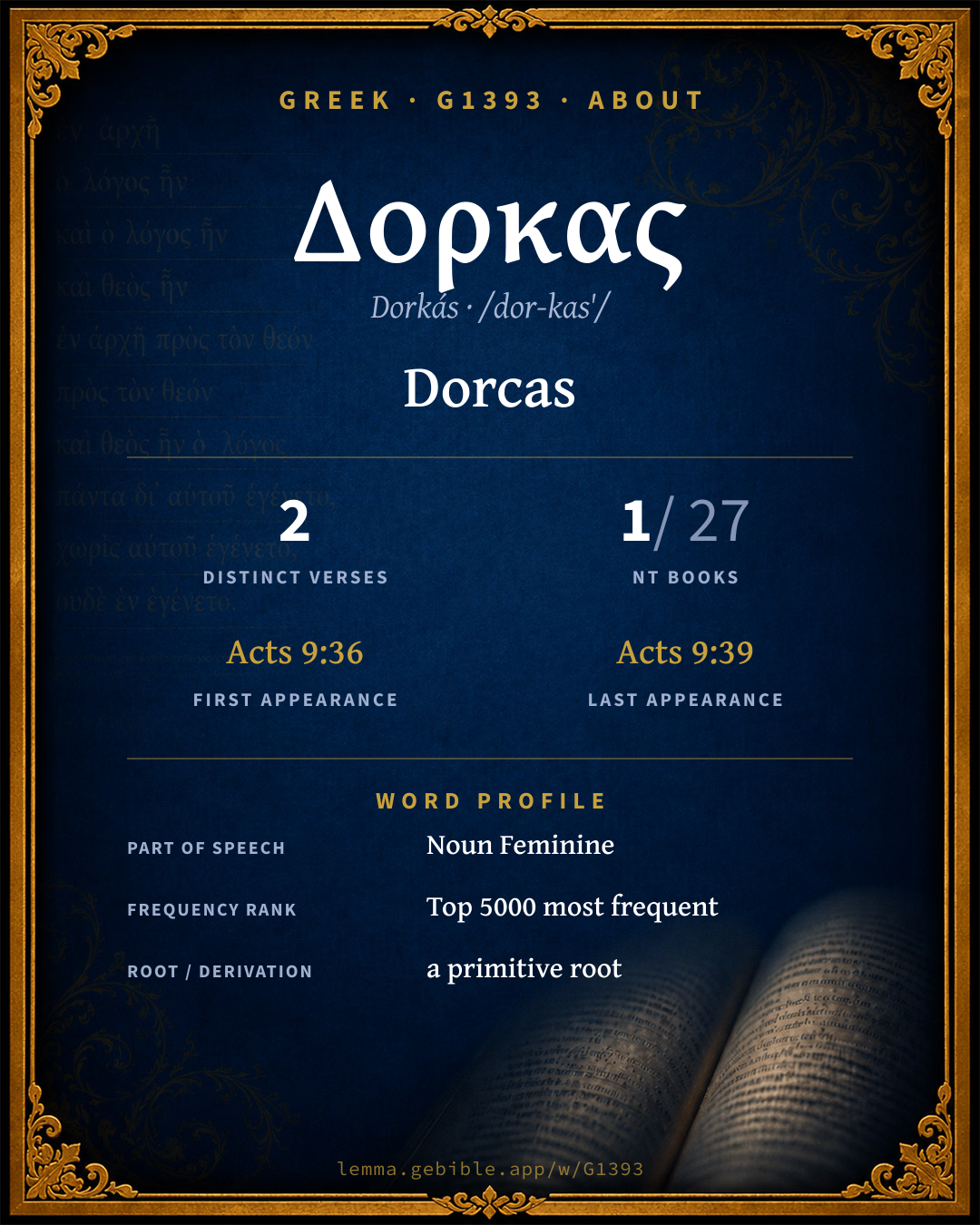
Δορκάς
Dorcas
Thayer's lists 2 entries for ‘Dorcas’ fuller range ↓
Full lexicon entry — Thayer's Greek Lexicon
From Thayer's Greek Lexicon
Where this word appears
Grammar key — what these labels mean
Part of speech
- Noun
- A naming word — a person, place, thing, or idea.
Case
- Nominative
- The case of the subject (and the predicate nominative).
Gender
- Feminine
- Grammatically feminine.
Number
- Singular
- One.
Every verse where G1393 appears — 2 distinct verses across 1 book. Click any verse to open its interlinear word-by-word view. Verse text shown in the World English Bible for context — . Each verse’s Greek form is shown with its reference; the English is not keyword-highlighted, since the data carries no word-level English alignment. Use “Compare translations” on any verse to read it across multiple English versions. This concordance covers the Greek New Testament; Septuagint (Greek Old Testament) occurrences of this word are not indexed here.
Acts 2 verses
- Acts 9:36 Δορκάς n nom sg fem Now there was at Joppa a certain disciple named Tabitha, which when translated, means Dorcas. This woman was full of good works and acts of mercy which she did.
- Acts 9:39 Δορκάς n nom sg fem Peter got up and went with them. When he had come, they brought him into the upper chamber. All the widows stood by him weeping, and showing the coats and garments which Dorcas had made while she was with them.
About this entry
At a glance — auto-summarized from this page’s data, not written by a person. Every figure links to its source below. This summary describes the numbers; it doesn’t interpret them.
Δορκας — transliterated Dorkás — is a Greek name carrying the sense “Dorcas.” With only 2 verses it sits in the long tail of Greek New Testament vocabulary. More than three-quarters of its appearances fall in Acts. Debuting at Acts 9:36, it then recurs through the corpus. Each statement above links to its evidence; the full detail follows below.
Gloss history
Strong's 1890 vs modern scholarship
About this word
Strong's G1393 catalogs a Greek word from the Greek New Testament.
These counts are not copied from any lexicon or concordance. They are computed here, from the morphology-tagged Greek New Testament. What Lemma adds →
- 2
- distinct verses
- The word appears in 2 distinct verses.
- 1 / 27
- NT books
- The word appears in 1 of 27 New Testament books.
- #2,678
- by frequency
- Top 5000 most frequent Greek words (rank 2,678 of 5,347 Greek words by occurrence).
View all 2 occurrences in the concordance →
Most concentrated in
- Acts 2 verses 100%
By section of the New Testament
By traditional corpus
Conventional, traditional groupings — biblical authorship is debated, so this is a traditional corpus grouping, not an authorship claim. Some books belong to more than one corpus (Luke is in both the Gospels and the Lukan corpus, and so on), so these shares overlap and need not total 100%. Each figure is a share of the word’s 2 distinct verses.
- Lukan (Luke–Acts) 2 verses · 100%
How translations render this word
Counts come from each version’s own published word-to-Strong’s tagging or interlinear alignment — an approximate guide to how each version renders this word, not a word-level alignment the data otherwise carries. Because each total is that version’s own tagged count, the per-version totals vary from one another and need not match the appearance or distinct-verse counts above. These counts may also differ from a printed concordance because Lemma counts each distinctly tagged rendering and does not collapse phrase taggings into a single head-word total. This is a fixed set of word-tagged versions (KJV, ASV, BSB, ULT) and does not change with the reading translation you choose elsewhere. Each version’s license is shown beside its name below (and on Sources).
- King James Version: Dorcas 2×
- American Standard Version: Dorcas 2×
- Berean Standard Bible: Dorcas 2×
- unfoldingWord Literal Text: Dorcas 2×
King James Version Public Domain
Renders G1393 across 2 tagged occurrences — most commonly:
American Standard Version Public Domain
Renders G1393 across 2 tagged occurrences — most commonly:
Berean Standard Bible Public Domain
Renders G1393 across 2 tagged occurrences — most commonly:
unfoldingWord Literal Text CC BY-SA 4.0
Renders G1393 across 2 tagged occurrences — most commonly:
Senses in Thayer's
The 2 senses Thayer's distinguishes for this word, in lexicon order (not ranked by frequency or importance). The full entry — with sub-senses — is in the Lexicon Entry tab.
- Dorcas = "gazelle"
- the name of a woman Peter raised from the dead
Word origin
Origin: a primitive root
gazelle ; Dorcas a Christian woman : - Dorcas.
— Strong’s Exhaustive Concordance (1890), public domain.
Bible dictionary
Public-domain dictionary articles matched to this entry by name (Dorcas). A biblical name can be shared by more than one person or place, so an article may treat several.
Easton's Bible Dictionary · M. G. Easton, 1897
A female antelope, or gazelle, a pious Christian widow at Joppa whom Peter restored to life (Acts 9:36-41). She was a Hellenistic Jewess, called Tabitha by the Jews and Dorcas by the Greeks.
Smith's Bible Dictionary · William Smith, 1863
(gazelle). [Tabitha]
Hitchcock's Bible Names Dictionary · Roswell D. Hitchcock, 1869
a female roe-deer
Classic public-domain reference works; full attribution on Sources.
Septuagint usage
The same Greek word Δορκας appears 13 times in the Greek Old Testament (Septuagint), across 13 verses in 6 books.
- 13
- LXX occurrences
- Tagged occurrences of this Greek word in the Septuagint.
- 13
- verses
- Distinct Septuagint verses containing this word.
- 6 / 39
- OT books
- The word appears in 6 of the 39 Old Testament books.
Sample Septuagint occurrences
- Deuteronomy 12:15 δορκάς
- 2 Samuel 2:18 δορκάς
- 1 Kings 2:46 δορκάς
- 1 Chronicles 12:9 δορκάς
- Proverbs 6:5 δορκάς
- Song of Solomon 2:9 δορκάς
Septuagint occurrences (same lexeme)
Every verse where the same Strong’s number (G1393) appears in the Greek Septuagint. Verse text shown in the World English Bible for context; the Greek form is the matched word — the English is not keyword-highlighted.
- Deuteronomy 12:15 δορκάς Notwithstanding, you may kill and eat flesh within all your gates, after all the desire of your soul, according to the blessing of Yahweh your God which he has given you: the unclean and the clean may eat of it, as of the gazelle, and as of the hart.
- Deuteronomy 12:22 δορκάς Even as the gazelle and as the hart is eaten, so you shall eat of it: the unclean and the clean may eat of it alike.
- Deuteronomy 14:5 δορκάς the hart, and the gazelle, and the roebuck, and the wild goat, and the ibex, and the antelope, and the chamois.
- Deuteronomy 15:22 δορκάς You shall eat it within your gates: the unclean and the clean [shall eat it] alike, as the gazelle, and as the hart.
- 2 Samuel 2:18 δορκάς The three sons of Zeruiah were there, Joab, and Abishai, and Asahel: and Asahel was as light of foot as a wild gazelle.
- 1 Kings 2:46 δορκάς So the king commanded Benaiah the son of Jehoiada; and he went out, and fell on him, so that he died. The kingdom was established in the hand of Solomon.
- 1 Kings 5:3 δορκάς You know how that David my father could not build a house for the name of Yahweh his God for the wars which were about him on every side, until Yahweh put them under the soles of his feet.
- 1 Chronicles 12:9 δορκάς Ezer the chief, Obadiah the second, Eliab the third,
- Proverbs 6:5 δορκάς Free yourself, like a gazelle from the hand of the hunter, Like a bird from the snare of the fowler.
- Song of Solomon 2:9 δορκάς My beloved is like a roe or a young hart. Behold, he stands behind our wall! He looks in at the windows. He glances through the lattice.
- Song of Solomon 4:5 δορκάς Your two breasts are like two fawns That are twins of a roe, Which feed among the lilies.
- Song of Solomon 7:4 δορκάς Your neck is like an ivory tower. Your eyes are like the pools in Heshbon by the gate of Bath-rabbim; Your nose is like the tower of Lebanon which looks toward Damascus.
- Song of Solomon 8:14 δορκάς Come away, my beloved! Be like a gazelle or a young stag on the mountains of spices!
These are occurrences of the same Greek lexeme (G1393) in the Septuagint — not a translation of any one Hebrew word. The store carries no word-level Hebrew↔Greek alignment, so no Hebrew original is asserted here. Counts come from the recovered LXX Strong's tagging — high-frequency vocabulary is well covered, while rare or late forms may be untagged — so they reflect tagged occurrences and may slightly undercount.