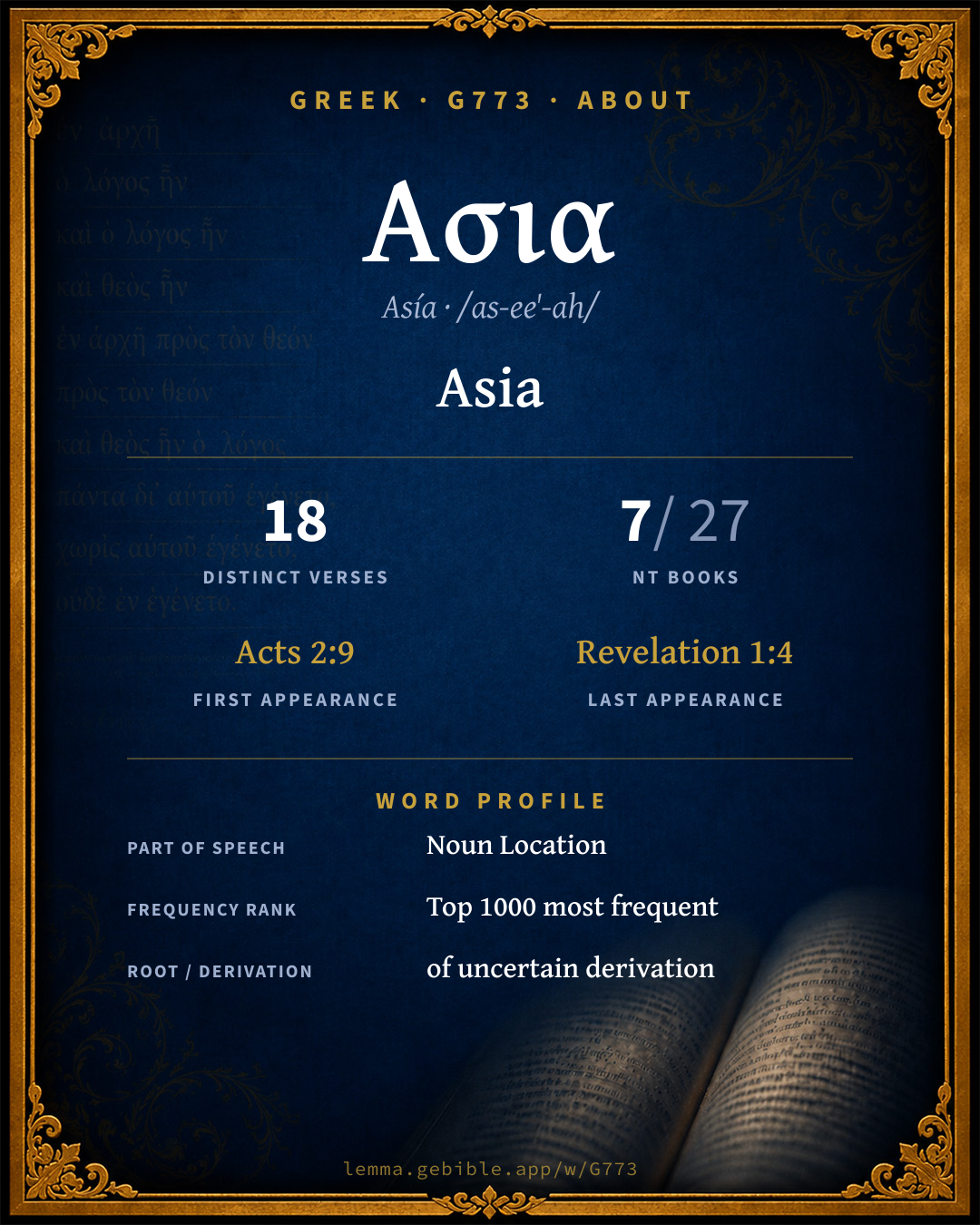
Ἀσία
Asia
Thayer's lists 2 entries for ‘Asia’ fuller range ↓
Full lexicon entry — Thayer's Greek Lexicon
From Thayer's Greek Lexicon
Where this word appears
See every Genitive-case word in the Greek New Testament →
Grammar key — what these labels mean
Part of speech
- Noun
- A naming word — a person, place, thing, or idea.
Case
- Genitive
- The case of source, possession, or “of” — answers “whose / from what.”
- Accusative
- The case of the direct object and of extent.
- Dative
- The case of the indirect object, means, or location — “to / for / with / in.”
- Nominative
- The case of the subject (and the predicate nominative).
Gender
- Feminine
- Grammatically feminine.
Number
- Singular
- One.
Grammatical forms
- Noun, Genitive, Singular, Feminine 7 times (39%)
- Noun, Accusative, Singular, Feminine 5 times (28%)
- Noun, Dative, Singular, Feminine 5 times (28%)
- Noun, Nominative, Singular, Feminine 1 time (6%)
Parsed forms decoded from the imported morphology (Robinson–Tischendorf, public domain), counted across 18 parsed occurrences — not distinct verses.
Every verse where G773 appears — 18 distinct verses across 7 books. Click any verse to open its interlinear word-by-word view. Verse text shown in the World English Bible for context — . Each verse’s Greek form is shown with its reference; the English is not keyword-highlighted, since the data carries no word-level English alignment. Use “Compare translations” on any verse to read it across multiple English versions. This concordance covers the Greek New Testament; Septuagint (Greek Old Testament) occurrences of this word are not indexed here.
Acts 12 verses
- Acts 2:9 Ἀσίαν n acc sg fem Parthians, Medes, Elamites, and people from Mesopotamia, Judea, Cappadocia, Pontus, Asia,
- Acts 6:9 Ἀσίας n gen sg fem But some of those who were of the synagogue called "The Libertines," and of the Cyrenians, of the Alexandrians, and of those of Cilicia and Asia arose, disputing with Stephen.
- Acts 16:6 Ἀσίᾳ n dat sg fem When they had gone through the region of Phrygia and Galatia, they were forbidden by the Holy Spirit to speak the word in Asia.
- Acts 19:10 Ἀσίαν n acc sg fem This continued for two years, so that all those who lived in Asia heard the word of the Lord Jesus, both Jews and Greeks.
- Acts 19:22 Ἀσίαν n acc sg fem Having sent into Macedonia two of those who ministered to him, Timothy and Erastus, he himself stayed in Asia for a while.
- Acts 19:26 Ἀσίας n gen sg fem You see and hear, that not at Ephesus alone, but almost throughout all Asia, this Paul has persuaded and turned away many people, saying that they are no gods, that are made with hands.
- Acts 19:27 Ἀσία n nom sg fem Not only is there danger that this our trade come into disrepute, but also that the temple of the great goddess Artemis will be counted as nothing, and her majesty destroyed, whom all Asia and the world worships."
- Acts 20:16 Ἀσίᾳ n dat sg fem For Paul had determined to sail past Ephesus, that he might not have to spend time in Asia; for he was hastening, if it were possible for him, to be in Jerusalem on the day of Pentecost.
- Acts 20:18 Ἀσίαν n acc sg fem When they had come to him, he said to them, "You yourselves know, from the first day that I set foot in Asia, how I was with you all the time,
- Acts 21:27 Ἀσίας n gen sg fem When the seven days were almost completed, the Jews from Asia, when they saw him in the temple, stirred up all the multitude and laid hands on him,
- Acts 24:18 Ἀσίας n gen sg fem amid which certain Jews from Asia found me purified in the temple, not with a mob, nor with turmoil.
- Acts 27:2 Ἀσίαν n acc sg fem Embarking in a ship of Adramyttium, which was about to sail to places on the coast of Asia, we put to sea; Aristarchus, a Macedonian of Thessalonica, being with us.
Romans 1 verse
1 Corinthians 1 verse
2 Corinthians 1 verse
2 Timothy 1 verse
1 Peter 1 verse
Revelation 1 verse
About this entry
At a glance — auto-summarized from this page’s data, not written by a person. Every figure links to its source below. This summary describes the numbers; it doesn’t interpret them.
The Greek name Ασια centers on the idea of “Asia.” The word gravitates to Acts (67%), then Romans and 1 Corinthians. It turns up in 18 verses across 7 books, an uncommon footprint. First canonically at Acts 2:9, it enters the text early. For the data behind this summary, explore 18-verse concordance and the renderings breakdown below.
Gloss history
Strong's 1890 vs modern scholarship
About this word
Strong's G773 catalogs a Greek word from the Greek New Testament.
These counts are not copied from any lexicon or concordance. They are computed here, from the morphology-tagged Greek New Testament. What Lemma adds →
- 18
- distinct verses
- The word appears in 18 distinct verses.
- 7 / 27
- NT books
- The word appears in 7 of 27 New Testament books.
- #664
- by frequency
- Top 1000 most frequent Greek words (rank 664 of 5,347 Greek words by occurrence).
View all 18 occurrences in the concordance →
Most concentrated in
- Acts 12 verses 67%
- Romans 1 verse 6%
- 1 Corinthians 1 verse 6%
By section of the New Testament
By traditional corpus
Conventional, traditional groupings — biblical authorship is debated, so this is a traditional corpus grouping, not an authorship claim. Some books belong to more than one corpus (Luke is in both the Gospels and the Lukan corpus, and so on), so these shares overlap and need not total 100%. Each figure is a share of the word’s 18 distinct verses.
- Lukan (Luke–Acts) 12 verses · 67%
- Pauline corpus 4 verses · 22%
- Johannine 1 verse · 6%
- General (Catholic) Epistles 1 verse · 6%
- Revelation 1 verse · 6%
How translations render this word
Counts come from each version’s own published word-to-Strong’s tagging or interlinear alignment — an approximate guide to how each version renders this word, not a word-level alignment the data otherwise carries. Because each total is that version’s own tagged count, the per-version totals vary from one another and need not match the appearance or distinct-verse counts above. These counts may also differ from a printed concordance because Lemma counts each distinctly tagged rendering and does not collapse phrase taggings into a single head-word total. This is a fixed set of word-tagged versions (KJV, ASV, BSB, ULT) and does not change with the reading translation you choose elsewhere. Each version’s license is shown beside its name below (and on Sources).
- King James Version: Asia 19×
- American Standard Version: Asia 16×
- Berean Standard Bible: Asia 18×
- unfoldingWord Literal Text: Asia 18×
King James Version Public Domain
Renders G773 across 19 tagged occurrences — most commonly:
American Standard Version Public Domain
Renders G773 across 18 tagged occurrences — most commonly:
Plus 2 renderings that appear only once — usually multi-word phrases or single function words the recovered tagging swept in, not distinct renderings.
Berean Standard Bible Public Domain
Renders G773 across 18 tagged occurrences — most commonly:
unfoldingWord Literal Text CC BY-SA 4.0
Renders G773 across 18 tagged occurrences — most commonly:
Senses in Thayer's
The 2 senses Thayer's distinguishes for this word, in lexicon order (not ranked by frequency or importance). The full entry — with sub-senses — is in the Lexicon Entry tab.
- Asia = "orient"
- Asia proper or proconsular Asia embracing Mysia, Lydia, Phrygia, and Caria, corresponding closely to Turkey today
Word origin
Origin: of uncertain derivation
Of uncertain derivation; Asia that is Asia Minor or (usually) only its western shore : - Asia.
— Strong’s Exhaustive Concordance (1890), public domain.
Forms in the corpus
The 4 distinct written forms G773 takes in the Greek New Testament, most frequent first — each parse links to that case’s occurrences in the concordance.
| Form | Parsing | Example | Uses |
|---|---|---|---|
| Ἀσίας Asías | Noun, Genitive, Singular, Feminine | Acts 6:9 | 7 |
| Ἀσίαν Asían | Noun, Accusative, Singular, Feminine | Acts 2:9 | 5 |
| Ἀσίᾳ Asía | Noun, Dative, Singular, Feminine | Acts 16:6 | 5 |
| Ἀσία Asía | Noun, Nominative, Singular, Feminine | Acts 19:27 | 1 |
Same root — word family
Other Thayer's entries built from the same root as G773, grouped by Strong’s listed origin. These share a root / origin per the lexicon — not necessarily a shared meaning. Each links to that word’s own entry.
Proper names from this root
People and places named from this root — a name, not an additional meaning of the word.
Compare all same-root words → 2 of the same-root words are proper names (people or places). They share a root, not necessarily a meaning.
Bible dictionary
Public-domain dictionary articles matched to this entry by name (Asia). A biblical name can be shared by more than one person or place, so an article may treat several.
Easton's Bible Dictionary · M. G. Easton, 1897
Is used to denote Proconsular Asia, a Roman province which embraced the western parts of Asia Minor, and of which Ephesus was the capital, in Acts 2:9; 6:9; 16:6; 19:10, 22; 20:4, 16, 18, etc., and probably Asia Minor in Acts 19:26, 27; 21:27; 24:18; 27:2. Proconsular Asia contained the seven churches of the Apocalypse (Rev. 1:11). The "chiefs of Asia" (Acts 19:31) were certain wealthy citizens who were annually elected to preside over the games and religious festivals of the several cities to which they belonged. Some of these "Asiarchs" were Paul's friends.
Smith's Bible Dictionary · William Smith, 1863
(orient). The passages in the New Testament where this word occurs are the following; (Acts 2:9; 6:9; 16:6; 19:10,22,26,27; 20:4,16,18; 21:27; 27:2; Romans 16:5; 1 Corinthians 16:19; 2 Corinthians 1:8; 2 Timothy 1:15; 1 Peter 1:1; Revelation 1:4,11) In all these it may be confidently stated that the word is used for a Roman province which embraced the western part of the peninsula of Asia Minor and of which Ephesus was the capital.
Hitchcock's Bible Names Dictionary · Roswell D. Hitchcock, 1869
muddy; boggy
Classic public-domain reference works; full attribution on Sources.