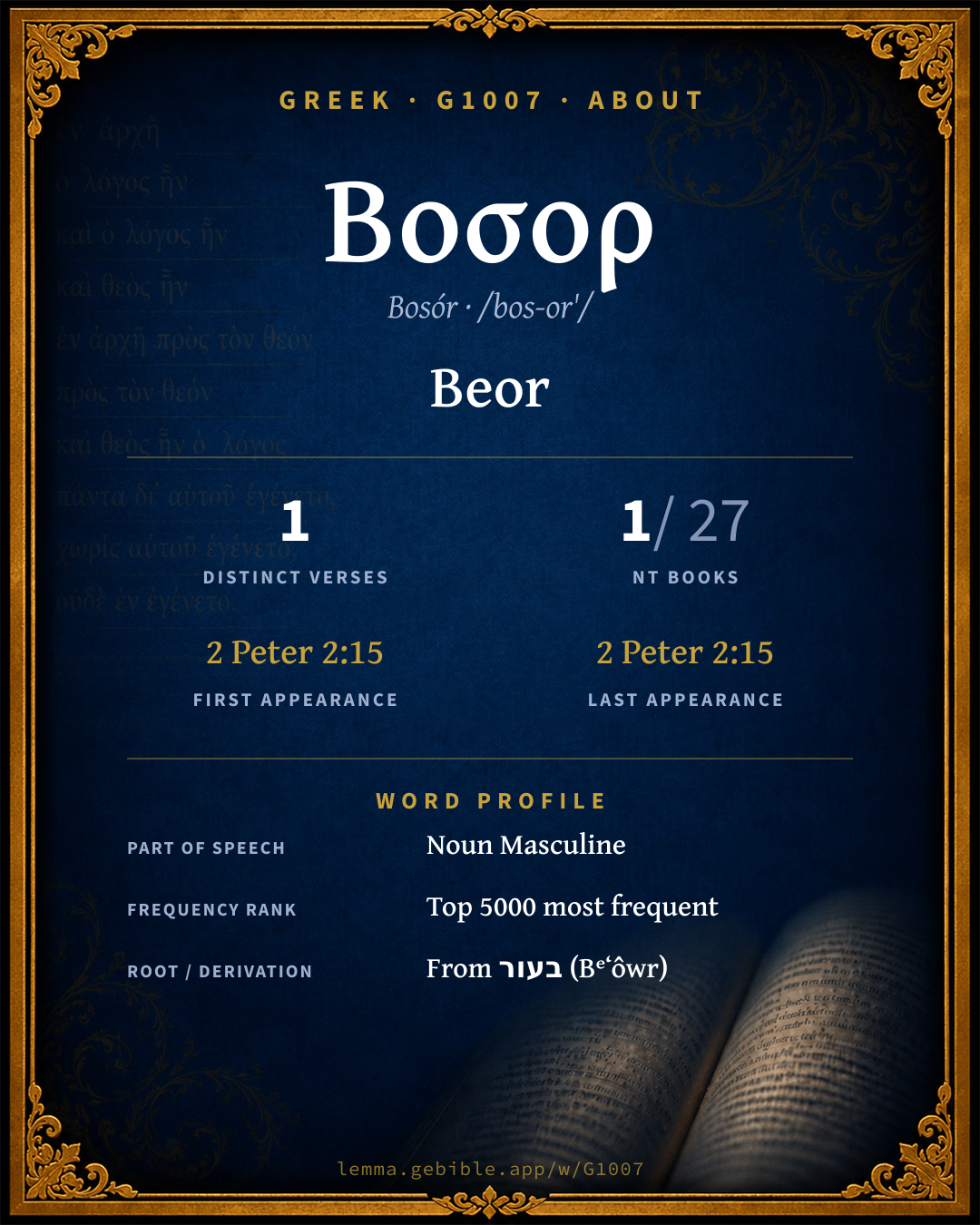
Βοσόρ
Beor
Thayer's lists 2 entries for ‘Beor’ fuller range ↓
Full lexicon entry — Thayer's Greek Lexicon
From Thayer's Greek Lexicon
Where this word appears
Every verse where G1007 appears — 1 distinct verse across 1 book. Click any verse to open its interlinear word-by-word view. Verse text shown in the World English Bible for context — . Each verse’s Greek form is shown with its reference; the English is not keyword-highlighted, since the data carries no word-level English alignment. Use “Compare translations” on any verse to read it across multiple English versions. This concordance covers the Greek New Testament; Septuagint (Greek Old Testament) occurrences of this word are not indexed here.
2 Peter 1 verse
About this entry
At a glance — auto-summarized from this page’s data, not written by a person. Every figure links to its source below. This summary describes the numbers; it doesn’t interpret them.
“Beor” is the headline sense of the Greek name Βοσορ (Bosór). The Greek New Testament uses it only 1 verse. It clusters heavily in 2 Peter, which alone accounts for 100% of its uses. Found nowhere else but 2 Peter 2:15. The sections below give every occurrence and version rendering.
Gloss history
Strong's 1890 vs modern scholarship
About this word
Strong's G1007 catalogs a Greek word from the Greek New Testament.
These counts are not copied from any lexicon or concordance. They are computed here, from the morphology-tagged Greek New Testament. What Lemma adds →
- 1
- distinct verses
- The word appears in 1 distinct verse.
- 1 / 27
- NT books
- The word appears in 1 of 27 New Testament books.
- #3,503
- by frequency
- Top 5000 most frequent Greek words (rank 3,503 of 5,347 Greek words by occurrence).
View all 1 occurrence in the concordance →
Most concentrated in
- 2 Peter 1 verse 100%
By section of the New Testament
By traditional corpus
Conventional, traditional groupings — biblical authorship is debated, so this is a traditional corpus grouping, not an authorship claim. Some books belong to more than one corpus (Luke is in both the Gospels and the Lukan corpus, and so on), so these shares overlap and need not total 100%. Each figure is a share of the word’s 1 distinct verse.
- General (Catholic) Epistles 1 verse · 100%
How translations render this word
Counts come from each version’s own published word-to-Strong’s tagging or interlinear alignment — an approximate guide to how each version renders this word, not a word-level alignment the data otherwise carries. Because each total is that version’s own tagged count, the per-version totals vary from one another and need not match the appearance or distinct-verse counts above. These counts may also differ from a printed concordance because Lemma counts each distinctly tagged rendering and does not collapse phrase taggings into a single head-word total. This is a fixed set of word-tagged versions (KJV, ASV, BSB, ULT) and does not change with the reading translation you choose elsewhere. Each version’s license is shown beside its name below (and on Sources).
- King James Version: Son of bosor 1×
- American Standard Version: Son of beor 1×
- Berean Standard Bible: Beor 1×
- unfoldingWord Literal Text: Bosor 1×
King James Version Public Domain
Renders G1007 across 1 tagged occurrence — most commonly:
American Standard Version Public Domain
Renders G1007 across 1 tagged occurrence — most commonly:
Berean Standard Bible Public Domain
Renders G1007 across 1 tagged occurrence — most commonly:
unfoldingWord Literal Text CC BY-SA 4.0
Renders G1007 across 1 tagged occurrence — most commonly:
Senses in Thayer's
The 2 senses Thayer's distinguishes for this word, in lexicon order (not ranked by frequency or importance). The full entry — with sub-senses — is in the Lexicon Entry tab.
- Bosor = "burning or torch"
- the father of Balaam
Word origin
Derived from בעור (Bᵉʻôwr) (H1160) — Beor.
Of hebrew origin [ H1160 ]; Bosor (that is Beor ) a Moabite : - Bosor.
— Strong’s Exhaustive Concordance (1890), public domain.
Bible dictionary
Public-domain dictionary articles matched to this entry by name (Beor). A biblical name can be shared by more than one person or place, so an article may treat several.
Easton's Bible Dictionary · M. G. Easton, 1897
A torch. (1.) The father of Bela, one of the kings of Edom (Gen. 36:32).
(2.) The father of Balaam (Num. 22:5; 24:3, 15; 31:8). In 2 Pet. 2:15 he is called Bosor.
Smith's Bible Dictionary · William Smith, 1863
(burning or torch).
+ The father of Bela, one of the early Edomite kings. (Genesis 36:32; 1 Chronicles 1:43) + Father of Balaam. (Numbers 22:5; 24:3,15; 31:8; 23:4; Joshua 13:22; 24:9; Micah 6:5) He is called Bosor in the New Testament. (B.C. before 1450.)
Hitchcock's Bible Names Dictionary · Roswell D. Hitchcock, 1869
burning; foolish; mad
Classic public-domain reference works; full attribution on Sources.
Septuagint usage
The same Greek word Βοσορ appears 10 times in the Greek Old Testament (Septuagint), across 10 verses in 6 books.
- 10
- LXX occurrences
- Tagged occurrences of this Greek word in the Septuagint.
- 10
- verses
- Distinct Septuagint verses containing this word.
- 6 / 39
- OT books
- The word appears in 6 of the 39 Old Testament books.
Sample Septuagint occurrences
- Deuteronomy 4:43 βοσορ
- Joshua 20:5 βοσορ
- 1 Samuel 30:9 βοσορ
- 1 Chronicles 6:63 βοσορ
- Isaiah 34:6 βοσορ
- Jeremiah 31:24 βοσορ
Septuagint occurrences (same lexeme)
Every verse where the same Strong’s number (G1007) appears in the Greek Septuagint. Verse text shown in the World English Bible for context; the Greek form is the matched word — the English is not keyword-highlighted.
- Deuteronomy 4:43 βοσορ [namely], Bezer in the wilderness, in the plain country, for the Reubenites; and Ramoth in Gilead, for the Gadites; and Golan in Bashan, for the Manassites.
- Joshua 20:5 βοσορ If the avenger of blood pursue after him, then they shall not deliver up the manslayer into his hand; because he struck his neighbor unawares, and didn't hate him before.
- Joshua 21:36 βοσορ Out of the tribe of Reuben, Bezer with its suburbs, and Jahaz with its suburbs,
- 1 Samuel 30:9 βοσορ So David went, he and the six hundred men who were with him, and came to the brook Besor, where those who were left behind stayed.
- 1 Samuel 30:10 βοσορ But David pursued, he and four hundred men; for two hundred stayed behind, who were so faint that they couldn't go over the brook Besor.
- 1 Samuel 30:21 βοσορ David came to the two hundred men, who were so faint that they could not follow David, whom also they had made to abide at the brook Besor; and they went forth to meet David, and to meet the people who were with him: and when David came near to the people, he greeted them.
- 1 Chronicles 6:63 βοσορ To the sons of Merari [were given] by lot, according to their families, out of the tribe of Reuben, and out of the tribe of Gad, and out of the tribe of Zebulun, twelve cities.
- Isaiah 34:6 βοσορ The sword of Yahweh is filled with blood, it is made fat with fatness, with the blood of lambs and goats, with the fat of the kidneys of rams; for Yahweh has a sacrifice in Bozrah, and a great slaughter in the land of Edom.
- Isaiah 63:1 βοσορ Who is this who comes from Edom, with dyed garments from Bozrah? this who is glorious in his clothing, marching in the greatness of his strength? I who speak in righteousness, mighty to save.
- Jeremiah 31:24 βοσορ Judah and all the cities of it shall dwell therein together, the farmers, and those who go about with flocks.
These are occurrences of the same Greek lexeme (G1007) in the Septuagint — not a translation of any one Hebrew word. The store carries no word-level Hebrew↔Greek alignment, so no Hebrew original is asserted here. Counts come from the recovered LXX Strong's tagging — high-frequency vocabulary is well covered, while rare or late forms may be untagged — so they reflect tagged occurrences and may slightly undercount.