
1 Timothy 1:6

Greek (Tischendorf 8th ed.) 1 Timothy 1:6 appears in the Greek New Testament. The text above is from the Tischendorf 8th edition. Each word links to its Strong’s number and a concise gloss. Click any word for its full Thayer’s Greek Lexicon entry.
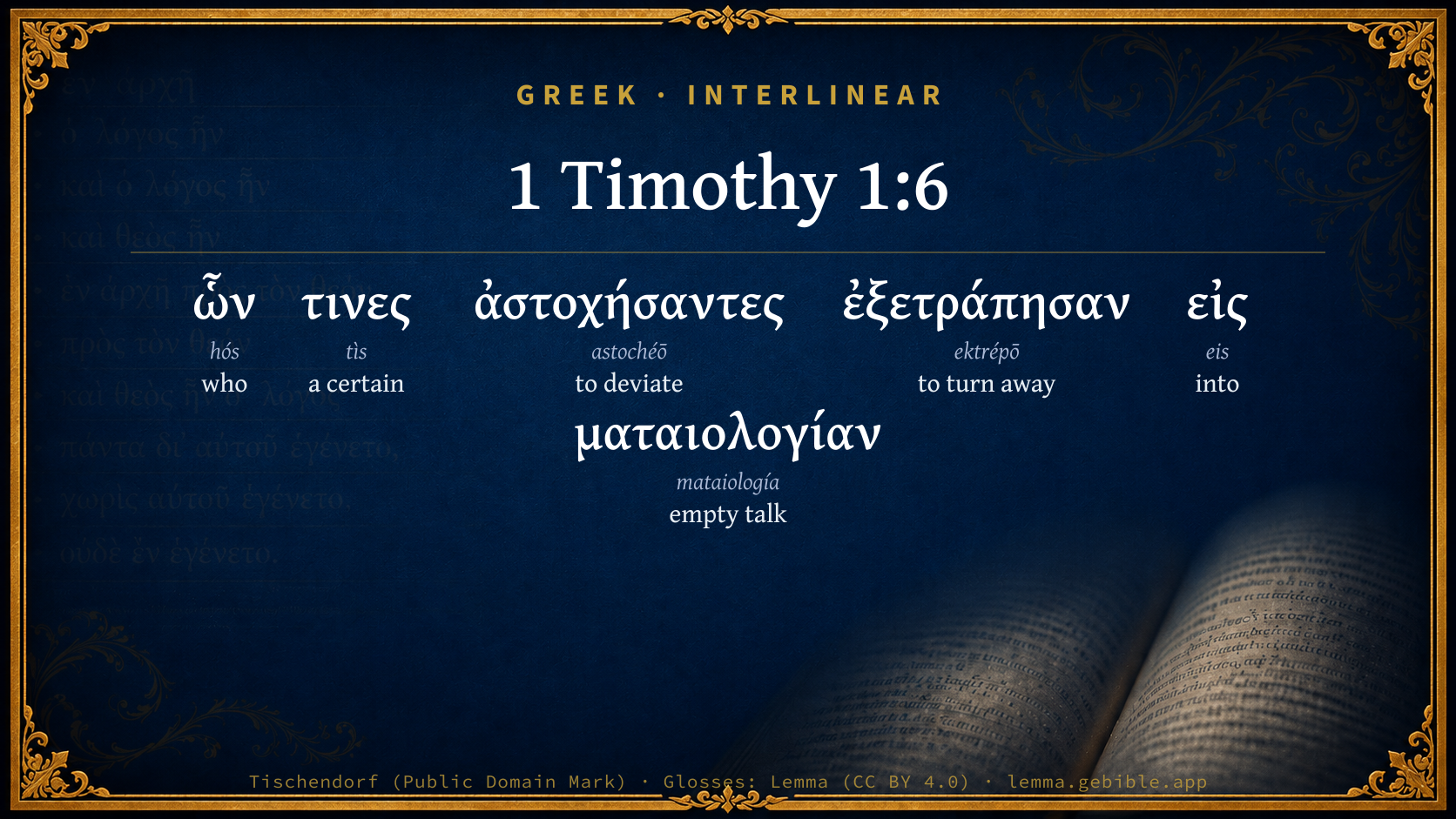
Download image
Cite this verse

1 Timothy 1:6 (World English Bible). Public Domain. Lemma interlinear Bible study tool, https://lemma.gebible.app/v/1-timothy/1/6.

Show BibTeX & RIS
BibTeX
RIS
English Translation
from which things some, having missed the mark, have turned aside to vain talking;
World English Bible · Public Domain
Highlights
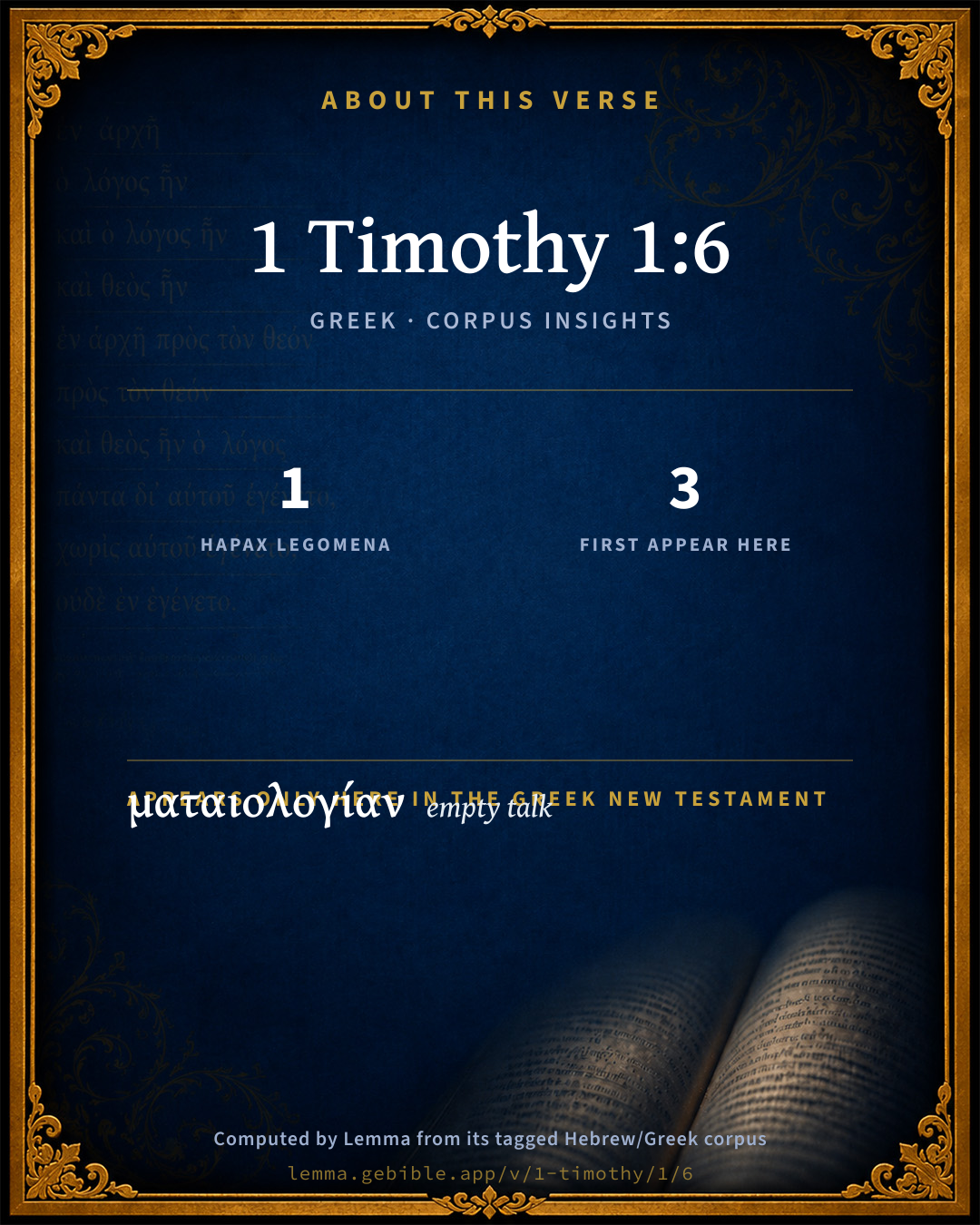
  • 1 hapax legomenon — only here in the Greek New Testament
  • 3 first appearances in the Greek New Testament
Full analysis ↓
Download a study sheet

One document with this verse’s original text, its word-by-word gloss line, the meaning frame, cross-references with their text, attributed commentary, and full source and license credits — printable, and it pastes into notes with its structure intact.

This verse Autodidact and up

Study sheet (.html) Plain text (.txt)

A passage Seminary Student

Up to 50 verses in one chapter. A passage sheet keeps up to 6 commentary sources and 12 cross-references per verse, in the order this page ranks them, and says so on the sheet whenever that leaves anything out. Ask for a single verse and you get the Autodidact verse sheet above.

Everything on this page stays free to read, with no account — the sheet is a download of what is already on screen, not access to it.

Want to remove ads? Support Godless Engineer
Compare translations 3

The same verse in 3 English versions, stacked beneath the original-language interlinear above. Click any original word for its lexicon entry.

Each is an independent rendering of the whole verse — the interlinear is not word-aligned to these translations.

Highlighted words mark where these versions differ — a whole-verse word diff, not a word-by-word alignment.

  • World English Bible Public Domain
    from which things some, having missed the mark, have turned aside to vain talking;
  • King James Version Public Domain
    From which some having swerved have turned aside unto vain jangling;
  • unfoldingWord Literal Text CC BY-SA 4.0
    from which some, having missed the mark, have turned away to foolish talk,

unfoldingWord Literal Text — © unfoldingWord, licensed CC BY-SA 4.0. Word-aligned USFM3 via Door43 (git.door43.org/unfoldingWord/en_ult).

Versions to compare (up to 4)

3 of 4 selected

Show all 19 translations

Every available English version of this verse, each an independent rendering of the whole verse.

  • World English Bible Public Domain
    from which things some, having missed the mark, have turned aside to vain talking;
  • Berean Standard Bible Public Domain
    Some have strayed from these ways and turned aside to empty talk.
  • Majority Standard Bible Public Domain
    Some have strayed from these ways and turned aside to empty talk.
  • King James Version Public Domain
    From which some having swerved have turned aside unto vain jangling;
  • American Standard Version (1901) Public Domain
    from which things some having swerved have turned aside unto vain talking;
  • Revised Version (1885) Public Domain
    from which things some having swerved have turned aside unto vain talking;
  • Geneva Bible (1599) Public Domain
    From the which things some haue erred, and haue turned vnto vaine iangling.
  • Douay-Rheims (1899) Public Domain
    From which things some going astray, are turned aside unto vain babbling:
  • Young's Literal Translation Public Domain
    from which certain, having swerved, did turn aside to vain discourse,
  • Literal Standard Version CC BY-SA 4.0
    from which certain [men], having swerved, turned aside to vain discourse,
  • Unlocked Literal Bible CC BY-SA 4.0
    Some people have missed the mark and have turned away from these things to foolish talk.
  • unfoldingWord Literal Text CC BY-SA 4.0
    from which some, having missed the mark, have turned away to foolish talk,
  • Darby Bible Public Domain
    which [things] some having missed, have turned aside to vain discourse,
  • World Messianic Bible Public Domain
    from which things some, having missed the mark, have turned away to vain talking,
  • Webster's Bible Public Domain
    From which some having swerved, have turned aside to vain jangling;
  • Free Bible Version CC BY-SA 4.0
    Some have deviated from these things, and have ended up talking nonsense.
  • Bible in Basic English Public Domain
    From which some have been turned away, giving themselves to foolish talking;
  • Text-Critical English NT CC BY 4.0
    Some have strayed from these and have turned aside to meaningless talk,
  • Tyndale New Testament (1534) Public Domain
    from the which thinges some have erred and have turned vnto vayne iangelinge

Literal Standard Version (2020), Covenant Press — licensed CC BY-SA 4.0. Text via the HelloAO Bible API (eBible.org). Unlocked Literal Bible (unfoldingWord) — licensed CC BY-SA 4.0. Text via the HelloAO Bible API (eBible.org). unfoldingWord Literal Text — © unfoldingWord, licensed CC BY-SA 4.0. Word-aligned USFM3 via Door43 (git.door43.org/unfoldingWord/en_ult). Free Bible Version, Dr. Jonathan Gallagher — licensed CC BY-SA 4.0. Text via the HelloAO Bible API (eBible.org).

Word by word

More ways to search: Search by grammar → Find every occurrence → Compare this word →

Practice this passage: Drill this verse → Learn its vocabulary →

About this verse

These counts appear in no published source. They are computed here, from the morphology-tagged text and Lemma’s own curated glosses. What Lemma adds →

6
words
6
distinct lemmas
Pauline Epistles
section

Notable vocabulary

1 hapax legomenon — a word that appears only here in the entire Greek New Testament:

  • ματαιολογίαν empty talk G3150

First appearance in Scripture

These words make their first canonical appearance in the Greek New Testament here:

  • ἀστοχήσαντες to deviate G795
  • ἐξετράπησαν to turn away G1624
  • ματαιολογίαν empty talk G3150

Shared distinctive vocabulary

ἀστοχήσαντες to deviate G795 occurs in 3 verses of the Greek New Testament. Also found in:
Cross-references

8

Topical passages linked to 1 Timothy 1:6 in the Treasury of Scripture Knowledge — connected by theme and wording, ordered by reader-vote popularity; previews shown in the World English Bible.

  • Titus 1:10 For there are also many unruly men, vain talkers and deceivers, especially those of the circumcision,
  • 2 Timothy 2:23–24 But refuse foolish and ignorant questionings, knowing that they generate strife.
  • 1 Timothy 6:20–21 Timothy, guard that which is committed to you, turning away from the empty chatter and oppositions of the knowledge which is falsely so called;
  • Titus 3:9 but shun foolish questionings, genealogies, strife, and disputes about the law; for they are unprofitable and vain.
  • 1 Timothy 5:15 For already some have turned aside after Satan.
  • 2 Timothy 2:18 men who have erred concerning the truth, saying that the resurrection is already past, and overthrowing the faith of some.
  • 2 Timothy 4:10 for Demas left me, having loved this present world, and went to Thessalonica; Crescens to Galatia, and Titus to Dalmatia.
  • 1 Timothy 6:4–5 he is conceited, knowing nothing, but obsessed with arguments, disputes, and word battles, from which come envy, strife, reviling, evil suspicions,

Cross-references courtesy of OpenBible.info (CC BY 4.0).

Commentary

Notes on 1 Timothy 1:6 from classic Christian and Jewish commentators (each source and its license shown beneath its notes). The classic Christian expositions comment on the surrounding passage and are grouped to its opening verse, so a note may address several verses; the Jewish commentaries on the Tanakh (Rashi and others) are per-verse, so they appear only where the commentator wrote on this verse.

Lemma curates 59 commentaries, every one of them public domain or Creative Commons licensed, each selected and text-cleaned for this edition rather than reprinted as found. About our sources →

MacLaren's Expositions of Holy Scripture

Alexander MacLaren

1 Timothy

THE END OF THE COMMANDMENT

1Ti 1:6.

The Apostle has just said that he left Timothy in Ephesus, in order to check some tendencies there which were giving anxiety. Certain teachers had appeared, the effect of whose activity was to create parties, to foster useless speculations, and to turn the minds of the Ephesian Christians away from the practical and moral side of Christianity. In opposition to these, the Apostle here lays down the broad principle that God has spoken, not in order to make acute theologians, or to provide materials for controversy, but in order to help us to love. The whole of these latest letters of the Apostle breathe the mellow wisdom of old age, which has learned to rate brilliant intellectualism, agility, incontroversial fence and the like, far lower than homely goodness. And so, says Paul, ‘the end of the commandment is love.’

Now he here states, not only the purpose of the divine revelation, but gives us a summary, but yet sufficient, outline of the method by which God works towards that purpose. The commandment is the beginning, love is the end or aim. And between these two there are inserted three things, a ‘pure heart,’ a ‘good conscience,’ ‘faith unfeigned.’ Now of these three the two former are closely connected, and the third is the cause, or condition, of both of them. It is, therefore, properly named last as being first in order, and therefore last reached in analysis. When you track a stream from its mouth to its source, the fountain-head is the last thing that you come to. And here we have, as in these great lakes in Central Africa--out of which finally the Nile issues--the stages of the flow. There are the twin lakes, a ‘good conscience’ and a ‘pure heart.’ These come from ‘unfeigned faith,’ which lies higher up in the hills of God; and they run down into the love which is the ‘end of the commandment.’ The faith lays hold on the commandment, and so the process is complete. Or, if you begin at the top, instead of at the bottom, God gives the word; faith grasps the word, and thereby nourishes a ‘pure heart’ and a ‘good conscience,’ and thereby produces a universal love. So, then, we have three steps to look at here.

I. First of all, what God speaks to us for.

‘The end of the commandment is love.’

Now, I take it that the word ‘commandment’ here means, not this or that specific precept, but the whole body of Christian revelation, considered as containing laws for life. And to begin with, and only to mention, it is something to get that point of view, that all which God says, be it promise, be it self-manifestation, be it threatening, or be it anything else, has a preceptive bearing, and is meant to influence life and conduct. I shall have a word or two more to say about that presently, but note, just as we go on, how remarkable it is, and how full of lessons, if we will ponder it, that one name for the Gospel on the lips of the man who had most to say about the contrast between Gospel and Law is ‘commandment.’ Try to feel the stringency of that aspect of evangelical truth and of Christian revelation.

Then I need not remind you how here the indefinite expression ‘love’ must be taken, as I think is generally the case in the New Testament, when the object on which the love rests is not defined, as including both of the twin commandments, of which the second, our Master says, is like unto the first, love to God and love to man. In the Christian idea these two are one. They are shoots from the one root. The only difference is that the one climbs and the other grows along the levels of earth. There is no gulf set in the New Testament teaching, and there ought to be none in the practice and life of a Christian man, between the love of God and the love of man. They are two aspects of one thing.

Then, if so, mark how, according to the Apostle’s teaching here, in this one thought of a dual-sided love, one turned upwards, one turned earthwards, there lies the whole perfection of a human soul. You want nothing more if you are ‘rooted and grounded in love.’ That will secure all goodness, all morality, all religion, everything that is beautiful, and everything that is noble. And all this is meant to be the result of God’s speech to us.

So, then, two very plain practical principles may be deduced and enforced from this first thought. First, the purpose of all revelation and the test of all religion is--character and conduct.

It is all very well to know about God, to have our minds filled with true thoughts about Him, His nature, and dealings with us. Orthodoxy is good, but orthodoxy is a means to an end. There should be nothing in a man’s creed which does not act upon his life. Or, if I may put it into technical words, all a man’s credenda should be his agenda ; and whatsoever he believes should come straight into his life to influence it, and to shape character. Here, then, is the warning against a mere notional orthodoxy, and against regarding Christian truth as being intended mainly to illuminate the understanding, or to be a subject of speculation and discussion. There are people in all generations, and there are plenty of them to-day, who seem to think that the great verities of the Gospel are mainly meant to provide material for controversy--

‘As if religion were intended For nothing else but to be mended’;

and that they have done all that can be expected when they have tried to apprehend the true bearing of this revelation, and to contend against misinterpretations. This is the curse of religious controversy, that it blinds men to the practical importance of the truths for which they are fighting. It is as if one were to take some fertile wheat-land, and sand it all over, and roll it down, and make it smooth for a gymnasium, where nothing would grow. So the temper which finds in Christian truth simply a ‘ministration of questions,’ as my text says, mars its purpose, and robs itself of all the power and nourishment that it might find there.

No less to be guarded against is the other misconception which the clear grasp of our text would dismiss at once, that the great purpose for which God speaks to us men, in the revelation of Jesus Christ, is that we may, as we say, be ‘forgiven,’ and escape any of the temporal or eternal consequences of our wrongdoing. That is a purpose, no doubt, and men will never rise to the apprehension of the loftiest purposes, nor penetrate to a sympathetic perception of the inmost sweetness of the Gospel, unless they begin with its redemptive aspect, even in the narrowest sense of that word. But there are a miserable number of so-called and of real Christians in this world, and in our churches to-day, who have little conception that God has spoken to them for anything else than to deliver them from the fear of death, and from the incidence on them of future condemnation. He has spoken for this purpose, but the ultimate end of all is that we may be helped to love Him, and so to be like Him. The aim of the commandment is love, and if you ever are tempted to rest in intellectual apprehensions, or to pervert the truth of God into a mere arena on which you can display your skill of fence and your intellectual agility, or if ever you are tempted to think that all is done when the sweet message of forgiveness is sealed upon a man’s heart, remember the solemn and plain words of my text--the final purpose of all is that we may love God and man.

But then, on the other side, note that no less distinctly is the sole foundation of this love laid in God’s speech. My text, in its elevation of sentiment and character and conduct above doctrine, falls in with the prevailing tendencies of this day; but it provides the safeguards which these tendencies neglect. Notice that this favourite saying of the most advanced school of broad thinkers, who are always talking about the decay of dogma, and the unimportance of doctrine as compared with love, is here uttered by a man who was no sentimentalist, but to whom the Christian system was a most distinct and definite thing, bristling all over with the obnoxious doctrines which are by some of us so summarily dismissed as of no importance. My very text protests against the modern attempt to wrench away the sentiments and emotions produced in men, by the reception of Christian truth, from the truth which it recognises as the only basis on which they can be produced. It declares that the ‘commandment’ must come first, before love can follow; and the rest of the letter, although, as I say, it decisively places the end of revelation as being the moral and religious perfecting of men into assimilation with the divine love, no less decisively demands that for such a perfecting there shall be laid the foundation of the truth as it is revealed in Jesus Christ.

And that is what we want to-day in order to make breadth wholesome, and if only we will carry with us the two thoughts, the commandment and love, we shall not go far wrong. But what would you think of a man that said, ‘I do not want any foundations. I want a house to live in’? And pray how are you going to get your house without the foundations? Or would he be a wise man who said, ‘Oh, never mind about putting grapes into the vine vat, and producing fermentation; give me the wine!’ Yes! But you must have the fermentation first. The process is not the result, of course, but there is no result without the process. And according to New Testament teaching, which, I am bold to say, is verified by experience, there is no deep, all-swaying, sovereign, heart-uniting love to God which is not drawn from the acceptance of the truth as it is in Jesus Christ.

II. And so I come, secondly, to note the purifying which is needed prior to such love.

Our text, as I said, divides the process into stages; or, if I may go back to a former illustration, into levels. And on the level immediately above the love, down into which the waters of the twin lakes glide, are a pure heart and a good conscience. These are the requisites for all real and operative love. Now they are closely connected, as it seems to me, more closely so than with either the stage which precedes or that which follows. They are, in fact, two twin thoughts, very closely identified, though not quite identical.

A pure heart is one that has been defecated and cleansed from the impurities which naturally attach to human affections. A ‘good conscience’ is one which is void of offence towards God and man, and registers the emotions of a pure heart. It is like a sheet of sensitive paper that, with a broken line, indicates how many hours of sunshine in the day there have been. We need not discuss the question as to which of these two great gifts and blessings which sweeten a whole life come first. In the initial stages of the Christian life I suppose the good conscience precedes the pure heart. For forgiveness which calms the conscience and purges it of the perilous stuff which has been injected into it by our corruptions--forgiveness comes before cleansing, and the conscience is calm before the heart is purified. But in the later stages of the Christian life the order seems to be reversed, and there cannot be in a man a conscience that is good unless there is a heart that is pure.

But however that may be--and it does not affect the general question before us--mark how distinctly Paul lays down here the principle that you will get no real love of God or man out of men whose hearts are foul, and whose consciences are either torpid or stinging them. I need not dwell upon that, for it is plain to anybody that will think for a moment that all sin separates between a man and God; and that from a heart all seething and bubbling, like the crater of a volcano, with foul liquids, and giving forth foul odours, there can come no love worth calling so to God, nor any benevolence worth calling so to man. Wherever there is sin, unrecognised, unconfessed, unpardoned, there there is a black barrier built up between a man’s heart and the yearning heart of God on the other side. And until that barrier is swept away, until the whole nature receives a new set, until it is delivered from the love of evil, and from its self-centred absorption, and until conscience has taken into grateful hands, if I might so say, the greatest of all gifts, the assurance of the divine forgiveness, I, for one, do not believe that deep, vital, and life-transforming love to God is possible. I know that it is very unfashionable, I know it is exceedingly narrow teaching, but it seems to me that it is Scriptural teaching; and it seems to me that if we will strip it of the exaggerations with which it has often been surrounded, and recognise that there may be a kind of instinctive and occasional recognition of a divine love, there may be a yearning after a clear light, and fuller knowledge of it, and yet all the while no real love to God, rooted in and lording over and moulding the life, we shall not find much in the history of the world, or in the experience of ourselves or of others, to contradict the affirmation that you need the cleansing of forgiveness, and the recognition of God’s love in Jesus Christ, before you can get love worth calling so in return to Him in men’s hearts.

Brethren, there is much to-day to shame Christian men in the singular fact which is becoming more obvious daily, of a divorce between human benevolence and godliness. It is a scandal that there should be so many men in the world who make no pretensions to any sympathy with your Christianity, and who set you an example of benevolence, self-sacrifice, enthusiasm for humanity, as it is called. I believe that the one basis upon which there can be solidly built benevolence to men is devotion to God, because of God’s great love to us in Jesus Christ. But I want to stir, if I might not say sting, you and myself into a recognition of our obligations to mankind, more stringent and compelling than we have ever felt it, by this phenomenon of modern life, that a divorce has been proclaimed between philanthropy and religion. The end of the commandment is love, out of a pure heart, and of a good conscience.

III. Lastly, notice the condition of such purifying.

To recur to my former illustration, we have to go up country to a still higher level. What feeds the two reservoirs that feed the love? What makes the heart pure and the conscience good? Paul answers, ‘faith unfeigned’; not mere intellectual apprehension, not mere superficial or professed, but deep, genuine, and complete faith which has in it the element of reliance as well as the element of credence. Belief is not all that goes to make faith. Trust is not all that goes to make faith. Belief and trust are indissolubly wedded in the conception of it. Such a faith, which knows what it lays hold of--for it lays hold upon definite truth, and lays hold on what it knows, for it trusts in Him whom the truth reveals--such a faith makes the heart pure and the conscience good.

And how does it do so? By nothing in itself. There is no power in my faith to make me one bit better than I am. There is no power in it to still one accusation of conscience. It is only the condition on which the one power that purges and that calms enters into my heart and works there. The power of faith is the power of that which faith admits to operate in my life. If we open our hearts the fire will come in, and it will thaw the ice, and melt out the foulness from my heart. It is important for practice that we should clearly understand that the great things which the Bible says of faith it says of it only because it is the channel, the medium, the condition, by and on which the real power, which is Jesus Christ Himself, acts upon us. It is not the window, but the sunshine, that floods this building with light. It is not the opened hand, but the gift laid in it, that enriches the pauper. It is not the poor leaden pipe, but the water that flows through it, that fills the cistern, and cleanses it, whilst it fills. It is not your faith, but the Christ whom your faith brings into your heart and conscience, that purges the one, and makes the other void of offence towards God and man.

So, brethren, let us learn the secret of all nobility, of all power, of all righteousness of character and conduct. Put your foot on the lowest round of the ladder, and then aspire and climb, and you will reach the summit. Take the first step, and be true to it after you have taken it, and the last will surely come. He that can say, ‘We have known and believed the love that God hath to us,’ will also be able to say, ‘We love Him because He first loved us.’ ‘And this commandment have we of God, that he who loves God loves his brother also.’

Alexander MacLaren, Expositions of Holy Scripture (1904–1910) — public domain. Text from a community e-Sword module.

Tyndale Open Study Notes

Tyndale Open Resources

1:6-11 Paul now elaborates on the false teachers and turns their subject matter against them.

1:6 Some people is probably a put-down, demoting the false teachers to a general class of opponents of the Good News (cp. Rom 3:8; 1 Cor 4:18; 2 Cor 3:1; Gal 1:7). • They were professing believers who had missed the whole point of the Good News and had turned away.

Tyndale Open Study Notes — © Tyndale Open Resources, licensed CC BY-SA 4.0. Text via the HelloAO Bible API.

Bengel's Gnomon

Johann Albrecht Bengel

1Ti 1:6. Ὧν, from which) a pure heart, etc.—ἀστοχήσαντες) The same word is found at ch. 1Ti 6:21; 2Ti 2:18. ἀστοχεῖν is said of him who misses the point at which he aimed, who does not obtain his end.—ἐξετράπησαν, have turned away) Not only did they not become better, but worse. A false and preposterous elevation and extent of knowledge renders its possessor more estranged from the faith, and from the sense of good and evil, etc., than is any illiterate person.—εἰς ματαιολογίαν, unto vain jangling) Tit 1:10; Tit 3:9. He comprehends in this one term the empty (vain) babblings and oppositions, ch. 1Ti 6:20. It is the greatest vanity where Divine things are not truthfully discussed; Rom 1:21.

Bengel's Gnomon of the New Testament — English translation (T&T Clark, Edinburgh, 1860) — public domain. Text from a community e-Sword module.

Meyer's Critical & Exegetical Commentary

Heinrich August Wilhelm Meyer

1Ti_1:6-7. At 1Ti_1:6 the apostle passes to the heretics.

ων] refers to the ideas immediately preceding: ἐκ καθαρᾶς καρδίας κ.τ.λ., notas Wiesinger rightly remarksto ἀγάπη direct, since εἰς ματαιολογίαν manifestly denotes a false goal in contrast with the true goal, which is ἀγάπη.[52]

ἀστοχήσαντες] This verb occurs only in the Pastoral Epistles, in this passage and also in 1Ti_6:21 and 2Ti_2:18 (where it is joined with περί and the accusative). Here it stands in its original sense: a scopo sive meta aberrare (comp. Plut. de Defect. Oracul. chap. 10), which corresponds to the τέλος mentioned in 1Ti_1:5, and gives us to understand that the heretics had at first been on the way which leads to the goal, but had not remained in it. In this way Schleiermachers criticism (p. 90), that the word here is far from clear, loses its force.

ἐξετράπησαν] ἐξ has its full force (Josephus, Antiq. xiii. 18: ἐκτρέπεσθαι τῆς ὁδοῦ δικαίας) in this verb, which, except in Heb_12:13, only occurs in the Epistles to Timothy. The goal to which they have come after turning from the τέλος τῆς παραγγελίας is ματαιολογία. This word (only found here; Tit_1:10 : ματαιολόγοι) characterizes the heresy as empty in nature, contributing nothing to the furtherance of the Christian life. It consists on the one hand of μύθοις καὶ γενεαλογίαις, on the other of such definitions regarding the law as were opposed to evangelic doctrine. This latter reference is proved by the close connection of the verse with what follows.

θέλοντες] The participle does not express contrast: although; it gives rather a more precise definition of the previous verb ἐξετράπησαν. Some expositors (de Wette: wish to be, without being so in reality; Bengel has temere; so also Plitt) rightly urge that θέλειν expresses an allegation of their own; Hofmann, on the other hand, wrongly takes it in the sense of arbitrary assumption.[53]

νομοδιδάσκαλοι] Luthers translation is, masters of the Scripture (and similar explanations are given; Heinrichs has teachers); but this does not give the full force of νόμος. By νόμος we must of course understand the Mosaic law, though it does not follow that the heretics here were Judaizers such as those against whom Paul contends in the Epistles to the Romans and to the Galatians: they might rather be men who acquired the name by laying down arbitrary commands in their interpretations of the law, and calling these the right knowledge of the law. Baurs theory, that Paul gave this name to the heretics because of their antinomianism, is quite arbitrary, and contrary to the natural meaning of the words. De Wette rightly disproves this by referring to Tit_1:14, from which it is abundantly clear that the heretics made it their business to lay down arbitrary commands. Baurs appeal to 1Ti_1:8, according to which he thinks the heretics must have declared that the law was not good, must decidedly be rejected, since the idea is only an arbitrary importation into 1Ti_1:8.[54]

μὴ νοοῦντες] This participle expresses contrast (Leo: quamquam ignorant), without, however, understanding. The object of νοοῦντες is given in a sentence of two clauses: μήτε … μήτε. The first: μήτε ἃ λέγουσι, is clear in itself; the second: μήτε περὶ τίνων διαβεβαιοῦνται, has been variously explained. Most find the difference between the clauses to lie in this, that the one refers to the utterances themselves, the other to things of which the utterance was made, i.e. to the subject-matter of the doctrine (so Raphelius, Leo, Matthies, Wiesinger, Plitt, Oosterzee, Hofmann). De Wette, again, thinks that this explanation rests on a grammatical error, and that περὶ τίνων does not refer to the things of which corroboratory assertions were made, but to these assertions themselves (Luther: what they say or what they suppose). In support of this opinion de Wette wrongly appeals to Tit_3:8.[55] He is wrong, too, in translating διαβεβ. by corroborate; it means rather: give full assurance. Hofmann says, to express oneself with confidence regarding anything. The expression is quite general, and Mack seems to be arbitrary in limiting the thought by explaining how ἃ λεγ. refers to expressions in the law brought forward as proofs of assertions with which they had no real connection, and περὶ τίν. βεβ. to those assertions for which proofs out of the law were given, and which in themselves had no meaning. Paul merely says that the νομοδιδάσκαλοι possessed no insight into the nature of the law, and hence they made assertions regarding it which were not understood even by themselves.[56]

[52] Hofmann is wrong in disputing the reason given by Wiesinger, and maintaining that παραγγελία and not τέλος τῆς παραγγελίας is opposed to ματαιολογία. There is no ground also for his assertion that ἀστοχεῖν has here the general sense of to leave uncared for. The ἐξετράπησαν clearly shows that ἀστοχεῖν is to be taken in its own proper sense.

[53] Hofmanns reason for this explanation is, that νομοδιδάσκαλοι, who make the law of Israel the subject of their instruction, have no business in the church of the gospel. This is altogether wrong, as may be seen when, further on, Paul appears as a νομοδιδάσκαλος.

[54] Contrary to the train of thought, van Oosterzee remarks on νομοδιδάσκαλοι: not in a good, rather in a bad, non-evangelical meaning of this word; men who mixed up law and gospel. In this explanation he overlooks the θέλοντες εἶναι.

[55] The classical usage is against de Wettes explanation; comp. Plutarch, Fabii Vita, chap. 14: διαβεβαιούμενος περὶ τῶν πραγμάτων; Polyb. xii. 12. 6 : διοριζόμενος καὶ διαβεβαιούμενος περὶ τούτων.

[56] On the conjunction of the relative and interrogative pronouns ἅ … τίνων, see Winer, p. 159 [E. T. p. 211].

Meyer — Critical and Exegetical Commentary on the New Testament — English translation by Peter Christie, edited by Frederick Crombie (T&T Clark, 1880) — public domain. Text from a community e-Sword module.

Expositor's Greek Testament

ed. W. Robertson Nicoll

1Ti 1:6 . ὧν : i.e. , the disposition, conscience, and faith as qualified. τινὲς : see note on 1Ti 1:3 . ἀστοχήσαντες : ( aberrantes , Vulg.; recedentes , [254] 7 ; excedentes , [255] 50 ). In the other passages where this word occurs the A.V. and R.V. have erred ; here swerved . They missed the mark in point of fact. It may be questioned whether they really had aimed at a pure heart, etc. But having missed, being in fact “corrupted in mind” 1Ti 6:5 ; “branded in their conscience,” 1Ti 4:2 ; and “reprobate concerning the faith,” 2Ti 3:8 , they did not secure as their own love , practical beneficence, but its exact opposite, empty talking, vaniloquium , Tit 1:10 . The content of this empty talking is analysed in Tit 3:9 .

[254] Speculum

[255] Speculum

It is more natural to suppose that ὧν is governed by ἀστοχήσαντες (Huther, Grimm, Alf.) than by ἐξετράπησαν (Ellicott). ἀστοχεῖν is used absolutely with περί elsewhere in the Pastorals; but in Ecclus. it governs a genitive directly. ἐκτρέπεσθαι governs both gen. and acc.; the latter in 1Ti 6:20 .

Moulton and Milligan, Expositor , vii., vii. 373, quote examples of ἀστοχέω from papyri (ii. B.C. ii. A.D.) in the sense “fail” or “forget,” e.g. , ἀστοχήσαντες τοῦ καλῶς ἔχοντος . ἐξετράπησαν introduces a new metaphor: they had turned aside out of the right path . ματαιολογία : Here only; but ματαιολόγοι occurs, Tit 1:10 . See 1Ti 6:20 : “Vanitas maxima, ubi de rebus divinis non vere disseritur, Rom 1:21 ” (Bengel).

The Expositor's Greek Testament, edited by W. Robertson Nicoll (1897–1910) — public domain. Text from a community e-Sword module.

Geneva Bible (1599)

Geneva Bible translators

That which he spake before generally of vain and curious controversies, he applieth to them, which pretending a zeal of the Law, dwelled upon outward things, and never made an end of babbling of foolish trifles.

Geneva Bible (1599) marginal notes — public domain. Text via Bolls.life.

Jamieson, Fausset & Brown

Robert Jamieson, A. R. Fausset & David Brown

From which--namely, from a pure heart, good conscience, and faith unfeigned, the well-spring of love.

having swerved--literally, "having missed the mark (the 'end') to be aimed at." It is translated, "erred," Ti1 6:21; Ti2 2:18. Instead of aiming at and attaining the graces above named, they "have turned aside (Ti1 5:15; Ti2 4:4; Heb 12:13) unto vain jangling"; literally, "vain talk," about the law and genealogies of angels (Ti1 1:7; Tit 3:9; Tit 1:10); Ti1 6:20, "vain babblings and oppositions." It is the greatest vanity when divine things are not truthfully discussed (Rom 1:21) [BENGEL].

Jamieson, Fausset & Brown — Commentary Critical and Explanatory on the Whole Bible (1871) — public domain (CC PDM 1.0). Text via the HelloAO Bible API.

Adam Clarke's Commentary

Verse 6. From which some having swerved] From which some, though they have pretended to aim at the τελος, scope, or mark, have missed that mark. This is the import of the original word αστοχησαντες.

Turned aside unto vain jangling] The original term, ματαιολογιαν, signifies empty or vain talking; discourses that turn to no profit; a great many words and little sense; and that sense not worth the pains of hearing. Such, indeed, is all preaching where Jesus Christ is not held forth.

Adam Clarke's Commentary on the Bible (1810–1826) — public domain. Text from a community e-Sword/MySword module.

John Calvin's Commentaries

6 From which some having gone astray He continues to pursue the metaphor of an object or end; for the verb ἀστοχεῖν, the participle of which is here given, signifies to err or go aside from a mark.

Have turned aside to idle talking This is a remarkable passage, in which he condemns for “idle talking” all the doctrines which do not aim at this single end, and at the same time points out that the views and thoughts of all who aim at any other object vanish away. It is, indeed, possible that useless trifles may be regarded by many persons with admiration; but the statement of Paul remains unshaken, that everything that does not edify in godliness is ματαιολογία, “idle talking.” We ought; therefore to take the greatest possible care not to seek anything in the holy and sacred word of God but solid edification, lest otherwise he inflict on us severe punishment for abusing it.

John Calvin's Commentaries (1540-1563) — public domain. Text from the Calvin Translation Society English edition (1840s-50s) via the Christian Classics Ethereal Library (ccel.org). Calvin's coverage is partial (roughly two-thirds of the Bible); uncommented books and verses are honest gaps, never fabricated. The 19th-century editor's footnotes and remarks are omitted so the notes are faithfully Calvin's own voice.

Ellicott's Commentary for English Readers

(6) From which some having swerved have turned aside.—This sentence is rendered more accurately: From which some, having gone wide in aim, have turned themselves aside. These words seem to tell us that these teachers had once been in the right direction, but had not kept in it; indeed, from the whole tenor of St. Paul’s directions to Timothy it is clear that these persons not only had been, but were still, reckoned among the Christian congregations of the Ephesian Church. The presiding presbyter appointed by St. Paul could have exercised no possible authority over any not reckoned in the Church’s pale.

Unto vain jangling.—These men, having missed the true aim of the commandment, have now turned themselves to vain, empty talking, which could lead to nothing except wranglings and angry disputations.

A Bible Commentary for English Readers, edited by Charles John Ellicott (1878–1897) — public domain. Text from a community e-Sword module.

The Cambridge Bible for Schools and Colleges

gen. ed. J. J. S. Perowne

6. from which] Plural from which things, that is the love and its threefold helpers, in the grace, the life, and the creed.

having swerved] Lit. ‘having missed the mark,’ another of the words peculiar to these epistles, occurring only ch. 1Ti_6:21 and 2Ti_2:18.

vain jangling] empty talking; the word occurs in the adjective form once again, in the still stronger warning against the same class of teachers in Tit_1:10, where they are said to be mostly ‘of the Circumcision,’ and to give heed to ‘Jewish fables.’ The law of which they are setting themselves up to be teachers is of course the law of Moses, but corrupted by allegorical interpretations and philosophisings which whittled away the keen edge of its moral precepts and blunted all sense of the paramount necessity of holy living.

The Cambridge Bible for Schools and Colleges (gen. ed. J. J. S. Perowne; Cambridge University Press, 1878–1918) — public domain. Text from a community e-Sword module.

John Gill's Exposition

From which some having swerved,.... The apostle, in this verse and the next, describes the persons he suspected of teaching other doctrines, and of introducing fables and endless genealogies; they were such who departed from the above things; they erred from the commandment, or law, notwithstanding their great pretensions to a regard unto it; at least they missed the mark, the end and design of it; they went astray from that, and instead of promoting charity or love, created feuds, contentions, and divisions in the churches; and were far from having a pure heart, being filthy dreamers, and sensual persons, destitute of the Spirit of God, and were such who put away a good conscience, and made shipwreck of faith: such were Hymenaeus, Philetus, Alexander, and others, of whom he also says, they

have turned aside to vain jangling; which he elsewhere calls empty talk, and vain babblings, Ti1 6:20, from the solid doctrines of the Gospel, and a solid way of handling them, they turned to vain, idle, useless, and unprofitable subjects of discourse, and to treating upon subjects in a vain, jejune, and empty manner; entertaining their hearers with foolish and trifling questions and answers to them about the law, and with strifes about words, which were unserviceable and unedifying; they were unruly and vain talkers, Tit 1:10.

John Gill's Exposition of the Whole Bible (1746–1763) — public domain (CC PDM 1.0). Text via the HelloAO Bible API.

Trapp's Complete Commentary

John Trapp

6 From which some having swerved have turned aside unto vain jangling;

Ver. 6. Some having swerved] αστοχησαντες. "Having missed the mark," as unskilful shooters, being "heavenly wide," as Sir Philip Sidney translateth that proverb, Toto errant caelo.

Having turned aside unto vain jangling] Ignoble quarrels, ubi vincere inglorium est, atteri sordidum, wherein a man cannot quit himself so as to come off with credit or comfort. (Mr Burroughs.) Mr Deal never loved to meddle with controversies of the times; he gave that reason, he found his heart the worse when he did. Grinseus, provoked by Pistorius to dispute, sent back the letters (not so much as opening the seal) with this answer out of Chrysostom, Inhonestum est, honestam matronam cum meretrice litigare, It is no honour for an honest matron to scold with a harlot. (Melch. Adam.) {See Trapp on "1Ti 1:4"}

John Trapp, A Commentary or Exposition upon All the Books of the Old and New Testament (1647–1656) — public domain. Text from a community e-Sword module.

Albert Barnes' Notes on the Bible

From which some having swerved - Margin, “not aiming at.” The word here used - ἀστοχέω astocheō - means properly, to miss the mark; to err; and then, to swerve from compare 1Ti 6:21; 2Ti 2:18. It does not mean that they had ever had that from which they are said to have swerved - for it does not follow that a man who misses a mark had ever hit it - but merely that they failed of the things referred to, and had turned to vain talk. The word “which” ὧν hōn, in the plural, refers not to the law, but to the things enumerated - a pure heart, a good conscience, and unfeigned faith.

Have turned aside unto vain jangling - Vain talk, empty declamation, discourses without sense. The word here used does not mean contention or strife, but that kind of discourse which is not founded in good sense. They were discourses on their pretended distinctions in the law; on their traditions and ceremonies; on their useless genealogies, and on the fabulous statements which they had appended to the law of Moses.

Albert Barnes' Notes on the Bible (1834–1885) — public domain. Text from a community e-Sword/MySword module.

Whedon's Commentary on the Bible

Daniel D. Whedon

6. Having swerved—The Greek, missing the mark, as an archer. They undertook to hit the mark, the end, but were induced by the seductions of the fables and genealogies to waver and miss.

Jangling—This word, in which the sense is indicated by the sound, is suitably selected by our translators for a word not belonging to classic Greek, used by St. Paul to express contempt of the fables and genealogies with which the errorists were befooling themselves.

Daniel D. Whedon (gen. ed.), Commentary on the Old and New Testaments (1874–1909) — public domain. Text from a community e-Sword module.

The Pulpit Commentary

Which things for which, A.V; talking for jangling, A.V Having swerved (ajstochsantev); literally, having missed the mark, as in the margin. It is found in the New Testament only here and 1 Timothy 2Ti_2:18. In Ecc_7:19 (21, A.V) and 8:9 (11, A.V) it is used in a slightly different sense, "forego" and "miss." In Polybius and Plutarch repeatedly, "to miss the mark.... to fail," with the kindred astocov ajstocia astochma, These men missed the true end of the gospel purity of heart and conscience and life and only reached vain and boastful talking. Have turned aside (ejxetraphsan); 1Ti_5:15 1Ti_6:20; 2Ti_4:4; a); Heb_12:13; but not elsewhere in the New Testament. It is found in the active voice in the LXX, and is common in all voices in classical Greek. Vain talking (mataiologi) here only in the New Testament, and not feared in the LXX, but used by Strabo, Plutarch, and Porphyry. The adjective mataiologov is used in Tit_1:10, and applied especially to those "of the circumcision." The Latin equivalents are vaniloquus dud vaniloquium. Livy"s description of a vaniloquus is "Maria terrasque inani sonitu verborum complevit" (lib. 35:48; comp. Jud_1:16)

The Pulpit Commentary (1880–1919), ed. H.D.M. Spence-Jones & Joseph S. Exell — public domain. Text from a community e-Sword module.

John Wesley's Explanatory Notes

From which - Love and a good conscience. Some are turned aside - An affectation of high and extensive knowledge sets a man at the greatest distance from faith, and all sense of divine things. To vain jangling - And of all vanities, none are more vain than dry, empty disputes on the things of God.

John Wesley, Explanatory Notes Upon the Whole Bible (1754–1765) — public domain. Text via the GEBible commentary corpus.

Fairbairn on Ezekiel, Jonah & the Pastoral Epistles

Patrick Fairbairn

Ver. 6. From which—namely, the several moral qualities just mentioned—some having swerved, ἀστοχήσαντες (found only besides in 1Ti 6:20, 2Ti 2:18, where it is coupled with περί),—“said in regard to those who do not reach whither they are tending—do not attain their aim” (Bengel): failing, either because they did not set the aim properly before them, or did not prosecute it in a manner fitted to accomplish what was sought. They wanted, in short, the requisite moral bent and energy of soul; and so they turned aside into vain talk—the preposition in the verb (ἐξετράπησαν) having respect to the path or direction which should have been followed, but from which the parties in question deviated. They had not the root of the matter in them; and having thus no heart for the great things of the gospel, they naturally fell to discoursing about vain questions, the debateable and speculative points about which they could find themselves at home. The secret undoubtedly lies here of much unsatisfactory and unprofitable preaching. If the heart is not in the great things of the gospel, if it is out of accord with their deep spiritual tone, it cannot delight to speak of them, and will be only too glad to turn aside to inferior topics.

Patrick Fairbairn — An Exposition of Ezekiel (1851), Jonah (1849), and The Pastoral Epistles (1874) — public domain. Text from a community e-Sword module.

The People's New Testament

B. W. Johnson

6. From which some having swerved. From love based on these three principles. Unto vain jangling. Are engaging in idle disputes.

B. W. Johnson's The People's New Testament with Notes (1889–1891) — public domain. Electronic text from the Christian Classics Ethereal Library (CCEL) ThML edition.

Cambridge Greek Testament for Schools and Colleges

6. ὧν, sc. the three above-mentioned sources of ἀγάπη. ὧν is apparently governed by ἀστοχήσαντες, not by ἐξετράπησαν.

τινές. Note the usual vague reference to the false teachers.

ἀστοχήσαντες. Having missed (their aim). ἀστοχεῖν is only used here and at 1Ti 6:21, 2Ti 2:18 in N.T. (cp. Sir 7:19; Sir 8:9), and, in each case, of the failure of the ἐτεροδιδάσκαλοι; they may have meant well, but through want of sound method they failed to reach their goal.

ἐξετράπησαν. Have swerved aside, as from the straight path. Being once in the right way, they did not keep to it. ἐκτρέπεσθαι occurs four times in the Pastorals, but not again in St Paul; cp. Amo 5:8 and Heb 12:13.

εἰς ματαιολογίαν. To vain talking. This was a special characteristic of the false teachers, who busied themselves unduly with vain and irrelevant questions; they are called ματαιολόγοι in the parallel passage Tit 1:10. The abstract word ματαιολογία does not occur again in the Greek Bible.

ματαιολογία, vaniloquium, has in many ages and countries, and not only at Ephesus in the days of Timothy, proved the bane of theology. The subtleties of the Talmud are not worse than the absurdities of speculation to be found in so great a book as the Summa Theologica of St Thomas Aquinas.

Cambridge Greek Testament for Schools and Colleges (Cambridge University Press, 1896; 21 vols, various authors incl. Carr, Maclear, Plummer, Farrar, Lumby, Moule, M. R. James, Simcox) — public domain. Text from a community e-Sword module.

Alford’s Greek Testament

Henry Alford

6.] (the connexion is—it was by declining from these qualities that these men entered on their paths of error) of which (the καθαρὰ καρδία,—συνείδησις ἀγαθή, and πίστις ἀνυπόκριτος—the sources of ἀγάπη, which last they have therefore missed by losing them) some having failed (reff.: ‘missed their mark:’ but this seems hardly precise enough: it is not so much to miss a thing at which a man is aiming, as to leave unregarded one at which he ought to be aiming: as Schweigh. Lex. Polyb., ‘rationem alicujus rei non habere, et respectu ejus sibi male consulere.’ Thus Polyb. i. 33. 10, τῆς μὲν πρὸς τὰ θηρία μάχης δεόντως ἦσαν ἐστοχασμένοι, τῆς δὲ πρὸς τοὺς ἱππεῖς, πολλαπλασίους ὄντας τῶν παρʼ αὐτοῖς, ὁλοσχερῶς ἠστόχησαν: v. 107. 2, πρὸς μὲν τὸ παρὸν ἐνδεχομένως ἐβουλεύσατο, τοῦ δὲ μέλλοντος ἠστόχησε: see also vii. 14. 3) turned aside to (ἐξ-, away from the path leading to the τέλος, ver. 5, in which they should have been walking: the idiom is often found in the examples cited by Wetst.: e.g. Plato, Phædr., δεῦρʼ ἐκτραπόμενος κατὰ τὸν Ἴλισσον ἴωμεν,—Thuc. v. 65, τὸ ὕδωρ ἐξέτρεπε κατὰ τὴν Μαντινικήν,—and in Polyb., ἐκτρέπεσθαι εἰς ὀλιγαρχίαν, vi. 4. 9,—εἰς τὴν συμφυῆ κακίαν, ib. 10. 2 and 7: and in Hippocr. de temp. morbi, even nearer to our present phrase,—εἰς μακρολογίαν ἐξετράποντο) foolish speaking (of what kind, is explained ver. 7, and Tit 3:9, which place connects this expression with our ver. 4. It is the vain questions arising out of the law which he thus characterizes. Herod. (ii. 118) uses μάταιος λόγος of an idle tale, an empty fable:—εἰρομένου δέ μευ τοὺς ἱρέας, εἰ μάταιον λόγον λέγουσι οἱ Ἕλληνες τὰ περὶ Ἴλιον γενέσθαι), wishing to be (giving themselves out as, without really being: so Paus. i. 4. 6, αὐτοὶ δὲ Ἄρκαδες ἐθέλουσιν εἶναι τῶν ὁμοῦ Τηλέφῳ διαβάντων ἐς τὴν Ἀσίαν. Cf. Palm and Rost’s Lex. sub voce) teachers of the law (of what law? and in what sense? To the former question, but one answer can be given. The law is that of Moses; the law, always so known. The usage of νομοδιδάσκαλος (reff.) forbids our giving the word, as coming from a Jew, any other meaning. That this is so, is also borne out by Tit 1:14. Then as to the sense in which these men professed themselves teachers of the law. (1) Clearly not, as Baur, by their very antinomianism,—teachers of the law by setting it aside: this would at best be an unnatural sense to extract from the word, and it is not in any way countenanced by vv. 8 ff. as Baur thinks: see below. (2) Hardly, in the usual position of those Judaizing antagonists of St. Paul against whom he directs his arguments in Rom., Gal., and Col. Of these he would hardly have predicated ματαιολογία, nor would he have said μὴ νοοῦντες κ.τ.λ. Their offence was not either of these things, promulgating of idle fables, or ignorance of their subject, but one not even touched on here—an offence against the liberty of the Gospel, and its very existence, by reintroducing the law and its requirements. (3) We may see clearly by the data furnished in these pastoral Epistles, that it was with a different class of adversaries that the Apostle had in them to deal: with men who corrupted the material enactments of the moral law, and founded on Judaism not assertions of its obligation, but idle fables and allegories, letting in latitude of morals, and unholiness of life. It is against this abuse of the law that his arguments are directed: no formal question arises of the obligation of the law: these men struck, by their interpretation, at the root of all divine law itself, and therefore at that root itself does he meet and grapple with them. (See more in Prolegg.) Hence the following description), understanding neither (notice μήτε … μήτε, making the two branches of the negation parallel, not progressively exclusive, as would be the case with μηδέ: they understand as little about the one as about the other) the things which they say (the actual diatribes which they themselves put forth, they do not understand: they are not honest men, speaking from conviction, and therefore lucidly: but men depraved in conscience (Tit 1:14, Tit 1:15), and putting forth things obscure to themselves, for other and selfish purposes), nor concerning what things they make their affirmations (nor those objective truths which properly belong to and underlie the matters with which they are thus tampering. This explanation of the sentence is called in question by De W., on the ground of the parallel expression in Tit 3:8, περὶ τούτων βούλομαί σε διαβεβαιοῦσθαι, in which he maintains that in διαβεβαιοῦσθαι περί τινος, περί τινος represents the mere thing asserted, not the objective matter concerning which the assertion is made,—and he therefore holds our sentence to be a mere tautology,—ἃ λέγουσιν answering exactly to περὶ τίνων διαβεβαιοῦνται. But in reply we may say, that there is not the slightest necessity for such a construction in the passage of Titus: see note there. And so Huth., Wies. Cf. Arrian. Epict. ii. 21, τί δʼ ἐροῦσι καὶ περὶ τίνων ἢ πρὸς τίνας, καὶ τί ἔσται αὐτοῖς ἐκ τῶν λόγων τούτων, οὐδὲ καταβραχὲς πεφροντίκασι).

8 ff.] On the other hand the law has its right use:—not that to which they put it, but to testify against sins in practice: the catalogue of which seems to be here introduced, on account of the lax moral practice of these very men who were, or were in danger of, falling into them: not, as Baur imagines, because they were antinomians and set aside the (moral) law. They did not set it aside, but perverted it, and practised the very sins against which it was directed. Now (slight contrast to last verse, taking up the matter on general grounds) we know (see ref.: especially Rom 7:14: a thoroughly pauline expression) that the law is good (Rom 7:16: not only, as Thdrt., ὠφέλιμον, but in a far higher sense, as in Rom 7:12, Rom 7:14: good abstractedly,—in accordance with the divine holiness and justice and truth; see ver. 18, ch. 4:4) if a man (undoubtedly, in the first place, and mainly, a teacher: but not (as Bengel, De W., and Ellic.) to be confined to that meaning: all that is here said might apply just as well to a private Christian’s thoughts and use of the law, as to the use of it by teachers themselves) use it lawfully (i.e. not, as most expositors, according to its intention as law (ἐάν τις ἀκολουθῇ αὐτοῦ τῷ σκόπῳ, Thdrt.), and as directed against the following sins in Christians: but clearly, from what follows, as De W. insists (see also Ellic.), and as Chrys. obscurely notices amongst other interpretations, νομίμως in the Gospel sense: i.e. as not binding on, nor relevant to Christian believers, but only a means of awakening repentance in the ungodly and profane. Chr.’s words are: τίς δὲ αὐτῷ νομίμως χρήσεται; ὁ εἰδὼς ὅτι οὐ δεῖται αὐτοῦ. His further references of νομίμως, ‘as leading us to Christ,’—as ‘inducing to piety not by its injunctions but by purer motives,’ &c., are not in place here), being aware of this (belongs to τις, the teacher, or former of a judgment on the matter. εἰδώς implies both the possession and the application of the knowledge: ‘heeding,’ or ‘being aware of’), that for a just man (in what sense? in the mere sense of ‘virtuous,’ ‘righteous,’ in the world’s acceptation of the term? in Chrys.’s third alternative, δίκαιον ἐνταῦθα καλεῖ τὸν κατωρθωκότα τὴν ἀρετήν? or as Thl., ὃς διʼ αὐτὸ τὸ καλὸν τήν τε πονηρίαν μισεῖ καὶ τὴν ἀρετὴν περιπτύσσεται? All such meanings are clearly excluded by ver. 11, which sets the whole sentence in the full light of Gospel doctrine, and necessitates a corresponding interpretation for every term used in it. δίκαιος therefore can only mean, righteous in the Christian sense, viz. by justifying faith and sanctification of the Spirit,—‘justitia per sanctificationem,’ as De Wette from Croc.,—one who is included in the actual righteousness of Christ by having put Him on, and so not forensically amenable to the law,—partaker of the inherent righteousness of Christ, inwrought by the Spirit, which unites him to Him, and so not morally needing it) the law (as before: not, ‘a law’ in general, as will be plain from the preceding remarks: nor does the omission of the article furnish any ground for such a rendering, in the presence of numerous instances where νόμος, anarthrous, is undeniably ‘the Law’ of Moses. Cf. Rom 2:25 bis; ib. 27; 3:28, 31 bis; 5:20; 7:1; 10:4: Gal 2:19; Gal 6:13,—to say nothing of the very many examples after prepositions. And of all parts of the N. T. anarthrousness need least surprise us in these Epistles, where many theological terms, having from constant use become technical words, have lost their articles. No such compromise as that of Bishop Middleton’s, that the Mosaic law is comprehended in νόμος, will answer the requirements of the passage, which strictly deals with the Mosaic law and with nothing else: cf. on the catalogue of sins below. As De Wette remarks, this assertion = that in Rom 6:14, οὐ γὰρ ἐστὲ ὑπὸ νόμον, ἀλλὰ ὑπὸ χάριν,—Gal 5:18, εἰ πνεύματι ἄγεσθε, οὐκ ἐστὲ ὑπὸ νόμον) is not enacted (see very numerous instances of νόμος κεῖται in Wetst. The following are some: Eur. Ion 1046, 7, ὅταν δὲ πολεμίους δρᾶσαι κακῶς | θέλῃ τις, οὐδεὶς ἐμποδὼν κεῖται νόμος: Thueyd. ii. 37, νόμως … ὅσοι τε ἐπʼ ὠφελείᾳ τῶν ἀδικουμένων κεῖνται: Galen. a. Julian. (Wetst.), νόμος οὐδεὶς κεῖται κατὰ τῶν ψευδῶς ἐγκαλούντων), but for lawless (reff.: not as in 1Co 9:21) and insubordinate (reff. Tit.: it very nearly = ἀπειθής, see Tit 1:16; Tit 3:3,—this latter being more subjective, whereas ἀνυποτάκτ. points to the objective fact. This first pair of adjectives expresses opposition to the law, and so stands foremost as designating those for whom it is enacted), for impious and sinful (see especially ref. 1 Pet. This second pair expresses opposition to God, whose law it is—ἀσεβής being the man who does not reverence Him, ἁμαρτωλός the man who lives in defiance of Him), for unholy and profane (this last pair betokens separation and alienation from God and His law alike—those who have no share in His holiness, no relation to things sacred. “The ἀσεβής is unholy through his lack of reverence: the ἀνόσιος, through his lack of inner purity.” Ellic.), for father-slayers and mother-slayers (or it may be taken in the wider sense, as Ellic., ‘smiters of fathers:’ so Hesych.: ὁ τὸν πατέρα ἀτιμάζων, τύπτων ἢ κτείνων. In Demosth. κατὰ Τιμοκράτους, p. 732. 14, the word is used of ἡ τῶν γονέων κάκωσις: cf. the law cited immediately after. And Plato, Phæd. 114 a, apparently uses it in the same wide sense, as he distinguishes πατράλοιαι and μητράλοιαι from ἀνδροφόνοι.

Hitherto the classes have been general, and (see above) arranged according to their opposition to the law, or to God, or to both: now he takes the second table of the decalogue and goes through its commandments, to the ninth inclusive, in order. πατρολῴαις καὶ μητρολῴαις are the transgressors of the fifth), for manslayers (the sixth), for fornicators, for sodomites (sins of abomination against both sexes: the seventh), for slave-dealers (εἴρηται ἀνδραποδιστὴς παρὰ τὸ ἄνδρα ἀποδίδοσθαι, τουτέστι πωλεῖν, Schol. Aristoph. Plut. ver. 521. The etymology is wrong, but the meaning as he states: cf. Xen. Mem. i. 2. 6, τοὺς λαμβάνοντας τῆς ὁμιλίας μισθὸν ἀνδραποδιστὰς ἑαυτῶν ἀπεκάλει: and Pollux. Onomast. iii. 78, ἀνδραποδιστής, ὁ τὸν ἐλεύθερον καταδουλούμενος ἢ τὸν ἀλλότριον οἰκέτην ὑπαγόμενος. (Ellic.) The Apostle puts the ἀνδραποδιστής as the most flagrant of all breakers of the eighth commandment. No theft of a man’s goods can be compared with that most atrocious act, which steals the man himself, and robs him of that free will which is the first gift of his Creator. And of this crime all are guilty, who, whether directly or indirectly, are engaged in, or uphold from whatever pretence, the making or keeping of slaves), for liars, for perjurers (breakers of the ninth commandment. It is remarkable that he does not refer to that very commandment by which the law wrought on himself when he was alive without the law and sin was dead in him, viz. the tenth. Possibly this may be on account of its more spiritual nature, as he here wishes to bring out the grosser kinds of sin against which the moral law is pointedly enacted. The subsequent clause however seems as if he had it in his mind, and on that account added a concluding general and inclusive description), and if any thing else (he passes to sins themselves from the committers of sins) is opposed (reff.) to the healthy teaching (i.e. that moral teaching which is spiritually sound: = ἡ κατʼ εὐσέβειαν διδασκαλία, ch. 6:3, where it is parallel with ὑγιαίνοντες λόγοι οἱ τοῦ κυρ. ἡμ. Ἰησ. χριστοῦ. “The formula … stands in clear and suggestive contrast to the sickly (ch. 6:4) and morbid (2Ti 2:17) teaching of Jewish gnosis.” Ellic.)—according to (belongs, not to ἀντίκειται, which would make the following words a mere flat repetition of τῇ ὑγιαιν. διδασκ. (see ch. 6:1, 3)—nor to διδασκαλία, as Thl.,—τῇ ὑγ. διδ. τῇ οὔση κατὰ τὸ εὐαγγ.,—all. (see D1 in digest),—for certainly in this case the specifying article must have been inserted,—and thus also the above repetition would occur;—but to the whole preceding sentence,—the entire exposition which he has been giving of the freedom of Christians from the moral law of the decalogue) the gospel of the glory (not, ‘the glorious gospel,’ see ref. 2 Cor.: all propriety and beauty of expression is here, as always, destroyed by this adjectival rendering. The gospel is ‘the glad tidings of the glory of God,’ as of Christ in 1. c., inasmuch as it reveals to us God in all His glory, which glory would be here that of justifying the sinner without the law by His marvellous provision of redemption in Christ) of the blessed God (μακὰριος, used of God, is called unpaulinisch) by De Wette, occurring only in 1 Tim. (ref.): in other words, one of those expressions which are peculiar to this later date and manner of the Apostle. On such, see Prolegomena), with which I (emphatic) was (aorist, indicating simply the past; pointing to the time during which this his commission had been growing into its fulness and importance) entrusted (not these τινές.

ὃ ἐπιστεύθην is a construction only and characteristically pauline: see reff. The connexion with the following appears to be this: his mind is full of thankfulness at the thought of the commission which was thus entrusted to him: he does not regret the charge, but overflows with gratitude at the remembrance of Christ’s grace to him, especially when he recollects also what he once was; how nearly approaching (for I would not exclude even that thought as having contributed to produce these strong expressions) some of those whom he has just mentioned. So that he now goes off from the immediate subject, even more completely and suddenly than is his wont in his other writings, as again and again in these pastoral Epistles: shewing thereby, I believe, the tokens of advancing age, and of that faster hold of individual habits of thought and mannerisms, which characterizes the decline of life):

(12 ff.] See summary, on ver. 3.) I give thanks (χάριν ἔχειν (reff.) is only used by the Apostle here and in 2 Tim. ref.) to Him who enabled me (viz. for His work: not only as Chr., in one of his finest passages,—φορτίον ὑπῆλθε μέγα, καὶ πολλῆς ἐδεῖτο τῆς ἄνωθεν ῥοπῆς. ἐννόησον γὰρ ὅσον ἦν πρὸς καθημερινὰς ὕβρεις, λοιδορίας, ἐπιβουλάς, κινδύνους, σκώμματα, ὀνείδη, θανάτους ἵστασθαι, καὶ μὴ ἀποκάμνειν, μηδὲ ὀλισθαίνειν, μηδὲ περιτρέπεσθαι, ἀλλὰ πάντοθεν βαλλόμενον μυρίοις καθʼ ἑκάστην ἡμέραν τοῖς βέλεσιν, ἀτενὲς ἔχοντα τὸ ὄμμα ἑστάναι καὶ ἀκατάπληκτον,—see also Php 4:13,—for he evidently is here treating of the divine enlightening and strengthening which he received for the ministry: cf. Act 9:22, where the same word occurs—a coincidence not to be overlooked. So Thdrt.: οὐ γὰρ οἰκείᾳ δυνάμει χρώμενος ταύτην τοῖς ἀνθρώποις προσφέρω τὴν διδασκαλίαν, ἀλλʼ ὑπὸ τοῦ σεσωκότος ῥωννύμενός τε καὶ νευρούμενος, Christ Jesus our Lord (not to be taken as the dativus commodi after ἐνδυναμώσαντι, but in apposition with τῷ ἐνδυν.), that (not, ‘because:’ it is the main ground of the χάριν ἔχω: the specification of τῷ ἐνδυναμώσαντι introducing a subordinate ground) He accounted me faithful (cf. the strikingly similar expression, 1Co 7:25, γνώμην δίδωμι ὡς ἠλεημένος ὑπὸ κυρίου πιστὸς εἶναι:—He knew me to be such an one, in His foresight, as would prove faithful to the great trust), appointing me (cf. ref. 1 Thess. The expression is there used of that appointment of God in His sovereignty, by which our course is marked for a certain aim or end: and so it is best taken here,—not for the act of ‘putting me into’ the ministry, as E. V. But the present sense must be kept: not ‘having appointed,’ θέμενος constituting the external proof of πιστόν με ἡγήσ.) to the ministry (what sort of διακονία, is declared, Act 20:24, ἡ διακονία ἣν ἔλαβον παρὰ τοῦ κυρίου Ἰησοῦ, διαμαρτύρασθαι τὸ εὐαγγέλιον τῆς χάριτος τοῦ θεοῦ),

Henry Alford, The Greek Testament (1849–1861) — public domain. Text from a community e-Sword module.

International Critical Commentary

6. ὧν] Failure in these moral qualities loses sight of the true goal; cf. 1:19.

ἀστοχ.] 6:21, 2Ti 2:18 (only in N.T.), Ecclus 7:19, 8:9, and common in Polybius and Plutarch, “failing to strike,” or perhaps, rather more definitely, “taking no pains to aim at the right path”; cf. the description of their character in 6:3-5, Ecclus 8:9 μὴ ἀστόχει διηγήματος γερόντων: and for the thought, Mat 7:14.

ἐξετραπ.] 5:15, 6:20, 2Ti 4:4, Heb 12:13 only in N.T. ματαιολογία here only in N.T.; cf. Tit 1:10, Rom 1:21.

International Critical Commentary — older volumes (1896–1929), various authors — public domain. Text from a community e-Sword module.

Vincent's Word Studies in the New Testament

Marvin R. Vincent

Having swerved [αστοχησαντες] . Past o. In LXX, Sir. 7 19; 1Co 7:9. It means to miss the mark.

Have turned aside [εξετραπησαν] . o P. Comp. 1Ti 5:15; 1Ti 6:20; 2Ti 4:4; Heb 12:13.

Vain Jangling [ματαιολογιαν] . N. T. o. o LXX o Class. The word Illustrates the writer's fondness for unusual compounds. Jangling is an early English word from the old French jangler, comp. Jongleur a teller of tales. Hence jangling is empty chatter So Chaucer, "Them that jangle of love." Troil, and Cress 2 800.

And Piers Ploughman, "And al day to drynken At diverse tavernes And there to jangle and jape." Vision, Pasc. 2 1069.

Shakespeare, "This their jangling I esteem a sport." Mids. Night 's D. 3 2.

Wiclif, Exo 17:7 (earlier version), uses jangling for wrangling. "And he clepide the name of the place Temptynge for the jangling of the sons of Israel."

Marvin R. Vincent, Word Studies in the New Testament (1887–1900) — public domain. Text from a community e-Sword/MySword module.

Lesson kit

Teaching starters — assembled from the data on this page, not authored interpretation. Every prompt links to the verse data it draws on. Edit before teaching.

1 Timothy, in the Pauline Epistles, opens this verse with 6 words (6 distinct Greek lemmas). Its most distinctive word is mataiología (“empty talk”). A historical commentator’s framing appears above. Read the whole chapter for the surrounding context.

Discussion questions

  1. How does “empty talk” (mataiología) shape what this verse is saying?
  2. This verse holds 1 word here found nowhere else in the Greek New Testament. What might the rare word draw attention to?
  3. 3 words here appear for the first time in Scripture. What is being introduced at this debut?
  4. 1 Timothy 6:21 shares the word «to deviate» with this verse. How do the two illuminate each other?
  5. The translations on this page render this verse differently — a whole-verse word diff, not a word-by-word alignment. What might account for the different wordings?
  6. Reading how MacLaren's Expositions of Holy Scripture and Tyndale Open Study Notes read this verse, where do the two commentators agree and where do they part?

Things to notice

  • 1 word in this verse appears nowhere else in the Greek New Testament.
  • 3 words make their first canonical appearance in Scripture here.
  • These translations choose different wording for 11 words in this verse.
  • 6 distinct Greek lemmas span 6 words in this verse.

Reading settings

Reading text

Shown beneath each verse's original-language words.

Old Testament
Old Testament edition

Read the OT as the Masoretic Hebrew (MT) or the Greek Septuagint (LXX).

English shown for the Greek Septuagint (in the Hebrew ↔ Greek comparison).

Comparing translations? Open the Compare panel on any verse page to stack up to four side by side.