1 Timothy 5:3

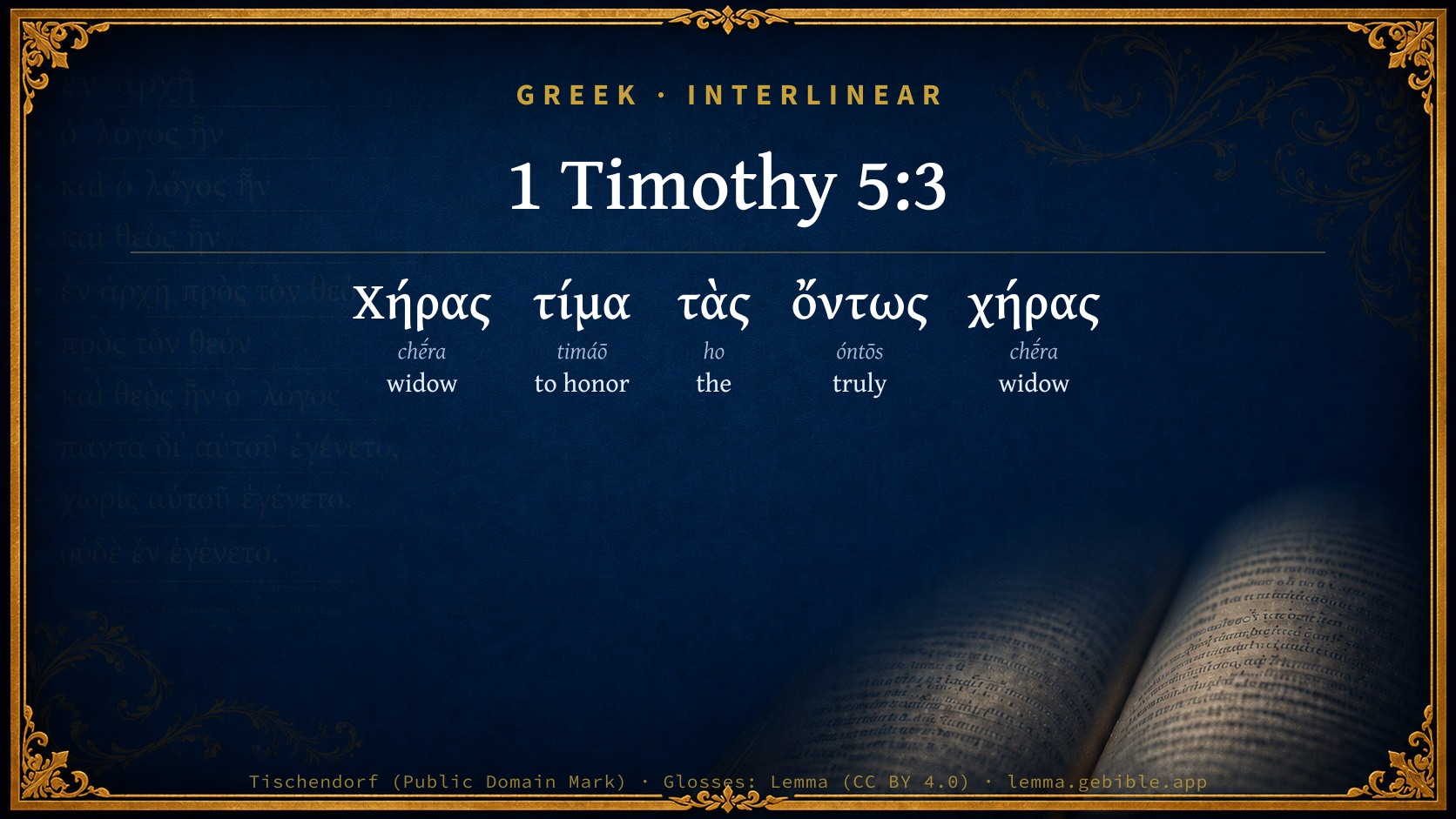
Greek (Tischendorf 8th ed.) 1 Timothy 5:3 appears in the Greek New Testament. The text above is from the Tischendorf 8th edition. Each word links to its Strong’s number and a concise gloss. Click any word for its full Thayer’s Greek Lexicon entry.
Download image
Cite this verse

1 Timothy 5:3 (World English Bible). Public Domain. Lemma interlinear Bible study tool, https://lemma.gebible.app/v/1-timothy/5/3.

Show BibTeX & RIS
BibTeX
RIS
English Translation
Honor widows who are widows indeed.
World English Bible · Public Domain
Download a study sheet

One document with this verse’s original text, its word-by-word gloss line, the meaning frame, cross-references with their text, attributed commentary, and full source and license credits — printable, and it pastes into notes with its structure intact.

This verse Autodidact and up

Study sheet (.html) Plain text (.txt)

A passage Seminary Student

Up to 50 verses in one chapter. A passage sheet keeps up to 6 commentary sources and 12 cross-references per verse, in the order this page ranks them, and says so on the sheet whenever that leaves anything out. Ask for a single verse and you get the Autodidact verse sheet above.

Everything on this page stays free to read, with no account — the sheet is a download of what is already on screen, not access to it.

Want to remove ads? Support Godless Engineer
Compare translations 3

The same verse in 3 English versions, stacked beneath the original-language interlinear above. Click any original word for its lexicon entry.

Each is an independent rendering of the whole verse — the interlinear is not word-aligned to these translations.

Highlighted words mark where these versions differ — a whole-verse word diff, not a word-by-word alignment.

  • World English Bible Public Domain
    Honor widows who are widows indeed.
  • King James Version Public Domain
    Honour widows that are widows indeed.
  • unfoldingWord Literal Text CC BY-SA 4.0
    Honor widows—real widows.

unfoldingWord Literal Text — © unfoldingWord, licensed CC BY-SA 4.0. Word-aligned USFM3 via Door43 (git.door43.org/unfoldingWord/en_ult).

Versions to compare (up to 4)

3 of 4 selected

Show all 19 translations

Every available English version of this verse, each an independent rendering of the whole verse.

  • World English Bible Public Domain
    Honor widows who are widows indeed.
  • Berean Standard Bible Public Domain
    Honor the widows who are truly widows.
  • Majority Standard Bible Public Domain
    Honor the widows who are truly widows.
  • King James Version Public Domain
    Honour widows that are widows indeed.
  • American Standard Version (1901) Public Domain
    Honor widows that are widows indeed.
  • Revised Version (1885) Public Domain
    Honour widows that are widows indeed.
  • Geneva Bible (1599) Public Domain
    Honour widowes, which are widowes in deede.
  • Douay-Rheims (1899) Public Domain
    Honour widows, that are widows indeed.
  • Young's Literal Translation Public Domain
    honour widows who are really widows;
  • Literal Standard Version CC BY-SA 4.0
    honor widows who are really widows;
  • Unlocked Literal Bible CC BY-SA 4.0
    Honor widows, the real widows.
  • unfoldingWord Literal Text CC BY-SA 4.0
    Honor widows—real widows.
  • Darby Bible Public Domain
    Honour widows who are really widows;
  • World Messianic Bible Public Domain
    Honor widows who are widows indeed.
  • Webster's Bible Public Domain
    Honor widows that are widows indeed.
  • Free Bible Version CC BY-SA 4.0
    Help widows who don't have a family.
  • Bible in Basic English Public Domain
    Give honour to widows who are truly widows.
  • Text-Critical English NT CC BY 4.0
    Honor widows who are truly widows.
  • Tyndale New Testament (1534) Public Domain
    Honoure widdowes which are true wyddowes.

Literal Standard Version (2020), Covenant Press — licensed CC BY-SA 4.0. Text via the HelloAO Bible API (eBible.org). Unlocked Literal Bible (unfoldingWord) — licensed CC BY-SA 4.0. Text via the HelloAO Bible API (eBible.org). unfoldingWord Literal Text — © unfoldingWord, licensed CC BY-SA 4.0. Word-aligned USFM3 via Door43 (git.door43.org/unfoldingWord/en_ult). Free Bible Version, Dr. Jonathan Gallagher — licensed CC BY-SA 4.0. Text via the HelloAO Bible API (eBible.org).

Word by word

More ways to search: Search by grammar → Find every occurrence → Compare this word →

Practice this passage: Drill this verse → Learn its vocabulary →

About this verse

These counts appear in no published source. They are computed here, from the morphology-tagged text and Lemma’s own curated glosses. What Lemma adds →

5
words
4
distinct lemmas
Pauline Epistles
section

Notable vocabulary

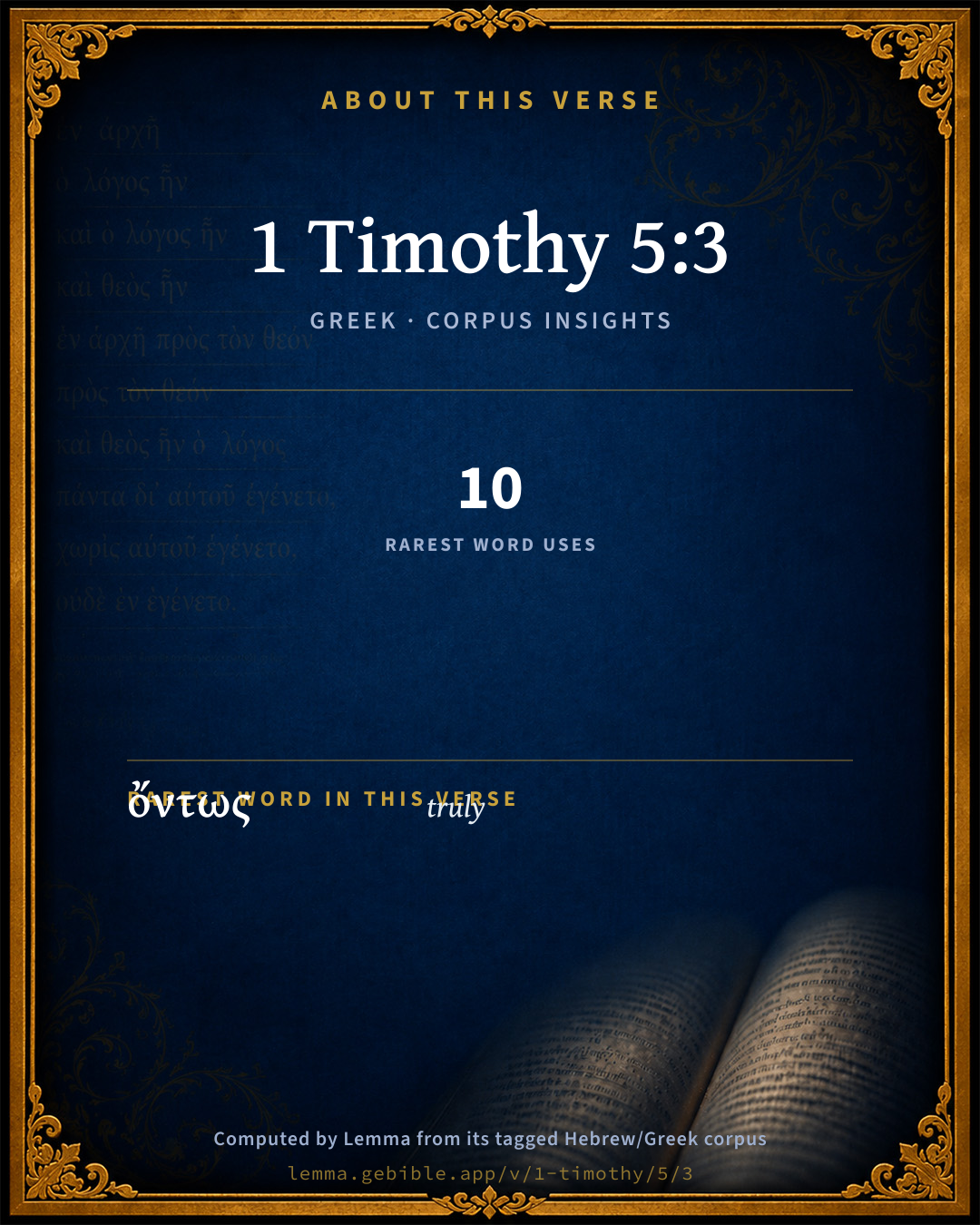
The rarest word here is ὄντως truly G3689 — appearing just 10 times in the whole Greek New Testament.

Shared distinctive vocabulary

ὄντως truly G3689 occurs in 10 verses of the Greek New Testament. Also found in:

Repetition

A word recurs within this verse:

  • Χήρας widow G5503 ×2

Cross-references

26

Topical passages linked to 1 Timothy 5:3 in the Treasury of Scripture Knowledge — connected by theme and wording, ordered by reader-vote popularity; previews shown in the World English Bible.

  • Deuteronomy 27:19 Cursed be he who wrests the justice [due] to the foreigner, fatherless, and widow. All the people shall say, Amen.
  • Deuteronomy 10:18 He does execute justice for the fatherless and widow, and loves the foreigner, in giving him food and clothing.
  • Deuteronomy 14:29 and the Levite, because he has no portion nor inheritance with you, and the foreigner living among you, and the fatherless, and the widow, who are within your gates, shall come, and shall eat and be satisfied; that Yahweh your God may bless you in all the work of your hand which you do.
  • Acts 6:1 Now in those days, when the number of the disciples was multiplying, a complaint arose from the Grecian Jews against the Hebrews because their widows were neglected in the daily service.
  • Exodus 20:12 "Honor your father and your mother, that your days may be long in the land which Yahweh your God gives you.
  • Deuteronomy 16:11 and you shall rejoice before Yahweh your God, you, and your son, and your daughter, and your man-servant, and your maid-servant, and the Levite who is within your gates, and the foreigner, and the fatherless, and the widow, who are in the midst of you, in the place which Yahweh your God shall choose, to cause his name to dwell there.
  • Deuteronomy 16:14 and you shall rejoice in your feast, you, and your son, and your daughter, and your man-servant, and your maid-servant, and the Levite, and the foreigner, and the fatherless, and the widow, who are within your gates.
  • Psalms 68:5 A father of the fatherless, and a defender of the widows, Is God in his holy habitation.
  • Psalms 146:9 Yahweh preserves the foreigners. He upholds the fatherless and widow, But the way of the wicked he turns upside down.
  • Matthew 15:6 he shall not honor his father or mother.' You have made the commandment of God void because of your tradition.
  • 1 Thessalonians 2:6 nor seeking glory from men (neither from you nor from others), when we might have claimed authority as apostles of Christ.
  • 1 Timothy 5:4–5 But if any widow has children or grandchildren, let them learn first to show piety towards their own family, and to repay their parents, for this is acceptable in the sight of God.
  • 1 Timothy 5:16–17 If any man or woman who believes has widows, let them relieve them, and don't let the assembly be burdened; that it might relieve those who are widows indeed.
  • 1 Peter 2:17 Honor all men. Love the brotherhood. Fear God. Honor the king.
  • Job 29:13 The blessing of him who was ready to perish came on me, And I caused the widow's heart to sing for joy.
  • Job 31:16 "If I have withheld the poor from their desire, Or have caused the eyes of the widow to fail,
  • Psalms 94:6 They kill the widow and the alien, And murder the fatherless.
  • Jeremiah 49:11 Leave your fatherless children, I will preserve them alive; and let your widows trust in me.
  • Matthew 23:13 "Woe to you, scribes and Pharisees, hypocrites! For you devour widows' houses, and as a pretense you make long prayers. Therefore you will receive greater condemnation.
  • Luke 2:37 and she had been a widow for about eighty-four years), who didn't depart from the temple, worshipping with fastings and petitions night and day.
  • Acts 9:39 Peter got up and went with them. When he had come, they brought him into the upper chamber. All the widows stood by him weeping, and showing the coats and garments which Dorcas had made while she was with them.
  • 1 Timothy 5:9–11 Let no one be enrolled as a widow under sixty years old, having been the wife of one man,
  • James 1:27 Pure religion and undefiled before our God and Father is this: to visit the fatherless and widows in their affliction, and to keep oneself unstained by the world.
  • 1 Peter 3:7 You husbands, in like manner, live with your wives according to knowledge, giving honor to the woman, as to the weaker vessel, as being also joint heirs of the grace of life; that your prayers may not be hindered.
  • Luke 7:12 Now when he drew near to the gate of the city, behold, one who was dead was carried out, the only son of his mother, and she was a widow. Many people of the city were with her.
  • 1 Timothy 5:2 the elder women as mothers; the younger as sisters, in all purity.

Cross-references courtesy of OpenBible.info (CC BY 4.0).

Commentary

Notes on 1 Timothy 5:3 from classic Christian and Jewish commentators (each source and its license shown beneath its notes). The classic Christian expositions comment on the surrounding passage and are grouped to its opening verse, so a note may address several verses; the Jewish commentaries on the Tanakh (Rashi and others) are per-verse, so they appear only where the commentator wrote on this verse.

Lemma curates 59 commentaries, every one of them public domain or Creative Commons licensed, each selected and text-cleaned for this edition rather than reprinted as found. About our sources →

The Cambridge Bible for Schools and Colleges

gen. ed. J. J. S. Perowne

3. Honour widows] The honour implied is further referred to in 1Ti_5:9; as the honour of 1Ti_5:17 is defined by 1Ti_5:18. So in Act_28:10 the Melitans ‘honoured us with many honours, and when we sailed they put on board such things as we needed.’ Cf. Lewin’s note there. ‘The honours probably included pecuniary aid. Honor was often used for money; whence honorarium a fee.’

that are widows indeed] So 1Ti_5:16; and in the true text 1Ti_6:19, ‘the life which is life indeed:’ a usage of the article with this adverb peculiar to this Epistle.

3–16. Timothy’s duties in regard to widows

Counsel on alms and charities for widows. The natural and obvious view of this passage studied in itself is to present the Church charities of this period as having reached an intermediate stage between the common purse or daily ministration of Act_2:45; Act_6:1, and the order of widows publicly appointed and maintained with specified duties of education, superintendence and the like, which seems to have arisen later, perhaps from a strained interpretation of this passage itself, and which was abolished by the 11th Canon of the Council of Laodicea. ‘The women who are called by the Greeks “presbyters,” and by us “senior widows,” “once-wives,” and “churchmothers” ought not to have a position as an ordained body in the Church.’ Such a view is exactly parallel with that of the Church polity in these Epistles as ‘intermediate between the presbyterian episcopacy of the earlier apostolic period and the post-apostolic episcopacy.’

If this is correct, we shall not distinguish, with Bp Ellicott, ‘the desolate and destitute widow’ of 1Ti_5:3-8 from ‘the ecclesiastical or presbyteral widow’ of 1Ti_5:9-16. More distinct and definite direction is given in 1Ti_5:10 for the selection of the widows who are described in general terms in 1Ti_5:5. A generation of Christian life has passed now since the loving undiscriminating ‘ministration’ of the first days. The very numbers of ‘Christian widows’ with varying character and circumstances, as well as the reasonableness of the thing itself, require the test of the past conduct, 1Ti_5:10, and the present life, 1Ti_5:5. ‘Charity organisation’ is the pastor’s duty.

The Cambridge Bible for Schools and Colleges (gen. ed. J. J. S. Perowne; Cambridge University Press, 1878–1918) — public domain. Text from a community e-Sword module.

Joseph Benson's Commentary

1Ti 5:3-4. Honour — And endeavour honourably to support from the public stock; widows — Whose destitute circumstances recommend them as the certain objects of charity. According to the Greek commentators, the widows of whom the apostle speaks in this passage were aged women appointed by the church to instruct the young of their own sex in the principles of the Christian faith, and who, for that service, were maintained out of the funds of the church. This opinion is rendered probable by the apostle’s order to Timothy, (1Ti 5:9,) to admit none into the number of widows without inquiring into their age, circumstances, character, and qualifications, even as in ordaining bishops and deacons; who are widows indeed — Really such; that is, who are desolate, and neither able to maintain themselves, nor have any near relations to provide for them, and who are wholly devoted to God. But if any widow have children — Able to provide for her; or nephews — Rather grand-children, as εκγονα signifies; let them learn — Their children or descendants; first to show piety at home — Before the church be burdened with them; and to requite their parents — For all their former care, trouble, and expense; for that is good — Καλον, decent, fair, and amiable, in the eyes of men; and acceptable before God — Who requires us, out of regard to his honour and favour, to attend carefully to the duties of those relations in which we stand to each other.

Joseph Benson's Commentary on the Old and New Testaments (1811–1818) — public domain. Text from a community e-Sword module.

The Preacher's Complete Homiletical Commentary

Joseph S. Exell (gen. ed.)

CRITICAL AND EXPLANATORY NOTES

1Ti_5:4. Children or nephews.—R.V. “children or grandchildren.” “Descendants, or more specially, as the context implies, grandchildren—nephews in the original but now antiquated sense of the word” (Ellicott). Shew piety at home.—Another example of St. Paul’s natural religion. Filial piety is what he here enjoins.

1Ti_5:5. She that is a widow indeed.—Like old Anna who “departed not from the Temple”—left desolate for a long lifetime.

1Ti_5:6. She that liveth in pleasure.—R.V. “giveth herself to pleasure.” The only other use of the word in the New Testament is Jas_5:5.—an instructive parallel. Dead while she liveth.—As in the vivid thought of the East that which was certain was spoken of as actual, so St. Paul regards a wanton life as an actual death.

1Ti_5:8. If any provide not.—If he does not use his judgment to anticipate the needs. For his own, and specially for those of his own house.—This cuts at the root of the improvidence which might originate in the care of the Church, through the deacons, for those who were destitute. A man’s household must be his concern rather than that of the Church or the board of guardians.

1Ti_5:9. Let not a widow be taken into the number.—R.V. “Let none be enrolled as a widow.” It has been suggested that they were an order of widows who took the oversight of the younger women. Perhaps they acted as chaperons.

1Ti_5:10. Brought up children.—Whether her own children, or others left as orphans, it is not easy to decide. Lodged strangers.—R.V. “used hospitality to.” Not only with the possibility of finding angels (Heb_13:2) amongst them, but with the direct assurance that the Lord Himself, in His lowliest servant, was honoured.

1Ti_5:11. The younger widows refuse.—“They were not necessarily to be excluded from the alms of the Church, but were only to be held ineligible for the collegium viduarum” (Ellicott).

1Ti_5:13. Tattlers also, and busy-bodies.—Like Diotrephes—going about prating against St. John—these babblers give unrestrained licence to their tongues, and permit others no peace from their meddlesomeness.

1Ti_5:16. If any man or woman that believeth have widows.—How were the younger widows to be supported then? Let their relatives care for them rather than place them in a position to bring reproach on the community.

MAIN HOMILETICS OF THE PARAGRAPH.—1Ti_5:3-16

Widows and the Early Christian Church.

I. There was a distinction recognised between the different grades of widowhood.—In this paragraph four classes of widows are mentioned.

1. The widow indeed (1Ti_5:3; 1Ti_5:5). She is desolate, quite alone in the world. She has not only lost her husband, but is without children or any other near relative to provide for her needs. The Church must be to her in place of husband and family, and seek to mitigate as much as possible the oppressive loneliness of her life.

2. The widow with a family. “Children and grandchildren” (1Ti_5:4). It is the Christian duty of the members of the family to provide for the wants of the home (1Ti_5:4; 1Ti_5:8; 1Ti_5:16). The Church must not burden itself with responsibilities that belong to others, and which they must be taught to discharge.

3. The widow living in pleasure. Gay, frivolous, and even worse (1Ti_5:6; 1Ti_5:11-15). Her young, passionate nature must be restrained, and be warned not to bring discredit and disgrace upon herself and the Church. 4. The enrolled widow (1Ti_5:9-10). She must be sixty years of age, have had only one husband, have had experience in the bringing up of children, and be well known as devoted to good works. She is a widow indeed, and something more. She has an office in the Church with definite functions to discharge, and the Church is responsible for her support.

II. Discretion and tact were necessary in dealing with the different classes of widows.—Timothy was young, and was exhorted so to behave himself that his moral integrity should command respect in spite of his youth. Respect must be shown towards age and moral worth (1Ti_5:3), and discretion exercised in dealing with the young and wanton (1Ti_5:6-7). There is a shrewd insight into human nature in one of the rules imposed by Wesley on his early preachers: “Converse sparingly with women, especially with young women.” “Care must be taken not to encourage either a rigour not likely to be maintained, or opportunities of idleness certain to lead to mischief. Help is to be generously afforded to the destitute, but the resources of the Church must be jealously guarded. They must not be wasted on the unworthy, or on those who have other means of help. And, so far as possible, the independence of those who are relieved must be protected by employing them in the service of the Church” (1Ti_5:3-16) (Plummer).

III. The principle of self-help and independence in the Christian family is recognised and strongly enforced (1Ti_5:4; 1Ti_5:8; 1Ti_5:16).—The Church is not to be regarded as a permanent board of relief constituted for the administration of indiscriminate charity. It does not and should not free any of its members from responsibilities by undertaking for them in mistaken charity the duties they ought to discharge and are capable of discharging themselves. Christianity teaches the gospel of work, not as an end in itself, but as a means of securing support and independence, and of freely ministering to the good of others. No one should be encouraged to attach himself or herself to the Church for the sake of personal maintenance. The Church must keep her needy members, but all who can work should be stimulated to honest and diligent industry.

Lessons.—

1. The young minister must be circumspect in his behaviour towards women.

2. The Church should shelter and help its deserving widows.

3. The Church should encourage work and a spirit of independence.

GERM NOTES ON THE VERSES

1Ti_5:4; 1Ti_5:8; 1Ti_5:16. Family Responsibilities.

I. Parents and children should mutually contribute to the family support.

II. The help of children afforded to their parents is a just requital of parental toil and affection.

III. The neglect of self-evident family duties is utterly alien to the spirit and teaching of Christianity (1Ti_5:8).

1Ti_5:4. The Christian Home—

I. Is the sphere for exercising practical religion.—“Learn first to show piety at home.”

II. Recognises the righteous claims of the widowed mother to affection and support.—“If any widow have children or grandchildren, let them … requite their parents.”

III. Enjoys the Divine approval.—“For that is good and acceptable before God.”

Piety at Home.

I. The home must be safe.

II. Make it attractive.

III. Make it instructive.

IV. Make the home a preparation for life.

V. Make the home a preparation for heaven.

VI. Keep the home near heaven.—J. Hamilton.

1Ti_5:8. Consistency of Benevolence with providing for our own.

I. Whenever the conduct proposed is physically impossible, it cannot be our duty.

II. Wherever this conduct would frustrate the great end of benevolence by lessening human happiness, it cannot be our duty.—

1. If the interests and duties of mankind were all thrown into a common stock, there would be little or no good done to any.

2. The division of human industry should be voluntary.

3. By the institution of families preparation is effectually made for the preservation, support, and education of children.

4. All the duties of man respect especially the objects he best knows, those to which he can most frequently and effectually extend his beneficence.—Dwight.

1Ti_5:11-15. Young Widowhood—

I. Has its special perils.—

1. In rebelling against the claims of Christ (1Ti_5:11-12).

2. In degenerating into habits of idleness and mischievous gossip (1Ti_5:13).

II. Has its safeguards in the duties and responsibilities of domestic life.

The Preacher's Complete Homiletical Commentary (gen. ed. Joseph S. Exell; Funk & Wagnalls, c. 1892) — public domain (pre-1929). A full-Bible homiletical/sermon-outline anthology covering 65 of 66 books (2 John is absent from the source module). Text from a community e-Sword module.

The Expositor's Bible

Chapter 14

THE PASTORS BEHAVIOR TOWARDS WOMEN-THE CHURCH WIDOW. - 1Ti_5:3-4; 1Ti_5:9

THE subject of this fifth chapter is "The Behavior of the Pastor towards the older and younger men and women in the congregation." Some have thought that it forms the main portion of the letter to which all the rest is more or less introductory or supplementary. But the structure of the letter cannot easily be brought into harmony with this view. It seems to be much nearer the truth to say that the unpremeditated way in which this subject is introduced cannot well be explained unless we assume that we are reading a genuine letter, and not a forged treatise. The connection of the different subjects touched upon is loose and not always very obvious. Points are mentioned in the order in which they occur to the writers mind without careful arrangement. After the personal exhortations given at the close of chapter 4, which have a solemnity that might lead one to suppose that the Apostle was about to bring his words to a close, he makes a fresh start and treats of an entirely new subject which has occurred to him.

It is not difficult to guess what has suggested the new subject. The personal exhortations with which the previous section ends contain these words, "Let no man despise thy youth; but be thou an ensample to them that believe, in word, in manner of life, in love, in faith, in purity." Timothy is not to allow the fact that he is younger than many of those over whom he is set to interfere with the proper discharge of his duties. He is to give no one a handle for charging him with want of gravity or propriety. Sobriety of conduct is to counterbalance any apparent lack of experience. But St. Paul remembers that there is another side to that. Although Timothy is to behave in such a way as never to remind his flock of his comparative youthfulness, yet he himself is always to bear in mind that he is still a young man. This is specially to be remembered in dealing with persons of either sex who are older than himself, and in his bearing towards young women. St. Paul begins with the treatment of older men and returns to this point again later on. Between these two passages about men he gives directions for Timothys guidance respecting the women in his flock, and specially respecting widows. The subject occupies more than half the chapter and is of very great interest, as being our chief source of information respecting the treatment of widows in the early Church.

Commentators are by no means unanimous in their interpretation of the details of the passage, but it is believed that the explanation which is now offered is in harmony with the original Greek, consistent with itself, and not contradicted by anything which is known from other sources.

It is quite evident that more than one kind of widow is spoken of: and one of the questions which the passage raises is-How many classes of widows are indicated? We can distinguish four kinds; and it seems probable that the Apostle means to give us four kinds;

1. There is "the widow indeed (η οντως χηρα)." Her characteristic is that she is "desolate," i.e., quite alone in the world. She has not only lost her husband, but she has neither children nor any other near relation to minister to her necessities. Her hope is set on God, to Whom her prayers ascend night and day. She is contrasted with two other classes of widow, both of whom are in worldly position better off than she is, for they are not desolate or destitute; yet one of these is far more miserable than the widow indeed, because the manner of life which she adopts is so unworthy of her.

2. There is the widow who "hath children or grandchildren." Natural affection will cause these to take care that their widowed parent does not come to want. If it does not, then they must learn that "to show piety towards their own family and to requite their parents" is a paramount duty, and that the congregation must not be burdened with the maintenance of their mother until they have first done all they can for her. To ignore this plain duty is to deny the first principles of Christianity, which is the gospel of love and duty, and to fall below the level of the unbelievers, most of whom recognized the duty of providing for helpless parents. Nothing is said of the character of the widow who has children or grandchildren to support her; but, like the widow indeed, she is contrasted with the third class of widow, and, therefore, we infer that her character is free from reproach.

3. There is the widow who "giveth herself to pleasure." Instead of continuing in prayers and supplications night and day, she continues in frivolity and luxury, or worse. Of her, as of the Church of Sardis, it may be said, "Thou hast a name that thou livest, and thou art dead." {Rev_3:1}

4. There is the "enrolled" widow; i.e., one whose name has been entered on the Church rolls as such. She is a "widow indeed" and something more. She is not only a person who needs and deserves the support of the congregation, but has special rights and duties. She holds an office, and has a function to discharge. She is a widow, not merely as having lost her husband, but as having been admitted to the company of those bereaved women whom the Church has entrusted with a definite portion of Church work. This being so, something more must be looked to than the mere fact of her being alone in. the world. She must be sixty years of age, must have had only one husband, have had experience in the bringing up of children, and be well known as devoted to good works. If she has these qualifications, she may be enrolled as a Church widow; but it does not follow that because she has them she will be appointed.

The work to which these elderly women had to devote themselves was twofold:

(1) Prayer, especially intercession for those in trouble;

(2) Works of mercy, especially ministering to the sick, guiding younger Christian women in lives of holiness, and winning over heathen women to the faith.

These facts we learn from the frequent regulations respecting widows during the second, third, and fourth centuries. It was apparently during the second century that the order of widows flourished most.

This primitive order of Church widows must be distinguished from the equally primitive order of deaconesses, and from a later order of widows, which grew up side by side with the earlier order, and continued long after the earlier order had ceased to exist. But it would be contrary to all probability, and to all that we know about Church offices in the Apostolic and sub-Apostolic age, to suppose that the distinctions between different orders of women were as marked in the earliest periods as they afterwards became, or that they were precisely the same in all branches of the Church.

It has been sometimes maintained that the Church widow treated of in the passage before us is identical with the deaconess. The evidence that the two orders were distinct is so strong as almost to amount to demonstration.

1. It is quite possible that this very Epistle supplies enough evidence to make the identification very improbable. If the "women" mentioned in the section about deacons {1Ti_3:11} are deaconesses, then the qualifications for this office are quite different from the qualifications for that of a widow, and are treated of in quite different sections of the letter.

2. But even if deaconesses are not treated of at all in that passage, the limit of age seems quite out of place, if they are identical with the widows. In the case of the widows it was important to enroll for this special Church work none who were likely to wish to marry again. And as their duties consisted in a large measure in prayer, advanced age was no impediment, but rather the contrary. But the work of the deaconess was for the most part active work, and it would be unreasonable to admit no one to the office until the best part of her working life was quite over.

The difference in the work assigned to them points in the same direction. As already stated, the special work of the widow was intercessory prayer and ministering to the sick. The special work of the deaconess was guarding the womens door in the churches, seating the women in the congregation, and attending women at baptisms. Baptism being usually administered by immersion, and adult baptism being very frequent, there was much need of female attendants.

1. At her appointment the deaconess received the imposition of hands, the widow did not. The form of prayer for the ordination of a deaconess is given in the Apostolical Constitutions (8:19, 20), and is worthy of quotation. "Concerning a deaconess, I Bartholomew make this constitution: O Bishop, thou shalt lay thy hands upon her in the presence of the presbytery and of the deacons and deaconesses, and shalt say; O eternal God, the Father of our Lord Jesus Christ, the Creator of man and of woman; Who didst replenish with the Spirit Miriam, Deborah, Anna, and Huldah; Who didst not disdain that Thy Only begotten Son should be born of a woman; Who also in the tabernacle of the testimony and in the temple didst ordain women to be keepers of Thy holy gates; -look down now also upon this Thy servant, who is to be ordained to the office of a deaconess. Grant her Thy Holy Spirit and cleanse her from all defilement of flesh and spirit, that she may worthily discharge the work which is committed to her, to Thy glory and the praise of Thy Christ; with Whom be glory and adoration to Thee and to the Holy Spirit forever and ever. Amen." Nothing of the kind is found for the appointment of a Church widow.

2. It is quite in harmony with the fact that the deaconesses were ordained, while the widows were not, that the widows are placed under the deaconesses. "The widows ought to be grave, obedient to their bishops, their presbyters, and their deacons; and besides these to the deaconesses, with piety, reverence, and fear."

3. The deaconess might be either an unmarried woman or a widow, and apparently the former was preferred. "Let the deaconess be a pure virgin; or at least a widow who has been but once married." But, although such things did occur, Tertullian protests that it is a monstrous irregularity to admit an unmarried woman to the order of widows. Now, if widows and deaconesses were identical, unmarried "widows" would have been quite common, for unmarried deaconesses were quite common. Yet he speaks of the one case of a "virgin widow" which had come under his notice as a marvel, and a monstrosity, and a contradiction in terms. It is true that Ignatius in his letter to the Church of Smyrna uses language which has been thought to support the identification: "I salute the households of my brethren with their wives and children, and the virgins who are called widows." But it is incredible that at Smyrna all the Church widows were unmarried; and it is equally improbable that Ignatius should send a salutation to the unmarried "widows" (if such there were), and ignore the rest. His language, however, may be quite easily explained without any such strange hypothesis. He may mean "I salute those who are called widows, but whom one might really regard as virgins." And in support of this interpretation Bishop Lightfoot quotes Clement of Alexandria, who says that the continent man, like the continent widow, becomes again a virgin; and Tertullian, who speaks of continent widows as being in Gods sight maidens (Deo) as for a second time virgins. But, whatever Ignatius may have meant by "the virgins who are called widows," we may safely conclude that neither in his time, any more than that of St, Paul, were the widows identical with the deaconesses.

The later order of widows which grew up side by side with the Apostolic order, and in the end supplanted., or at any rate survived, the older order, came into existence about the third century. It consisted of persons who had lost their husbands and made a vow never to marry again. From the middle of the second century or a little later we find a strong feeling against second marriages springing up, and this feeling was very possibly intensified when the Gospel came in contact with the German tribes, among whom the feeling already existed independently of Christianity. In this new order of widows who had taken the vow of continence there was no restriction of age, nor was it necessary that they should be persons in need of the alms of the congregation. In the Apostolic order the fundamental idea seems to have been that destitute: widows ought to be supported by the Church, and that in return for this, those of them who were qualified should do some special Church work. In the later order the fundamental idea was that it was a good thing for a widow to remain unmarried, and that a vow to do so would help her to persevere.

In commanding Timothy to "honor widows that are widows indeed" the Apostle states a principle which has had a wide and permanent influence, not only on ecclesiastical discipline but upon European legislation. Speaking of the growth of the modern idea of a will, by which a man can regulate the descent of his property inside and outside his family, Sir Henry Maine remarks, that "the exercise of the Testamentary power was seldom allowed to interfere with the right of the widow to a definite share, and of the children to certain fixed proportions of the devolving inheritance. The shares of the children, as their amount shows, were determined by the authority of Roman law. The provision for the widow was attributable to the exertions of the Church, which never relaxed its solicitude for the interest of wives surviving their husbands-winning, perhaps, one of the most arduous of its triumphs when, after exacting for two or three centuries an express promise from the husband at marriage to endow his wife, it at length succeeded in engrafting the principle of Dower on the Customary Law of all Western Europe." This is one of the numerous instances in which the Gospel, by insisting upon the importance of some humane principle, has contributed to the progress and security of the best elements in civilization.

Not only the humanity, but the tact and common sense of the Apostle are conspicuous throughout the whole passage, whether we regard the general directions respecting the bearing of the young pastor towards the different sections of his flock, old and young, male and female, or the special rules respecting widows. The sum and substance of it appears to be that the pastor is to have abundance of zeal and to encourage it in others, but he is to take great care that, neither in himself nor in those whom he has to guide, zeal outruns discretion. Well-deserved rebukes may do far more harm than good, if they are administered without respect to the position of those who need them. And in all his ministrations the spiritual overseer must beware of giving a handle to damaging criticism. He must not let his good be evil spoken of. So also with regard to the widows. No hard-and-fast rule can be safely laid down. Almost everything depends upon circumstances. On the whole, the case of widows is analogous to that of unmarried women. For those who have strength to forego the married state, in order to devote more time and energy to the direct service of God, it is better to remain unmarried, if single, and if widows, not to marry again. But there is no peculiar blessedness in the unmarried state, if the motive for avoiding matrimony is a selfish one, e.g., to avoid domestic cares and duties and have leisure for personal enjoyment. Among younger women the higher motive is less likely to be present, or at any rate to be permanent. They are so likely sooner or later to desire to marry, that it will be wisest not to discourage them to do so. On the contrary, let it be regarded as the normal thing that a young woman should marry, and that a young widow should marry again. It is not the best thing for them, but it is the safest. Although the highest work for Christ can best be done by those who by remaining single have kept their domestic ties at a minimum, yet young women are more likely to do useful work in society, and are less likely to come to harm, if they marry and have children. Of older women this is not true. Age itself is a considerable guarantee: and a woman of sixty, who is willing to give such a pledge, may be encouraged to enter upon a life of perpetual widowhood. But there must be other qualifications as well, if she wishes to be enrolled among those who not only are entitled by their destitute condition to receive maintenance from the Church, but by reason of their fitness are commissioned to undertake Church work. And these qualifications must be carefully investigated. It would be far better to reject some, who might after all have been useful, than to run the risk of admitting any who would exhibit the scandal of having been supported by the Church and specially devoted to Christian works of mercy, and of having after all returned to society as married women with ordinary pleasures and cares.

One object throughout these directions is the economy of Christian resources. The Church accepts the duty which it inculcates of "providing for its own." But it ought not to be burdened with the support of any but those who are really destitute. The near relations of necessitous persons must be taught to leave the Church free to relieve those who have no near relations to support them. Secondly, so far as is possible, those who are relieved by the alms of the congregation must be encouraged to make some return in undertaking Church work that is suitable to them. St. Paul has no idea of pauperizing people. So long as they can, they must maintain themselves. When they have ceased to be able to do this, they must be supported by their children or grandchildren. If they have no one to help them, the Church must undertake their support; but both for their sake as well as for the interests of the community, it must, if possible, make the support granted to be a return for work done rather than mere alms. Widowhood must not be made a plea for being maintained in harmful idleness. But the point which the Apostle insists on most emphatically, stating it in different ways no less than three times in this short section (1Ti_5:4; 1Ti_5:8; 1Ti_5:16) is this, - that widows as a rule ought to be supported by their own relations; only in exceptional cases, where there are no relations who can help, ought the Church to have to undertake this duty. We have here a warning against the-mistake so often made at the present day of freeing people from their responsibilities by undertaking for them in mistaken charity the duties which they ought to discharge, and are capable of discharging, themselves.

We may, therefore, sum up the principles laid down thus:-

Discretion and tact are needed in dealing with the different sections of the congregation, and especially in relieving the widows. Care must be taken not to encourage either a rigor not likely to be maintained, or opportunities of idleness certain to lead to mischief. Help is to be generously afforded to the destitute; but the resources of the Church must be jealously guarded. They must not be wasted on the unworthy, or on those who have other means of help. And, so far as possible, the independence of those who are relieved must be protected by employing them in the service of the Church.

In conclusion it may be worth while to point out that this mention of an order of widows is no argument against the Pauline authorship of these Epistles, as if no such thing existed in his time. In Act_6:1 the widows appear as a distinct body in the Church at Jerusalem. In Act_9:39; Act_9:41, they appear almost as an order in the Church at Joppa. They "show the coats and garments which Dorcas made" in a way which seems to imply that it was their business to distribute such things among the needy. Even if it means no more than that Dorcas made them for the relief of the widows themselves, still the step from a body of widows set apart for the reception of alms to an order of widows set apart for the duty of intercessory prayer and ministering to the sick is not a long one, and may easily have been made in St. Pauls lifetime.

William Robertson Nicoll, ed., The Expositor's Bible (London: Hodder & Stoughton, 1887–1910) — public domain. 65 of 66 books (1 Corinthians is not separately keyed, as that volume carries no machine-parseable verse references); section-level commentary keyed to the opening verse. Introductory and overview sections not keyed to a specific passage are excluded.

Tyndale Open Study Notes

Tyndale Open Resources

5:3-16 A widow without wealth or family was alone in a world that did not provide for her. The Christian community was expected to care for such widows among its members (see Deut 10:17-19; Isa 1:17; cp. Acts 6:1-6; Jas 1:27). Some have argued that this passage suggests a religious order of widows in the first-century church at Ephesus, but there is no certain evidence of such an order in the first-century church, only of a ministry of care for community members without means.

Tyndale Open Study Notes — © Tyndale Open Resources, licensed CC BY-SA 4.0. Text via the HelloAO Bible API.

Bengel's Gnomon

Johann Albrecht Bengel

1Ti 5:3. Χήρας, widows) Chrysostom speaks at great length of widows, de Sacerd., p. 166, et seqq.—τίμα, honour) by acts of kindness, 1Ti 5:17-18.—ὄντως χήρας, widows indeed) Ploce;[39] the word indeed excludes those who have children or live luxuriously (1Ti 5:6).

[39] A word put twice, first in the simple sense, afterwards to express an attribute of the simple word. Widows, in the second instance here, means one who realizes the description given in ver. 5.—ED.

Bengel's Gnomon of the New Testament — English translation (T&T Clark, Edinburgh, 1860) — public domain. Text from a community e-Sword module.

Meyer's Critical & Exegetical Commentary

Heinrich August Wilhelm Meyer

1Ti_5:3. From this to 1Ti_5:16 we have instructions regarding the widows of the church.

χήρας τίμα] Theodoret, Theophylact, Pelagius, and most recent expositors, among others, de Wette and Wiesinger, refer τίμα to the support of the widows by money. De Wette explains τίμα directly as care for them, support them, adding, he is speaking of support from the church-purse. Wiesinger, on the other hand, remarks: We do not say that τιμάω means support exactly, but it means an honouring which was to manifest itself in supporting them. In proof of this view, appeal is made to the passages in Act_6:1; Act_28:10; Mat_15:4-6; but wrongly. In the two last passages the meaning support with money can only arbitrarily be given to τιμᾷν (see Meyer on Act_28:10); and though the widows were supported by the church, as we learn from Act_6:1 (comp. also Ignatius, ad Polycarp. chap. iv.; Justin Martyr, Apolog. i. 67), we cannot from that draw any inference as to the meaning of τιμᾷν. But even the context does not necessitate us to specialize the meaning. Granted that all that follows referred only to money-support to be given to the widows, why should not these special exhortations be introduced by one of a more general nature? Besides, the support mentioned being the business of the church, and not of Timothy alone, the apostleaccording to the analogy of καταλεγέσθω (1Ti_5:9)would not have written τίμα, but χῆραι τιμάσθωσαν. Hence, with several old and some recent commentators, such as Matthies, van Oosterzee, Plitt, Hofmann, we should retain the usual meaning of τιμᾷν. Their support by the church is simply a consequence and proof of the τιμᾷν.

τὰς ὄντως χήρας] is added to define more precisely what widows Paul was thinking of, viz. those who are widows in the true and proper sense of the word (Luther: right widows). Ὄντως is used as an adjective only here in the N. T. (Plato, Phaedr. 260a: τὰ ὄντως ἀγαθά). What kind of widows are meant thereby, we are to infer from what follows.

Meyer — Critical and Exegetical Commentary on the New Testament — English translation by Peter Christie, edited by Frederick Crombie (T&T Clark, 1880) — public domain. Text from a community e-Sword module.

Expositor's Greek Testament

ed. W. Robertson Nicoll

1Ti 5:3 . τίμα : It is difficult to fix precisely the force of τιμάω in this connexion. On the one hand, the passage (1Ti 5:3-8 ) is a part of the general directions as to Timothy’s personal relations to his flock. Respect, honour , would, then, render the word adequately. On the other hand, 1Ti 5:4 ; 1Ti 5:8 show that the question of widows’ maintenance, as a problem of Church finance, was in the apostle’s mind; and he goes on, in 1Ti 5:9 , to lay down regulations for the admission of widows to the number of those who were entered on the Church register for support. Perhaps respect was first in the writer’s mind, while the term used, τίμα , easily lent itself to the expression of the notion of support , which immediately suggested itself. Similarly Chrys. ( τῆς τῶν ἀναγκαίων τροφῆς ), comparing 1Ti 5:17 , where τιμή has the sense of pay, cf. Sir 38:1 , Mat 15:4-6 , Act 28:10 . Honora beneficiis is Bengel’s comment.

τὰς ὄντως : Those who really deserve the name of widows are (1) those who have no younger relatives on whom they have a claim for support, (2) those who conform to certain moral and spiritual requirements detailed below.

The Expositor's Greek Testament, edited by W. Robertson Nicoll (1897–1910) — public domain. Text from a community e-Sword module.

Geneva Bible (1599)

Geneva Bible translators

Have care of those widows which have need of help.

The Apostle giveth these rules touching the care of widows.

Geneva Bible (1599) marginal notes — public domain. Text via Bolls.life.

Matthew Henry's Commentary

Directions are here given concerning the taking of widows into the number of those who were employed by the church and had maintenance from the church: Honour widows that are widows indeed. Honour them, that is, maintain them, admit them into office. There was in those times an office in the church in which widows were employed, and that was to tend the sick and the aged, to look to them by the direction of the deacons. We read of the care taken of widows immediately upon the first forming of the Christian church (Act 6:1), where the Grecians thought their widows were neglected in the daily ministration and provision made for poor widows. The general rule is to honour widows that are widows indeed, to maintain them, to relieve them with respect and tenderness.

I. It is appointed that those widows only should be relieved by the charity of the church who were pious and devout, and not wanton widows that lived in pleasure, Ti1 5:5, Ti1 5:6. She is to be reckoned a widow indeed, and it to be maintained at the church's charge, who, being desolate, trusteth in God. Observe, It is the duty and comfort of those who are desolate to trust in God. Therefore God sometimes brings his people into such straits that they have nothing else to trust to, that they may with more confidence trust in him. Widowhood is a desolate estate; but let the widows trust in me (Jer 49:11), and rejoice that they have a God to trust to. Again, Those who trust in God must continue in prayer. If by faith we confide in God, by prayer we must give glory to God and commit ourselves to his guidance. Anna was a widow indeed, who departed not from the temple (Luk 2:37), but served God with fasting and prayer night and day. But she is not a widow indeed that lives in pleasure (Ti1 5:6), or who lives licentiously. A jovial widow is not a widow indeed, not fit to be taken under the care of the church. She that lives in pleasure is dead while she lives, is no living member of the church, but as a carcase in it, or a mortified member. We may apply it more generally; those who live in pleasure are dead while they live, spiritually dead, dead in trespasses and sins; they are in the world to no purpose, buried alive as to the great ends of living.

II. Another rule he gives is that the church should not be charged with the maintenance of those widows who had relations of their own that were able to maintain them. This is mentioned several times (Ti1 5:4): If any widow have children or nephews, that is grandchildren or near relations, let them maintain them, and let not the church be burdened. So Ti1 5:16. This is called showing piety at home (Ti1 5:4), or showing piety towards their own families. Observe, The respect of children to their parents, with their care of them, is fitly called piety. This is requiting their parents. Children can never sufficiently requite their parents for the care they have taken of them, and the pains they have taken with them; but they must endeavour to do it. It is the indispensable duty of children, if their parents be in necessity, and they in ability to relieve them, to do it to the utmost of their power, for this is good and acceptable before God. The Pharisees taught that a gift to the altar was more acceptable to God than relieving a poor parent, Mat 15:5. But here we are told that this is better than all burnt-offerings and sacrifices; this is good and acceptable, etc. He speaks of this again (Ti1 5:8), If any provide not for his own, etc. If any men or women do not maintain their own poor relations who belong to them, they do in effect deny the faith; for the design of Christ was to confirm the law of Moses, and particularly the law of the fifth commandment, which is, Honour thy father and mother; so that those deny the faith who disobey that law, much more if they provide not for their wives and children, who are parts of themselves; if they spend that upon their lusts which should maintain their families, they have denied the faith and are worse than infidels. One reason why this care must be taken that those who are rich should maintain their poor relations, and not burden the church with them is (Ti1 5:16) that it may relieve those who are widows indeed. Observe, Charity misplaced is a great hindrance to true charity; there should be prudence in the choice of the objects of charity, that it may not be thrown away upon those who are not properly so, that there may be the more for those who are real objects of charity.

III. He gives directions concerning the characters of the widows that were to be taken into the number to receive the church's charity: not under sixty years old, nor any who have divorced their husbands or been divorced from them and have married again; she must have been the wife of one man, such as had been a housekeeper, had a good name for hospitality and charity, well reported of for good works. Observe, Particular care ought to be taken to relieve those, when they fall into decay, who, when they had wherewithal, were ready to every good work. Here are instances of such good works as are proper to be done by good wives: If she have brought up children: he does not say, If she have borne children (children are a heritage of the Lord), that depends on the will of God; but, if she had not children of her own, yet if she had brought up children. If she have lodged strangers, and washed the saints' feet; if she have been ready to give entertainment to good Christians and good ministers, when they were in their travels for the spreading of the gospel. Washing of the feet o their friends was a part of their entertainments. If she have relieved the afflicted when she had ability, let her be relieved now. Observe, Those who would find mercy when they are in distress must show mercy when they are in prosperity.

IV. He cautions them to take heed of admitting into the number those who are likely to be no credit to them (Ti1 5:11): The younger widows refuse: they will be weary of their employments in the church, and of living by rule, as they must do; so they will marry, and cast off their first faith. You read of a first love (Rev 2:4), and here of a first faith, that is, the engagements they gave to the church to behave well, and as became the trust reposed in them: it does not appear that by their first faith is meant their vow not to marry, for the scripture is very silent on that head; besides the apostle here advises the younger widows to marry (Ti1 5:14), which he would not if hereby they must have broken their vows. Dr. Whitby well observes, "If this faith referred to a promise made to the church not to marry, it could not be called their first faith." Withal they learn to be idle, and not only idle, but tattlers, etc., Ti1 5:13. Observe, It is seldom that those who are idle are idle only, they learn to be tattlers and busy-bodies, and to make mischief among neighbours, and sow discord among brethren. Those who had not attained to such a gravity of mind as was fit for the deaconesses (or the widows who were taken among the church's poor), let them marry, bear children, etc., Ti1 5:14. Observe, If housekeepers do not mind their business, but are tattlers, they give occasion to the adversaries of Christianity to reproach the Christian name, which, it seems, there were some instances of, Ti1 5:15. We learn hence, 1. In the primitive church there was care taken of poor widows, and provision made for them; and the churches of Christ in these days should follow so good an example, as far as they are able. 2. In the distribution of the church's charity, or alms, great care is to be taken that those share in the public bounty who most want it and best deserve it. A widow was not to be taken into the primitive church that had relations who were able to maintain her, or who was not well reported of for good works, but lived in pleasure: But the younger widows refuse, for, when they have begun to wax wanton against Christ, they will marry. 3. The credit of religion, and the reputation of Christian churches, are very much concerned in the character and behaviour of those that are taken into any employment in the church, though of a lower nature (such as the business of deaconesses), or that receive alms of the church; if they do not behave well, but are tatlers and busy-bodies, they will give occasion to the adversary to speak reproachfully. 4. Christianity obliges its professors to relieve their indigent friends, particularly poor widows, that the church may not be charged with them, that it may relieve those that are widows indeed: rich people should be ashamed to burden the church with their poor relations, when it is with difficulty that those are supplied who have no children or nephews, that is, grand-children, who are in a capacity to relieve them.

Matthew Henry's Commentary on the Whole Bible (1708–1710) — public domain (CC PDM 1.0). Text via the HelloAO Bible API.

Jamieson, Fausset & Brown

Robert Jamieson, A. R. Fausset & David Brown

Honour--by setting on the church roll, as fit objects of charitable sustenance (Ti1 5:9, Ti1 5:17-18; Act 6:1). So "honor" is used for support with necessaries (Mat 15:4, Mat 15:6; Act 28:10).

widows indeed-- (Ti1 5:16). Those really desolate; not like those (Ti1 5:4) having children or relations answerable for their support, nor like those (in Ti1 5:6) "who live in pleasure"; but such as, from their earthly desolation as to friends, are most likely to trust wholly in God, persevere in continual prayers, and carry out the religious duties assigned to Church widows (Ti1 5:5). Care for widows was transferred from the Jewish economy to the Christian (Deu 14:29; Deu 16:11; Deu 24:17, Deu 24:19).

Jamieson, Fausset & Brown — Commentary Critical and Explanatory on the Whole Bible (1871) — public domain (CC PDM 1.0). Text via the HelloAO Bible API.

Adam Clarke's Commentary

Verse 3. Honour widows that are widows indeed.] One meaning of the word τιμαω, to honour, is to support, sustain, c., Mat 15:4-5; and here it is most obviously to be taken in this sense. Provide for those widows especially which are widows indeed-persons truly destitute, being aged and helpless, and having neither children nor friends to take care of them, and who behave as becometh their destitute state. But see the note on 1Ti 5:10.

Adam Clarke's Commentary on the Bible (1810–1826) — public domain. Text from a community e-Sword/MySword module.

John Calvin's Commentaries

3 Honor widows that are really widows. By the word honor he does not mean any expression of respect, but that special care of them which bishops took in the ancient Church; for widows were taken under the protection of the Church, that they might be supported out of the common funds. The meaning of this mode of expression is as if he had said, “For selecting widows that are to be taken under your care and that of the deacons, you ought to consider who they are that are really widows What was their condition we shall afterwards explain more fully. But we must here attend to the reason why Paul does not admit any but those who are absolutely widows, and, at the same time, widows without children; for, in that condition, they dedicated themselves to the Church, that they might withdraw from all the private concerns of a family, and might lay aside every hindrance. Justly, therefore, does Paul forbid to receive the mothers of families, who are already bound by a charge of a different kind. When he calls them “really widows”, he alludes to the Greek word χήρα, which is derived ἀπὸ τοῦ χηροῦσθαι, from a verb which signifies to be “deprived” or “destitute.”

John Calvin's Commentaries (1540-1563) — public domain. Text from the Calvin Translation Society English edition (1840s-50s) via the Christian Classics Ethereal Library (ccel.org). Calvin's coverage is partial (roughly two-thirds of the Bible); uncommented books and verses are honest gaps, never fabricated. The 19th-century editor's footnotes and remarks are omitted so the notes are faithfully Calvin's own voice.

Ellicott's Commentary for English Readers

(3) Honour widows that are widows indeed.—The mention of the relations of a pastor to the female members of the flock suggests another train of thought. Christianity had, during the thirty years of its history, developed a perfectly new existence for women who professed the faith of Jesus of Nazareth. In the Master’s new and strange (new and strange to the civilised world of that day) command—that the poor, the needy, and the sick should be succoured, that the helpless should be helped, and the comfortless comforted—a blessed calling was invented. so to speaks for Christian women. Their secluded and, in many respects, degraded life in the old world was, in great measure, owing to the fact that till Christ taught the universal duty of charity, women had no recognised public occupation in the world. The charge of the Founder of the new religion provided an endless variety of blessed, happiness-giving work for women of all ages and rank.

The novel prominence, however, of females in such great centres as Ephesus not only necessitated some organisation which should administer the alms, and generally watch over and direct the self-sacrificing labours of the female portion of the community, but also required special vigilance, on the part of the chief pastor and his assistant presbyters and deacons, to prevent the charities of the Church being misused. The widow—the desolate and destitute, the mourning widow indeed, she who is in every sense a widow and has no one to whom to look for aid—she always has a claim on the Church. Not merely is she to be honoured by a simple exhibition of respect, but she is to be assisted and supported out of the alms of the faithful.

A Bible Commentary for English Readers, edited by Charles John Ellicott (1878–1897) — public domain. Text from a community e-Sword module.

John Gill's Exposition

Honour widows that are widows indeed. Who those are, see in Ti1 1:5. The honour to be given them is not a putting of them into the office of a deaconess, in the church; which office, some think, is referred to in Act 6:1, and did obtain in some of the primitive churches; and it might be that some of these widows, the apostle here and hereafter speaks of, might be preferred to the rest, and be set over them, and have the care of such, who were more infirm; but then this could only be the case of some, whereas the honour here spoken of is what is to be given to all that are really widows; and therefore rather regards some external honour and respect to be shown them, by words and actions; and especially it designs an honourable provision for them, and maintenance of them; in which sense the word is used in Ti1 5:17. So, with the Jews, giving gifts to persons, and making presents to them, is called honour. When Manoah asked the angel's name, that he might do him honour, when his saying came to pass, Jdg 13:17 the sense, according to them, is (q),

"that I may inquire in what place I may find thee, when thy prophecy is fulfilled, and give thee "a gift"; for there is no honour but what signifies a gift, as it is said, Num 22:17, "honouring I will honour thee".''

So giving gifts to the poor, or providing for their maintenance, is doing them honour; and that this is the sense here, appears by what follows in the context.

(q) Bemidbar Rabba, sect. 10. fol. 199. 4.

John Gill's Exposition of the Whole Bible (1746–1763) — public domain (CC PDM 1.0). Text via the HelloAO Bible API.

Trapp's Complete Commentary

John Trapp

3 Honour widows that are widows indeed.

Ver. 3. Honour widows indeed] That is, such as are widows not by divorce, but by the death of their husbands, and loss of their children; such as was Naomi. Honour them, that is, take them into the college of widows, to be maintained at the Church’s charge. In this sense ministers are to have double honour, {see 1Ti 5:17} which is therefore so termed, because they testified thereby the virtues of those so sustained.

John Trapp, A Commentary or Exposition upon All the Books of the Old and New Testament (1647–1656) — public domain. Text from a community e-Sword module.

Albert Barnes' Notes on the Bible

Honour widows - The particular attention and respect which are enjoined here, seem to refer to the class of widows who were supported by the church, and who were entrusted with the performance of certain duties toward the other female members, see 1Ti 5:9. It is to be remembered that the contact of the sexes was much more circumscribed in Oriental countries than it is among us; that access to the female members of the church would be much less free than it is now, and that consequently there might have been a special propriety in entrusting the duty of watching over the younger among them to the more aged. This duty would be naturally entrusted to those who had not the care of families. It would also be natural to commit it, if they were qualified, to those who had not the means of support, and who, while they were maintained by the church, might be rendering a valuable service to it. It would seem, therefore, that there was a class of this description, who were entrusted with these duties, and in regard to whose qualifications it was proper that Timothy should be instructed. The change of customs in society has made this class less necessary, and probably the arrangement was never designed to be permanent, but still it may be a question whether such an arrangement would not now be wise and useful in the church. On this subject, see the notes on Rom 16:1.

That are widows indeed - Who are truly widows. We associate with the word “widow,” commonly, not only the idea of the loss of a husband, but many other things that are the usual accompaniments of widowhood - a poor and dependent condition; care and solicitude; sadness and sorrow. This idea is implied in the use of the word employed here - χήρα chēra - which means properly one who is “bereaved,” (from the adjective χήρος chēros, “bereaved”), and which, as Calvin says, conveys the idea of one in distressed circumstances. What Paul regarded as constituting true widowhood, he specifies in 1Ti 5:4-5, 1Ti 5:9-10. He connects with it the idea that she had no persons dependent on her; that she was desolate, and evinced true trust in God; that she was so aged that she would not marry again; and that by her life she had given evidence of possessing a heart of true benevolence; 1Ti 5:10.

Albert Barnes' Notes on the Bible (1834–1885) — public domain. Text from a community e-Sword/MySword module.

Haydock's Catholic Bible Commentary

Honour widows. To honour, here means to relieve and maintain. (Witham)

George Leo Haydock (1774–1849), Haydock's Catholic Family Bible and Commentary, 1859 edition — public domain. Excludes Psalms (Douay-Rheims chapter numbering differs from Protestant) and Deuterocanonical books (Catholic canon only).

Matthew Poole's English Annotations

Honour widows; give a respect to such as have lost their husbands, with a regard to that honourable estate of marriage in which they have been formerly, and do not only pay them a due respect, but afford them a maintenance, Act 6:1.

That are widows indeed: who are widows indeed he openeth further, 1Ti 5:5; such as are not only pious, but desolate, as the Greek word for a widow implies, according to its derivation.

Matthew Poole's English Annotations on the Holy Bible (1683–1685) — public domain. Text from a community e-Sword/MySword module.

Whedon's Commentary on the Bible

Daniel D. Whedon

3. Honour—Rightly appreciate after due scrutiny.

Widows indeed—Real and not spurious widows. To a real widow three things were requisite: first, actual death of husband; second, actual destitution, with no relatives to support her; and, third, worthiness as member of the Church.

Daniel D. Whedon (gen. ed.), Commentary on the Old and New Testaments (1874–1909) — public domain. Text from a community e-Sword module.

The Pulpit Commentary

Honor (tima). The use of the verb timaw in the comment on the fourth commandment in Mat_15:4-6, where the withholding of the honor due consists in saying, "It is corban, by whatsoever thou mightest be profited by me," and so withholding the honor due, shows clearly that in the notion of honoring is included that material support which their condition as widows required. So again in ver. 17 of this chapter, the double honor" due to elders who labor in the Word and doctrine is clearly shown by ver. 18 to include payment for their maintenance. This is also borne out by the frequent use of timh in the sense of "price" (Mat_27:6, Mat_27:9; Act_4:34 Act_7:16 Act_19:19; 1Co_6:20, etc.) The passage might, therefore, be paraphrased, "Pay due regard to the wants of those widows who are widows indeed." The "honor" here prescribed would be exactly the opposite to the "neglect" (pareqewrounto) complained of by the Grecian Jews. (Act_6:1) The same idea is in the Latin honorarium, for a fee. Widows indeed; i.e. really, as in vers. 5 and 16, desolate and alone. We learn from this passage that the care of widows by the whole Church, which began at Jerusalem in the very infancy of the Church, was continued in the Churches planted by St. Paul. We find the same institution though somewhat different in character, in subsequent ages of the Church. Widowhood, as well as virginity, became a religious profession, and widows were admitted with certain ceremonies, including the placing on their heads a veil consecrated by the bishop. Deaconesses were very frequently chosen from the ranks of the widows (Bingham, "Antiq.," bk. 7. 1 Timothy 4.).

Vers. 3-16.

Church charities.

One of the most difficult problems to solve in any well-ordered human society is so to administer charity to the indigent as not to encourage indigence which might be avoided not to injure the character by endeavors to benefit the body. It is certain that the expectation of being provided for by others, without any efforts of his own, has a tendency to check those exertions by which a man may provide for himself. But it is no less certain that there is room in the world for the exercise of a wholesome charity, and that to dry up the streams of benevolence would be as great an injury to the givers as to the receivers. The result is that great care and much wisdom are requisite to regulate the administration of all charities on a large scale. The early Church, with an instinctive wisdom, directed its chief care to the support of widows. Here the main cause of the indigence, at least, was one which no human forethought could prevent the death of the bread-winner. But even in their case many prudent cautions were interposed. The widow must have age of not less than threescore years, as well as widowhood, to commend her. She must be desolate, without any relations or friends whose natural duty it would be to support her. She must have established a good Christian character in the days of her prosperity, and shown her love to Christ, and the people of Christ, by works of mercy and pity. In like manner all public charities should be administered so as to encourage industry and to check idleness; so as to countenance virtue and rebuke vice; so as to prevent the unworthy from appropriating the provision that was intended for the worthy and unfortunate. In a word, in the administration of charitable funds, charity and wisdom must work hand-in-hand.

Vers. 3-7.

Directions with regard to widows.

The gospel provides for the helpless.

I THE CLAIMS OF WIDOWS.

1. These were abundantly recognized in Old Testament times. The fatherless and the widow were commended, to the special care of the Israelites. The garments of widows were never to be taken in pledge. The man was cursed who perverted the judgment of the widow. The widow was never to be afflicted or made a prey (Deu_16:11 Deu_27:19; Jer_7:6; Isa_10:2)

2. The claims of widows were officially recognized in New Testament times. The order of deaconship arose out of the necessity of widows. (Act_6:1-7)

II THE DIFFERENT CLASSES OF WIDOWS IN THE CHURCH. "Honor widows that are widows indeed." There are three classes of widows referred to by the apostle.

1. There are widows who are not only deeply religious, but quite destitute. She who is a widow indeed is "desolate, has set her hope in God, and abides in supplications and prayers night and day.

(1) There are widows without husband, without children or grandchildren, and. without means of living. They have no friends to cheer the loneliness or relieve the necessities of their widowed life.

(2) They are deeply religious and trustful. "She has set her hope in God," who is the Husband of the widow; and is constant in prayers like Anna the prophetess, to that God who gives her a daily supply of comforts, and cheers her in her solitude.

2. There are widows who are not so destitute, for they have children and grandchildren to provide for their wants.

3. There are widows who are fond of gaiety and pleasure, and destitute of religion. "She that liveth in pleasure is dead while she liveth." They are dead spiritually, like those who "have a name to live, but are dead". (Rev_3:1) "If ye live after the flesh, ye shall die". (Rom_8:13) This class of widows resembled the daughters of Sodom. (Eze_16:49) There was in their case the union of soul and body, but no quickening principle of spiritual life. They savor the things that be of men rather than the things that be of God.

III THE DUTY OF THE CHURCH IN RELATION TO THESE DIFFERENT CLASSES OF WIDOWS.

1. The Church was not bound to support or assist widows with children or grandchildren, who were therefore to he taught "to show piety at home, and to requite their parents." The Church was not to be burdened with their support. Their relatives were not exempt under the gospel from the necessity of providing for them. The apostle adds that the discharge of this off-forgotten duty is "good and acceptable before God". (Eph_6:2, Eph_6:3; Mar_7:10, 11)

2. The Church owned no obligation of any sort to pleasure-loving widows, except to warn them of the sin, folly, and danger of their life.

3. The Church was to pay due regard to "widows indeed" who were destitute of all resources. "Honor widows that are widows indeed." The term implies more than deference or respect; such widows were entitled to receive relief from the Christian community. It was a loving duty to provide for such sad-hearted, friendless beings.

IV THE NECESSITY OF MAKING A RULE FOR THE CHURCH"S GUIDANCE. things command, that they may he without reproach." The injunction was necessary for the Church"s sake, that it might not neglect its proper duty to this destitute class, and for the sake of the various classes of widows and their relatives, who needed to be without reproach, as they were supposedly members of the Church. T.C.

Sympathy with widows.

widows." Let them have a special place in reverent care and common prayer, as they have a lot which is so isolated and so hard a battle so keen and terrible, and as they find that the slender means are so soon spent. The lonely hours are full of pictures of the past: as wives they were the first to be thought of and provided for the best was for them, the first place at the table and in the heart was theirs; so honor them, for they are sensitive to slight and indifference. Let the Church counteract the neglect of the world.

I THE SPIRIT OF CHILDREN. If they have children, or, as sometimes happens, nephews or sister"s children who lost their mother in life"s dawn of morning, let them show piety at home the piety of gratitude, the piety of help, the piety of reverence, the piety of requital. How large a word "piety" is! An ungrateful child, who never thinks on a parent"s past self-denial in its education, a parent"s watchfulness in times of weakness and sickness, a parent"s interest in its pleasures and counsels as to its companionships, and a parent"s long interest in all that relates to mind and heart, is an impious child. Quick, clever, it may be flattered by new friends, and favored by fortune with pleasant looks, and yet be selfish, indifferent, and forgetful.

II THE REQUITAL TO BE GIVEN. Remember, young friends, that you have to requite your parents, not with the patronage of commercial payment when you succeed, but with the requital of the tender inquiry, the watchful love, the jealous service, the gracious respect. W.M.S.

The Pulpit Commentary (1880–1919), ed. H.D.M. Spence-Jones & Joseph S. Exell — public domain. Text from a community e-Sword module.

John Wesley's Explanatory Notes

honour - That is, maintain out of the public stock.

John Wesley, Explanatory Notes Upon the Whole Bible (1754–1765) — public domain. Text via the GEBible commentary corpus.

Fairbairn on Ezekiel, Jonah & the Pastoral Epistles

Patrick Fairbairn

Ver. 3. Honour widows that are widows indeed. It is questioned whether the honouring here enjoined is to be understood in the general sense of showing deference and respect to one, or in the more specific sense of ministering support, relieving and raising one’s condition: a very needless question, as appears to me. The general, and what is also the usual import of the expression, is perfectly sufficient. The widows who are such in reality,—those, namely, who are in a truly widowed and forlorn condition, and have a state of mind and behaviour suited to their circumstances,—are the proper subjects of respectful and considerate treatment; but the particular direction this should take, the substantial acts in which it should manifest itself, will naturally be determined by the circumstances in which the individuals are placed: if destitute in a pecuniary respect, then of course chiefly in furnishing them with the means of material comfort; but if otherwise, with suitable manifestations of sympathy and regard. Ministrations of the former kind are afterwards specifically noticed (1Ti 5:8); but it by no means follows from this (as is supposed by De Wette, Wiesinger, Alford, Ellicott, etc.), that such alone were here in the eye of the apostle: for neither might these be always the chief, nor in any case, indeed, could they be the only marks of honourable treatment which a Christian community should give to persons in that state of bereavement. It seems best, therefore, to take the brief exhortation at the outset as indicating generally the kind of behaviour that should be exhibited toward them; and to see in the directions which follow detailed instructions as to the proper mode of applying it to particular cases.

Patrick Fairbairn — An Exposition of Ezekiel (1851), Jonah (1849), and The Pastoral Epistles (1874) — public domain. Text from a community e-Sword module.

Burkitt's Expository Notes on the New Testament

William Burkitt

Our apostle proceeds to give Timothy directions concerning widows, particularly those who were to be maintained by the church’s charity, and to live upon it.

Note, 1. The persons who were to be relieved and supported by the church’s charity: widows indeed; that is, such widows as were desolate, being deprived both of husband and maintenance at once; and having neither children, nor grand-children, nor near relations, in a capacity to relieve them; and they were also such as were resolved to continue in widowhood: these he required should be honoured, that is, have respect shown them, maintenance allowed them, employment provided for them, to visit the sick and poor, and give notice of their wants to the church, and to spend their time in the exercise of devotion, trusting in God: Continue in supplication and prayer night and day.

Note, 2. That such widows as had children and near relations, were to be taken care for, by them, and not by the church; Let them learn to shew piety at home, that is, relieve their own relations before they show kindness to strangers, or before the church be burdened with them; where the original word is very emphatical and significative. Let them exercise religion and godliness towards their own house; implying, that to extend our charity to our nearest relations is a duty in the first place, and to perform it with cheerfulness is an act of religion and godliness, and that it is in vain to pretend to religion, if we see a relation in want, and are able, but unwilling, to relieve them.

Note, 3. The character which St. Paul gave of some widows in his time: they lived in pleasure; with the censure which he passed upon them, namely, that they were dead whilst they lived; she that liveth in pleasure, that is, licentiously, sportingly, wantonly, profusely, to the dishonour of her husband’s memory, and her own personal disgrace, she is dead in sin, dead to Christ and his holy religion, whilst she lives in the world; and so is not to be looked upon by the church as a vital member of it, much less to be maintained by the church’s charity. This is what St. Paul thought needful to give Timothy in charge concerning widows, that so they might be found blameless, and without scandal to religion.

William Burkitt's Expository Notes on the New Testament (1700–1703) — public domain. Text from a community e-Sword module.

The People's New Testament

B. W. Johnson

3, 4. Honor widows that are widows indeed. In the church at Jerusalem the widows were honored with support (Acts 6:1). The teaching of Paul here seems to place widows who were above sixty years old, and without children or grandchildren to support them, in a class of church widows devoted to the work of the church, and supported out of its funds. Such were “widows indeed.”

B. W. Johnson's The People's New Testament with Notes (1889–1891) — public domain. Electronic text from the Christian Classics Ethereal Library (CCEL) ThML edition.

unfoldingWord translationNotes

Door43 World Missions Community

Honor widows

"Respect and provide for widows"

the real widows

"widows with no one to provide for them"

let them first learn

"first of all they should learn" or "let them make it a priority to learn"

in their own household

"to their own family" or "to those living in their homes"

Let them repay their parents

"Let them do good to their parents in return for the good things their parents have given them"

translationWords

honor

household

God

unfoldingWord translationNotes — © Distant Shores Media and the Door43 World Missions Community, licensed CC BY-SA 4.0. Source: git.door43.org/Door43/en_tn.

Cambridge Greek Testament for Schools and Colleges

3–8. (a) CONCERNING THEIR MAINTENANCE

3. χήρας τίμα κ.τ.λ. Honour as widows those that are widows indeed.

ἡ ὄντως χήρα is a bona fide widow, i.e. one who is alone in the world without husband or grown-up children to support her. This is apparent from the next verse. The force of τίμα has been disputed; but although τιμᾷν does not as a rule carry the idea of material support, it does not exclude it (cp. διπλῆς τιμῆς in 1Ti 5:17 and St Mat 15:5 ff.), and it is plain that to an ὄντως χήρα due honour and respect would necessarily involve such assistance. In the earliest days of the Church the support of widows was counted a Christian duty, as the narrative of Act 6:1 ff. shews. Cp. Ignat. Polyc. 4 χῆραι μὴ ἀμελείσθωσαν.

Cambridge Greek Testament for Schools and Colleges (Cambridge University Press, 1896; 21 vols, various authors incl. Carr, Maclear, Plummer, Farrar, Lumby, Moule, M. R. James, Simcox) — public domain. Text from a community e-Sword module.

Alford’s Greek Testament

Henry Alford

3-16.] Directions concerning widows. This whole passage is somewhat difficult, and has been very variously understood. The differences will be seen below.

3. τίμα] Is this to be interpreted generally, ‘honour’ merely, or with reference to the context? The best guide to an answer will be what follows. If the command be merely to hold them in honour, why should the destitute be held in more honour than those who had families? The command χήρας τίμα would surely apply to all alike. But seeing that it does not apply to all alike, we must necessarily limit its general meaning to that particular in which the one would be honoured, and the other not. Thus without giving or seeking for an unusual meaning to τίμα, we may fairly interpret it of this particular kind of honour, viz. being inscribed on the Church’s κατάλογος (ver. 9) as a fit object of charitable sustenance. That such a roll existed in the very earliest days of the church, we know from Act 6:1. Cf. also Ignat. ad Polyc. c. 4, p. 721 f.: Justin M. Apol. i. 67, p. 84: Euseb. H. E. vi. 43. Thus Huther and De W., and Ellic., after Grot., Calv., all.

τὰς ὄντως χήρας] cf. ver. 16 below,—those who are really in a widowed (destitute) state, as contrasted with those described ver. 4. But then the enquiry has been made, Is this ὄντως χήρα to be defined by mere external circumstances, or not rather by the religious character, described below, ver. 5? Or are we to bind (as Chrys., al.) the two together? In a certain sense, I believe we must thus unite them. The Apostle commands, ‘Honour (by placing on the list) those who are widows indeed:’ for it is these especially, they who are destitute of earthly friends, who are most likely to carry out the true religious duties of a widow. Thus, without the two qualifications being actually united, the former is insisted on as ordinarily ensuring the latter.

Henry Alford, The Greek Testament (1849–1861) — public domain. Text from a community e-Sword module.

International Critical Commentary

3-16. The care for widows, based on natural sympathy for suffering (τὴν σιδηρᾶν τῆς χηρείας κάμινον, Chrys. de Sacerd. i. 2), was characteristic of the Jews (cf. Psa 68:6, Deu 10:18, Deu 24:17, Isa 1:17, Luk 2:37) and carried on at once by the Christian Church (Act 6:1, Jas 1:27; Ign. Smyrn. 6, with Lightfoot’s note). They received of the alms of the Church (Justin M. Apol. i. 67), and were specially commended to the bishop’s care (Ign. ad Polyc. 4). A common instinct drew them together, and they were grouped as a body (Act 9:39, Act 9:41 πᾶσαι αἱ χῆραι) occupied in deeds of kindness to the poor (ib.). At some time a formal list (καταλόγος, cf. 9; “Vidua-tus,” Tert. de virg. v. 9) was made of them, and there were two classes of them, one objects of honour and charity, the other active officials of the Church; cf. Eg. Ch. Order, pp. 180, 189; Hippol. Canons, 59, 157, and most fully for the later details; Test. Dom. N. 40-43 (with notes by Maclean and Cooper); Const. Apol. iii. I-3; St. Chrys. de Sacerdot. iii. 16; Dict. Christ. Antiqq. s.v.; Wordsworth, Ministry of Grace, pp. 264-74.

The exact status implied here is not clear. A formal list is assumed to exist (9): there is a danger that unworthy recipients of charity will be admitted, and the main purpose of the writer is to control applicants, to exclude rather than to include (4, 8, 16): some have already been untrue to their ideal (12, 15). These facts imply some lapse of time. On the other hand, there are more detailed regulations for the qualifications of a widow than there were for bishop or deacon, as if the order were not yet fully established; and there is a more definite recommendation of second marriages than would have been likely in the 2nd century. It is also not clear whether two classes are implied here: (a) recipients of charity, not included in any list but dealt with as necessity arose (4-8), and (b) active officials busied with deeds of kindness (9-15). This is possible, though we might expect such a distinction to have been more clearly marked at 5:9.

The care of widows would be required Very early, and all that is laid down here would be possible in a church that had been founded for ten years.

Paraphrase. In dealing with widows, distinguish between those who have any to support them and those who have not. To the last give official recognition and support; but if any have children or grandchildren, let these learn their first lessons in true piety by respect for their own family, and make due return to their forbears, for this is acceptable in God’s sight. But one who is really a widow and left entirely alone in the world has only God to trust in, and remains constant in her prayers and supplications evening and morning: whereas a widow who lives a life of pleasure and self-indulgence is no better than a living corpse. Hand on to them these instructions, that none of them may be liable to censure. But any Christian who makes no provision for his own kith and kin, especially those who live under his own roof, thereby gives the lie to the Christian faith and is worse than his heathen neighbours.

There is another distinction to be made. You must have an official list for widows in the service of the Church, and no one should be put on this list unless she is at least sixty years old, and has proved herself faithful to her husband: she must be one of whom her neighbours speak well for her kind actions, if she has brought up children carefully, if she has shown hospitality to strangers, if she has with her own hands washed the feet of God’s people on their travels, if she has relieved those in trouble—in a word, if she has at all times thrown her whole heart into good deeds.

But do not put on your list of widows any one younger than sixty. For such, whenever they chafe and fret against the restrictions which their allegiance to Christ involves, wish to marry and so expose themselves to censure as being untrue to their first devotion to Him. Nay, more than that, they also train themselves to be nothing better than idlers, as they gad about from house to house: yes, not only idlers but gossips and busybodies, chattering about things on which it is better to be silent. It is my wish therefore that younger women should marry, bear children, rule their households, and so give no occasion to any enemy to abuse the Church. For, short as the time has been, yet some have already turned aside from their allegiance to Christ to be followers of Satan.

One word more. If any such woman has any widows in her household, she should, as I have already said about men, support them herself and not let the expense fall on the Church funds: they are needed for the support of those who are widows in the fullest sense, with no one to support them.

Parry suggests a possible displacement of the text and would arrange the verses in this order: 3, 4, 8, 7, 5, 6, 9. This would be more natural, but is scarcely necessary.

3. τίμα] “Show due respect and honour to” (cf. vv. 1, 2 and 6:1). Such respect would include (a) sustenance when needed. Cf. 17, Mat 15:4-6; and Wohlenberg aptly quotes Hom. Il. 12. 310, Γλαῦκε, τίη δὴ νῶι τετιμήμεσθα μάλιστα ἕδρῃ τε κρέασίν τʼ ἠδὲ πλείοις δεπάεσσιν;

(b) Perhaps also a special seat in the meetings and rank in the Church hierarchy; cf. Origen, in Joannem, ii. p. 412 (Lommatzsch), ἡ καταλεγομένη εἰς ἐκκλησιαστικὴν τιμὴν χήρα. Concil. Laodic. Canon 11, αἱ προκαθημέναι: but it must not be limited to these. Respect would be equally due to widows not supported by the Church, cf. 4; cf. Hippol. Canons, 59, “Viduis propter copiosas orationes, infirmorum curam et frequens jejunium præcipuus honor tribuatur.”

τὰς ὄντως] in contrast to (a) any who have friends who can support them4; (b) any who live self-indulgent lives, who deserve neither support nor respect6.

International Critical Commentary — older volumes (1896–1929), various authors — public domain. Text from a community e-Sword module.

Vincent's Word Studies in the New Testament

Marvin R. Vincent

Honor [τιμα] . Not only by respectful treatment but by financial support. Comp. timhsei, Mt 14:5, and pollaiv timaiv ejtimhsan, Act 28:10; and diplhv timhv 1Ti 5:17. Comp. Sir. 38 1. 'The verb only once in Paul (Eph 6:2, citation), and only here in Pastorals.

Widows [χηρας] . Paul alludes to widows in 1Co 7:8 only, where he advises them against remarrying. They are mentioned as a class in Act 6:1, in connection With the appointment of the seven. Also Act 9:39, 41. In the Pastorals they receive special notice, indicating their advance from the position of mere beneficiaries to a quasi - official position in the church. from the very first, the church recognised its obligation to care for their support. A widow, in the East, was peculiarly desolate and helpless. 119 In return for their maintenance certain duties were required of them, such as the care of orphans, sick and prisoners, and they were enrolled in an order, which, however, did not include all of their number who received alms of the church. In Polyearp's Epistle to the Philippians, they are styled "the altar of God." To such an order the references in the Pastorals point. The Fathers, from the end of the second century to the fourth, recognised a class known as presbutidev aged women (Tit 2:3), who had oversight of the female church - members and a separate seat in the congregation. The council of Laoclicaea abolished this institution, or so modified it that widows no longer held an official relation to the church. Who are widows indeed [τας οντως χηρας] . Comp. vv. 5, 16. Ontwv verily, truly, twice in Paul, 1Co 14:25; Gal 3:21. See on 2Pe 2:18. Wherever ontwv is used by Paul or by any other N. T. writer, it is used purely as an adverb (see Luk 23:47; Luk 24:34) : but in all the four instances in the Pastorals, it is preceded by the article and converted into an adjective. The meaning is, who are absolutely bereaved, without children or relations (comp. ver. 4), and have been but once married. There is probably also an implied contrast with those described in vv. 6, 11 - 13.

Marvin R. Vincent, Word Studies in the New Testament (1887–1900) — public domain. Text from a community e-Sword/MySword module.

Lesson kit

Teaching starters — assembled from the data on this page, not authored interpretation. Every prompt links to the verse data it draws on. Edit before teaching.

1 Timothy, in the Pauline Epistles, opens this verse with 5 words (4 distinct Greek lemmas). Its most distinctive word is óntōs (“truly”). A historical commentator’s framing appears above. Read the whole chapter for the surrounding context.

Discussion questions

  1. The word óntōs carries the sense “truly.” How does it shape the verse?
  2. How does Mark 11:32, which shares the word «truly», read alongside this verse?
  3. What does the repetition of “widow” (2× in this one verse) do in this verse?
  4. These translations render this verse differently; the difference is in the English rendering, not the original. What questions does that raise?
  5. Compare how The Cambridge Bible for Schools and Colleges and Joseph Benson's Commentary read this verse. Where do they agree or differ?

Things to notice

  • These translations choose different wording for 5 words in this verse.
  • “widow” occurs 2× in this single verse.
  • 4 distinct Greek lemmas span 5 words in this verse.

Reading settings

Reading text

Shown beneath each verse's original-language words.

Old Testament
Old Testament edition

Read the OT as the Masoretic Hebrew (MT) or the Greek Septuagint (LXX).

English shown for the Greek Septuagint (in the Hebrew ↔ Greek comparison).

Comparing translations? Open the Compare panel on any verse page to stack up to four side by side.