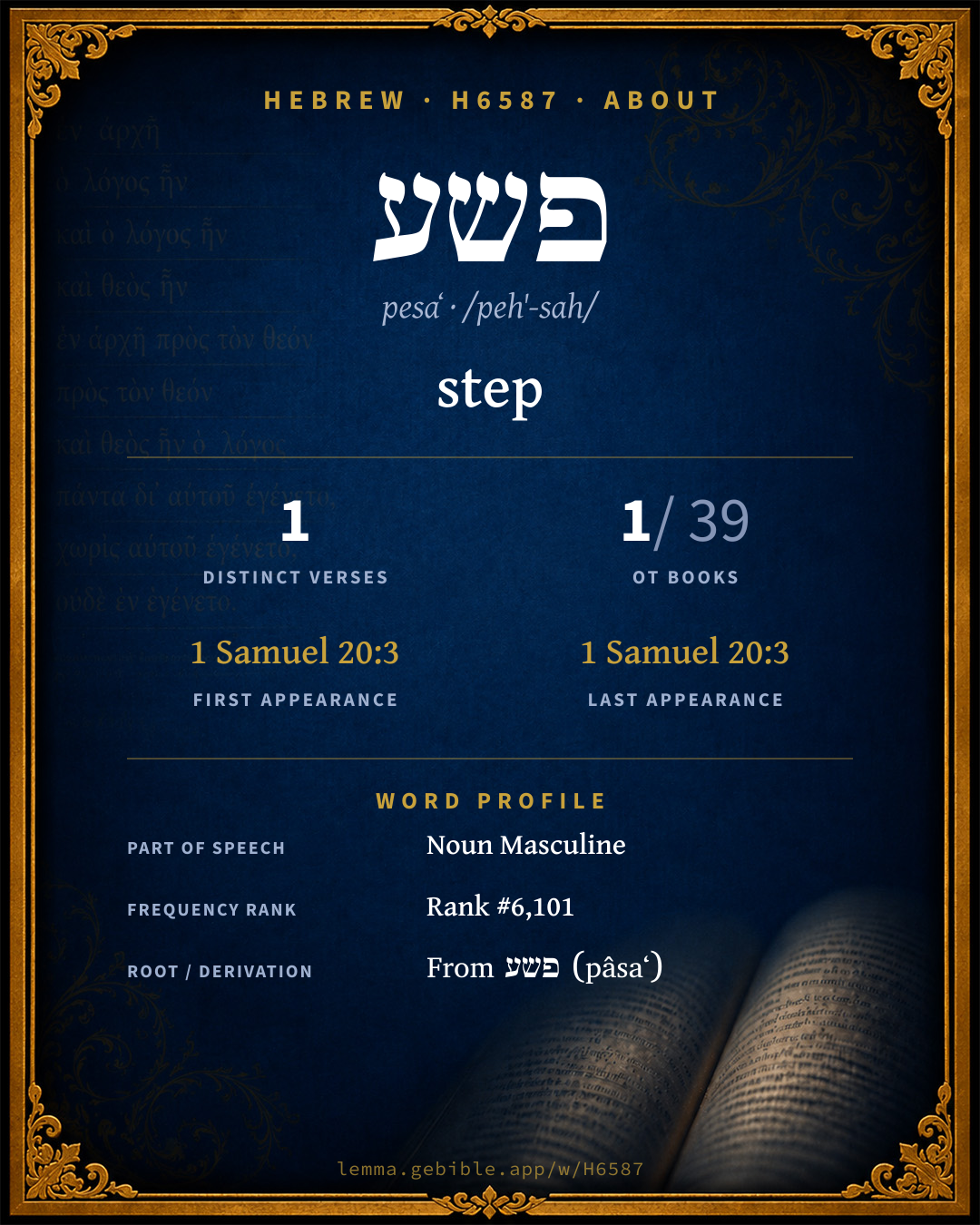
פֶּ֫שַׂע
step
Full lexicon entry — Brown-Driver-Briggs (BDB)
From Brown-Driver-Briggs (BDB)
Where this word appears
Grammar key — what these labels mean
Noun type
- Common
- A common noun — a general class of person, place, or thing (“king,” “city,” “water”), not a specific name.
State
- Absolute
- The independent form of a noun, not bound to a following word.
Gender
- Masculine
- Grammatically masculine.
Number
- Singular
- One.
Every verse where H6587 appears — 1 distinct verse across 1 book. Click any verse to open its interlinear word-by-word view. Verse text shown in the World English Bible for context — . Each verse’s Hebrew form is shown with its reference; the English is not keyword-highlighted, since the data carries no word-level English alignment. Use “Compare translations” on any verse to read it across multiple English versions. This concordance covers the Hebrew Bible; Septuagint (Greek Old Testament) occurrences are not indexed here.
1 Samuel 1 verse
About this entry
At a glance — auto-summarized from this page’s data, not written by a person. Every figure links to its source below. This summary describes the numbers; it doesn’t interpret them.
“step” is the headline sense of the Hebrew noun פשע (pesaʻ). The Hebrew Bible uses it only 1 verse. More than three-quarters of its appearances fall in 1 Samuel. It occurs only once, in 1 Samuel 20:3. Related forms include פשע, מפשעה and פשע. See the sense tree, 1-verse concordance, and the renderings breakdown below.
Gloss history
Strong's 1890 vs modern scholarship
About this word
Strong's H6587 catalogs a Hebrew word from the Hebrew Old Testament.
These counts are not copied from any lexicon or concordance. They are computed here, from the morphology-tagged Hebrew Old Testament. What Lemma adds →
- 1
- distinct verses
- The word appears in 1 distinct verse.
- 1 / 39
- OT books
- The word appears in 1 of 39 Old Testament books.
- #6,101
- by frequency
- Rank #6,101 (rank 6,101 of 8,640 Hebrew words by occurrence).
View all 1 occurrence in the concordance →
Most concentrated in
- 1 Samuel 1 verse 100%
By section of the Old Testament
By traditional corpus
Conventional, traditional groupings — biblical authorship is debated, so this is a traditional corpus grouping, not an authorship claim. Each share is this word’s portion of its verses in that division of the Hebrew canon. Each figure is a share of the word’s 1 distinct verse.
- Prophets (Nevi'im) 1 verse · 100%
How translations render this word
Counts come from each version’s own published word-to-Strong’s tagging or interlinear alignment — an approximate guide to how each version renders this word, not a word-level alignment the data otherwise carries. Because each total is that version’s own tagged count, the per-version totals vary from one another and need not match the appearance or distinct-verse counts above. These counts may also differ from a printed concordance because Lemma counts each distinctly tagged rendering and does not collapse phrase taggings into a single head-word total. This is a fixed set of word-tagged versions (KJV, ASV, BSB, ULT) and does not change with the reading translation you choose elsewhere. Each version’s license is shown beside its name below (and on Sources).
- King James Version: Is but a step 1×
- American Standard Version: Is but a step 1×
- Berean Standard Bible: Is but a step 1×
- unfoldingWord Literal Text: Like a step 1×
King James Version Public Domain
Renders H6587 across 1 tagged occurrence — most commonly:
American Standard Version Public Domain
Renders H6587 across 1 tagged occurrence — most commonly:
Berean Standard Bible Public Domain
Renders H6587 across 1 tagged occurrence — most commonly:
unfoldingWord Literal Text CC BY-SA 4.0
Renders H6587 across 1 tagged occurrence — most commonly:
Senses in BDB
The 1 sense BDB distinguishes for this word, in lexicon order (not ranked by frequency or importance). The full entry — with sub-senses — is in the Lexicon Entry tab.
- step
Word origin
Derived from פשע (pâsaʻ) (H6585) — to step.
Jastrow Dictionary
A second Hebrew/Aramaic lexicon for comparison, covering Aramaic and post-biblical (Talmudic, Targumic, Midrashic) usage that the biblical-Hebrew BDB does not. Matched by lemma rather than by Strong’s number, so a lemma may carry more than one Jastrow headword (shown separately below), and the entries cover usage well beyond the Bible.
פָּשַׁע
- (b. h.) [to pass beyond,]
- 1. to be wilful, rebellious. Yoma IV, 2 פָּשַׁעְתִּי; ib. VI, 2 פָּשְׁעוּ, v. עָוָה; a. fr.—פּוֹשֵׁעַ a wilful transgressor, rebel, apostate. Gitt. 57ᵃ פ׳ ישראל a Jewish apostate (the censor’s disguise for Jesus). Ib. תא חזי מה בין פּוֹשְׁעֵי ישראל וכ׳ come and see the difference between Jewish apostates and gentile prophets. R. Hash. 17ᵃ פ׳ ישראל בגופן Jewish sinners with their bodies (disregarding the ceremonial laws intended to guard the purity of life); פ׳ אומות העולם בגופן gentile sinners with their bodies (lustful and violent). Midr. Till. to Ps. LI כשאתה אומר לפּוֹשְׁעִים … אם תקבלני כל הפושעים משלימים לך when thou sayest to the sinners, why have you not repented? (they may plead ignorance of thy goodness, but) if thou receivest me, all sinners will make peace with thee; a. fr.
- 2. to be faithless. Gen. R. s. 52 (ref. to Prov. XVIII, 19) פָּשַׁעְתָּ באברהם thou (Lot) wast faithless to Abraham; Num. R. s. 18 זה קרח שפ׳ בתורה וכ׳ this refers to Korah who was faithless to the Law, which is called ‘strength’; a. fr.—Esp. (with ref. to Ex. XXII, 8) to be negligent in guarding a trust. B. Mets. 36ᵇ פ׳ בה וכ׳ if he was careless in guarding the animal, and it went out &c. Ib. 34ᵃ כיון שאמר פשעתי וכ׳ as soon as he says, ‘I have been at fault’, he surrenders the eventual fine (of the thief) to the owner. Ib. 58ᵃ כי היכי דלא לקרו להו פושעים in order that they may not be called faithless guardians; a. fr.—Ber. 28ᵃ ונקרא פושע and he is called negligent (because he delayed his prayers). e.g. Proverbs 18:19
- to cause to transgress. Num. R. s. 9 (ref. to Ex. XXII, 8) מדבר באהרן שה׳ ישראל בדיבור לא יהיה it alludes to Aaron who caused Israel to transgress the commandment, ‘thou shalt have no other gods &c.’ (Ex. XX, 3). e.g. Exodus 22:8
פְּשַׁע
- Taan. 24ᵃ כל מאן דפ׳ מחשדינא וכ׳ if a child rebels (refuses to study), I bribe him by giving him &c. Gitt. 36ᵃ הוה פָּשַׁע בינוקי he was faithless to (maltreated) the children; Macc. 16ᵇ
פֶּשַׁע
- preced.) rebellion, sin. Gen. R. s. 22 ילפִשְׁעִי, v. סָבַל. Tanḥ. Vayesheb 4 מה פשעי what wrong have I done?; a. e.—Pl. פְּשָׁעִים. Yoma III, 8; IV, 2. Ib. 36ᵇ פ׳ אלו המרדים by p’shaʿim are meant rebellious acts; Y. ib. III, 40ᵈ bot. פִּשְׁעֵיהֶם; Tosef. ib. II, 1; a. e.
A Dictionary of the Targumim, the Talmud Babli and Yerushalmi, and the Midrashic Literature (Marcus Jastrow; London, Luzac, 1903) — Public Domain. Digitized via Sefaria. Digitized via Sefaria. Full attribution on Sources.
Same root — word family
Other BDB entries built from the same root as H6587, grouped by Strong’s listed origin. These share a root / origin per the lexicon — not necessarily a shared meaning. Each links to that word’s own entry.
Derives from
Shares the same root
Compare all same-root words → They share a root, not necessarily a meaning.
Septuagint verse parallels
This word appears in 1 verse that also exists in the Greek Old Testament (Septuagint), out of the 1 Hebrew verse it occurs in. You can read those verses in Greek by switching the Old Testament edition to the Septuagint.
Read these verses in the Septuagint
This is a verse-level parallel only — the same verses exist in both the Hebrew and Greek Old Testaments. No word-level Hebrew↔Greek correspondence is claimed: the data carries no such alignment, so no Greek word is shown as this Hebrew word’s translation. Coverage is not total — the Septuagint omits the deuterocanon and renumbers the Psalms, so some Hebrew verses have no direct Greek parallel.