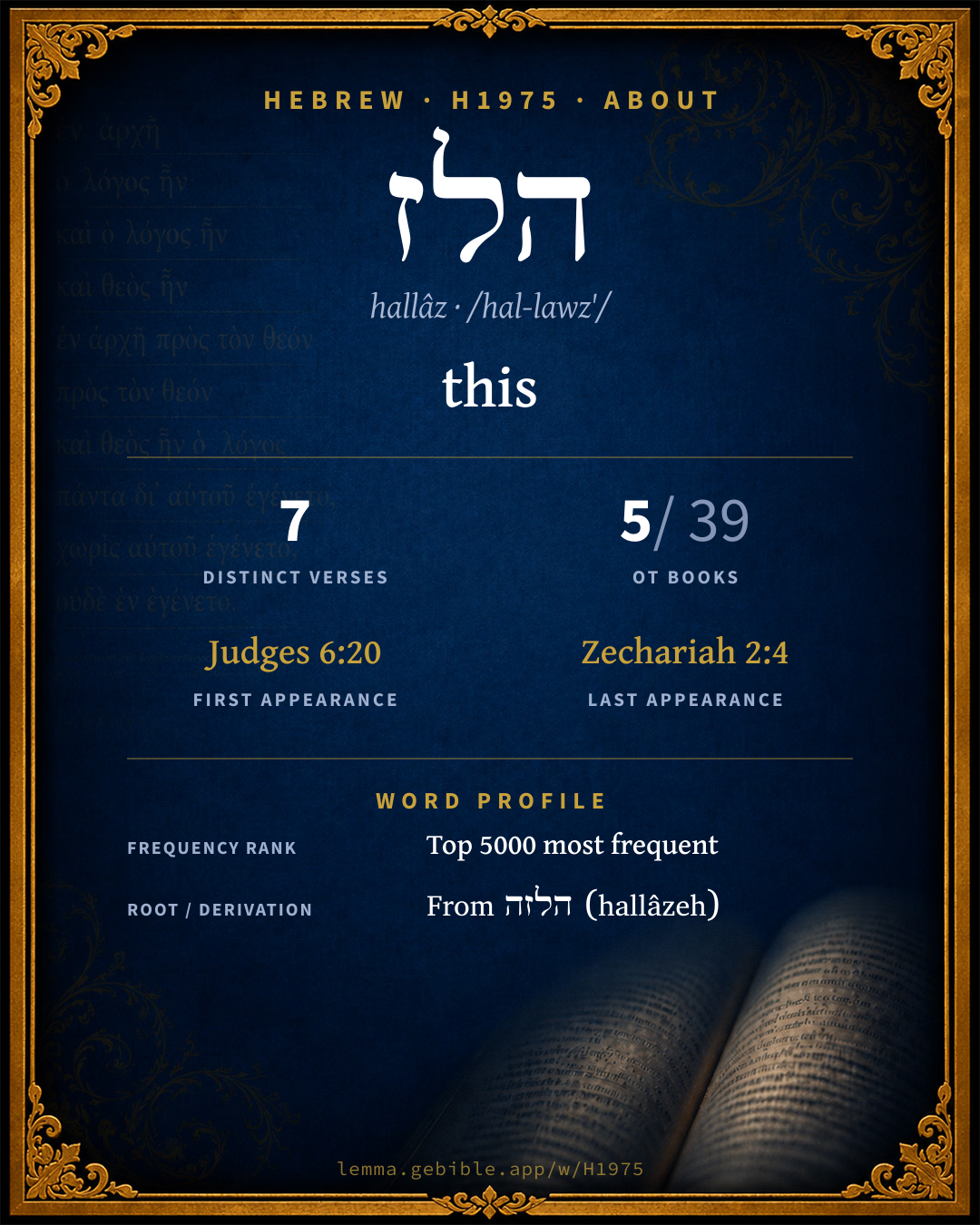
הַלָּז
this
Full lexicon entry — Brown-Driver-Briggs (BDB)
From Brown-Driver-Briggs (BDB)
Where this word appears
Grammar key — what these labels mean
Part of speech
- Pronoun
- A word standing in for a noun (“he,” “this,” “who”).
Gender
- Common
- Either gender — not distinguished for this form.
- Masculine
- Grammatically masculine.
Number
- Singular
- One.
Grammatical forms
- Pronoun, Demonstrative, Common, Singular 4 times (57%)
- Pronoun, Demonstrative, Masculine, Singular 3 times (43%)
Parsed forms decoded from the imported morphology (morphhb / Westminster Leningrad Codex — WLC text public domain, morphhb tagging CC BY 4.0), counted across 7 parsed occurrences — not distinct verses.
Every verse where H1975 appears — 7 distinct verses across 5 books. Click any verse to open its interlinear word-by-word view. Verse text shown in the World English Bible for context — . Each verse’s Hebrew form is shown with its reference; the English is not keyword-highlighted, since the data carries no word-level English alignment. Use “Compare translations” on any verse to read it across multiple English versions. This concordance covers the Hebrew Bible; Septuagint (Greek Old Testament) occurrences are not indexed here.
Judges 1 verse
1 Samuel 2 verses
- 1 Samuel 14:1 הַלָּ֑ז pron dem cs Now it fell on a day, that Jonathan the son of Saul said to the young man who bore his armor, Come, and let us go over to the Philistines' garrison, that is on yonder side. But he didn't tell his father.
- 1 Samuel 17:26 הַלָּ֔ז pron dem ms David spoke to the men who stood by him, saying, What shall be done to the man who kills this Philistine, and takes away the reproach from Israel? for who is this uncircumcised Philistine, that he should defy the armies of the living God?
2 Kings 2 verses
- 2 Kings 4:25 הַלָּֽז pron dem ms So she went, and came to the man of God to Mount Carmel. It happened, when the man of God saw her afar off, that he said to Gehazi his servant, Behold, yonder is the Shunammite:
- 2 Kings 23:17 הַלָּ֔ז pron dem cs Then he said, What monument is that which I see? The men of the city told him, It is the tomb of the man of God, who came from Judah, and proclaimed these things that you have done against the altar of Bethel.
Daniel 1 verse
Zechariah 1 verse
About this entry
At a glance — auto-summarized from this page’s data, not written by a person. Every figure links to its source below. This summary describes the numbers; it doesn’t interpret them.
The Hebrew word הלז centers on the idea of “this.” First canonically at Judges 6:20, it enters the text early. It turns up in 7 verses across 5 books, an uncommon footprint. The word gravitates to 1 Samuel (29%), then 2 Kings and Judges. It clusters with הלזה and הלזו under a shared root. Dig into 7-verse concordance and the renderings breakdown below.
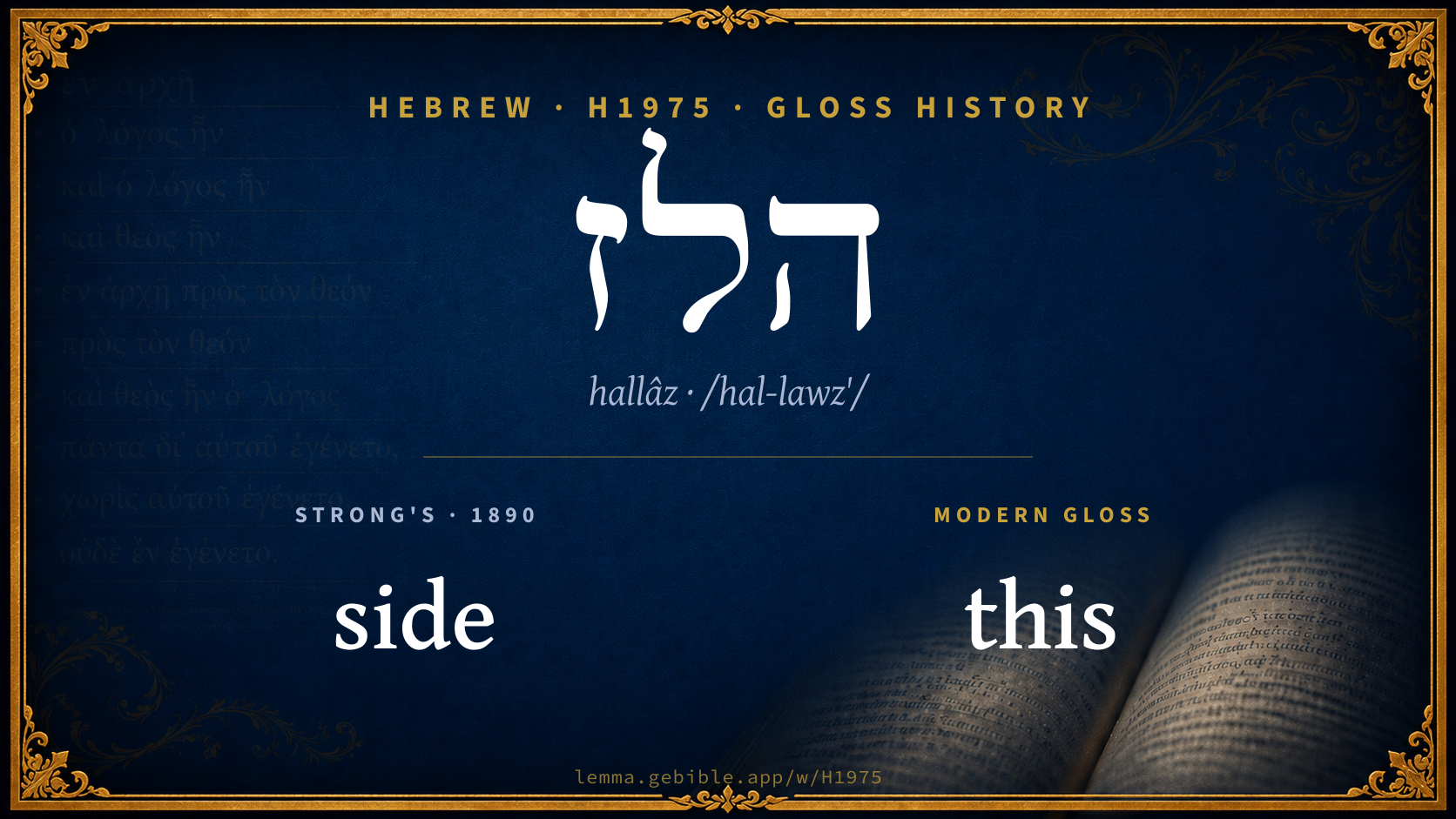
Gloss history
Strong's 1890 vs modern scholarship
About this word
Strong's H1975 catalogs a Hebrew word from the Hebrew Old Testament.
These counts are not copied from any lexicon or concordance. They are computed here, from the morphology-tagged Hebrew Old Testament. What Lemma adds →
- 7
- distinct verses
- The word appears in 7 distinct verses.
- 5 / 39
- OT books
- The word appears in 5 of 39 Old Testament books.
- #2,835
- by frequency
- Top 5000 most frequent Hebrew words (rank 2,835 of 8,640 Hebrew words by occurrence).
View all 7 occurrences in the concordance →
By section of the Old Testament
By traditional corpus
Conventional, traditional groupings — biblical authorship is debated, so this is a traditional corpus grouping, not an authorship claim. Each share is this word’s portion of its verses in that division of the Hebrew canon. Each figure is a share of the word’s 7 distinct verses.
- Prophets (Nevi'im) 6 verses · 86%
- Writings (Ketuvim) 1 verse · 14%
How translations render this word
Counts come from each version’s own published word-to-Strong’s tagging or interlinear alignment — an approximate guide to how each version renders this word, not a word-level alignment the data otherwise carries. Because each total is that version’s own tagged count, the per-version totals vary from one another and need not match the appearance or distinct-verse counts above. These counts may also differ from a printed concordance because Lemma counts each distinctly tagged rendering and does not collapse phrase taggings into a single head-word total. This is a fixed set of word-tagged versions (KJV, ASV, BSB, ULT) and does not change with the reading translation you choose elsewhere. Each version’s license is shown beside its name below (and on Sources).
- King James Version: This 3×
- American Standard Version: This 3×
- Berean Standard Bible: This 2×
- unfoldingWord Literal Text: This 3×, That 2×
King James Version Public Domain
Renders H1975 across 6 tagged occurrences — most commonly:
Plus 3 renderings that appear only once — usually multi-word phrases or single function words the recovered tagging swept in, not distinct renderings. Not rendered by a distinct English word in 1 further occurrence.
American Standard Version Public Domain
Renders H1975 across 6 tagged occurrences — most commonly:
Plus 3 renderings that appear only once — usually multi-word phrases or single function words the recovered tagging swept in, not distinct renderings.
Berean Standard Bible Public Domain
Renders H1975 across 6 tagged occurrences — most commonly:
Plus 4 renderings that appear only once — usually multi-word phrases or single function words the recovered tagging swept in, not distinct renderings. Not rendered by a distinct English word in 1 further occurrence.
unfoldingWord Literal Text CC BY-SA 4.0
Renders H1975 across 7 tagged occurrences — most commonly:
Plus 2 renderings that appear only once — usually multi-word phrases or single function words the recovered tagging swept in, not distinct renderings.
Senses in BDB
The 1 sense BDB distinguishes for this word, in lexicon order (not ranked by frequency or importance). The full entry — with sub-senses — is in the Lexicon Entry tab.
- this, this one (without subst), yonder
Word origin
pron.comm. this, a rare synonym of זֶה or הַזֶּה, this (Arabic اَلَّذِى (also اَلَّذْ), pl. اَلَّذِينَ, who, which (cf. זֶה, which is used also sometimes as rel.), formed from اَلْ the def. art., and the pron. ذَا, זֶה, זוּ, with the insertion of the demonstr. element la, and thus in fact = הַזֶּה: WAG i. § 347, CG p. 177)—ususally with subst. defined by the art., Ju 6:20 הַסֶּלַע הַלָּז this rock, 1 S 14:1 מֵעֵבֶר הַלָּז off this side-across, 17:26 אֶת־הַפְּלִשְׁתִּי הַלָּז, (+ 20:19 𝔊 Th We Dr τὸ ἐργαβ ἐκεῖνο, i.e. (or הַלָּאז) הָאַרְגָּב הַלָּז this mound (or cairn), for האבן האזל) 2 K 23:17; Zc 2:8; with a fem., 2 K 4:25 הַשּׁוּנַמִּית הַלָּז: without a subst. Dn 8:16 לְהַלָּז to this one (= normal לָזֶה). The fuller form is
— Brown-Driver-Briggs (Oxford 1906, public domain), digitized via Sefaria, supplemented by the OpenScriptures HebrewLexicon (CC BY 4.0). See Sources.
Derived from הלזה (hallâzeh) (H1976).
Jastrow Dictionary
A second Hebrew/Aramaic lexicon for comparison, covering Aramaic and post-biblical (Talmudic, Targumic, Midrashic) usage that the biblical-Hebrew BDB does not. Matched by lemma rather than by Strong’s number, so a lemma may carry more than one Jastrow headword (shown separately below), and the entries cover usage well beyond the Bible.
הַלָּז
- v. הַלּ־ a. this here, that there. Snh. 11ᵇ סופר ה׳ ed. (missing in Ms. M.; Tosef. ib. II, 6 הלה, Var. הלך); Y. ib. I, 18ᵈ top; Y. Maas. Sh. V, 56ᶜ top הסופר ה׳ the, then, scribe; v. נָזוּף.—Keth. 36ᵇ. Y. Erub. I, 18ᶜ bot. פירצה של ה׳ the breach on the other side.—Fem. הַלֵּזוּ. Yeb. XIII, 7 (109ᵃ) ה׳ תצא (missing in Mish. ed.) the other sister is free. Ib. ותצא ה׳. Ib. 51ᵇ; (Eduy. IV, 9 הלה).
A Dictionary of the Targumim, the Talmud Babli and Yerushalmi, and the Midrashic Literature (Marcus Jastrow; London, Luzac, 1903) — Public Domain. Digitized via Sefaria. Digitized via Sefaria. Full attribution on Sources.
Forms in the corpus
The 5 distinct written forms H1975 takes in the Hebrew Bible, most frequent first — each parse links to that state’s occurrences in the concordance. Hebrew forms include their vowel points and cantillation, so a single lemma takes many written forms.
| Form | Parsing | Example | Uses |
|---|---|---|---|
| הַלָּ֔ז | Pronoun, Demonstrative, Common, Singular | 2 Kings 23:17 | 3 |
| הַלָּ֑ז | Pronoun, Demonstrative, Common, Singular | 1 Samuel 14:1 | 1 |
| הַלָּ֖ז | Pronoun, Demonstrative, Masculine, Singular | Zechariah 2:4 | 1 |
| הַלָּֽז | Pronoun, Demonstrative, Masculine, Singular | 2 Kings 4:25 | 1 |
| לְ/הַלָּ֖ז | Pronoun, Demonstrative, Common, Singular | Daniel 8:16 | 1 |
Same root — word family
Other BDB entries built from the same root as H1975, grouped by Strong’s listed origin. These share a root / origin per the lexicon — not necessarily a shared meaning. Each links to that word’s own entry.
Derives from
Shares the same root
Compare all same-root words → They share a root, not necessarily a meaning.
Septuagint verse parallels
This word appears in 7 verses that also exist in the Greek Old Testament (Septuagint), out of the 7 Hebrew verses it occurs in. You can read those verses in Greek by switching the Old Testament edition to the Septuagint.
Read these verses in the Septuagint
This is a verse-level parallel only — the same verses exist in both the Hebrew and Greek Old Testaments. No word-level Hebrew↔Greek correspondence is claimed: the data carries no such alignment, so no Greek word is shown as this Hebrew word’s translation. Coverage is not total — the Septuagint omits the deuterocanon and renumbers the Psalms, so some Hebrew verses have no direct Greek parallel.