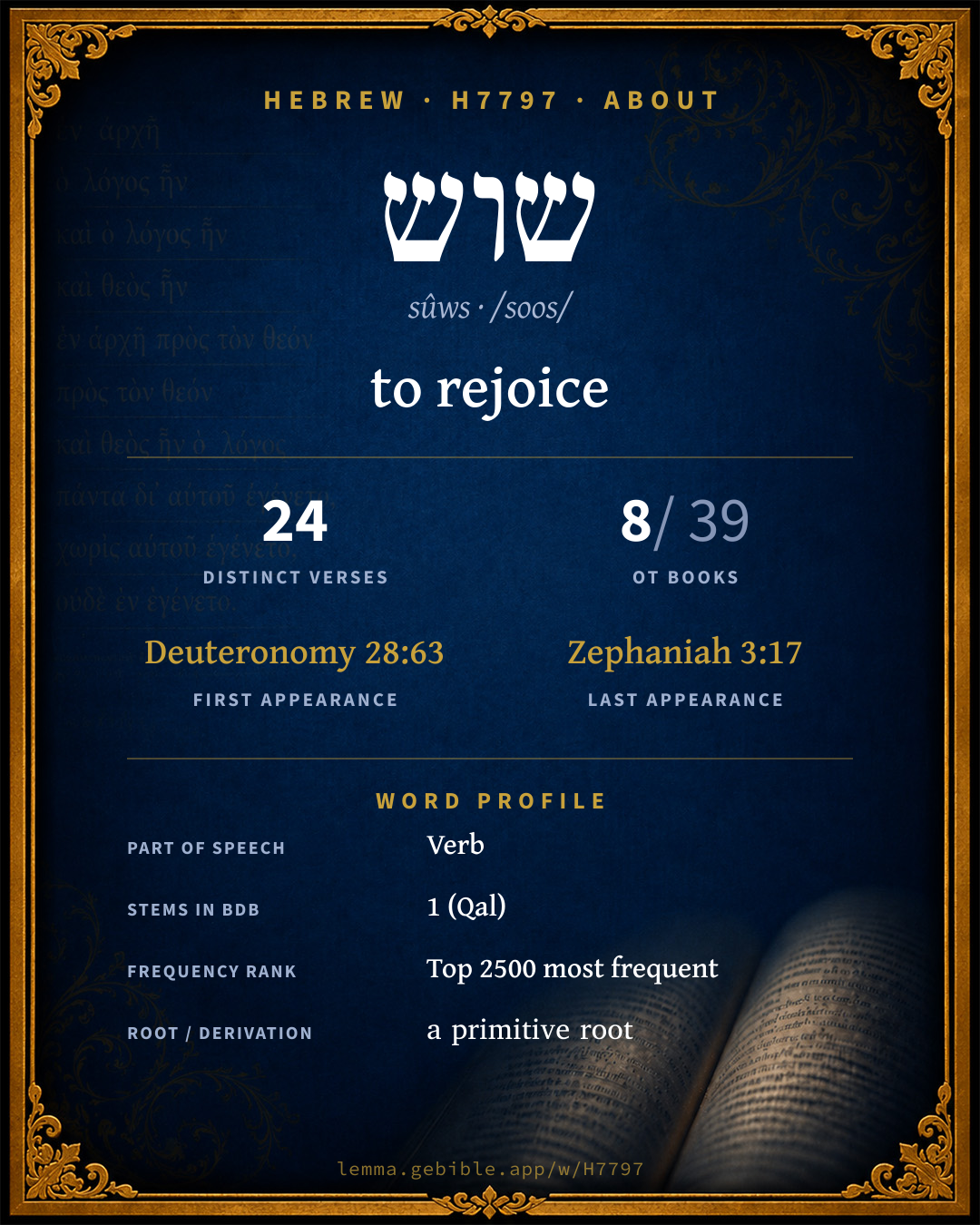
שׂוּשׂ
to rejoice
‘to rejoice’ is one of 2 main senses fuller range ↓
Full lexicon entry — Brown-Driver-Briggs (BDB)
From Brown-Driver-Briggs (BDB)
Where this word appears
Grammar key — what these labels mean
Part of speech
- Verb
- An action or state-of-being word.
Stem
- Qal
- The basic, simple active stem — the plain form of the verb (“he wrote”).
Form
- Imperfect
- An incomplete, ongoing, or future action (“he will / would write”).
- Sequential Perfect
- A perfect with prefixed waw continuing a preceding imperfect or command (waw-consecutive perfect).
- Perfect
- A completed action or state — Hebrew marks aspect (completeness) more than strict tense (“he wrote”).
- Participle Active
- A verbal adjective expressing ongoing or characteristic action (“writing / one who writes”).
- Imperative
- A direct command (“write!”).
- Infinitive Construct
- A bound verbal noun, frequently with prepositions (“to write / in writing”).
- Infinitive Absolute
- An unbound verbal noun, often intensifying or standing in for a finite verb.
State
- Absolute
- The independent form of a noun, not bound to a following word.
Person
- 3rd Person
- The one spoken about (“he / she / it / they”).
- 1st Person
- The speaker (“I / we”).
- 2nd Person
- The one addressed (“you”).
Gender
- Masculine
- Grammatically masculine.
- Common
- Either gender — not distinguished for this form.
- Feminine
- Grammatically feminine.
Number
- Singular
- One.
- Plural
- More than one (in Hebrew, generally three or more).
Every verse where H7797 appears in the Book of Ezekiel — 1 distinct verse. Click any verse to open its interlinear word-by-word view. Verse text shown in the World English Bible for context — . Each verse’s Hebrew form is shown with its reference; the English is not keyword-highlighted, since the data carries no word-level English alignment. Use “Compare translations” on any verse to read it across multiple English versions. This concordance covers the Hebrew Bible; Septuagint (Greek Old Testament) occurrences are not indexed here.
Ezekiel
About this entry
At a glance — auto-summarized from this page’s data, not written by a person. Every figure links to its source below. This summary describes the numbers; it doesn’t interpret them.
שוש (sûws) is a Hebrew verb most often rendered “to rejoice.” It first appears in Deuteronomy 28:63. The Hebrew Bible uses it across 24 verses — uncommon. Isaiah dominates its distribution — 8 of 24 verses. Not a single-sense word: explore its full sense range. Dig into 24-verse concordance and the renderings breakdown below.
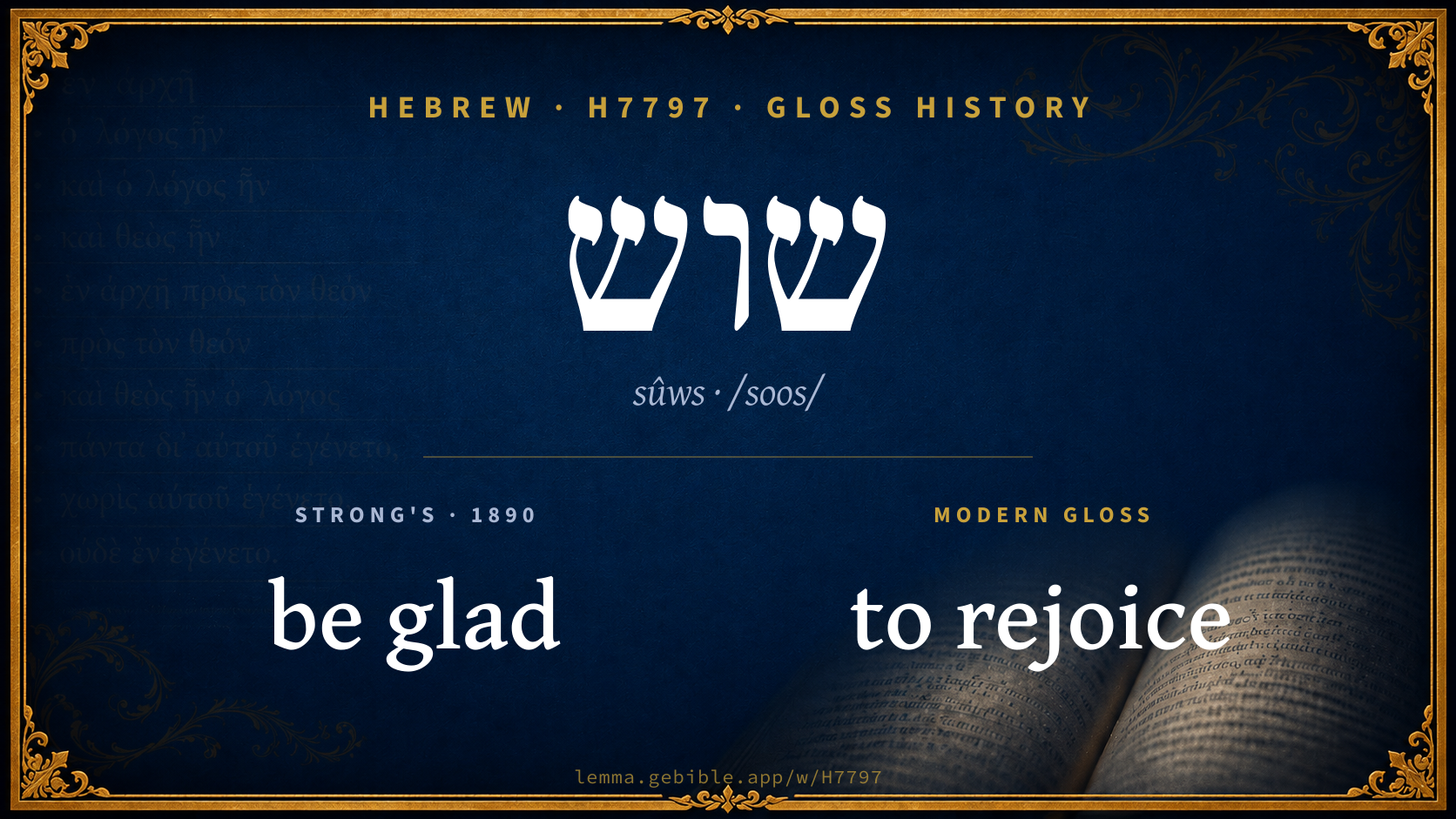
Gloss history
Strong's 1890 vs modern scholarship
About this word
Strong's H7797 catalogs a Hebrew word from the Hebrew Old Testament.
These counts are not copied from any lexicon or concordance. They are computed here, from the morphology-tagged Hebrew Old Testament. What Lemma adds →
- 24
- distinct verses
- The word appears in 24 distinct verses.
- 8 / 39
- OT books
- The word appears in 8 of 39 Old Testament books.
- #1,226
- by frequency
- Top 2500 most frequent Hebrew words (rank 1,226 of 8,640 Hebrew words by occurrence).
View all 24 occurrences in the concordance →
Most concentrated in
- Isaiah 8 verses 33%
- Psalms 7 verses 29%
- Deuteronomy 2 verses 8%
By section of the Old Testament
By traditional corpus
Conventional, traditional groupings — biblical authorship is debated, so this is a traditional corpus grouping, not an authorship claim. Each share is this word’s portion of its verses in that division of the Hebrew canon. Each figure is a share of the word’s 24 distinct verses.
- Prophets (Nevi'im) 11 verses · 46%
- Writings (Ketuvim) 11 verses · 46%
- Torah (Pentateuch) 2 verses · 8%
How translations render this word
Counts come from each version’s own published word-to-Strong’s tagging or interlinear alignment — an approximate guide to how each version renders this word, not a word-level alignment the data otherwise carries. Because each total is that version’s own tagged count, the per-version totals vary from one another and need not match the appearance or distinct-verse counts above. These counts may also differ from a printed concordance because Lemma counts each distinctly tagged rendering and does not collapse phrase taggings into a single head-word total. This is a fixed set of word-tagged versions (KJV, ASV, BSB, ULT) and does not change with the reading translation you choose elsewhere. Each version’s license is shown beside its name below (and on Sources).
- King James Version: Rejoice 6×, Rejoiceth 3×, Shall rejoice 2×
- American Standard Version: Rejoice 3×, Rejoiceth 3×, Thee rejoice 2×
- Berean Standard Bible: Rejoice 4×, Exult 2×, Will rejoice 2×
- unfoldingWord Literal Text: Rejoice 6×, Will rejoice 5×, I will rejoice 2×
King James Version Public Domain
Renders H7797 across 27 tagged occurrences — most commonly:
Plus 14 renderings that appear only once — usually multi-word phrases or single function words the recovered tagging swept in, not distinct renderings.
American Standard Version Public Domain
Renders H7797 across 26 tagged occurrences — most commonly:
Plus 18 renderings that appear only once — usually multi-word phrases or single function words the recovered tagging swept in, not distinct renderings.
Berean Standard Bible Public Domain
Renders H7797 across 26 tagged occurrences — most commonly:
Plus 18 renderings that appear only once — usually multi-word phrases or single function words the recovered tagging swept in, not distinct renderings. Not rendered by a distinct English word in 1 further occurrence.
unfoldingWord Literal Text CC BY-SA 4.0
Renders H7797 across 29 tagged occurrences — most commonly:
Plus 12 renderings that appear only once — usually multi-word phrases or single function words the recovered tagging swept in, not distinct renderings.
Senses in the full BDB
What do BDB’s symbols mean?
BDB uses these scholarly abbreviations:
| Symbol | Meaning |
|---|---|
| 𝔊 | the Septuagint (the ancient Greek translation, LXX) |
| 𝔙 | the Vulgate (the Latin translation) |
| 𝔖 | the Syriac version (the Peshitta) |
| 𝔗 | the Targum (the Aramaic translation) |
| ψ | the Psalms |
| √ | root (the underlying root or stem) |
| ‖ | parallel passage (a synonymous or contrasted parallel) |
| † | the dagger: every passage where the word occurs is cited |
The 1 sense the full Brown-Driver-Briggs lexicon distinguishes for this word, in lexicon order (not ranked by frequency), with BDB’s own verbatim wording and sub-sense lettering. Shown in Hebrew script with BDB’s own scholarly abbreviations. The condensed entry is in the Lexicon Entry tab. See also the Forms in the corpus table below.
Qal
- Pf. 3 ms. שָׂשׂ Dt 28:63 +, 1 s. שַׂשְׂתִּי ψ 119:14, etc.; Impf. 3 ms. יָשִׂישׂ Dt 28:63 +, 3 mpl. יְשֻׂשׂוּם Is 35:1 (Ges§ 47 n Kö i. 510, but ם erron. Kenn Ol § 244 a, prob. dittogr., so Lo Hi Gr CheHpt. Marti), etc.; Imv. fs. שִׂישִׂי La 4:2, mpl. שִׂישׂוּ Is 65:18; 66:10; Inf. abs. שׂוֹשׂ 61:10; cstr. לָשׂוּשׂ Dt 30:9;—exult, display joy,c. עַל over, Dt 28:63(×2); 30:9(×2); Je 32:41; Is 62:5; Zp 3:17 (+ בְּשִׂמְחָה; ‖ גִּיל), ψ 119:162; c. ב Is 61:10 (שׂוֹשׂ אָשִׂישׂ), 65:19 ψ 35:9 (all ‖ גִּיל); 40:17; 68:4 (+ בְּשִׂמְחָה; ‖ עָלַץ), 70:5 (all ‖ שָׂמַח); 119:14; Jb 39:21 (horse), ψ 19:6 (sun, as athlete); c. כִּי and cl. La 1:21; abs. Is 35:1; 65:18 (both ‖ גִּיל), 64:4 (but del. שָׂשׂ וְ 𝔊 Gr Du CheHpt Marti), 68:14; La 4:21 (‖ שָׂמַת), Jb 3:22 (‖ שָׂמַח אֱלֵ י־גִיל), Is 66:10 (acc. cogn.; ‖ גִּיל, שָׂמַח) v 14. Ez 21:15 is crpt., Co reads לְאַנְשֵׁי (for נָשִׂישׂ), Krae לִנְשִׂיאֵי, other conj. in comm.; on cl. vid. especially Da ToyHeb. Hpt.. e.g. Deuteronomy 28:63
Senses from the full Brown-Driver-Briggs lexicon (Brown, Driver, Briggs; Oxford 1906 — public domain), digitized via Sefaria, supplemented by the OpenScriptures HebrewLexicon (CC BY 4.0). Full attribution on Sources.
Word origin
vb. exult, rejoice (Nö ZMG xxxvii (1883), 536 der. (‘perhaps’) from interj., as شَأْشَأْ an enticing call, so Gerber20);—
— Brown-Driver-Briggs (Oxford 1906, public domain), digitized via Sefaria, supplemented by the OpenScriptures HebrewLexicon (CC BY 4.0). See Sources.
Origin: a primitive root
Jastrow Dictionary
A second Hebrew/Aramaic lexicon for comparison, covering Aramaic and post-biblical (Talmudic, Targumic, Midrashic) usage that the biblical-Hebrew BDB does not. Matched by lemma rather than by Strong’s number, so a lemma may carry more than one Jastrow headword (shown separately below), and the entries cover usage well beyond the Bible.
שׂוּשׂ
- (b. h.) to be bright, quick, glad. Sabb. 28ᵃ ששָׂשׂ בגוונין וכ׳ (Ar. שסָס), v. סַסְגּוֹנָא. Cant. R. to I, 9; Mekh. B’shall. s. 6 (play on לססתי, Cant. l. c.) כשם ששַׂשְׂתִּי על … כך (כמעט) ששתי על וכ׳ as I was quick to destroy the Egyptians, so I was (almost) ready to destroy Israel &c. Ib. 1 they praised God שלא ראו … ושָׂשׂוּ וכ׳ that their enemies had not seen (the deaths among them), and rejoiced at their calamity. B. Mets. 83ᵇ שִׂישׂוּ בני מעי שישו rejoice, my entrails, rejoice! Snh. 39ᵇ הוא אינו שָׂשׂ … מֵשִׂישׂ the Lord himself does not rejoice (over the downfall of the wicked), but he causes others to rejoice; דכתיב יָשִׂישׂ ולא כתיב יָשׂוּשׂ for it is written (Deut. XXVIII, 63) yasis (Hif.), and not yasus (Kal); Meg. 10ᵇ; a. e. e.g. Deuteronomy 28:63
- to gladden. Ib., v. supra. Koh. R. to VII, 19 כבד לחמה … הריאה מְשַׂשְׂתָּן the liver is the organ of anger, the gall, of jealousy, the lungs gladden them again; a. e.
שׁוּשׁ
- Shush or Sh’vash (prob. the modern Sus = Shushan, v. Sm. Gr. a. Rom. Geogr. s. v. Susa). Snh. 94ᵃ כי מטי שׁוֹש אמרי שׁוֹיא לארעין Rashi (ed. כי ארעין) when they (the Jewish exiles) came to Sh., they said, this is as good as our land. Ib. שוש תרי, v. שׁוּשְׁתְּרֵי.
A Dictionary of the Targumim, the Talmud Babli and Yerushalmi, and the Midrashic Literature (Marcus Jastrow; London, Luzac, 1903) — Public Domain. Digitized via Sefaria. Digitized via Sefaria. Full attribution on Sources.
Forms in the corpus
The 24 distinct written forms H7797 takes in the Hebrew Bible, most frequent first — each parse links to that stem’s occurrences in the concordance. Hebrew forms include their vowel points and cantillation, so a single lemma takes many written forms.
| Form | Parsing | Example | Uses |
|---|---|---|---|
| יָ֘שִׂ֤ישׂוּ | Verb, Qal, Imperfect, 3rd Person, Masculine, Plural | Psalms 40:16 | 2 |
| יָשִׂ֥ישׂ | Verb, Qal, Imperfect, 3rd Person, Masculine, Singular | Isaiah 62:5 | 2 |
| שִׂ֤ישׂוּ | Verb, Qal, Imperative, 2nd Person, Masculine, Plural | Isaiah 65:18 | 2 |
| אָשִׂ֣ישׂ | Verb, Qal, Imperfect, 1st Person, Common, Singular | Isaiah 61:10 | 1 |
| וְ/יָשִׂ֣ישׂ | Verb, Qal, Imperfect, 3rd Person, Masculine, Singular | Job 39:21 | 1 |
| וְ/יָשִׂ֥ישׂוּ | Verb, Qal, Imperfect, 3rd Person, Masculine, Plural | Psalms 68:3 | 1 |
| וְ/שַׂשְׂתִּ֣י | Verb, Qal, Sequential Perfect, 1st Person, Common, Singular | Isaiah 65:19 | 1 |
| וְ/שַׂשְׂתִּ֥י | Verb, Qal, Sequential Perfect, 1st Person, Common, Singular | Jeremiah 32:41 | 1 |
| וְ/שָׂ֣שׂ | Verb, Qal, Sequential Perfect, 3rd Person, Masculine, Singular | Isaiah 66:14 | 1 |
| יְשֻׂשׂ֥וּ/ם | Verb, Qal, Imperfect, 3rd Person, Masculine, Plural | Isaiah 35:1 | 1 |
| יָ֝שִׂ֗ישׂוּ | Verb, Qal, Imperfect, 3rd Person, Masculine, Plural | Job 3:22 | 1 |
| יָשִׂ֤ישׂ | Verb, Qal, Imperfect, 3rd Person, Masculine, Singular | Deuteronomy 28:63 | 1 |
| יָשִׂ֨ישׂ | Verb, Qal, Imperfect, 3rd Person, Masculine, Singular | Zephaniah 3:17 | 1 |
| לָ/שׂ֤וּשׂ | Verb, Qal, Infinitive Construct | Deuteronomy 30:9 | 1 |
| נָשִׂ֔ישׂ | Verb, Qal, Imperfect, 1st Person, Common, Plural | Ezekiel 21:10 | 1 |
| שׂ֧וֹשׂ | Verb, Qal, Infinitive Absolute | Isaiah 61:10 | 1 |
| שִׂ֤ישִׂי | Verb, Qal, Imperative, 2nd Person, Feminine, Singular | Lamentations 4:21 | 1 |
| שַׂ֗שְׂתִּי | Verb, Qal, Perfect, 1st Person, Common, Singular | Psalms 119:14 | 1 |
| שָׂ֔שׂוּ | Verb, Qal, Perfect, 3rd Person, Common, Plural | Lamentations 1:21 | 1 |
| שָׂ֖שׂ | Verb, Qal, Perfect, 3rd Person, Masculine, Singular | Deuteronomy 30:9 | 1 |
| שָׂ֣שׂ | Verb, Qal, Participle Active, Masculine, Singular, Absolute | Psalms 119:162 | 1 |
| שָׂ֨שׂ | Verb, Qal, Perfect, 3rd Person, Masculine, Singular | Deuteronomy 28:63 | 1 |
| שָׂשׂ֙ | Verb, Qal, Participle Active, Masculine, Singular, Absolute | Isaiah 64:5 | 1 |
| תָּ֝שִׂישׂ | Verb, Qal, Imperfect, 3rd Person, Feminine, Singular | Psalms 35:9 | 1 |
Same root — word family
Other BDB entries built from the same root as H7797, grouped by Strong’s listed origin. These share a root / origin per the lexicon — not necessarily a shared meaning. Each links to that word’s own entry.
Derived from this word
Proper names from this root
People and places named from this root — a name, not an additional meaning of the word.
Compare all same-root words → Showing 4 of 5 — not the complete family. 1 of the same-root words is a proper name (a person or place). They share a root, not necessarily a meaning.
Septuagint verse parallels
This word appears in 20 verses that also exist in the Greek Old Testament (Septuagint), out of the 24 Hebrew verses it occurs in. You can read those verses in Greek by switching the Old Testament edition to the Septuagint.
Read these verses in the Septuagint
This is a verse-level parallel only — the same verses exist in both the Hebrew and Greek Old Testaments. No word-level Hebrew↔Greek correspondence is claimed: the data carries no such alignment, so no Greek word is shown as this Hebrew word’s translation. Coverage is not total — the Septuagint omits the deuterocanon and renumbers the Psalms, so some Hebrew verses have no direct Greek parallel.