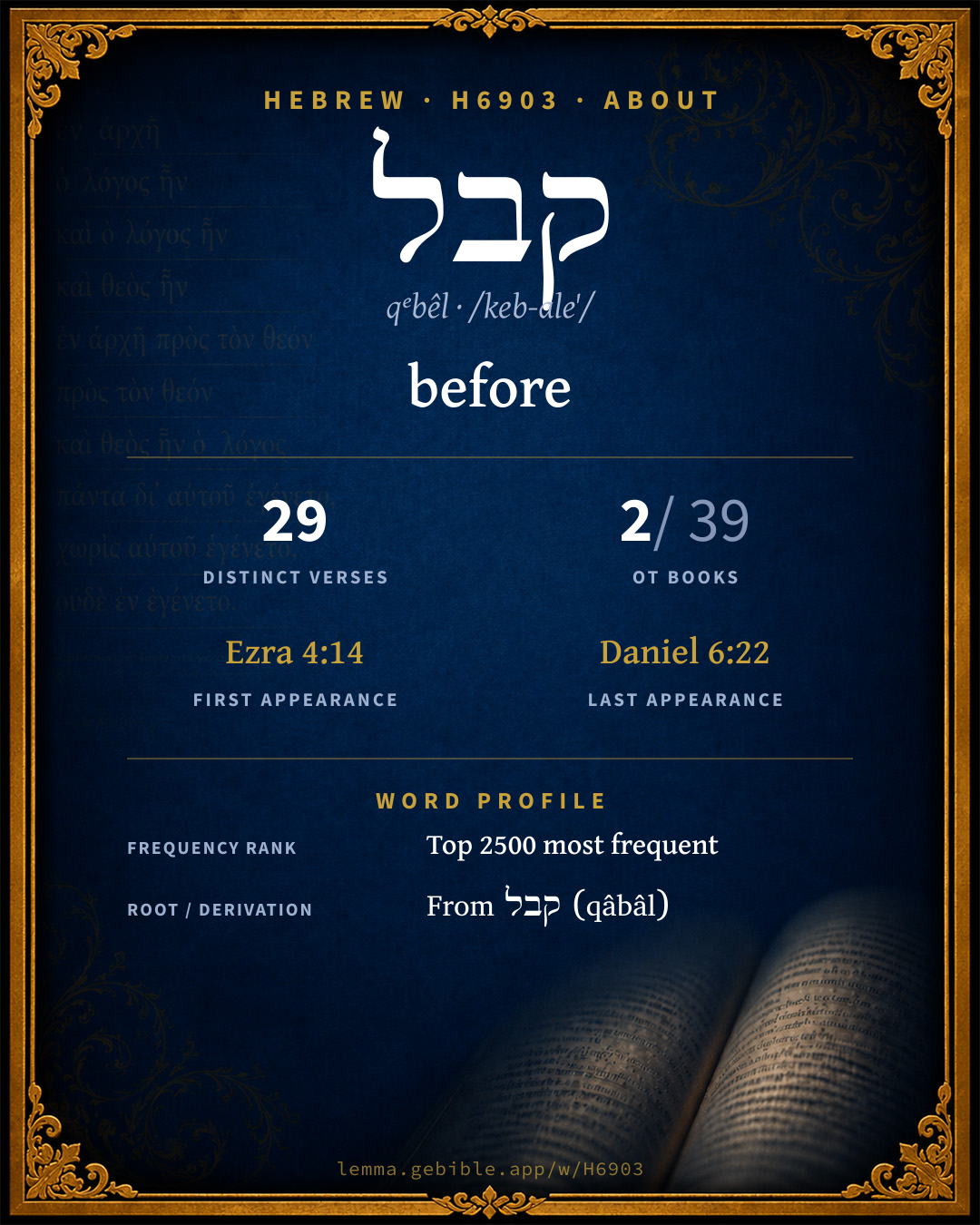
קֳבֵל
before
‘before’ is one of 4 main senses fuller range ↓
Full lexicon entry — Brown-Driver-Briggs (BDB)
From Brown-Driver-Briggs (BDB)
Where this word appears
Grammar key — what these labels mean
Part of speech
- Conjunction
- A joining word (e.g. “and,” “but”) linking words or clauses.
Grammatical forms
- Conjunction 23 times (79%)
- Preposition 6 times (21%)
Parsed forms decoded from the imported morphology (morphhb / Westminster Leningrad Codex — WLC text public domain, morphhb tagging CC BY 4.0), counted across 29 parsed occurrences — not distinct verses.
Every verse where H6903 appears — 29 distinct verses across 2 books. Click any verse to open its interlinear word-by-word view. Verse text shown in the World English Bible for context — . Each verse’s Hebrew form is shown with its reference; the English is not keyword-highlighted, since the data carries no word-level English alignment. Use “Compare translations” on any verse to read it across multiple English versions. This concordance covers the Hebrew Bible; Septuagint (Greek Old Testament) occurrences are not indexed here.
Ezra 5 verses
- Ezra 4:14 קֳבֵל֙ conj Now because we eat the salt of the palace, and it is not appropriate for us to see the king's dishonor, therefore have we sent and informed the king;
- Ezra 4:16 לָ/קֳבֵ֣ל conj + conj We inform the king that, if this city be built, and the walls finished, by this means you shall have no portion beyond the River.
- Ezra 6:13 לָ/קֳבֵ֗ל prep + prep Then Tattenai, the governor beyond the River, Shetharbozenai, and their companions, because that Darius the king had sent, did accordingly with all diligence.
- Ezra 7:14 קֳבֵ֗ל conj Because you are sent of the king and his seven counselors, to inquire concerning Judah and Jerusalem, according to the law of your God which is in your hand,
- Ezra 7:17 קֳבֵ֣ל conj therefore you shall with all diligence buy with this money bulls, rams, lambs, with their meal-offerings and their drink-offerings, and shall offer them on the altar of the house of your God which is in Jerusalem.
Daniel 24 verses
- Daniel 2:8 קֳבֵל֙ conj The king answered, I know of a certainty that you would gain time, because you see the thing is gone from me.
- Daniel 2:10 קֳבֵ֗ל conj The Chaldeans answered before the king, and said, There is not a man on the earth who can show the king's matter, because no king, lord, or ruler, has asked such a thing of any magician, or enchanter, or Chaldean.
- Daniel 2:12 קֳבֵ֣ל conj For this cause the king was angry and very furious, and commanded to destroy all the wise men of Babylon.
- Daniel 2:24 קֳבֵ֣ל conj Therefore Daniel went in to Arioch, whom the king had appointed to destroy the wise men of Babylon; he went and said thus to him: Don't destroy the wise men of Babylon; bring me in before the king, and I will show to the king the interpretation.
- Daniel 2:31 לְ/קָבְלָ֑/ךְ prep + prep + sfx pers 2ms You, O king, saw, and, behold, a great image. This image, which was mighty, and whose brightness was excellent, stood before you; and the aspect of it was awesome.
- Daniel 2:40 קֳבֵ֗ל conj The fourth kingdom shall be strong as iron, because iron breaks in pieces and subdues all things; and as iron that crushes all these, shall it break in pieces and crush.
- Daniel 2:41 קֳבֵל֙ conj Whereas you saw the feet and toes, part of potters' clay, and part of iron, it shall be a divided kingdom; but there shall be in it of the strength of the iron, because you saw the iron mixed with miry clay.
- Daniel 2:45 קֳבֵ֣ל conj Because you saw that a stone was cut out of the mountain without hands, and that it broke in pieces the iron, the brass, the clay, the silver, and the gold; the great God has made known to the king what shall happen hereafter: and the dream is certain, and the interpretation of it sure.
- Daniel 3:3 לָ/קֳבֵ֣ל prep + prep Then the satraps, the deputies, and the governors, the judges, the treasurers, the counselors, the sheriffs, and all the rulers of the provinces, were gathered together to the dedication of the image that Nebuchadnezzar the king had set up; and they stood before the image that Nebuchadnezzar had set up.
- Daniel 3:7 קֳבֵ֣ל conj Therefore at that time, when all the peoples heard the sound of the horn, flute, zither, lyre, harp, pipe, and all kinds of music, all the peoples, the nations, and the languages, fell down and worshiped the golden image that Nebuchadnezzar the king had set up.
- Daniel 3:8 קֳבֵ֤ל conj Therefore at that time certain Chaldeans came near, and brought accusation against the Jews.
- Daniel 3:22 קֳבֵ֣ל conj Therefore because the king's commandment was urgent, and the furnace exceeding hot, the flame of the fire killed those men who took up Shadrach, Meshach, and Abednego.
- Daniel 3:29 קֳבֵ֗ל conj Therefore I make a decree, that every people, nation, and language, which speak anything evil against the God of Shadrach, Meshach, and Abednego, shall be cut in pieces, and their houses shall be made a dunghill; because there is no other god who is able to deliver after this sort.
- Daniel 4:18 קֳבֵל֙ conj This dream I, king Nebuchadnezzar, have seen; and you, Belteshazzar, declare the interpretation, because all the wise men of my kingdom are not able to make known to me the interpretation; but you are able; for the spirit of the holy gods is in you.
- Daniel 5:1 וְ/לָ/קֳבֵ֥ל conj + prep + Preposition Belshazzar the king made a great feast to a thousand of his lords, and drank wine before the thousand.
- Daniel 5:5 לָ/קֳבֵ֣ל prep + prep In the same hour came forth the fingers of a man's hand, and wrote over against the lampstand on the plaster of the wall of the king's palace: and the king saw the part of the hand that wrote.
- Daniel 5:10 לָ/קֳבֵ֨ל prep + prep [Now] the queen by reason of the words of the king and his lords came into the banquet house: the queen spoke and said, O king, live forever; don't let your thoughts trouble you, nor let your face be changed.
- Daniel 5:12 קֳבֵ֡ל conj because an excellent spirit, and knowledge, and understanding, interpreting of dreams, and showing of dark sentences, and dissolving of doubts, were found in the same Daniel, whom the king named Belteshazzar. Now let Daniel be called, and he will show the interpretation.
- Daniel 5:22 קֳבֵ֕ל conj You his son, Belshazzar, have not humbled your heart, though you knew all this,
- Daniel 6:3 קֳבֵ֗ל conj Then this Daniel was distinguished above the presidents and the satraps, because an excellent spirit was in him; and the king thought to set him over the whole realm.
- Daniel 6:4 קֳבֵל֙ conj Then the presidents and the satraps sought to find occasion against Daniel as touching the kingdom; but they could find no occasion nor fault, because he was faithful, neither was there any error or fault found in him.
- Daniel 6:9 קֳבֵ֖ל conj Therefore king Darius signed the writing and the interdict.
- Daniel 6:10 קֳבֵל֙ conj When Daniel knew that the writing was signed, he went into his house (now his windows were open in his chamber toward Jerusalem) and he kneeled on his knees three times a day, and prayed, and gave thanks before his God, as he did before.
- Daniel 6:22 קֳבֵ֗ל conj My God has sent his angel, and has shut the lions' mouths, and they have not hurt me; because as before him innocence was found in me; and also before you, O king, have I done no hurt.
About this entry
At a glance — auto-summarized from this page’s data, not written by a person. Every figure links to its source below. This summary describes the numbers; it doesn’t interpret them.
קבל (qᵉbêl) is a Hebrew word most often rendered “before.” It clusters heavily in Daniel, which alone accounts for 83% of its uses. With 29 verses in 2 books, it is a moderately common word in the Hebrew Bible. It first appears in Ezra 4:14. Ranging over 4 senses, it is not a single-sense word. The sections below give every sense, occurrence, and version rendering.
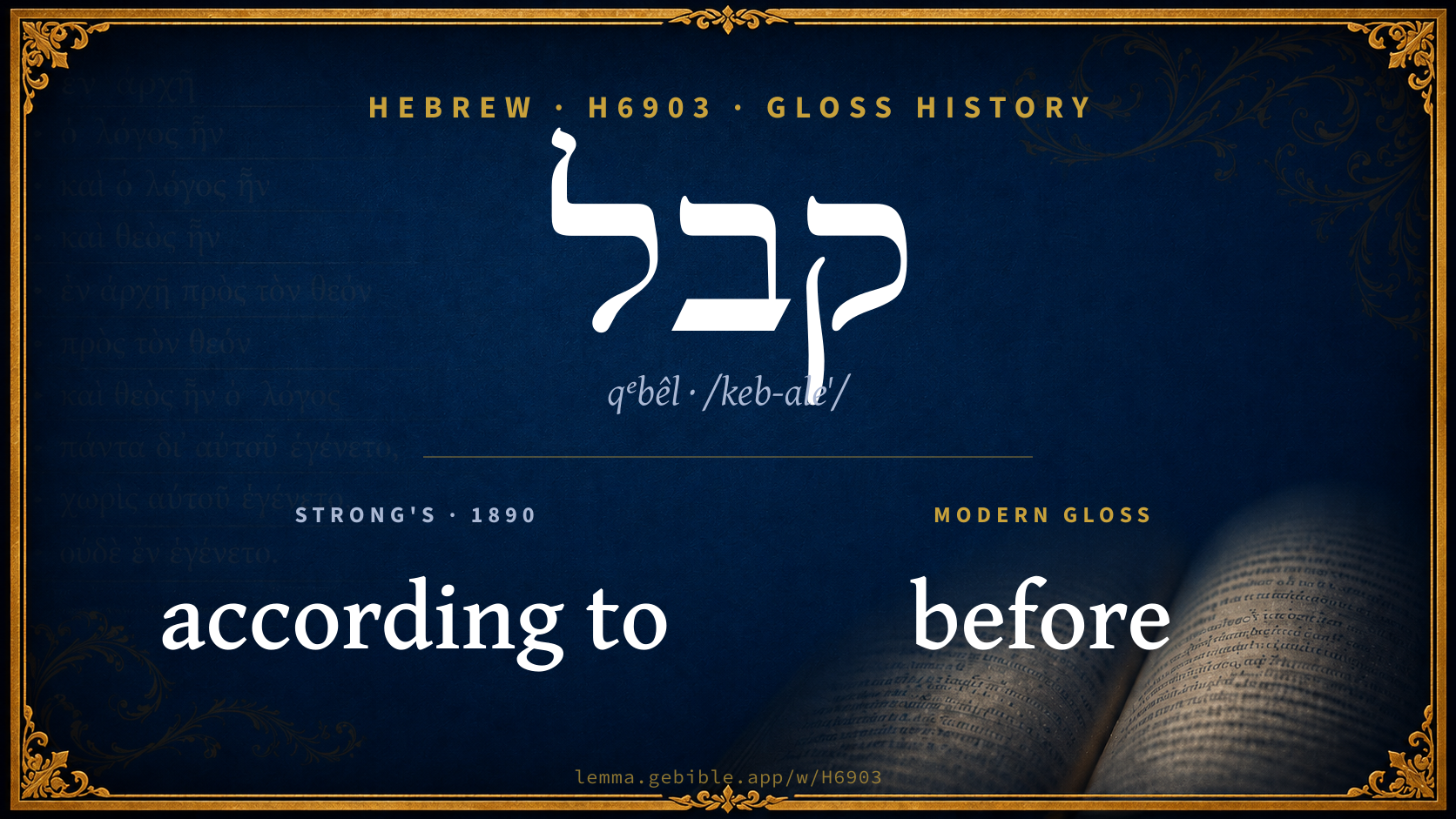
Gloss history
Strong's 1890 vs modern scholarship
About this word
Strong's H6903 catalogs a Hebrew word from the Hebrew Old Testament.
These counts are not copied from any lexicon or concordance. They are computed here, from the morphology-tagged Hebrew Old Testament. What Lemma adds →
- 29
- distinct verses
- The word appears in 29 distinct verses.
- 2 / 39
- OT books
- The word appears in 2 of 39 Old Testament books.
- #1,160
- by frequency
- Top 2500 most frequent Hebrew words (rank 1,160 of 8,640 Hebrew words by occurrence).
View all 29 occurrences in the concordance →
By traditional corpus
Conventional, traditional groupings — biblical authorship is debated, so this is a traditional corpus grouping, not an authorship claim. Each share is this word’s portion of its verses in that division of the Hebrew canon. Each figure is a share of the word’s 29 distinct verses.
- Writings (Ketuvim) 29 verses · 100%
How translations render this word
Counts come from each version’s own published word-to-Strong’s tagging or interlinear alignment — an approximate guide to how each version renders this word, not a word-level alignment the data otherwise carries. Because each total is that version’s own tagged count, the per-version totals vary from one another and need not match the appearance or distinct-verse counts above. These counts may also differ from a printed concordance because Lemma counts each distinctly tagged rendering and does not collapse phrase taggings into a single head-word total. This is a fixed set of word-tagged versions (KJV, ASV, BSB, ULT) and does not change with the reading translation you choose elsewhere. Each version’s license is shown beside its name below (and on Sources).
- King James Version: Because 3×, Before 3×, Therefore 2×
- American Standard Version: Because 3×, Before 3×, Forasmuch 2×
- Berean Standard Bible: Because 3×, For 3×, Just as 2×
- unfoldingWord Literal Text: Because 10×, Therefore 5×, Of 3×
King James Version Public Domain
Renders H6903 across 20 tagged occurrences — most commonly:
Plus 12 renderings that appear only once — usually multi-word phrases or single function words the recovered tagging swept in, not distinct renderings. Not rendered by a distinct English word in 9 further occurrences.
American Standard Version Public Domain
Renders H6903 across 21 tagged occurrences — most commonly:
Plus 9 renderings that appear only once — usually multi-word phrases or single function words the recovered tagging swept in, not distinct renderings.
Berean Standard Bible Public Domain
Renders H6903 across 17 tagged occurrences — most commonly:
Plus 9 renderings that appear only once — usually multi-word phrases or single function words the recovered tagging swept in, not distinct renderings. Not rendered by a distinct English word in 11 further occurrences.
unfoldingWord Literal Text CC BY-SA 4.0
Renders H6903 across 30 tagged occurrences — most commonly:
Plus 10 renderings that appear only once — usually multi-word phrases or single function words the recovered tagging swept in, not distinct renderings.
Senses in BDB
The 4 senses BDB distinguishes for this word, in lexicon order (not ranked by frequency or importance). The full entry — with sub-senses — is in the Lexicon Entry tab.
- front (substantive)
- in front of, before, because of, in view of, by reason of, because of this, therefore (preposition)
- because that, inasmuch as, although, according as, before (conjunction)
- accordingly, then (adverb)
Word origin
קֳבֵל 29 subst. front, as prep. in front of, before, because of; as conj. because that
— Brown-Driver-Briggs (Oxford 1906, public domain), digitized via Sefaria, supplemented by the OpenScriptures HebrewLexicon (CC BY 4.0). See Sources.
Derived from קבל (qâbâl) (H6905) — battering ram.
Jastrow Dictionary
A second Hebrew/Aramaic lexicon for comparison, covering Aramaic and post-biblical (Talmudic, Targumic, Midrashic) usage that the biblical-Hebrew BDB does not. Matched by lemma rather than by Strong’s number, so a lemma may carry more than one Jastrow headword (shown separately below), and the entries cover usage well beyond the Bible.
קָבַל I
- [to seize; to join, meet, correspond.]
- to receive, accept; to take an obligation upon one’s self; to contract, agree. Zeb. II, 1 כל הזבחים שק׳ דמן זר וכ׳ all sacrifices whose blood was received (in a vessel) by a non-priest &c. Ib. 4 ק׳ והלך וזרק וכ׳ if he received the blood, or carried or sprinkled it with the thought of disposal at an unlawful time. Ib. 3; a. fr.—Ab. I, 1 משה ק׳ וכ׳ Moses received the (traditional) law from Sinai, and handed it over to &c. Ib. 4 קִבְּלוּ מהם (Var. ממנו) received the traditions from them. Ib. 3 לקַבֵּל וכ׳, v. עֶבֶד. Erub. 72ᵇ מְקַבְּלֵי פרס; ib. 73ᵃ מְקַבְּלוֹת, v. פְּרָס. Ab. I, 15 הוי מְקַבֵּל את כל וכ׳ receive every man &c., v. סֵבֶר. Keth. 58ᵃ (a mnemonical formula) ק׳ מסר והלך if he (the betrothed) accepted (was satisfied to marry her in spite of blemishes discovered), or if the father handed his daughter over to the groom’s delegates, or if the father (or his delegates) went along with the groom’s delegates; Kidd. 11ᵃ. Keth. 56ᵇ, a. fr. ק׳ עליו אחריות if he assumed the guaranty. Dem. II, 2, sq. המקבל עליו וכ׳ he that obligates himself &c., v. נֶאֱמָן. Ex. R. s. 3 והם לא קבלו על וכ׳ and did they not receive (punishment) for what they did? Ib. אינו מקבל מוסר does not accept correction. Men. 96ᵇ, a. fr. מקבל טומאה susceptible of levitical uncleanness; a. v. fr.—Esp. to take on lease, to rent a field either on shares (v. אָרִיס) or at a fixed rent (v. חָכִיר). B. Mets. IX, 1. Ib. 9 קִבְּלָהּ הימנו לשבע וכ׳ if he rented it of him for seven years. Ib. 10 קבלה הימנו שבע … בשבע וכ׳ if he rented it for ‘seven years at a rent of seven hundred Zuz’, the Sabbatical year is not included; a. fr.—ק׳ פנים, v. Hif.—ק׳ קיבולת, v. קִיבּוֹלֶת.—Part. pass. מְקוּבָּל a) accepted, acceptable, well-liked, beloved. Ber. V, 5, v. טָרַף. Ib. 17ᵃ ויהא מק׳ על הבריות and that he may be well-liked of men.—b) holding a tradition. Peah II, 6 מק׳ אני מר׳ … שקבל וכ׳ I hold a tradition from R. M. who received it of &c.; Naz. 56ᵇ כך מְקוּבְּלַנִי וכ׳; a. e.
- (with פנים or sub. פנים; interch. with Pi.) to ask for a favorable reception, to visit, pay one’s respects to. Y. Erub. V, beg. 22ᵇ אילולא דייו אלא שהיה מקבל פני רבו שכל המַקְבִּיל פני רבו כאילו מקבל וכ׳ (not דיין; = אילו לא עשה כלום אלא … דייו) had he done nothing (during the thirteen years of his waiting on his master) but greet his teacher, it were sufficient; for he that pays his respects to his teacher is considered as one waiting on the Divine Presence; Y. Snh. XI, 30ᵇ top. Ḥag. 5ᵇ אתם הִקְבַּלְתֶּם … תזכו להַקְבִּיל וכ׳ you have greeted a countenance that is seen but cannot see (a blind man), may you be permitted to greet the Countenance that sees and cannot be seen. Snh. 42ᵃ אילמלא … להַקְבִּיל פני וכ׳ if Israelites were permitted to greet their Father in heaven only once a month &c.; כל המברך … כאילו מקבל וכ׳ saying the blessing over the new moon in its due time, is, as it were, greeting the Divine Presence; Yalk. Ex. 189 מקביל. Y. Ḥag. I, beg. 75ᵈ והִקְבּילוּ ר׳ י׳ בבקיעין and waited upon (visited) R. J. in B’ḳiin; Y. Sot. III, 18ᵈ bot.; Tosef. Sot. VII, 9, והקבילו פני וכ׳; Ḥag. 3ᵃ הלכו להקביל פני וכ׳; a. fr.—Sabb. 152ᵃ, v. infra.
- (with פנים, or ל־) to be placed opposite, be admitted to the presence of, (a polite expression for:) to be visited. Sabb. 152ᵃ מפני מה לא הוּקְבַּלְנוּ פניך … שהוּקְבְּלוּ אבותי לאבותיך early eds. (Ms. M. לא הוקבלו, incorr.; later eds. הִקְבַּלְנוּ … שהִקְבִּילוּ Hif.; v. Rabb. D. S. a. l. note) why were we not permitted to see you on the festive day, as my ancestors used to receive thy ancestors?
- 1. to be received, accepted. Sifra Vayikra, N’dab., ch. IV, Par. 4 הדם הדם שנ׳ בכלי ‘they shall sprinkle the blood’ (Lev. I, 5), the blood which has been received in a vessel. Zeb. 34ᵇ, sq.; a. e.—Pesik. R. s. 44 ספק מִתְקַבֵּל ספק אינו מתקבל it is doubtful, will he or will he not be favorably received. Ab. d’R. N. ch. IV תפלתו מִתְקַבֶּלֶת ברצון his prayer was accepted with favor; a. fr. e.g. Leviticus 1:5
- 2. to make one’s self the recipient of, to receive, accept. Keth. V, 1 הִתְקַבַּלְתִּי ממך וכ׳ I have received at thy hands (on account) one hundred &c. Gitt. VI, 1 הִתְקַבֵּל גט זה וכ׳ make thyself the receiver of this letter of divorce in behalf of my wife. Ib. התקבל לי גטי accept my letter of divorce in my behalf; a. fr.
קְבַל
- 1. (with אפי) to visit. Targ. Ps. XLI, 7. Ib. XLV, 10.
- 2. ק׳ למימרא to listen, obey, v. infra.
- to receive, take, accept. Targ. Ex. XXIII, 8. Targ. II Sam. XIV, 14 (h. text ישא נפש!). Targ. Ps. XXIV, 5. Targ. Is. XII, 3. Targ. Lev. XX, 17; a. fr.—Targ. Ps. LXII, 11 ed. Lag. (ed. תהבלו = חבל׳ seize), v. הֲבַל.—Esp. ק׳ למימרא to accept, consent, listen to, obey. Targ. Gen. III, 17 (Y. ed. Vien. קְבֵלַת Pe.). Ib. XVI, 2. Targ. Deut. XXVI, 17; a. fr.—B. Mets. 117ᵃ קַבִּילִי עלאי I took upon myself (consented to, was prepared for), v. עֲלִיָּה. Y. Ḥag. II, 77ᵈ מרתא דביתא דקַבַּלְתָּן the mistress of the house who received us (whose guests we were). Sabb. 17ᵃ גזור וקַבְּלוּ מינייהו they decreed the prohibition, and the people accepted it of them. Bekh. 38ᵃ בר קַבּוּלֶי טומאה susceptible of levitical uncleanness; a. fr.
- 1. to be received, accepted. Targ. Num. XV, 7; 10; 13. Targ. II Chr. XXX, 27; a. fr.
- 2. (v. preced.Hithpa.) to be made the recipient of, to have assigned to. Targ. O. Deut. XXXIII, 21 ויתקבל בקדמיתא דיליה ed. Berl. (oth. ed. ואתק׳) to him (to God) shall be (has been) assigned a share in the foremost part of it (of the land; h. text וירא ראשית לו).
קָבַל II
- (cmp. חבל) to feel oppressed; to cry; (cmp. צָוַח) to complain, bring charges. Yad. IV, 6 קוֹבְלִין אנו עליכם we cry out against you (we say, ‘woe unto you’). Ib. 8 קוֹבֵל אני עליכם I accuse you. Gen. R. s. 96 (ref. to ויקרבו, Gen. XLVII, 29, v. קָרַב) אמר [לו] הקב"ה היום קובל עליך לומר בי הוא יקום (not כי) the Lord said to him, the day brings suit against thee (summons thee before court) saying, with me (on this day) he shall stand (before the throne of justice); Tanḥ. Vayḥi 2; Yalk. Kings 168. Deut. R. s. 9 (ref. to Deut. XXXI, 14 הן קרבו) היום קבל לפני הקב"ה וכ׳ (some ed. קובל) the day cried out before the Lord saying, O Lord, I will not move, I will not set, and Moses shall live; Yalk. ib. 941 כאדם שאומר פלוני קובל … כך היום קובל וכ׳ (not קיבל) as one says, that man is bringing charges against thee …, so (the Lord said,) the day is summoning thee, but the sun said, I will not move &c. Y. Peah I, 15ᶜ אמו של … וקָבְלָה עליו לרבותינו וכ׳ R. Yishmael’s mother … came and complained of him before our teachers, saying &c.; Y. Kidd. I, 61ᵇ; a. e. e.g. Genesis 47:29
- same. Ab. d’R. N. ch. XVI הִקְבִּילָה וכ׳ she complained to her mistress.
קְבַל ²
- , to cry out, complain, lament. Targ. Esth. IV, 1 (h. text זעק). Targ. Ps. LXXVII, 2 (ed. Lag. a. oth. קַבֵּילִית Pa.; h. text צעק). Targ. O. Ex. XXII, 22 (Y. צוח); a. fr.—Snh. 31ᵇ עוקבן … ק׳ קדמנא ʿU. the Babylonian brought suit before us. Kidd. 59ᵃ אזיל … קַבְלֵיה לר׳ זירא R. G. came and complained against him to R. Z.; אזל ר׳ ז׳ וקבליה וכ׳ R. Z. went and laid the suit before &c. Y. Kidd. I, 61ᶜ top; Y. Peah I, 15ᵈ ק׳ לי על בריה וכ׳ he brought complaint before me against his son (asking) that he should support him; Pesik. R. s. 23-24; a. e.
- same. Targ. Job XXXV, 9 (Bxt. מַקְבְּלִין Af.; h. text יזעיקו); v. supra.
קְבַל III
- (cmp. preced.) [to be thick,] to be misty, dark. Targ. Mic. III, 6. Targ. Is. XIII, 10; a. e.—Part. קָבֵיל, קָבֵל, קְבִילָא. Targ. Ps. CXXXIX, 11 (not קַ׳, קֳ׳; h. text אוֹר!). Targ. Y. Lev. XIV, 57 יומא ק׳ a cloudy day, opp. נהירא; a. e.—V. next art.
- to darken. Targ. Am. V, 8. Ib. VIII, 9.
קַבָּל
- m. h., v. קַבּלָן
קַבָּל ²
- (preced. art.) foggy, dark; trnsf. obscure. Targ. Y. I Gen. XV, 12 בבל קַבְּלָא Babylonia the foggy (v. חֲשׁוֹכָא II).—Snh. 14ᵃ; 92ᵃ לעולם הוי ק׳ וקיים remain always obscure (without office) and live.
קְבל IV
- (preced.)
- 1. darkness, fog. Targ. O. Gen. XV, 12. Ib. 17 (ed. Amst. קַבְלָה). Targ. O. Ex. X, 21 קֵבַל ליליא ed. Berl. (oth. ed. קְבֵיל, קְבַל). Ib. 22 חשוך ק׳; Y. חשוך דקביל. Targ. O. Deut. XXVIII, 29 קַבְ׳ (ed. Amst. קַבְּ׳); Y. קִיבְ׳. Targ. Job III, 3 (some ed. קְבָ׳); a. fr.—Pl. קִבְלַיָּא, קִי׳. Targ. Ps. LXXIII, 18 (h. text חלקות).
- 2. vapor, vanity. Targ. Job VI, 26 ולקִבְ׳ (ed. Lag. ולקִיבְ׳; h. text ולרוח).—V. קַבָּלָא.
A Dictionary of the Targumim, the Talmud Babli and Yerushalmi, and the Midrashic Literature (Marcus Jastrow; London, Luzac, 1903) — Public Domain. Digitized via Sefaria. Digitized via Sefaria. Full attribution on Sources.
Forms in the corpus
The 12 distinct written forms H6903 takes in the Hebrew Bible, most frequent first — each parse links to that state’s occurrences in the concordance. Hebrew forms include their vowel points and cantillation, so a single lemma takes many written forms.
| Form | Parsing | Example | Uses |
|---|---|---|---|
| קֳבֵ֗ל | Conjunction | Daniel 2:10 | 6 |
| קֳבֵ֣ל | Conjunction | Daniel 2:12 | 6 |
| קֳבֵל֙ | Conjunction | Daniel 2:8 | 6 |
| לָ/קֳבֵ֣ל | Preposition | Daniel 3:3 | 3 |
| וְ/לָ/קֳבֵ֥ל | Preposition | Daniel 5:1 | 1 |
| לְ/קָבְלָ֑/ךְ | Preposition | Daniel 2:31 | 1 |
| לָ/קֳבֵ֗ל | Preposition | Ezra 6:13 | 1 |
| לָ/קֳבֵ֨ל | Preposition | Daniel 5:10 | 1 |
| קֳבֵ֕ל | Conjunction | Daniel 5:22 | 1 |
| קֳבֵ֖ל | Conjunction | Daniel 6:9 | 1 |
| קֳבֵ֡ל | Conjunction | Daniel 5:12 | 1 |
| קֳבֵ֤ל | Conjunction | Daniel 3:8 | 1 |
Septuagint verse parallels
This word appears in 28 verses that also exist in the Greek Old Testament (Septuagint), out of the 29 Hebrew verses it occurs in. You can read those verses in Greek by switching the Old Testament edition to the Septuagint.
Read these verses in the Septuagint
This is a verse-level parallel only — the same verses exist in both the Hebrew and Greek Old Testaments. No word-level Hebrew↔Greek correspondence is claimed: the data carries no such alignment, so no Greek word is shown as this Hebrew word’s translation. Coverage is not total — the Septuagint omits the deuterocanon and renumbers the Psalms, so some Hebrew verses have no direct Greek parallel.