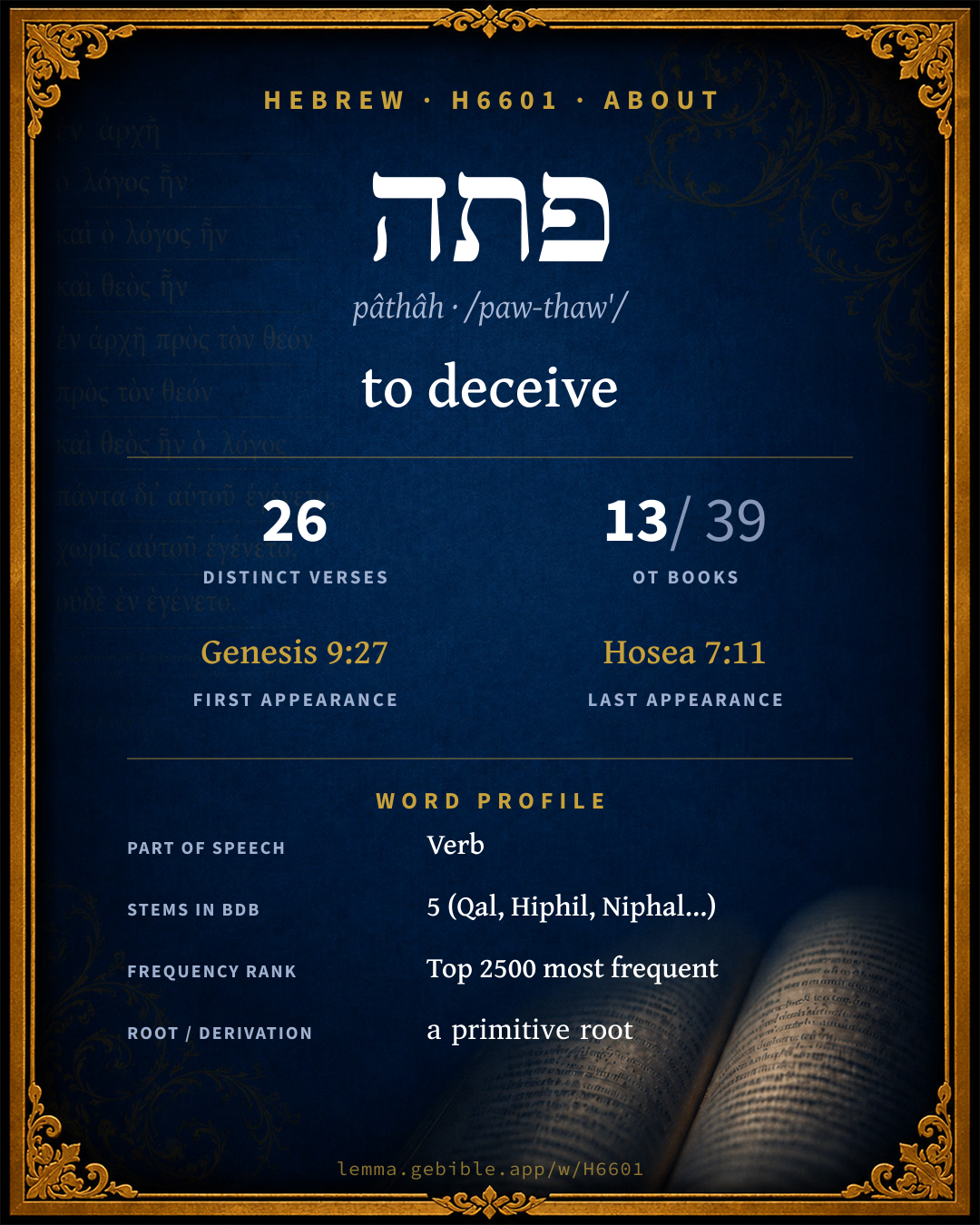
פָּתָה
to deceive
‘to deceive’ is one of 2 main senses fuller range ↓
Full lexicon entry — Brown-Driver-Briggs (BDB)
From Brown-Driver-Briggs (BDB)
Where this word appears
See every Qal verb in the Hebrew Bible →
Grammar key — what these labels mean
Part of speech
- Verb
- An action or state-of-being word.
Stem
- Piel
- An intensive or resultative active stem. Here: ‘persuade’
- Pual
- The passive counterpart of the Piel. Here: ‘be persuaded’
- Qal
- The basic, simple active stem — the plain form of the verb (“he wrote”). Here: ‘be open-minded(?)’
- Niphal
- Usually the simple passive or reflexive of the Qal (“he was written”).
- Hiphil
- The causative active stem (“he caused / brought about”).
Form
- Imperfect
- An incomplete, ongoing, or future action (“he will / would write”).
- Imperative
- A direct command (“write!”).
- Participle Active
- A verbal adjective expressing ongoing or characteristic action (“writing / one who writes”).
- Perfect
- A completed action or state — Hebrew marks aspect (completeness) more than strict tense (“he wrote”).
- Sequential Imperfect
- An imperfect with prefixed waw — the standard past-narrative form (waw-consecutive imperfect).
- Infinitive Construct
- A bound verbal noun, frequently with prepositions (“to write / in writing”).
- Jussive
- A third- or second-person volitional form expressing wish or command (“let him write”).
State
- Absolute
- The independent form of a noun, not bound to a following word.
- Construct
- A noun bound to a following noun in a possessive / “of” relationship (the construct chain).
Person
- 3rd Person
- The one spoken about (“he / she / it / they”).
- 2nd Person
- The one addressed (“you”).
- 1st Person
- The speaker (“I / we”).
Gender
- Masculine
- Grammatically masculine.
- Feminine
- Grammatically feminine.
- Common
- Either gender — not distinguished for this form.
Number
- Singular
- One.
- Plural
- More than one (in Hebrew, generally three or more).
1 verse where H6601 appears in the Niphal stem in the Book of Job. Filtered view — show all forms. Click any verse to open its interlinear word-by-word view. Verse text shown in the World English Bible for context — . Each verse’s Hebrew form is shown with its reference; the English is not keyword-highlighted, since the data carries no word-level English alignment. Use “Compare translations” on any verse to read it across multiple English versions. This concordance covers the Hebrew Bible; Septuagint (Greek Old Testament) occurrences are not indexed here.
Job
About this entry
At a glance — auto-summarized from this page’s data, not written by a person. Every figure links to its source below. This summary describes the numbers; it doesn’t interpret them.
פתה — transliterated pâthâh — is a Hebrew verb carrying the sense “to deceive.” Across 5 stems, its meaning turns on the binyan (Qal, Hiphil). With 26 verses in 13 books, it is a moderately common word in the Hebrew Bible. It first appears in Genesis 9:27. From the same root come פתי, פתי and יפת. See the sense tree, 26-verse concordance, and the renderings breakdown below.
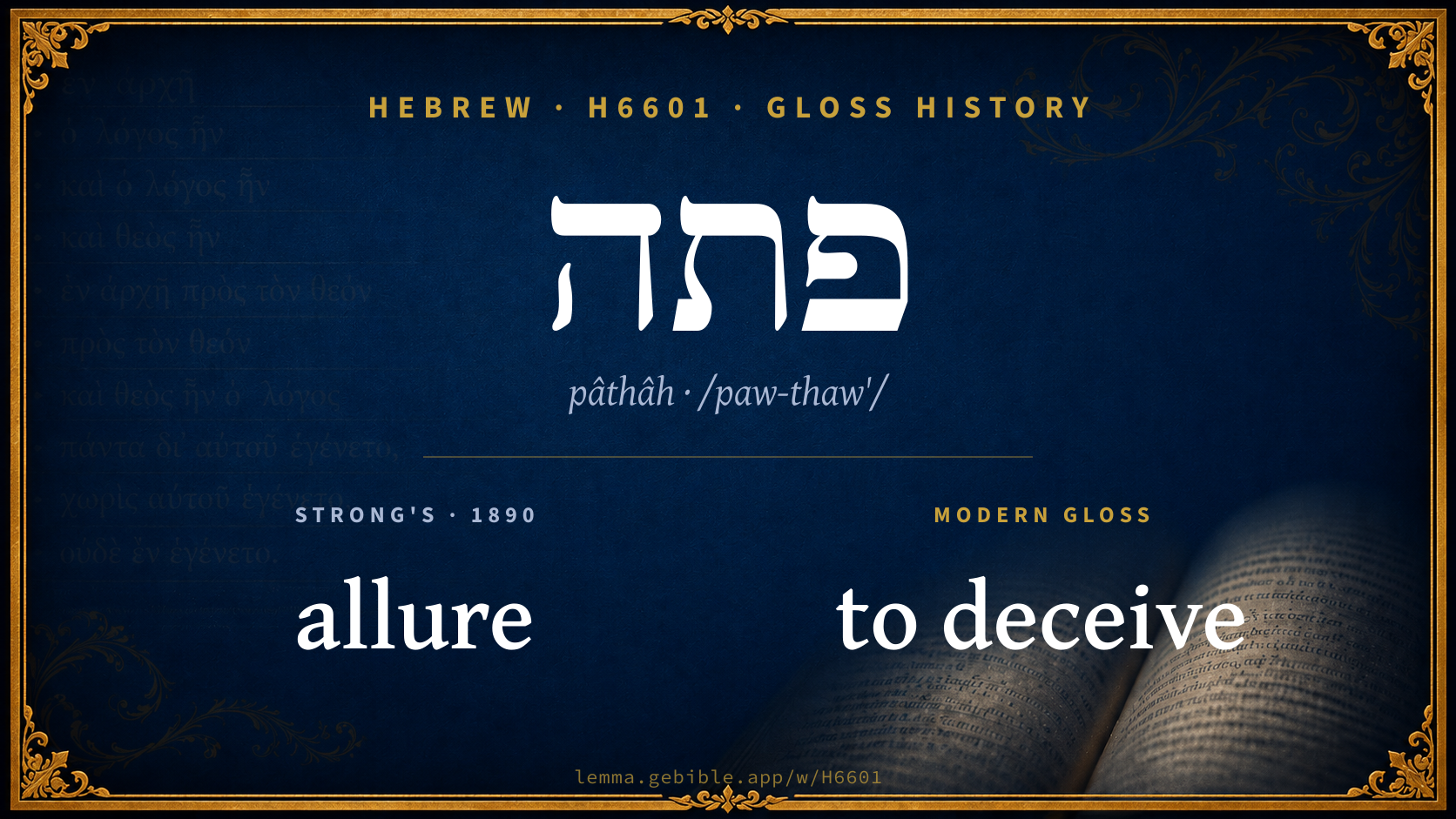
Gloss history
Strong's 1890 vs modern scholarship
About this word
Strong's H6601 catalogs a Hebrew word from the Hebrew Old Testament.
These counts are not copied from any lexicon or concordance. They are computed here, from the morphology-tagged Hebrew Old Testament. What Lemma adds →
- 26
- distinct verses
- The word appears in 26 distinct verses.
- 13 / 39
- OT books
- The word appears in 13 of 39 Old Testament books.
- #1,190
- by frequency
- Top 2500 most frequent Hebrew words (rank 1,190 of 8,640 Hebrew words by occurrence).
View all 26 occurrences in the concordance →
Most concentrated in
- Proverbs 5 verses 19%
- 1 Kings 3 verses 12%
- 2 Chronicles 3 verses 12%
By section of the Old Testament
By traditional corpus
Conventional, traditional groupings — biblical authorship is debated, so this is a traditional corpus grouping, not an authorship claim. Each share is this word’s portion of its verses in that division of the Hebrew canon. Each figure is a share of the word’s 26 distinct verses.
- Writings (Ketuvim) 12 verses · 46%
- Prophets (Nevi'im) 11 verses · 42%
- Torah (Pentateuch) 3 verses · 12%
How translations render this word
Counts come from each version’s own published word-to-Strong’s tagging or interlinear alignment — an approximate guide to how each version renders this word, not a word-level alignment the data otherwise carries. Because each total is that version’s own tagged count, the per-version totals vary from one another and need not match the appearance or distinct-verse counts above. These counts may also differ from a printed concordance because Lemma counts each distinctly tagged rendering and does not collapse phrase taggings into a single head-word total. This is a fixed set of word-tagged versions (KJV, ASV, BSB, ULT) and does not change with the reading translation you choose elsewhere. Each version’s license is shown beside its name below (and on Sources).
BDB lists this Strong’s number as 2 distinct words (homographs). Each count above pools all of them and is not split by sense — see the Senses section below. A low-frequency rendering may belong to a different one of those words, not the primary meaning.
- King James Version†: Entice 4×, Deceive 2×
- American Standard Version†: Entice 3×, Deceive 2×, Shall entice 2×
- Berean Standard Bible†: Enticed 3×, Entice 2×, Will entice 2×
- unfoldingWord Literal Text†: And 2×, Entice 2×, Will deceive 2×
King James Version Public Domain
Renders H6601 across 28† tagged occurrences — most commonly:
Plus 22 renderings that appear only once — usually multi-word phrases or single function words the recovered tagging swept in, not distinct renderings.
American Standard Version Public Domain
Renders H6601 across 28† tagged occurrences — most commonly:
Plus 19 renderings that appear only once — usually multi-word phrases or single function words the recovered tagging swept in, not distinct renderings.
Berean Standard Bible Public Domain
Renders H6601 across 28† tagged occurrences — most commonly:
Plus 19 renderings that appear only once — usually multi-word phrases or single function words the recovered tagging swept in, not distinct renderings.
unfoldingWord Literal Text CC BY-SA 4.0
Renders H6601 across 33† tagged occurrences — most commonly:
Plus 27 renderings that appear only once — usually multi-word phrases or single function words the recovered tagging swept in, not distinct renderings.
12 senses and sub-senses in the full BDB
Hebrew verbs can shift meaning by stem (binyan): Qal is the basic action, Niphal is often passive or reflexive, Piel often intensifies or makes it factitive, and Hiphil is typically causative. The senses below are grouped under the stem BDB assigns to each. This entry also uses Pual (the passive of Piel).
What do BDB’s symbols mean?
BDB uses these scholarly abbreviations:
| Symbol | Meaning |
|---|---|
| 𝔊 | the Septuagint (the ancient Greek translation, LXX) |
| 𝔙 | the Vulgate (the Latin translation) |
| 𝔖 | the Syriac version (the Peshitta) |
| 𝔗 | the Targum (the Aramaic translation) |
| ψ | the Psalms |
| √ | root (the underlying root or stem) |
| ‖ | parallel passage (a synonymous or contrasted parallel) |
| † | the dagger: every passage where the word occurs is cited |
The 12 senses and sub-senses the full Brown-Driver-Briggs lexicon distinguishes for this word, in lexicon order (not ranked by frequency), with BDB’s own verbatim wording and sub-sense lettering. Shown in Hebrew script with BDB’s own scholarly abbreviations. The condensed entry is in the Lexicon Entry tab. See also the Forms in the corpus table below.
פתה I be spacious, wide, open (Aramaic פְּתָא be spacious, ܦܬܳܐ be spacious, abundant
Qal
- Pt. פֹּתֶה Pr 20:19 poss. one open as to lips, but v. פָּתָה denom. infr. e.g. Proverbs 20:19
Hiphil
- Impf. 3 ms. juss. יַפְתְּ א׳ לְיֶפֶת Gn 9:27 may God make wide for Japhet (give him an extensive inheritance).—Pf. poss. Pr 24:28 (reading וְהִפְתִּיתָ בִּשְׂפָתֶ֑יךָ; make wide with (open wide) thy lips, for MT וַהֲפִתִּיתָ בִּשׂ׳, so SS; but cf. פָּתָה denom. Pi.). e.g. Genesis 9:27
פתה II denom. be simple (NH Pi. entice)
Qal
- Impf. 3 ms. יִפְתֶּה Dt 11:16; וַיִּפְתְּ Jb 31:27; Pt. פֹּתֶה Jb 5:2 Pr 20:19; f. פּוֹתֶה Ho 7:11;— e.g. Deuteronomy 11:16
- 1. be open-minded(?), simple Jb 5:2; יוֹנָה פוֹתָה Ho 7:11 silly dove; פֹּתֶה שְׂפָתָיו Pr 20:19 one foolish as to his lips (most, openeth wide his lips). e.g. Job 5:2
- 2. be enticed deceived Dt 11:16 Jb 31:27. e.g. Deuteronomy 11:16
Niphal
- Pf. 3 ms. נִפְתָּה Jb 31:9; Impf. 1 s. וָאֶפָּת Je 20:7;—be deceived Je 20:7; c. עַל enticed unto Jb 31:9. e.g. Job 31:9
Piel
- Pf. 2 ms. פִּתִּיתָ Pr 24:28; sf. פִּתִּיתַנִי Je 20:7; 1 s. פִּתֵּיתִי Ez 14:9; Impf. 3 ms. יְפַתֶּה Ex 22:15 +, etc.; Imv. פַּתִּי Ju 14:15; 16:5; Inf. cstr. sf. פַּתֹּתְךָ 2 S 3:25; Pt. sf. מְפַתֶּיהָ (Ges§ 93 ss) Ho 2:15;— e.g. Proverbs 24:28
- 1. persuade, woman Ho 2:16 (fig., י׳ subj.), seduce, virgin Ex 22:15; entice, husband Ju 14:15; 16:5; a man to sin Pr 1:10; 16:29. e.g. Hosea 2:16
- 2. deceive, 2 S 3:25 Pr 24:28 (yet cf. √ Hiph. supr.); subj. י׳, obj. proph., Je 20:7; Ez 14:9, cf. 1 K 22:20, 21, 22 = 2 Ch 18:19, 20, 21; obj. י׳, ψ 78:36. e.g. 2 Samuel 3:25
Pual
- Impf. 3 ms. יְפֻתֶּה:
- 1. be persuaded, Pr 25:15. e.g. Proverbs 25:15
- 2. be deceived, 20:7, 10 be beguiled by י׳, Ez 14:9. e.g. Jeremiah 20:7
Senses from the full Brown-Driver-Briggs lexicon (Brown, Driver, Briggs; Oxford 1906 — public domain), digitized via Sefaria, supplemented by the OpenScriptures HebrewLexicon (CC BY 4.0). Full attribution on Sources.
Word origin
I. vb. be spacious, wide, open (Aramaic פְּתָא be spacious, ܦܬܳܐ be spacious, abundant; cf. Arabic فَتُوَ, فَتِىَ, be youthful, in prime of life, فَتًى young man, one in prime of life (development of various meanings from √ not wholly clear, cf. NöZMG xi (1886). 735));—
II. vb. denom. be simple (NH Pi. entice);—
— Brown-Driver-Briggs (Oxford 1906, public domain), digitized via Sefaria, supplemented by the OpenScriptures HebrewLexicon (CC BY 4.0). See Sources.
Origin: a primitive root
Jastrow Dictionary
A second Hebrew/Aramaic lexicon for comparison, covering Aramaic and post-biblical (Talmudic, Targumic, Midrashic) usage that the biblical-Hebrew BDB does not. Matched by lemma rather than by Strong’s number, so a lemma may carry more than one Jastrow headword (shown separately below), and the entries cover usage well beyond the Bible.
פָּתָה
- , v. פתי
פתי
- 1. [to be open, wide,] to be accessible to influences, be compliant. Ex. R. s. 21 (ref. to Hos. VII, 11) אצלי הם כיונה פוֹתָה וכ׳ towards me they are like a tame dove, whatever I decree over them, they do and obey, but towards the nations of the world they are intractable like wild beasts. e.g. Hosea 7:11
- 2. to open; trnsf. to influence, persuade, entice. Snh. 38ᵃ (play on מי פתי Prov. IX, 16) מי פְּתָאוֹ לזה וכ׳ who persuaded this man (Adam)? A woman spoke to him; (differ. in Yalk. Prov. 943).—[Num. R. s. 7 ופותין, read: ופוֹתְתִין, v. פָּתַת.] e.g. Proverbs 9:16
- [to open the heart of,] to persuade;
- 1. (in a good sense) to win, conquer. Lev. R. s. 29 (ref. to Ps. LXXXIX, 16) שהם מכירין לפַתּוֹת וכ׳ they know how to win the favor of their Creator &c.; (Midr. Till. to Ps. 81 לרצות); Yalk. Ps. 840; Pesik. Baḥod., p. 152ᵃ. Y. Kidd. III, 64ᶜ top מְפַתִּים אותו … וכופין וכ׳ they (the court) persuade him to give her a letter of divorce, but they force him to &c.; a. fr.—Gen. R. s. 71 פיתיתי, v. infra. e.g. Psalms 89:16
- 2. to gratify; to mislead by gratifying; to deceive. Lev. R. s. 6, beg. (ref. to יהפתית, Prov. XXIV, 28) מאחר שפִּתִּיתֶם אותו בסיני וכ׳ after you gratified him at Sinai, saying (Ex. XXIV, 7) &c. Ib. מאחר שפִּתִּיתָ בשפתיך וכ׳ after thou hast gratified with thy lips (promised to appear as witness) and caused him to go to law; a. e.—Deut. R. s. 7 (play on ובמ̇ופ̇ת̇ים, Deut. IV, 34) היו המכות מְ֗פַ֗תּ֗וֹת אותם וכ׳ the plagues (by coming at intervals) deceived them (made the Egyptians believe every time that they were relieved forever); Midr. Till, to Ps. LXXVIII, 43 מפיתית בהן ed. Bub. (oth. ed. שפותות בהן; corr. acc.). e.g. Proverbs 24:28
- 3. to entice. Y. Snh. X, 28ᵈ the strong Moabite wine שהוא מְפַתֶּה הגנף לזנות which opens the body to lust; Num. R. s. 10, a. e., v. פְּתוּגְתָּא; a. fr.—Esp. to seduce. Keth. III, 9 (41ᵃ) האומר פִּיתֵּיתִי את וכ׳ if one declares, I have seduced that man’s daughter. Ib. 4 המְפַתֶּה נותן the seducer pays three fines, opp. to אונס; a. fr.—Y. Keth. III, 27ᵇ שהפיתתו, read: שהיא פִיתְּתוֹ when she seduced him.
- to be persuaded; to be seduced. Gen. R. s. 71; Yalk. ib. 127 פּוּתֵּיתִי (not פית׳), v. יָסַת.—Part. f. מְפוּתָּה a seduced woman. Keth. 39ᵇ; a. fr.
- 1. to be widened. Yalk. Is. 302 אף היא מִתְפַּתָּה … ומרחבת וכ׳ it (Gehenna), too, grows every day wider and broader and deeper (with ref. to תפתה, Is. XXX, 33). e.g. Isaiah 30:33
- 2. to be persuaded; to be enticed. Gen. R. s. 17 מפני מה האיש נוח להִתְפַּתּוֹת וכ׳ why is man easily appeased and woman is not?; v. פִּיּוּס.—Num. R. l. c. ע"י היין נִתְפַּתּוּ וזנו through wine they were enticed and they committed whoredom. Erub. 19ᵃ (play on תפתה, v. supra) כל המִתְפַּתֶּה ביצרו יפול שם whosoever is carried away by his evil desire falls into it (Gehenna). Yalk. Is. l. c.—Keth. IV, 1 נערה שנִתְפַּתְּתָה וכ׳ if a young girl has been seduced (v. נַעֲרָה); a. fr.
- 3. to insinuate one’s self, to make one’s self popular. Esth. R. introd. (play on אפ̇ת̇ם, Ezra IV, 13) אפי׳ דברים שהמלכות מִתְפַּתָּה בהם וכ׳ even with those things by which the (Roman) government makes itself popular, as theatres and circuses, it does harm. e.g. Ezra 4:13
A Dictionary of the Targumim, the Talmud Babli and Yerushalmi, and the Midrashic Literature (Marcus Jastrow; London, Luzac, 1903) — Public Domain. Digitized via Sefaria. Digitized via Sefaria. Full attribution on Sources.
Forms in the corpus
The 22 distinct written forms H6601 takes in the Hebrew Bible, most frequent first — each parse links to that stem’s occurrences in the concordance. Hebrew forms include their vowel points and cantillation, so a single lemma takes many written forms.
Same root — word family
Other BDB entries built from the same root as H6601, grouped by Strong’s listed origin. These share a root / origin per the lexicon — not necessarily a shared meaning. Each links to that word’s own entry.
Derived from this word
Proper names from this root
People and places named from this root — a name, not an additional meaning of the word.
Compare all same-root words → Showing 4 of 5 — not the complete family. 2 of the same-root words are proper names (people or places). They share a root, not necessarily a meaning.
Septuagint verse parallels
This word appears in 25 verses that also exist in the Greek Old Testament (Septuagint), out of the 26 Hebrew verses it occurs in. You can read those verses in Greek by switching the Old Testament edition to the Septuagint.
Read these verses in the Septuagint
- Genesis 9:27
- Exodus 22:16
- Deuteronomy 11:16
- Judges 14:15
- 2 Samuel 3:25
- 1 Kings 22:20
- 2 Chronicles 18:19
- Job 5:2
- Proverbs 1:10
- Jeremiah 20:7
- Ezekiel 14:9
- Hosea 2:14
This is a verse-level parallel only — the same verses exist in both the Hebrew and Greek Old Testaments. No word-level Hebrew↔Greek correspondence is claimed: the data carries no such alignment, so no Greek word is shown as this Hebrew word’s translation. Coverage is not total — the Septuagint omits the deuterocanon and renumbers the Psalms, so some Hebrew verses have no direct Greek parallel.