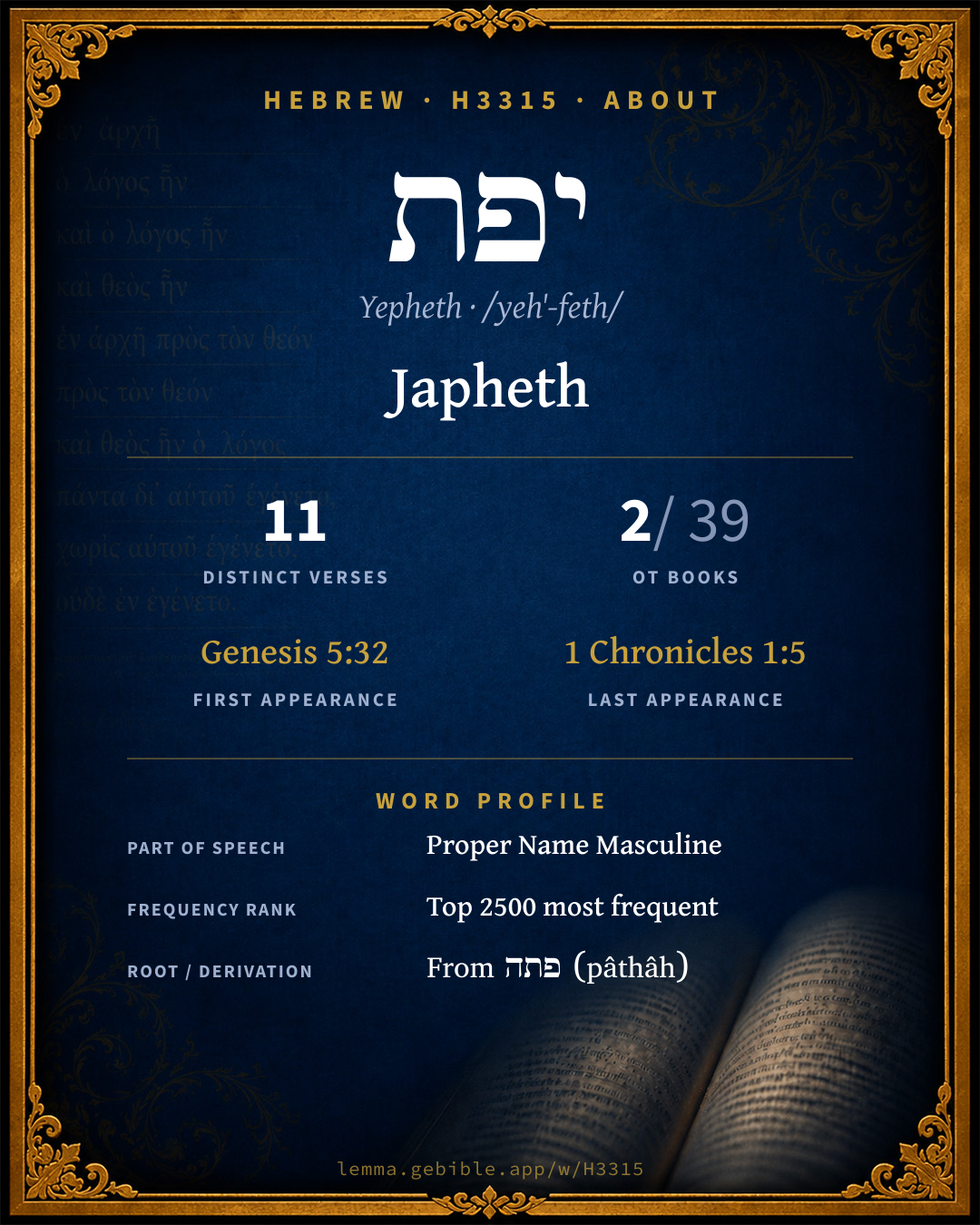
יֶ֫פֶת
Japheth
BDB lists 2 entries for ‘Japheth’ fuller range ↓
Full lexicon entry — Brown-Driver-Briggs (BDB)
From Brown-Driver-Briggs (BDB)
Where this word appears
Grammar key — what these labels mean
Part of speech
- Noun
- A naming word — a person, place, thing, or idea.
Noun type
- Proper
- A name of a specific person, place, or people (e.g. Abraham, Zion, Israel).
Every verse where H3315 appears — 11 distinct verses across 2 books. Click any verse to open its interlinear word-by-word view. Verse text shown in the World English Bible for context — . Each verse’s Hebrew form is shown with its reference; the English is not keyword-highlighted, since the data carries no word-level English alignment. Use “Compare translations” on any verse to read it across multiple English versions. This concordance covers the Hebrew Bible; Septuagint (Greek Old Testament) occurrences are not indexed here.
Genesis 9 verses
- Genesis 5:32 יָֽפֶת n Proper Noah was five hundred years old, and Noah became the father of Shem, Ham, and Japheth.
- Genesis 6:10 יָֽפֶת n Proper Noah became the father of three sons: Shem, Ham, and Japheth.
- Genesis 7:13 וָ/יֶ֖פֶת conj + n Proper In the same day Noah, and Shem, Ham, and Japheth, the sons of Noah, and Noah's wife, and the three wives of his sons with them, entered into the ark;
- Genesis 9:18 וָ/יָ֑פֶת conj + n Proper The sons of Noah who went forth from the ark were Shem, Ham, and Japheth. Ham is the father of Canaan.
- Genesis 9:23 וָ/יֶ֜פֶת conj + n Proper Shem and Japheth took a garment, and laid it on both their shoulders, went in backwards, and covered the nakedness of their father. Their faces were backwards, and they didn't see their father's nakedness.
- Genesis 9:27 לְ/יֶ֔פֶת prep + n Proper God enlarge Japheth, Let him dwell in the tents of Shem; Let Canaan be his servant."
- Genesis 10:1 וָ/יָ֑פֶת conj + n Proper Now this is the history of the generations of the sons of Noah and of Shem, Ham, and Japheth. Sons were born to them after the flood.
- Genesis 10:2 יֶ֔פֶת n Proper The sons of Japheth: Gomer, Magog, Madai, Javan, Tubal, Meshech, and Tiras.
- Genesis 10:21 יֶ֥פֶת n Proper To Shem, the father of all the children of Eber, the elder brother of Japheth, to him also were children born.
1 Chronicles 2 verses
About this entry
At a glance — auto-summarized from this page’s data, not written by a person. Every figure links to its source below. This summary describes the numbers; it doesn’t interpret them.
At its core, יפת (Yepheth) means “Japheth.” The word gravitates to Genesis (82%), then 1 Chronicles. It turns up in 11 verses across 2 books, an uncommon footprint. Scripture first uses it in Genesis 5:32. See 11-verse concordance and the renderings breakdown below.
Gloss history
Strong's 1890 vs modern scholarship
About this word
Strong's H3315 catalogs a Hebrew word from the Hebrew Old Testament.
These counts are not copied from any lexicon or concordance. They are computed here, from the morphology-tagged Hebrew Old Testament. What Lemma adds →
- 11
- distinct verses
- The word appears in 11 distinct verses.
- 2 / 39
- OT books
- The word appears in 2 of 39 Old Testament books.
- #2,210
- by frequency
- Top 2500 most frequent Hebrew words (rank 2,210 of 8,640 Hebrew words by occurrence).
View all 11 occurrences in the concordance →
Most concentrated in
- Genesis 9 verses 82%
- 1 Chronicles 2 verses 18%
By section of the Old Testament
By traditional corpus
Conventional, traditional groupings — biblical authorship is debated, so this is a traditional corpus grouping, not an authorship claim. Each share is this word’s portion of its verses in that division of the Hebrew canon. Each figure is a share of the word’s 11 distinct verses.
- Torah (Pentateuch) 9 verses · 82%
- Writings (Ketuvim) 2 verses · 18%
How translations render this word
Counts come from each version’s own published word-to-Strong’s tagging or interlinear alignment — an approximate guide to how each version renders this word, not a word-level alignment the data otherwise carries. Because each total is that version’s own tagged count, the per-version totals vary from one another and need not match the appearance or distinct-verse counts above. These counts may also differ from a printed concordance because Lemma counts each distinctly tagged rendering and does not collapse phrase taggings into a single head-word total. This is a fixed set of word-tagged versions (KJV, ASV, BSB, ULT) and does not change with the reading translation you choose elsewhere. Each version’s license is shown beside its name below (and on Sources).
BDB lists this Strong’s number as 2 distinct words (homographs). Each count above pools all of them and is not split by sense — see the Senses section below. A low-frequency rendering may belong to a different one of those words, not the primary meaning.
- King James Version†: Japheth 11×
- American Standard Version†: Japheth 11×
- Berean Standard Bible†: Japheth 11×
- unfoldingWord Literal Text†: Japheth 11×
King James Version Public Domain
Renders H3315 across 11† tagged occurrences — most commonly:
American Standard Version Public Domain
Renders H3315 across 11† tagged occurrences — most commonly:
Berean Standard Bible Public Domain
Renders H3315 across 11† tagged occurrences — most commonly:
unfoldingWord Literal Text CC BY-SA 4.0
Renders H3315 across 12† tagged occurrences — most commonly:
Plus 1 rendering that appears only once — usually multi-word phrases or single function words the recovered tagging swept in, not distinct renderings.
Senses in BDB
The 2 senses BDB distinguishes for this word, in lexicon order (not ranked by frequency or importance). The full entry — with sub-senses — is in the Lexicon Entry tab.
- Japheth = "opened"
- the 3rd son of Noah whose descendants after the flood settled on the coastal lands of the Mediterranean spreading north…
Word origin
n.pr.m. third son of Noah, Ιαφεθ;—יַפְתְּ א׳ לְיֶפֶת ׃יֶפֶת Gn 9:27 (J), 7:13; 10:2 (P) = 1 Ch 1:4; Gn 9:23; 10:21 (J); יָפֶ֑ת 9:18 (J), 5:32; 6:10; 10:1 (P), 1 Ch 1:5.
— Brown-Driver-Briggs (Oxford 1906, public domain), digitized via Sefaria, supplemented by the OpenScriptures HebrewLexicon (CC BY 4.0). See Sources.
Derived from פתה (pâthâh) (H6601) — to deceive.
Jastrow Dictionary
A second Hebrew/Aramaic lexicon for comparison, covering Aramaic and post-biblical (Talmudic, Targumic, Midrashic) usage that the biblical-Hebrew BDB does not. Matched by lemma rather than by Strong’s number, so a lemma may carry more than one Jastrow headword (shown separately below), and the entries cover usage well beyond the Bible.
יֶפֶת
- (b. h.) pr. n. m. Japheth, one of the sons of Noah, progenitor of the Aryan races (Greeks, Persians &c.). Gen. R. s. 36 (ref. to Gen. IX, 27) זה כורש that is Cyrus (the Persians). Ib. יהיו … בלשונו של י׳ the words of the Law shall be recited in the language of J. (Greek). Pesik. R. s. 35 כורש … שהוא מזרעו של י׳ Cyrus … who is a descendant of J. Meg. 9ᵇ, v. יָפְיוּת; a. fr. e.g. Genesis 9:27
A Dictionary of the Targumim, the Talmud Babli and Yerushalmi, and the Midrashic Literature (Marcus Jastrow; London, Luzac, 1903) — Public Domain. Digitized via Sefaria. Digitized via Sefaria. Full attribution on Sources.
Forms in the corpus
The 8 distinct written forms H3315 takes in the Hebrew Bible, most frequent first — each parse links to that state’s occurrences in the concordance. Hebrew forms include their vowel points and cantillation, so a single lemma takes many written forms.
| Form | Parsing | Example | Uses |
|---|---|---|---|
| וָ/יָ֑פֶת | Noun, Proper | Genesis 9:18 | 2 |
| יֶ֔פֶת | Noun, Proper | Genesis 10:2 | 2 |
| יָֽפֶת | Noun, Proper | Genesis 5:32 | 2 |
| וָ/יֶ֖פֶת | Noun, Proper | Genesis 7:13 | 1 |
| וָ/יֶ֜פֶת | Noun, Proper | Genesis 9:23 | 1 |
| וָ/יָֽפֶת | Noun, Proper | 1 Chronicles 1:4 | 1 |
| יֶ֥פֶת | Noun, Proper | Genesis 10:21 | 1 |
| לְ/יֶ֔פֶת | Noun, Proper | Genesis 9:27 | 1 |
Same root — word family
Other BDB entries built from the same root as H3315, grouped by Strong’s listed origin. These share a root / origin per the lexicon — not necessarily a shared meaning. Each links to that word’s own entry.
Derives from
Shares the same root
Proper names from this root
People and places named from this root — a name, not an additional meaning of the word.
Compare all same-root words → Showing 4 of 5 — not the complete family. 1 of the same-root words is a proper name (a person or place). They share a root, not necessarily a meaning.
Bible dictionary
Public-domain dictionary articles matched to this entry by name (Japheth). A biblical name can be shared by more than one person or place, so an article may treat several.
Easton's Bible Dictionary · M. G. Easton, 1897
Wide spreading: "God shall enlarge Japheth" (Heb. Yaphat Elohim le-Yephet, Gen. 9:27. Some, however, derive the name from yaphah, "to be beautiful;" hence white), one of the sons of Noah, mentioned last in order (Gen. 5:32; 6:10; 7:13), perhaps first by birth (10:21; comp. 9:24). He and his wife were two of the eight saved in the ark (1 Pet. 3:20). He was the progenitor of many tribes inhabiting the east of Europe and the north of Asia (Gen. 10:2-5). An act of filial piety (9:20-27) was the occasion of Noah's prophecy of the extension of his posterity.
After the Flood the earth was re-peopled by the descendants of Noah, "the sons of Japheth" (Gen. 10:2), "the sons of Ham" (6), and "the sons of Shem" (22). It is important to notice that modern ethnological science, reasoning from a careful analysis of facts, has arrived at the conclusion that there is a three-fold division of the human family, corresponding in a remarkable way with the great ethnological chapter of the book of Genesis (10). The three great races thus distinguished are called the Semitic, Aryan, and Turanian (Allophylian). "Setting aside the cases where the ethnic names employed are of doubtful application, it cannot reasonably be questioned that the author [of Gen. 10] has in his account of the sons of Japheth classed together the Cymry or Celts (Gomer), the Medes (Madai), and the Ionians or Greeks (Javan), thereby anticipating what has become known in modern times as the Indo-European Theory,' or the essential unity of the Aryan (Asiatic) race with the principal races of Europe, indicated by the Celts and the Ionians. Nor can it be doubted that he has thrown together under the one head of 'children of Shem' the Assyrians (Asshur), the Syrians (Aram), the Hebrews (Eber), and the Joktanian Arabs (Joktan), four of the principal races which modern ethnology recognizes under the heading of Semitic.' Again, under the heading of sons of Ham,' the author has arranged Cush', i.e., the Ethiopians; Mizraim,' the people of Egypt; Sheba and Dedan,' or certain of the Southern Arabs; and Nimrod,' or the ancient people of Babylon, four races between which the latest linguistic researches have established a close affinity" (Rawlinson's Hist. Illustrations).
Smith's Bible Dictionary · William Smith, 1863
(enlargement), one of the three sons of Noah. The descendants of Japheth occupied the "isles of the Gentiles," (Genesis 10:5)--i.e. the coast lands of the Mediterranean Sea in Europe and Asia Minor-- whence they spread northward over the whole continent of Europe and a considerable portion of Asia.
Classic public-domain reference works; full attribution on Sources.
Septuagint verse parallels
This word appears in 11 verses that also exist in the Greek Old Testament (Septuagint), out of the 11 Hebrew verses it occurs in. You can read those verses in Greek by switching the Old Testament edition to the Septuagint.
Read these verses in the Septuagint
This is a verse-level parallel only — the same verses exist in both the Hebrew and Greek Old Testaments. No word-level Hebrew↔Greek correspondence is claimed: the data carries no such alignment, so no Greek word is shown as this Hebrew word’s translation. Coverage is not total — the Septuagint omits the deuterocanon and renumbers the Psalms, so some Hebrew verses have no direct Greek parallel.