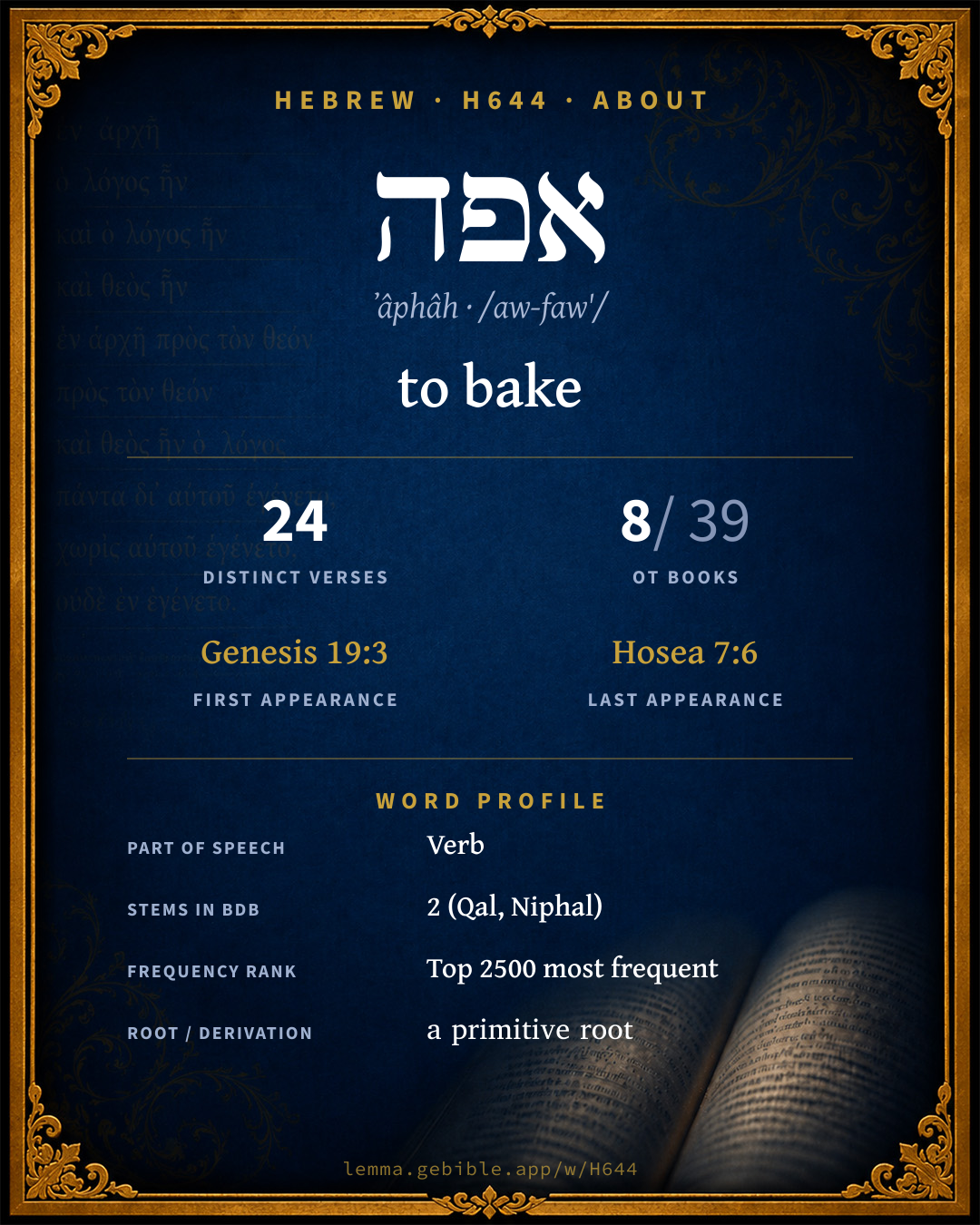
אָפָה
to bake
‘to bake’ is one of 2 main senses fuller range ↓
Full lexicon entry — Brown-Driver-Briggs (BDB)
From Brown-Driver-Briggs (BDB)
Where this word appears
See every Qal verb in the Hebrew Bible →
Grammar key — what these labels mean
Part of speech
- Verb
- An action or state-of-being word.
Stem
- Qal
- The basic, simple active stem — the plain form of the verb (“he wrote”).
- Niphal
- Usually the simple passive or reflexive of the Qal (“he was written”).
Form
- Participle Active
- A verbal adjective expressing ongoing or characteristic action (“writing / one who writes”).
- Imperfect
- An incomplete, ongoing, or future action (“he will / would write”).
- Sequential Perfect
- A perfect with prefixed waw continuing a preceding imperfect or command (waw-consecutive perfect).
- Sequential Imperfect
- An imperfect with prefixed waw — the standard past-narrative form (waw-consecutive imperfect).
- Perfect
- A completed action or state — Hebrew marks aspect (completeness) more than strict tense (“he wrote”).
- Imperative
- A direct command (“write!”).
State
- Absolute
- The independent form of a noun, not bound to a following word.
- Construct
- A noun bound to a following noun in a possessive / “of” relationship (the construct chain).
Person
- 3rd Person
- The one spoken about (“he / she / it / they”).
- 2nd Person
- The one addressed (“you”).
- 1st Person
- The speaker (“I / we”).
Gender
- Masculine
- Grammatically masculine.
- Feminine
- Grammatically feminine.
- Common
- Either gender — not distinguished for this form.
Number
- Plural
- More than one (in Hebrew, generally three or more).
- Singular
- One.
Grammatical forms 16 distinct
- Verb, Qal, Participle Active, Masculine, Plural, Absolute 6 times (24%)
- Verb, Qal, Participle Active, Masculine, Singular, Absolute 4 times (16%)
- Verb, Niphal, Imperfect, 3rd Person, Feminine, Singular 2 times (8%)
- Verb, Qal, Participle Active, Feminine, Plural, Absolute 1 time (4%)
- Verb, Qal, Sequential Perfect, 2nd Person, Masculine, Singular 1 time (4%)
- Verb, Qal, Sequential Perfect, 3rd Person, Common, Plural 1 time (4%)
- Verb, Qal, Sequential Perfect, 3rd Person, Masculine, Singular 1 time (4%)
- Verb, Qal, Sequential Imperfect, 3rd Person, Feminine, Singular 1 time (4%)
+8 more forms (8 occurrences)
Parsed forms decoded from the imported morphology (morphhb / Westminster Leningrad Codex — WLC text public domain, morphhb tagging CC BY 4.0), counted across 25 parsed occurrences — not distinct verses.
Every verse where H644 appears — 24 distinct verses across 8 books. Click any verse to open its interlinear word-by-word view. Verse text shown in the World English Bible for context — . Each verse’s Hebrew form is shown with its reference; the English is not keyword-highlighted, since the data carries no word-level English alignment. Use “Compare translations” on any verse to read it across multiple English versions. This concordance covers the Hebrew Bible; Septuagint (Greek Old Testament) occurrences are not indexed here.
Genesis 9 verses
- Genesis 19:3 אָפָ֖ה Qal pf 3ms He urged them greatly, and they came in with him, and entered into his house. He made them a feast, and baked unleavened bread, and they ate.
- Genesis 40:1 וְ/הָ/אֹפֶ֑ה conj + ptcl def.art + Qal ptcp.act ms It happened after these things, that the butler of the king of Egypt and his baker offended their lord, the king of Egypt.
- Genesis 40:2 הָ/אוֹפִֽים ptcl def.art + Qal ptcp.act mp Pharaoh was angry with his two officers, the chief cupbearer and the chief baker.
- Genesis 40:5 וְ/הָ/אֹפֶ֗ה conj + ptcl def.art + Qal ptcp.act ms They both dreamed a dream, each man his dream, in one night, each man according to the interpretation of his dream, the cupbearer and the baker of the king of Egypt, who were bound in the prison.
- Genesis 40:16 הָ/אֹפִ֖ים ptcl def.art + Qal ptcp.act mp When the chief baker saw that the interpretation was good, he said to Joseph, "I also was in my dream, and, behold, three baskets of white bread were on my head.
- Genesis 40:17 אֹפֶ֑ה Qal ptcp.act ms In the uppermost basket there was all kinds of baked food for Pharaoh, and the birds ate them out of the basket on my head."
- Genesis 40:20 הָ/אֹפִ֖ים ptcl def.art + Qal ptcp.act mp It happened the third day, which was Pharaoh's birthday, that he made a feast for all his servants, and he lifted up the head of the chief cupbearer and the head of the chief baker among his servants.
- Genesis 40:22 הָ/אֹפִ֖ים ptcl def.art + Qal ptcp.act mp but he hanged the chief baker, as Joseph had interpreted to them.
- Genesis 41:10 הָ/אֹפִֽים ptcl def.art + Qal ptcp.act mp Pharaoh was angry with his servants, and put me in custody in the house of the captain of the guard, me and the chief baker.
Exodus 2 verses
- Exodus 12:39 וַ/יֹּאפ֨וּ conj + Qal wimpf 3mp They baked unleavened cakes of the dough which they brought forth out of Egypt; for it wasn't leavened, because they were thrust out of Egypt, and couldn't wait, neither had they prepared for themselves any food.
- Exodus 16:23 תֹּאפ֞וּ אֵפ֗וּ Qal impf 2mp Qal impv 2mp He said to them, "This is that which Yahweh has spoken, 'Tomorrow is a solemn rest, a holy Sabbath to Yahweh. Bake that which you want to bake, and boil that which you want to boil; and all that remains over lay up for yourselves to be kept until the morning."
Leviticus 5 verses
- Leviticus 6:17 תֵאָפֶה֙ Niphal impf 3fs It shall not be baked with yeast. I have given it as their portion of my offerings made by fire. It is most holy, as the sin offering, and as the trespass offering.
- Leviticus 7:9 תֵּֽאָפֶה֙ Niphal impf 3fs Every meal offering that is baked in the oven, and all that is dressed in the frying pan, and on the baking pan, shall be the priest's who offers it.
- Leviticus 23:17 תֵּאָפֶ֑ינָה Niphal impf 3fp You shall bring out of your habitations two wave-loaves of two tenth parts of an ephah: they shall be of fine flour, they shall be baked with yeast, for first fruits to Yahweh.
- Leviticus 24:5 וְ/אָפִיתָ֣ conj + Qal wpf 2ms "You shall take fine flour, and bake twelve cakes of it: two tenth parts of an ephah shall be in one cake.
- Leviticus 26:26 וְ֠/אָפוּ conj + Qal wpf 3cp When I break your staff of bread, ten women shall bake your bread in one oven, and they shall deliver your bread again by weight: and you shall eat, and not be satisfied.
1 Samuel 2 verses
- 1 Samuel 8:13 וּ/לְ/אֹפֽוֹת conj + prep + Qal ptcp.act fp He will take your daughters to be perfumers, and to be cooks, and to be bakers.
- 1 Samuel 28:24 וַ/תֹּפֵ֖/הוּ conj + Qal wimpf 3fs + sfx pers 3ms The woman had a fattened calf in the house; and she hurried, and killed it; and she took flour, and kneaded it, and did bake unleavened bread of it:
Isaiah 2 verses
- Isaiah 44:15 וְ/אָ֣פָה conj + Qal wpf 3ms Then shall it be for a man to burn; and he takes of it, and warms himself; yes, he kindles it, and bakes bread: yes, he makes a god, and worships it; he makes it an engraved image, and falls down to it.
- Isaiah 44:19 אָפִ֤יתִי Qal pf 1cs None calls to mind, neither is there knowledge nor understanding to say, I have burned part of it in the fire; yes, also I have baked bread on the coals of it; I have roasted flesh and eaten it: and shall I make the residue of it an abomination? shall I fall down to the stock of a tree?
Jeremiah 1 verse
Ezekiel 1 verse
Hosea 2 verses
- Hosea 7:4 מֵֽ/אֹפֶ֑ה prep + Qal ptcp.act ms They are all adulterers. They are burning like an oven that the baker stops stirring, From the kneading of the dough, until it is leavened.
- Hosea 7:6 אֹֽפֵ/הֶ֔ם Qal ptcp.act ms cs + sfx pers 3mp For they have made ready their heart like an oven, While they lie in wait. Their baker sleeps all the night. In the morning it burns as a flaming fire.
About this entry
At a glance — auto-summarized from this page’s data, not written by a person. Every figure links to its source below. This summary describes the numbers; it doesn’t interpret them.
At its core, אפה (ʼâphâh) means “to bake.” Older and newer Bibles part ways — “baker” in the King James Version, “bakers” (unfoldingWord Literal Text) in modern versions. See the renderings breakdown. It turns up in 24 verses across 8 books, an uncommon footprint. The word gravitates to Genesis (38%), then Leviticus and Exodus. The verb spans 2 stems, from Qal to Niphal. Each statement above links to its evidence; the full detail follows below.
Gloss history
Strong's 1890 vs modern scholarship
About this word
Strong's H644 catalogs a Hebrew word from the Hebrew Old Testament.
These counts are not copied from any lexicon or concordance. They are computed here, from the morphology-tagged Hebrew Old Testament. What Lemma adds →
- 24
- distinct verses
- The word appears in 24 distinct verses.
- 8 / 39
- OT books
- The word appears in 8 of 39 Old Testament books.
- #1,282
- by frequency
- Top 2500 most frequent Hebrew words (rank 1,282 of 8,640 Hebrew words by occurrence).
View all 24 occurrences in the concordance →
By section of the Old Testament
By traditional corpus
Conventional, traditional groupings — biblical authorship is debated, so this is a traditional corpus grouping, not an authorship claim. Each share is this word’s portion of its verses in that division of the Hebrew canon. Each figure is a share of the word’s 24 distinct verses.
- Torah (Pentateuch) 16 verses · 67%
- Prophets (Nevi'im) 8 verses · 33%
How translations render this word
Counts come from each version’s own published word-to-Strong’s tagging or interlinear alignment — an approximate guide to how each version renders this word, not a word-level alignment the data otherwise carries. Because each total is that version’s own tagged count, the per-version totals vary from one another and need not match the appearance or distinct-verse counts above. These counts may also differ from a printed concordance because Lemma counts each distinctly tagged rendering and does not collapse phrase taggings into a single head-word total. This is a fixed set of word-tagged versions (KJV, ASV, BSB, ULT) and does not change with the reading translation you choose elsewhere. Each version’s license is shown beside its name below (and on Sources).
- King James Version: Baker 8×, Bake 2×, Did bake 2×
- American Standard Version: Baker 8×, Bake 2×, Bakers 2×
- Berean Standard Bible: Baker 8×, Baked 5×, Bake 2×
- unfoldingWord Literal Text: Bakers 6×, Baker 5×
King James Version Public Domain
Renders H644 across 24 tagged occurrences — most commonly:
Plus 12 renderings that appear only once — usually multi-word phrases or single function words the recovered tagging swept in, not distinct renderings. Not rendered by a distinct English word in 1 further occurrence.
American Standard Version Public Domain
Renders H644 across 24 tagged occurrences — most commonly:
Plus 12 renderings that appear only once — usually multi-word phrases or single function words the recovered tagging swept in, not distinct renderings.
Berean Standard Bible Public Domain
Renders H644 across 25 tagged occurrences — most commonly:
Plus 8 renderings that appear only once — usually multi-word phrases or single function words the recovered tagging swept in, not distinct renderings.
unfoldingWord Literal Text CC BY-SA 4.0
Renders H644 across 27 tagged occurrences — most commonly:
Plus 16 renderings that appear only once — usually multi-word phrases or single function words the recovered tagging swept in, not distinct renderings.
Senses in the full BDB
Hebrew verbs can shift meaning by stem (binyan): Qal is the basic action, Niphal is often passive or reflexive, Piel often intensifies or makes it factitive, and Hiphil is typically causative. The senses below are grouped under the stem BDB assigns to each.
What do BDB’s symbols mean?
BDB uses these scholarly abbreviations:
| Symbol | Meaning |
|---|---|
| 𝔊 | the Septuagint (the ancient Greek translation, LXX) |
| 𝔙 | the Vulgate (the Latin translation) |
| 𝔖 | the Syriac version (the Peshitta) |
| 𝔗 | the Targum (the Aramaic translation) |
| ψ | the Psalms |
| √ | root (the underlying root or stem) |
| ‖ | parallel passage (a synonymous or contrasted parallel) |
| † | the dagger: every passage where the word occurs is cited |
The 2 senses and sub-senses the full Brown-Driver-Briggs lexicon distinguishes for this word, in lexicon order (not ranked by frequency), with BDB’s own verbatim wording and sub-sense lettering. Shown in Hebrew script with BDB’s own scholarly abbreviations. The condensed entry is in the Lexicon Entry tab. See also the Forms in the corpus table below.
Qal
- Pf. א׳ Gn 19:3; אָפִיתִי Is 44:19; וְאָפוּ consec. Lv 26:26 etc.; Impf. 3 fs. sf. וַתֹּפֵהוּ 1 S 28:24; יֹאפוּ Ez 46:20; תֹּאפוּ Ex 16:23; Imv. אֵפוּ Ex 16:23; Pt. אֹפֶה Gn 40:1 +; אֹפֵהֶם Ho 7:6; pl. אֹפִים Gn 40:16 +; אֹפוֹת 1 S 8:13, etc.—bake, obj. לֶחֶם Lv 26:26 (H) Is 44:15, 19 (cf. Je 37:21); מַצּוֹת Gn 19:3 (J) 1 S 28:24; עֻגֹת מצות Ex 12:39 (J); חַלּוֹת Lv 24:5 (H); מִנְחָה Ez 46:20; מָן Ex 16:23(×2) (P;—c. 2nd obj. of material Ex 12:39 בָּצֵק, Lv 24:5 סֹלֶת, 1 S 28:24 קֶמַח). Pt. always as subst. baker Gn 40:1, 2, 5, 16, 17, 20, 22; 41:10 (all E) Ho 7:4, 6; Je 37:21 מִחוּץ הָא׳ out of the bakers’ street; also 1 S 8:13 (‖ טַבָּחוֹת, רַקָּחוֹת; only here fem.) Nowhere as a menial office, not even 1 S 8:13 where despotic power & growth of court emphasized. e.g. Genesis 19:3
Niphal
- Impf. 3 fs. תֵּאָפֶה Lv 6:10; 7:9; 3 fpl. תֵּאָפֶינָה Lv 23:17;—pass. of Qal be baked, baken of לֶחֶם Lv 23:17; מִנְחָה 7:9 cf. 6:10. e.g. Leviticus 6:10
Senses from the full Brown-Driver-Briggs lexicon (Brown, Driver, Briggs; Oxford 1906 — public domain), digitized via Sefaria, supplemented by the OpenScriptures HebrewLexicon (CC BY 4.0). Full attribution on Sources.
Word origin
vb. bake (Assyrian epû, ZimBP 43 Aramaic אֲפָא, ܐܶܦܳܐ )—
— Brown-Driver-Briggs (Oxford 1906, public domain), digitized via Sefaria, supplemented by the OpenScriptures HebrewLexicon (CC BY 4.0). See Sources.
Origin: a primitive root
Jastrow Dictionary
A second Hebrew/Aramaic lexicon for comparison, covering Aramaic and post-biblical (Talmudic, Targumic, Midrashic) usage that the biblical-Hebrew BDB does not. Matched by lemma rather than by Strong’s number, so a lemma may carry more than one Jastrow headword (shown separately below), and the entries cover usage well beyond the Bible.
אָפָה
- to bake, v. אפי.
אַפָּהּ
- , v. אַפָּא
אָפֵי
- Targ. Gen. XIX, 3; a. fr.—Men. 94ᵃ כיון דא׳ לה after he baked it. Sabb. 63ᵇ למֵיפָא to bake.—אָפָן, אָפְיָיתָא baking women, bakers. Targ. I Sam. VIII, 13.—Ber. 58ᵇ שתין א׳ sixty bakers.—Ib. ואפיין and they used to bake. Y. Bets. IV, 62ᶜ bot. אתת מופה (read מֵיפָה) she came in order to bake; a. fr.
- to be baked. Targ. Lev. VI, 10; a. e.
A Dictionary of the Targumim, the Talmud Babli and Yerushalmi, and the Midrashic Literature (Marcus Jastrow; London, Luzac, 1903) — Public Domain. Digitized via Sefaria. Digitized via Sefaria. Full attribution on Sources.
Forms in the corpus
The 23 distinct written forms H644 takes in the Hebrew Bible, most frequent first — each parse links to that stem’s occurrences in the concordance. Hebrew forms include their vowel points and cantillation, so a single lemma takes many written forms.
Same root — word family
Other BDB entries built from the same root as H644, grouped by Strong’s listed origin. These share a root / origin per the lexicon — not necessarily a shared meaning. Each links to that word’s own entry.
Derived from this word
Compare all same-root words → They share a root, not necessarily a meaning.
Septuagint verse parallels
This word appears in 24 verses that also exist in the Greek Old Testament (Septuagint), out of the 24 Hebrew verses it occurs in. You can read those verses in Greek by switching the Old Testament edition to the Septuagint.
Read these verses in the Septuagint
- Genesis 19:3
- Exodus 12:39
- Leviticus 6:17
- 1 Samuel 8:13
- Isaiah 44:15
- Jeremiah 37:21
- Ezekiel 46:20
- Hosea 7:4
This is a verse-level parallel only — the same verses exist in both the Hebrew and Greek Old Testaments. No word-level Hebrew↔Greek correspondence is claimed: the data carries no such alignment, so no Greek word is shown as this Hebrew word’s translation. Coverage is not total — the Septuagint omits the deuterocanon and renumbers the Psalms, so some Hebrew verses have no direct Greek parallel.