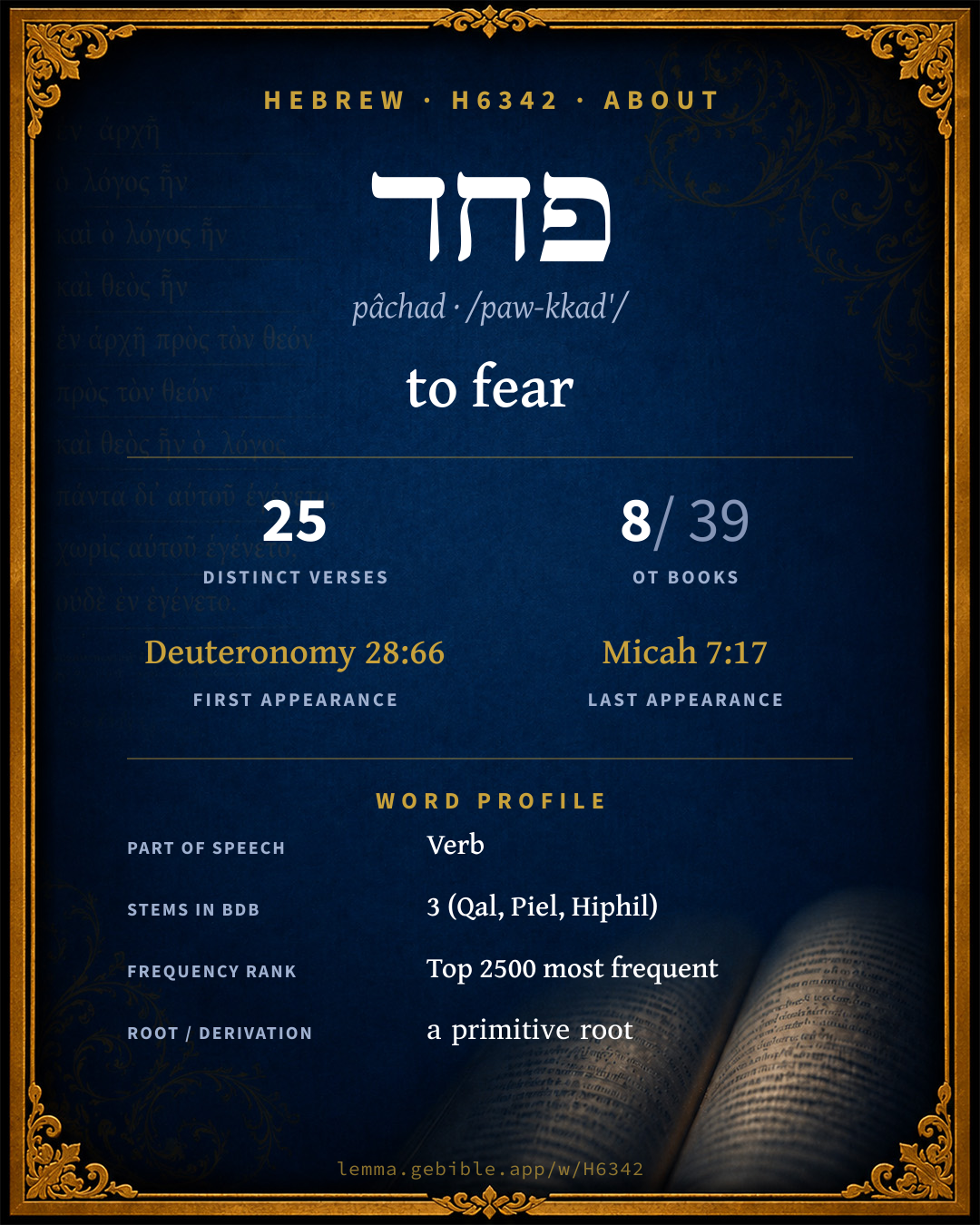
פָּחַד
to fear
also: tremble, revere, dread fuller range ↓
Full lexicon entry — Brown-Driver-Briggs (BDB)
From Brown-Driver-Briggs (BDB)
Where this word appears
See every Qal verb in the Hebrew Bible →
Grammar key — what these labels mean
Part of speech
- Verb
- An action or state-of-being word.
Stem
- Qal
- The basic, simple active stem — the plain form of the verb (“he wrote”). Here: ‘be in dread’
- Piel
- An intensive or resultative active stem. Here: ‘be in great dread’
- Hiphil
- The causative active stem (“he caused / brought about”).
Form
- Perfect
- A completed action or state — Hebrew marks aspect (completeness) more than strict tense (“he wrote”).
- Sequential Perfect
- A perfect with prefixed waw continuing a preceding imperfect or command (waw-consecutive perfect).
- Imperfect
- An incomplete, ongoing, or future action (“he will / would write”).
- Sequential Imperfect
- An imperfect with prefixed waw — the standard past-narrative form (waw-consecutive imperfect).
- Participle Active
- A verbal adjective expressing ongoing or characteristic action (“writing / one who writes”).
- Jussive
- A third- or second-person volitional form expressing wish or command (“let him write”).
State
- Absolute
- The independent form of a noun, not bound to a following word.
Person
- 3rd Person
- The one spoken about (“he / she / it / they”).
- 1st Person
- The speaker (“I / we”).
- 2nd Person
- The one addressed (“you”).
Gender
- Common
- Either gender — not distinguished for this form.
- Masculine
- Grammatically masculine.
Number
- Plural
- More than one (in Hebrew, generally three or more).
- Singular
- One.
Every verse where H6342 appears in the Book of Isaiah — 8 distinct verses. Click any verse to open its interlinear word-by-word view. Verse text shown in the World English Bible for context — . Each verse’s Hebrew form is shown with its reference; the English is not keyword-highlighted, since the data carries no word-level English alignment. Use “Compare translations” on any verse to read it across multiple English versions. This concordance covers the Hebrew Bible; Septuagint (Greek Old Testament) occurrences are not indexed here.
Isaiah
- Isaiah 12:2 אֶפְחָ֑ד Qal impf 1cs Behold, God is my salvation. I will trust, and will not be afraid; for Yah, Yahweh, is my strength and song; and he has become my salvation."
- Isaiah 19:16 וּ/פָחַ֗ד conj + Qal wpf 3ms In that day shall the Egyptians be like women; and they shall tremble and fear because of the shaking of the hand of Yahweh of Hosts, which he shakes over them.
- Isaiah 19:17 יִפְחָ֑ד Qal impf 3ms The land of Judah shall become a terror to Egypt; everyone to whom mention is made of it shall be afraid, because of the purpose of Yahweh of Hosts, which he purposes against it.
- Isaiah 33:14 פָּחֲד֤וּ Qal pf 3cp The sinners in Zion are afraid; trembling has seized the godless ones: Who among us can dwell with the devouring fire? who among us can dwell with everlasting burning?
- Isaiah 44:8 תִּפְחֲדוּ֙ Qal juss 2mp Don't fear, neither be afraid: haven't I declared to you of old, and shown it? You are my witnesses. Is there a God besides me? Indeed, there is not. I don't know any Rock.
- Isaiah 44:11 יִפְחֲד֖וּ Qal impf 3mp Behold, all his fellows shall be disappointed; and the workmen, they are of men: let them all be gathered together, let them stand up; they shall fear, they shall be put to shame together.
- Isaiah 51:13 וַ/תְּפַחֵ֨ד conj + Piel wimpf 2ms and have forgotten Yahweh your Maker, who stretched forth the heavens, and laid the foundations of the earth; and fear continually all the day because of the fury of the oppressor, when he makes ready to destroy? and where is the fury of the oppressor?
- Isaiah 60:5 וּ/פָחַ֥ד conj + Qal wpf 3ms Then you shall see and be radiant, and your heart shall thrill and be enlarged; because the abundance of the sea shall be turned to you, the wealth of the nations shall come to you.
About this entry
At a glance — auto-summarized from this page’s data, not written by a person. Every figure links to its source below. This summary describes the numbers; it doesn’t interpret them.
פחד — transliterated pâchad — is a Hebrew verb carrying the sense “to fear.” It first appears in Deuteronomy 28:66. The Hebrew Bible uses it across 25 verses — uncommon. More than a quarter of its appearances fall in Isaiah. Different stems carry different senses — BDB groups them under 3 stems, among them Qal and Piel. Each statement above links to its evidence; the full detail follows below.
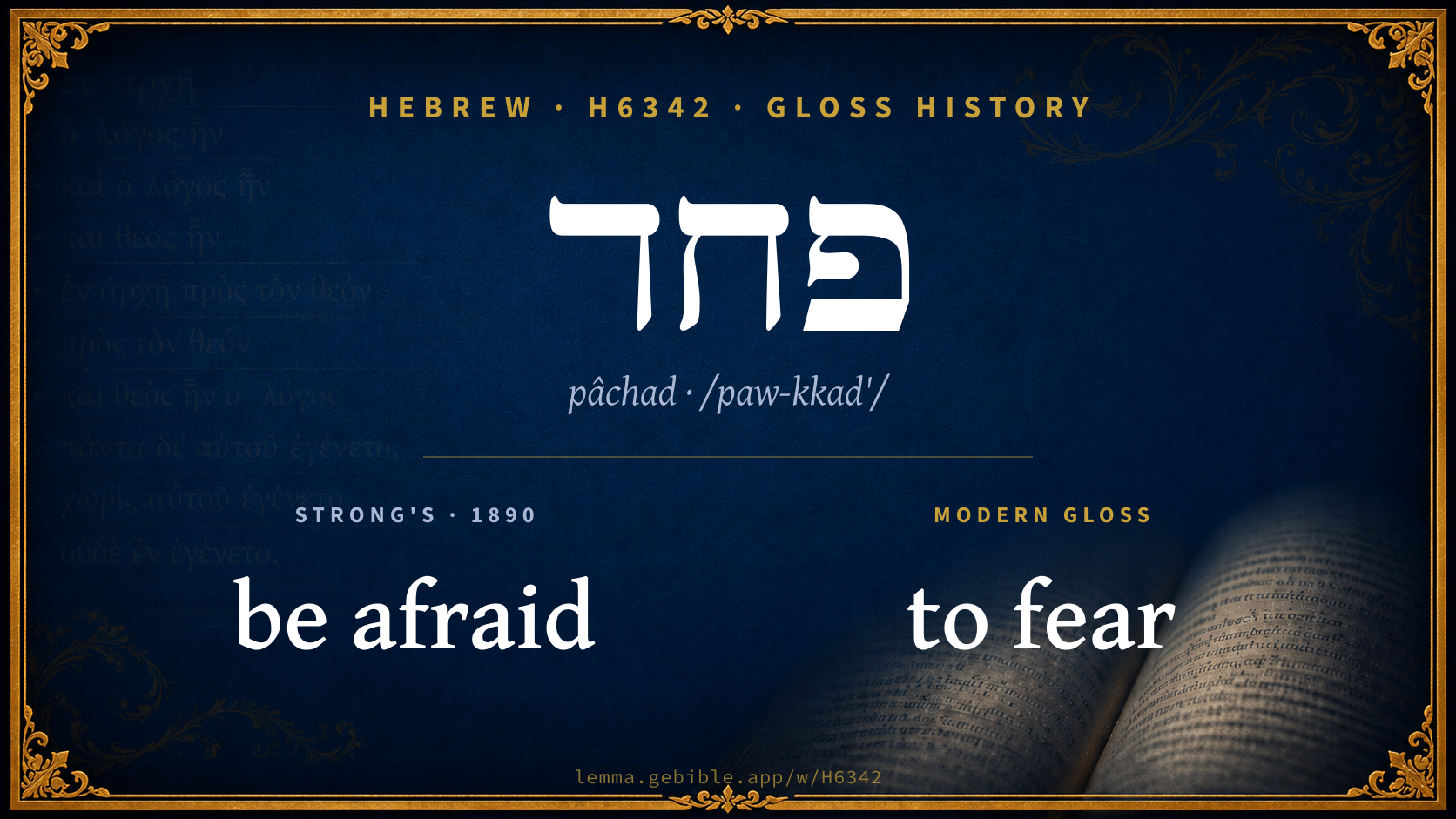
Gloss history
Strong's 1890 vs modern scholarship
About this word
Strong's H6342 catalogs a Hebrew word from the Hebrew Old Testament.
These counts are not copied from any lexicon or concordance. They are computed here, from the morphology-tagged Hebrew Old Testament. What Lemma adds →
- 25
- distinct verses
- The word appears in 25 distinct verses.
- 8 / 39
- OT books
- The word appears in 8 of 39 Old Testament books.
- #1,282
- by frequency
- Top 2500 most frequent Hebrew words (rank 1,282 of 8,640 Hebrew words by occurrence).
View all 25 occurrences in the concordance →
By section of the Old Testament
By traditional corpus
Conventional, traditional groupings — biblical authorship is debated, so this is a traditional corpus grouping, not an authorship claim. Each share is this word’s portion of its verses in that division of the Hebrew canon. Each figure is a share of the word’s 25 distinct verses.
- Prophets (Nevi'im) 13 verses · 52%
- Writings (Ketuvim) 10 verses · 40%
- Torah (Pentateuch) 2 verses · 8%
How translations render this word
Counts come from each version’s own published word-to-Strong’s tagging or interlinear alignment — an approximate guide to how each version renders this word, not a word-level alignment the data otherwise carries. Because each total is that version’s own tagged count, the per-version totals vary from one another and need not match the appearance or distinct-verse counts above. These counts may also differ from a printed concordance because Lemma counts each distinctly tagged rendering and does not collapse phrase taggings into a single head-word total. This is a fixed set of word-tagged versions (KJV, ASV, BSB, ULT) and does not change with the reading translation you choose elsewhere. Each version’s license is shown beside its name below (and on Sources).
- King James Version: Fear 4×, Shall fear 2×, They shall fear 2×
- American Standard Version: Fear 4×
- Berean Standard Bible: Fear 3×, Be afraid 2×, Overwhelmed 2×
- unfoldingWord Literal Text: Fear 4×, They feared 2×
King James Version Public Domain
Renders H6342 across 25 tagged occurrences — most commonly:
Plus 17 renderings that appear only once — usually multi-word phrases or single function words the recovered tagging swept in, not distinct renderings.
American Standard Version Public Domain
Renders H6342 across 24 tagged occurrences — most commonly:
Plus 20 renderings that appear only once — usually multi-word phrases or single function words the recovered tagging swept in, not distinct renderings.
Berean Standard Bible Public Domain
Renders H6342 across 25 tagged occurrences — most commonly:
Plus 18 renderings that appear only once — usually multi-word phrases or single function words the recovered tagging swept in, not distinct renderings.
unfoldingWord Literal Text CC BY-SA 4.0
Renders H6342 across 26 tagged occurrences — most commonly:
Plus 20 renderings that appear only once — usually multi-word phrases or single function words the recovered tagging swept in, not distinct renderings.
Senses in the full BDB
Hebrew verbs can shift meaning by stem (binyan): Qal is the basic action, Niphal is often passive or reflexive, Piel often intensifies or makes it factitive, and Hiphil is typically causative. The senses below are grouped under the stem BDB assigns to each.
What do BDB’s symbols mean?
BDB uses these scholarly abbreviations:
| Symbol | Meaning |
|---|---|
| 𝔊 | the Septuagint (the ancient Greek translation, LXX) |
| 𝔙 | the Vulgate (the Latin translation) |
| 𝔖 | the Syriac version (the Peshitta) |
| 𝔗 | the Targum (the Aramaic translation) |
| ψ | the Psalms |
| √ | root (the underlying root or stem) |
| ‖ | parallel passage (a synonymous or contrasted parallel) |
| † | the dagger: every passage where the word occurs is cited |
The 5 senses and sub-senses the full Brown-Driver-Briggs lexicon distinguishes for this word, in lexicon order (not ranked by frequency), with BDB’s own verbatim wording and sub-sense lettering. Shown in Hebrew script with BDB’s own scholarly abbreviations. The condensed entry is in the Lexicon Entry tab. See also the Forms in the corpus table below.
Qal
- Pf. 3 ms. פָּחַד ψ 119:161, וּפ׳ consec. Is 19:16; 60:5; 1 s. פָּחַדְתִּי Jb 3:25, etc.; Impf. 3 ms. יִפְחָ֑ד Is 19:17; 2 ms. תִּפְחָ֑ד Dt 28:67 +, etc.;— e.g. Psalms 119:161
- 1. be in dread, abs. Dt 28:66; Is 12:2; 33:14; 44:8, 11 ψ 78:53; Pr 3:24; לֹא פ׳ Je 36:24 sign of callousness; c. acc. cogn. פַּחַד Dt 28:67; Jb 3:25 ψ 14:5 = 53:6; c. מִן pers. Is 19:37 Jb 23:15 ψ 27:1 (‖ יָרֵא), cf. 119:161, and (c. מִפְּנֵי) Is 19:16; c. עַל rei Je 33:9 (+ רָֽגְזוּ); c. אֶל, pregn., turn in dread to each other Je 36:16, submitting to י׳ Ho 3:5 Mi 7:17 (‖ יָרֵא). e.g. Deuteronomy 28:66
- 2. be in awe (at י׳’s favour), abs., Is 60:5. e.g. Isaiah 60:5
Piel
- be in great dread, Impf. 2 ms. וַתְּפַחֵד Is 51:13, c. מִפְּנֵי rei; Pt. abs. מְפַחֵד Pr 28:14 deeply dreading (sc. sin). e.g. Isaiah 51:13
Hiphil
- Pf. 3 ms. הִפְחִיד Jb 4:14 filled my bones with dread. e.g. Job 4:14
Senses from the full Brown-Driver-Briggs lexicon (Brown, Driver, Briggs; Oxford 1906 — public domain), digitized via Sefaria, supplemented by the OpenScriptures HebrewLexicon (CC BY 4.0). Full attribution on Sources.
Word origin
vb. dread, be in dread, in awe (NH Hithp. (rare), Ecclus 41:12 Imv. פחד על fear for; 𝔗 פַּחְדָּא n.);—
— Brown-Driver-Briggs (Oxford 1906, public domain), digitized via Sefaria, supplemented by the OpenScriptures HebrewLexicon (CC BY 4.0). See Sources.
Origin: a primitive root
Jastrow Dictionary
A second Hebrew/Aramaic lexicon for comparison, covering Aramaic and post-biblical (Talmudic, Targumic, Midrashic) usage that the biblical-Hebrew BDB does not. Matched by lemma rather than by Strong’s number, so a lemma may carry more than one Jastrow headword (shown separately below), and the entries cover usage well beyond the Bible.
פָּחַד
- (b. h.) [to breathe, pant,] to fear; to be anxious. Esth. R. to V, 1 למה תִפְחְדִי why art thou afraid? Midr. Till. to Ps. XIV שלא פָחֲדוּ מן וכ׳ that they were not afraid of the Lord; a. e.
- to be frightened, excited. Esth. R. to IV, 15 היתה אסתר נִפְחֶדֶת מאוד וכ׳ Esther was greatly excited on account of the evil &c. Cant. R. to III, 8 מתיראין ומזדעזעין ונִפְחָדִין afraid, trembling, and excited; a. e.
- to frighten. Num. R. s. 16 כשמבקשין להַפְחִידוֹ when they want to frighten the child, v. רְצוּעָה; a. e.
- same. Part. pass. מְפוּחָד; pl. מְפוּחָדִים. Sifra B’har, Par. 3, ch. IV (ref. to Lev. XXV, 19) לא מפוזרים ולא מפ׳ neither scattered, nor frightened. e.g. Leviticus 25:19
- to be afraid; to be joyously excited; to await with anxiety. Pesik. R. s. 15 ולא היו מתיראים ולא מִתְפַּחֲדִים and they were neither afraid, nor excited; Yalk. Ps. 795. Deut. R. s. 1, end מתייראין ומִתְפַּחֲדִין מכם trembled and were afraid of you. Ab. d’R. N. ch. IX שיהא לבו של־אדם מִתְפַּחֵד וכ׳ that a man’s heart should be afraid (of an evil occurrence) every day. Gen. R. s. 48 זה מִתְפַּחֵד לומר איזו פרוקופי וכ׳ the one is excited thinking what the distinction will be which the king is to confer upon me; וזה מתפ׳ ואומר איזה דין וכ׳ and the other is excited thinking what the judgment will be &c.; Yalk. Is. 304. Tanḥ. Lekh 15 אתם מתפחדין על הטוב וכ׳ you will be excited with joy over the good which is reserved for you (ref. to ופחדו, Hos. III, 5). Cant. R. l. c.; a. fr. e.g. Hosea 3:5
פְּחַד
- Part. pass. פָּחִיד. Targ. O. Deut. XXVIII, 66 (ed. Berl. a. oth. תוה).
- same. Ber. 60ᵃ חזייה דקא מְפַחֵיד (Ms. F. פָּחִיד) he saw that he was in fear; ib. מ"ט קא מְפַחְדַּת Ms. M. (differ. in ed.) why art thou afraid?; Yalk. Job 897; Yalk. Is. l. c. מְפַחַד (Part. pass.). Pes. 111ᵇ, sq. מפחיד will be in fear (without knowing why); a. e.
פַּחַד
- preced.) fear. Esth. R. to IV, 6 פ׳ ורעד fear and trembling. Yalk. Ex. 181 נפל פַּחְדָּם עליהם the dread of them fell upon them. Gitt. 70ᵃ שלשה דברים … פ׳ דרך ועון three things break a man’s energies, they are, fear, travel, and sin. B. Bath. 10ᵃ גוף קשה פ׳ שוברו a body is strong, fear breaks it; פ׳ קשה יין מפיגו fear is strong, wine drives it out; a. e.
פַּחַד ²
- Targ. Esth. VIII, 17; a. fr.—[Targ. Y. Lev. XIV, 50 דפחד ed. Amst., v. פְּחַר.]—Sot. 20ᵇ, v. בִּיעֲתוּתָא. Snh. 95ᵇ bot. ההוא גברא בההוא פ׳ נמי יתיב this man, too, lives in that fear, i.e. that is the very thing that troubles me. B. Mets. 66ᵇ דילמא לפכוחי פַחְדֵּיה קא שתי perhaps he drinks to break his fear (to get courage)?; Taan. 13ᵇ פחודיה some ed. (corr. acc.).—[V. פַּחְדִּין.]
A Dictionary of the Targumim, the Talmud Babli and Yerushalmi, and the Midrashic Literature (Marcus Jastrow; London, Luzac, 1903) — Public Domain. Digitized via Sefaria. Digitized via Sefaria. Full attribution on Sources.
Forms in the corpus
The 25 distinct written forms H6342 takes in the Hebrew Bible, most frequent first — each parse links to that stem’s occurrences in the concordance. Hebrew forms include their vowel points and cantillation, so a single lemma takes many written forms.
Same root — word family
Other BDB entries built from the same root as H6342, grouped by Strong’s listed origin. These share a root / origin per the lexicon — not necessarily a shared meaning. Each links to that word’s own entry.
Derived from this word
Compare all same-root words → They share a root, not necessarily a meaning.
Septuagint verse parallels
This word appears in 23 verses that also exist in the Greek Old Testament (Septuagint), out of the 25 Hebrew verses it occurs in. You can read those verses in Greek by switching the Old Testament edition to the Septuagint.
Read these verses in the Septuagint
This is a verse-level parallel only — the same verses exist in both the Hebrew and Greek Old Testaments. No word-level Hebrew↔Greek correspondence is claimed: the data carries no such alignment, so no Greek word is shown as this Hebrew word’s translation. Coverage is not total — the Septuagint omits the deuterocanon and renumbers the Psalms, so some Hebrew verses have no direct Greek parallel.