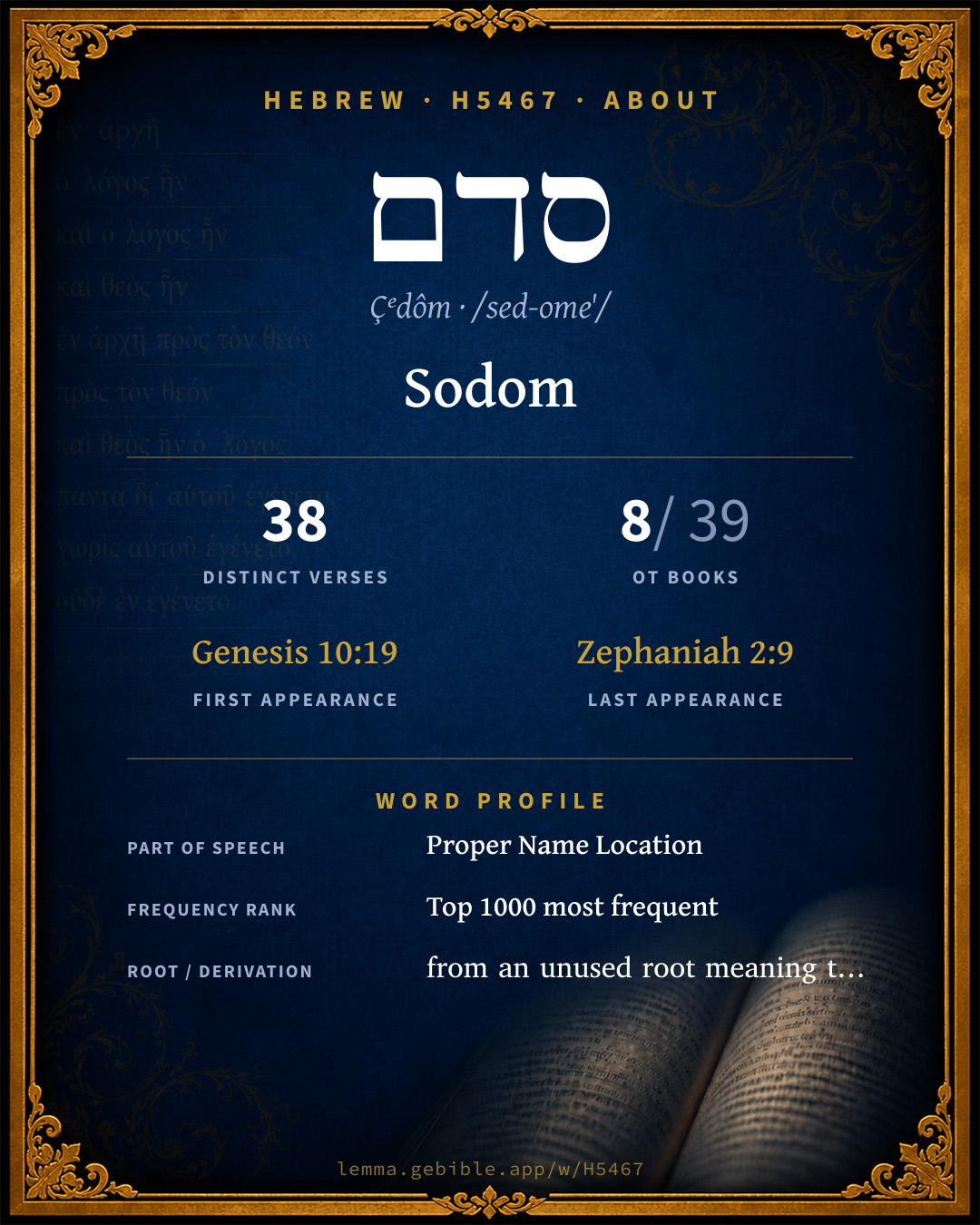
סְדֹם
Sodom
BDB lists 2 entries for ‘Sodom’ fuller range ↓
Full lexicon entry — Brown-Driver-Briggs (BDB)
From Brown-Driver-Briggs (BDB)
Where this word appears
Grammar key — what these labels mean
Part of speech
- Noun
- A naming word — a person, place, thing, or idea.
Noun type
- Proper
- A name of a specific person, place, or people (e.g. Abraham, Zion, Israel).
Every verse where H5467 appears in the Book of Amos — 1 distinct verse. Click any verse to open its interlinear word-by-word view. Verse text shown in the World English Bible for context — . Each verse’s Hebrew form is shown with its reference; the English is not keyword-highlighted, since the data carries no word-level English alignment. Use “Compare translations” on any verse to read it across multiple English versions. This concordance covers the Hebrew Bible; Septuagint (Greek Old Testament) occurrences are not indexed here.
Amos
About this entry
At a glance — auto-summarized from this page’s data, not written by a person. Every figure links to its source below. This summary describes the numbers; it doesn’t interpret them.
סדם (Çᵉdôm) is a Hebrew name most often rendered “Sodom.” Genesis dominates its distribution — 20 of 38 verses. The Hebrew Bible uses it across 38 verses — moderately common. Debuting at Genesis 10:19, it then recurs through the corpus. For the data behind this summary, explore 38-verse concordance and the renderings breakdown below.
Gloss history
Strong's 1890 vs modern scholarship
About this word
Strong's H5467 catalogs a Hebrew word from the Hebrew Old Testament.
These counts are not copied from any lexicon or concordance. They are computed here, from the morphology-tagged Hebrew Old Testament. What Lemma adds →
- 38
- distinct verses
- The word appears in 38 distinct verses.
- 8 / 39
- OT books
- The word appears in 8 of 39 Old Testament books.
- #922
- by frequency
- Top 1000 most frequent Hebrew words (rank 922 of 8,640 Hebrew words by occurrence).
View all 38 occurrences in the concordance →
By section of the Old Testament
By traditional corpus
Conventional, traditional groupings — biblical authorship is debated, so this is a traditional corpus grouping, not an authorship claim. Each share is this word’s portion of its verses in that division of the Hebrew canon. Each figure is a share of the word’s 38 distinct verses.
- Torah (Pentateuch) 22 verses · 58%
- Prophets (Nevi'im) 15 verses · 39%
- Writings (Ketuvim) 1 verse · 3%
How translations render this word
Counts come from each version’s own published word-to-Strong’s tagging or interlinear alignment — an approximate guide to how each version renders this word, not a word-level alignment the data otherwise carries. Because each total is that version’s own tagged count, the per-version totals vary from one another and need not match the appearance or distinct-verse counts above. These counts may also differ from a printed concordance because Lemma counts each distinctly tagged rendering and does not collapse phrase taggings into a single head-word total. This is a fixed set of word-tagged versions (KJV, ASV, BSB, ULT) and does not change with the reading translation you choose elsewhere. Each version’s license is shown beside its name below (and on Sources).
- King James Version: Sodom 34×
- American Standard Version: Sodom 33×
- Berean Standard Bible: Sodom 29×, Like sodom 5×, Toward sodom 2×
- unfoldingWord Literal Text: Sodom 31×, Like sodom 4×
King James Version Public Domain
Renders H5467 across 39 tagged occurrences — most commonly:
Plus 5 renderings that appear only once — usually multi-word phrases or single function words the recovered tagging swept in, not distinct renderings.
American Standard Version Public Domain
Renders H5467 across 39 tagged occurrences — most commonly:
Plus 6 renderings that appear only once — usually multi-word phrases or single function words the recovered tagging swept in, not distinct renderings.
Berean Standard Bible Public Domain
Renders H5467 across 39 tagged occurrences — most commonly:
Plus 3 renderings that appear only once — usually multi-word phrases or single function words the recovered tagging swept in, not distinct renderings.
unfoldingWord Literal Text CC BY-SA 4.0
Renders H5467 across 37 tagged occurrences — most commonly:
Plus 2 renderings that appear only once — usually multi-word phrases or single function words the recovered tagging swept in, not distinct renderings.
Senses in BDB
The 2 senses BDB distinguishes for this word, in lexicon order (not ranked by frequency or importance). The full entry — with sub-senses — is in the Lexicon Entry tab.
- Sodom = "burning"
- a Canaanite city…
Word origin
n.pr.loc. Sodom, important Canaanitish city named (usually) with Gomorrha (עֲמֹרָה, q.v.);—𝔊 Σόδομα (inflected Σοδόμων, Σοδόμοις):—ס׳ (on format. cf. LagBN 54), Gn 13:10, 12, 13 + 7 times Gn 18, 19, + סְדֹ֫מָה (ה loc.) Gn 10:19; 18:22; 19:1 (all J), + 8 times Gn 14; from 8th cent. onwards, used as illustrating י׳’s judgments, Am 4:11 Is 1:9; 13:19 Dt 29:22 Je 49:18; 50:40 Zp 2:9 La 4:6; as proverbial for open sin Is 3:9 Je 23:14, so metaph. קְצִינֵי ס׳ Is 1:10 (i.e. rulers as corrupt as in Sodom), גֶּפֶן ס׳ Dt 32:32 (i.e. wickedness like Sodom’s); Judah cp. with ס׳ to her disadvantage Ez 16:46, 48, 49, 53, 55, 56. Site prob. at S. end of Dead Sea, where are now Jebel Usdum (SW.), and Zoar SE. cf. Di Gn 19:20 ff. RobBR ii. 187 ff. GASmGeogr. 505 ff. BlankenhornZPV xix (1896), 53 ff. BdPal. 3, 146 BuhlGeogr. 117, 271, 274. Vid. also שִׂדִּים.
— Brown-Driver-Briggs (Oxford 1906, public domain), digitized via Sefaria, supplemented by the OpenScriptures HebrewLexicon (CC BY 4.0). See Sources.
Origin: from an unused root meaning to scorch
Forms in the corpus
The 21 distinct written forms H5467 takes in the Hebrew Bible, most frequent first — each parse links to that state’s occurrences in the concordance. Hebrew forms include their vowel points and cantillation, so a single lemma takes many written forms.
| Form | Parsing | Example | Uses |
|---|---|---|---|
| סְדֹ֑ם | Noun, Proper | Genesis 14:22 | 5 |
| סְדֹם֙ | Noun, Proper | Deuteronomy 32:32 | 5 |
| סְדֹ֣ם | Noun, Proper | Amos 4:11 | 4 |
| סְדֹ֖ם | Noun, Proper | Ezekiel 16:46 | 3 |
| סְדֹ֧ם | Noun, Proper | Genesis 14:11 | 3 |
| סְדֹ֔ם | Noun, Proper | Genesis 13:13 | 2 |
| סְדֹ֤ם | Noun, Proper | Deuteronomy 29:23 | 2 |
| סְדֹ֥ם | Noun, Proper | Genesis 14:10 | 2 |
| בִ/סְדֹ֛ם | Noun, Proper | Genesis 18:26 | 1 |
| בִּ/סְדֹֽם | Noun, Proper | Genesis 14:12 | 1 |
| כִּ/סְדֹ֔ם | Noun, Proper | Jeremiah 23:14 | 1 |
| כִּ/סְדֹ֣ם | Noun, Proper | Isaiah 1:9 | 1 |
| כִּ/סְדֹ֤ם | Noun, Proper | Zephaniah 2:9 | 1 |
| כִּ/סְדֹ֥ם | Noun, Proper | Isaiah 3:9 | 1 |
| סְדֹ֑מָ/ה | Noun, Proper | Genesis 18:22 | 1 |
| סְדֹ֛ם | Noun, Proper | Genesis 19:24 | 1 |
| סְדֹ֜ם | Noun, Proper | Genesis 14:8 | 1 |
| סְדֹ֧מָ/ה | Noun, Proper | Genesis 10:19 | 1 |
| סְדֹ֨מָ/ה֙ | Noun, Proper | Genesis 19:1 | 1 |
| סְדֹֽם | Noun, Proper | Genesis 13:12 | 1 |
| סְדֹם֮ | Noun, Proper | Genesis 14:17 | 1 |
Same root — word family
Other BDB entries built from the same root as H5467, grouped by Strong’s listed origin. These share a root / origin per the lexicon — not necessarily a shared meaning. Each links to that word’s own entry.
Proper names from this root
People and places named from this root — a name, not an additional meaning of the word.
Compare all same-root words → 1 of the same-root words is a proper name (a person or place). They share a root, not necessarily a meaning.
Bible dictionary
Public-domain dictionary articles matched to this entry by name (Sodom). A biblical name can be shared by more than one person or place, so an article may treat several.
Easton's Bible Dictionary · M. G. Easton, 1897
Burning; the walled, a city in the vale of Siddim (Gen. 13:10; 14:1-16). The wickedness of its inhabitants brought down upon it fire from heaven, by which it was destroyed (18:16-33; 19:1-29; Deut. 23:17). This city and its awful destruction are frequently alluded to in Scripture (Deut. 29:23; 32:32; Isa. 1:9, 10; 3:9; 13:19; Jer. 23:14; Ezek. 16:46-56; Zeph. 2:9; Matt. 10:15; Rom. 9:29; 2 Pet. 2:6, etc.). No trace of it or of the other cities of the plain has been discovered, so complete was their destruction. Just opposite the site of Zoar, on the south-west coast of the Dead Sea, is a range of low hills, forming a mass of mineral salt called Jebel Usdum, "the hill of Sodom." It has been concluded, from this and from other considerations, that the cities of the plain stood at the southern end of the Dead Sea. Others, however, with much greater probability, contend that they stood at the northern end of the sea. [in 1897].
Smith's Bible Dictionary · William Smith, 1863
(burning), one of the most ancient cities of Syria. It is commonly mentioned in connection with Gomorrah, but also with Admah and Zeboim, and on one occasion-- (Genesis 14:1) ...--with Bela or Zoar. Sodom was evidently the chief town in the settlement. The four are first named in the ethnological records of (Genesis 10:19) as belonging to the Canaanites. The next mention of the name of Sodom, (Genesis 13:10-13) gives more certain indication of the position of the city. Abram and Lot are standing together between Bethel and Ai, ver. 3, taking a survey of the land around and below them. Eastward of them, and absolutely at their feet, lay the "circle of Jordan." The whole circle was one great oasis--"a garden of Jehovah." ver. 10. In the midst of the garden the four cities of Sodom, Gomorrah, Admah and Zeboim appear to have been situated. It is necessary to notice how absolutely the cities are identified with the district. In the subsequent account of their destruction, (Genesis 19:1) ... the topographical terms are employed with all the precision which is characteristic of such early times. The mention of the Jordan is conclusive as to the situation of the district, for the Jordan ceases where it enters the Dead Sea, and can have no existence south of that point. The catastrophe by which they were destroyed is described in (Genesis 19:1) ... as a shower of brimstone and fire from Jehovah. However we may interpret the words of the earliest narrative, one thing is certain--that the lake was not one of the agents in the catastrophe. From all these passages, though much is obscure, two things seem clear:
+ That Sodom and the rest of the cities of the plain of Jordan stood on the north of the Dead Sea; + That neither the cities nor the district were submerged by the lake, but that the cities were overthrown and the land spoiled, and that it may still be seen in its desolate condition. When, however, we turn to more modern views, we discover a remarkable variance from these conclusions. + The opinion long current that the five cities were submerged in the lake, and that their remains--walls, columns and capitals--might he still discerned below the water, hardly needs refutation after the distinct statement and the constant implication of Scripture. But, + A more serious departure from the terms of the ancient history is exhibited in the prevalent opinion that the cities stood at the south end of the lake. This appears to, have been the belief of Josephus and Jerome. It seems to have been universally held by the medieval historians and pilgrims, and it is adopted by modern topographers probably without exception. There are several grounds for this belief; but the main point on which Dr. Robinson rests his argument is the situation of Zoar. (a) "Lot," says he, "fled to Zoar, which was near to Sodom; and Zoar lay almost at the southern end of the present sea, probably in the month of Wady Kerak ." (b) Another consideration in favor of placing the cities at the southern end of the lake is the existence of similar names in that direction. (c) A third argument, and perhaps the weightiest of the three, is the existence of the salt mountain at the south of the lake, and its tendency to split off in columnar masses presenting a rude resemblance to the human form. But it is by no means certain that salt does not exist at other spots round the lake. (d) (A fourth and yet stronger argument is drawn from the fact that Abraham saw the smoke of the burning cities from Hebron. (e) A fifth argument is found in the numerous lime-pits found at that southern end of the Dead Sea. Robinson, Schaff, Baedeker, Lieutenant Lynch and others favor this view.--ED.) It thus appears that on the situation of Sodom no satisfactory conclusion can at present be readied: On the one hand, the narrative of Genesis seems to state positively that it lay at the northern end of the Dead Sea. On the other hand, long-continued tradition and the names of the existing spots seem to pronounce with almost equal positiveness that it was at its southern end. Of the catastrophe which destroyed the city and the district of Sodom we can hardly hope ever to form a satisfactory conception. Some catastrophe there undoubtedly was but what secondary agencies, besides fire, were employed in the accomplishment of the punishment cannot be safely determined in the almost total absence of exact scientific description of the natural features of the ground round the lake. We may suppose, however, that the actual agent in the ignition and destruction of the cities had been of the nature of a tremendous thunder-storm accompanied by a discharge of meteoric stones, (and that these set on fire the bitumen with which the soil was saturated, and which was used in building the city. And it may be that this burning out of the soil caused the plain to sink below the level of the Dead Sea, and the waters to flow over it--if indeed Sodom and its sister cities are really under the water.--ED.) The miserable fate of Sodom and Gomorrah is held up as a warning in numerous passages of the Old and New Testaments. (Mark 8:11; 2 Peter 2:6; Jude 1:4-7)
Hitchcock's Bible Names Dictionary · Roswell D. Hitchcock, 1869
their secret; their cement
Classic public-domain reference works; full attribution on Sources.
Septuagint verse parallels
This word appears in 37 verses that also exist in the Greek Old Testament (Septuagint), out of the 38 Hebrew verses it occurs in. You can read those verses in Greek by switching the Old Testament edition to the Septuagint.
Read these verses in the Septuagint
- Genesis 10:19
- Deuteronomy 29:23
- Isaiah 1:9
- Jeremiah 23:14
- Lamentations 4:6
- Ezekiel 16:46
- Amos 4:11
- Zephaniah 2:9
This is a verse-level parallel only — the same verses exist in both the Hebrew and Greek Old Testaments. No word-level Hebrew↔Greek correspondence is claimed: the data carries no such alignment, so no Greek word is shown as this Hebrew word’s translation. Coverage is not total — the Septuagint omits the deuterocanon and renumbers the Psalms, so some Hebrew verses have no direct Greek parallel.