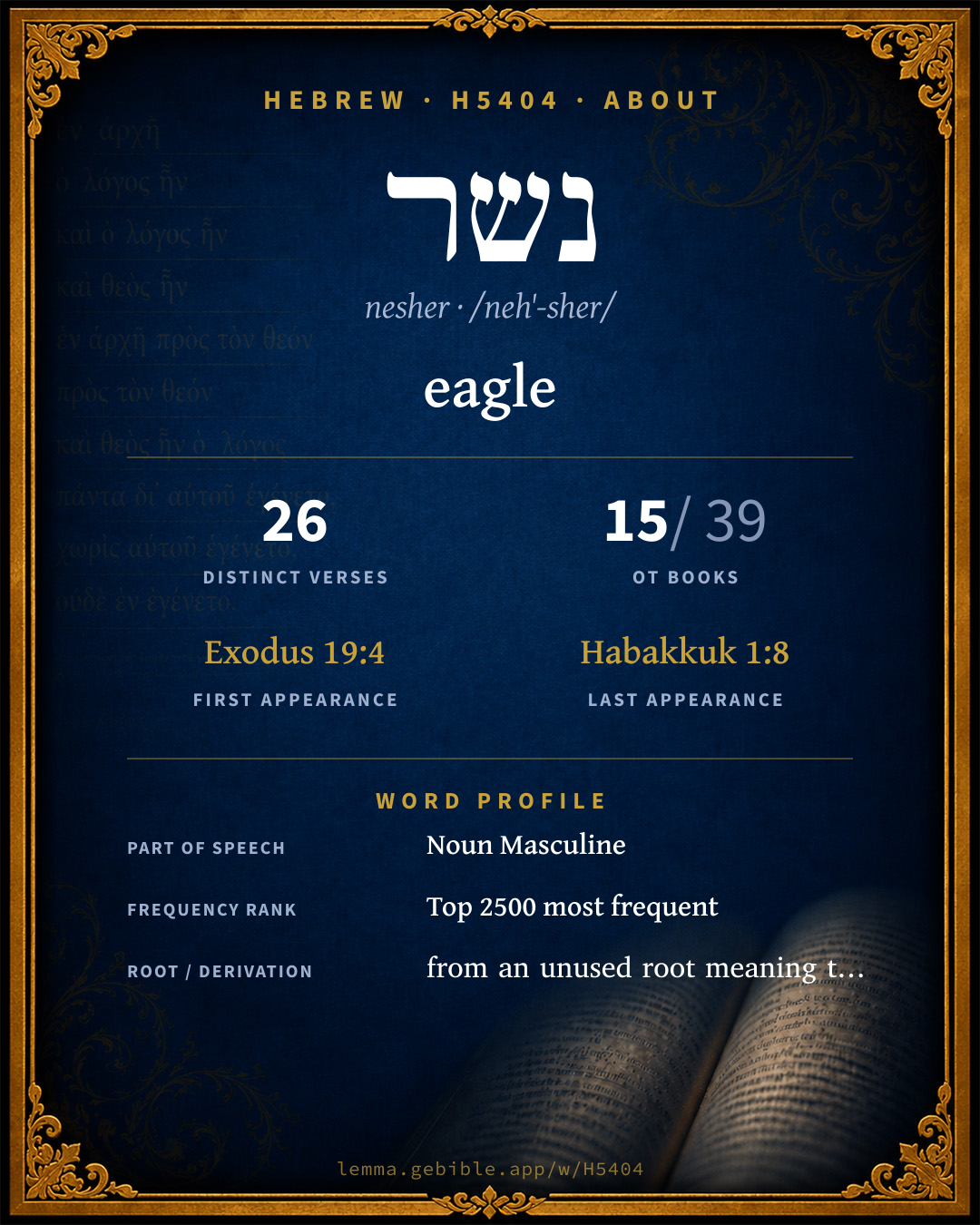
נֶשֶׁר
eagle
Full lexicon entry — Brown-Driver-Briggs (BDB)
From Brown-Driver-Briggs (BDB)
Where this word appears
See every Absolute-state word in the Hebrew Bible →
Grammar key — what these labels mean
Part of speech
- Noun
- A naming word — a person, place, thing, or idea.
Noun type
- Common
- A common noun — a general class of person, place, or thing (“king,” “city,” “water”), not a specific name.
State
- Absolute
- The independent form of a noun, not bound to a following word.
- Construct
- A noun bound to a following noun in a possessive / “of” relationship (the construct chain).
Gender
- Masculine
- Grammatically masculine.
Number
- Singular
- One.
- Plural
- More than one (in Hebrew, generally three or more).
Grammatical forms
- Noun, Common, Masculine, Singular, Absolute 21 times (81%)
- Noun, Common, Masculine, Plural, Absolute 4 times (15%)
- Noun, Common, Masculine, Plural, Construct 1 time (4%)
Parsed forms decoded from the imported morphology (morphhb / Westminster Leningrad Codex — WLC text public domain, morphhb tagging CC BY 4.0), counted across 26 parsed occurrences — not distinct verses.
Every verse where H5404 appears — 26 distinct verses across 15 books. Click any verse to open its interlinear word-by-word view. Verse text shown in the World English Bible for context — . Each verse’s Hebrew form is shown with its reference; the English is not keyword-highlighted, since the data carries no word-level English alignment. Use “Compare translations” on any verse to read it across multiple English versions. This concordance covers the Hebrew Bible; Septuagint (Greek Old Testament) occurrences are not indexed here.
Exodus 1 verse
Leviticus 1 verse
Deuteronomy 3 verses
- Deuteronomy 14:12 הַ/נֶּ֥שֶׁר ptcl def.art + n c ms But these are they of which you shall not eat: the eagle, and the gier-eagle, and the ospray,
- Deuteronomy 28:49 הַ/נָּ֑שֶׁר ptcl def.art + n c ms Yahweh will bring a nation against you from far, from the end of the earth, as the eagle flies; a nation whose language you shall not understand;
- Deuteronomy 32:11 כְּ/נֶ֨שֶׁר֙ prep + n c ms As an eagle that stirs up her nest, That flutters over her young, He spread abroad his wings, he took them, He bore them on his feathers.
2 Samuel 1 verse
Job 2 verses
Psalms 1 verse
Proverbs 3 verses
- Proverbs 23:5 כְּ֝/נֶ֗שֶׁר prep + n c ms Why do you set your eyes on that which is not? For it certainly sprouts wings like an eagle and flies in the sky.
- Proverbs 30:17 נָֽשֶׁר n c ms The eye that mocks at his father, And scorns obedience to his mother: The ravens of the valley shall pick it out, The young eagles shall eat it.
- Proverbs 30:19 הַ/נֶּ֨שֶׁר ptcl def.art + n c ms The way of an eagle in the air; The way of a serpent on a rock; The way of a ship in the midst of the sea; And the way of a man with a maiden.
Isaiah 1 verse
Jeremiah 4 verses
- Jeremiah 4:13 מִ/נְּשָׁרִ֖ים prep + n c mp Behold, he shall come up as clouds, and his chariots [shall be] as the whirlwind: his horses are swifter than eagles. Woe to us! for we are ruined.
- Jeremiah 48:40 כַ/נֶּ֖שֶׁר prep det + n c ms For thus says Yahweh: Behold, he shall fly as an eagle, and shall spread out his wings against Moab.
- Jeremiah 49:16 כַּ/נֶּ֨שֶׁר֙ prep det + n c ms As for your terror, the pride of your heart has deceived you, O you who dwell in the clefts of the rock, who hold the height of the hill: though you should make your nest as high as the eagle, I will bring you down from there, says Yahweh.
- Jeremiah 49:22 כַ/נֶּ֨שֶׁר֙ prep det + n c ms Behold, he shall come up and fly as the eagle, and spread out his wings against Bozrah: and the heart of the mighty men of Edom at that day shall be as the heart of a woman in her pangs.
Lamentations 1 verse
Ezekiel 4 verses
- Ezekiel 1:10 נֶ֖שֶׁר n c ms As for the likeness of their faces, they had the face of a man; and they four had the face of a lion on the right side; and they four had the face of an ox on the left side; they four had also the face of an eagle.
- Ezekiel 10:14 נָֽשֶׁר n c ms Every one had four faces: the first face was the face of the cherub, and the second face was the face of a man, and the third face the face of a lion, and the fourth the face of an eagle.
- Ezekiel 17:3 הַ/נֶּ֤שֶׁר ptcl def.art + n c ms and say, Thus says the Lord Yahweh: A great eagle with great wings and long feathers, full of feathers, which had various colors, came to Lebanon, and took the top of the cedar:
- Ezekiel 17:7 נֶֽשֶׁר n c ms There was also another great eagle with great wings and many feathers: and, behold, this vine did bend its roots toward him, and shot forth its branches toward him, from the beds of its plantation, that he might water it.
Hosea 1 verse
Obadiah 1 verse
Micah 1 verse
Habakkuk 1 verse
About this entry
At a glance — auto-summarized from this page’s data, not written by a person. Every figure links to its source below. This summary describes the numbers; it doesn’t interpret them.
נשר — transliterated nesher — is a Hebrew noun carrying the sense “eagle.” It first appears in Exodus 19:4. The Hebrew Bible uses it across 26 verses — moderately common. Related forms include נשר. The sections below give every sense, occurrence, and version rendering.
Gloss history
Strong's 1890 vs modern scholarship
About this word
Strong's H5404 catalogs a Hebrew word from the Hebrew Old Testament.
These counts are not copied from any lexicon or concordance. They are computed here, from the morphology-tagged Hebrew Old Testament. What Lemma adds →
- 26
- distinct verses
- The word appears in 26 distinct verses.
- 15 / 39
- OT books
- The word appears in 15 of 39 Old Testament books.
- #1,251
- by frequency
- Top 2500 most frequent Hebrew words (rank 1,251 of 8,640 Hebrew words by occurrence).
View all 26 occurrences in the concordance →
Most concentrated in
- Jeremiah 4 verses 15%
- Ezekiel 4 verses 15%
- Deuteronomy 3 verses 12%
By section of the Old Testament
By traditional corpus
Conventional, traditional groupings — biblical authorship is debated, so this is a traditional corpus grouping, not an authorship claim. Each share is this word’s portion of its verses in that division of the Hebrew canon. Each figure is a share of the word’s 26 distinct verses.
- Prophets (Nevi'im) 14 verses · 54%
- Writings (Ketuvim) 7 verses · 27%
- Torah (Pentateuch) 5 verses · 19%
How translations render this word
Counts come from each version’s own published word-to-Strong’s tagging or interlinear alignment — an approximate guide to how each version renders this word, not a word-level alignment the data otherwise carries. Because each total is that version’s own tagged count, the per-version totals vary from one another and need not match the appearance or distinct-verse counts above. These counts may also differ from a printed concordance because Lemma counts each distinctly tagged rendering and does not collapse phrase taggings into a single head-word total. This is a fixed set of word-tagged versions (KJV, ASV, BSB, ULT) and does not change with the reading translation you choose elsewhere. Each version’s license is shown beside its name below (and on Sources).
- King James Version: Eagle 15×, Eagles 2×, Than eagles 2×
- American Standard Version: Eagle 17×, Eagles 2×, Than eagles 2×
- Berean Standard Bible: Eagle 13×, Like an eagle 2×, Like the eagle 2×
- unfoldingWord Literal Text: Eagle 10×, Like an eagle 3×, Like the eagle 3×
King James Version Public Domain
Renders H5404 across 26 tagged occurrences — most commonly:
Plus 7 renderings that appear only once — usually multi-word phrases or single function words the recovered tagging swept in, not distinct renderings.
American Standard Version Public Domain
Renders H5404 across 25 tagged occurrences — most commonly:
Plus 4 renderings that appear only once — usually multi-word phrases or single function words the recovered tagging swept in, not distinct renderings.
Berean Standard Bible Public Domain
Renders H5404 across 26 tagged occurrences — most commonly:
Plus 7 renderings that appear only once — usually multi-word phrases or single function words the recovered tagging swept in, not distinct renderings.
unfoldingWord Literal Text CC BY-SA 4.0
Renders H5404 across 23 tagged occurrences — most commonly:
Plus 5 renderings that appear only once — usually multi-word phrases or single function words the recovered tagging swept in, not distinct renderings.
Senses in BDB
The 1 sense BDB distinguishes for this word, in lexicon order (not ranked by frequency or importance). The full entry — with sub-senses — is in the Lexicon Entry tab.
- eagle, vulture, griffon-vulture
Word origin
n.m. Dt 32:11 griffon-vulture, eagle (NH id.; Assyrian našru; 𝔗 נִשְׁרָא; Syriac ܢܶܫܪܳܐ; Arabic نَسْرٌ vulture (Lane 2780), vulg. نِسْرٌ; Ethiopic ንስር Di 641; Sab. נסר n.pr. dei, and ביתן נסר DHMZMG xxix (1875), 600; xxxvii (1883), 356);—abs. נ׳ Ho 8:1 +; נָ֑שֶׁר Dt 28:49 +; pl. נְשָׁרִים 2 S 1:23 +, cstr. נִשְׁרֵי La 4:19;—sometimes (perhaps not always) the griffon-vulture (TristrNHB 172 ff. Dr Dt 14:12 NowArch. i. 84 Lane 2780), Mi 1:16 (bald, in sim.), flying swiftly to prey Hb 1:8 Jb 9:26, cf. Pr 30:17 (בְּנֵי־נ׳), unclean Lv 11:13 Dt 14:12; soaring Jb 39:27, also in sim. Pr 23:5 Is 40:31 Ob 4, building nest high Je 49:16 (cf. also Jb 39:27); as swift also 2 S 1:23, especially of Bab. and Assyrian invader Je 4:13 La 4:19, cf. Ho 8:1 Dt 28:49 Je 48:40; 49:22 (all in comparisons), הַנֶּשֶׁר הַגָּדוֹל Ez 17:3 (fig. of Nebuch.), v 7 (fig. of king of Egypt); leaving no trace of flight Pr 30:19; as renewing youth (by moulting) ψ 103:5; as training and supporting its young Ex 19:4 (E), Dt 32:11 (song); פְּנֵי נ׳ of cherubim in vision Ez 1:10; 10:4.—Only Mi 1:16 seems to compel ref. to vulture (on eating fresh carrion by eagles v. reff. in Di Lv 11:13), and נ׳ may be a more comprehensive word, incl. both vulture and eagle.
— Brown-Driver-Briggs (Oxford 1906, public domain), digitized via Sefaria, supplemented by the OpenScriptures HebrewLexicon (CC BY 4.0). See Sources.
Origin: from an unused root meaning to lacerate
Jastrow Dictionary
A second Hebrew/Aramaic lexicon for comparison, covering Aramaic and post-biblical (Talmudic, Targumic, Midrashic) usage that the biblical-Hebrew BDB does not. Matched by lemma rather than by Strong’s number, so a lemma may carry more than one Jastrow headword (shown separately below), and the entries cover usage well beyond the Bible.
נָשַׁר
- (cmp. נָשַׁל) to drop, fall off. Peah VII, 3 איזהו פרט הנוֹשֵׁר וכ׳ by pereṭ (Lev. XIX, 10) is understood that which drops on cutting grapes. Bets. 2ᵇ פירות הנוֹשְׁרִין fruit which drops from the tree (on the Holy Day). Y. ib. I, beg. 60ᵃ ספק מהיום נָשְׁרוּ וכ׳ where it is doubtful whether they fell off to-day (on the Holy-Day) &c. Gen. R. s. 10, v. נָשַׁל; a. fr.—Sabb. XXII, 4 (146ᵇ) מי שנשרו כליו בדרך (במים) if one’s garments (cloak) fell into a puddle on the road. e.g. Leviticus 19:10
- (הִנְשִׁיר)
- 1. to let fall, drop. Ib. 67ᵃ אילן שמַשִּׁיר פירותיו a tree that drops its fruit prematurely. Naz. VI, 3 מפני שמַשֶּׁרֶת וכ׳ because it causes falling out of the hair. Y. Peah VIII, 20ᵃ bot. מַשִּׁיר (not משייר), v. מַחֲבוֹא. Midr. Till. to Ps. XIV עתיד … להַשִּׁירוֹ the Lord will cause him to drop, v. נוֹבֶלֶת. Keth. 6ᵇ אע"פ שמַשִּׁיר צרורות although (by walking through the breach) he causes pebbles to break loose; Y. Ber. II, 5ᵇ top אפי׳ מַשֶּׁרֶת צרורות even if the wall is so brittle as to drop &c.; a. fr.—Bets. 35ᵇ מַשִּׁירִין, מַנְשִׁירִין (prob. to be read: מְנַשְּׁרִין as versions of מַשִּׁילִין, v. נָשַׁל).—Esth. R. to I, 14 ומַשִּׁירָן, v. כַּרְשׁינָה II.
- 1. to drop, let drop, v. supra.
- 2. (cmp. Assyr. našâru, Del. Assyr. Handw., p. 487) to tear, lacerate. Ab. Zar. 11ᵃ sq. איזהו עיקור … המְנַשֵּׁר פרסותיה וכ׳ what mutilation of an animal’s feet does not affect its vitality (v. טְרֵפָה)? Cutting the tendons of its hoofs beneath the ankle; ib. 13ᵃ. Pesik. R. s. 31 מְנַשְּׁרִים בשערו they pluck his hair.
נְשַׁר I
- 1. to fall off. Koh. R. to V, 8 נַשְׁרִין, נַשְׁרָן, v. נָשַׁל.
- 2. to lacerate. Ber. 8ᵃ [a gloss, v. Ar. ed. Koh. s. v. נשר 4] דלאחורי נַשְׁרָא (Ar. נָשְׁרֵי) which tears backwards (when you attempt to pull it out), v. חִיזְרָא I.
- to cause to fall off, drop. Targ. I Chr. V, 23, v. סְרֵי II.
נֶשֶׁר I
- (preced.) dropping, dropped fruit. Succ. I, 3 מפני הנ׳ to intercept the droppings (from the branches covering the Succah). Pes. 56ᵃ להאכיל נ׳ לעניים וכ׳ to give the poor an opportunity to eat of the fallen fruit (on Sabbaths &c.) in years of famine; Men. 71ᵃ; a. fr.—Pl. נְשָׁרִים, נְשָׁרִין. Tosef. Pes. II (III), 19. Y. Bets. I, bg. 60ᵃ; a. e.
נֶשֶׁר II
- (v. נָשַׁרPi.) eagle. Ḥag. 13ᵇ מּלך שבעופות נ׳ the king of birds is the eagle. Ḥull. 60ᵇ sq. (ref. to Lev. XI, 13) נ׳ מה נ׳ וכ׳ the text specifies the eagle to intimate, as the eagle has no additional toe …, so all birds like him are unclean. Y. Peah I, 15ᵈ top נ׳ שהוא רחמן the eagle who is kind (to his young ones); Yalk. Prov. 963. Mekh. Yithro, Baḥod., s. 2; a. fr.—Snh. 12ᵃ (in a secret letter) ותפשו נ׳ and the eagle (Roman) caught them (the messengers, v. נְצִיב).—Pl. נְשָׁרִים. Ib. 92ᵇ עושה להם כנפים כנ׳ וכ׳ he shall give them (the righteous) wings like those of the eagles, and they shall soar &c.; a. e. e.g. Leviticus 11:13
נְשַׁר II
- 1. same. Targ. Lev. XI, 13; a. fr.—Pl. נִשְׁרִין, נִשְׁרַיָּא, נִי׳. Targ. Ex. XIX, 4. Targ. II Sam. I, 23.—Erub. 53ᵇ, v. נְקַף I.
- 2. Nishra, name of an Arabian deity (Sabaean: Nasr). Ab. Zar. 11ᵇ.—[נשרא, Ber. 8ᵃ, v. נְשַׁר I.]—קַן נִשְׁרַיָּיא pr. n. pl., v. קֵן ch.
A Dictionary of the Targumim, the Talmud Babli and Yerushalmi, and the Midrashic Literature (Marcus Jastrow; London, Luzac, 1903) — Public Domain. Digitized via Sefaria. Digitized via Sefaria. Full attribution on Sources.
Forms in the corpus
The 23 distinct written forms H5404 takes in the Hebrew Bible, most frequent first — each parse links to that state’s occurrences in the concordance. Hebrew forms include their vowel points and cantillation, so a single lemma takes many written forms.
Same root — word family
Other BDB entries built from the same root as H5404, grouped by Strong’s listed origin. These share a root / origin per the lexicon — not necessarily a shared meaning. Each links to that word’s own entry.
Derived from this word
Compare all same-root words → They share a root, not necessarily a meaning.
Septuagint verse parallels
This word appears in 24 verses that also exist in the Greek Old Testament (Septuagint), out of the 26 Hebrew verses it occurs in. You can read those verses in Greek by switching the Old Testament edition to the Septuagint.
Read these verses in the Septuagint
- Exodus 19:4
- Leviticus 11:13
- Deuteronomy 14:12
- 2 Samuel 1:23
- Job 9:26
- Psalms 103:5
- Proverbs 23:5
- Isaiah 40:31
- Jeremiah 4:13
- Lamentations 4:19
- Ezekiel 1:10
- Hosea 8:1
This is a verse-level parallel only — the same verses exist in both the Hebrew and Greek Old Testaments. No word-level Hebrew↔Greek correspondence is claimed: the data carries no such alignment, so no Greek word is shown as this Hebrew word’s translation. Coverage is not total — the Septuagint omits the deuterocanon and renumbers the Psalms, so some Hebrew verses have no direct Greek parallel.