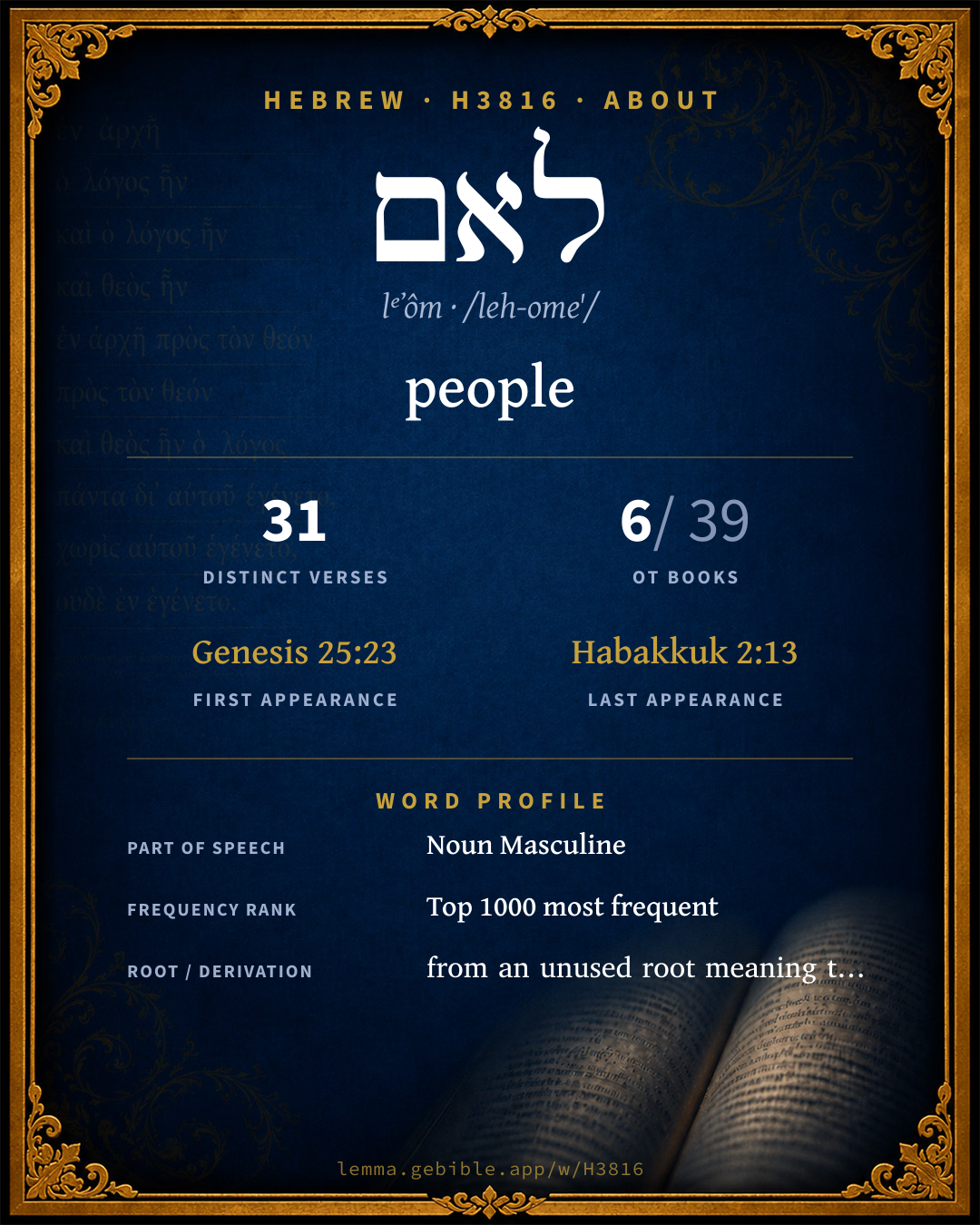
לְאֹם
people
Full lexicon entry — Brown-Driver-Briggs (BDB)
From Brown-Driver-Briggs (BDB)
Where this word appears
Grammar key — what these labels mean
Part of speech
- Noun
- A naming word — a person, place, thing, or idea.
- Particle
- A short function word — article, negation, interrogative, the sign of the direct object, and the like.
Noun type
- Common
- A common noun — a general class of person, place, or thing (“king,” “city,” “water”), not a specific name.
State
- Absolute
- The independent form of a noun, not bound to a following word.
- Construct
- A noun bound to a following noun in a possessive / “of” relationship (the construct chain).
Gender
- Masculine
- Grammatically masculine.
Number
- Plural
- More than one (in Hebrew, generally three or more).
- Singular
- One.
Every verse where H3816 appears in the Book of Psalms — 13 distinct verses. Click any verse to open its interlinear word-by-word view. Verse text shown in the World English Bible for context — . Each verse’s Hebrew form is shown with its reference; the English is not keyword-highlighted, since the data carries no word-level English alignment. Use “Compare translations” on any verse to read it across multiple English versions. This concordance covers the Hebrew Bible; Septuagint (Greek Old Testament) occurrences are not indexed here.
Psalms
- Psalms 2:1 וּ֝/לְאֻמִּ֗ים conj + n c mp Why do the nations rage, And the peoples plot a vain thing?
- Psalms 7:7 לְ֭אֻמִּים n c mp Let the congregation of the peoples surround you. Rule over them on high.
- Psalms 9:8 לְ֝אֻמִּ֗ים n c mp He will judge the world in righteousness. He will administer judgment to the peoples in uprightness.
- Psalms 44:2 לְ֝אֻמִּ֗ים n c mp You drove out the nations with your hand, But you planted them. You afflicted the peoples, But you spread them abroad.
- Psalms 44:14 בַּל אֻמִּֽים ptcl neg n c mp You make us a byword among the nations, A shaking of the head among the peoples.
- Psalms 47:3 וּ֝/לְאֻמִּ֗ים conj + n c mp He subdues nations under us, And peoples under our feet.
- Psalms 57:9 אֻמִּֽים n c mp I will give thanks to you, Lord, among the peoples. I will sing praises to you among the nations.
- Psalms 65:7 לְאֻמִּֽים n c mp Who stills the roaring of the seas, The roaring of their waves, And the turmoil of the nations.
- Psalms 67:4 לְאֻ֫מִּ֥ים וּ/לְאֻמִּ֓ים n c mp conj + n c mp Oh let the nations be glad and sing for joy, For you will judge the peoples with equity, And govern the nations on earth. Selah.
- Psalms 105:44 לְאֻמִּ֣ים n c mp He gave them the lands of the nations. They took the labor of the peoples in possession,
- Psalms 108:3 אֻמִּֽים n c mp I will give thanks to you, Yahweh, among the nations. I will sing praises to you among the peoples.
- Psalms 148:11 לְאֻמִּ֑ים n c mp Kings of the earth and all peoples; Princes and all judges of the earth;
- Psalms 149:7 אֻמִּֽים n c mp To execute vengeance on the nations, And punishments on the peoples;
About this entry
At a glance — auto-summarized from this page’s data, not written by a person. Every figure links to its source below. This summary describes the numbers; it doesn’t interpret them.
The Hebrew noun לאם centers on the idea of “people.” Its English rendering has broadened — “people” classically, “peoples” (Berean Standard Bible) in modern versions; see the renderings breakdown. The Hebrew Bible uses it across 31 verses — moderately common. Psalms dominates its distribution — 13 of 31 verses. Its earliest occurrence is Genesis 25:23. Dig into 31-verse concordance and the renderings breakdown below.
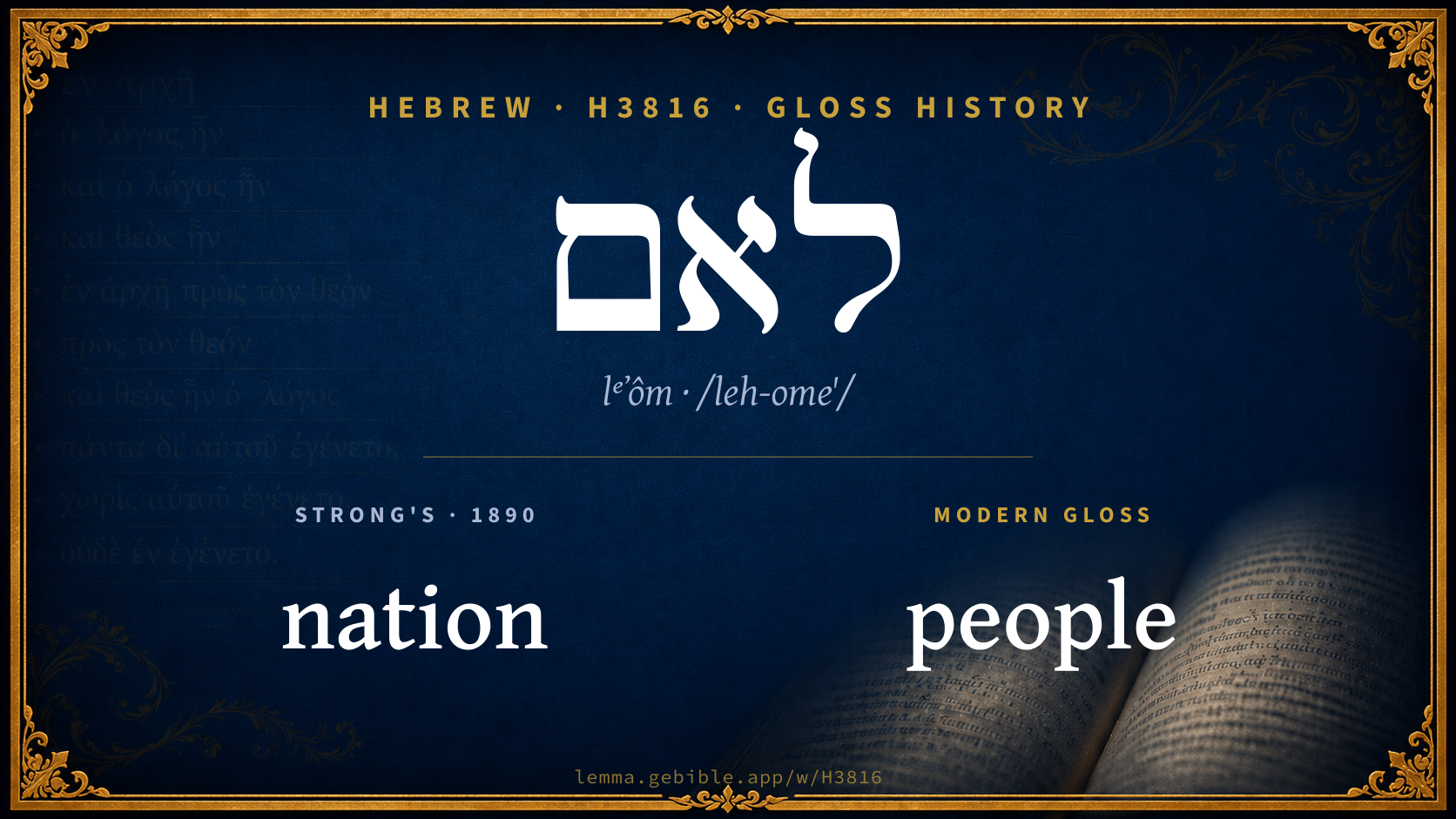
Gloss history
Strong's 1890 vs modern scholarship
About this word
Strong's H3816 catalogs a Hebrew word from the Hebrew Old Testament.
These counts are not copied from any lexicon or concordance. They are computed here, from the morphology-tagged Hebrew Old Testament. What Lemma adds →
- 31
- distinct verses
- The word appears in 31 distinct verses.
- 6 / 39
- OT books
- The word appears in 6 of 39 Old Testament books.
- #990
- by frequency
- Top 1000 most frequent Hebrew words (rank 990 of 8,640 Hebrew words by occurrence).
View all 31 occurrences in the concordance →
By section of the Old Testament
By traditional corpus
Conventional, traditional groupings — biblical authorship is debated, so this is a traditional corpus grouping, not an authorship claim. Each share is this word’s portion of its verses in that division of the Hebrew canon. Each figure is a share of the word’s 31 distinct verses.
- Writings (Ketuvim) 17 verses · 55%
- Prophets (Nevi'im) 12 verses · 39%
- Torah (Pentateuch) 2 verses · 6%
How translations render this word
Counts come from each version’s own published word-to-Strong’s tagging or interlinear alignment — an approximate guide to how each version renders this word, not a word-level alignment the data otherwise carries. Because each total is that version’s own tagged count, the per-version totals vary from one another and need not match the appearance or distinct-verse counts above. These counts may also differ from a printed concordance because Lemma counts each distinctly tagged rendering and does not collapse phrase taggings into a single head-word total. This is a fixed set of word-tagged versions (KJV, ASV, BSB, ULT) and does not change with the reading translation you choose elsewhere. Each version’s license is shown beside its name below (and on Sources).
- King James Version: People 14×, Nations 4×, Let the people 2×
- American Standard Version: Peoples 11×, Nations 4×, People 2×
- Berean Standard Bible: Peoples 11×, Nations 10×, People 2×
- unfoldingWord Literal Text: Peoples 21×, Nations 8×, And 2×
King James Version Public Domain
Renders H3816 across 35 tagged occurrences — most commonly:
Plus 11 renderings that appear only once — usually multi-word phrases or single function words the recovered tagging swept in, not distinct renderings.
American Standard Version Public Domain
Renders H3816 across 32 tagged occurrences — most commonly:
Plus 15 renderings that appear only once — usually multi-word phrases or single function words the recovered tagging swept in, not distinct renderings.
Berean Standard Bible Public Domain
Renders H3816 across 30 tagged occurrences — most commonly:
Plus 7 renderings that appear only once — usually multi-word phrases or single function words the recovered tagging swept in, not distinct renderings. Not rendered by a distinct English word in 1 further occurrence.
unfoldingWord Literal Text CC BY-SA 4.0
Renders H3816 across 37 tagged occurrences — most commonly:
Plus 6 renderings that appear only once — usually multi-word phrases or single function words the recovered tagging swept in, not distinct renderings.
Senses in BDB
The 1 sense BDB distinguishes for this word, in lexicon order (not ranked by frequency or importance). The full entry — with sub-senses — is in the Lexicon Entry tab.
- a people, nation
Word origin
n.m. Gn 25:23 people, poet. and chiefly late;—ל׳ abs. Gn 25:23(×2) Pr 14:28, לְאוֹם Pr 11:26; sf. לְאוּמִּו Is 51:4; pl. לְאֻמִּים Gn 25:23 + 28 times; לְאוּמִּים Is 55:4;—people, both of Isr. and of Edom, Gn 25:23(×3) (J; Jacob and Esau; ‖ גּוֹי); elsewhere of Isr. only Is 51:4 (sg. ‖ עַם); usually pl. of other peoples:—שְׁאוֹן ל׳ Is 17:12 (‖ הֲמוֹן עמים), cf. v 13; ‖ גּוֹיִם Is 34:1; 43:9; ψ 2:1; 44:3, 15; 105:44; 149:7, cf. Is 55:4(×2) (גּוֹי in v 5); ‖ עַמִּים Gn 27:29 (J), Hb 2:13 Je 51:58 ψ 47:4; 57:10; 67:5(×2); 108:4; Pr 24:24; further Is 41:1; 49:1 (both ‖ אִיִּים), 43:4 (‖ אָדָם), 60:2 (‖ אֶרֶץ), ψ 9:9 (‖ תֵּבֵל), 148:11 (‖ מַלְכֵי אֶרֶץ, etc.); עֲדַת לְאֻמִּים ψ 7:8, הֲמוֹן ל׳ 65:8; of any and all peoples Pr 14:34; sg. indef. = people in gen., as making public opinion, 11:26 (coll., c. pl. vb.); = population, as subjects of prince 14:28 (‖ עַם).
— Brown-Driver-Briggs (Oxford 1906, public domain), digitized via Sefaria, supplemented by the OpenScriptures HebrewLexicon (CC BY 4.0). See Sources.
Origin: from an unused root meaning to gather
Jastrow Dictionary
A second Hebrew/Aramaic lexicon for comparison, covering Aramaic and post-biblical (Talmudic, Targumic, Midrashic) usage that the biblical-Hebrew BDB does not. Matched by lemma rather than by Strong’s number, so a lemma may carry more than one Jastrow headword (shown separately below), and the entries cover usage well beyond the Bible.
אִם
- 1. if, when. Mekh. Yithro, end כל א׳ שבתורה רשות every Im (If) in the Torah refers to voluntary actions (which you may or may not do) except three &c. Y. Gitt. VII, 48ᵈ בגין דאמר א׳ because he said, If (I die), i.e. conditional divorce. Succ. 53ᵃ א׳ אני כאן when I am here; a. fr.
- 2. whether. Yoma III, 1; a. fr.—א׳ … א׳ whether … or. Y. Pes. VI, beg. 33ᵃ א׳ פסח וכ׳ whether or not the Passover ceremonies supersede the Sabbath; a. fr. [Ib. אם יש תוחלת read יש וכ׳ אפשר, as before.]—אִם כֵּן (abbrev. א"כ) if this be so. Ber. I, 1; a. fr.—אֶלָּא אִם כֵּן (abbr. אא"כ) only when indeed, not until, unless. Keth. 76ᵃ; a. fr.
אֵם
- 1. mother, freq. = my mother. Sabb. 134ᵃ; a. fr.—Y. M. Kat. III, beg. 81ᶜ הניח חק אִמֹּו left his mother’s lap (Palestine).—Num. R. s. 10 (ref. to immo Prov. XXXI, 1) אמו זו … התורה וכ׳ ‘his mother’ that means the Law which trained Solomon and which is called a mother of those studying it, as you read (Prov. II, 3; text אִם is read אֵם ēm). e.g. Proverbs 31:1
- 2. womb, mouth of the womb. Ḥull. III, 2 (54ᵃ) ניטלה האם וכ׳ if the mouth of the womb is absent, cut out. Bekh. IV, 4 (28ᵇ).—Trnsf. legitimate existence, authority. Succ. 6ᵇ, a. fr. יש א׳ למסורת the traditional Scripture text (letters without vowels) is authoritative in Biblical interpretation, opp. יש א׳ למקרא the traditional reading (vowels) must guide us, e.g. בחלב (Ex. XXIII, 19) may be read בַּחֲלֵב as the traditional vocalization, or בְּחֵלֶב in the fat of.— Pl. אִמָּהוֹת, אִימָּהוֹת. Kidd. IV, 4 her genealogy must be traced back ארבע א׳ to the mothers of four generations (on each side) which is eight mothers. Y. Snh. II, 20ᵇ bot. they are not אֲמָהוֹת אלא אִימָּהוֹת maid-servants but mothers (of the nation).—Trnsf. א׳ של בצלים seed-onions. Peah III, 4. Erub. 29ᵃ; a. e.—Ch. אִימָּא. [Koh. R. to XII, 7 א׳ דבצלי׳, v. אַמָּה.] e.g. Exodus 23:19
A Dictionary of the Targumim, the Talmud Babli and Yerushalmi, and the Midrashic Literature (Marcus Jastrow; London, Luzac, 1903) — Public Domain. Digitized via Sefaria. Digitized via Sefaria. Full attribution on Sources.
Forms in the corpus
The 21 distinct written forms H3816 takes in the Hebrew Bible, most frequent first — each parse links to that state’s occurrences in the concordance. Hebrew forms include their vowel points and cantillation, so a single lemma takes many written forms.
Same root — word family
Other BDB entries built from the same root as H3816, grouped by Strong’s listed origin. These share a root / origin per the lexicon — not necessarily a shared meaning. Each links to that word’s own entry.
Proper names from this root
People and places named from this root — a name, not an additional meaning of the word.
Compare all same-root words → 1 of the same-root words is a proper name (a person or place). They share a root, not necessarily a meaning.
Septuagint verse parallels
This word appears in 30 verses that also exist in the Greek Old Testament (Septuagint), out of the 31 Hebrew verses it occurs in. You can read those verses in Greek by switching the Old Testament edition to the Septuagint.
Read these verses in the Septuagint
This is a verse-level parallel only — the same verses exist in both the Hebrew and Greek Old Testaments. No word-level Hebrew↔Greek correspondence is claimed: the data carries no such alignment, so no Greek word is shown as this Hebrew word’s translation. Coverage is not total — the Septuagint omits the deuterocanon and renumbers the Psalms, so some Hebrew verses have no direct Greek parallel.