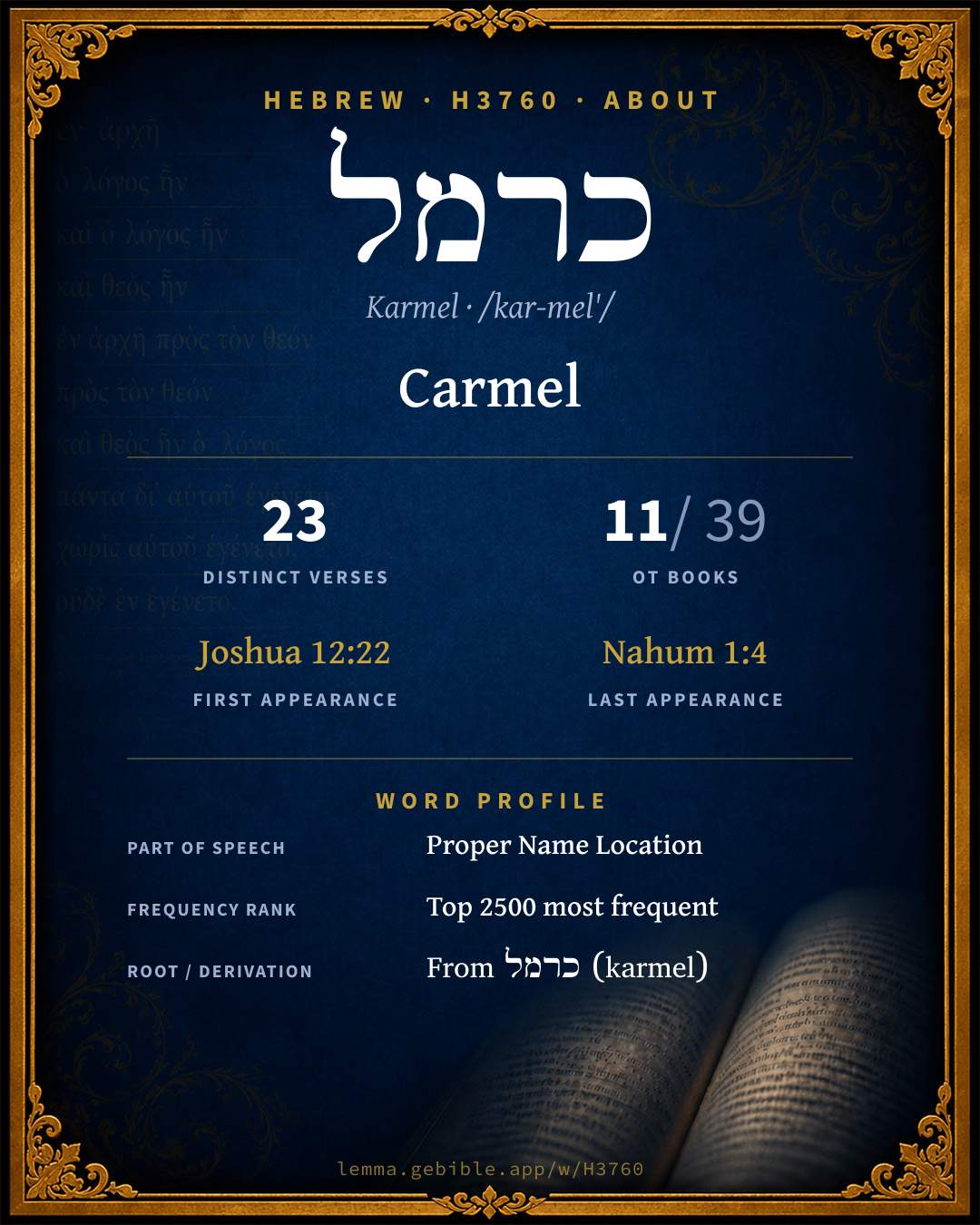
כַּרְמֶל
Carmel
BDB lists 3 entries for ‘Carmel’ fuller range ↓
Full lexicon entry — Brown-Driver-Briggs (BDB)
From Brown-Driver-Briggs (BDB)
Where this word appears
Grammar key — what these labels mean
Part of speech
- Noun
- A naming word — a person, place, thing, or idea.
Noun type
- Proper
- A name of a specific person, place, or people (e.g. Abraham, Zion, Israel).
- Common
- A common noun — a general class of person, place, or thing (“king,” “city,” “water”), not a specific name.
State
- Absolute
- The independent form of a noun, not bound to a following word.
Gender
- Masculine
- Grammatically masculine.
Number
- Singular
- One.
Every verse where H3760 appears in the Book of 2 Kings — 2 distinct verses. Click any verse to open its interlinear word-by-word view. Verse text shown in the World English Bible for context — . Each verse’s Hebrew form is shown with its reference; the English is not keyword-highlighted, since the data carries no word-level English alignment. Use “Compare translations” on any verse to read it across multiple English versions. This concordance covers the Hebrew Bible; Septuagint (Greek Old Testament) occurrences are not indexed here.
2 Kings
- 2 Kings 2:25 הַ/כַּרְמֶ֑ל ptcl def.art + n Proper He went from there to Mount Carmel, and from there he returned to Samaria.
- 2 Kings 4:25 הַ/כַּרְמֶ֑ל ptcl def.art + n Proper So she went, and came to the man of God to Mount Carmel. It happened, when the man of God saw her afar off, that he said to Gehazi his servant, Behold, yonder is the Shunammite:
About this entry
At a glance — auto-summarized from this page’s data, not written by a person. Every figure links to its source below. This summary describes the numbers; it doesn’t interpret them.
At its core, כרמל (Karmel) means “Carmel.” It first appears in Joshua 12:22. It turns up in 23 verses across 11 books, an uncommon footprint. Each statement above links to its evidence; the full detail follows below.
Gloss history
Strong's 1890 vs modern scholarship
About this word
Strong's H3760 catalogs a Hebrew word from the Hebrew Old Testament.
These counts are not copied from any lexicon or concordance. They are computed here, from the morphology-tagged Hebrew Old Testament. What Lemma adds →
- 23
- distinct verses
- The word appears in 23 distinct verses.
- 11 / 39
- OT books
- The word appears in 11 of 39 Old Testament books.
- #1,327
- by frequency
- Top 2500 most frequent Hebrew words (rank 1,327 of 8,640 Hebrew words by occurrence).
View all 23 occurrences in the concordance →
By section of the Old Testament
By traditional corpus
Conventional, traditional groupings — biblical authorship is debated, so this is a traditional corpus grouping, not an authorship claim. Each share is this word’s portion of its verses in that division of the Hebrew canon. Each figure is a share of the word’s 23 distinct verses.
- Prophets (Nevi'im) 21 verses · 91%
- Writings (Ketuvim) 2 verses · 9%
How translations render this word
Counts come from each version’s own published word-to-Strong’s tagging or interlinear alignment — an approximate guide to how each version renders this word, not a word-level alignment the data otherwise carries. Because each total is that version’s own tagged count, the per-version totals vary from one another and need not match the appearance or distinct-verse counts above. These counts may also differ from a printed concordance because Lemma counts each distinctly tagged rendering and does not collapse phrase taggings into a single head-word total. This is a fixed set of word-tagged versions (KJV, ASV, BSB, ULT) and does not change with the reading translation you choose elsewhere. Each version’s license is shown beside its name below (and on Sources).
BDB lists this Strong’s number as 2 distinct words (homographs). Each count above pools all of them and is not split by sense — see the Senses section below. A low-frequency rendering may belong to a different one of those words, not the primary meaning.
- King James Version†: Carmel 23×
- American Standard Version†: Carmel 18×, Fruitful field 2×
- Berean Standard Bible†: Carmel 19×
- unfoldingWord Literal Text†: Carmel 19×
King James Version Public Domain
Renders H3760 across 26† tagged occurrences — most commonly:
Plus 3 renderings that appear only once — usually multi-word phrases or single function words the recovered tagging swept in, not distinct renderings.
American Standard Version Public Domain
Renders H3760 across 26† tagged occurrences — most commonly:
Plus 6 renderings that appear only once — usually multi-word phrases or single function words the recovered tagging swept in, not distinct renderings.
Berean Standard Bible Public Domain
Renders H3760 across 22† tagged occurrences — most commonly:
Plus 3 renderings that appear only once — usually multi-word phrases or single function words the recovered tagging swept in, not distinct renderings.
unfoldingWord Literal Text CC BY-SA 4.0
Renders H3760 across 21† tagged occurrences — most commonly:
Plus 2 renderings that appear only once — usually multi-word phrases or single function words the recovered tagging swept in, not distinct renderings.
Senses in the full BDB
What do BDB’s symbols mean?
BDB uses these scholarly abbreviations:
| Symbol | Meaning |
|---|---|
| 𝔊 | the Septuagint (the ancient Greek translation, LXX) |
| 𝔙 | the Vulgate (the Latin translation) |
| 𝔖 | the Syriac version (the Peshitta) |
| 𝔗 | the Targum (the Aramaic translation) |
| ψ | the Psalms |
| √ | root (the underlying root or stem) |
| ‖ | parallel passage (a synonymous or contrasted parallel) |
| † | the dagger: every passage where the word occurs is cited |
The 4 senses and sub-senses the full Brown-Driver-Briggs lexicon distinguishes for this word, in lexicon order (not ranked by frequency), with BDB’s own verbatim wording and sub-sense lettering. Shown in Hebrew script with BDB’s own scholarly abbreviations. The condensed entry is in the Lexicon Entry tab. See also the Forms in the corpus table below.
כרמל I
- 1. garden-land, Is 16:10 (‖ כְּרָמִים), 10:18 (‖ יַעַר), 29:17(×2) (opp. לְבָנוֹן, יַעַר), 32:15(×2) (opp. מִדְבָּר, יַעַר), v 16 Je 4:26 (opp. מִדְבָּר), 48:33 2 Ch 26:10 (opp. הֶהָרִים); אֶרֶץ הַכּ׳ Je 2:7 the country of garden-land, i.e. fertile; יַעַר כַּרְמִלּוֹ 2 K 19:23 = Is 37:24, the garden-like forest of it (viz. of Lebanon). On Mi 7:14 v. ii. כַּרְמֶל. e.g. Isaiah 16:10
- 2. by meton. (fresh) fruit, garden-growth, 2 K 4:42 (+ לֶחֶם שְׂעוֹרִים); Lv 2:14 (+ אָבִיב קָלוּי בָּאֵשׁ, and גֶּרֶשׂ, q.v.), לֶחֶם וְקָלִי וכי Lv 23:14. e.g. 2 Kings 4:42
כרמל II mont. et urb. Carmel
- 1. mt.-promontory on Mediterranean, with fertile slopes, Tel el-Amarna (Ginti-)Kirmil, Jastrow JBL xi. 1892, 115; Jos 19:26, הַר־הַכּ׳ 1 K 18:19, 20 2 K 2:25; 4:25; רֹאשׁ הַכּ׳ Am 1:2; 9:3; 1 K 18:42; c. art. also Jos 12:22; and, + בָּשָׁן, Je 50:19, as pasturage (in fig. of Isr. as flock of י׳), cf. (כ׳ without art.) Mi 7:14 (less prob. rend. garden-land, i. כַּרְמֶל, so We GASm); הַכּ׳ Is 35:2 (+ הַלְּבָנוֹן, הַשָּׁרוֹן); כ׳ Is 33:9 (+ לְבָנוֹן, הַשָּׁרוֹן and בָּשָׁן, marking extent of land), Na 1:4 (+ לְבָנוֹן, בָּשָׁן); כְּכַרְמֶל בַּיָּם Je 46:18 (sim. of Nebuchad.); Ct 7:6 רֹאשֵׁךְ עָלַיִךְ כַּכּ׳ (but v. כַּרְמִיל);—on Carmel v. GASmG. 337 ff. BuhlG. 23. e.g. Joshua 19:26
- 2. city, 3 h. S. of Hebron, כַּרְמֶל Jos 15:55; בַּכּ׳ 1 S 25:2(×2), 7; כַּרְמֶ֫לָה v 5 (= to Carmel); הַכַּרְמֶ֫לָה 15:12; 25:40.—Mod. Kurmul, RobBR i. 492–498, ii. 97 BuhlG. 163. e.g. Joshua 15:55
Senses from the full Brown-Driver-Briggs lexicon (Brown, Driver, Briggs; Oxford 1906 — public domain), digitized via Sefaria, supplemented by the OpenScriptures HebrewLexicon (CC BY 4.0). Full attribution on Sources.
Word origin
I. n.m. Is 29:17 1. plantation, garden-land. 2. fruit, garden-growth (ל + כֶּרֶם, cf. Ges§ 85, 52 Sta§ 299);—abs. כ׳ Is 16:10 + 12 times; sf. כַּרְמִלּוֹ Is 10:18 + 2 times;—
II. n.pr.mont. et urb. Carmel:—
— Brown-Driver-Briggs (Oxford 1906, public domain), digitized via Sefaria, supplemented by the OpenScriptures HebrewLexicon (CC BY 4.0). See Sources.
Derived from כרמל (karmel) (H3759) — orchard.
Jastrow Dictionary
A second Hebrew/Aramaic lexicon for comparison, covering Aramaic and post-biblical (Talmudic, Targumic, Midrashic) usage that the biblical-Hebrew BDB does not. Matched by lemma rather than by Strong’s number, so a lemma may carry more than one Jastrow headword (shown separately below), and the entries cover usage well beyond the Bible.
כַּרְמֶל
- v. כֶּרֶם)
- 1. a well-cultivated plot; whence (sub. גרש) (grist of) early ripened and tender barley. Men. 66ᵇ; Sifra Vayikra, N’dabah, ch. XIV, Par. 13 (ref. to Lev. II, 14). כ̇ר̇מ̇ל̇ ר̇ך̇ ומ̇ל̇ soft yet brittle; Y. Sabb. I, 2ᵈ bot. [read:] רך מל לא לח וכ׳ soft yet brittle, neither green nor dry, but between the two. Sifra l. c.; Men. l. c. (another explan.) כ̇ר̇ מ̇ל̇א rounded and full. e.g. Leviticus 2:14
- 2. pr. n. Carmel; (prob. everywhere) Mount Carmel. Y. Succ. III, 53ᵈ כשעוה וכשושנת כ׳ of the color of wax or of the lily of Carmel (v. יְרַקְרַק); (Tosef. Neg. I, 5 כשעוה וכקורמל, Var. וכקורמן; R. S. to Neg. XI, 4 וכקורמין).—Y. Ber. I, 2ᵇ bot. ראש הר הכ׳; Sabb. 35ᵃ ראש הכ׳ (Ms. M. ראש הר הכ׳) the summit of M. C. Gen. R. s. 99; Mekh. Yithro, Baḥod., s. 5 (alluding to Jer. XLVI, 18) תבור … וכ׳ מאספמיא Tabor came (to the desert for the law-giving) from Beth-Elim and C. from Ispamia; Meg. 29ᵃ e.g. Jeremiah 46:18
A Dictionary of the Targumim, the Talmud Babli and Yerushalmi, and the Midrashic Literature (Marcus Jastrow; London, Luzac, 1903) — Public Domain. Digitized via Sefaria. Digitized via Sefaria. Full attribution on Sources.
Forms in the corpus
The 19 distinct written forms H3760 takes in the Hebrew Bible, most frequent first — each parse links to that state’s occurrences in the concordance. Hebrew forms include their vowel points and cantillation, so a single lemma takes many written forms.
| Form | Parsing | Example | Uses |
|---|---|---|---|
| הַ/כַּרְמֶ֑ל | Noun, Proper | 1 Kings 18:19 | 3 |
| בַּ/כַּרְמֶֽל | Noun, Proper | 1 Samuel 25:2 | 2 |
| הַ/כַּרְמֶ֖ל | Noun, Proper | Isaiah 35:2 | 2 |
| הַ/כַּרְמֶֽל | Noun, Proper | Amos 1:2 | 2 |
| בַ/כַּרְמֶ֗ל | Noun, Proper | 1 Samuel 25:2 | 1 |
| בְּ/כַרְמֶל֙ | Noun, Proper | Joshua 19:26 | 1 |
| הַ/כַּרְמֶ֑לָ/ה | Noun, Proper | 1 Samuel 25:40 | 1 |
| הַ/כַּרְמֶ֔ל | Noun, Proper | Amos 9:3 | 1 |
| הַ/כַּרְמֶ֨לָ/ה֙ | Noun, Proper | 1 Samuel 15:12 | 1 |
| הַ/כַּרְמֶל֙ | Noun, Proper | 1 Kings 18:42 | 1 |
| וְ/כַרְמֶ֔ל | Noun, Proper | Nahum 1:4 | 1 |
| וְ/כַרְמֶֽל | Noun, Proper | Isaiah 33:9 | 1 |
| וּ/בַ/כַּרְמֶ֔ל | Noun, Common, Masculine, Singular, Absolute | 2 Chronicles 26:10 | 1 |
| וּ/כְ/כַרְמֶ֖ל | Noun, Proper | Jeremiah 46:18 | 1 |
| כַרְמֶ֨לָ/ה֙ | Noun, Proper | 1 Samuel 25:5 | 1 |
| כַּ/כַּרְמֶ֔ל | Noun, Proper | Song of Solomon 7:5 | 1 |
| כַּרְמֶ֑ל | Noun, Common, Masculine, Singular, Absolute | Micah 7:14 | 1 |
| כַּרְמֶ֖ל | Noun, Proper | Joshua 15:55 | 1 |
| לַ/כַּרְמֶ֖ל | Noun, Proper | Joshua 12:22 | 1 |
Same root — word family
Other BDB entries built from the same root as H3760, grouped by Strong’s listed origin. These share a root / origin per the lexicon — not necessarily a shared meaning. Each links to that word’s own entry.
Derives from
Proper names from this root
People and places named from this root — a name, not an additional meaning of the word.
Compare all same-root words → 1 of the same-root words is a proper name (a person or place). They share a root, not necessarily a meaning.
Bible dictionary
Public-domain dictionary articles matched to this entry by name (Carmel). A biblical name can be shared by more than one person or place, so an article may treat several.
Easton's Bible Dictionary · M. G. Easton, 1897
A park; generally with the article, "the park." (1.) A prominent headland of Central Palestine, consisting of several connected hills extending from the plain of Esdraelon to the sea, a distance of some 12 miles or more. At the east end, in its highest part, it is 1,728 feet high, and at the west end it forms a promontory to the bay of Acre about 600 feet above the sea. It lay within the tribe of Asher. It was here, at the east end of the ridge, at a place called el-Mukhrakah (i.e., the place of burning), that Elijah brought back the people to their allegiance to God, and slew the prophets of Baal (1 Kings 18). Here were consumed the "fifties" of the royal guard; and here also Elisha received the visit of the bereaved mother whose son was restored by him to life (2 Kings 4:25-37). "No mountain in or around Palestine retains its ancient beauty so much as Carmel. Two or three villages and some scattered cottages are found on it; its groves are few but luxuriant; it is no place for crags and precipices or rocks of wild goats; but its surface is covered with a rich and constant verdure." "The whole mountain-side is dressed with blossom, and flowering shrubs, and fragrant herbs." The western extremity of the ridge is, however, more rocky and bleak than the eastern. The head of the bride in Cant. 7:5 is compared to Carmel. It is ranked with Bashan on account of its rich pastures (Isa. 33:9; Jer. 50:19; Amos 1:2). The whole ridge is deeply furrowed with rocky ravines filled with dense jungle. There are many caves in its sides, which at one time were inhabited by swarms of monks. These caves are referred to in Amos 9:3. To them Elijah and Elisha often resorted (1 Kings 18:19, 42; 2 Kings 2:25). On its north-west summit there is an ancient establishment of Carmelite monks. Vineyards have recently been planted on the mount by the German colonists of Haifa. The modern Arabic name of the mount is Kurmul, but more commonly Jebel Mar Elyas, i.e., Mount St. Elias, from the Convent of Elias.
(2.) A town in the hill country of Judah (Josh. 15:55), the residence of Nabal (1 Sam. 25:2, 5, 7, 40), and the native place of Abigail, who became David's wife (1 Sam. 27:3). Here king Uzziah had his vineyards (2 Chr. 26:10). The ruins of this town still remain under the name of Kurmul, about 10 miles south-south-east of Hebron, close to those of Maon.
Smith's Bible Dictionary · William Smith, 1863
(fruitful place or park).
+ A mountain which forms one of the most striking and characteristic features of the country of Palestine. It is a noble ridge, the only headland of lower and central Palestine, and forms its southern boundary, running out with a bold bluff promontory, nearly 600 feet high, almost into the very waves of the Mediterranean, then extending southeast for a little more than twelve miles, when it terminates suddenly in a bluff somewhat corresponding to its western end. In form Carmel is a tolerably continuous ridge, its highest point, about four miles from the eastern end, being 1740 feet above the sea. That which has made the name of Carmel most familiar to the modern world is its intimate connection with the history of the two great prophets of Israel, Elijah and Elisha. (2 Kings 2:25; 4:25; 1 Kings 18:20-42) It is now commonly called Mar Elyas; Kurmel being occasionally, but only seldom, hear. + A town in the mountainous country of Judah, (Joshua 15:55) familiar to us as the residence of Nabal. (1 Samuel 25:2,5,7,40)
Hitchcock's Bible Names Dictionary · Roswell D. Hitchcock, 1869
circumcised lamb; harvest; full of ears of corn
Classic public-domain reference works; full attribution on Sources.
Septuagint verse parallels
This word appears in 21 verses that also exist in the Greek Old Testament (Septuagint), out of the 23 Hebrew verses it occurs in. You can read those verses in Greek by switching the Old Testament edition to the Septuagint.
Read these verses in the Septuagint
- Joshua 12:22
- 1 Samuel 15:12
- 1 Kings 18:19
- 2 Kings 2:25
- 2 Chronicles 26:10
- Song of Solomon 7:5
- Isaiah 33:9
- Amos 1:2
- Micah 7:14
- Nahum 1:4
This is a verse-level parallel only — the same verses exist in both the Hebrew and Greek Old Testaments. No word-level Hebrew↔Greek correspondence is claimed: the data carries no such alignment, so no Greek word is shown as this Hebrew word’s translation. Coverage is not total — the Septuagint omits the deuterocanon and renumbers the Psalms, so some Hebrew verses have no direct Greek parallel.