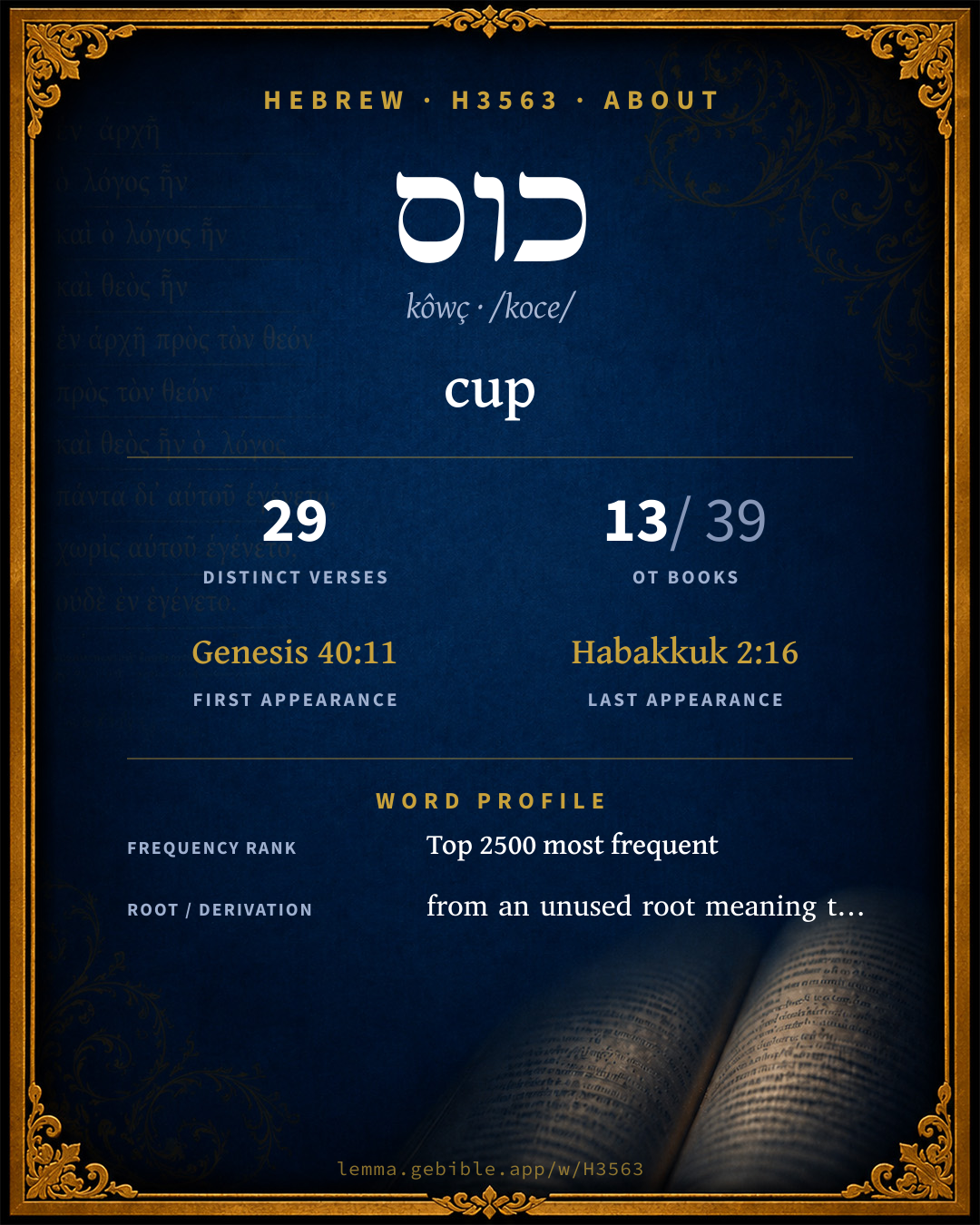
כּוֹס
cup
‘cup’ is one of 2 main senses fuller range ↓
Full lexicon entry — Brown-Driver-Briggs (BDB)
From Brown-Driver-Briggs (BDB)
Where this word appears
See every Construct-state word in the Hebrew Bible →
Grammar key — what these labels mean
Part of speech
- Noun
- A naming word — a person, place, thing, or idea.
Noun type
- Common
- A common noun — a general class of person, place, or thing (“king,” “city,” “water”), not a specific name.
State
- Construct
- A noun bound to a following noun in a possessive / “of” relationship (the construct chain).
- Absolute
- The independent form of a noun, not bound to a following word.
Gender
- Feminine
- Grammatically feminine.
- Masculine
- Grammatically masculine.
Number
- Singular
- One.
- Plural
- More than one (in Hebrew, generally three or more).
Grammatical forms
- Noun, Common, Feminine, Singular, Construct 20 times (59%)
- Noun, Common, Feminine, Singular, Absolute 10 times (29%)
- Noun, Common, Masculine, Singular, Absolute 2 times (6%)
- Noun, Common, Feminine, Plural, Absolute 1 time (3%)
- Noun, Common, Masculine, Singular, Construct 1 time (3%)
Parsed forms decoded from the imported morphology (morphhb / Westminster Leningrad Codex — WLC text public domain, morphhb tagging CC BY 4.0), counted across 34 parsed occurrences — not distinct verses.
Every verse where H3563 appears — 29 distinct verses across 13 books. Click any verse to open its interlinear word-by-word view. Verse text shown in the World English Bible for context — . Each verse’s Hebrew form is shown with its reference; the English is not keyword-highlighted, since the data carries no word-level English alignment. Use “Compare translations” on any verse to read it across multiple English versions. This concordance covers the Hebrew Bible; Septuagint (Greek Old Testament) occurrences are not indexed here.
Genesis 3 verses
- Genesis 40:11 וְ/כ֥וֹס כּ֣וֹס הַ/כּ֖וֹס conj + n c fs cs n c fs cs ptcl def.art + n c fs Pharaoh's cup was in my hand; and I took the grapes, and pressed them into Pharaoh's cup, and I gave the cup into Pharaoh's hand."
- Genesis 40:13 כוֹס n c fs cs Within three more days, Pharaoh will lift up your head, and restore you to your office. You will give Pharaoh's cup into his hand, the way you did when you were his cupbearer.
- Genesis 40:21 הַ/כּ֖וֹס ptcl def.art + n c fs He restored the chief cupbearer to his position again, and he gave the cup into Pharaoh's hand;
Leviticus 1 verse
Deuteronomy 1 verse
2 Samuel 1 verse
1 Kings 1 verse
2 Chronicles 1 verse
Psalms 6 verses
- Psalms 11:6 כּוֹסָֽ/ם n c fs cs + sfx pers 3mp On the wicked he will rain blazing coals; Fire, sulfur, and scorching wind shall be the portion of their cup.
- Psalms 16:5 וְ/כוֹסִ֑/י conj + n c fs cs + sfx pers 1cs Yahweh assigned my portion and my cup. You made my lot secure.
- Psalms 23:5 כּוֹסִ֥/י n c fs cs + sfx pers 1cs You prepare a table before me in the presence of my enemies. You anoint my head with oil. My cup runs over.
- Psalms 75:8 כ֪וֹס n c fs For in the hand of Yahweh there is a cup, Full of foaming wine mixed with spices. He pours it out. Indeed the wicked of the earth drink and drink it to its very dregs.
- Psalms 102:6 כְּ/כ֣וֹס prep + n c ms cs I am like a pelican of the wilderness. I have become as an owl of the waste places.
- Psalms 116:13 כּוֹס n c fs cs I will take the cup of salvation, and call on the name of Yahweh.
Proverbs 1 verse
Isaiah 2 verses
- Isaiah 51:17 כּ֣וֹס כּ֧וֹס n c fs cs n c fs cs Awake, awake, stand up, Jerusalem, that have drunk at the hand of Yahweh the cup of his wrath; you have drunken the bowl of the cup of staggering, and drained it.
- Isaiah 51:22 כּ֣וֹס כּ֣וֹס n c fs cs n c fs cs Thus says your Lord Yahweh, and your God who pleads the cause of his people, Behold, I have taken out of your hand the cup of staggering, even the bowl of the cup of my wrath; you shall no more drink it again:
Jeremiah 7 verses
- Jeremiah 16:7 כּ֣וֹס n c fs cs neither shall men break [bread] for them in mourning, to comfort them for the dead; neither shall men give them the cup of consolation to drink for their father or for their mother.
- Jeremiah 25:15 כּ֨וֹס n c fs cs For thus says Yahweh, the God of Israel, to me: take this cup of the wine of wrath at my hand, and cause all the nations, to whom I send you, to drink it.
- Jeremiah 25:17 הַ/כּ֖וֹס ptcl def.art + n c fs Then took I the cup at Yahweh's hand, and made all the nations to drink, to whom Yahweh had sent me:
- Jeremiah 25:28 הַ/כּ֥וֹס ptcl def.art + n c fs It shall be, if they refuse to take the cup at your hand to drink, then shall you tell them, Thus says Yahweh of Hosts: You shall surely drink.
- Jeremiah 35:5 וְ/כֹס֑וֹת conj + n c fp I set before the sons of the house of the Rechabites bowls full of wine, and cups; and I said to them, Drink you wine.
- Jeremiah 49:12 הַ/כּוֹס֙ ptcl def.art + n c fs For thus says Yahweh: Behold, they to whom it didn't pertain to drink of the cup shall assuredly drink; and are you he who shall altogether go unpunished? you shall not go unpunished, but you shall surely drink.
- Jeremiah 51:7 כּוֹס n c fs cs Babylon has been a golden cup in Yahweh's hand, who made all the earth drunken: the nations have drunk of her wine; therefore the nations are mad.
Lamentations 1 verse
Ezekiel 3 verses
- Ezekiel 23:31 כוֹסָ֖/הּ n c fs cs + sfx pers 3fs You have walked in the way of your sister; therefore will I give her cup into your hand.
- Ezekiel 23:32 כּ֤וֹס n c fs cs Thus says the Lord Yahweh: You shall drink of your sister's cup, which is deep and large; you shall ridiculed and had in derision; it contains much.
- Ezekiel 23:33 כּ֚וֹס כּ֖וֹס n c fs cs n c fs cs You shall be filled with drunkenness and sorrow, with the cup of astonishment and desolation, with the cup of your sister Samaria.
Habakkuk 1 verse
About this entry
At a glance — auto-summarized from this page’s data, not written by a person. Every figure links to its source below. This summary describes the numbers; it doesn’t interpret them.
The Hebrew word כוס centers on the idea of “cup.” Debuting at Genesis 40:11, it then recurs through the corpus. Spanning 29 verses in 13 books, it ranks among the moderately common words of the Hebrew Bible. BDB distinguishes 2 senses for it. Sharing its root, it stands alongside כיס and קסת. For the data behind this summary, explore the sense tree and the renderings breakdown below.
Gloss history
Strong's 1890 vs modern scholarship
About this word
Strong's H3563 catalogs a Hebrew word from the Hebrew Old Testament.
These counts are not copied from any lexicon or concordance. They are computed here, from the morphology-tagged Hebrew Old Testament. What Lemma adds →
- 29
- distinct verses
- The word appears in 29 distinct verses.
- 13 / 39
- OT books
- The word appears in 13 of 39 Old Testament books.
- #1,041
- by frequency
- Top 2500 most frequent Hebrew words (rank 1,041 of 8,640 Hebrew words by occurrence).
View all 29 occurrences in the concordance →
By section of the Old Testament
By traditional corpus
Conventional, traditional groupings — biblical authorship is debated, so this is a traditional corpus grouping, not an authorship claim. Each share is this word’s portion of its verses in that division of the Hebrew canon. Each figure is a share of the word’s 29 distinct verses.
- Prophets (Nevi'im) 15 verses · 52%
- Writings (Ketuvim) 9 verses · 31%
- Torah (Pentateuch) 5 verses · 17%
How translations render this word
Counts come from each version’s own published word-to-Strong’s tagging or interlinear alignment — an approximate guide to how each version renders this word, not a word-level alignment the data otherwise carries. Because each total is that version’s own tagged count, the per-version totals vary from one another and need not match the appearance or distinct-verse counts above. These counts may also differ from a printed concordance because Lemma counts each distinctly tagged rendering and does not collapse phrase taggings into a single head-word total. This is a fixed set of word-tagged versions (KJV, ASV, BSB, ULT) and does not change with the reading translation you choose elsewhere. Each version’s license is shown beside its name below (and on Sources).
BDB lists this Strong’s number as 2 distinct words (homographs). Each count above pools all of them and is not split by sense — see the Senses section below. A low-frequency rendering may belong to a different one of those words, not the primary meaning.
- King James Version†: Cup 26×, Little owl 2×
- American Standard Version†: Cup 20×, 's cup 4×, Little owl 2×
- Berean Standard Bible†: Cup 28×, Little owl 2×
- unfoldingWord Literal Text†: Cup 17×, Cup of 9×, Little owl 2×
King James Version Public Domain
Renders H3563 across 34† tagged occurrences — most commonly:
Plus 6 renderings that appear only once — usually multi-word phrases or single function words the recovered tagging swept in, not distinct renderings.
American Standard Version Public Domain
Renders H3563 across 34† tagged occurrences — most commonly:
Plus 8 renderings that appear only once — usually multi-word phrases or single function words the recovered tagging swept in, not distinct renderings.
Berean Standard Bible Public Domain
Renders H3563 across 32† tagged occurrences — most commonly:
Plus 2 renderings that appear only once — usually multi-word phrases or single function words the recovered tagging swept in, not distinct renderings. Not rendered by a distinct English word in 1 further occurrence.
unfoldingWord Literal Text CC BY-SA 4.0
Renders H3563 across 32† tagged occurrences — most commonly:
Plus 4 renderings that appear only once — usually multi-word phrases or single function words the recovered tagging swept in, not distinct renderings.
Senses in BDB
The 2 senses BDB distinguishes for this word, in lexicon order (not ranked by frequency or importance). The full entry — with sub-senses — is in the Lexicon Entry tab.
- cup (noun feminine)
- a kind of owl (an unclean bird) (noun masculine)
Word origin
I. n.f. La 4:21 cup (√ unknown; perhaps kindred with כִּיס, q.v.; NH id.; Ph. כסת; Aramaic כָּס, ܟܳܣ; Arabic كَأْسٌ is Aramaic loan-wd. according to Frä 171, but see DHMVOJ i, 27)—כ׳ abs. Gn 40:11 +; כּ֯יֹס Pr 23:31; cstr. Gn 40:11 +; sf. כּוֹסִי ψ 16:5; 23:5 etc.; pl. abs. כֹּסוֹת Je 35:5;—cup 2 S 12:3; for wine Gn 40:11(×3), 13, 21 (all E), Pr 23:31 Je 35:5; שְׂפַת־כּוֹס 1 K 7:26 2 Ch 4:5; כ׳ תַּנְחוּמִים Je 16:7 the cup offered to mourners; fig. (wine-) cup of judgment of י׳, from which the nations, or Isr., must drink Je 46:12 La 4:21 ψ 75:9; כ׳ חֲמָתוֹ Is 51:17, 22; כ׳ הַיַּיִן הַחֵמָה Je 25:15, cf. v 17. 28; כ׳ הַתַּרְעֵלָה Is 51:17, 22; כ׳ שַׁמָּה וּשְׁמָמָה Ez 23:33, cf. v 31, 32, 33; כ׳ יְמִין י׳ Hb 2:16; by bold metaph. Babylon is such a cup כ׳ זָהָב בְּיַד י׳ Je 51:7; so of wicked persons, fire, brimstone, and burning wind are מְנָת־כּוֹסָם ψ 11:6 the portion of their cup; כ׳ in good sense, cup of blessing ψ 23:5 (overflowing); י׳ מְנָת חֶלְקִי וְכוֹסִי ψ 16:5; כ׳ יְשׁוּעוֹת ψ 116:13.
II. n.[m.] a kind of owl (according to Vrss; v. Kn-Di Lv 11:17; wd. perhaps onomatop.)—unclean bird Lv 11:17 Dt 14:16, dwelling in ruins כ׳ חֳרָבוֹת ψ 102:7
— Brown-Driver-Briggs (Oxford 1906, public domain), digitized via Sefaria, supplemented by the OpenScriptures HebrewLexicon (CC BY 4.0). See Sources.
Origin: from an unused root meaning to hold together
Jastrow Dictionary
A second Hebrew/Aramaic lexicon for comparison, covering Aramaic and post-biblical (Talmudic, Targumic, Midrashic) usage that the biblical-Hebrew BDB does not. Matched by lemma rather than by Strong’s number, so a lemma may carry more than one Jastrow headword (shown separately below), and the entries cover usage well beyond the Bible.
כּוֹס I
- c. (b. h.; or כנס, v. Ges. Thes., a. Hebr. Dict.10 s. v.)
- 1. cup, also a drink. Tam. III, 4. Erub. 65ᵇ בג׳ … בכיסו בכוֹסוֹ בכעסו man’s character is found out in three things, in his money bag, in his cup (when drinking) and in his anger; Der. Er. Zutta ch. V.—Keth. 75Keth. 75ᵇ, sq., v. בָּדַק. Pes. 105ᵃ קדושה על הכ׳ sanctification (of the Sabbath or Holy Day) over a cup of wine. Ib. אם אין לו אלא כ׳ אחד if he has only enough wine for one cup. Sabb. XIV, 3 כ׳ עיקרים, v. עִיקָּר; a. fr.—Pl. כּוֹסוֹת. Kel. XXII, 1; Y. Ab. Zar. II, end, 42ᵃ, v. הַנָּחָה. Men. 28ᵇ, v. אֲלֶכְסַנְדְּרִי. Pes. X, 1, a. fr. ארבע כ׳ four cups of wine to be drunk on the Passover night; a. fr.
- 2. cavity. Par. II, 5 (two black or white hairs) בתוך כ׳ אחד in one follicle (v. גוּמָּא).—Pl. as ab. Ib. Y. Ab. Zar. l. c. הן כ׳ הן גומות kosoth and gummoth mean the same things.—בֵּית הכּוֹסוֹת the second stomach of ruminants. Ḥull. III, 1 (42ᵃ), v. comment. a. הַבְלִילָא. Ḥull. 49ᵃ; 50ᵇ עובי בית הכ׳ the folds (thick walls) of the etc.; a. fr.
*כּוֹס II
- (כסס, v. כֵּיסָא) thorn.—Pl. כּוֹסִים. Pesik. B’shall. p. 92ᵃ (Y. Maasr. III, 50ᵈ bot. קוצין), v. כָּסַח.
כּוֹס III
- , v. נָכַס, נְכַס a. כְּסַס.
A Dictionary of the Targumim, the Talmud Babli and Yerushalmi, and the Midrashic Literature (Marcus Jastrow; London, Luzac, 1903) — Public Domain. Digitized via Sefaria. Digitized via Sefaria. Full attribution on Sources.
Forms in the corpus
The 22 distinct written forms H3563 takes in the Hebrew Bible, most frequent first — each parse links to that state’s occurrences in the concordance. Hebrew forms include their vowel points and cantillation, so a single lemma takes many written forms.
Same root — word family
Other BDB entries built from the same root as H3563, grouped by Strong’s listed origin. These share a root / origin per the lexicon — not necessarily a shared meaning. Each links to that word’s own entry.
Derived from this word
Compare all same-root words → They share a root, not necessarily a meaning.
Septuagint verse parallels
This word appears in 27 verses that also exist in the Greek Old Testament (Septuagint), out of the 29 Hebrew verses it occurs in. You can read those verses in Greek by switching the Old Testament edition to the Septuagint.
Read these verses in the Septuagint
- Genesis 40:11
- Leviticus 11:17
- Deuteronomy 14:16
- 2 Samuel 12:3
- 1 Kings 7:26
- 2 Chronicles 4:5
- Psalms 11:6
- Proverbs 23:31
- Isaiah 51:17
- Jeremiah 16:7
- Lamentations 4:21
- Ezekiel 23:31
This is a verse-level parallel only — the same verses exist in both the Hebrew and Greek Old Testaments. No word-level Hebrew↔Greek correspondence is claimed: the data carries no such alignment, so no Greek word is shown as this Hebrew word’s translation. Coverage is not total — the Septuagint omits the deuterocanon and renumbers the Psalms, so some Hebrew verses have no direct Greek parallel.