
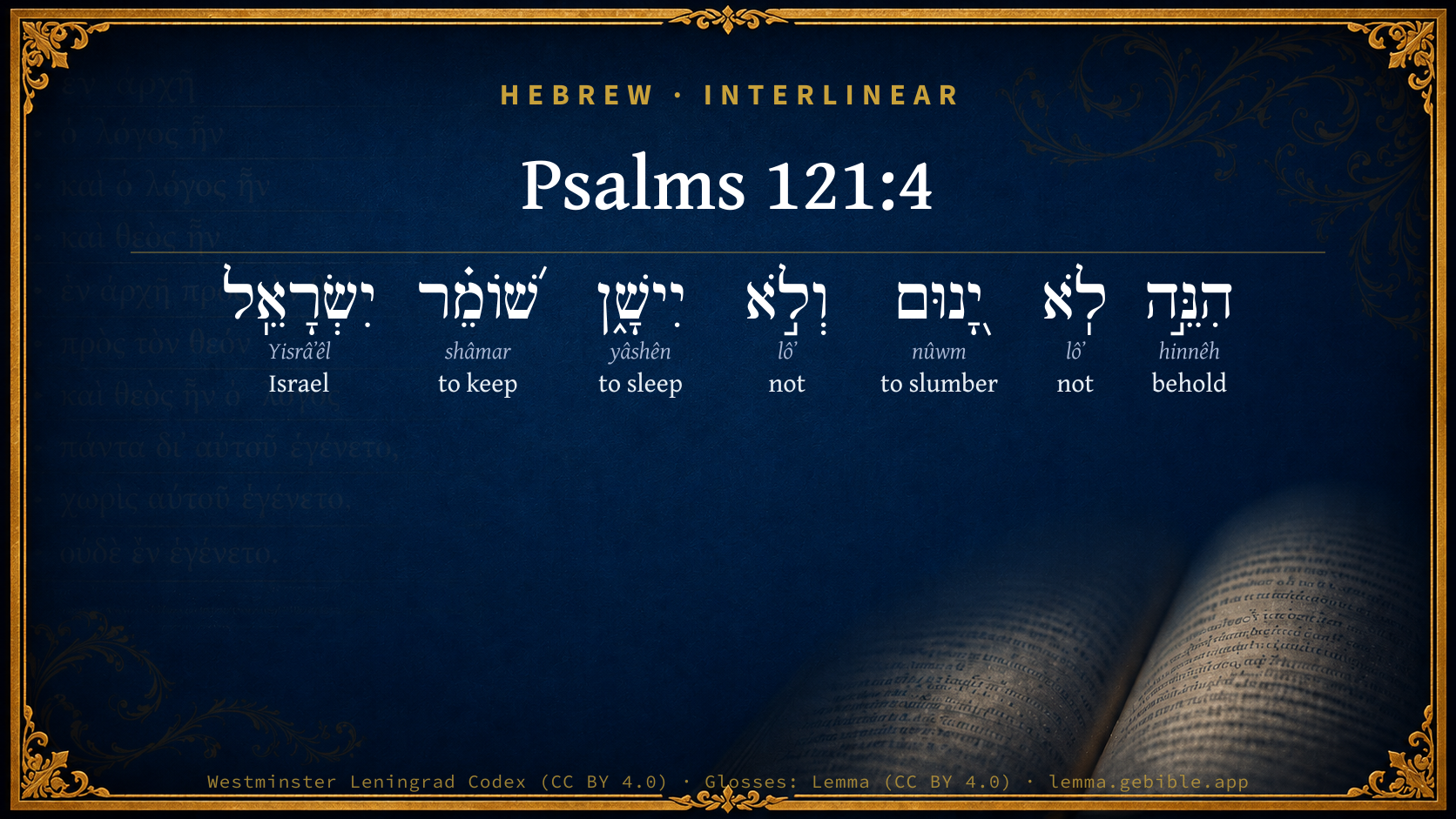
Psalms 121:4

Hebrew (Westminster Leningrad Codex) Psalms 121:4 appears in the Hebrew Old Testament. The text above is from the Westminster Leningrad Codex. Each word links to its Strong’s number, a concise gloss, and parsing drawn from the Open Scriptures Hebrew Bible morphology. Click any word for its full Brown-Driver-Briggs (BDB) entry.
Download image
Cite this verse

Psalms 121:4 (World English Bible). Public Domain. Lemma interlinear Bible study tool, https://lemma.gebible.app/v/psalms/121/4.

Show BibTeX & RIS
BibTeX
RIS
English Translation
Behold, he who keeps Israel Will neither slumber nor sleep.
World English Bible · Public Domain
Download a study sheet

One document with this verse’s original text, its word-by-word gloss line, the meaning frame, cross-references with their text, attributed commentary, and full source and license credits — printable, and it pastes into notes with its structure intact.

This verse Autodidact and up

Study sheet (.html) Plain text (.txt)

A passage Seminary Student

Up to 50 verses in one chapter. A passage sheet keeps up to 6 commentary sources and 12 cross-references per verse, in the order this page ranks them, and says so on the sheet whenever that leaves anything out. Ask for a single verse and you get the Autodidact verse sheet above.

Everything on this page stays free to read, with no account — the sheet is a download of what is already on screen, not access to it.

Want to remove ads? Support Godless Engineer
Compare translations 3

The same verse in 3 English versions, stacked beneath the original-language interlinear above. Click any original word for its lexicon entry.

Each is an independent rendering of the whole verse — the interlinear is not word-aligned to these translations.

Highlighted words mark where these versions differ — a whole-verse word diff, not a word-by-word alignment.

  • World English Bible Public Domain
    Behold, he who keeps Israel Will neither slumber nor sleep.
  • King James Version Public Domain
    Behold, he that keepeth Israel shall neither slumber nor sleep.
  • unfoldingWord Literal Text CC BY-SA 4.0
    Behold, he will not slumber, and he will not sleep, the keeper of Israel.

unfoldingWord Literal Text — © unfoldingWord, licensed CC BY-SA 4.0. Word-aligned USFM3 via Door43 (git.door43.org/unfoldingWord/en_ult).

Versions to compare (up to 4)

3 of 4 selected

Show all 18 translations

Every available English version of this verse, each an independent rendering of the whole verse.

  • World English Bible Public Domain
    Behold, he who keeps Israel Will neither slumber nor sleep.
  • Berean Standard Bible Public Domain
    Behold, the Protector of Israel will neither slumber nor sleep.
  • Majority Standard Bible Public Domain
    Behold, the Protector of Israel will neither slumber nor sleep.
  • King James Version Public Domain
    Behold, he that keepeth Israel shall neither slumber nor sleep.
  • American Standard Version (1901) Public Domain
    Behold, he that keepeth Israel Will neither slumber nor sleep.
  • Revised Version (1885) Public Domain
    Behold, he that keepeth Israel shall neither slumber nor sleep.
  • Geneva Bible (1599) Public Domain
    Beholde, he that keepeth Israel, wil neither slumber nor sleepe.
  • Douay-Rheims (1899) Public Domain
    The sharp arrows of the mighty, with coals that lay waste.
  • Young's Literal Translation Public Domain
    Lo, He slumbereth not, nor sleepeth, He who is preserving Israel.
  • Literal Standard Version CC BY-SA 4.0
    Behold, He does not slumber, nor sleep, || He who is preserving Israel.
  • Unlocked Literal Bible CC BY-SA 4.0
    See, the guardian of Israel never slumbers or sleeps.
  • unfoldingWord Literal Text CC BY-SA 4.0
    Behold, he will not slumber, and he will not sleep, the keeper of Israel.
  • Darby Bible Public Domain
    Behold, he that keepeth Israel will neither slumber nor sleep.
  • World Messianic Bible Public Domain
    Behold, he who keeps Israel will neither slumber nor sleep.
  • Webster's Bible Public Domain
    Behold, he that keepeth Israel shall neither slumber nor sleep.
  • Free Bible Version CC BY-SA 4.0
    In fact he who watches over you doesn't take naps or fall asleep.
  • Bible in Basic English Public Domain
    See, the eyes of Israel's keeper will not be shut in sleep.
  • JPS Tanakh (1917) Public Domain
    Behold, He that keepeth Israel doth neither slumber nor sleep.

Literal Standard Version (2020), Covenant Press — licensed CC BY-SA 4.0. Text via the HelloAO Bible API (eBible.org). Unlocked Literal Bible (unfoldingWord) — licensed CC BY-SA 4.0. Text via the HelloAO Bible API (eBible.org). unfoldingWord Literal Text — © unfoldingWord, licensed CC BY-SA 4.0. Word-aligned USFM3 via Door43 (git.door43.org/unfoldingWord/en_ult). Free Bible Version, Dr. Jonathan Gallagher — licensed CC BY-SA 4.0. Text via the HelloAO Bible API (eBible.org).

Word by word

More ways to search: Search by grammar → Find every occurrence → Compare this word →

Practice this passage: Drill this verse → Learn its vocabulary →

About this verse

These counts appear in no published source. They are computed here, from the morphology-tagged text and Lemma’s own curated glosses. What Lemma adds →

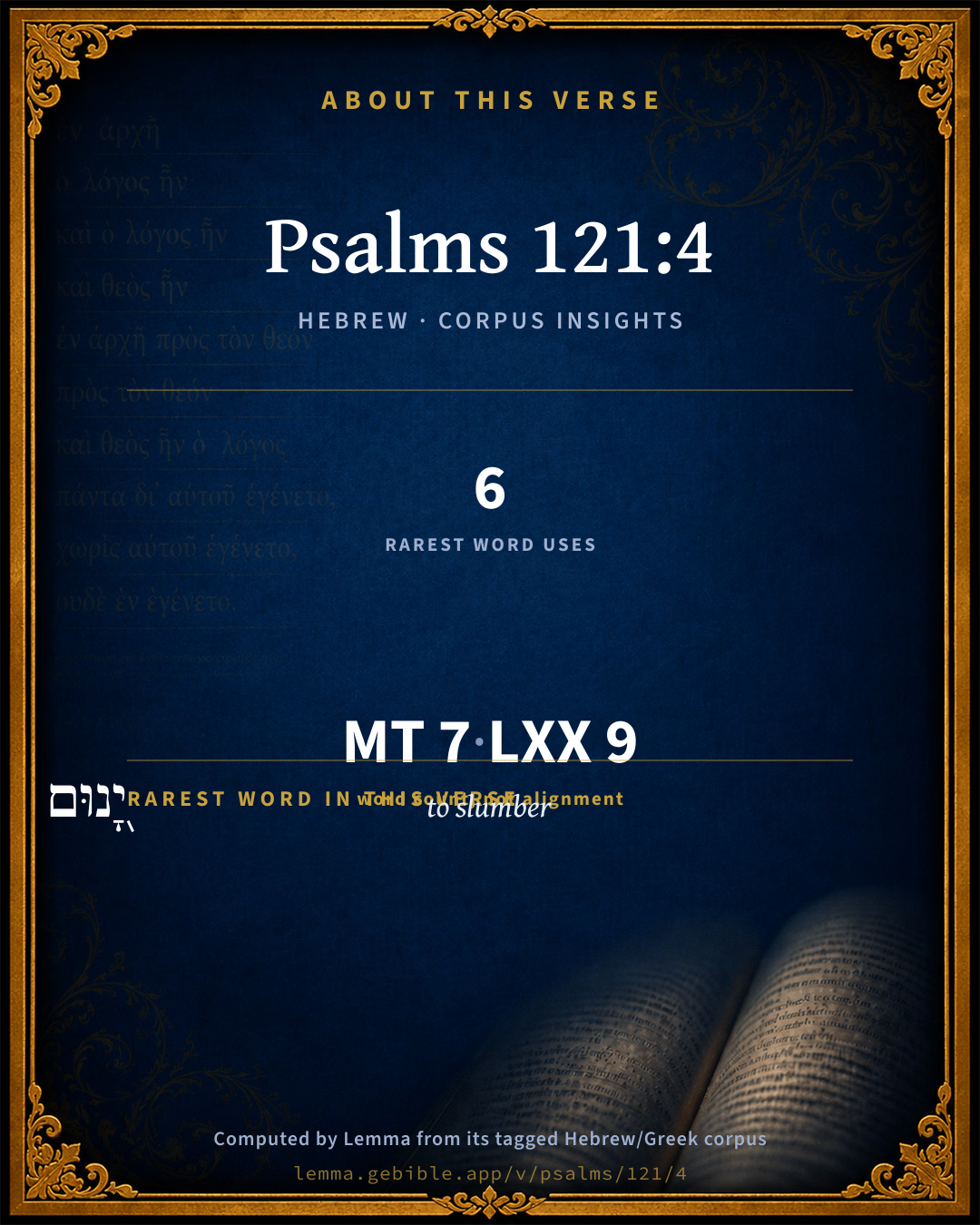
7
words
6
distinct lemmas
Wisdom
section

Notable vocabulary

The rarest word here is יָ֭נוּם to slumber H5123 — appearing just 6 times in the whole Hebrew Bible.

Shared distinctive vocabulary

יָ֭נוּם to slumber H5123 occurs in 6 verses of the Hebrew Bible. Also found in:

Grammatical profile

  • 3 verbs
  • 1 noun
  • 3 particles

Verb forms

  • יָ֭נוּם Qal · Imperfect
  • יִישָׁ֑ן Qal · Imperfect
  • שׁ֝וֹמֵ֗ר Qal · Participle Active

Repetition

A word recurs within this verse — often emphatic in Hebrew:

Hebrew & Septuagint length

In English translation the verse runs 10 words from the Hebrew and 10 from the Septuagint (LXX English) — the same length.

A rough comparison of the two English renderings, which tokenize alike — not a word-level alignment.

Word counts can differ between the Hebrew and the Greek without any difference in meaning — e.g. the Hebrew direct-object marker אֵת has no separate Greek word, and Greek often adds the article ὁ.

In the original languages it is 7 Hebrew tokens and 9 Greek tokens — but the two are counted differently (Hebrew bundles its prefixes and suffixes into one token; the Greek is in lemma form), so that isn’t a like-for-like length.

Cross-references

7

Topical passages linked to Psalms 121:4 in the Treasury of Scripture Knowledge — connected by theme and wording, ordered by reader-vote popularity; previews shown in the World English Bible.

  • Psalms 127:1 Unless Yahweh builds the house, They labor in vain who build it. Unless Yahweh watches over the city, The watchman guards it in vain.
  • Isaiah 27:3 I Yahweh am its keeper; I will water it every moment: lest any hurt it, I will keep it night and day.
  • Psalms 32:7–8 You are my hiding place. You will preserve me from trouble. You will surround me with songs of deliverance. Selah.
  • Ecclesiastes 8:16 When I applied my heart to know wisdom, and to see the business that is done on the earth (for also there is that neither day nor night sees sleep with his eyes),
  • 1 Kings 18:27 It happened at noon, that Elijah mocked them, and said, Cry aloud; for he is a god: either he is musing, or he is gone aside, or he is on a journey, or peradventure he sleeps and must be awakened.
  • Psalms 27:1 Yahweh is my light and my salvation. Whom shall I fear? Yahweh is the strength of my life. Of whom shall I be afraid?
  • Revelation 7:15 Therefore they are before the throne of God, they serve him day and night in his temple. He who sits on the throne will spread his tent over them.

Cross-references courtesy of OpenBible.info (CC BY 4.0).

Hebrew and Greek witnesses Masoretic Hebrew ↔ Greek Septuagint

The same verse in the two great witnesses to the Old Testament, shown verse-for-verse.

You’re reading Greek Psalm 120 (Hebrew Psalm 121). The Septuagint counts the superscription, so verse numbers can differ from the Hebrew — chapter-level alignment, not verse-by-verse. Numbering follows Rahlfs.

These are two independent witnesses, not word-aligned to each other, and the Septuagint is shown in lemma (dictionary) form.

Hebrew Psalms 121:4 Masoretic · Westminster Leningrad Codex

הִנֵּ֣ה לֹֽא יָ֭נוּם וְלֹ֣א יִישָׁ֑ן שׁ֝וֹמֵ֗ר יִשְׂרָאֵֽל

Behold, he who keeps Israel Will neither slumber nor sleep.

World English Bible · Public Domain

Greek LXX Greek Psalm 120:4 Septuagint · lemma form

ἰδού οὐ νυστάζω οὐδέ ὑπνόω ὁ φυλάσσω ὁ ἰσραήλ

Behold, he that keeps Israel shall not slumber nor sleep.

LXX2012 (modern English Septuagint) · Public Domain

Hebrew: Westminster Leningrad Codex (CC BY 4.0). Greek: Septuagint (public domain); English from LXX2012 (modern English Septuagint) (Public Domain). How the Septuagint differs from the Hebrew →

Commentary

Notes on Psalms 121:4 from classic Christian and Jewish commentators (each source and its license shown beneath its notes). The classic Christian expositions comment on the surrounding passage and are grouped to its opening verse, so a note may address several verses; the Jewish commentaries on the Tanakh (Rashi and others) are per-verse, so they appear only where the commentator wrote on this verse.

Lemma curates 59 commentaries, every one of them public domain or Creative Commons licensed, each selected and text-cleaned for this edition rather than reprinted as found. About our sources →

Trapp's Complete Commentary

John Trapp

Psa 121:4 Behold, he that keepeth Israel shall neither slumber nor sleep.

Ver. 4. Behold, he that keepeth, &c.] He repeateth that sweetest promise (that we may roll it as sugar under our tongues, that we may suck and be satisfied, Isa 66:11), and setteth it forth with a behold, q.d. mark it, "and know thou it for thy good," Job 5:27.

Shall neither slumber nor sleep] Shall not fetch one wink of sleep. Dormitamus priusquam dormiamus, we slumber before we sleep; but God shall do neither. His seven eyes {Zec 3:9} are ever open, yea, they run to and fro through the whole earth, Zec 4:10, sc. spectat universes, quasi singulos; sic singulos, quasi solos. Howbeit, he looketh with special care and complacency on the godly, Isa 66:2.

John Trapp, A Commentary or Exposition upon All the Books of the Old and New Testament (1647–1656) — public domain. Text from a community e-Sword module.

The Biblical Illustrator

Joseph S. Exell

Psa_121:4

Behold, He that keepeth Israel shall neither slumber nor sleep.

God, the Keeper of Israel

Why was this added? Was it not enough to say, He that keepeth thee will not slumber? Nay, this is not mere repetition. In the one sentence God is spoken of as the Keeper generally of His Church, or people; in the other sentence as the keeper of the believer individually. And the transition from the believer to the Church is exquisitely beautiful and comforting. For the individual, on being told of the wakefulness of his heavenly Keeper, might say--Can I dare to hope that one so insignificant as myself is to be the object of so unwearied attention? And why not, O thou of little faith? Thou art a member of that body which God hath purchased to Himself at inestimable cost. Dost thou not know, that to touch this body is to touch the apple of His eye? and is not the body touched, if touched in the very least of its members? If thou canst believe that He that keepeth Israel never slumbers, is not the wakeful eye upon thyself? What is Israel but the aggregate of such units as thyself? and how can Israel be incessantly watched if a single unit be overlooked? Or there is another way, in which the third and fourth verses may be connected. There is nothing of selfishness in religion. It does not content the believer that great privileges are his; he longs to share them with others; they seem but half enjoyed, unless enjoyed in fellowship and communion with multitudes possessing like precious faith. Does his heart, then, bound at being told--He that keepeth thee will not slumber? Yes, but his joy is not full till the celestial voice adds--He that keepeth Israel shall neither slumber nor sleep. Then he feels--There is a blessed company who share with me this unwearied protection. I am not alone, and I would not be alone, in the favour of that glorious Being, who made heaven and earth. Friends, kinsmen, children, all may be included. There is room for an innumerable multitude:--oh! that an innumerable multitude may suffer themselves to be gathered under the shadow of His wings. (H Melvill, B. D.)

The wakeful eyes of God

I. The Lord keeps Israel--

1. As a shepherd keeps his sheep--by feeding them, by supplying all their needs, and also by guarding them from all their adversaries. He keeps the flock with vigilance so that it is not diminished either by the ravaging of the wolf or by the straying of the sheep.

2. As a king keeps his jewels. God hides His people in the casket of His power, and protects them with all His wisdom and strength.

3. As a governor keeps the city committed to his charge.

II. He shall neither slumber nor sleep.

1. Think of Gods eyes as never wearying of His people. Infinite patience!

2. God is never forgetful of His people for a single moment.

3. God is always ready to show Himself strong on behalf of those who trust Him.

4. God is never asleep in the sense that He ceases to consider us. You and I, in thinking of one thing, often forget another; but it is not so with God. He is so great that His centre is everywhere, and His circumference is nowhere; and you, dear brother or sister, may be the very centre of Gods thoughts, and so may I; and all His redeemed may at the same moment have His thoughts fixed upon each one of them. (C. H. Spurgeon.)

There is no sleep with God

His eye is ever upon His people for good. That great eye never closes. That great eye is as bright and piercing as ever, and not for a single instant is the vigilance relaxed. A poor woman, as the Eastern story has it, came to the Sultan one day, and asked compensation for the loss of some property. How did you lose it? said the monarch. I fell asleep, was the reply, and a robber entered my dwelling. Why did you fall asleep? I fell asleep because I believed that you were awake. The Sultan was so much delighted with the answer of the woman that he ordered her loss to be made up. But what is true, only by a legal fiction, of human governments, that they never sleep, is true in the most absolute sense with reference to the Divine government. We can sleep in safety, because our God is ever awake. We are safe, because He never slumbers. (N. McMichael.)

All preserved for Israels sake

As He preserved the ark for Noahs sake, and Goshen for the ancient Israelites sake, and all that were in the ship for St. Pauls sake, and all that were in the bath for St. Johns sake, and all that fled to the tombs of the martyrs in Rome, when the Goths sacked the city, for the Christians sake: so at this day He supporteth all kingdoms and states for the Churches sake. The world is as a hop-yard, the Church as the hops, kingdoms, states, and commonwealths as the poles; and as the owner of the hop-yard preserveth the poles and stakes carefully, not for themselves, but that the hops may grow upon them: so God preserveth all states and societies of men, that they may be a support to His Church. We may take this note higher, and truly affirm that He keepeth heaven and earth for her sake; the earth to be as a nursery for her children, to grow awhile; and the heaven for His garden and celestial Paradise, whither He will transplant them all in the end. Wherefore, although the world never so much scorn, and contemn, and malign, and persecute Gods chosen, yet it is indebted to them for its being and continuance; for God keepeth the heavens for the earth, the earth for living creatures, other living creatures for men, men for Israel, and Israel for the elects sake. For their sake it is that the heavens move, the sun, moon and stars shine, the winds blow, the springs flow, the rivers run, the plants grow, the earth fructifieth, the beasts, fowls, and fishes multiply; for as soon as grace hath finished her work, and the whole number of the elect is accomplished, nature shall utterly cease, and this world shall give place to a better in which righteousness shall dwell. Yet when heaven and earth shall pass, this word of God shall not pass; for He that now keepeth militant Israel in the bosom of the earth shall then keep triumphant Israel in Abrahams bosom. (D. Featly, D. D.)

The Biblical Illustrator, edited by Joseph S. Exell (c. 1880s–1900s) — public domain. Text from a community e-Sword module.

J. A. Alexander on Psalms

Joseph Addison Alexander

4. (Psa 121:4) Lo, he shall not slumber, and he shall not sleep—the keeper of Israel. What is desired in the third verse, is affirmed in this. The position of the subject at the end of the sentence, in both cases, is emphatic. Most inter- preters assume a gradation in the meaning of the two verbs, as if one which is the stronger of the two expressions. The latest writers say the denoted lighter and the other deep sleep; but they differ on the question first. See above, on Psa 4:8.

Joseph Addison Alexander, The Psalms Translated and Explained (1850) — public domain. Text from a community e-Sword module.

Tyndale Open Study Notes

Tyndale Open Resources

121:4-6 The Creator (121:2) is the guardian of Israel. • God stands beside Israel, supporting and caring for the godly (see 16:7-8). • Both the sun and the moon were regarded as deities in the ancient Near East, but the Creator limits their power. They, too, praise the Lord (148:3).

121:4 God watches over his own, even and especially when they face many troubles (12:5, 7; 69:29; 91:14; 146:9).

Tyndale Open Study Notes — © Tyndale Open Resources, licensed CC BY-SA 4.0. Text via the HelloAO Bible API.

Adam Clarke's Commentary

Verse 4. He that keepeth Israel] The Divine Being represents himself as a watchman, who takes care of the city and its inhabitants during the night-watches; and who is never overtaken with slumbering or sleepiness. There is a thought in the Antigone of Sophocles, that seems the counterpart of this of the psalmist,

Ταν σαν, Ζευ, δυναμιν τις ανδρων

Ὑπερβασια κατασχοι,

Ταν ουθ' ὑπνος αἱ -

ρει ποθ' ὁ παντογηρως,

Ακαματοι τε θεων

Μηνες;

Antig. ver. 613, Edit. Johnson.

Shall men below control great Jove above,

Whose eyes by all-subduing sleep

Are never closed, as feeble mortals' are;

But still their watchful vigil keep

Through the long circle of th' eternal year?

FRANKLIN.

Adam Clarke's Commentary on the Bible (1810–1826) — public domain. Text from a community e-Sword/MySword module.

John Calvin's Commentaries

4. Behold! he who keepeth Israel will not slumber nor sleep. A notion was prevalent among the heathen, that their gods sometimes slept, and were not then conscious of the wants of their worshippers. Elijah thus addressed in irony the followers of Baal, 1 Kings 18:27:

“Cry aloud; for he is a god; either he is talking, or he is pursuing, or he is in a journey, or peradventure he sleepeth, and must be waked.”

Very different was the character of the guardian of Israel. He relaxed not his watchful care over his people by indulging in light slumbers during the day, nor even by sleeping in the night, when the tired frame of man seeks and demands repose.

John Calvin's Commentaries (1540-1563) — public domain. Text from the Calvin Translation Society English edition (1840s-50s) via the Christian Classics Ethereal Library (ccel.org). Calvin's coverage is partial (roughly two-thirds of the Bible); uncommented books and verses are honest gaps, never fabricated. The 19th-century editor's footnotes and remarks are omitted so the notes are faithfully Calvin's own voice.

Ellicott's Commentary for English Readers

(4) Slumber nor sleep.—This repetition, with the addition of a synonym, offers a very good instance of the step-like style supposed by many critics to give their name to these psalms. But it must be carefully noticed that there is no climax in the force of the two words, the first, if anything, being the stronger. It is used of the sleep of death (Psa_76:5).

A Bible Commentary for English Readers, edited by Charles John Ellicott (1878–1897) — public domain. Text from a community e-Sword module.

John Gill's Exposition

The Lord is thy keeper,.... This explains more fully who it is that keeps Israel and particular believers, and confirms the same; not a creature, but the Lord; the Word of the Lord, as the Targum, in Psa 121:7, Christ, the Word and Wisdom of God; who is the keeper of his people by the designation of his Father, who has put them into his hands to be kept by him; and by their full will and consent, who commit the keeping of their souls to him; for which he is abundantly qualified, being able as the mighty God; faithful to him that has appointed him; tender and compassionate to those under his care, whom he keeps as the apple of his eye; and diligent and constant, for he keeps them night and day, lest any hurt them: he keeps them as they are his flock, made his care and charge; as they are the vineyard of the Lord of hosts; as they are a city, which, unless the Lord keeps, the watchmen watch in vain; as they are his body and members of it, and as they are his jewels and peculiar treasure: these he keeps in the love of God; in his own hands; in the covenant of grace; in an estate of grace; and in his own ways, safe to his kingdom and glory;

the Lord is thy shade upon thy right hand; he is at the right hand of his people, to hold their right hand; to teach them to go, lead them into communion with himself, and hold them up safe; and to strengthen their right hand, assist them in working, without whom they can do nothing; and to counsel and direct them, and to protect and defend them against all their enemies. So a shadow signifies defence; see Num 14:9, Ecc 7:12; and such great personages are to others; in which sense Virgil (n) uses the word "shadow"; and much more true is this of God himself. And he is like the shadow of a great rock in a weary land; or of a spreading tree, which is a protection from heat, and very reviving and refreshing; see Isa 32:2. The allusion may be to the pillar of cloud by day, which guided and guarded the Israelites in the wilderness, and was a shadow from the heat, Isa 4:5; as Christ is from the heat of a fiery law, the flaming sword of justice, the wrath of God, and the fiery darts of Satan.

(n) "Et magnum reginae nomen obumbrat", Aeneid. l. xi.

John Gill's Exposition of the Whole Bible (1746–1763) — public domain (CC PDM 1.0). Text via the HelloAO Bible API.

Albert Barnes' Notes on the Bible

Behold, he that keepeth Israel - The Keeper - the Guardian - of his people. The psalmist here passes from his own particular case to a general truth - a truth to him full of consolation. It is, that the people of God must always be safe; that their great Guardian never slumbers; and that he, as one of his people, might, therefore, confidently look for his protecting care.

Shall neither slumber nor sleep - Never slumbers, never ceases to be watchful. Man sleeps; a sentinel may slumber on his post, by inattention, by long-continued wakefulness, or by weariness; a pilot may slumber at the helm; even a mother may fall asleep by the side of the sick child; but God is never exhausted, is never weary, is never inattentive. He never closes his eyes on the condition of his people, on the needs of the world.

Albert Barnes' Notes on the Bible (1834–1885) — public domain. Text from a community e-Sword/MySword module.

The Treasury of David

Charles H. Spurgeon

Ver. 4. Behold, he that keepeth Israel shall neither slumber nor sleep. The consoling truth must be repeated: it is too rich to be dismissed in a single line. It were well if we always imitated the sweet singer, and would dwell a little upon a choice doctrine, sucking the honey from it. What a glorious title is in the Hebrew"The keeper of Israel, "and how delightful to think that no form of unconsciousness ever steals over him, neither the deep slumber nor the lighter sleep. He will never suffer the house to be broken up by the silent thief; he is ever on the watch, and speedily perceives every intruder. This is a subject of wonder, a theme for attentive consideration, therefore the word "Behold" is set up as a waymark. Israel fell asleep, but his God was awake. Jacob had neither walls, nor curtains, nor body guard around him; but the Lord was in that place though Jacob knew it not, and therefore the defenceless man was safe as in a castle. In after days he mentioned God under this enchanting name"The God that led me all my life long": perhaps David alludes to that passage in this expression. The word "keepeth" is also full of meaning: he keeps us as a rich man keeps his treasures, as a captain keeps a city with a garrison, as a royal guard keeps his monarch's head. If the former verse is in strict accuracy a prayer, this is the answer to it; it affirms the matter thus, "Lo, he shall not slumber nor sleepthe Keeper of Israel". It may also be worthy of mention that in verse three the Lord is spoken of as the personal keeper of one individual, and here of all those who are in his chosen nation, described as Israel: mercy to one saint is the pledge of blessing to them all. Happy are the pilgrims to whom this psalm is a safe conduct; they may journey all the way to the celestial city without fear.

Ver. 4. It is necessary, observes S. Bernard, that "he who keepeth Israel" should "neither slumber nor sleep", for he who assails Israel neither slumbers nor sleeps. And as the One is anxious about us, so is the other to slay and destroy us, and his one care is that he who has once been turned aside may never come back. Neale and Littledale.

Ver. 4. Slumber. Sleep. There is no climax in these words, as some have supposed. Etymologically, the first is the stronger word, and it occurs in Ps 76:5 6 of the sleep of death. In this instance there is no real distinction between the two. Possibly there may be an allusion to the nightly encampment, and the sentries of the caravan. J.J. Stewart Perowne.

Ver. 4. He... shall neither slumber nor sleep. This form of expression, he will not slumber nor sleep, would be improper in other languages, according to the idiom of which it should rather be, He will not sleep, yea, he will not slumber: but when the Hebrews invert this order, they argue from the greater to the less. The sense then is, that as God never slumbers even in the smallest degree, we need not be afraid of any harm befalling us while he is asleep. John Calvin.

Ver. 4. He that keepeth Israel. With an allusion to Jacob, who slept at Bethel, and to whom the promise of God took this form, "And, behold, I am with thee, and will keep thee in all places whither thou guest": Ge 28:15. Aben Ezra, quoted by H.T. Armfield.

Ver. 4. Shall neither slumber nor sleep. Man sleeps; a sentinel may slumber on his post by inattention, by long continued wakefulness, or by weariness; a pilot may slumber at the helm; even a mother may fall asleep by the side of the sick child; but God is never exhausted, is never weary, is never inattentive. He never closes his eyes on the condition of his people, on the wants of the world. Albert Barnes.

Ver. 4. A number of years ago Captain D. commanded a vessel sailing from Liverpool to New York, and on one voyage he had all his family with him on board the ship.

One night, when all were quietly asleep, there arose a sudden squall of wind, which came sweeping over the waters until it struck the vessel, and instantly threw her on her side, tumbling and crashing everything that was moveable, and awakening the passengers to a consciousness that they were in imminent peril.

Everyone on board was alarmed and uneasy, and some sprang from their berths and began to dress, that they might be ready for the worst.

Captain D. had a little girl on board, just eight years old, who, of course, awoke with the rest.

"What's the matter?" said the frightened child.

They told her a squall had struck the ship.

"Is father on deck?" said she.

"Yes; father's on deck."

The little thing dropped herself on her pillow again without a fear, and in a few moments was sleeping sweetly in spite of winds or waves.

Fear not the windy tempests wild,

Thy bark they shall not wreck;

Lie down and sleep, O helpless child!.

Thy Father's on the deck. "The Biblical Treasury", 1873.

Ver. 4,5. The same that is the protector of the church in general, is engaged for the preservation of every particular believer; the same wisdom, the same power, the same promises. "He that keepeth Israel" (verse 4), "is thy keeper" (verse 5). The Shepherd of the flock is the Shepherd of every sheep, and will take care that not one, even of the little ones, shall perish.

Matthew Henry.

Ver. 4.

1. The suspicionthat God sleeps.

2. The denial.

3. The implied oppositehe is ever on the watch to bless.

Ver. 4. He keepeth Israel,

1. As his chief treasure, most watchfully.

2. As his dearest spouse, most tenderly.

3. As the apple of his eye, most charily and warily.

Daniel Featley, 1582-1645.

Psalms 121:5*

Charles H. Spurgeon's The Treasury of David (1869–1885) — public domain. Psalms only. Text from a community e-Sword/MySword module.

Whedon's Commentary on the Bible

Daniel D. Whedon

4. He that keepeth Israel—The safety of Israel is due to the vigilant care of God. It is a divine gift.

Neither slumber nor sleep—As the heathen gods were supposed to do. See 1Ki_18:27. Through all Israel’s meandering paths along the centuries Jehovah’s eye was upon them day and night.

Daniel D. Whedon (gen. ed.), Commentary on the Old and New Testaments (1874–1909) — public domain. Text from a community e-Sword module.

The Pulpit Commentary

Behold, he that keepeth Israel shall neither slumber nor sleep. The assurance rises from the particular to the general. It is not one Israelite alone over whom God will watch unceasingly, but the whole people of Israel.

The ever-watchful Watchman.

"Shall neither slumber nor sleep." The words "slumber" and "sleep" are not climactic. Indeed, the Hebrew word for "slumber" is the stronger term of the two. There is no more in the setting of the two terms than poetical repetition. The one peril of the night-watchman is that he might be overcome with sleep. The one duty of the watchman is to keep ever, through his watching-time, awake and alert. Yet at the best no absolute security can be placed in any human watchman. A man may be overpowered with sleep, and be physically unable to resist its advances. Absolute security of defense lies in God, and we may fully trust in him. It is inconceivable that we can be placed in any circumstances or conditions which are unknown to him. Illustrations may be taken from the wilderness-journey of Israel. The pillar-cloud of the Divine presence was always there, night and day; and never anything could happen to Israel that was not divinely permitted. Or illustrate from the sick-bed of the sufferer. Worn out, the nurse may fall asleep, but the eye of the God of all consolation is never dimmed (see Psalm 139).

I THE EVER-WATCHFUL WATCHMAN SEES. This is more necessary in a watchman than keeping awake; he must be quick to observe, attentive, noticing everything. "All things are naked and open unto the eyes of him with whom we have to do." God"s seeing includes what is by man seeable and by man unseeable; it includes what is and what is to be. "In every place, beholding the evil and the good.

II THE EVER-WATCHFUL WATCHMAN UNDERSTANDS. He not only sees things, but sees the significance of things. Estimates the importance of what he sees. Recognizes the relation of what he sees to his people. Makes what he sees the ground of his prompt and gracious action in their behalf.

III THE EVER-WATCHFUL WATCHMAN HELPS. By his merciful defendings: "No plague shall come nigh thy dwelling." By his wise upholdings: "Will not suffer thy foot to be moved." By his wonderful overrulings, which constantly turn seeming evil into real and permanent good. If our life is thus within the constant Divine inspection, we may put away all fears, and simply "seek the kingdom of God, and his righteousness. R.T.

The Pulpit Commentary (1880–1919), ed. H.D.M. Spence-Jones & Joseph S. Exell — public domain. Text from a community e-Sword module.

Lesson kit

Teaching starters — assembled from the data on this page, not authored interpretation. Every prompt links to the verse data it draws on. Edit before teaching.

Psalms, in the Wisdom, opens this verse with 7 words (6 distinct Hebrew lemmas). Its most distinctive word is nûwm (“to slumber”). A historical commentator’s framing appears above. Read the whole chapter for the surrounding context.

Discussion questions

  1. The word nûwm carries the sense “to slumber.” How does it shape the verse?
  2. Psalms 76:5 shares the word «to slumber» with this verse. How do the two illuminate each other?
  3. “not” occurs 2× in this one verse. What is the effect of the repetition?
  4. These translations render this verse differently. What is at stake in choosing one wording over another?
  5. The verb «יָ֭נוּם» is Qal Imperfect. How does its form color the action?
  6. Reading how Trapp's Complete Commentary and The Biblical Illustrator read this verse, where do the two commentators agree and where do they part?

Things to notice

Reading settings

Reading text

Shown beneath each verse's original-language words.

Old Testament
Old Testament edition

Read the OT as the Masoretic Hebrew (MT) or the Greek Septuagint (LXX).

English shown for the Greek Septuagint (in the Hebrew ↔ Greek comparison).

Comparing translations? Open the Compare panel on any verse page to stack up to four side by side.