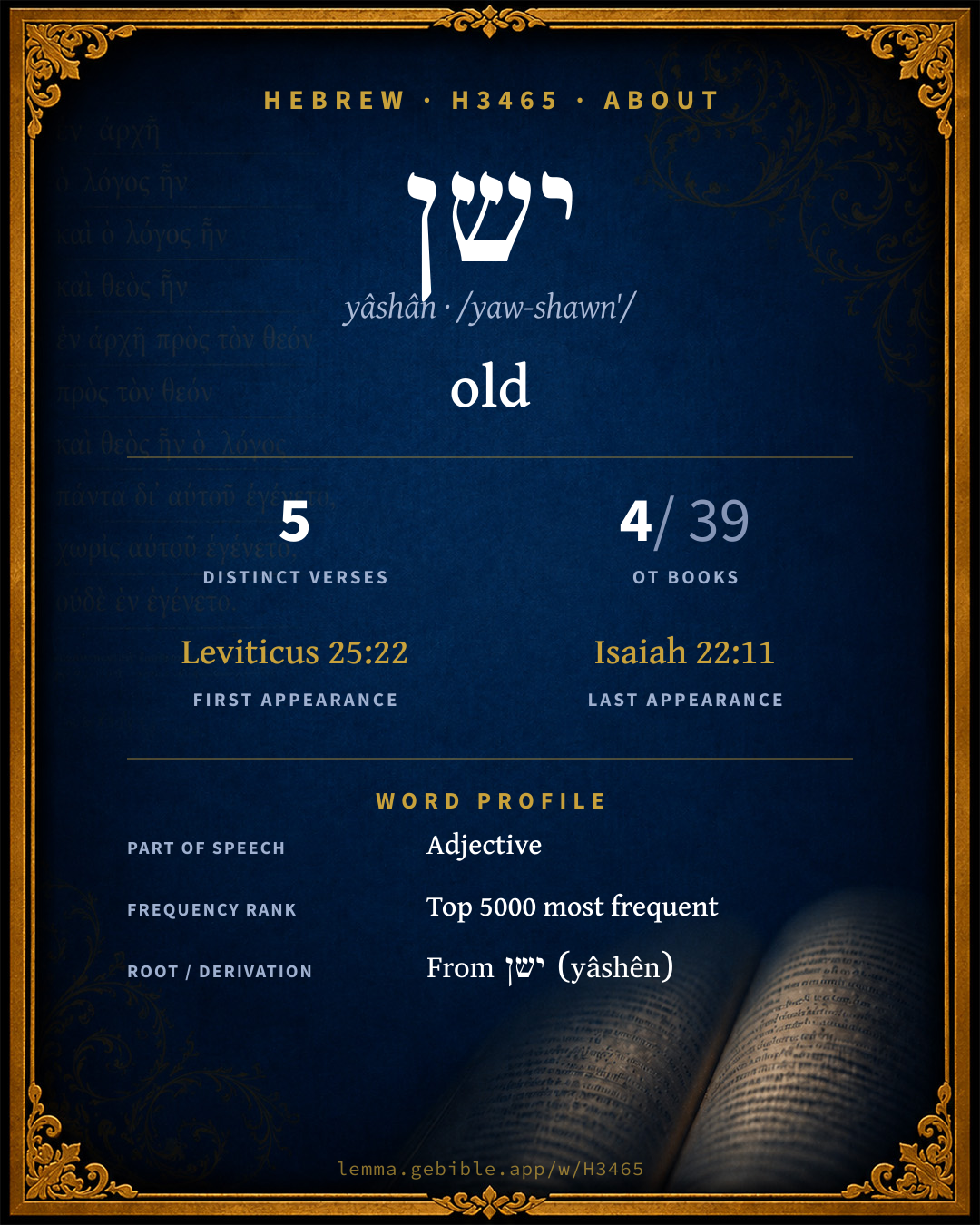
יָשָׁן
old
Full lexicon entry — Brown-Driver-Briggs (BDB)
From Brown-Driver-Briggs (BDB)
Where this word appears
Grammar key — what these labels mean
Part of speech
- Adjective
- A word that describes or qualifies a noun.
- Noun
- A naming word — a person, place, thing, or idea.
Noun type
- Proper
- A name of a specific person, place, or people (e.g. Abraham, Zion, Israel).
State
- Absolute
- The independent form of a noun, not bound to a following word.
Gender
- Masculine
- Grammatically masculine.
- Feminine
- Grammatically feminine.
Number
- Singular
- One.
- Plural
- More than one (in Hebrew, generally three or more).
Grammatical forms
- Adjective, Adjective, Masculine, Singular, Absolute 4 times (57%)
- Adjective, Adjective, Masculine, Plural, Absolute 1 time (14%)
- Noun, Proper 1 time (14%)
- Adjective, Adjective, Feminine, Singular, Absolute 1 time (14%)
Parsed forms decoded from the imported morphology (morphhb / Westminster Leningrad Codex — WLC text public domain, morphhb tagging CC BY 4.0), counted across 7 parsed occurrences — not distinct verses.
Every verse where H3465 appears — 5 distinct verses across 4 books. Click any verse to open its interlinear word-by-word view. Verse text shown in the World English Bible for context — . Each verse’s Hebrew form is shown with its reference; the English is not keyword-highlighted, since the data carries no word-level English alignment. Use “Compare translations” on any verse to read it across multiple English versions. This concordance covers the Hebrew Bible; Septuagint (Greek Old Testament) occurrences are not indexed here.
Leviticus 2 verses
- Leviticus 25:22 יָשָׁ֑ן יָשָֽׁן adj Adjective ms adj Adjective ms You shall sow the eighth year, and eat of the fruits, the old store; until the ninth year, until its fruits come in, you shall eat the old store.
- Leviticus 26:10 יָשָׁ֖ן וְ/יָשָׁ֕ן adj Adjective ms conj + Adjective Adjective ms You shall eat old store long kept, and you shall move out the old because of the new.
Nehemiah 1 verse
Song of Solomon 1 verse
Isaiah 1 verse
About this entry
At a glance — auto-summarized from this page’s data, not written by a person. Every figure links to its source below. This summary describes the numbers; it doesn’t interpret them.
ישן — transliterated yâshân — is a Hebrew adjective carrying the sense “old.” It occurs a mere 5 verses across Scripture. More than a third of its appearances fall in Leviticus. Its earliest occurrence is Leviticus 25:22. It shares a root with ישן, ישן and שנה. Each statement above links to its evidence; the full detail follows below.
Gloss history
Strong's 1890 vs modern scholarship
About this word
Strong's H3465 catalogs a Hebrew word from the Hebrew Old Testament.
These counts are not copied from any lexicon or concordance. They are computed here, from the morphology-tagged Hebrew Old Testament. What Lemma adds →
- 5
- distinct verses
- The word appears in 5 distinct verses.
- 4 / 39
- OT books
- The word appears in 4 of 39 Old Testament books.
- #2,835
- by frequency
- Top 5000 most frequent Hebrew words (rank 2,835 of 8,640 Hebrew words by occurrence).
View all 5 occurrences in the concordance →
Most concentrated in
- Leviticus 2 verses 40%
- Nehemiah 1 verse 20%
- Song of Solomon 1 verse 20%
By section of the Old Testament
By traditional corpus
Conventional, traditional groupings — biblical authorship is debated, so this is a traditional corpus grouping, not an authorship claim. Each share is this word’s portion of its verses in that division of the Hebrew canon. Each figure is a share of the word’s 5 distinct verses.
- Torah (Pentateuch) 2 verses · 40%
- Writings (Ketuvim) 2 verses · 40%
- Prophets (Nevi'im) 1 verse · 20%
How translations render this word
Counts come from each version’s own published word-to-Strong’s tagging or interlinear alignment — an approximate guide to how each version renders this word, not a word-level alignment the data otherwise carries. Because each total is that version’s own tagged count, the per-version totals vary from one another and need not match the appearance or distinct-verse counts above. These counts may also differ from a printed concordance because Lemma counts each distinctly tagged rendering and does not collapse phrase taggings into a single head-word total. This is a fixed set of word-tagged versions (KJV, ASV, BSB, ULT) and does not change with the reading translation you choose elsewhere. Each version’s license is shown beside its name below (and on Sources).
- King James Version: Old 5×
- American Standard Version: Old 4×
- Berean Standard Bible: Ancient 1×, Jeshanah 1×, Old 1×
- unfoldingWord Literal Text: Old 6×
King James Version Public Domain
Renders H3465 across 7 tagged occurrences — most commonly:
Plus 2 renderings that appear only once — usually multi-word phrases or single function words the recovered tagging swept in, not distinct renderings.
American Standard Version Public Domain
Renders H3465 across 7 tagged occurrences — most commonly:
Plus 3 renderings that appear only once — usually multi-word phrases or single function words the recovered tagging swept in, not distinct renderings.
Berean Standard Bible Public Domain
Renders H3465 across 5 tagged occurrences — most commonly:
Not rendered by a distinct English word in 2 further occurrences.
unfoldingWord Literal Text CC BY-SA 4.0
Renders H3465 across 9 tagged occurrences — most commonly:
Plus 3 renderings that appear only once — usually multi-word phrases or single function words the recovered tagging swept in, not distinct renderings.
Senses in BDB
The 1 sense BDB distinguishes for this word, in lexicon order (not ranked by frequency or importance). The full entry — with sub-senses — is in the Lexicon Entry tab.
- old, store, storage
Word origin
adj. old (orig., as it seems, withered, flabby, like a lifeless plant with top hanging down, as if in sleep; cf. Niph. supr., and NH יָשַׁן Pi. let a thing grow old)—יָשָׁן Lv 25:22 + 3 times; f. יְשָׁנָה Is 22:11 + 2 times; pl. יְשָׁנִים Ct 7:14;—old: הַבְּרֵכָה הַיְשָׁנָה Is 22:11; שַׁעַר הַיְשָׁנָה Ne 3:6; so 12:39; of choice fruits, Ct 7:14 (opp. חדשׁ); subst. old harvest, store, Lv 25:22(×2); 26:10(×2)
— Brown-Driver-Briggs (Oxford 1906, public domain), digitized via Sefaria, supplemented by the OpenScriptures HebrewLexicon (CC BY 4.0). See Sources.
Derived from ישן (yâshên) (H3462) — to sleep.
Jastrow Dictionary
A second Hebrew/Aramaic lexicon for comparison, covering Aramaic and post-biblical (Talmudic, Targumic, Midrashic) usage that the biblical-Hebrew BDB does not. Matched by lemma rather than by Strong’s number, so a lemma may carry more than one Jastrow headword (shown separately below), and the entries cover usage well beyond the Bible.
יָשֵׁן I
- [to recover strength, cmp. חָלַם,] to sleep, trnsf. to be idle, lazy. Shebu. III, 5 (I swear) שאִישַׁן that I will sleep, שיָשַׁנְתִּי that I have slept. Num. R. s. 20 בא לִישָׁן going to sleep.—Cant. R. to III, 1 ישנתי לי מן התירה וכ׳ I (Israel) have been lazy in the study of the Law and the performance of good deeds; a. fr.
יָשֵׁן II
- preced.) asleep, inactive. Midr. Till. to Ps. LIX הקב"ה עושה עצמו כביכול י׳ the Lord sometimes pretends, if it were permitted to say so, to be asleep; a. fr.—Pl. יְשֵׁנִים, יְשֵׁנִין, יְשֵי׳. Num. R. s. 20 הרי הן י׳ מן וכ׳ they are sluggish in study &c., v. preced. Cant. R. to VII, 10 י׳ במערת וכ׳ sleeping in the cave of Makhpelah. Ex. R. s. 1; a. fr.—Fem. יְשֵׁנָה, יְשֵׁי׳. Midr. Till. to Ps. CX, beg. (ref. to Is. XLI, 2) הצדקה היתה י׳ וכ׳ Righteousness was asleep and Abraham waked her up. Cant. R. to V, 2 אני י׳ מן וכ׳ I (Israel) was lazy &c., v. supra; a. fr. e.g. Isaiah 41:2
יָשַׁן
- cmp. preced. wds. a. to be strong, hard, old (cmp. קשיש).—V. יוֹשֶׁן a. next w.
- to let grow old (strong), keep, reserve. B. Bath. 91ᵇ דברים שדרכן ליַישְּׁנָן things which it is customary to keep (to store, as wine &c.). Deut. R. s. 9, beg. מן היין הזה אני מְיַישֵּׁן וכ׳ of this wine I will store away a portion for my son’s wedding. Tosef. Ab. Zar. VIII (IX), 3 צריך ליַשֵּׁן he must store them away (leave them unused); Tosef. Toh. XI, 16. Ib. כמה הוא מְיַשְּׁנָן, v. יִשּׁוּן; Y. Ab. Zar. V, end 45ᵇ מְיַישְּׁנָן כל י"ב וכ׳ he must leave them unused for the whole twelve-month; Bab. Ab. Zar. 75ᵃ.—Part. pass. מְיוּשָּׁן stored up, v. infra. Y. B. Bath. VII, end, 15ᶜ. Y. Gitt. III, end, 45ᵇ ‘old’ means last year’s crop, מי׳ של וכ׳ ‘stored’ means three years old.
- to be stored up, to improve with age. Sifra B’huck. ch. III; Yalk. Lev. 672 (ref. to ישן נושן, Lev. XXVI, 10) כל המִתְיַשֵּׁן יפה מחבירו the sort which is stored up is the better of its kind; B. Bath. l. c. [read with Ms. R.:] כל המְיוּשָּׁן יפה מחבירו. Y. Gitt. l. c. הדא אמרה דאי מתישן וכ׳ this intimates that if wine is sold as mithyashshen (fit for storage) the seller is responsible for three years. Sifra l. c. לרבות כל המִתְיַישְּׁנִים including all produces fit for storage (besides wine); Yalk. l. c. לרבות כל הדבר המיושן. e.g. Leviticus 26:10
- same. B. Bath. l. c.; a e., v. next w.
יָשָׁן
- preced.) hard, dry; old, of last year, opp. חָדָשׁ. Dem. IV, 7. B. Bath. 91ᵇ, a. e. expl. י׳ נוֹשָׁן (Lev. XXVI, 10), v. preced. Ab. IV, 20 קנקן חדש מלא י׳ a new vessel full of old wine (a young man but learned). Ab. Zar. III, 9 ואם י׳ וכ׳ and if the oven is old (dried) &c.; a. fr.—Pl. יְשָׁנִים. Ib. 33ᵃ י׳ ומזופפין old or pitched wine vessels. Yoma II, 4, v. חָדָשׁ. Lev. R. s. 2, v. חָדָשׁ; a. fr.—Fem. יְשָׁנָה. Kidd. IV, 5, Num. R. s. 9, v. אַרְכִי I.—Pl. יְשָׁנוֹת. Tosef. Ab. Zar. IV (V), 10 י׳ זפופות, v. supra; a. fr. e.g. Leviticus 26:10
A Dictionary of the Targumim, the Talmud Babli and Yerushalmi, and the Midrashic Literature (Marcus Jastrow; London, Luzac, 1903) — Public Domain. Digitized via Sefaria. Digitized via Sefaria. Full attribution on Sources.
Forms in the corpus
The 7 distinct written forms H3465 takes in the Hebrew Bible, most frequent first — each parse links to that state’s occurrences in the concordance. Hebrew forms include their vowel points and cantillation, so a single lemma takes many written forms.
| Form | Parsing | Example | Uses |
|---|---|---|---|
| הַ/יְשָׁנָ֑ה | Adjective, Adjective, Feminine, Singular, Absolute | Isaiah 22:11 | 1 |
| הַיְשָׁנָ֜ה | Noun, Proper | Nehemiah 3:6 | 1 |
| וְ/יָשָׁ֕ן | Adjective, Adjective, Masculine, Singular, Absolute | Leviticus 26:10 | 1 |
| יְשָׁנִ֑ים | Adjective, Adjective, Masculine, Plural, Absolute | Song of Solomon 7:13 | 1 |
| יָשָׁ֑ן | Adjective, Adjective, Masculine, Singular, Absolute | Leviticus 25:22 | 1 |
| יָשָׁ֖ן | Adjective, Adjective, Masculine, Singular, Absolute | Leviticus 26:10 | 1 |
| יָשָֽׁן | Adjective, Adjective, Masculine, Singular, Absolute | Leviticus 25:22 | 1 |
Same root — word family
Other BDB entries built from the same root as H3465, grouped by Strong’s listed origin. These share a root / origin per the lexicon — not necessarily a shared meaning. Each links to that word’s own entry.
Derives from
Shares the same root
Proper names from this root
People and places named from this root — a name, not an additional meaning of the word.
Compare all same-root words → Showing 4 of 6 — not the complete family. 1 of the same-root words is a proper name (a person or place). They share a root, not necessarily a meaning.
Septuagint verse parallels
This word appears in 4 verses that also exist in the Greek Old Testament (Septuagint), out of the 5 Hebrew verses it occurs in. You can read those verses in Greek by switching the Old Testament edition to the Septuagint.
Read these verses in the Septuagint
This is a verse-level parallel only — the same verses exist in both the Hebrew and Greek Old Testaments. No word-level Hebrew↔Greek correspondence is claimed: the data carries no such alignment, so no Greek word is shown as this Hebrew word’s translation. Coverage is not total — the Septuagint omits the deuterocanon and renumbers the Psalms, so some Hebrew verses have no direct Greek parallel.