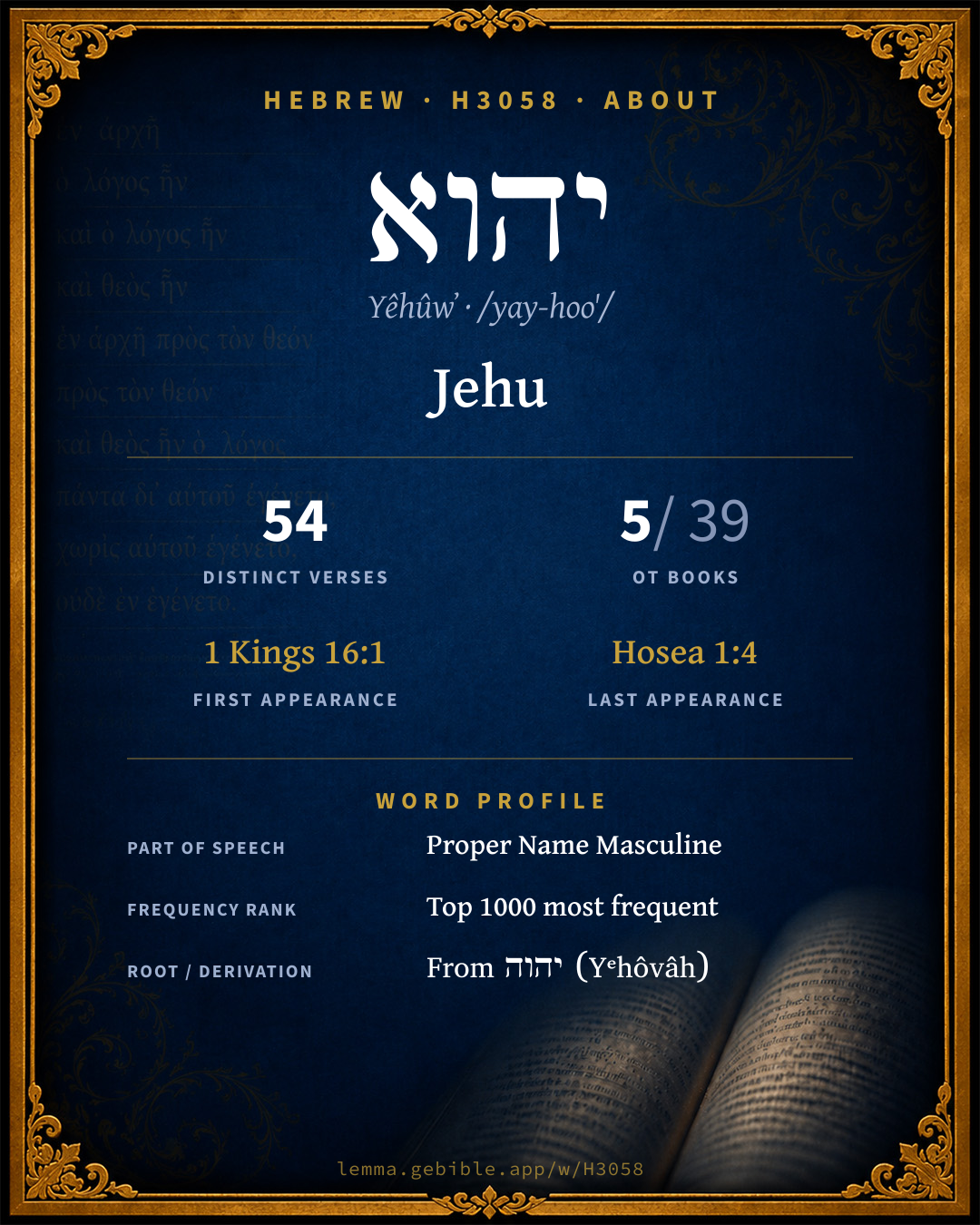
יֵהוּא
Jehu
BDB lists 6 entries for ‘Jehu’ fuller range ↓
Full lexicon entry — Brown-Driver-Briggs (BDB)
From Brown-Driver-Briggs (BDB)
Where this word appears
Grammar key — what these labels mean
Part of speech
- Noun
- A naming word — a person, place, thing, or idea.
Noun type
- Proper
- A name of a specific person, place, or people (e.g. Abraham, Zion, Israel).
Every verse where H3058 appears in the Book of 1 Chronicles — 3 distinct verses. Click any verse to open its interlinear word-by-word view. Verse text shown in the World English Bible for context — . Each verse’s Hebrew form is shown with its reference; the English is not keyword-highlighted, since the data carries no word-level English alignment. Use “Compare translations” on any verse to read it across multiple English versions. This concordance covers the Hebrew Bible; Septuagint (Greek Old Testament) occurrences are not indexed here.
1 Chronicles
- 1 Chronicles 2:38 יֵה֔וּא וְ/יֵה֖וּא n Proper conj + n Proper and Obed became the father of Jehu, and Jehu became the father of Azariah,
- 1 Chronicles 4:35 וְ/יֵהוּא֙ conj + n Proper and Joel, and Jehu the son of Joshibiah, the son of Seraiah, the son of Asiel,
- 1 Chronicles 12:3 וְ/יֵה֖וּא conj + n Proper The chief was Ahiezer; then Joash, the sons of Shemaah the Gibeathite, and Jeziel, and Pelet, the sons of Azmaveth, and Beracah, and Jehu the Anathothite,
About this entry
At a glance — auto-summarized from this page’s data, not written by a person. Every figure links to its source below. This summary describes the numbers; it doesn’t interpret them.
The Hebrew name יהוא centers on the idea of “Jehu.” The word gravitates to 2 Kings (72%), then 2 Chronicles and 1 Kings. It turns up in 54 verses across 5 books, a moderately common footprint. Its earliest occurrence is 1 Kings 16:1. For the data behind this summary, explore 54-verse concordance and the renderings breakdown below.
Gloss history
Strong's 1890 vs modern scholarship
About this word
Strong's H3058 catalogs a Hebrew word from the Hebrew Old Testament.
These counts are not copied from any lexicon or concordance. They are computed here, from the morphology-tagged Hebrew Old Testament. What Lemma adds →
- 54
- distinct verses
- The word appears in 54 distinct verses.
- 5 / 39
- OT books
- The word appears in 5 of 39 Old Testament books.
- #658
- by frequency
- Top 1000 most frequent Hebrew words (rank 658 of 8,640 Hebrew words by occurrence).
View all 54 occurrences in the concordance →
Most concentrated in
- 2 Kings 39 verses 72%
- 2 Chronicles 6 verses 11%
- 1 Kings 5 verses 9%
By section of the Old Testament
By traditional corpus
Conventional, traditional groupings — biblical authorship is debated, so this is a traditional corpus grouping, not an authorship claim. Each share is this word’s portion of its verses in that division of the Hebrew canon. Each figure is a share of the word’s 54 distinct verses.
- Prophets (Nevi'im) 45 verses · 83%
- Writings (Ketuvim) 9 verses · 17%
How translations render this word
Counts come from each version’s own published word-to-Strong’s tagging or interlinear alignment — an approximate guide to how each version renders this word, not a word-level alignment the data otherwise carries. Because each total is that version’s own tagged count, the per-version totals vary from one another and need not match the appearance or distinct-verse counts above. These counts may also differ from a printed concordance because Lemma counts each distinctly tagged rendering and does not collapse phrase taggings into a single head-word total. This is a fixed set of word-tagged versions (KJV, ASV, BSB, ULT) and does not change with the reading translation you choose elsewhere. Each version’s license is shown beside its name below (and on Sources).
BDB lists this Strong’s number as 2 distinct words (homographs). Each count above pools all of them and is not split by sense — see the Senses section below. A low-frequency rendering may belong to a different one of those words, not the primary meaning.
- King James Version†: Jehu 54×
- American Standard Version†: Jehu 50×
- Berean Standard Bible†: Jehu 51×, Jehu’s 2×
- unfoldingWord Literal Text†: Jehu 57×
King James Version Public Domain
Renders H3058 across 58† tagged occurrences — most commonly:
Plus 4 renderings that appear only once — usually multi-word phrases or single function words the recovered tagging swept in, not distinct renderings.
American Standard Version Public Domain
Renders H3058 across 58† tagged occurrences — most commonly:
Plus 8 renderings that appear only once — usually multi-word phrases or single function words the recovered tagging swept in, not distinct renderings.
Berean Standard Bible Public Domain
Renders H3058 across 57† tagged occurrences — most commonly:
Plus 4 renderings that appear only once — usually multi-word phrases or single function words the recovered tagging swept in, not distinct renderings. Not rendered by a distinct English word in 1 further occurrence.
unfoldingWord Literal Text CC BY-SA 4.0
Renders H3058 across 58† tagged occurrences — most commonly:
Plus 1 rendering that appears only once — usually multi-word phrases or single function words the recovered tagging swept in, not distinct renderings.
Senses in the full BDB
What do BDB’s symbols mean?
BDB uses these scholarly abbreviations:
| Symbol | Meaning |
|---|---|
| 𝔊 | the Septuagint (the ancient Greek translation, LXX) |
| 𝔙 | the Vulgate (the Latin translation) |
| 𝔖 | the Syriac version (the Peshitta) |
| 𝔗 | the Targum (the Aramaic translation) |
| ψ | the Psalms |
| √ | root (the underlying root or stem) |
| ‖ | parallel passage (a synonymous or contrasted parallel) |
| † | the dagger: every passage where the word occurs is cited |
The 5 senses and sub-senses the full Brown-Driver-Briggs lexicon distinguishes for this word, in lexicon order (not ranked by frequency), with BDB’s own verbatim wording and sub-sense lettering. Shown in Hebrew script with BDB’s own scholarly abbreviations. The condensed entry is in the Lexicon Entry tab. See also the Forms in the corpus table below.
יהוא I m. (prob. contr. from יהוהוא = י׳ is He, cf. יֵשׁוּעַ and reff.
- 1. king of Israel who overthrew the dynasty of Omri (𝔊 Εἰου, A often Ἰηου, 𝔊L Ἰου) 1 K 19:16, 17(×2) 2 K 9:2 + 36 times 2 K 9 & 10 + 12:2; 13:1; 14:8; 15:12; 2 Ch 22:7, 8, 9; 25:17; Ho 1:4. e.g. 1 Kings 19:16
- 2. prophet of N. Israel in time of Baasha & Jehoshaphat (𝔊 Εἰου, A Εἰηου 𝔊L Ἰου in K; 𝔊 Ἰου, Ἰησου, A 𝔊L Ἰηου in Ch) 1 K 16:1, 7, 12; 2 Ch 19:2; 20:34. e.g. 1 Kings 16:1
- 3. one of David’s heroes 1 Ch 12:3 (𝔊 Ἰηουλ, 𝔊L Ἰηουδ)). e.g. 1 Chronicles 12:3
- 4. a Judaite 1 Ch 2:38(×2) (𝔊 Ἰησους, A 𝔊L Ἰηου). e.g. 1 Chronicles 2:38
- 5. a Simeonite prince 1 Ch 4:35 (𝔊 οὗτος i.e. (י)הוּא; A 𝔊L Ἰηου). e.g. 1 Chronicles 4:35
יהוא II m. v. sub יהוה supr. p. 219.
Senses from the full Brown-Driver-Briggs lexicon (Brown, Driver, Briggs; Oxford 1906 — public domain), digitized via Sefaria, supplemented by the OpenScriptures HebrewLexicon (CC BY 4.0). Full attribution on Sources.
Word origin
I. n.pr.m. (prob. contr. from יהוהוא = י׳ is He, cf. יֵשׁוּעַ and reff.; cuneif. Ia-u-a COT 1 K 16:23 2 K 9:2 (further SchrMBAW 1880, 277, SchrZA iii. 3 HptBAS i. 296, 329 Jäger ib. 468); cf. also אֱלִיהוּ)—
II. n.pr.m. v. sub יהוה supr. p. 219.
— Brown-Driver-Briggs (Oxford 1906, public domain), digitized via Sefaria, supplemented by the OpenScriptures HebrewLexicon (CC BY 4.0). See Sources.
Derived from יהוה (Yᵉhôvâh) (H3068) — LORD.
Jastrow Dictionary
A second Hebrew/Aramaic lexicon for comparison, covering Aramaic and post-biblical (Talmudic, Targumic, Midrashic) usage that the biblical-Hebrew BDB does not. Matched by lemma rather than by Strong’s number, so a lemma may carry more than one Jastrow headword (shown separately below), and the entries cover usage well beyond the Bible.
יֵהוּא
- (b. h.) pr. n. m. Jehu, King of Israel. Meg. 14ᵃ. Hor. 11ᵇ אף י׳ … לא נמשח וכ׳ Jehu, too, would not have been anointed, but for the opposition to Joram; a. e.
A Dictionary of the Targumim, the Talmud Babli and Yerushalmi, and the Midrashic Literature (Marcus Jastrow; London, Luzac, 1903) — Public Domain. Digitized via Sefaria. Digitized via Sefaria. Full attribution on Sources.
Forms in the corpus
The 18 distinct written forms H3058 takes in the Hebrew Bible, most frequent first — each parse links to that state’s occurrences in the concordance. Hebrew forms include their vowel points and cantillation, so a single lemma takes many written forms.
| Form | Parsing | Example | Uses |
|---|---|---|---|
| יֵהוּא֙ | Noun, Proper | 2 Kings 9:5 | 9 |
| יֵה֛וּא | Noun, Proper | 2 Chronicles 25:17 | 8 |
| יֵה֣וּא | Noun, Proper | 1 Kings 16:1 | 6 |
| יֵה֖וּא | Noun, Proper | 1 Kings 19:17 | 5 |
| יֵה֔וּא | Noun, Proper | Hosea 1:4 | 4 |
| יֵה֗וּא | Noun, Proper | 2 Kings 9:27 | 4 |
| וְ/יֵה֖וּא | Noun, Proper | 1 Chronicles 2:38 | 3 |
| וְ/יֵה֗וּא | Noun, Proper | 2 Kings 9:11 | 3 |
| יֵה֨וּא | Noun, Proper | 1 Kings 16:7 | 3 |
| וְ/יֵה֞וּא | Noun, Proper | 2 Kings 9:24 | 2 |
| וְ/יֵהוּא֙ | Noun, Proper | 1 Chronicles 4:35 | 2 |
| יֵה֑וּא | Noun, Proper | 1 Kings 19:17 | 2 |
| יֵה֤וּא | Noun, Proper | 2 Kings 10:5 | 2 |
| יֵ֠הוּא | Noun, Proper | 2 Kings 10:25 | 1 |
| יֵה֥וּא | Noun, Proper | 1 Kings 16:12 | 1 |
| יֵהֽוּא | Noun, Proper | 2 Kings 9:13 | 1 |
| יֵהוּא֮ | Noun, Proper | 2 Chronicles 22:9 | 1 |
| לְ/יֵהוּא֙ | Noun, Proper | 2 Kings 12:1 | 1 |
Same root — word family
Other BDB entries built from the same root as H3058, grouped by Strong’s listed origin. These share a root / origin per the lexicon — not necessarily a shared meaning. Each links to that word’s own entry.
Derives from
Proper names from this root
People and places named from this root — a name, not an additional meaning of the word.
- הושמע Hôwshâmâʻ H1953 Hoshama
- יה Yâhh H3050 Jah
- יהואחז Yᵉhôwʼâchâz H3059 Jehoahaz
- יהואש Yᵉhôwʼâsh H3060 Jehoash
- יהוה Yᵉhôvih H3069 LORD
- יהוה יראה Yᵉhôvâh yirʼeh H3070 Jehovah-jireh
- יהוה נסי Yᵉhôvâh niççîy H3071 Jehovah-nissi
- יהוה צדקנו Yᵉhôvâh tsidqênûw H3072 a sacred name symbolically applied to
- יהוה שלום Yᵉhôvâh shâlôwm H3073 Jehovah-shalom
- יהוה שמה Yᵉhôvâh shâmmâh H3074 Jehovahshammah
- יהוזבד Yᵉhôwzâbâd H3075 Jehozabad
- יהוחנן Yᵉhôwchânân H3076 Jehohanan
- יהוידע Yᵉhôwyâdâʻ H3077 Jehoiada
- יהויכין Yᵉhôwyâkîyn H3078 Jehoiachin
- יהויקים Yᵉhôwyâqîym H3079 Jehoiakim
- יהויריב Yᵉhôwyârîyb H3080 Jehoiarib
- יהונדב Yᵉhôwnâdâb H3082 Jehonadab
- יהונתן Yᵉhôwnâthân H3083 Jonathan
- יהועדה Yᵉhôwʻaddâh H3085 Jehoadah
- יהועדין Yᵉhôwʻaddîyn H3086 Jehoaddan
- יהוצדק Yᵉhôwtsâdâq H3087 Jehozadak
- יהורם Yᵉhôwrâm H3088 Jehoram
- יהושבע Yᵉhôwshebaʻ H3089 Jehosheba
- יהושוע Yᵉhôwshûwaʻ H3091 Joshua
+11 more proper names from this root (not shown).
Compare all same-root words → Showing 4 of 37 — not the complete family. 36 of the same-root words are proper names (people or places). They share a root, not necessarily a meaning.
Bible dictionary
Public-domain dictionary articles matched to this entry by name (Jehu). A biblical name can be shared by more than one person or place, so an article may treat several.
Easton's Bible Dictionary · M. G. Easton, 1897
Jehovah is he. (1.) The son of Obed, and father of Azariah (1 Chr. 2:38).
(2.) One of the Benjamite slingers that joined David at Ziklag (1 Chr. 12:3).
(3.) The son of Hanani, a prophet of Judah (1 Kings 16:1, 7; 2 Chr. 19:2; 20:34), who pronounced the sentence of God against Baasha, the king of Israel.
(4.) King of Israel, the son of Jehoshaphat (2 Kings 9:2), and grandson of Nimshi. The story of his exaltation to the throne is deeply interesting. During the progress of a war against the Syrians, who were becoming more and more troublesome to Israel, in a battle at Ramoth-gilead Jehoram, the king of Israel, had been wounded; and leaving his army there, had returned to Jezreel, whither his ally, Ahaziah, king of Judah, had also gone on a visit of sympathy with him (2 Kings 8:28, 29). The commanders, being left in charge of the conduct of the war, met in council; and while engaged in their deliberations, a messenger from Elisha appeared in the camp, and taking Jehu from the council, led him into a secret chamber, and there anointed him king over Israel, and immediately retired and disappeared (2 Kings 9:5, 6). On being interrogated by his companions as to the object of this mysterious visitor, he informed them of what had been done, when immediately, with the utmost enthusiasm, they blew their trumpets and proclaimed him king (2 Kings 9:11-14). He then with a chosen band set forth with all speed to Jezreel, where, with his own hand, he slew Jehoram, shooting him through the heart with an arrow (9:24). The king of Judah, when trying to escape, was fatally wounded by one of Jehu's soldiers at Beth-gan. On entering the city, Jehu commanded the eunchs of the royal palace to cast down Jezebel into the street, where her mangled body was trodden under foot by the horses. Jehu was now master of Jezreel, whence he communicated with the persons in authority in Samaria the capital, commanding them to appear before him on the morrow with the heads of all the royal princes of Samaria. Accordingly on the morrow seventy heads were piled up in two heaps at his gate. At "the shearing-house" (2 Kings 10:12-14) other forty-two connected with the house of Ahab were put to death (2 Kings 10:14). As Jehu rode on toward Samaria, he met Jehonadab (q.v.), whom he took into his chariot, and they entered the capital together. By a cunning stratagem he cut off all the worshippers of Baal found in Samaria (2 Kings 10:19-25), and destroyed the temple of the idol (2 Kings 10:27).
Notwithstanding all this apparent zeal for the worship of Jehovah, Jehu yet tolerated the worship of the golden calves at Dan and Bethel. For this the divine displeasure rested upon him, and his kingdom suffered disaster in war with the Syrians (2 Kings 10:29-33). He died after a reign of twenty-eight years (B.C. 884-856), and was buried in Samaria (10:34-36). "He was one of those decisive, terrible, and ambitious, yet prudent, calculating, and passionless men whom God from time to time raises up to change the fate of empires and execute his judgments on the earth." He was the first Jewish king who came in contact with the Assyrian power in the time of Shalmaneser II.
Smith's Bible Dictionary · William Smith, 1863
(the living).
+ The founder of the fifth dynasty of the kingdom of Israel, son of Jehoshaphat. (2 Kings 9:2) He reigned over Israel 28 years, B.C. 884-856. His first appearance in history is when he heard the warning of Elijah against the murderer of Naboth. (2 Kings 9:25) In the reigns of Ahaziah and Jehoram, Jehu rose to importance. He was, under the last-named king, captain of the host in the siege of Ramoth-gilead. During this siege he was anointed by Elisha's servant, and told that he was appointed to be king of Israel and destroyer of the house of Ahab. (2 Kings 9:12) The army at once ordained him king, and he set off full speed for Jezreel. Jehoram, who was lying ill in Jezreel, came out to meet him, as it happened on the fatal field of Naboth. (2 Kings 9:21-24) Jehu seized his opportunity, and shot him through the heart. (2 Kings 9:24) Jehu himself advanced to the gates of Jezreel and fulfilled the divine warning on Jezebel as already on Jehoram. He then entered on a work of extermination hitherto unparalleled in the history of the Jewish monarchy. All the descendants of Ahab that remained in Jezreel, together with the officers of the court and the hierarchy of Eastward, were swept away. His next step was to secure Samaria. For the pretended purpose of inaugurating anew the worship of Baal, he called all the Bailouts together at Samaria. The vast temple raised by Ahab, (1 Kings 16:32) was crowded from end to end. The chief sacrifice was offered, as if in the excess of his zeal, by Jehu himself. As soon as it was ascertained that all, and none but, the idolaters were there, the signal was given to eighty trusted guards, and sweeping massacre removed at one blow the whole heathen population of the kingdom of Israel. This is the last public act recorded of Jehu. The remaining twenty-seven years of his long reign are passed over in a few words, in which two points only are material:--He did not destroy the calf-worship of Jeroboam:-- The transjordanic tribes suffered much from the ravages of Hazael. (2 Kings 10:29-33) He was buried in state in Samaria, and was succeeded by his son Jehoahaz. (2 Kings 10:35) His name is the first of the Israelite kings which appears in the Assyrian monuments. + Jehu son of Hanani; a prophet of Judah, but whose ministrations were chiefly directed to Israel. His father was probably the seer who attacked Asa. (2 Chronicles 16:7) He must have begun his career as a prophet when very young. He first denounced Baasha, (1 Kings 16:1,7) and then, after an interval of thirty years, reappeared to denounce Jehoshaphat for his alliance with Ahab. (2 Chronicles 19:2,3) He survived Jehoshaphat and wrote his life. ch. (2 Chronicles 20:34) + A man of Judah of the house of Hezron. (1 Chronicles 2:38) + A Simeonite, son of Josibiah. (1 Chronicles 4:35) + Jehu the Antothite was one of the chief of the heroes of Benjamin who joined David at Ziklag. (1 Chronicles 12:3)
Hitchcock's Bible Names Dictionary · Roswell D. Hitchcock, 1869
himself who exists
Classic public-domain reference works; full attribution on Sources.
Septuagint verse parallels
This word appears in 54 verses that also exist in the Greek Old Testament (Septuagint), out of the 54 Hebrew verses it occurs in. You can read those verses in Greek by switching the Old Testament edition to the Septuagint.
Read these verses in the Septuagint
This is a verse-level parallel only — the same verses exist in both the Hebrew and Greek Old Testaments. No word-level Hebrew↔Greek correspondence is claimed: the data carries no such alignment, so no Greek word is shown as this Hebrew word’s translation. Coverage is not total — the Septuagint omits the deuterocanon and renumbers the Psalms, so some Hebrew verses have no direct Greek parallel.